
Quick answer: A supply chain check is Amazon asking you to prove where your inventory came from. It usually follows an authenticity concern on specific ASINs, and it can escalate into an inauthentic deactivation if you cannot answer it. Amazon asks for supplier invoices that show the supplier’s name, phone number, address and website, an issue date within the 365 days before the notification, product identifiers that match your listing, and quantities that cover your sales and in-stock inventory for each cited ASIN over that period. Amazon says it may contact the supplier to verify. You win these cases on genuine documents from a supplier you can verify, a clear root cause, and sourcing controls you have already put in place, not on a longer letter.
Most sellers who receive a supply chain review did not set out to sell anything questionable. They bought from a wholesaler who looked fine, a liquidation lot or retail shelves. The notice arrives and the invoice folder holds email confirmations, a pro forma, a PDF with no supplier phone number and a few store receipts. That gap between what they have and what Amazon will accept is the whole case, and this guide is about closing it honestly. If your notice names counterfeit or inauthentic complaints more broadly, read our explainer on what an inauthentic suspension is alongside this one.
What a supply chain review is and why Amazon opens one
Amazon’s Anti-Counterfeiting policy says it is each seller’s and supplier’s responsibility to source, sell and fulfill only authentic products, and that by selling on Amazon you agree to provide records about the authenticity of your products if Amazon requests them. A supply chain check is that request in practice. Amazon is not asking whether you believe your goods are genuine. It is asking you to show a documented path from a legitimate source to your inventory.
The policy language that matters
The policy states that Amazon may request documentation, such as invoices, showing the authenticity of your products or your authorization to list them for sale. It allows you to remove pricing information, and it says that documents edited in any other way, or that are misleading, are a violation that will lead to enforcement against the account. It also states that Amazon may suspend or terminate the selling account and any related accounts, dispose of inauthentic inventory in its fulfillment centers at the seller’s expense, and withhold payments. Those are the stakes, so treat the first notice as the most important one you will answer.
What usually sets one off
Amazon does not publish a list of triggers, so treat these as patterns we see in case files, not Amazon rules: a rights owner complaint alleging inauthentic goods, buyer complaints describing an item as fake or different from the listing, Amazon’s own review of suspect listings (which the policy describes), a sudden sales jump on a brand new to you, and offers on brands that control distribution tightly. Sometimes the trigger is an earlier appeal whose invoices raised more questions than they answered.
How it shows up on your account
It usually appears on the Account Health page as a violation tied to specific ASINs, with a performance notification. The Account Health Rating runs from 0 to 1,000; Amazon describes 200 to 1,000 as Healthy, 100 to 199 as At Risk and 99 or lower as Unhealthy, meaning eligible for deactivation or already deactivated. Amazon also states that repeat violations of the same policy cost more points each time, and that reaching the maximum number of repeat violations for a single policy in a 180 day period can put the account at immediate risk, with that maximum as low as two for higher severity violations.
What Amazon asks you to provide
Amazon’s help page on invoice requirements for appealing a policy violation explains that invoices are required so Amazon can verify you are sourcing from legitimate suppliers. It defines an invoice as a document issued directly by a supplier that records the final transaction of goods, with an itemized list of goods received and the terms of sale for a completed transaction. That definition rules out more documents than most sellers expect.
The invoice itself
| Element | What Amazon’s page requires | How sellers get it wrong |
|---|---|---|
| Supplier information | Supplier name, phone number, address and website | Invoice shows only an email address, or a website that no longer resolves |
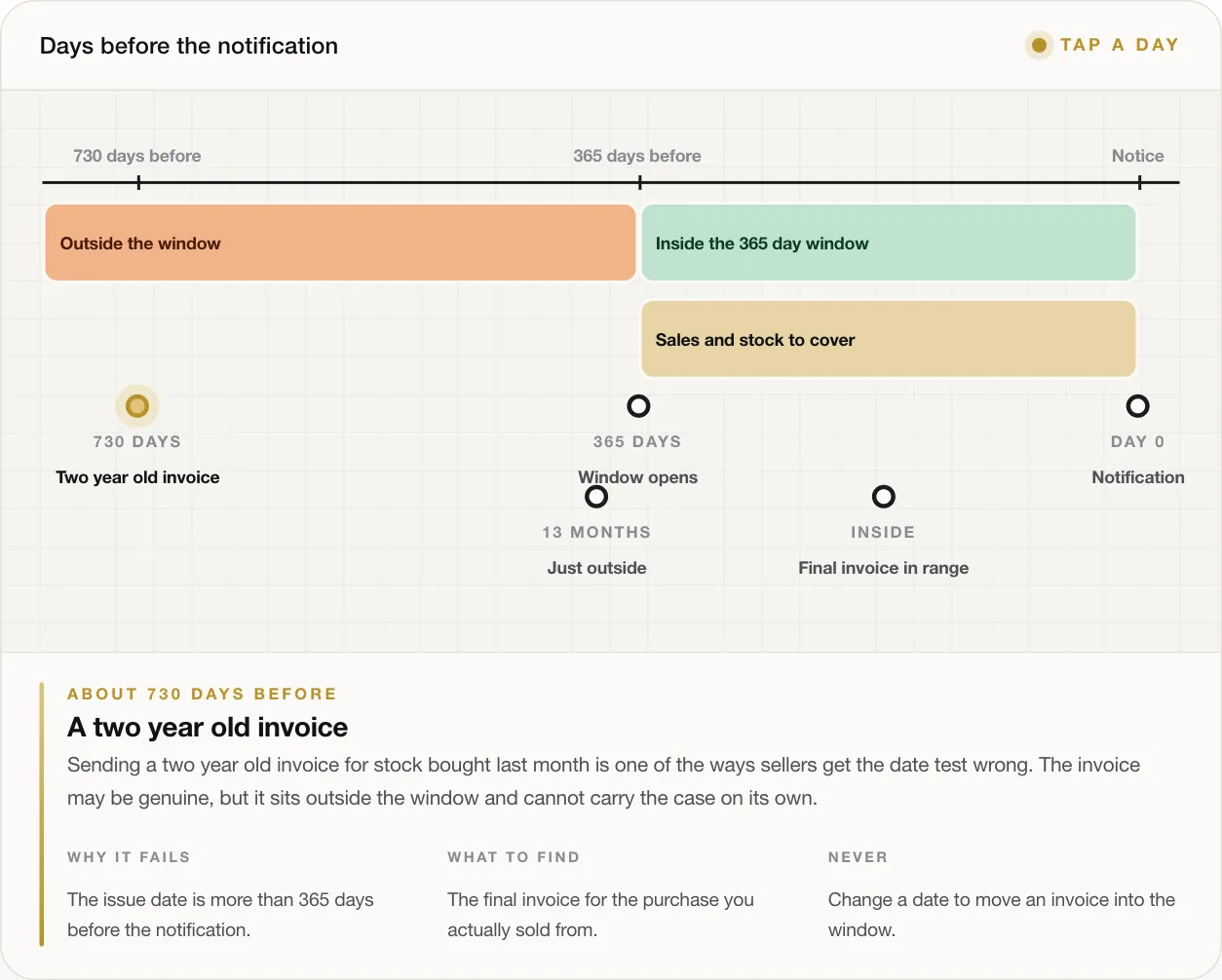
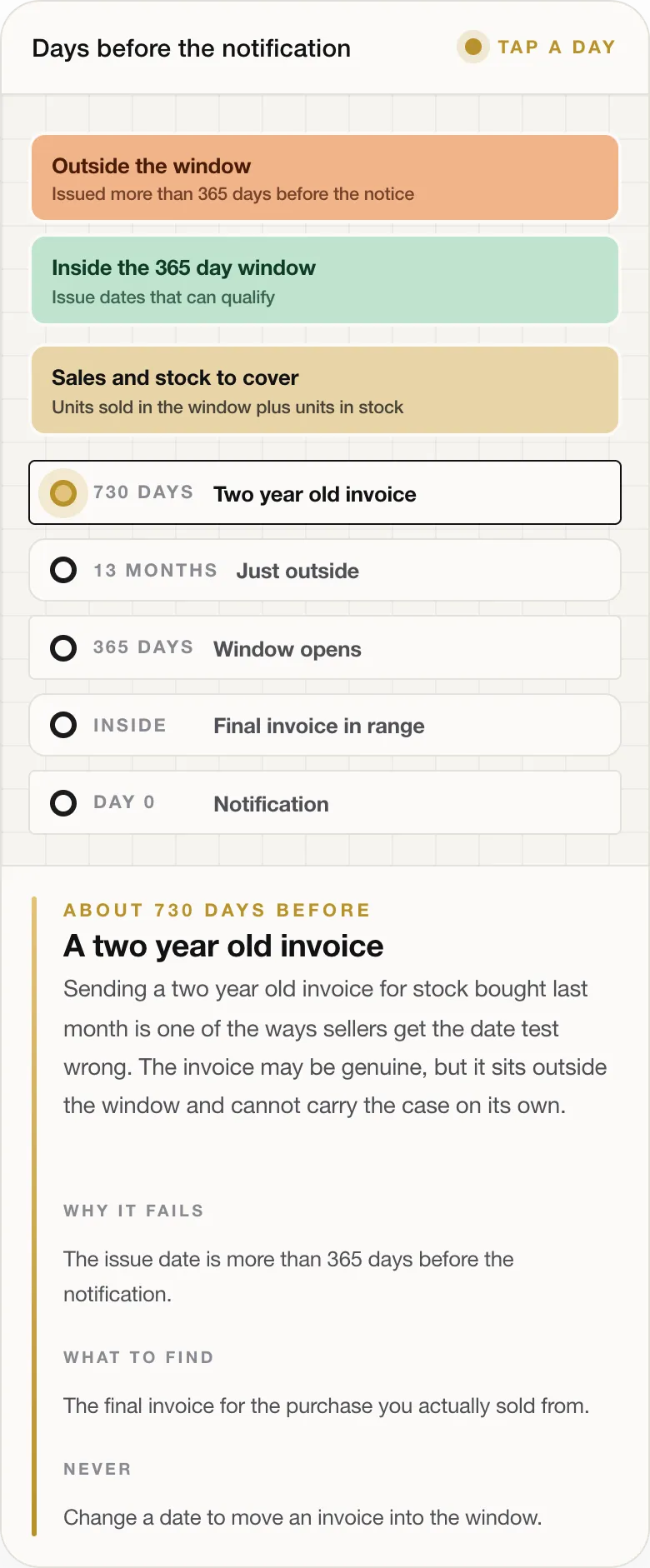
| Issue date | Clearly displayed, within the past 365 days before the performance notification | Sending a two year old invoice for stock bought last month |
| Quantity | Enough to cover sales volume and in-stock inventory for each cited ASIN over the past 365 days | One invoice for 50 units against 400 units sold |
| Product identifiers | Product names, model numbers, or UPC, EAN or ISBN; variation details; every bundle component | Line item reads “assorted health and beauty” or “mixed lot” |
| Transaction status | A completed and fulfilled transaction | Sending a quote, order confirmation or pro forma |
| Format | PDF, JPG, PNG or GIF, no larger than 10MB | Sending an editable Excel or Word file |
| Integrity | Authentic and unaltered; pricing may be removed, everything else must stay visible | Retyping, redrawing or “cleaning up” an invoice |
Amazon also lists what it will not accept: invoices sent by email or third-party sharing instead of through Seller Central, sales quotes and pro forma invoices, self-issued invoices or invoices where the supplier appears to be the same business entity as the buyer, digitally manipulated or editable documents, and anything illegible, low resolution, inconsistent or missing required details. Invoices do not have to be in English, and Amazon notes there may be additional regional requirements, such as tax information, stated in its emails.
The same page asks for sales records for each cited ASIN and lets you highlight the relevant product on a multi-item invoice. Highlighting and removing prices are the only changes it describes as acceptable.
Letters of authorization and supplier contact details
Amazon’s Anti-Counterfeiting page says that when appealing enforcement actions you are typically required to provide invoices or letters of authorization to demonstrate your right to sell the products, and that each violation type has its own appeal steps shown on the Account Health page. Its supplier due diligence page recommends checking whether a supplier can provide a Letter of Authorization from the brand, or invoices from their own supplier, to demonstrate the provenance of inventory, and it recommends cross-verifying any LOA by contacting the brand. Check Amazon’s separate Letter of Authorization help page for the current required elements. For why store receipts fall short, see our article on why Amazon does not accept receipts.
How Amazon may contact your supplier
Amazon’s invoice page says plainly that it might reach out to the supplier to verify the information on your documents, and that it will keep your supplier’s information confidential. That sentence changes how you should prepare.
What verification means for you
If Amazon calls the number on your invoice, someone must answer, recognize your business and confirm the transaction. A supplier who has closed or changed numbers can turn a genuine invoice into a doubted one. A doubted document is the starting point of the most dangerous case type there is, which we cover in our guide to forged or manipulated documentation suspensions.
Prepare the supplier before you submit
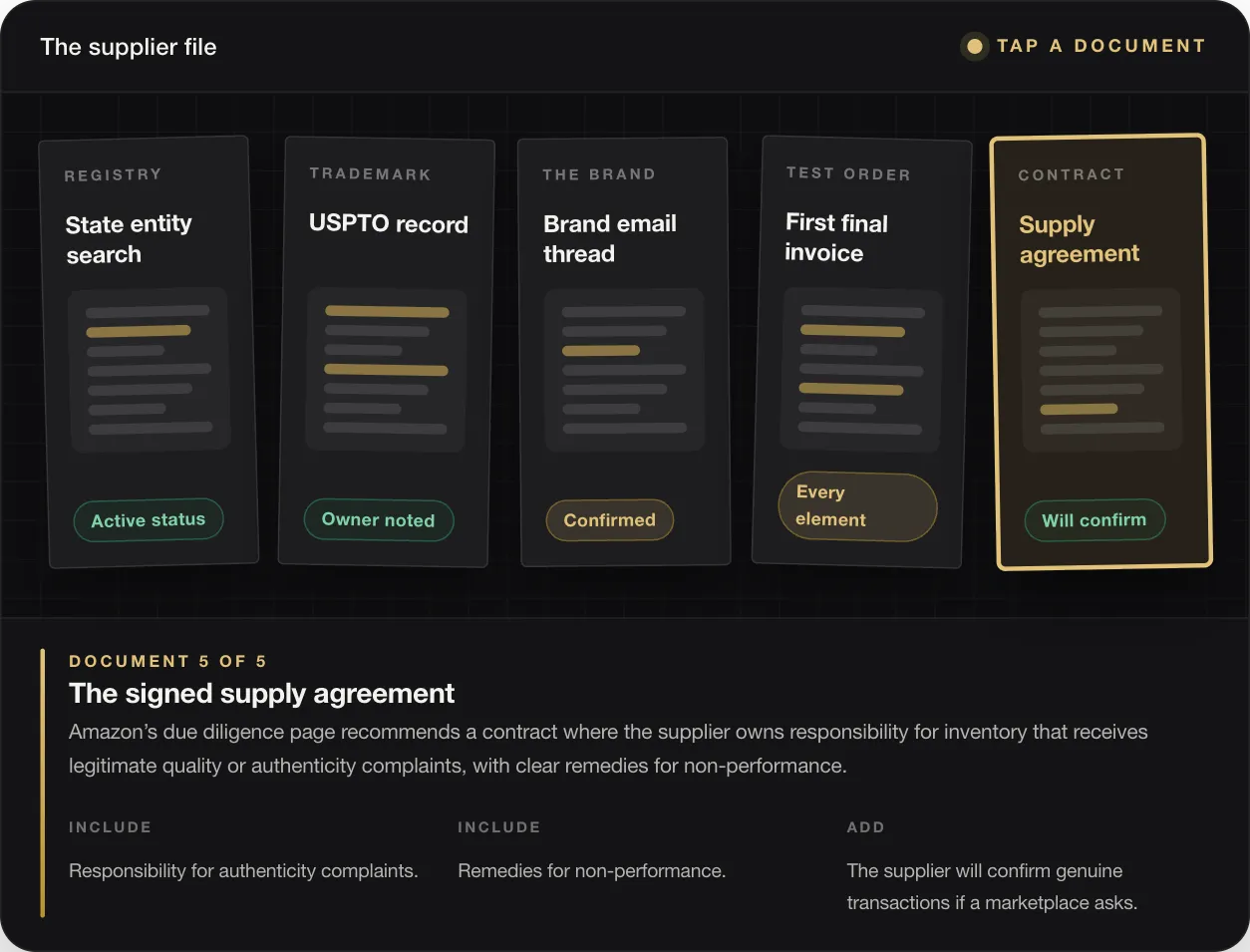
Before you upload anything, contact the supplier through the phone and email printed on the invoice. Tell them Amazon may contact them to confirm invoice numbers, dates, products and quantities, and ask whether they will confirm. Never script answers they cannot honestly give. If the supplier refuses or goes quiet, you have learned something critical before Amazon does.
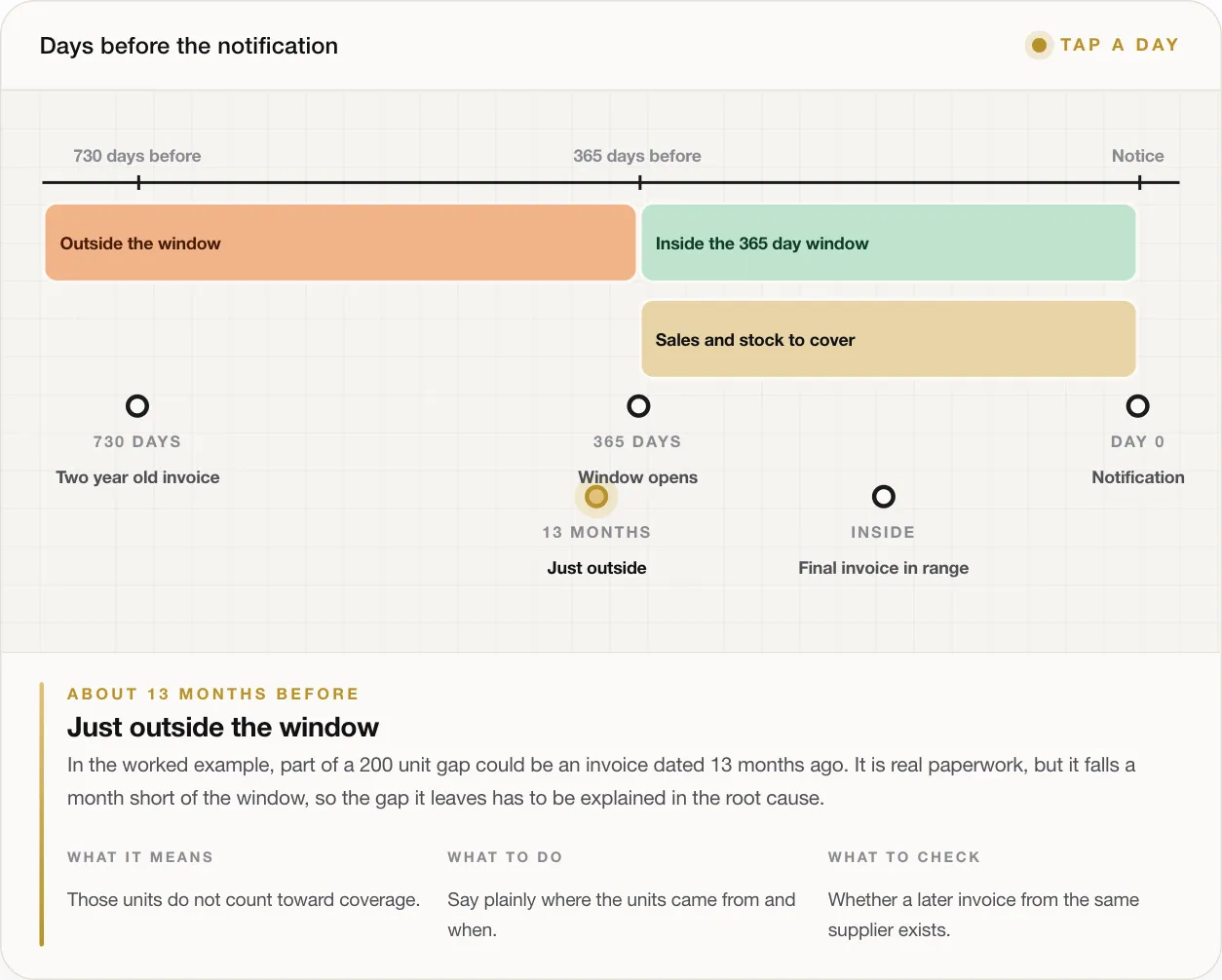
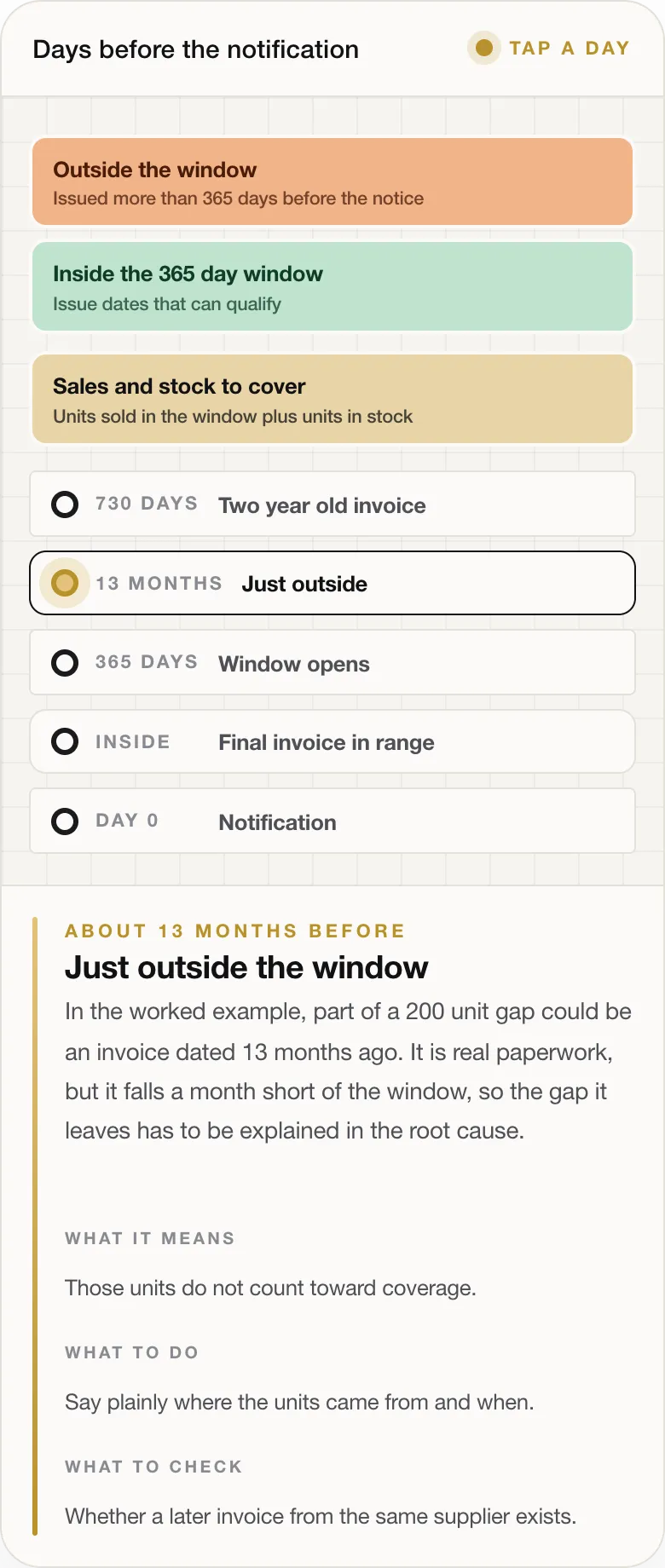
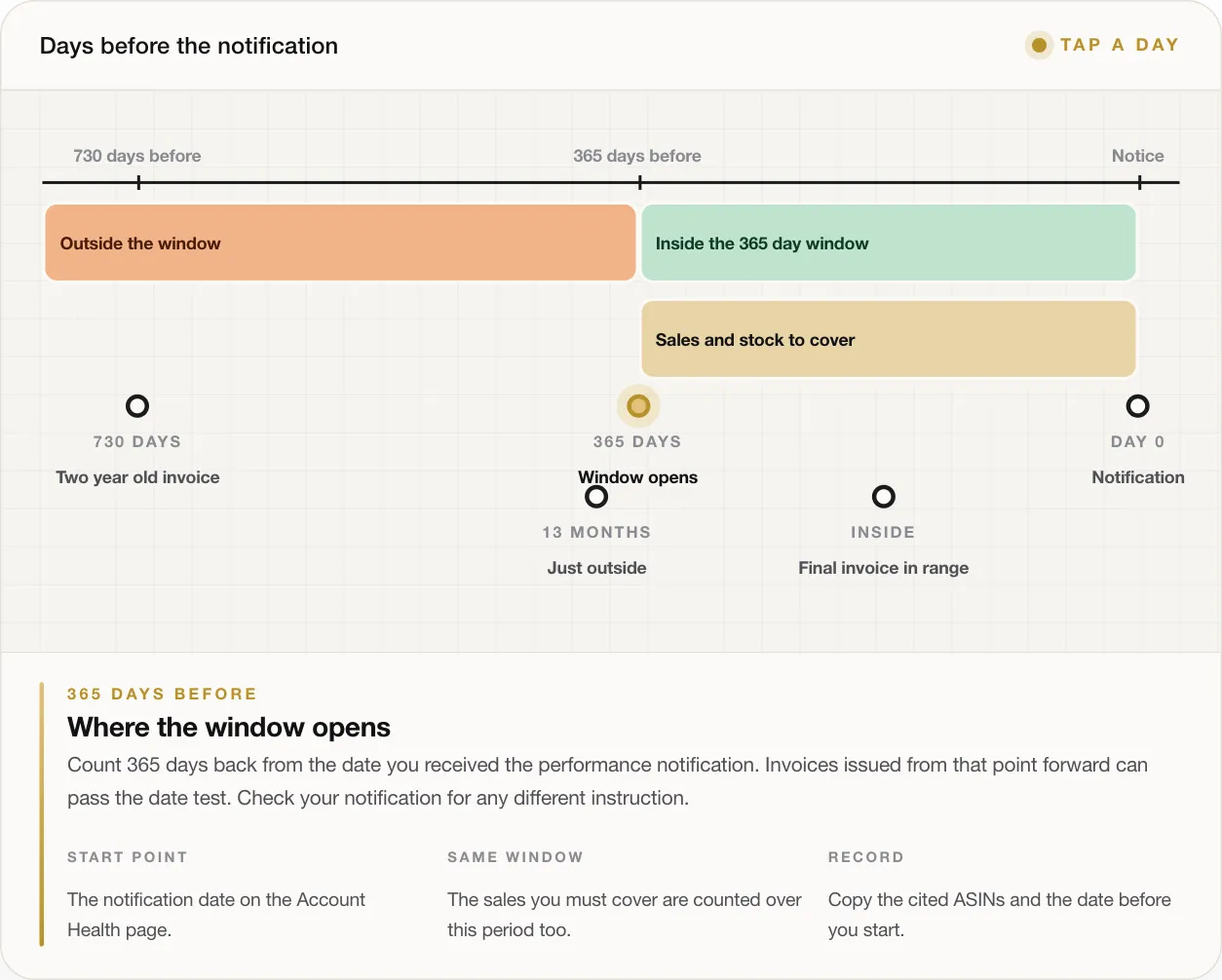
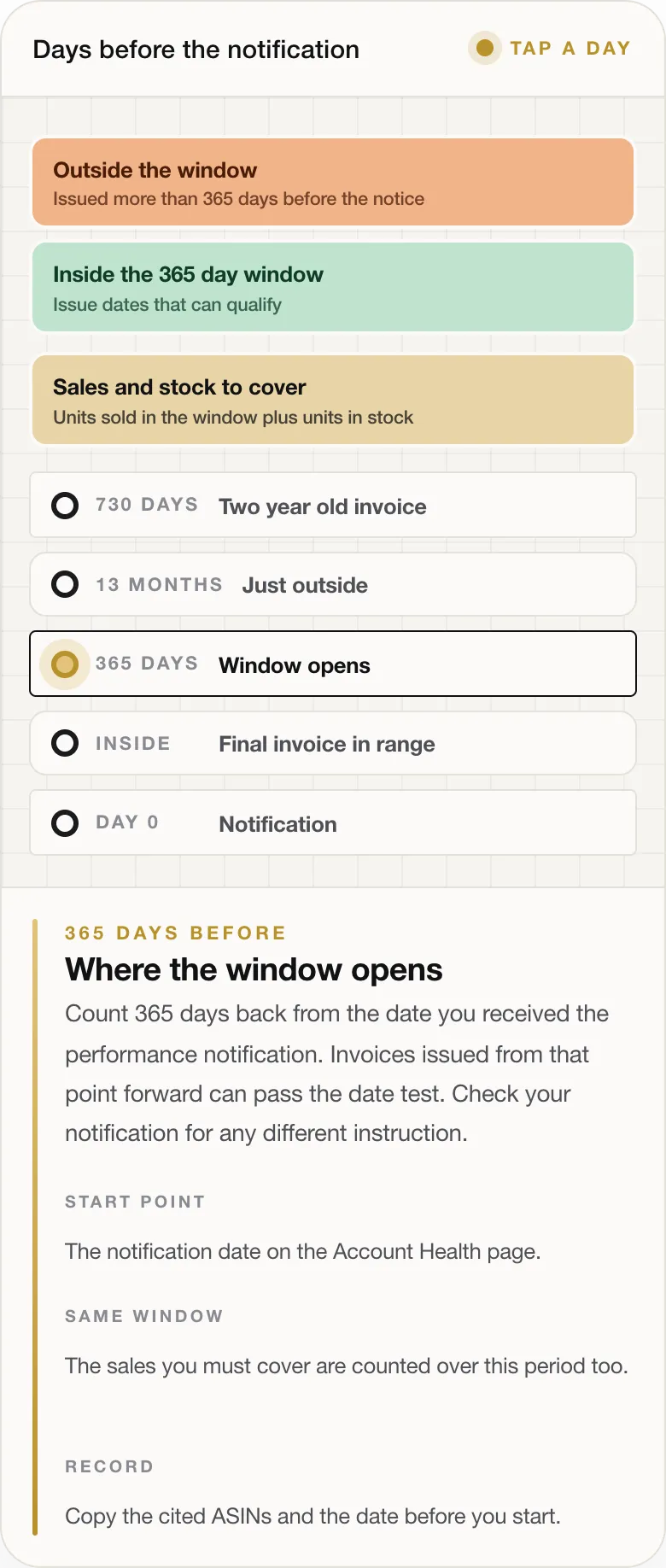
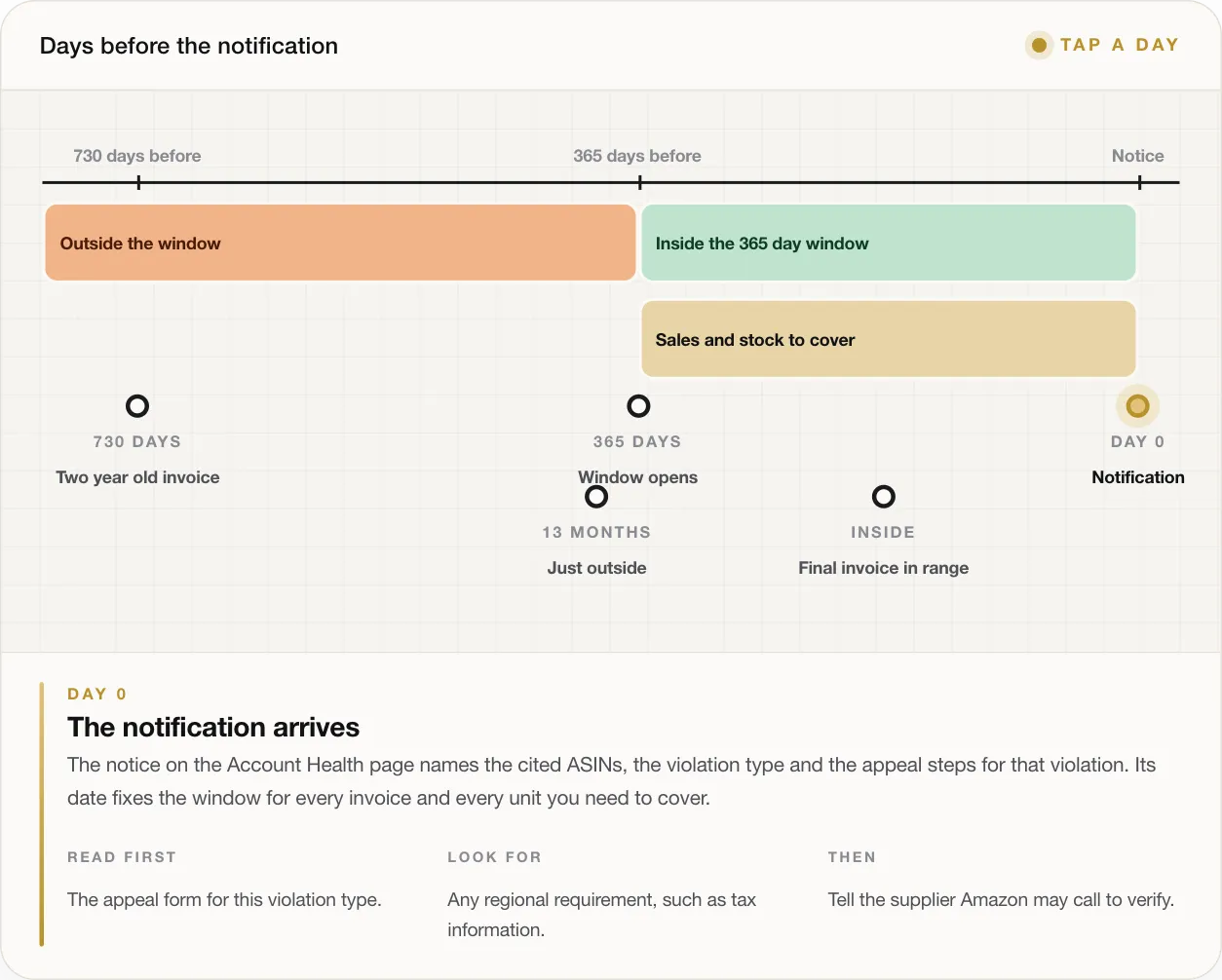
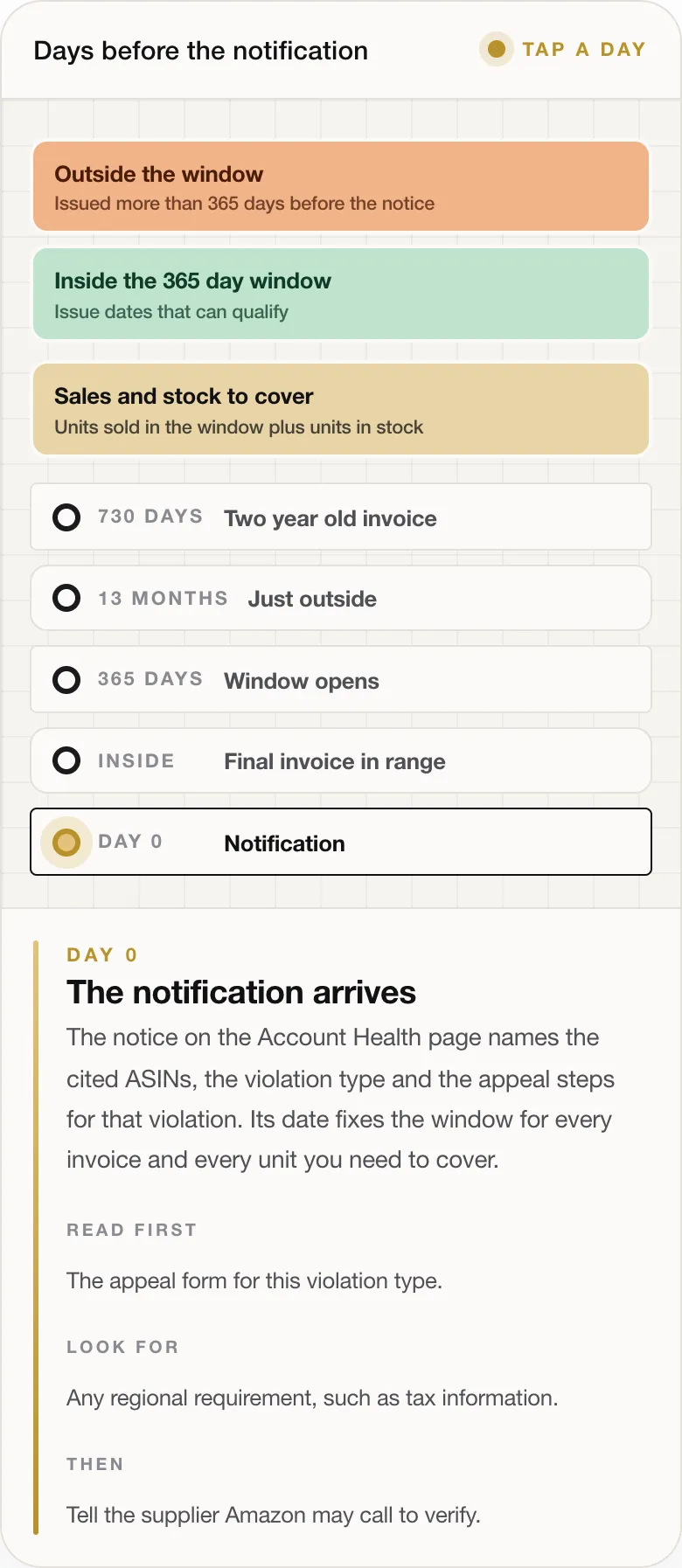
Your notification date sets the window.
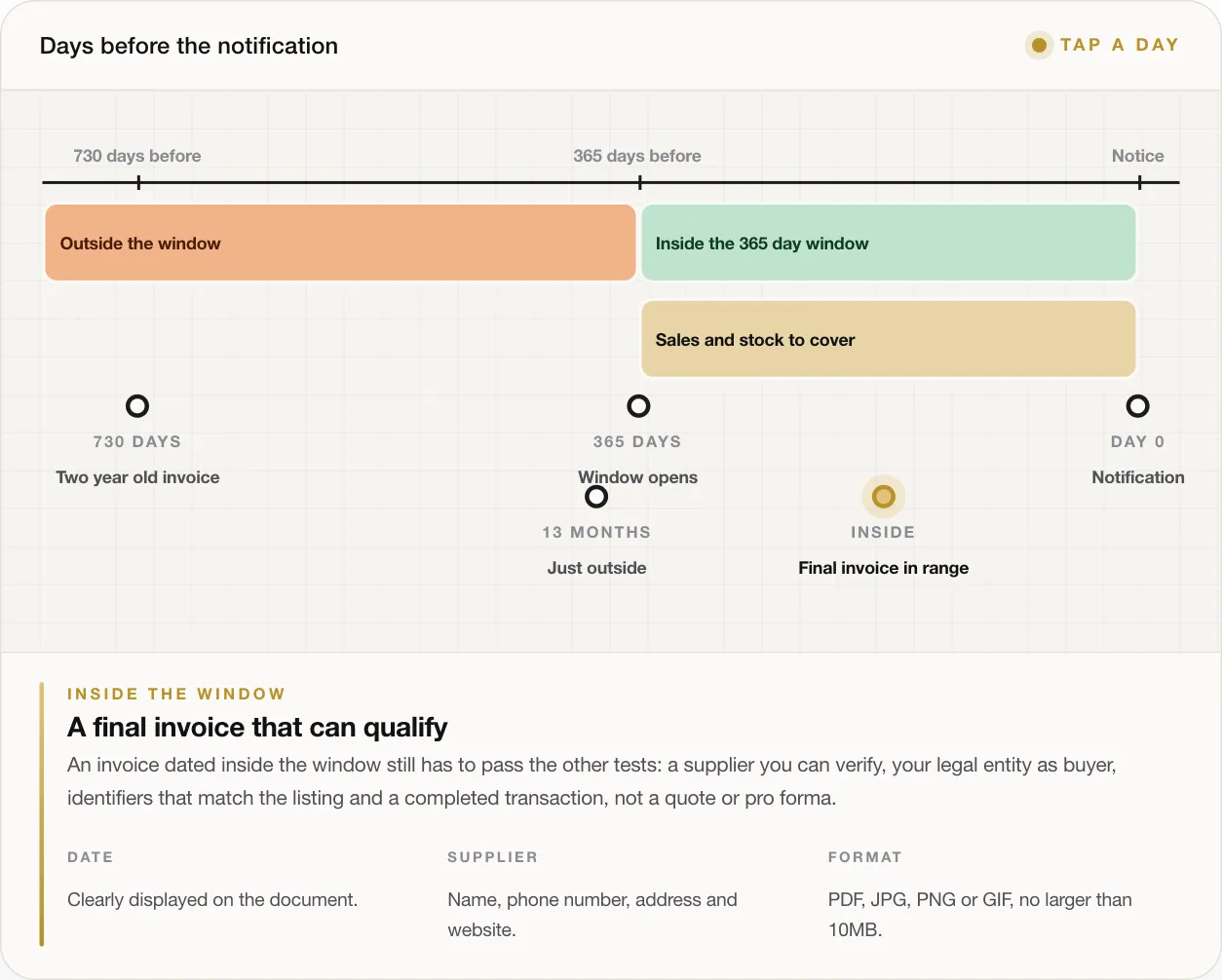
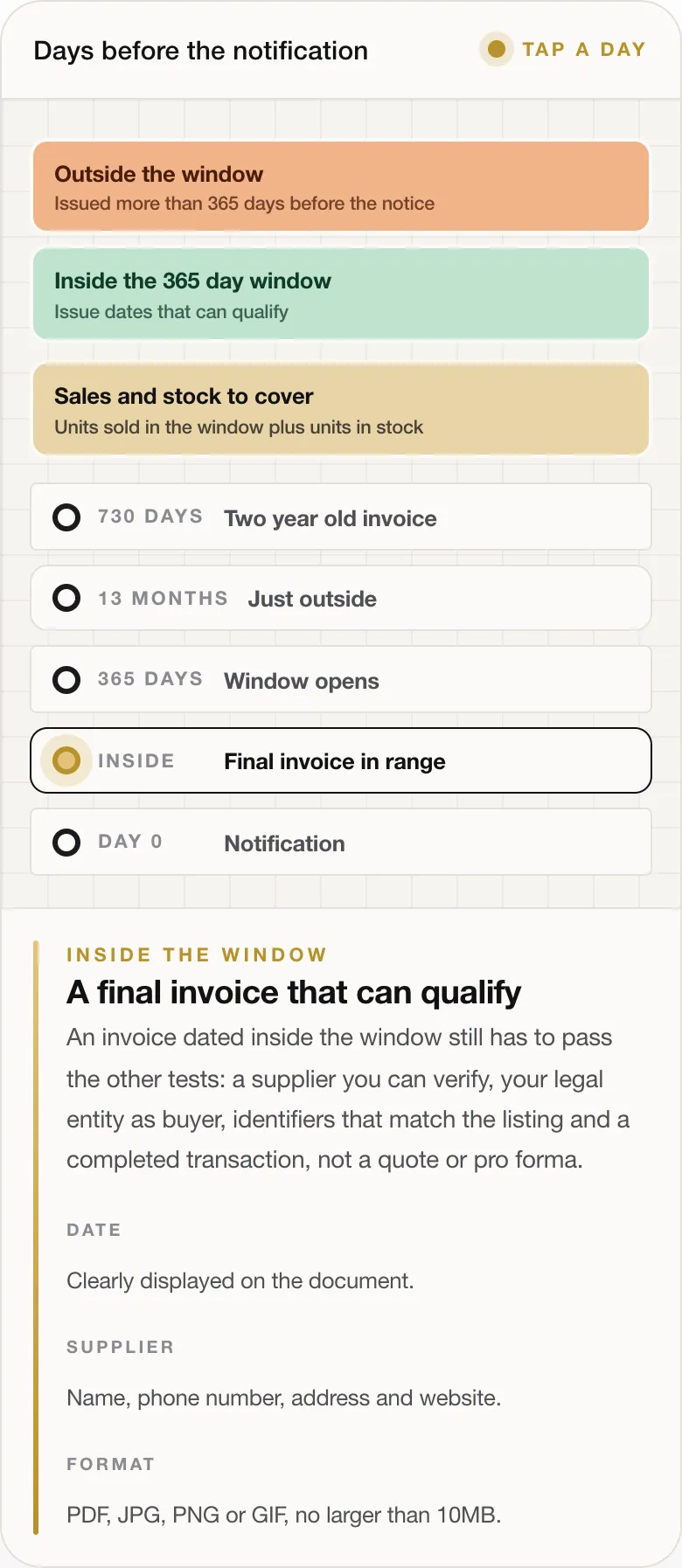
Amazon asks for invoices issued within the 365 days before you received the performance notification. Count back from that date and every invoice either lands inside the window or does not count on its own.
The invoice standard, tested line by line
Many rejected appeals fail on arithmetic or matching, not authenticity. Run every invoice through four tests: date, identity, product match and quantity.
The date and identity tests
The date test is the window above. The identity test asks two questions. First, is the buyer on the invoice the same legal entity as the selling account, with the same name and address you gave Amazon at verification? Second, is the supplier a separate business you can verify, with a name, phone number, address and website that all lead to the same company? Amazon will not accept self-issued invoices or invoices where the supplier appears to be the same entity as the buyer.
The product match test
Lay the invoice next to the listing. The product name, model number or UPC should identify the exact item. If the listing is a variation, the invoice should show the same color, size, version or style. Bundles need coverage for every component. A line reading “assorted” fails even when the goods were genuine.
The quantity test, with a worked example
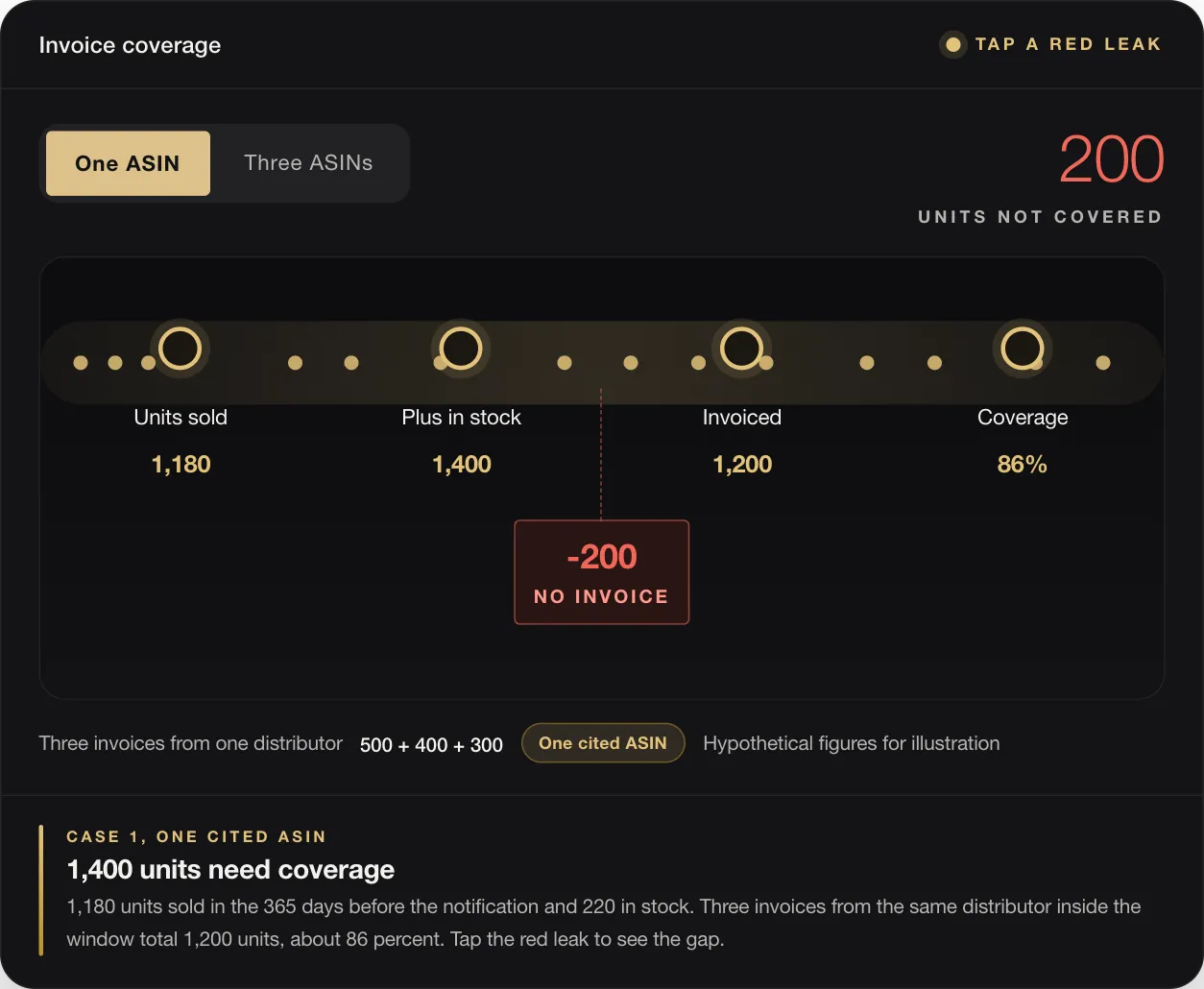
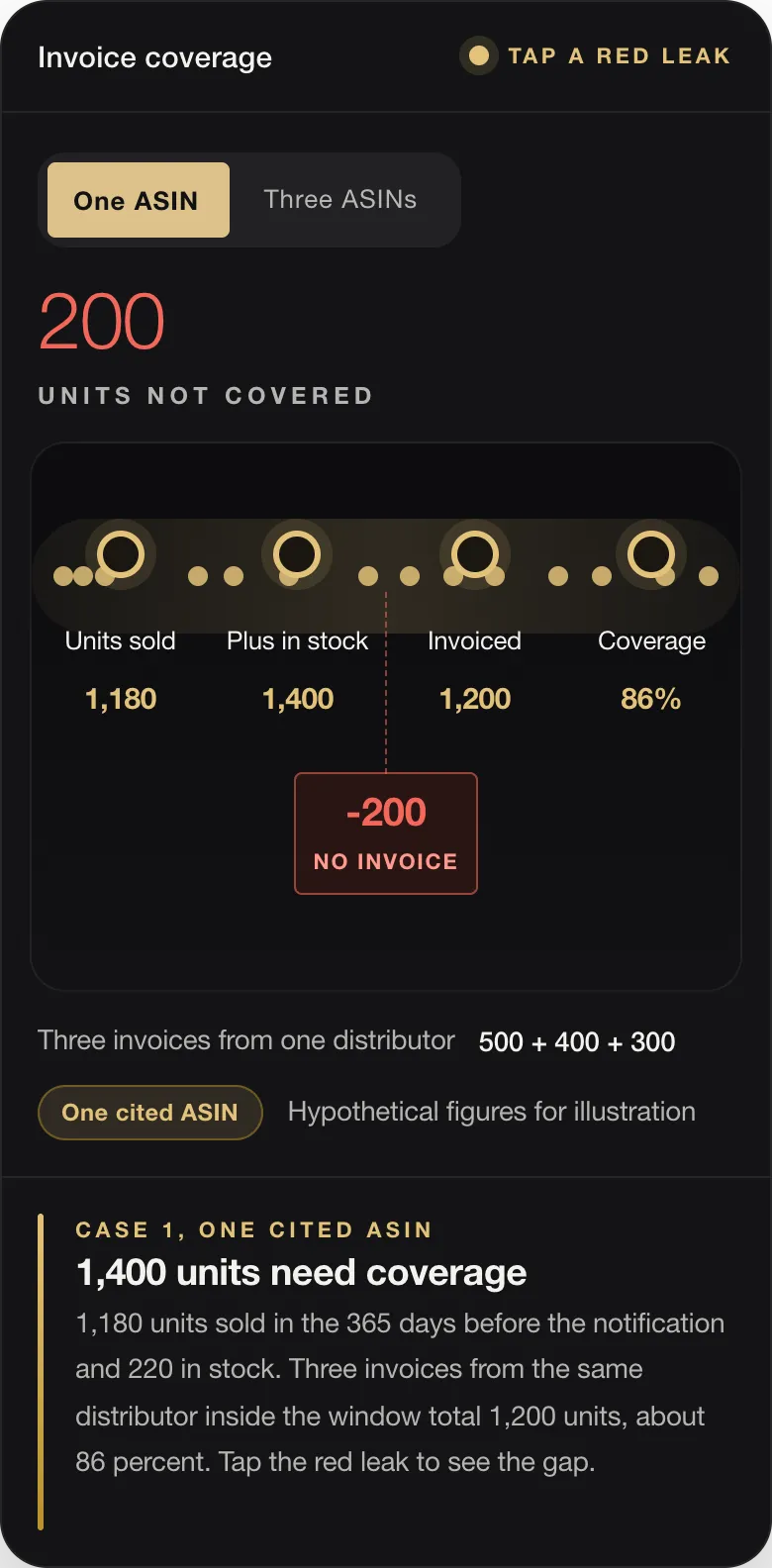
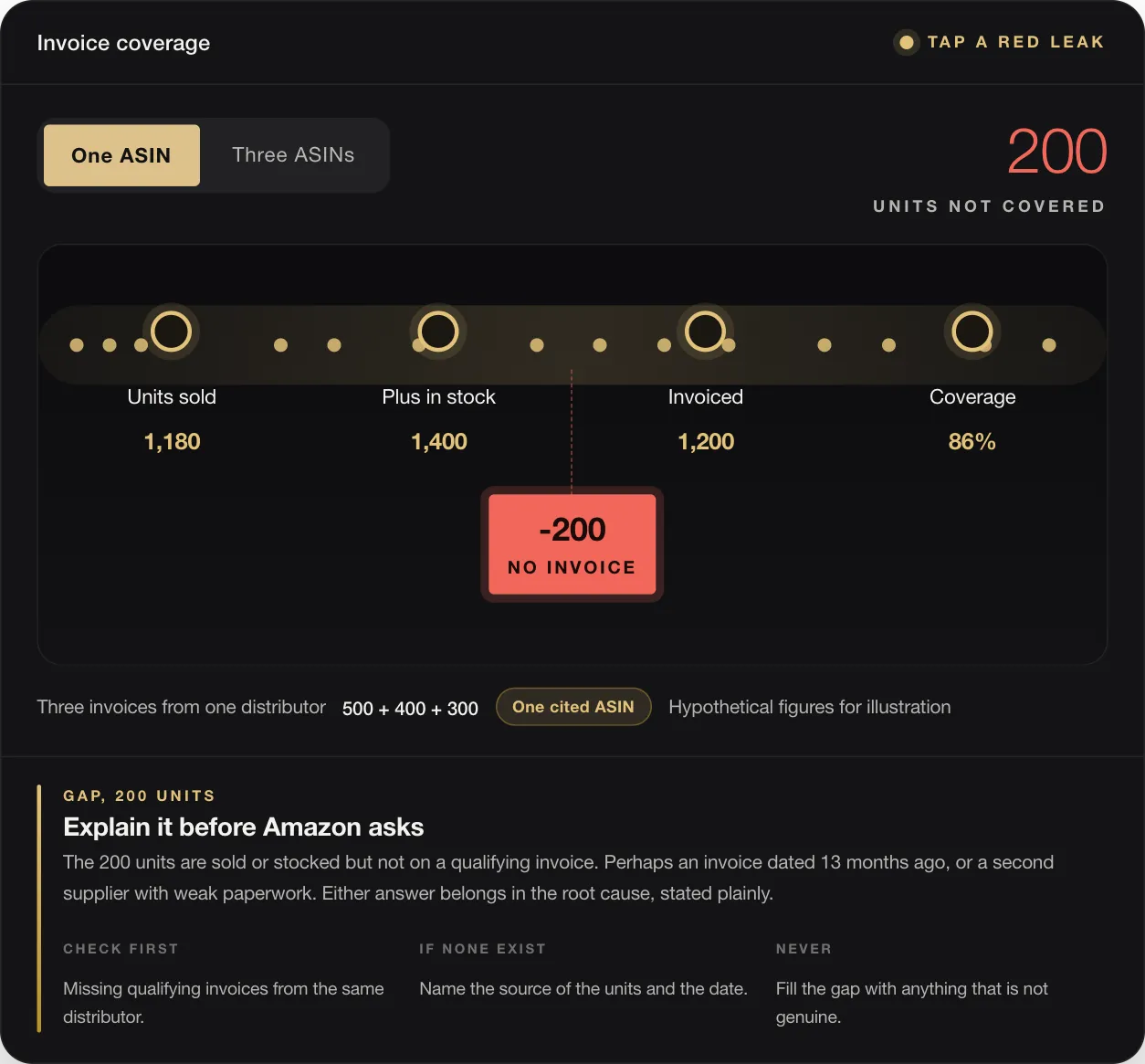
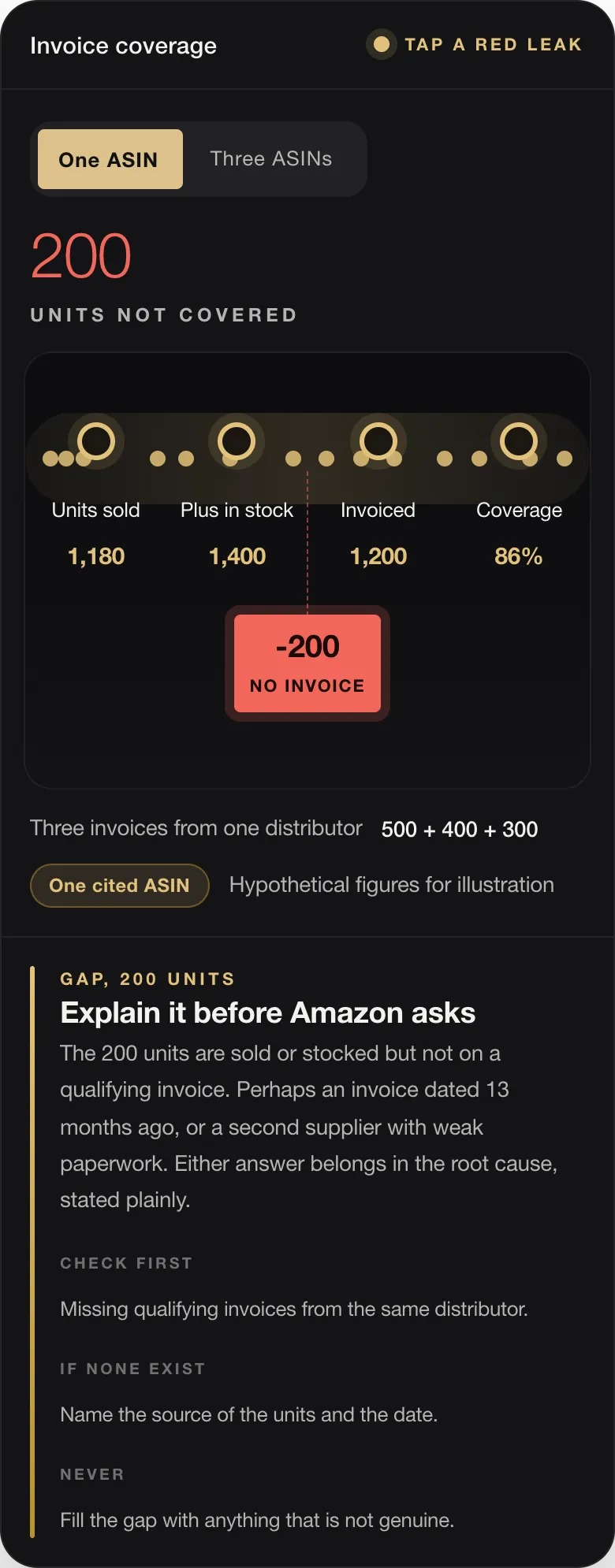
Hypothetical example: a seller has a notice on one ASIN. Over the 365 days before the notification they sold 1,180 units and they hold 220 units in stock, so they need invoice coverage for 1,400 units. They have three invoices from the same distributor inside the window for 500, 400 and 300 units, which totals 1,200. Their coverage is about 86 percent. The 200 unit gap needs an explanation before Amazon asks: perhaps an invoice dated 13 months ago, or a second supplier with weak paperwork. Either answer belongs in the root cause.
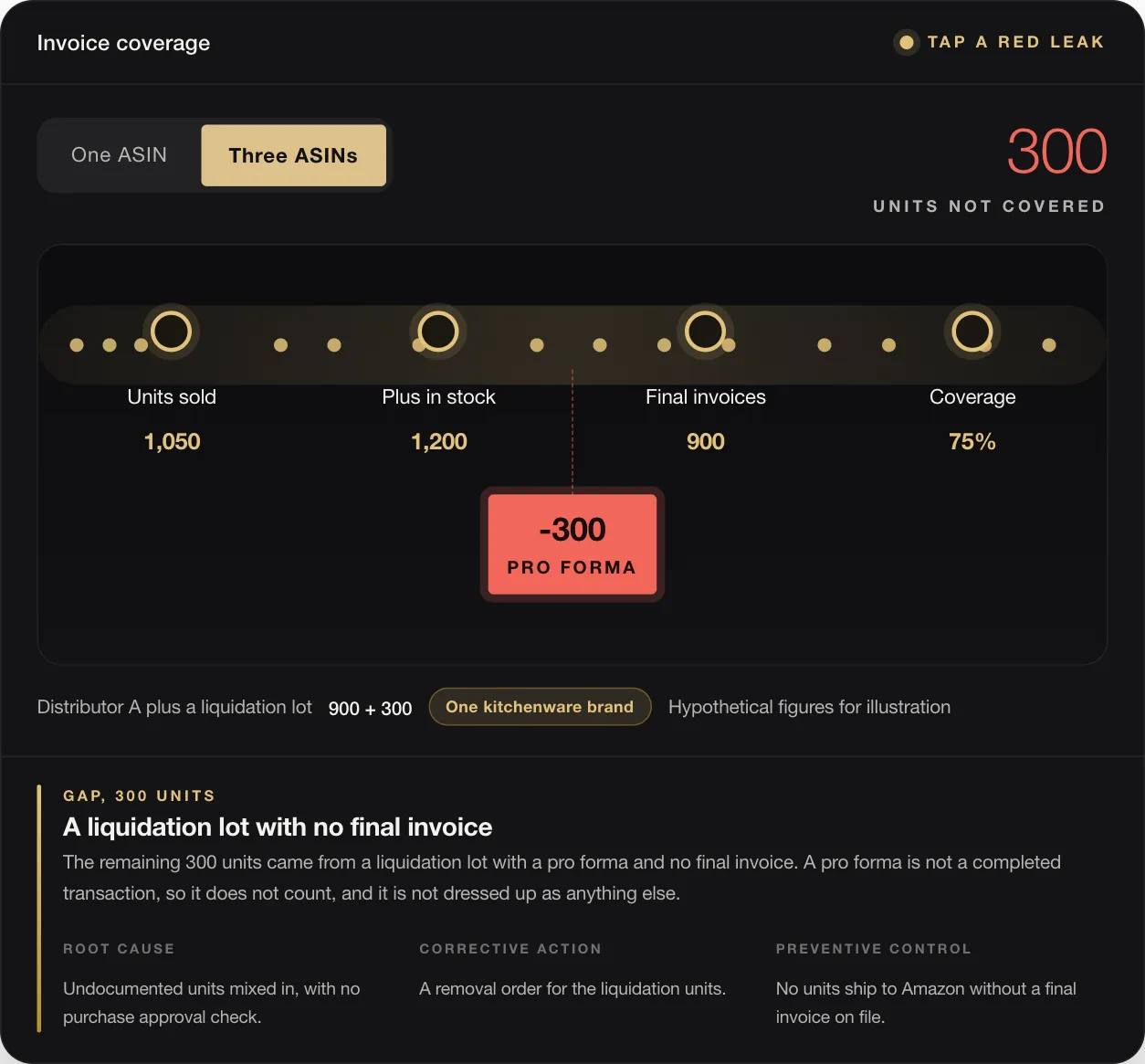
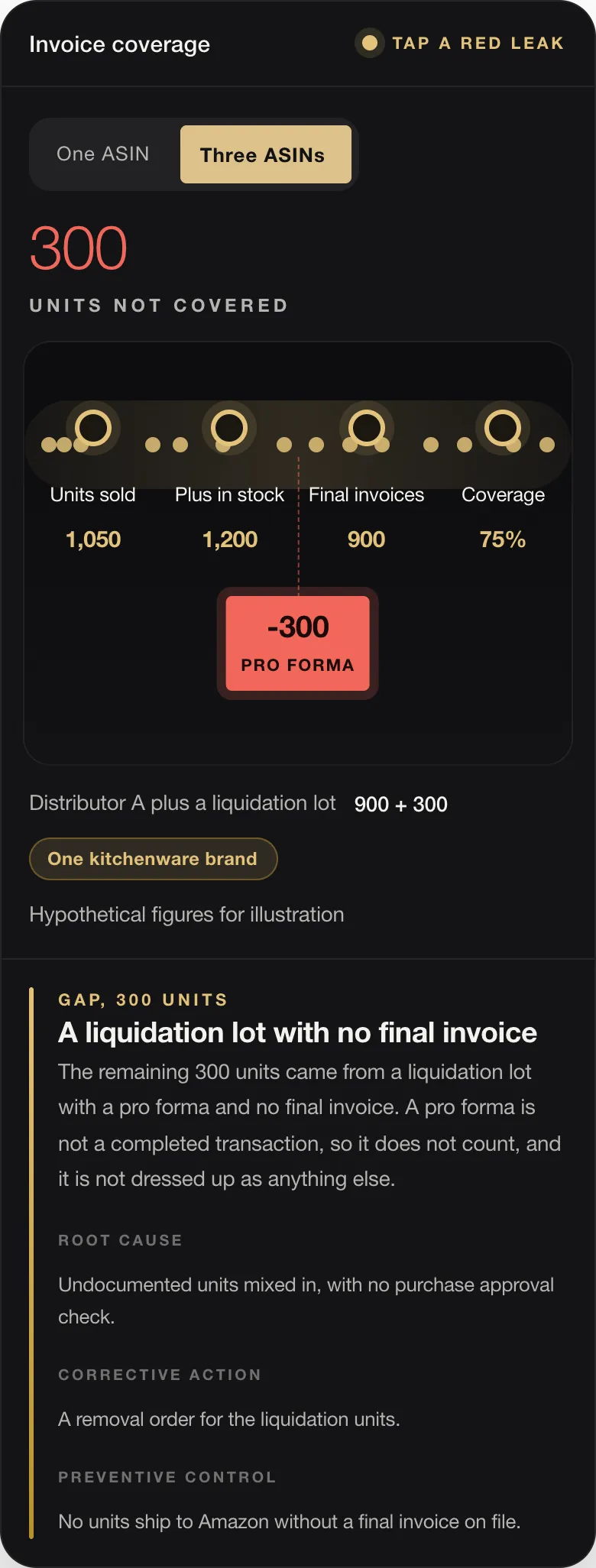
Follow the units. Find the gap before Amazon does.
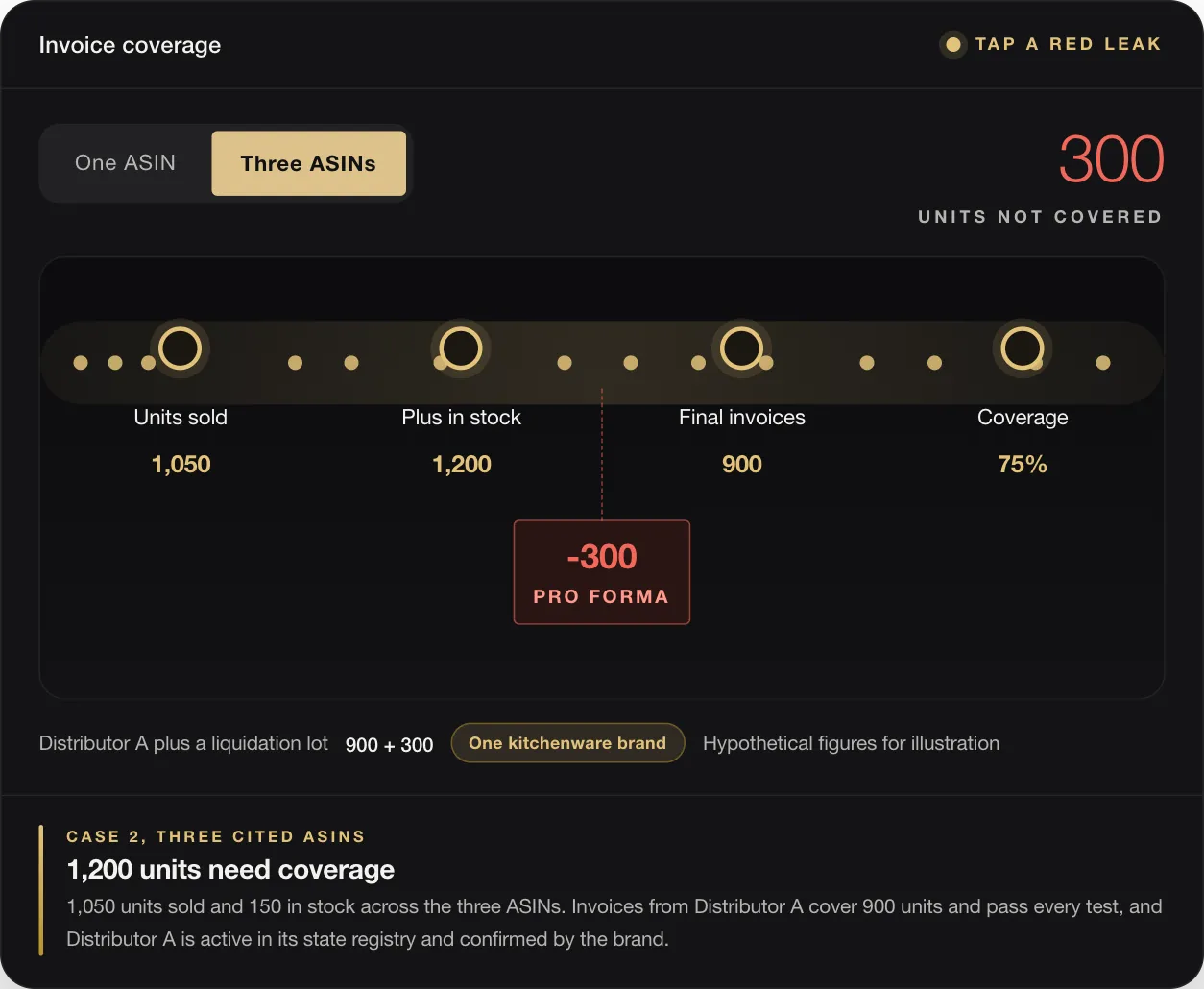
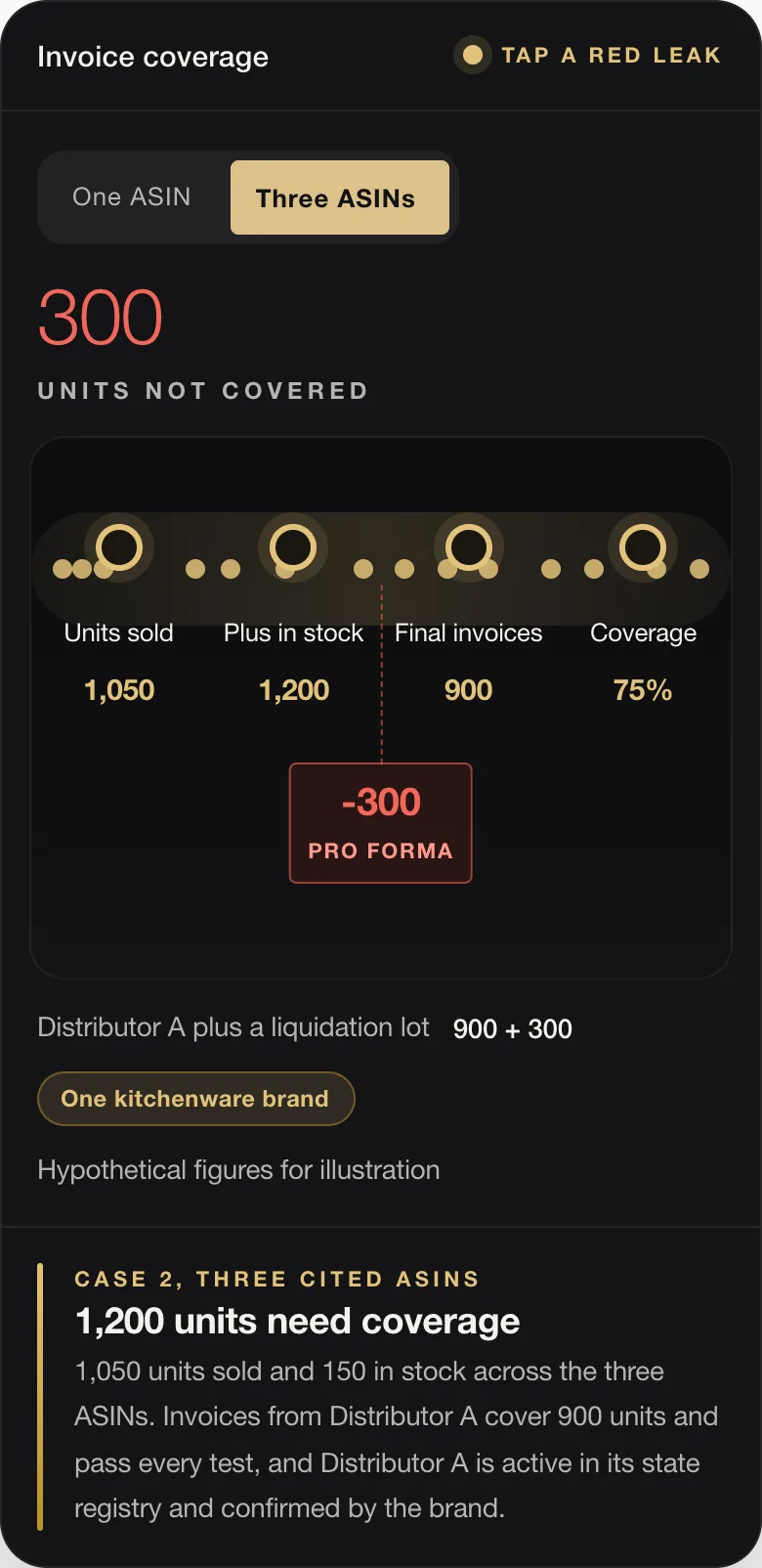
Add units sold in the window to units in stock, then compare against units on qualifying invoices. Pick a case and tap the red leak to see what the gap is and how to answer it honestly.
How to vet a supplier before you buy
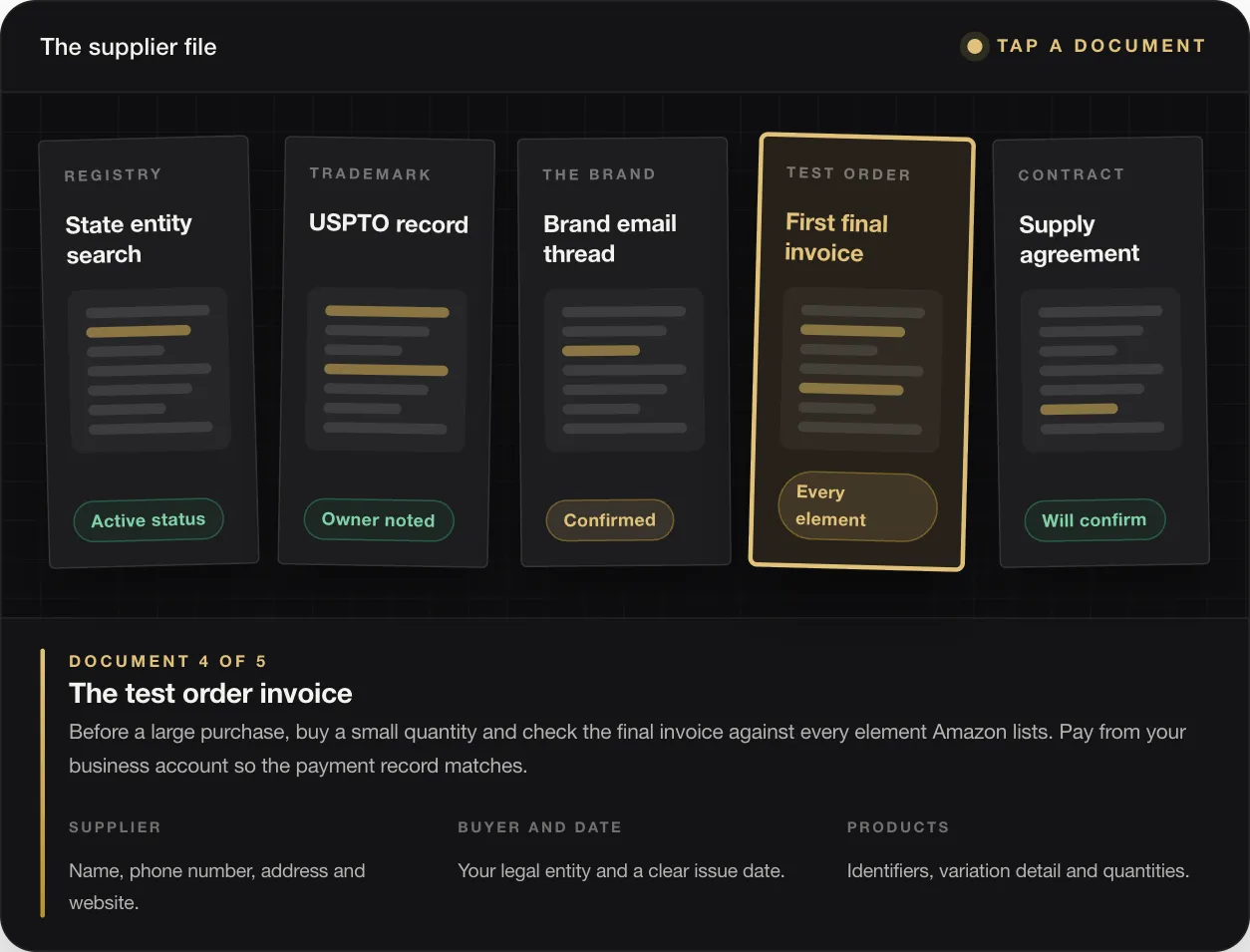
Amazon’s help page “Select reliable suppliers with due diligence” covers registration and legal compliance, brand affiliation, brand endorsement, reputation, operations and contract terms, noting that suppliers need not meet every criterion. The checks below turn that guidance into a routine that leaves evidence on file.
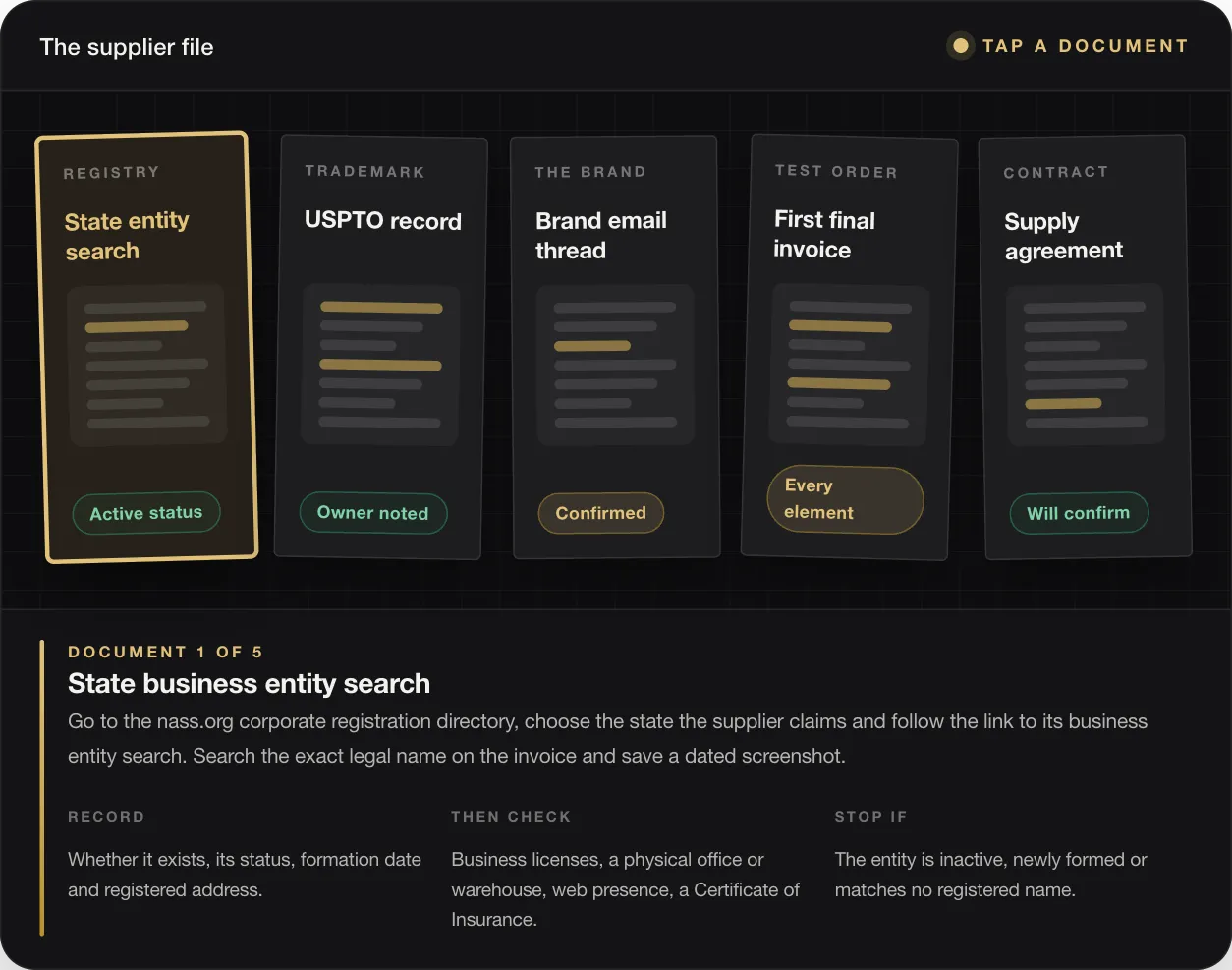
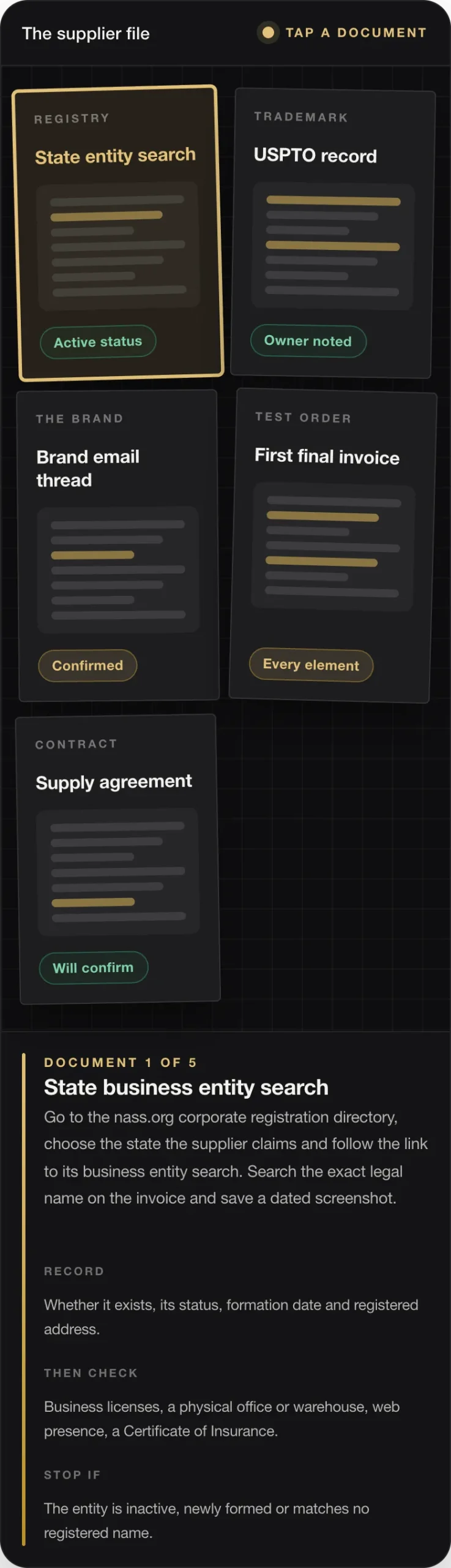
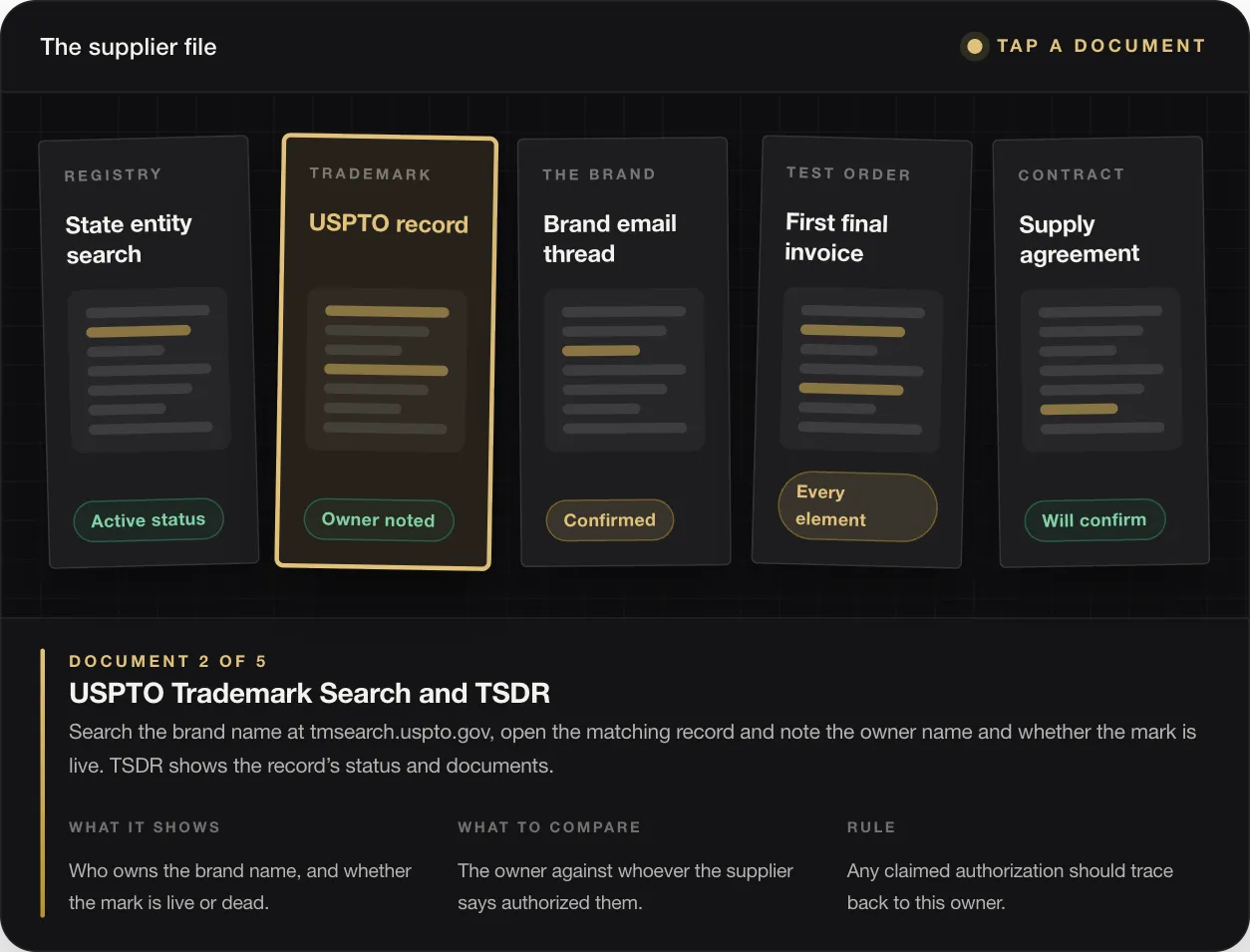
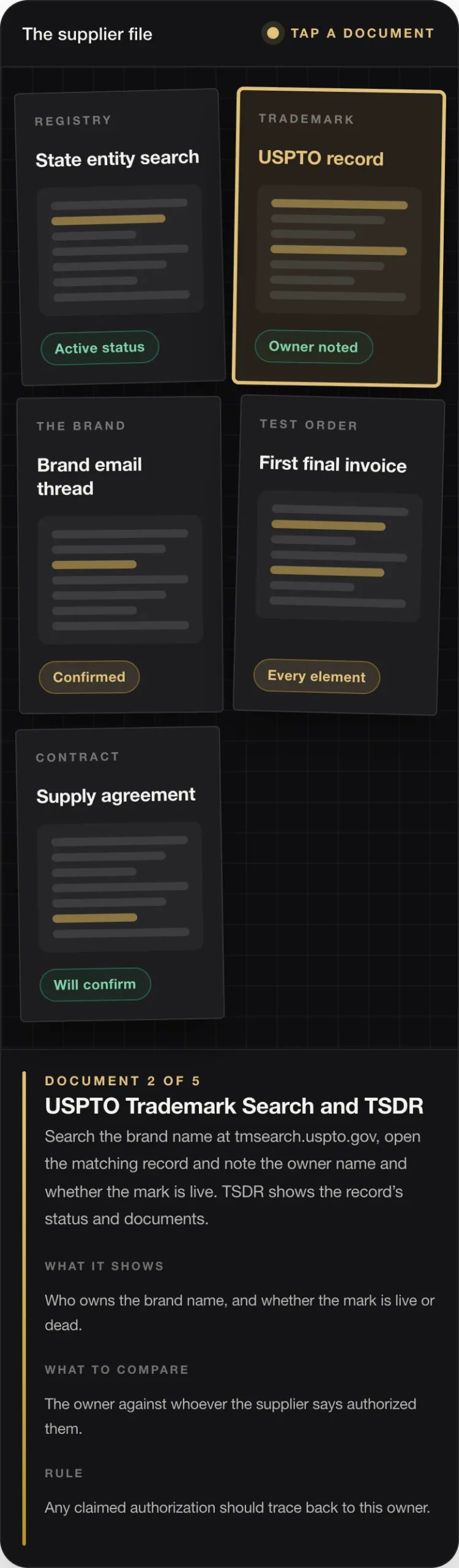
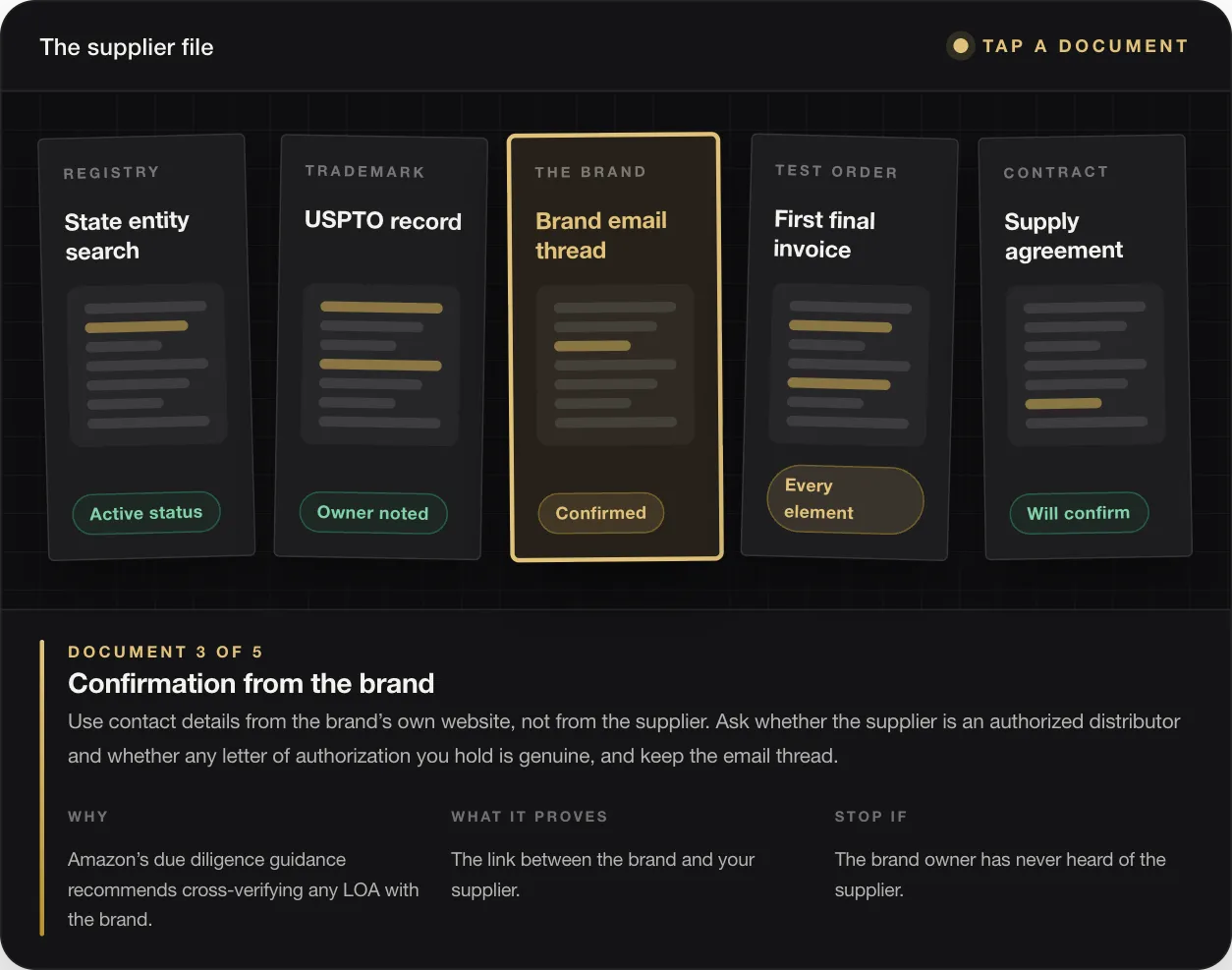
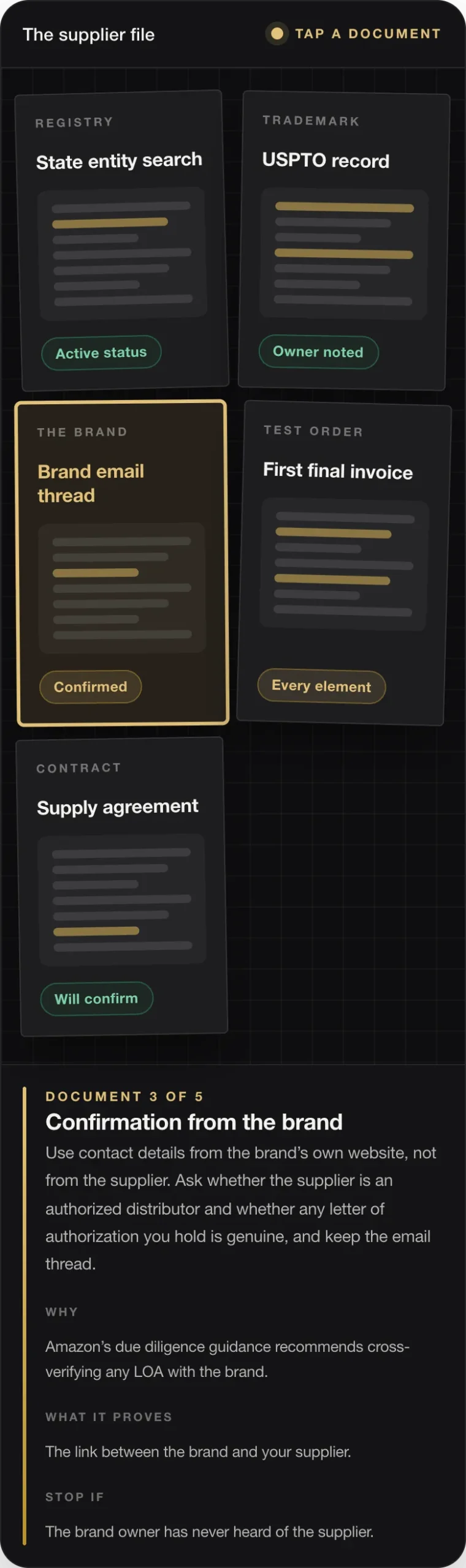
Five checks. Five dated records in the file.
Each vetting step leaves a document you can screenshot, date and save. Tap a document to see where it comes from and what it has to show before any money moves.
Red flags that should stop a purchase
Pause when the entity is inactive or newly formed, the invoice name matches no registered entity, the brand owner has never heard of the supplier, pricing is far below authorized channels, payment must go to a personal account, or the supplier offers to “make an invoice” for goods bought elsewhere. That last one is not a supplier. It is an invitation to commit the violation that ends accounts, and it would also breach the seller code of conduct, which requires you to provide accurate information to Amazon at all times.
Where to verify each claim
Every row produces something you can screenshot, date and save.
| Question | Where to check | What to look for |
|---|---|---|
| Does the supplier legally exist? | State business entity search, reached through the nass.org corporate registration directory | Exact legal name, active status, formation date, registered address matching the invoice |
| Who owns the brand name? | USPTO Trademark Search (tmsearch.uspto.gov) and TSDR | Owner name, live or dead status, and whether the owner matches who the supplier says authorized them |
| Is the supplier authorized by the brand? | The brand, contacted through its own website | Written confirmation of the relationship and confirmation that any LOA is genuine |
| Which ASINs are flagged and why? | Seller Central Account Health page and the performance notification | Cited ASINs, violation type, appeal instructions and any regional document requirements |
| How many units must the invoices cover? | Seller Central order reports and inventory reports for each cited ASIN | Units sold in the 365 days before the notification plus units currently in stock |
| Did the goods you received match what was invoiced? | Your receiving log, shipment records, and Seller Central shipment history | Shipment IDs, dates and unit counts that reconcile to invoice quantities |
| How exposed is the account? | Account Health Rating on the Account Health page | Current score band and any repeat violations under the same policy |
Read your sourcing model honestly before you write anything
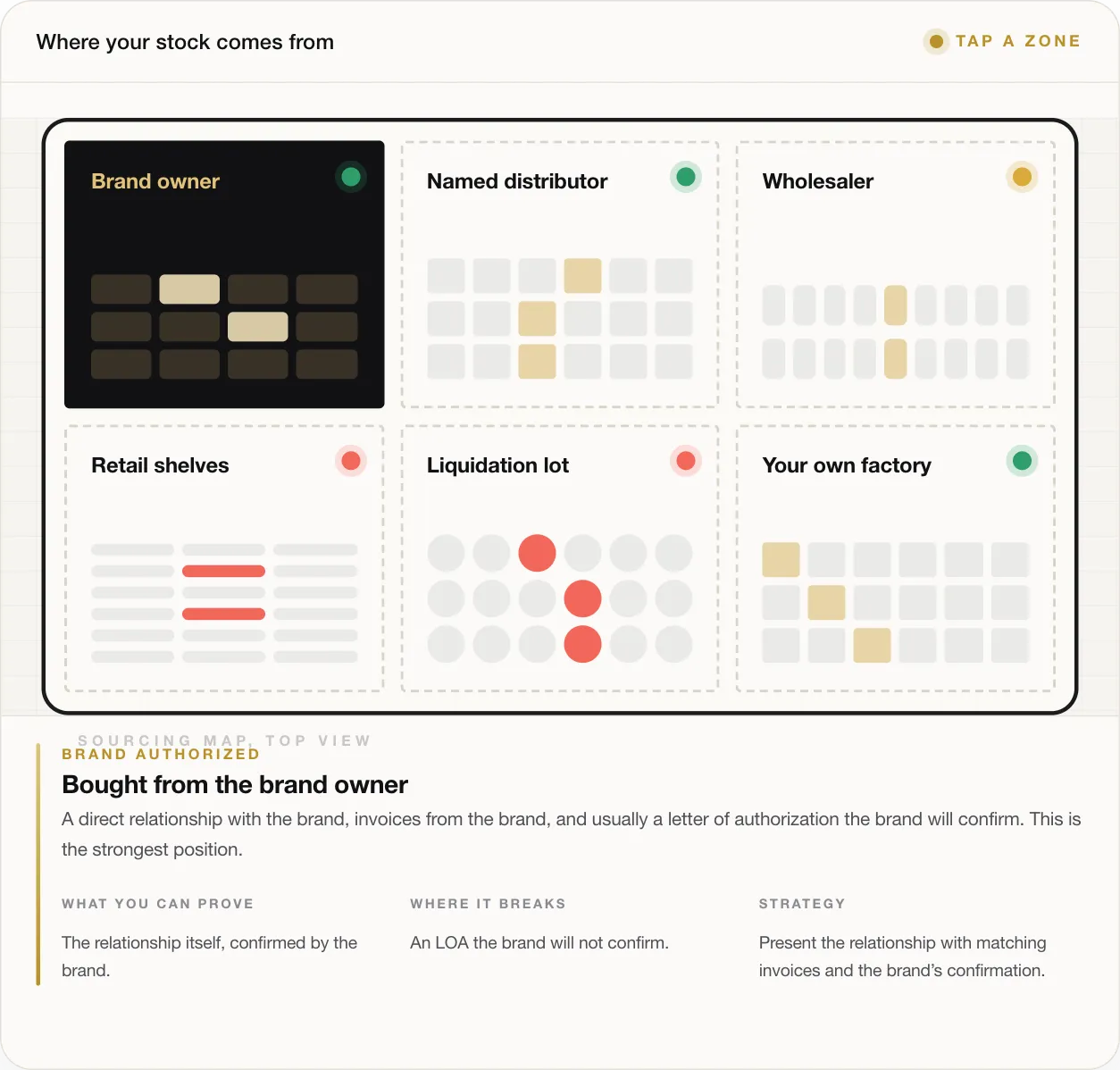
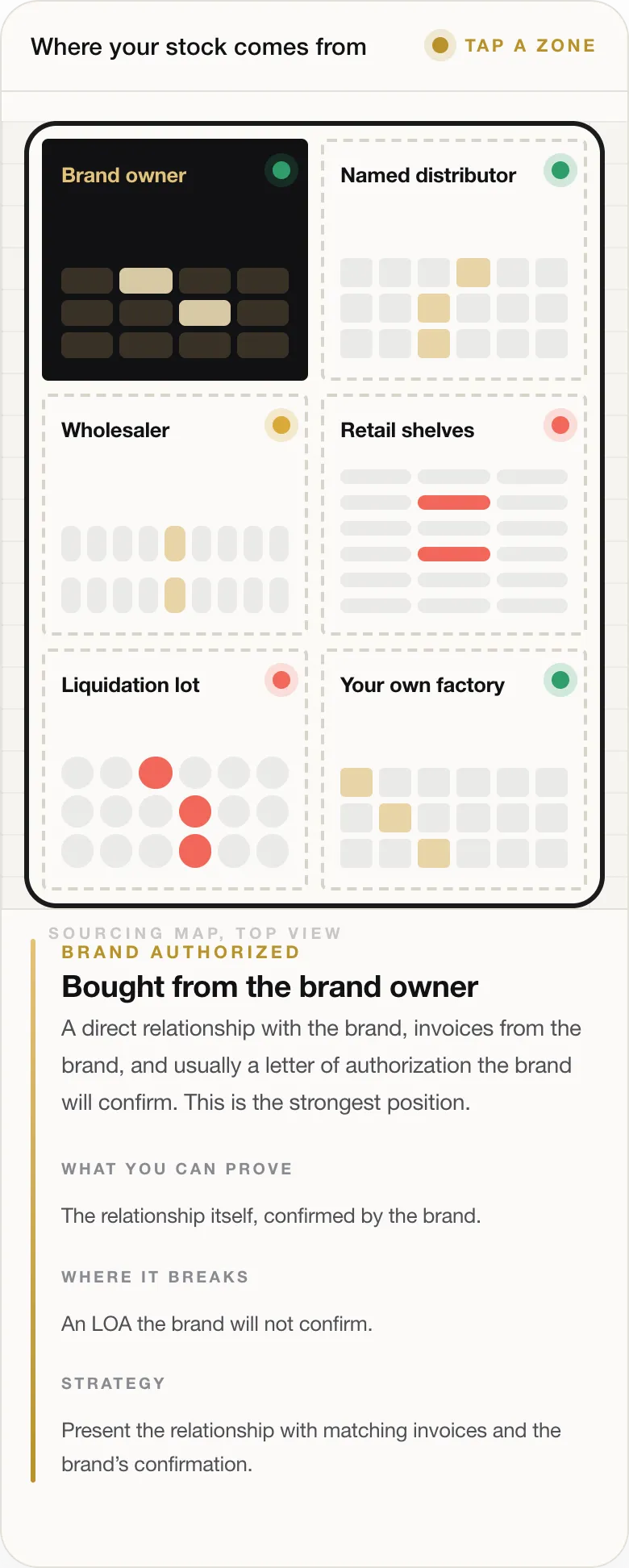
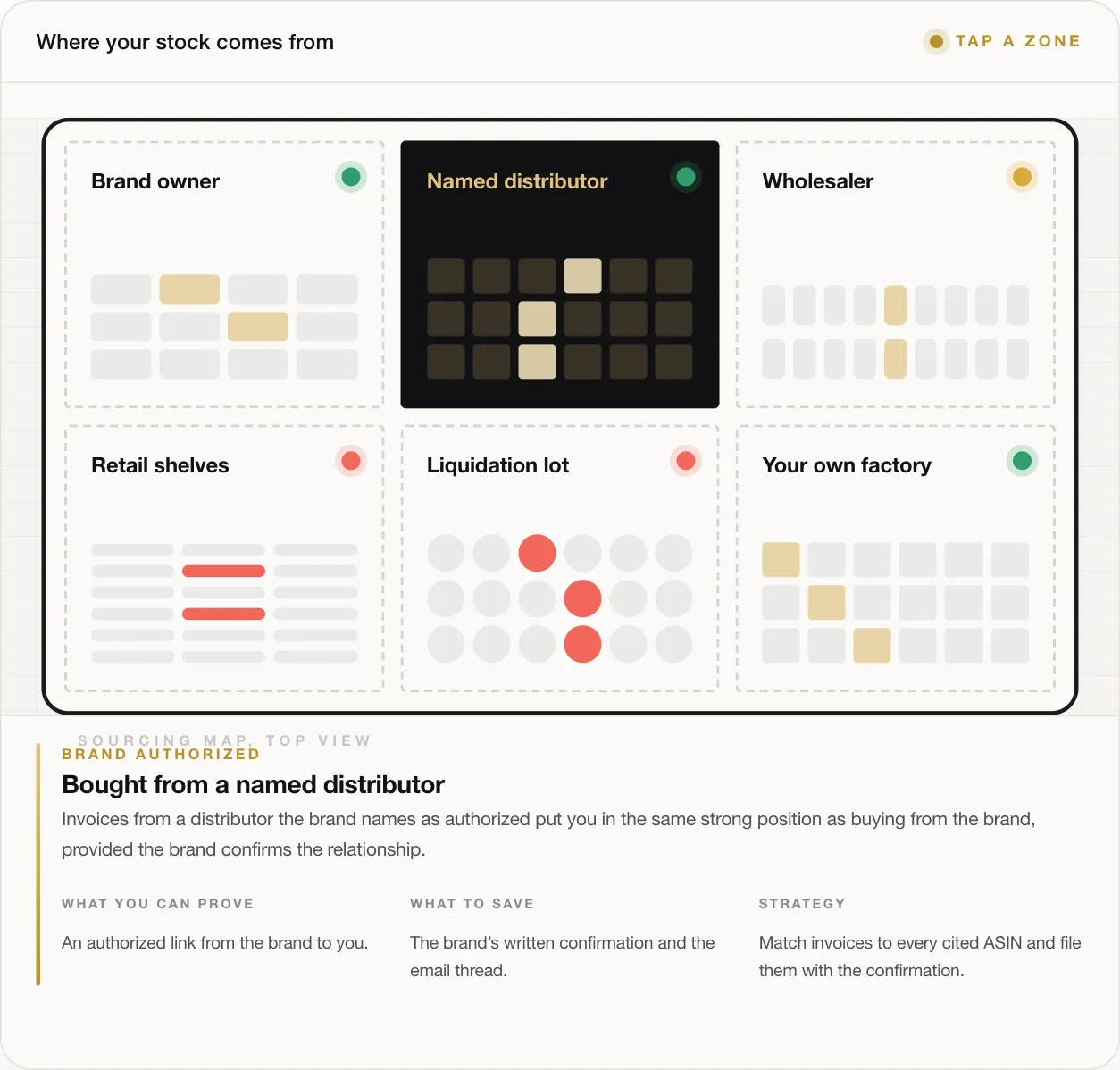
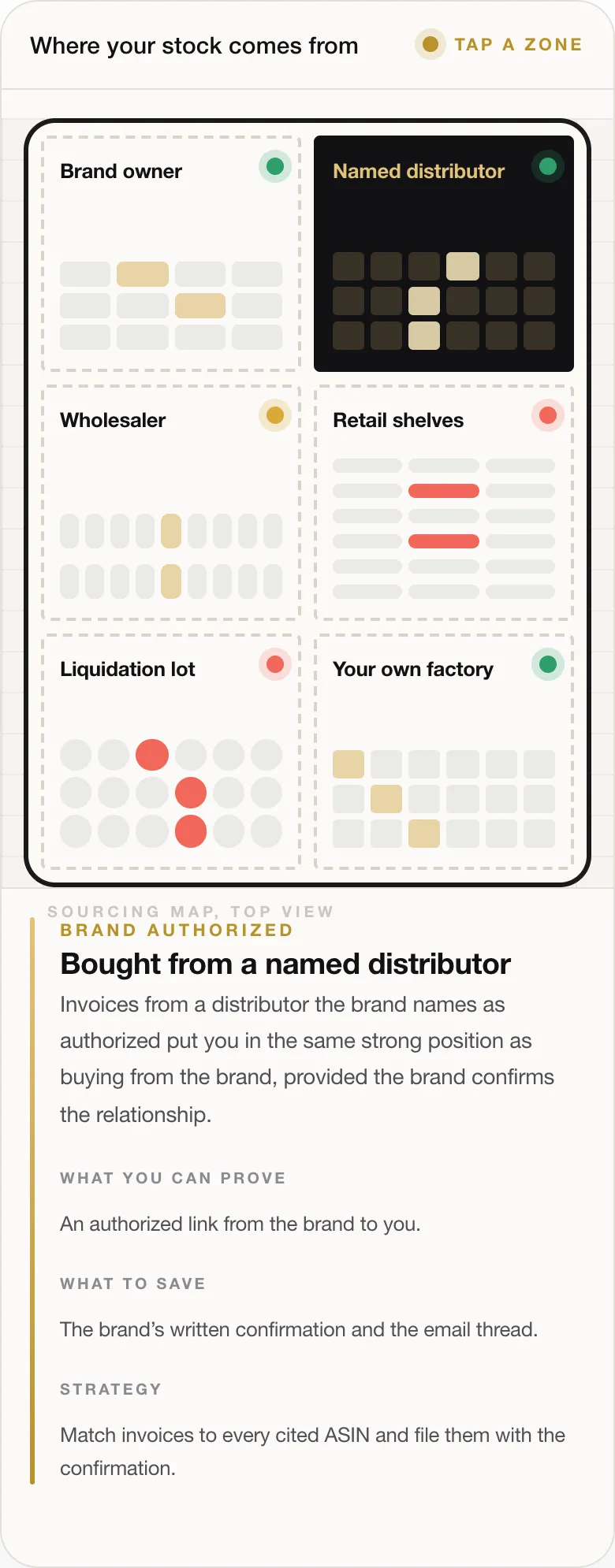
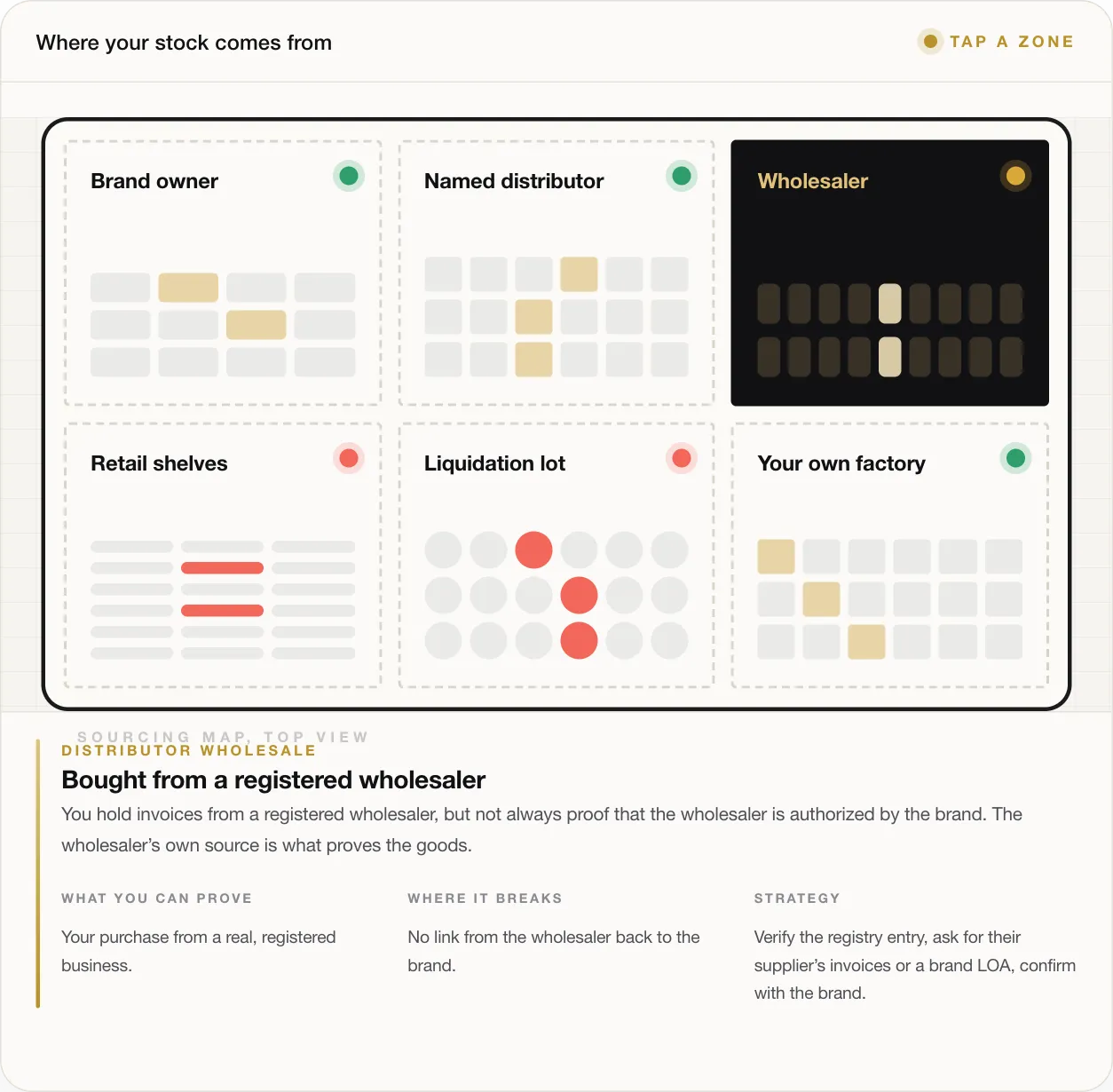
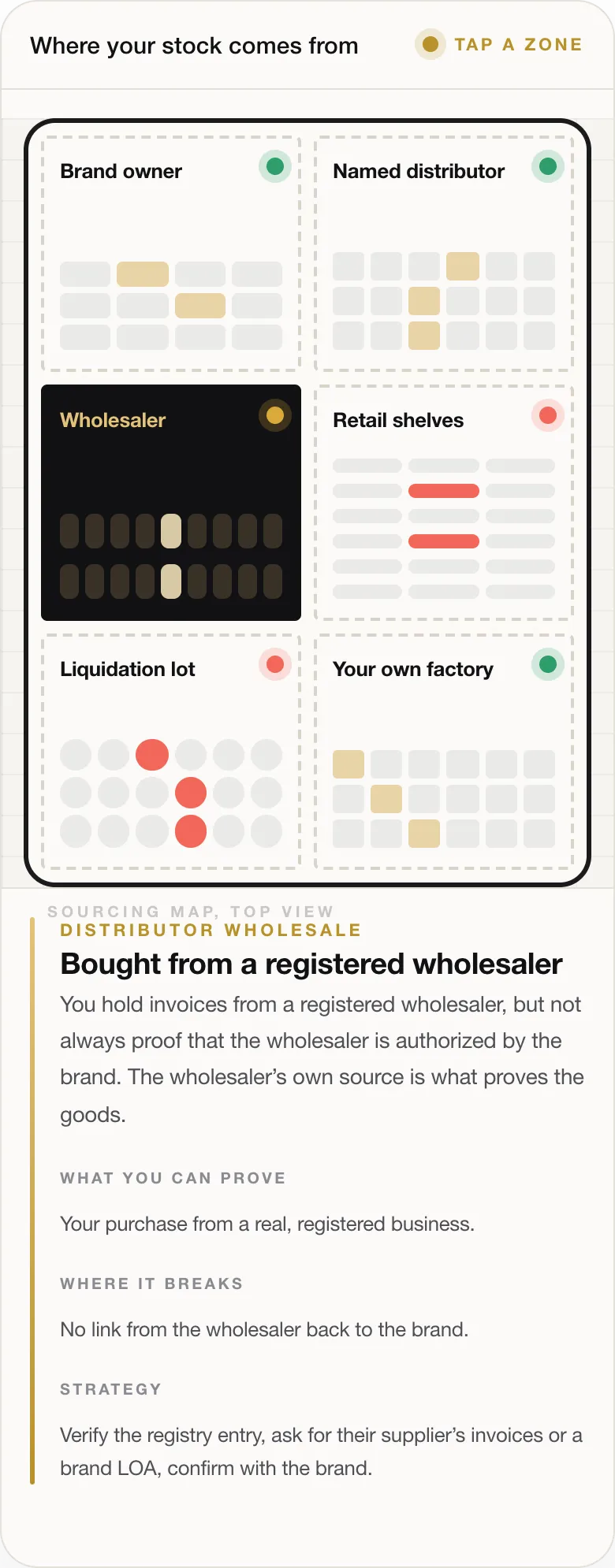
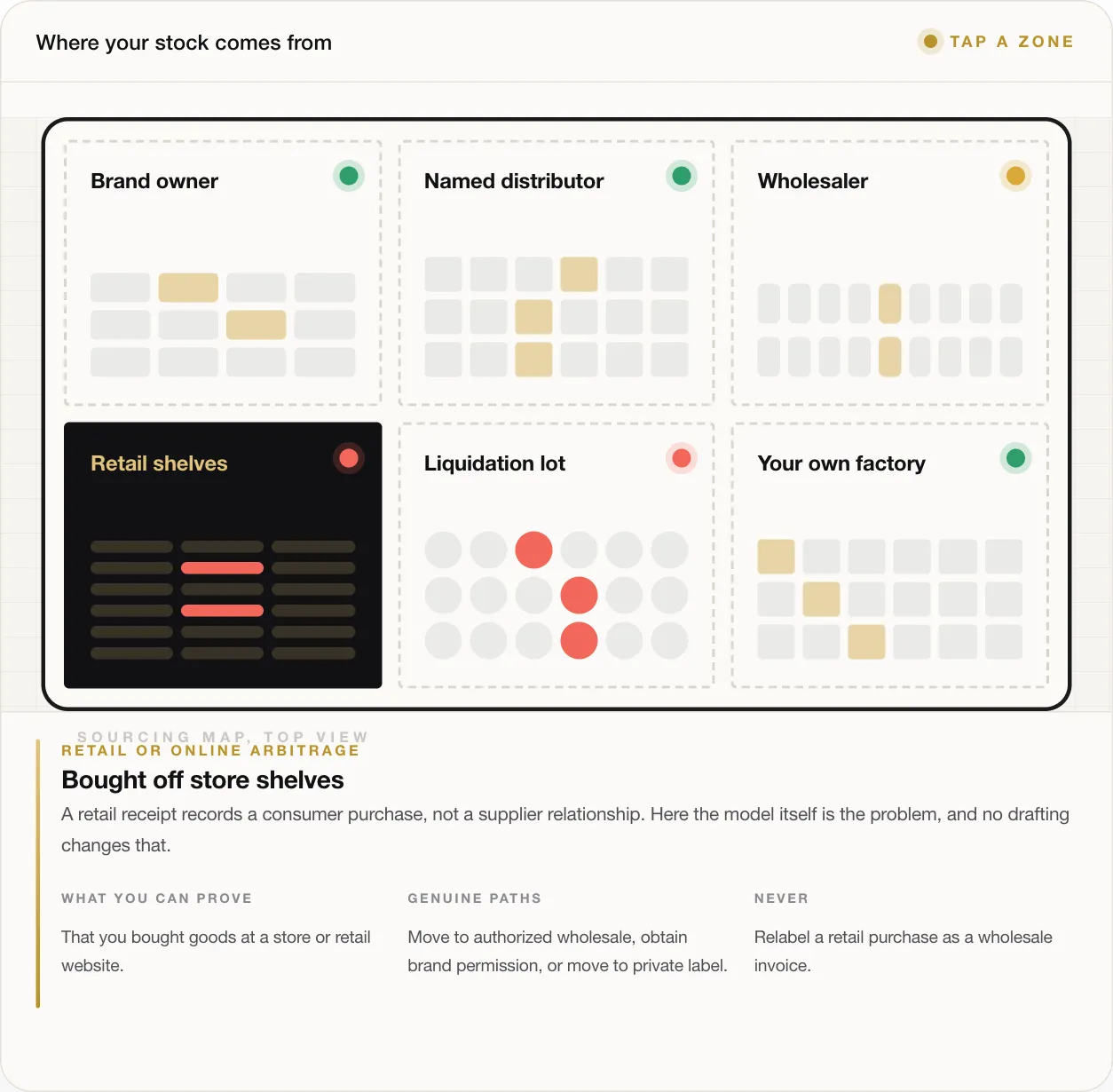
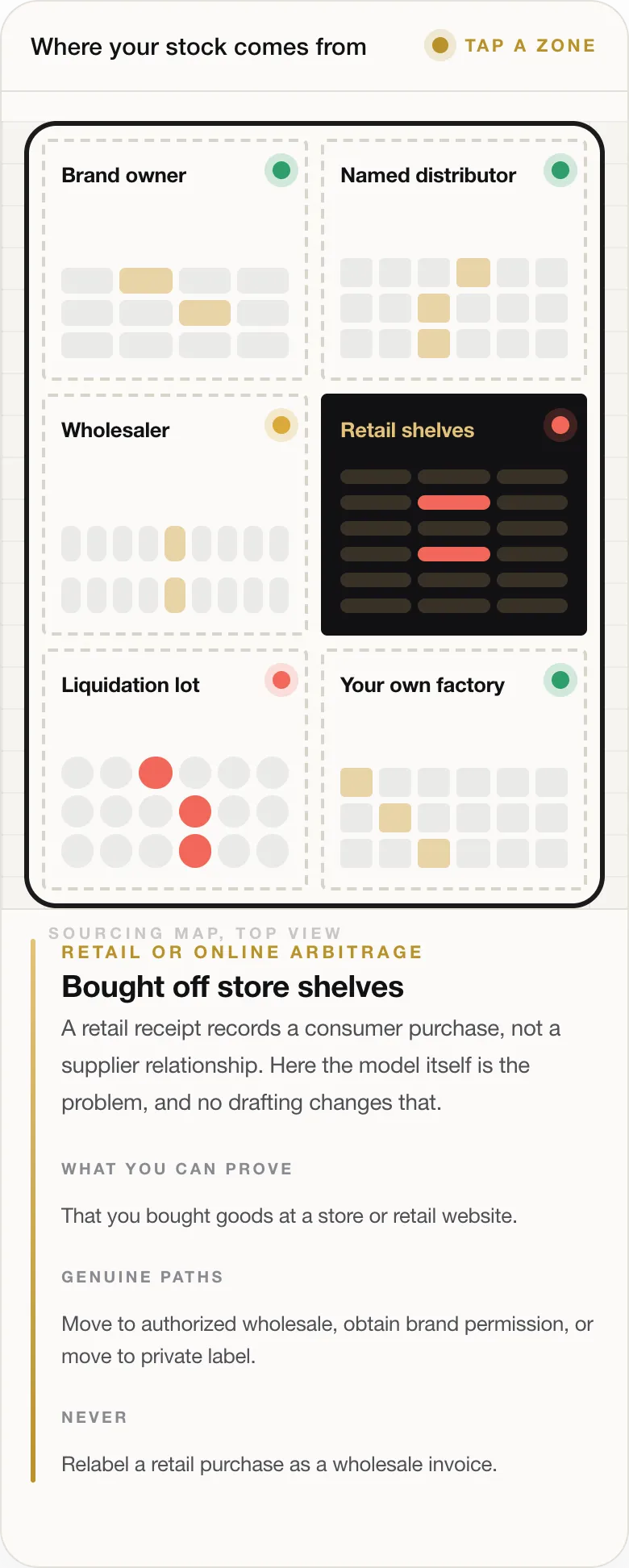
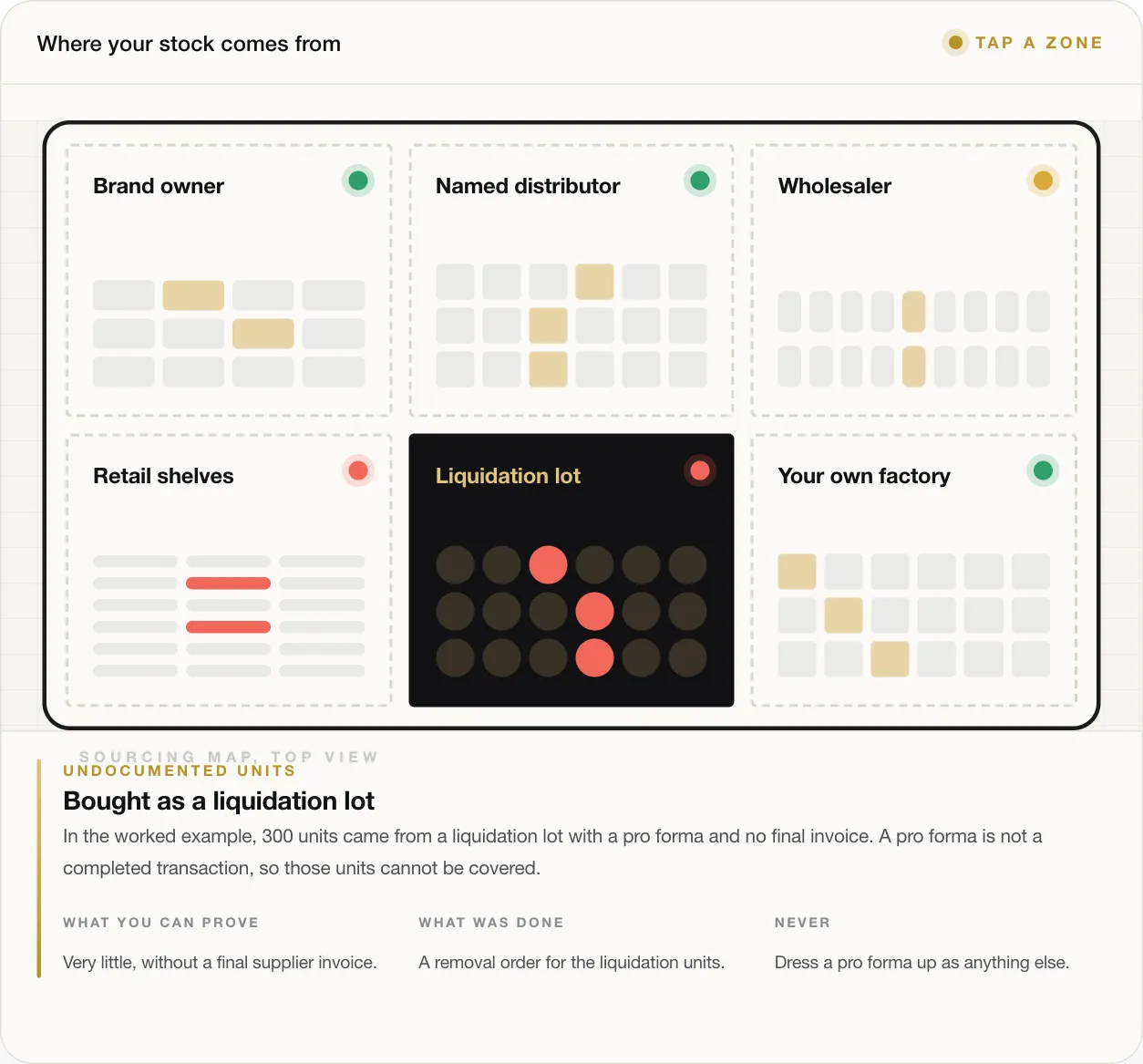
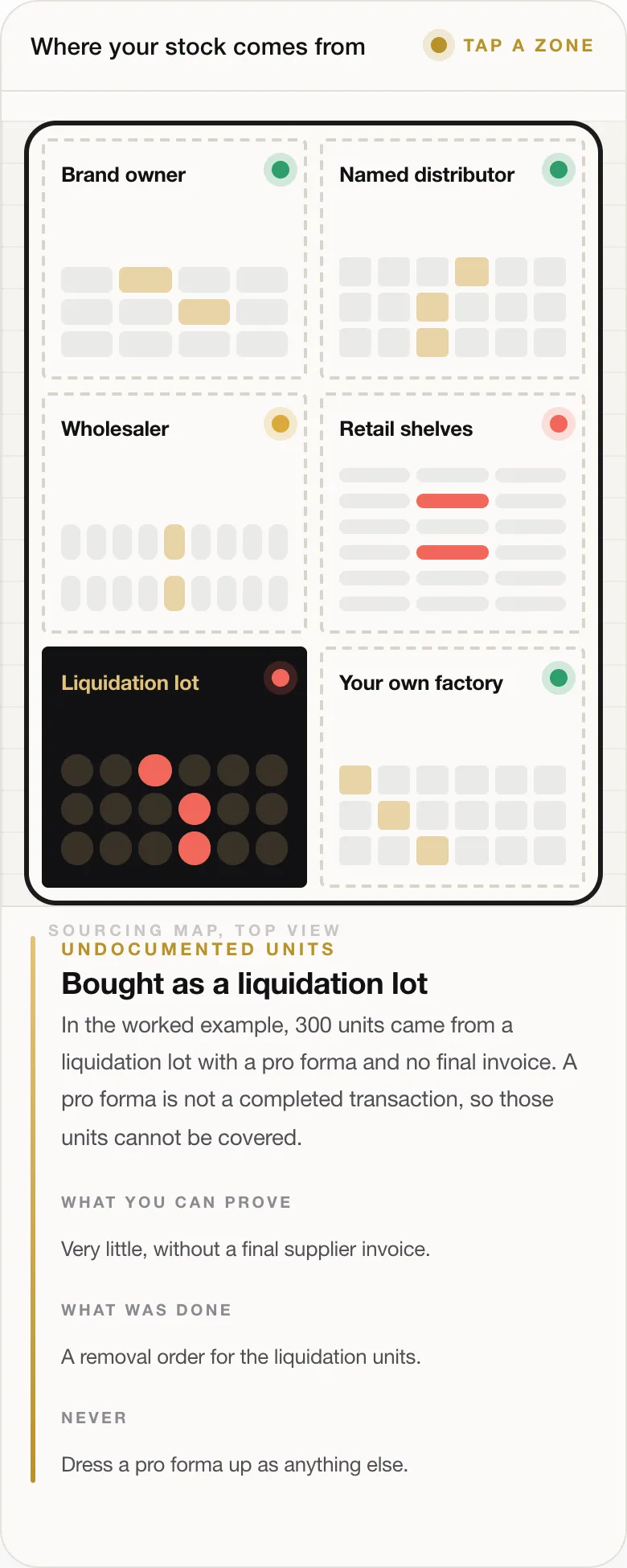
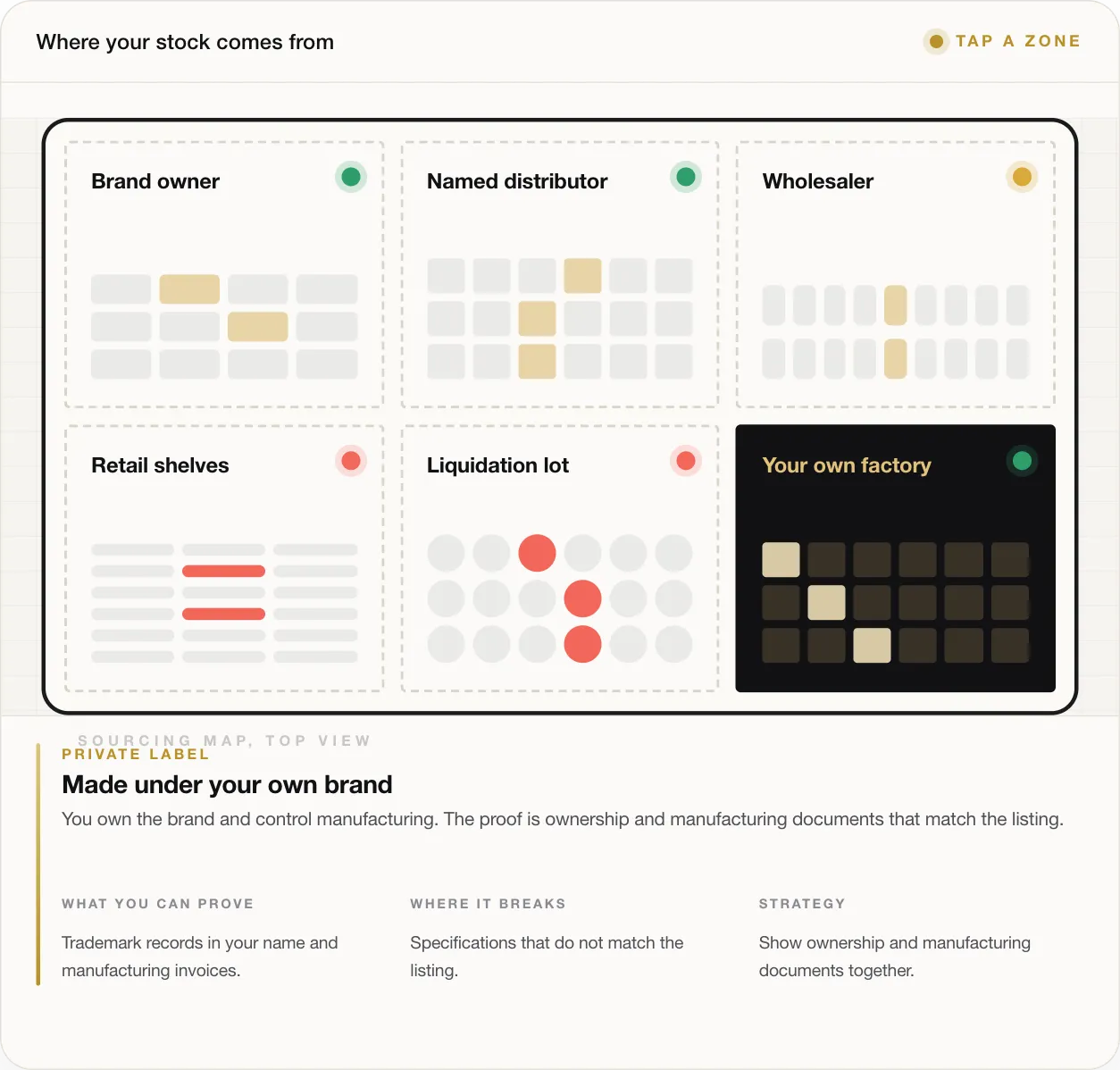
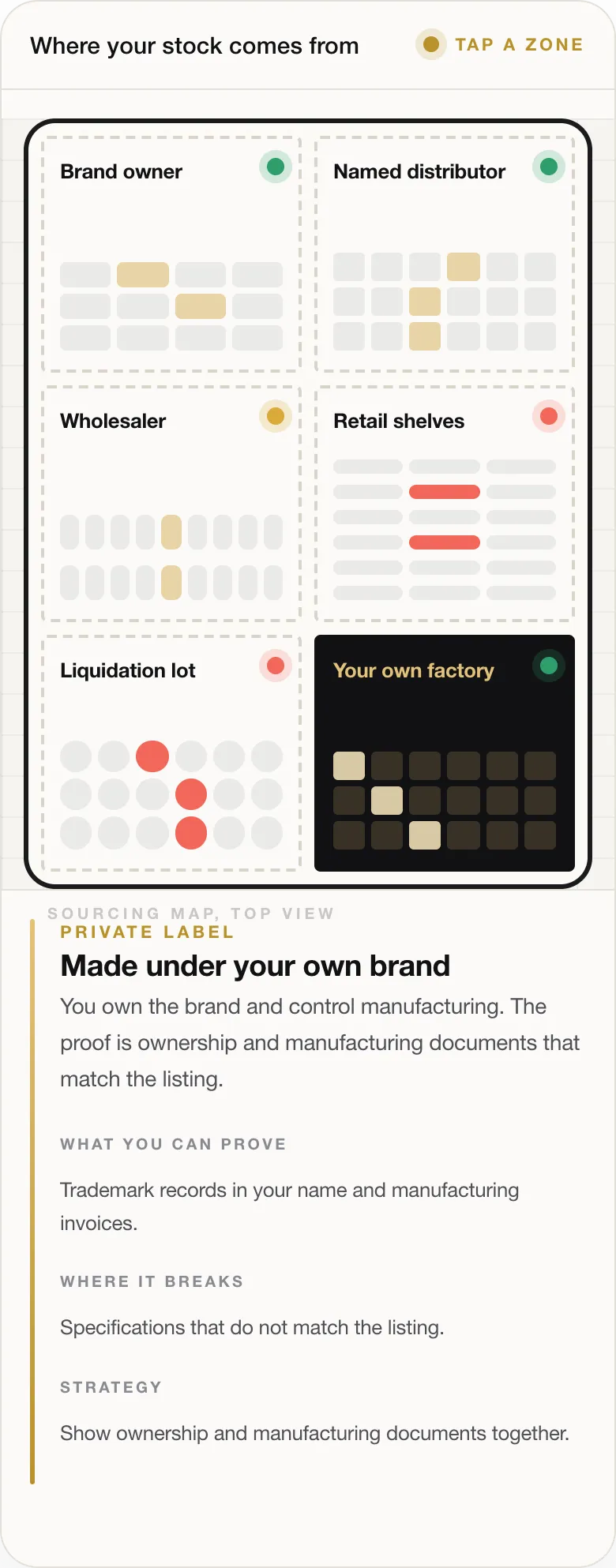
The biggest decision in a supply chain case is not wording. It is whether your sourcing model can produce what Amazon asks for, and no drafting changes that. Sort yourself honestly into one of these models.
Where the stock came from decides what you can prove.
No wording changes what a sourcing model can produce. Tap the place your inventory came from to see what it proves, where it breaks and the honest path forward.
When the model needs to change
“It used to be fine” does not answer the current standard. If your model cannot produce compliant documents, an appeal on it will not hold. The fix is a genuine change in sourcing, documented as it happens. For the brand side of this question, read the dangers of selling unauthorized brands on Amazon.
Building the supply chain evidence file
A strong file lets a reviewer confirm each claim without asking you anything. Build it per ASIN and name files by ASIN, supplier and invoice number.
What goes in the file
- The notification and a dated Account Health screenshot.
- Every qualifying invoice, as the original file the supplier issued.
- A per-ASIN coverage worksheet for your own use: units sold in the window, units in stock, units invoiced, and the gap.
- Proof of payment from your business account matching each invoice.
- The supplier’s state registry screenshot, the USPTO record for the brand, and any brand confirmation or letter of authorization with the brand’s confirming email.
- Receiving records with quantities and shipment IDs.
- Evidence of corrective actions already taken.
Upload only what the appeal form asks for, through Seller Central.
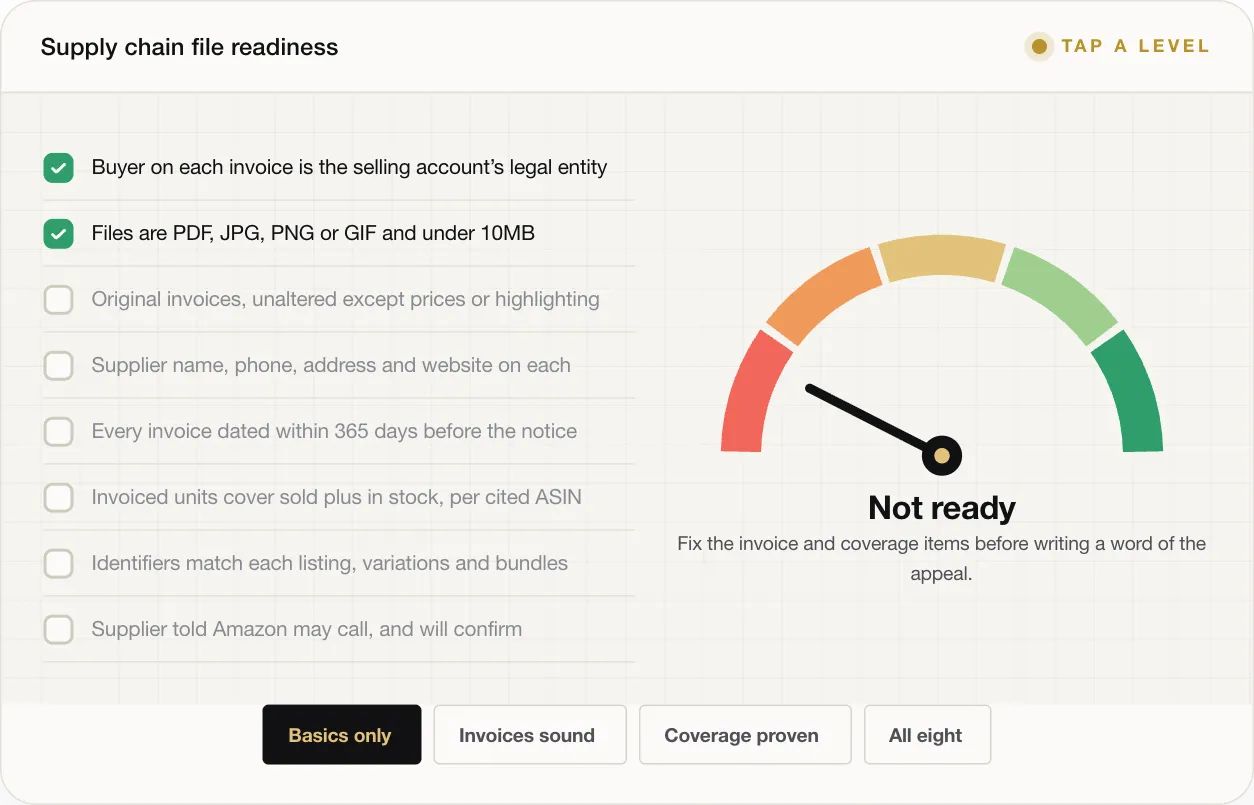
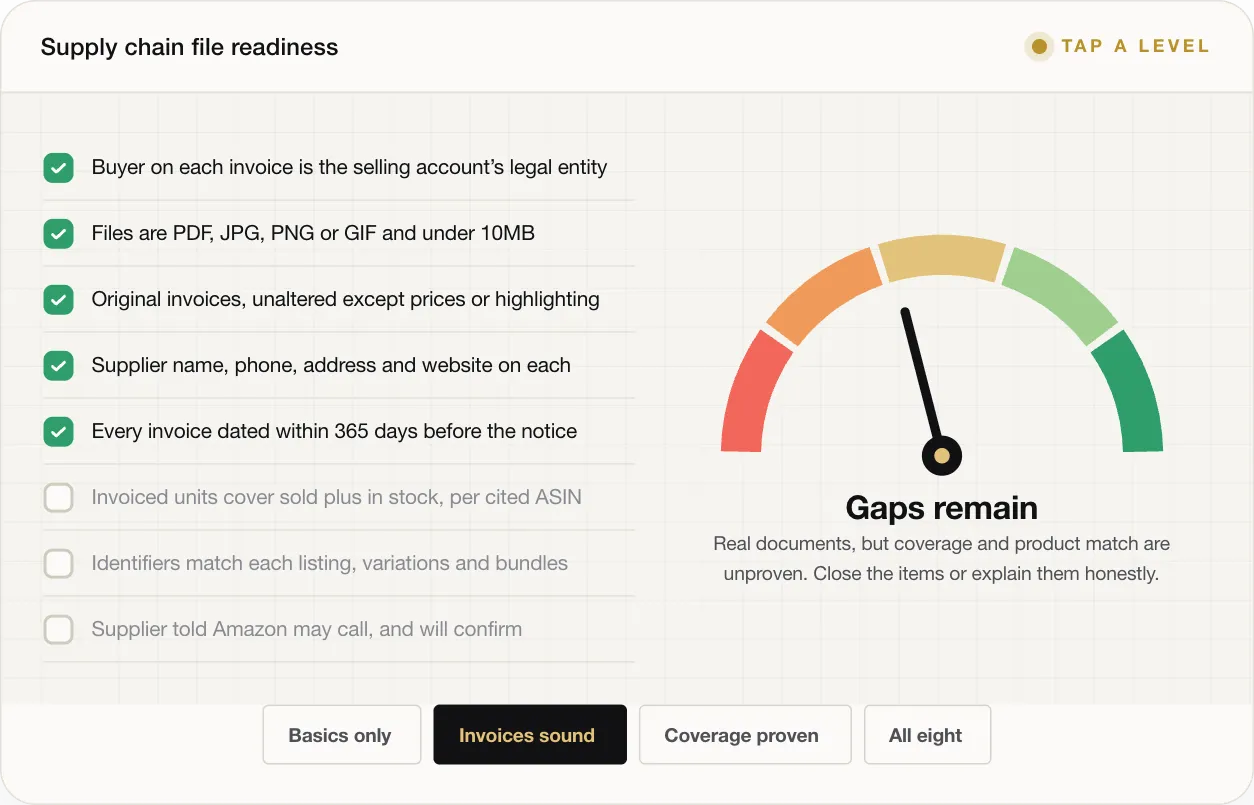
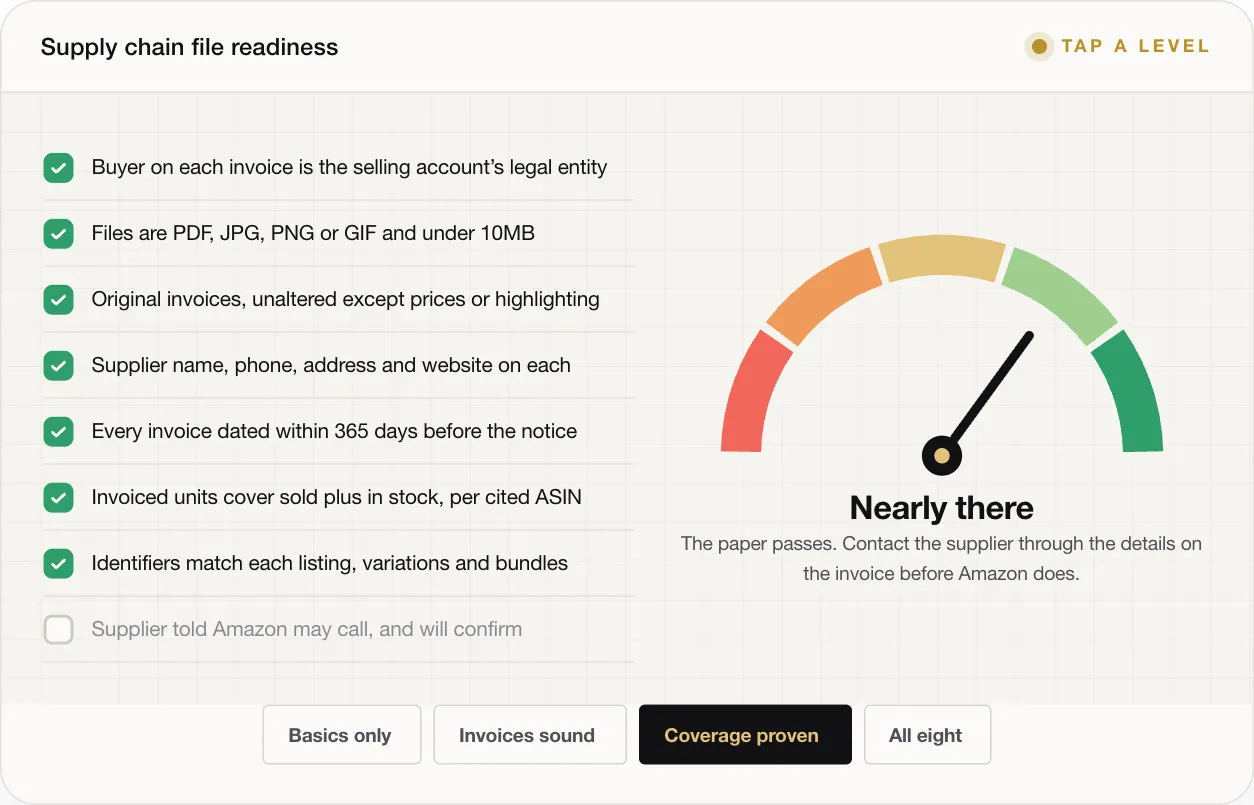
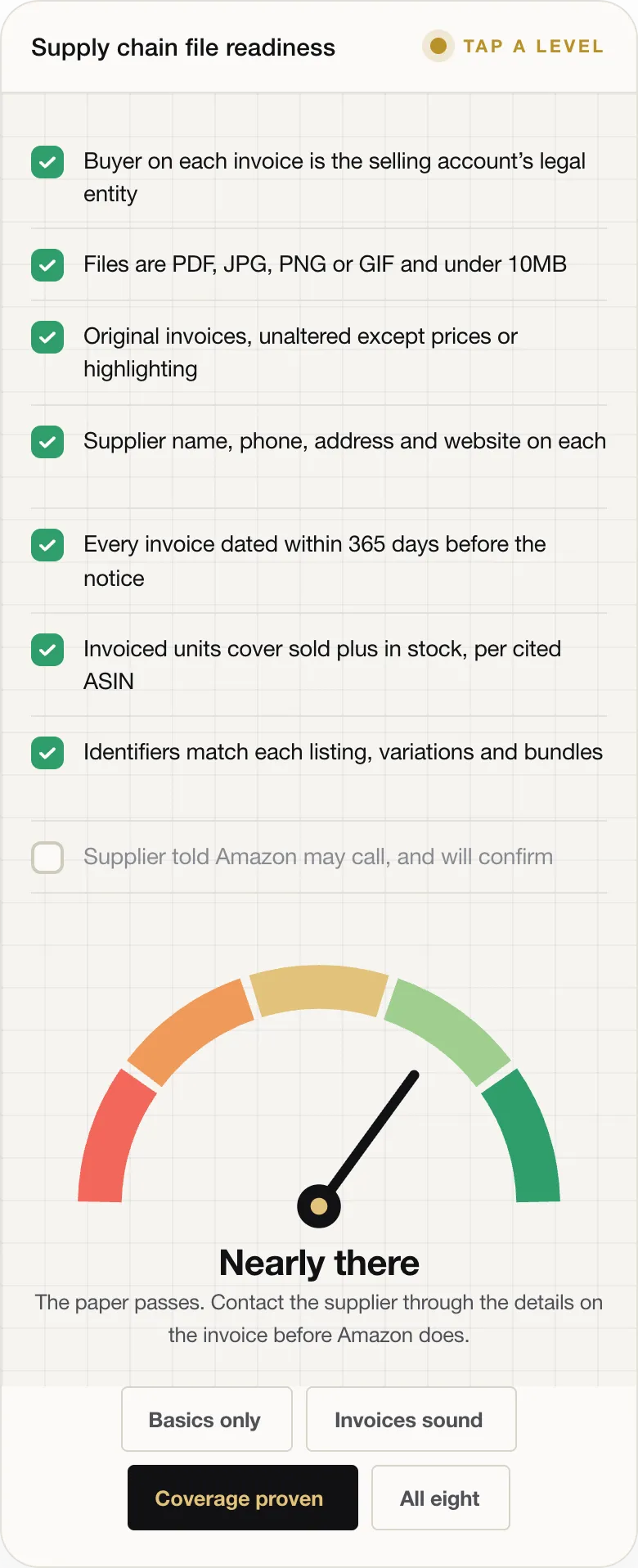
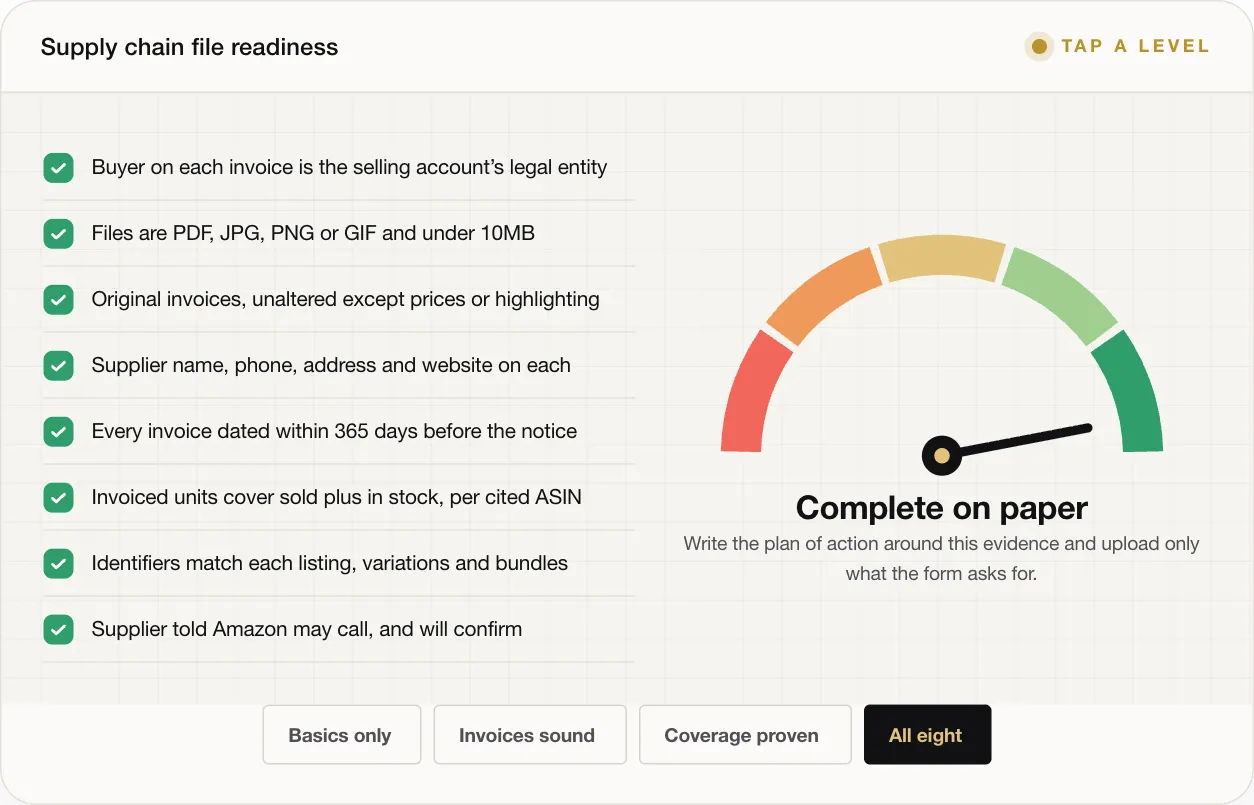
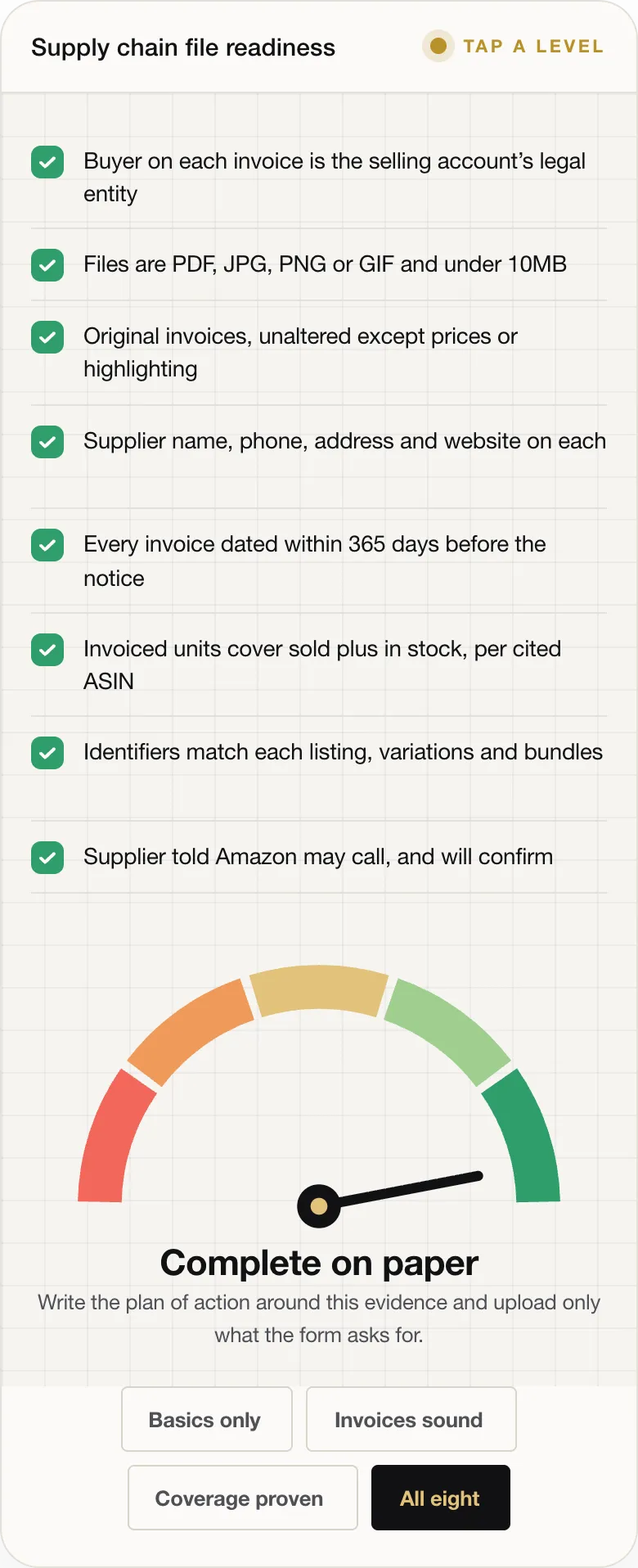
Is your supply chain file ready to submit?
Many rejected appeals fail on arithmetic or matching, not authenticity. Tap a level to see which checks a file at that stage usually has in place and what to do next.
When a supplier will not confirm
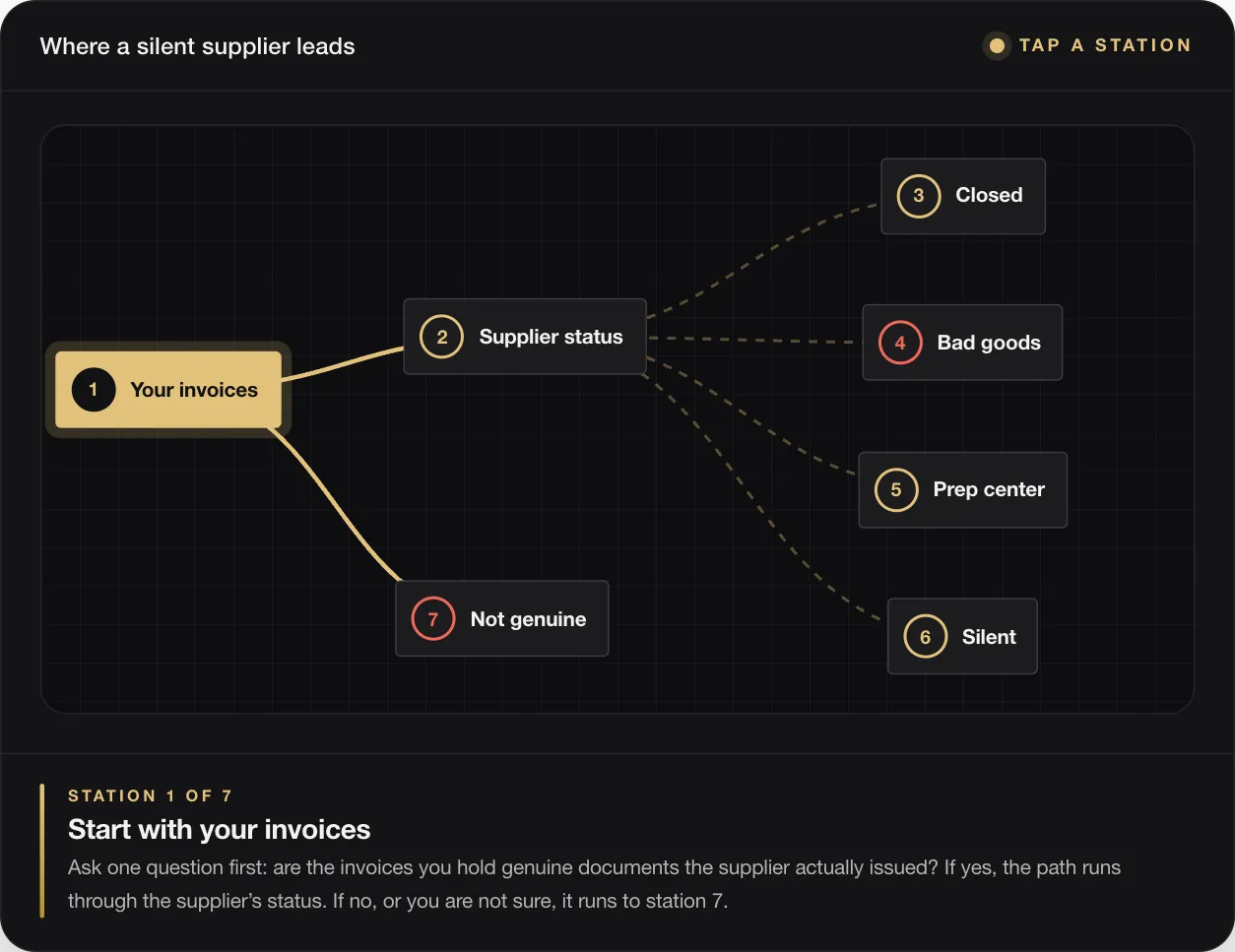
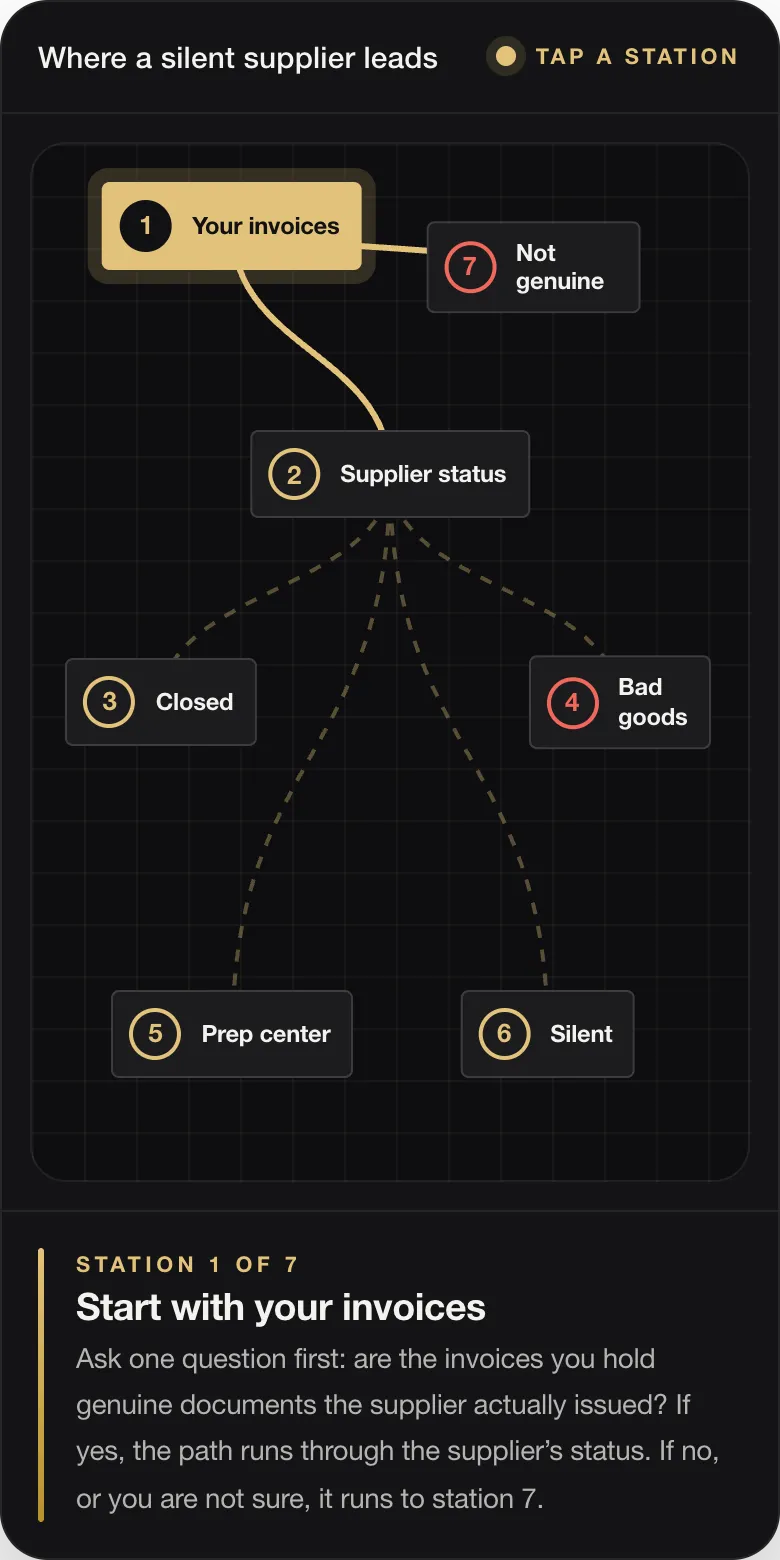
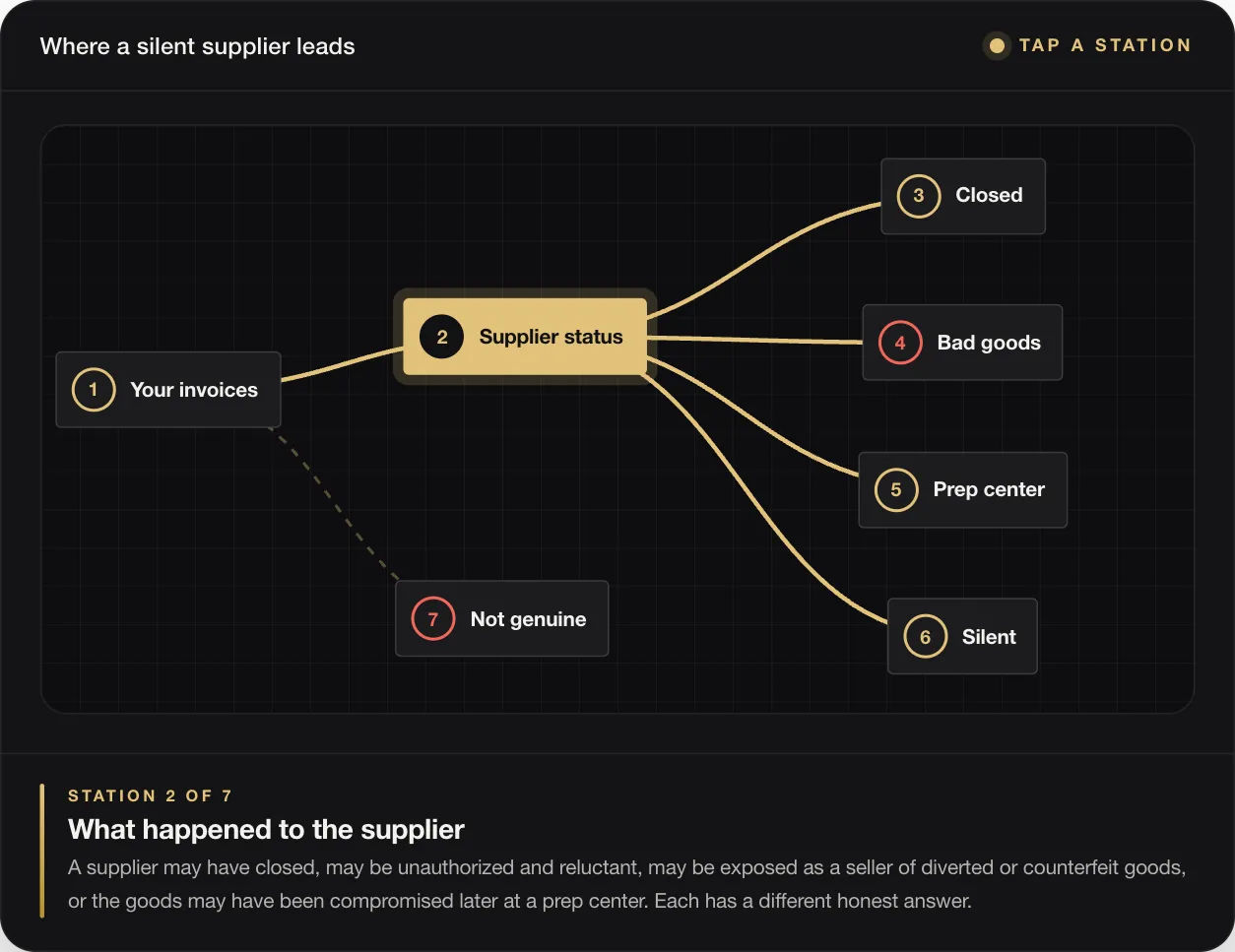
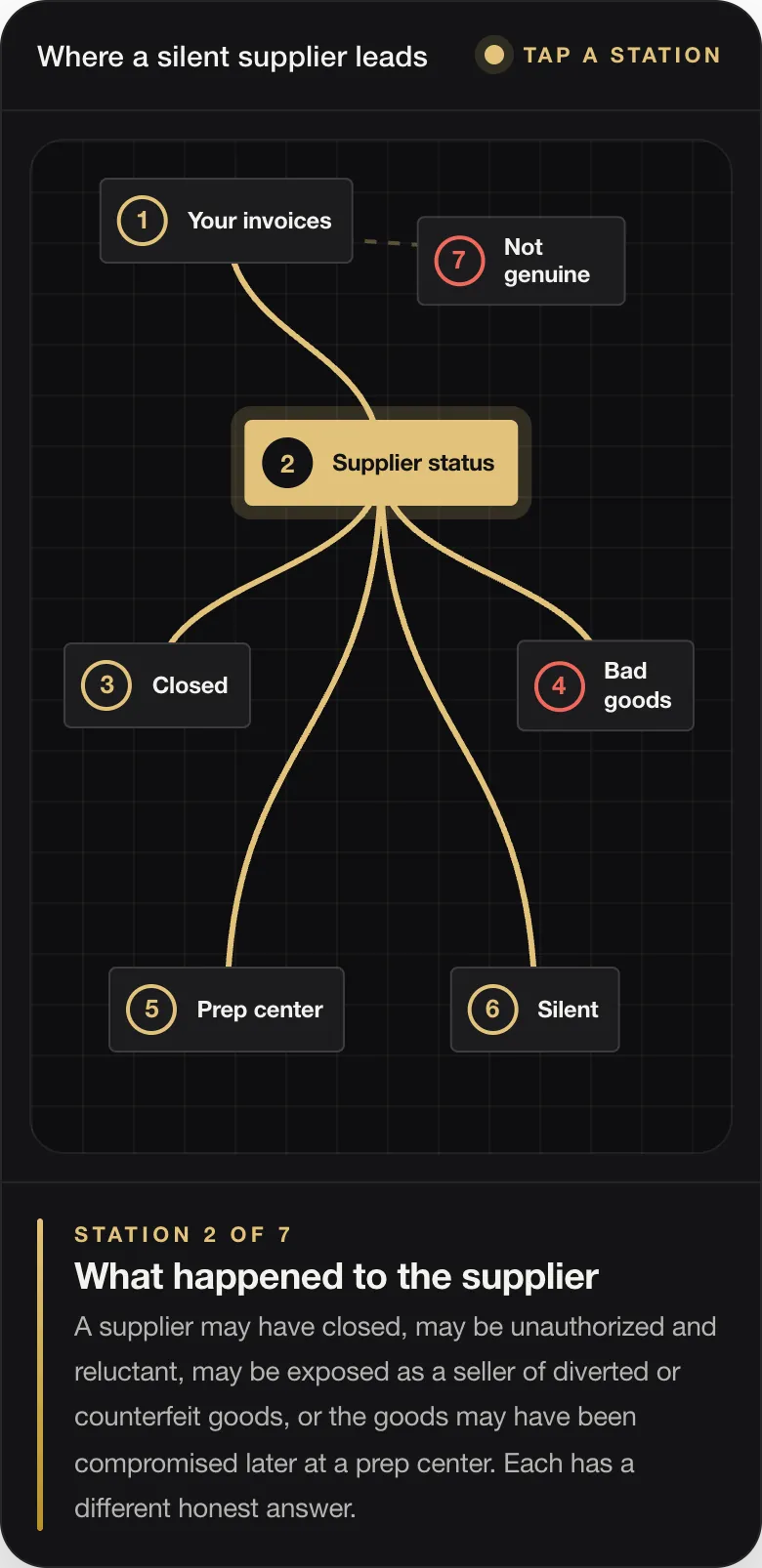
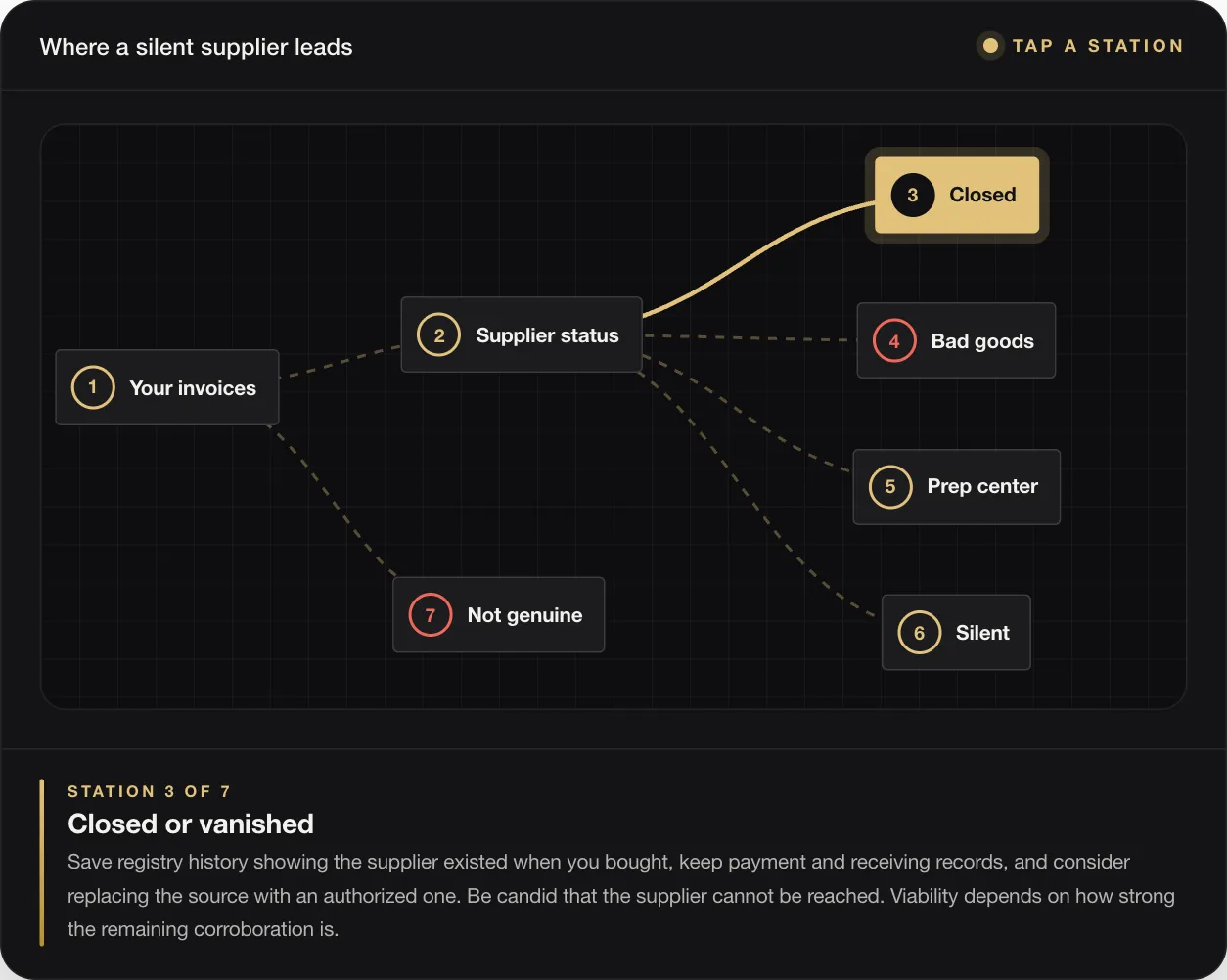
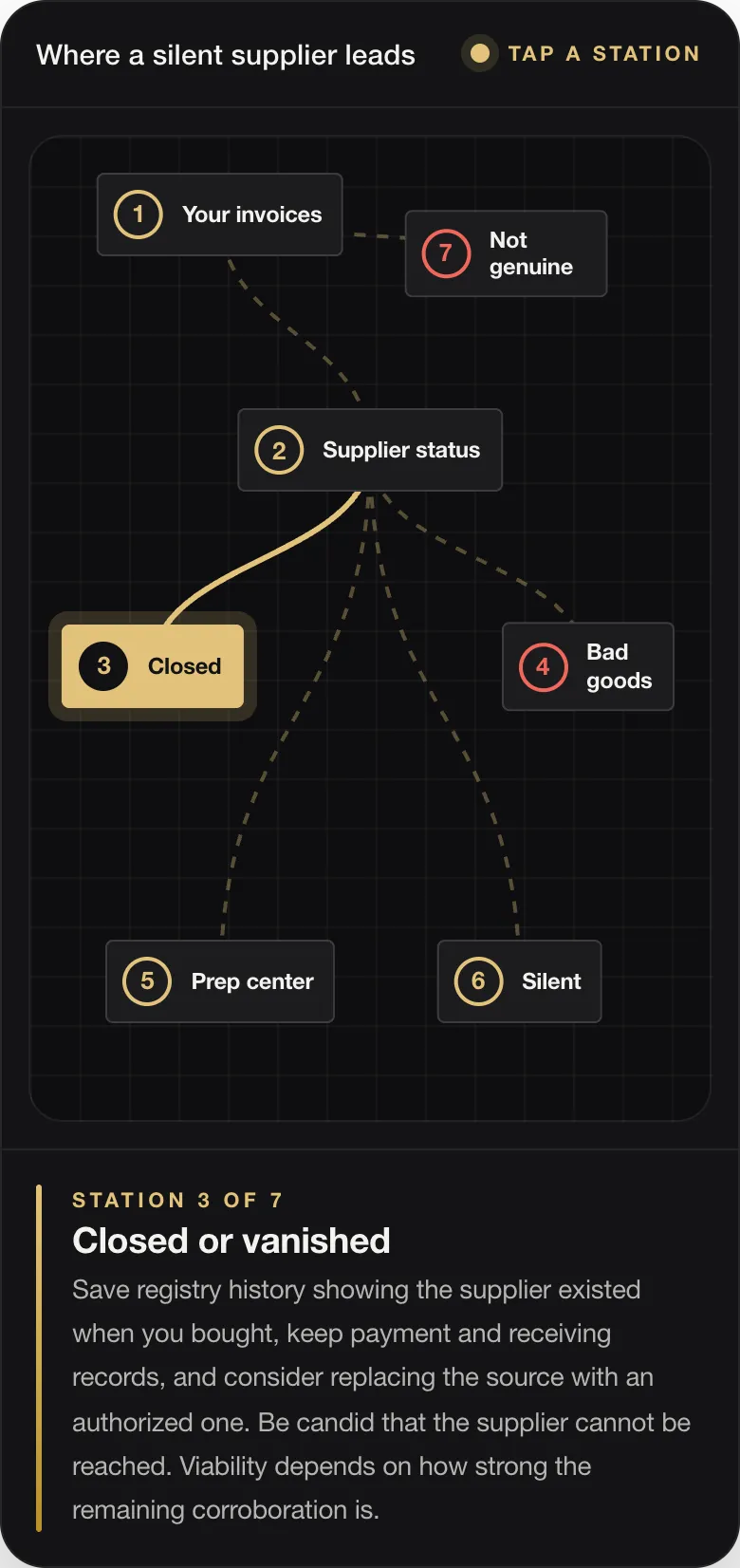
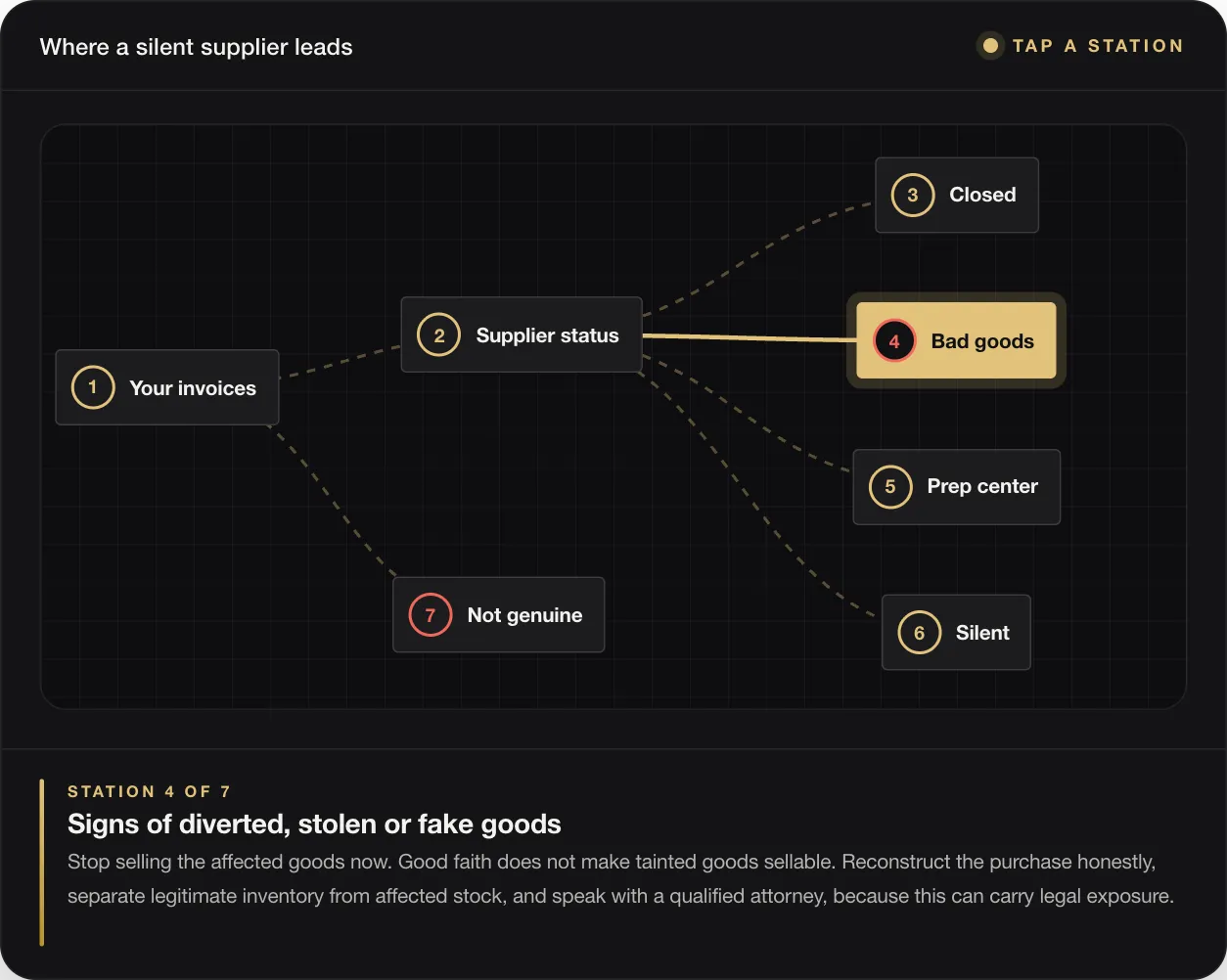
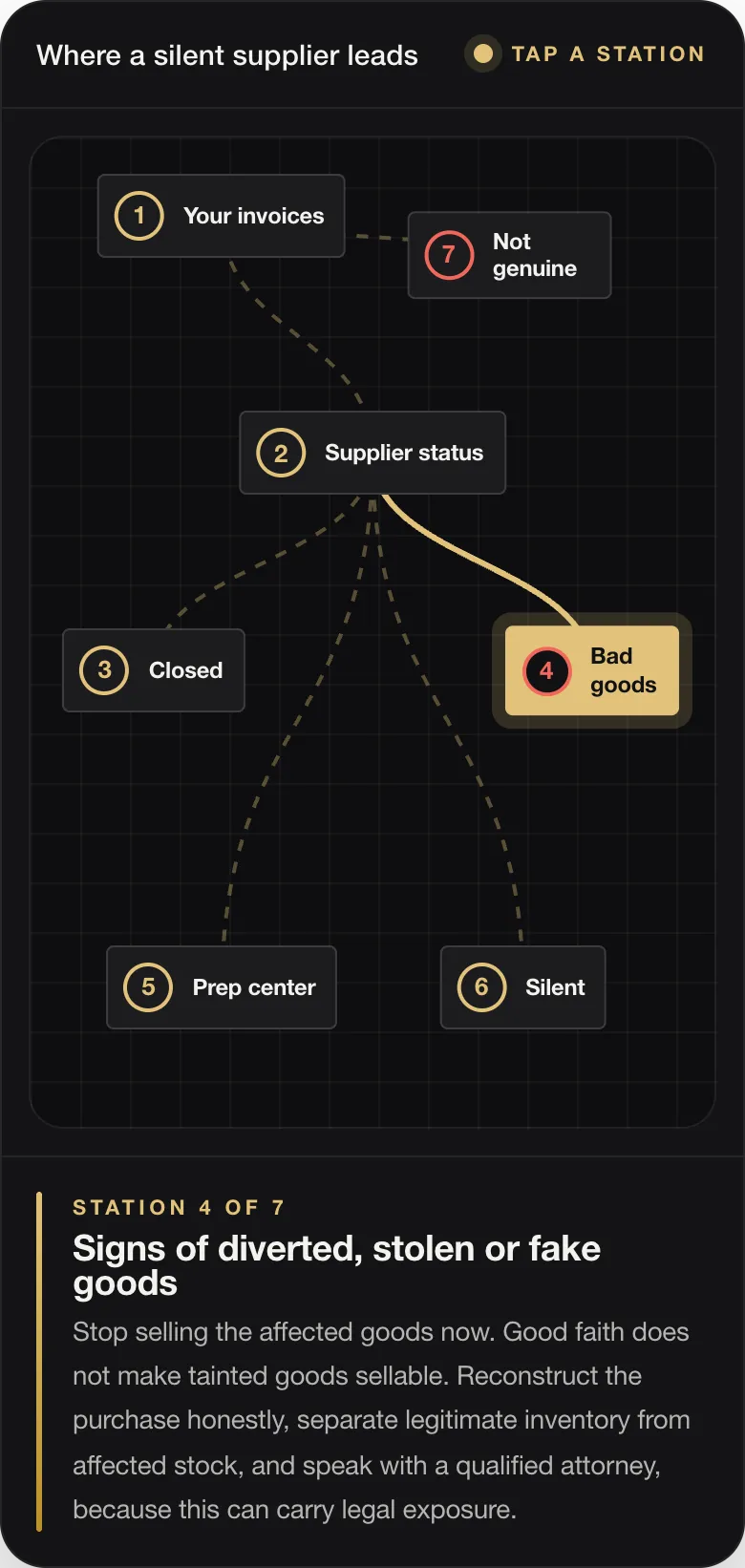
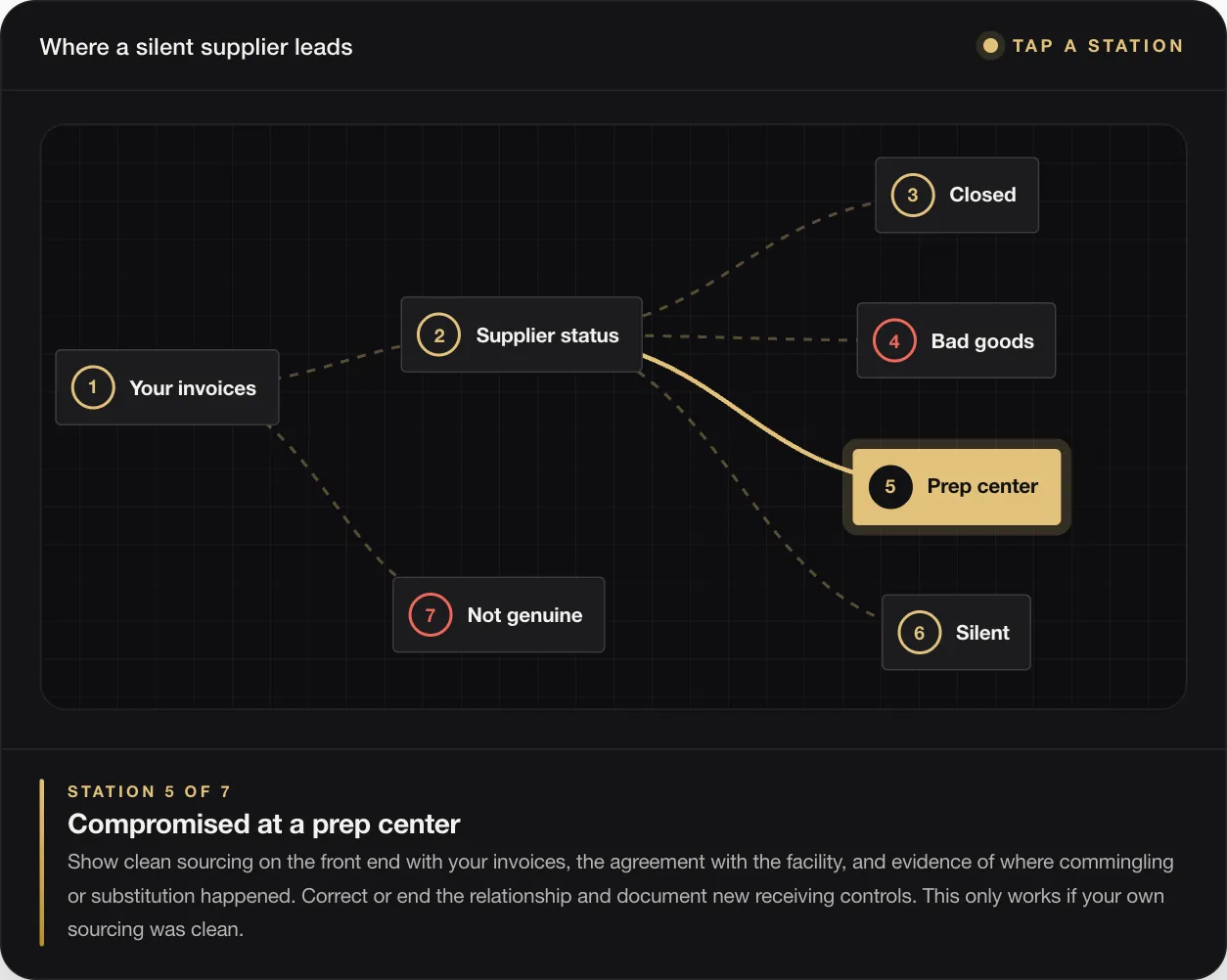
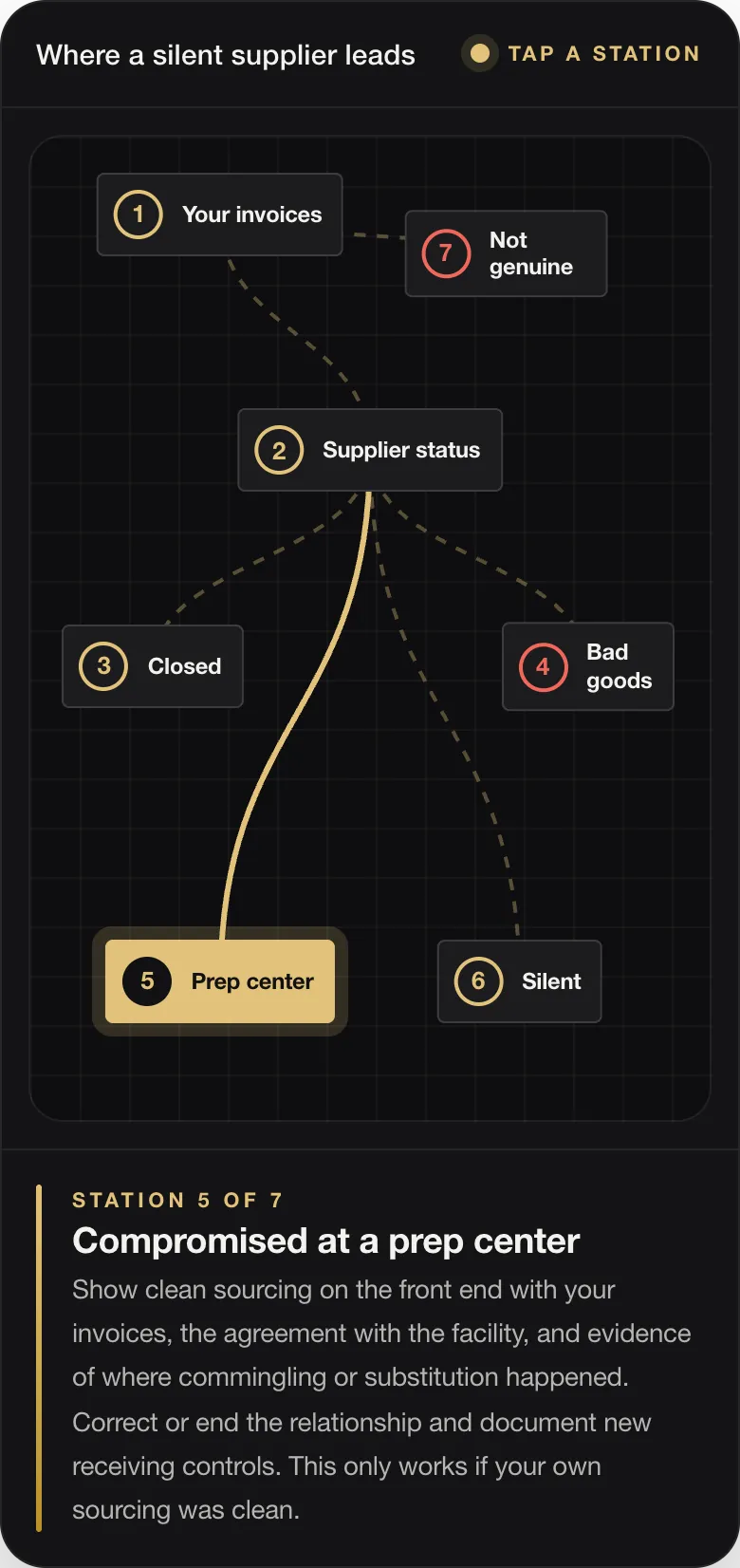
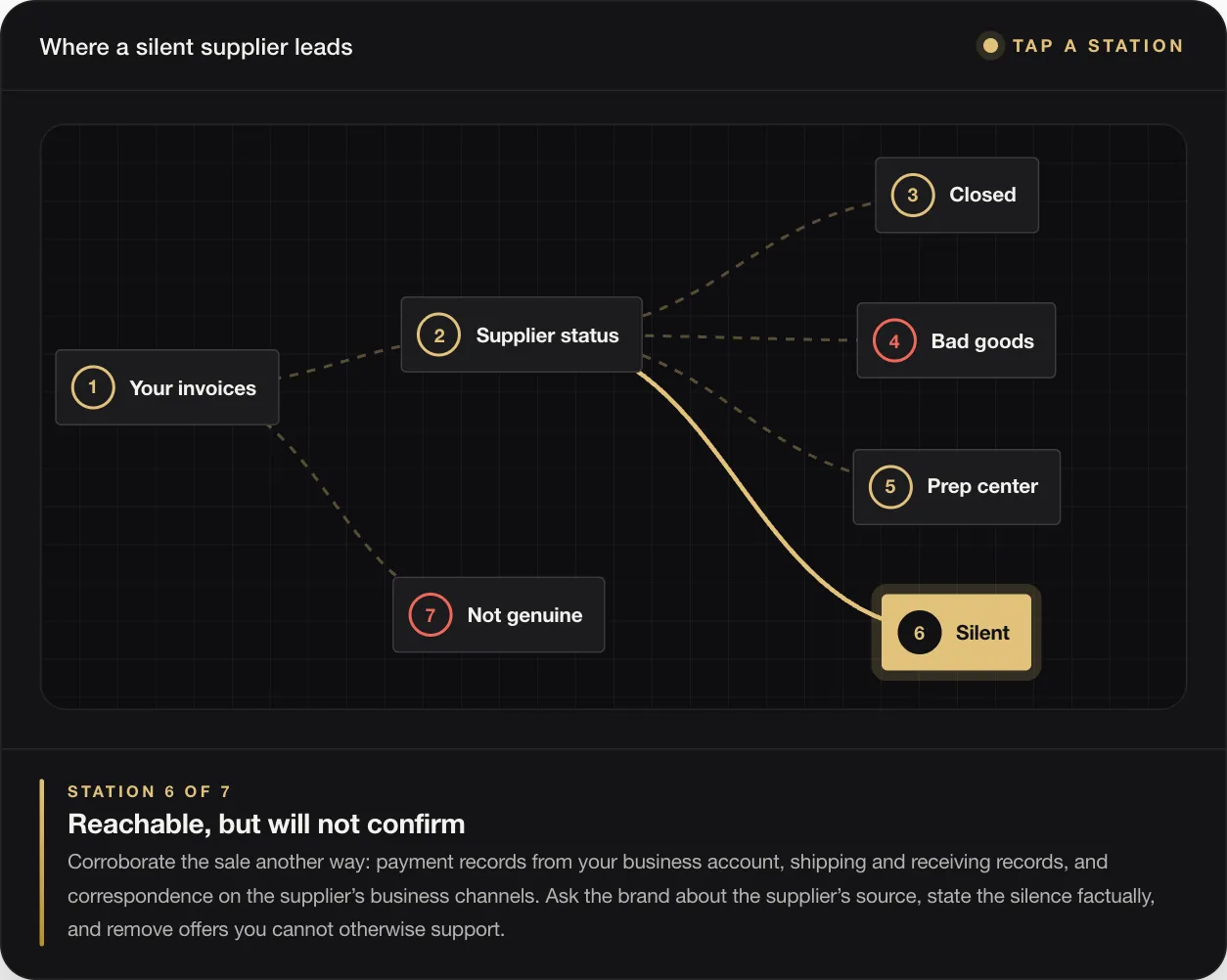
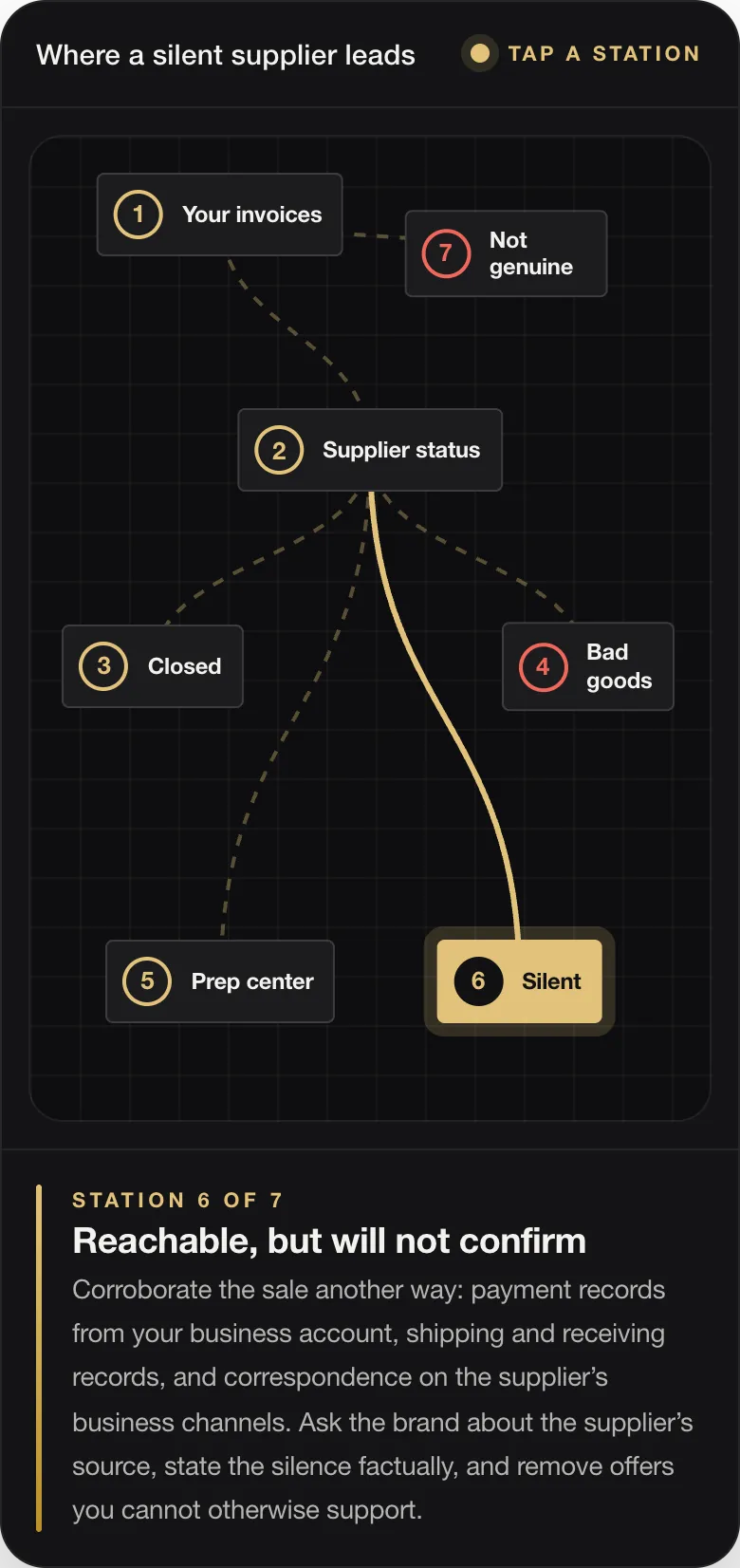
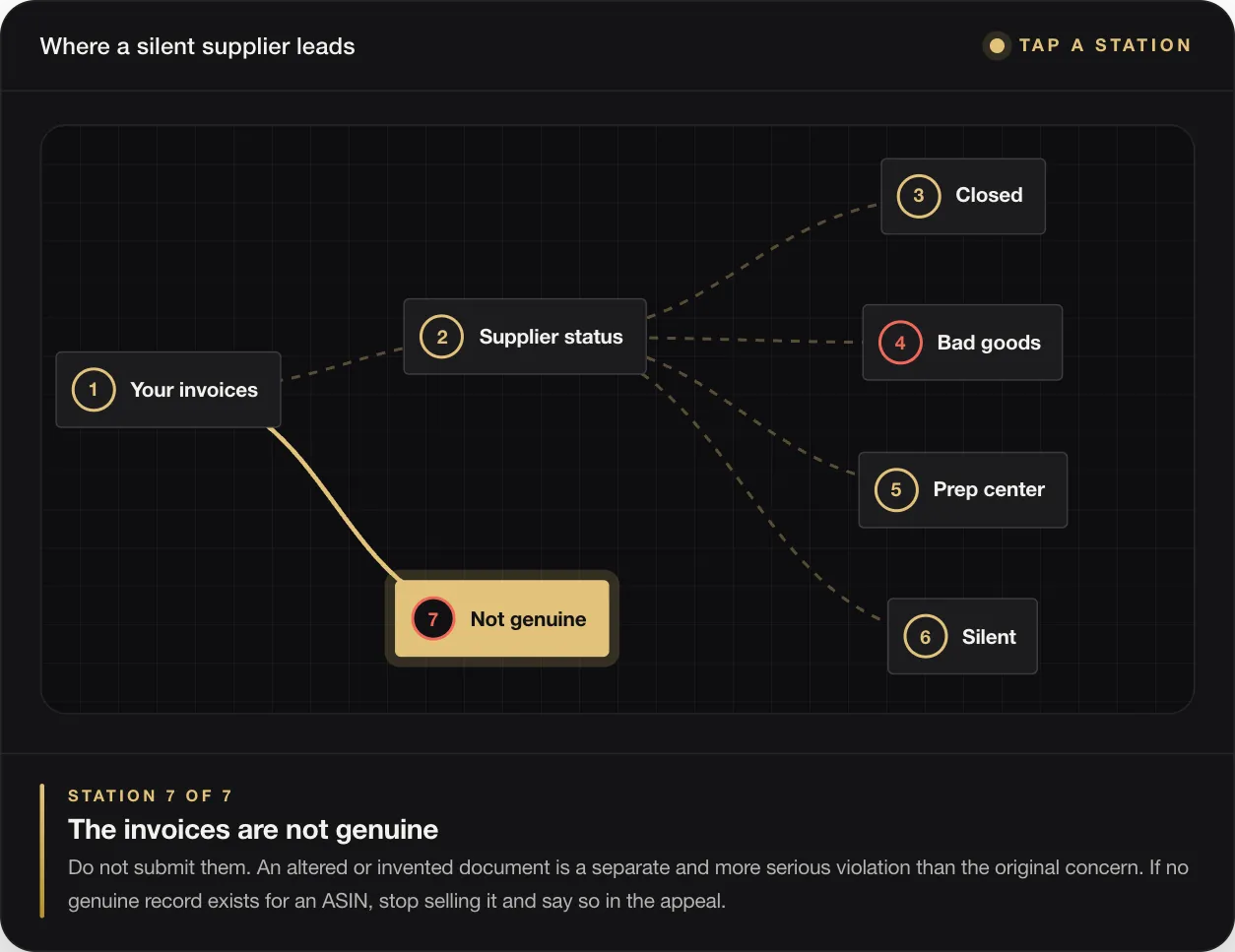
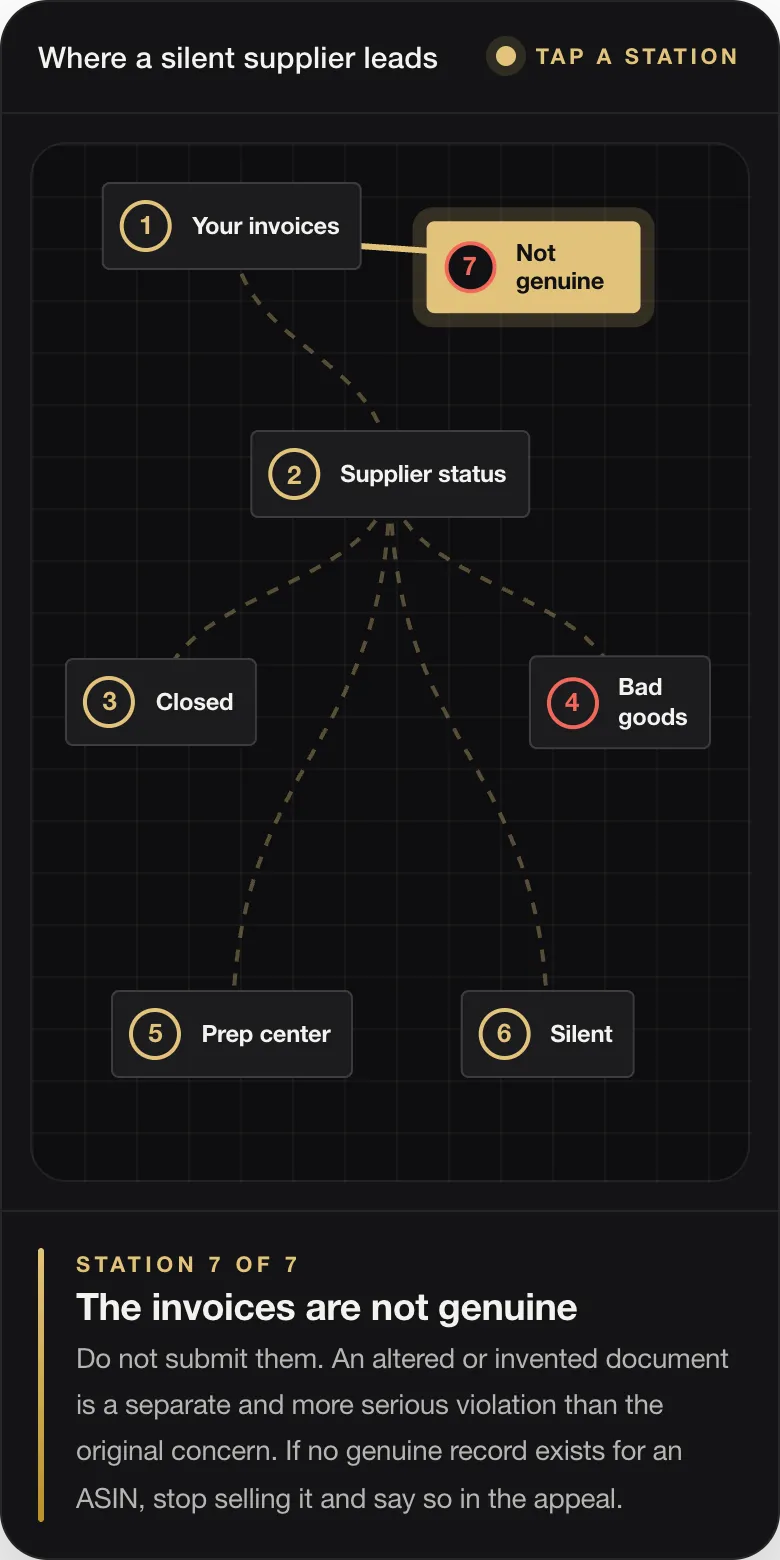
A supplier may have closed, may be unauthorized and reluctant, may be exposed as a seller of diverted or counterfeit goods, or the goods may have been compromised later at a prep center. Each has a different honest answer.
Why a supplier goes quiet decides the honest answer.
Start with your invoices. Whether they are genuine comes first, then what happened to the supplier or the goods. Tap a station to follow the path that matches your case.
If you bought from a supplier who turned out to be a fraud
The deciding question is whether you genuinely did not know. A seller who checked registration, paid a market price and stopped selling the day the problem surfaced differs from one who ignored a price too good to be true. Show the diligence you actually did and what you did when you learned. Good faith explains your conduct, but it does not make counterfeit or stolen inventory sellable.
Not sure your invoices will pass?
Send us the notice and your documents and we will review the file before anything goes to Amazon.
Writing the plan of action for a supply chain case
First, read the appeal form on your Account Health page. Amazon says each violation has its own appeal experience. Amazon’s policy violation appeals FAQ, for example, says a plan of action is not accepted for certain product condition violations, which use selected options and evidence instead. Where your form asks for a written explanation, use this structure. This is educational information, not legal advice.
Root cause: specific, owned, not blamed on anyone
Name the exact failure in plain language. “We made a mistake” is not a root cause. “We bought 600 units of the cited ASIN from a wholesaler we did not verify with the brand, and our invoices from that wholesaler did not list a phone number or website” is. Do not blame buyers, competitors or Amazon; reviewers read blame as a sign the problem will repeat.
Corrective actions already taken, with proof
List what you have already done, with numbers: the offers you closed, the units you removed from inventory, the listings you audited, the supplier you re-verified, the brand you contacted, the customers you refunded. Each should point to evidence.
Preventive controls: owner, checkpoint, date
Name the control, who owns it, when it started, and the checkpoint where it runs. For example: no purchase order is approved until the supplier passes a state registry check, a USPTO owner check and brand confirmation, owned by the purchasing lead, effective on a stated date, with a monthly audit of every new supplier.
Evidence and one clear request
Reference each document where it supports a claim, list only documents you can produce, and end with a single specific request, such as clearing the supply chain review on the cited ASINs. Keep the tone calm and factual.
A worked example
Hypothetical case: a seller receives a notice on three ASINs from one kitchenware brand. Their sales records show 1,050 units sold and 150 in stock across the three ASINs in the window, so 1,200 units need coverage. Invoices from Distributor A cover 900 units and pass every test. The remaining 300 units came from a liquidation lot with a pro forma and no final invoice. Distributor A is active in its state registry and the brand confirms it is authorized.
The root cause: undocumented liquidation units were mixed into ASINs otherwise supplied by an authorized distributor, with no purchase approval check. Corrective actions: a removal order for the liquidation units and an audit of other brands. Preventive control: a named owner approves every supplier, and no units ship to Amazon without a final invoice on file. The pro forma is not dressed up as anything else.
For more on how reviewers read authenticity complaints and how the response differs, see inauthentic versus counterfeit complaints.
Mistakes that sink supply chain appeals
Most rejected appeals come from making a file look complete instead of making it true.
A sourcing routine that keeps you out of this situation
Reviews are easier to survive when the evidence already exists.
Before the first order
Run the registry, USPTO and brand checks, save dated screenshots, and confirm the supplier’s invoices will show every element Amazon lists.
On every order
Pay from the business account, file the final invoice, log receiving, and ship nothing to Amazon without a final invoice.
Every month
For your top ASINs, compare units invoiced in the last 365 days with units sold plus units in stock, the same arithmetic Amazon uses. Review Account Health for new violations. If coverage slips below 100 percent, fix it while there is no notice.
Every year
Re-confirm brand authorizations, retire suppliers who will not keep paperwork to standard, and re-read Amazon’s invoice and due diligence pages. Our broader guide to acting on Amazon’s anti-counterfeiting policy covers the brand side of this routine.
Frequently Asked Questions
What is an Amazon supply chain check?
It is Amazon asking you to prove where specific products came from, usually through supplier invoices and sometimes a letter of authorization. Amazon’s Anti-Counterfeiting policy says sellers must provide authenticity records when Amazon requests them.
How old can my invoices be?
Amazon’s invoice requirements page asks for an issue date within the past 365 days before you received the performance notification. Older invoices may be real but will not satisfy that requirement on their own.
How many units do my invoices need to cover?
Enough to cover your sales volume and your in-stock inventory for each cited ASIN over the past 365 days. Add units sold in that window to units in stock and compare against invoiced units, ASIN by ASIN.
Will Amazon contact my supplier?
It may. Amazon says it might reach out to the supplier to verify document information and that it keeps supplier information confidential, so make sure the supplier expects the call and will confirm genuine transactions.
Can I remove prices from my invoices?
Yes. Amazon allows you to remove pricing information, but all other details must remain visible, and any other edit is treated as a policy violation.
Are retail receipts accepted?
Amazon’s invoice standard describes a supplier-issued record of a completed transaction with full supplier contact details. A retail receipt generally does not show a supply relationship, which is why arbitrage sourcing struggles in these cases.
How do I check whether a supplier is a real company?
Use the nass.org corporate registration directory to reach the state business entity search for the supplier’s state, and confirm the exact legal name, active status and formation date. Then verify their physical presence and web presence as Amazon’s due diligence page suggests.
What if my supplier will not confirm the sale?
Corroborate the transaction honestly through payment, shipping and receiving records, explain the situation factually, and stop selling anything you cannot document. Never create or alter a document to fill the gap.
Get Help With an Amazon Supply Chain Check
If you have a supply chain notice and are not sure your invoices will pass, our team can review your notice and documents before anything goes to Amazon. You can submit your case for review or book a consultation to talk it through. Learn more about our Amazon suspension appeal service.
This article is educational information about Amazon’s published policies and general sourcing practice. It is not legal advice, and it does not guarantee any outcome or timeline. Amazon’s policies change; confirm current requirements on Seller Central before acting, and consult a qualified attorney where legal exposure is involved.
Sources
- Amazon Seller Central: Invoice requirements for appealing a policy violation
- Amazon Seller Central: Select reliable suppliers with due diligence
- Amazon Seller Central: Amazon Anti-Counterfeiting policy
- Amazon Seller Central: Policy violation appeals FAQ
- Amazon Seller Central: Account Health Rating program policy
- Amazon Seller Central: Selling policies and seller code of conduct
- USPTO Trademark Search
- USPTO: Search our trademark database
- National Association of Secretaries of State: Corporate registration directory
