
Quick answer: A plan of action (POA) that gets acted on is a short, specific case record, not an apology. It answers the exact violation in your notice, names an honest root cause the business controls, lists corrective actions you have already completed with dated proof, and sets preventive controls that each have an owner, a start date, a scope and a way to prove they run. Every claim points to an exhibit a reviewer can check. Before writing, confirm Amazon actually asked for a POA: for product condition violations Amazon says it will not accept one. Investigate first, write last, run a readiness check, and if you are denied, diagnose what was missing before you submit anything again.
Most sellers write their first plan of action within hours of the notice, from memory. The result usually reads the same way: an apology, a promise to be more careful, a mention of years of good history, and a request for reinstatement. That letter tells a reviewer nothing about whether the risk is understood or contained. Each denial then joins the account record, and resending the same letter with new adjectives makes the file look worse with every attempt.
This guide teaches the method our team uses: read the notice precisely, investigate before writing, separate the trigger from the true cause, prove every claim, check readiness, and respond to a denial with diagnosis rather than repetition. It includes a worked hypothetical and a checklist you can score your own draft against. For the wider appeal process, see our guide to the right way to appeal an Amazon suspension.
What a plan of action is, and when Amazon does not want one
A plan of action shows three things: the root cause of what happened, the corrective actions already taken, and the preventive measures that stop it recurring. Amazon’s Policy violation appeals FAQ uses the same logic, asking sellers to identify the root cause, identify the corrections made, and provide supporting evidence of preventive or corrective actions such as updated training materials, packaging or quality checks.
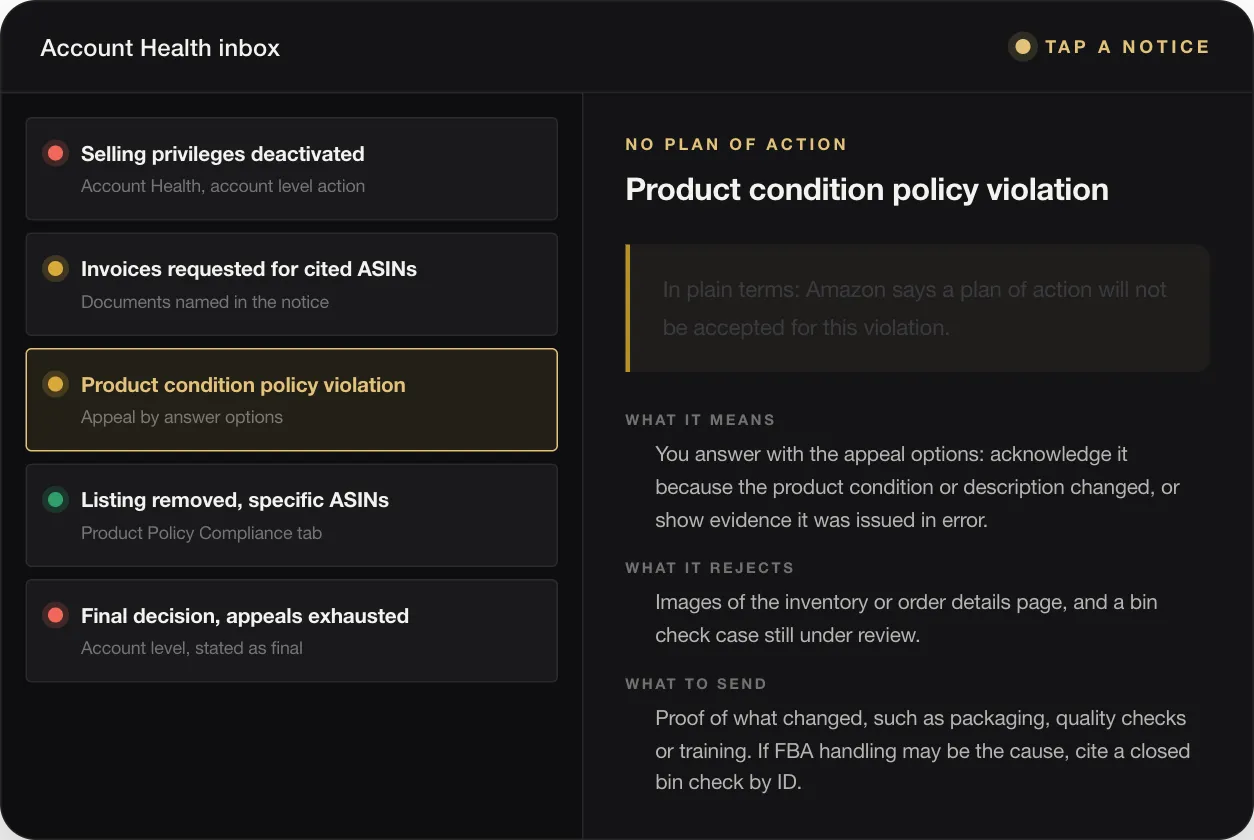
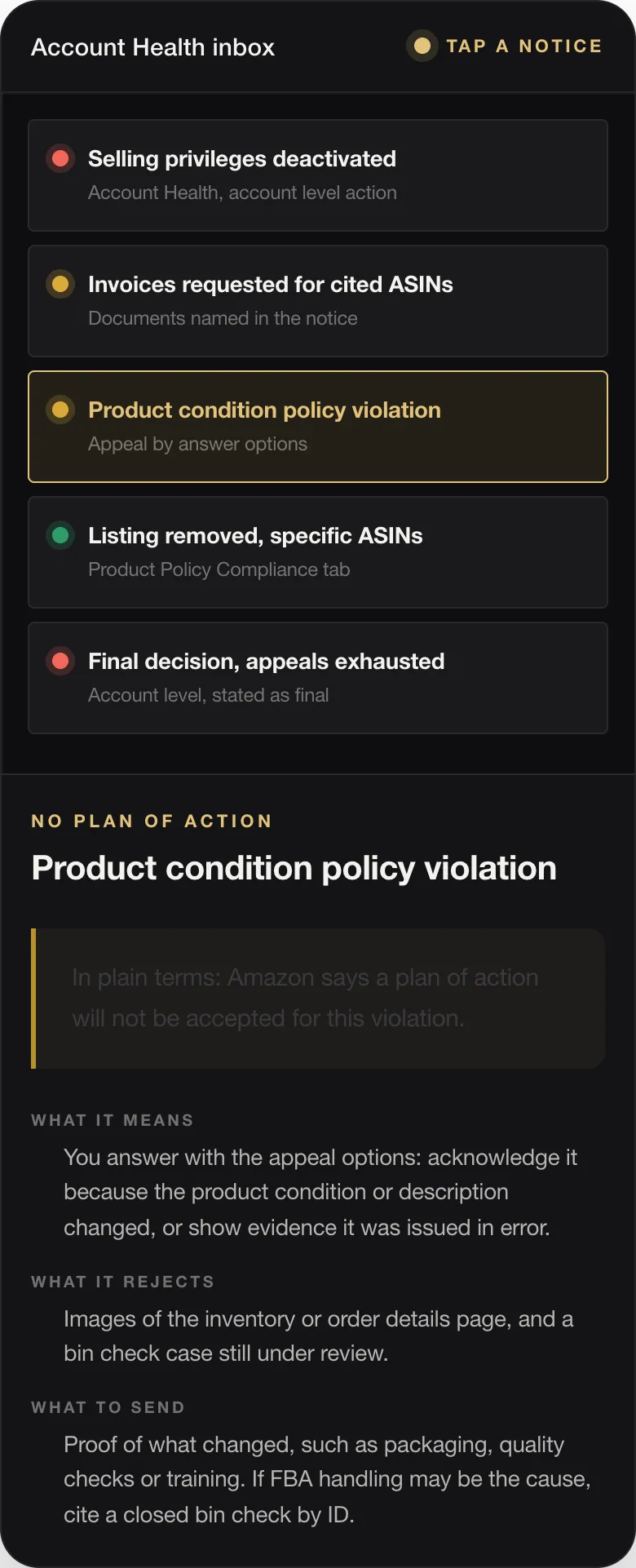
The first trap is assuming every notice wants a POA. The same FAQ says that for product condition policy violations, a plan of action will not be accepted. Those appeals use answer options: acknowledge the violation because you have changed the product condition or description, or state that you have evidence the violation was issued in error and attach it. Amazon also says it will not accept images of the inventory or order details page as evidence, or a bin check case still under review.
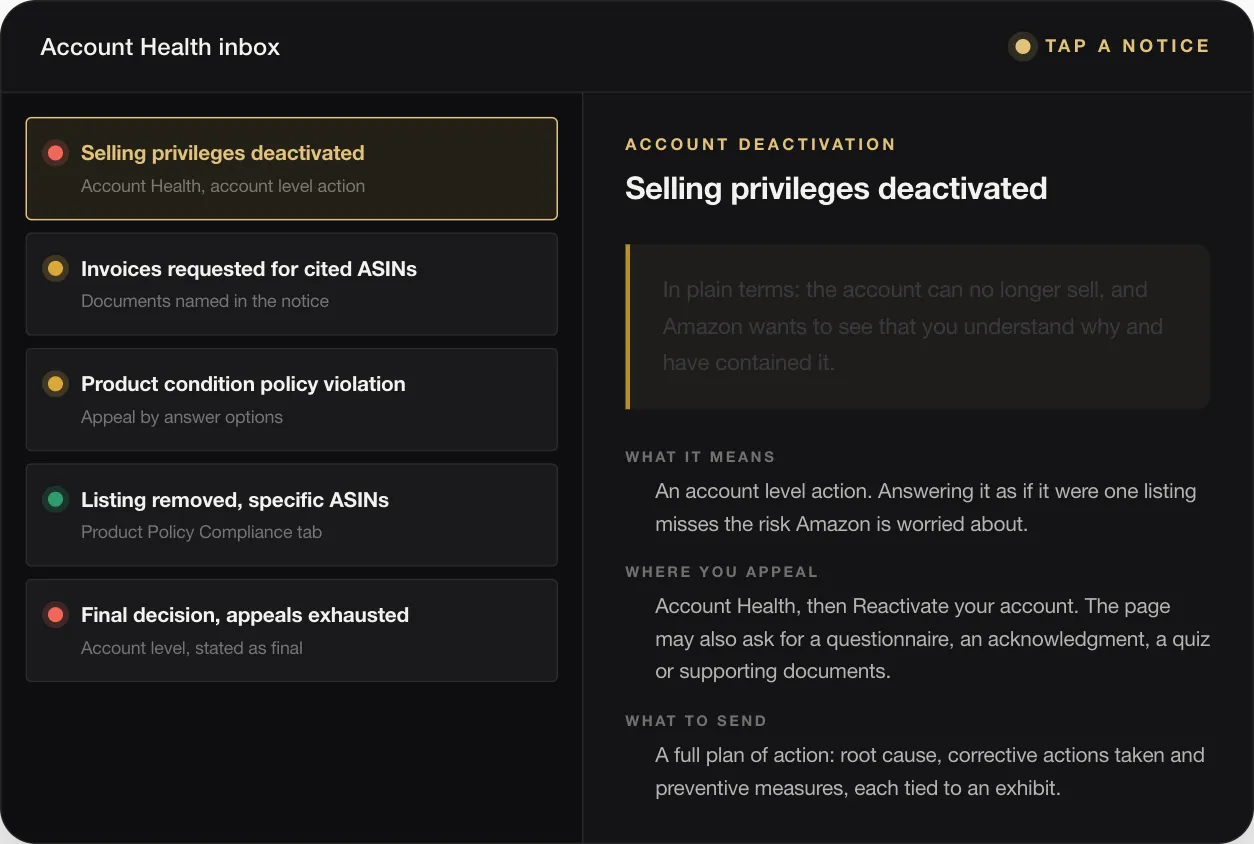
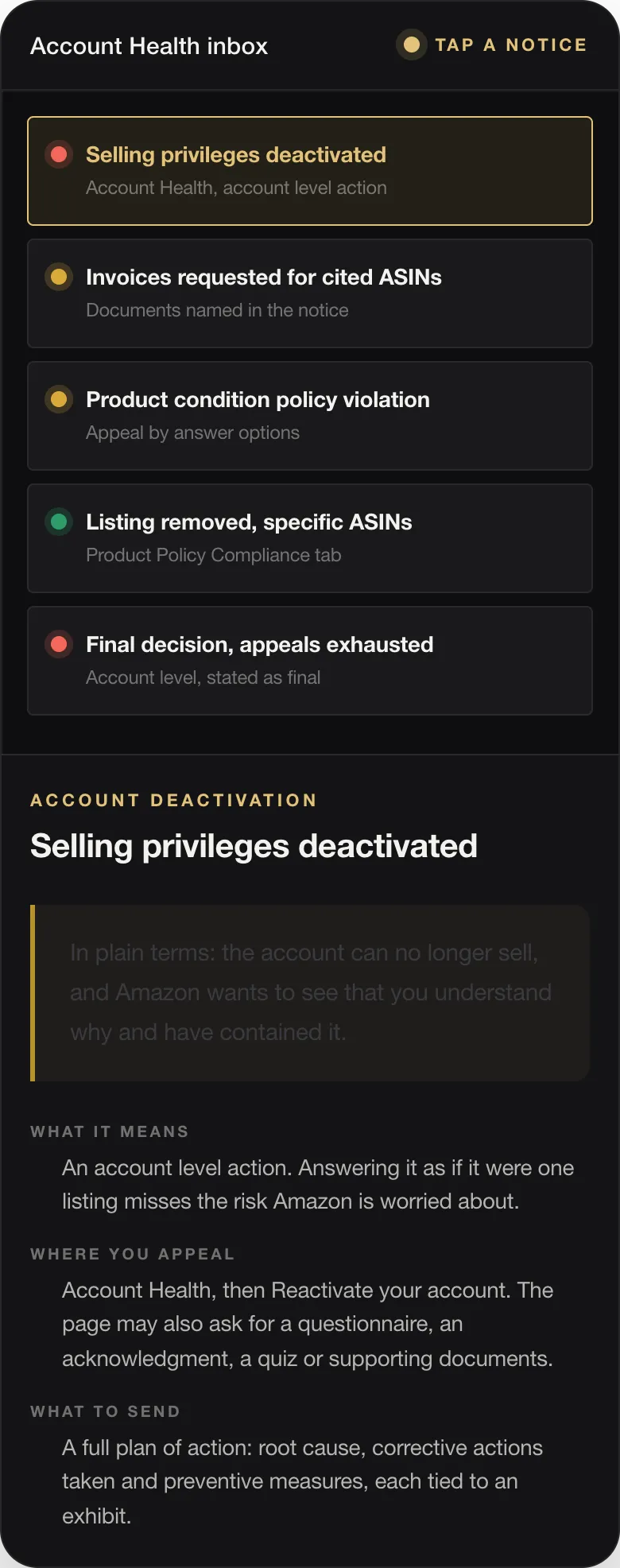
Amazon’s page on appealing an account deactivation or listing removal says to go to Account Health, select Reactivate your account, and follow the on-page instructions, which may ask for a questionnaire, an acknowledgment, a quiz or supporting documents. The format of your response is set by the notice and the appeal page, not by habit.
Listing actions versus account actions
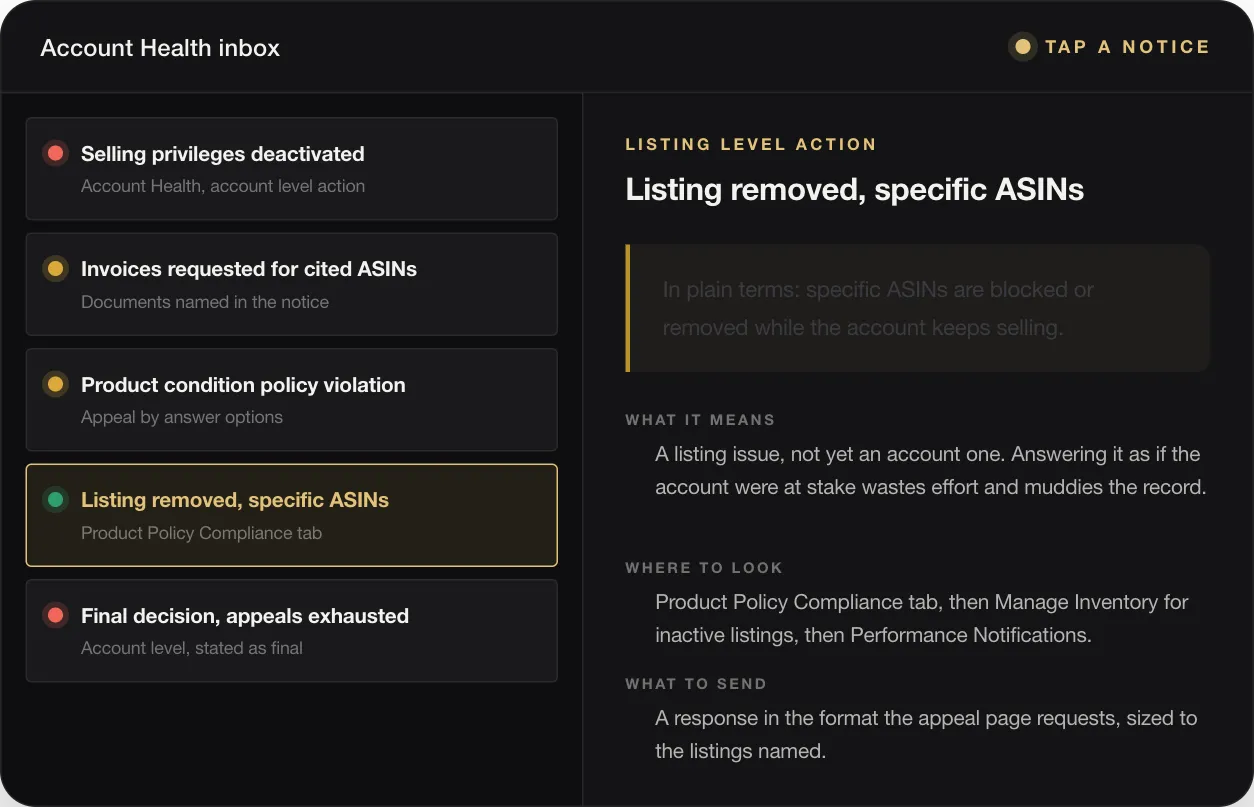
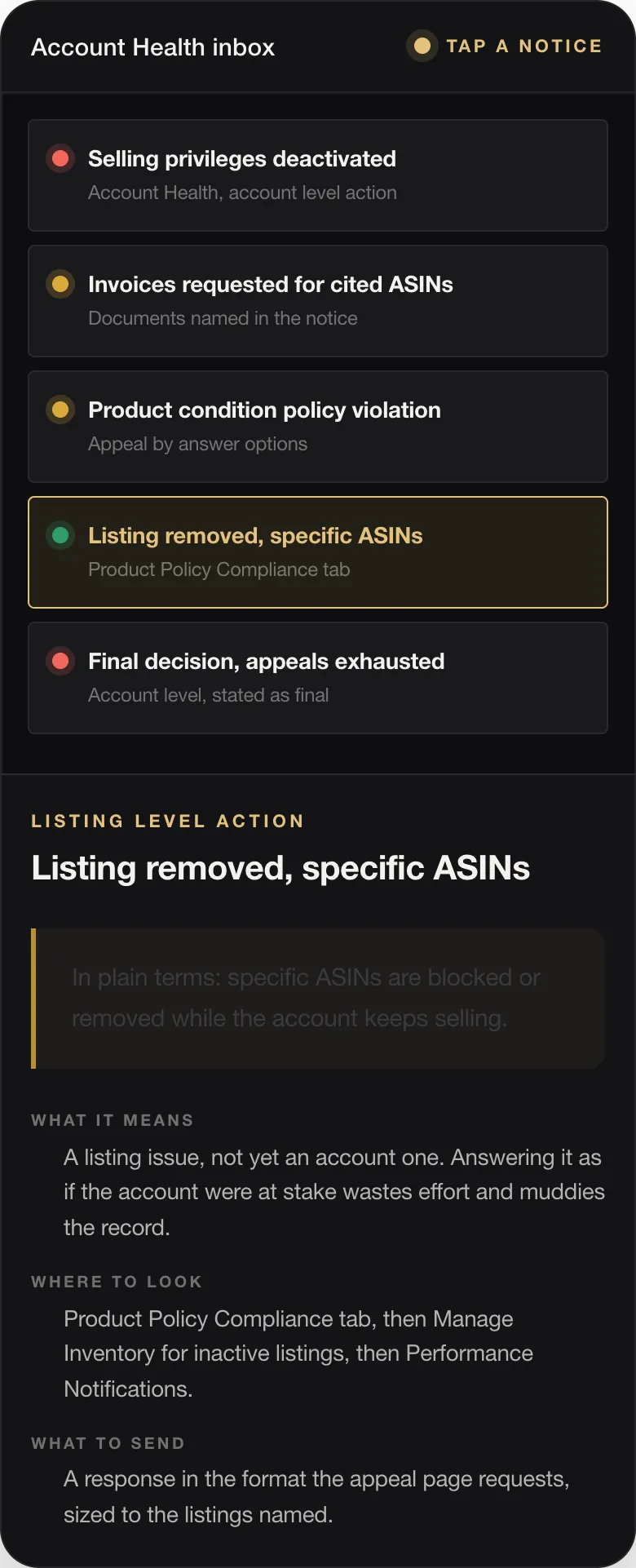
A listing-level action blocks or removes specific ASINs while the account keeps selling. An account-level deactivation switches off selling privileges. A warning removes nothing yet but becomes part of the record a later action can cite. For a removed listing, Amazon points sellers to the Product Policy Compliance tab, then Manage Inventory for inactive listings, then Performance Notifications. Answering a single ASIN removal as if the account were at stake wastes effort; answering a deactivation as if it were one listing misses the risk Amazon is worried about.
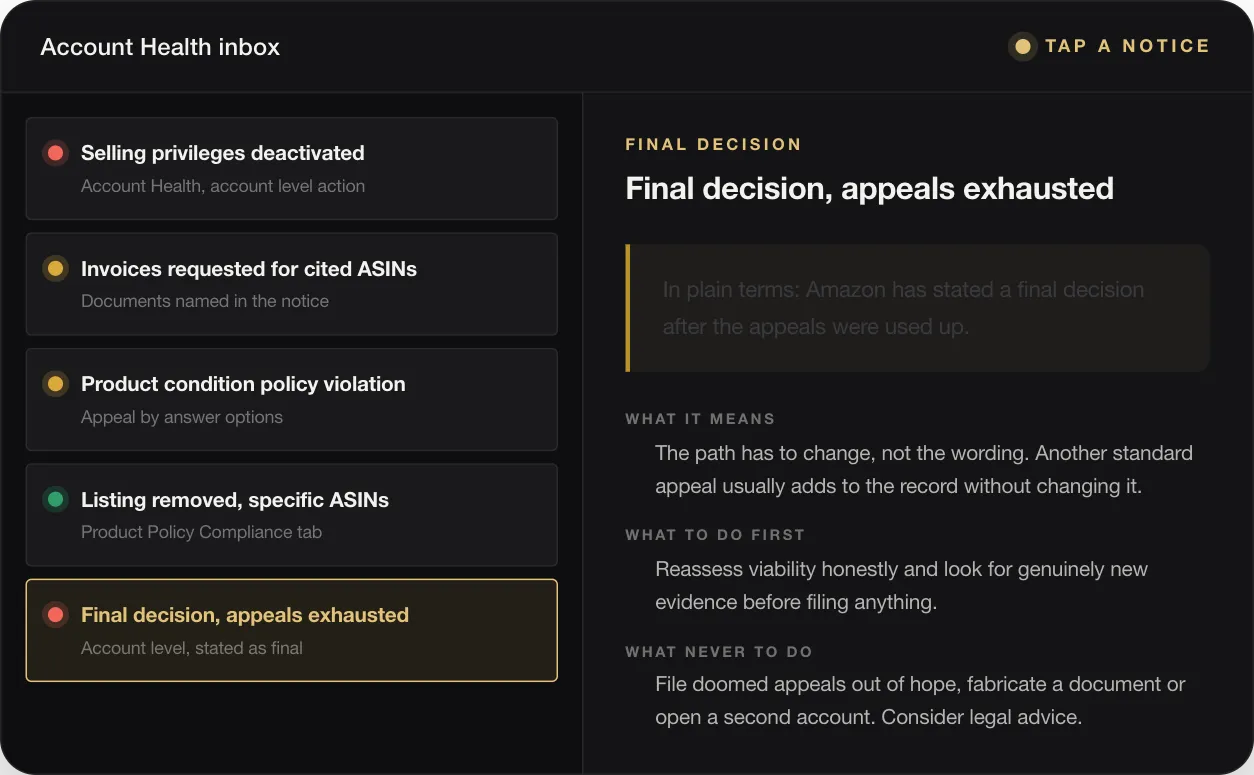
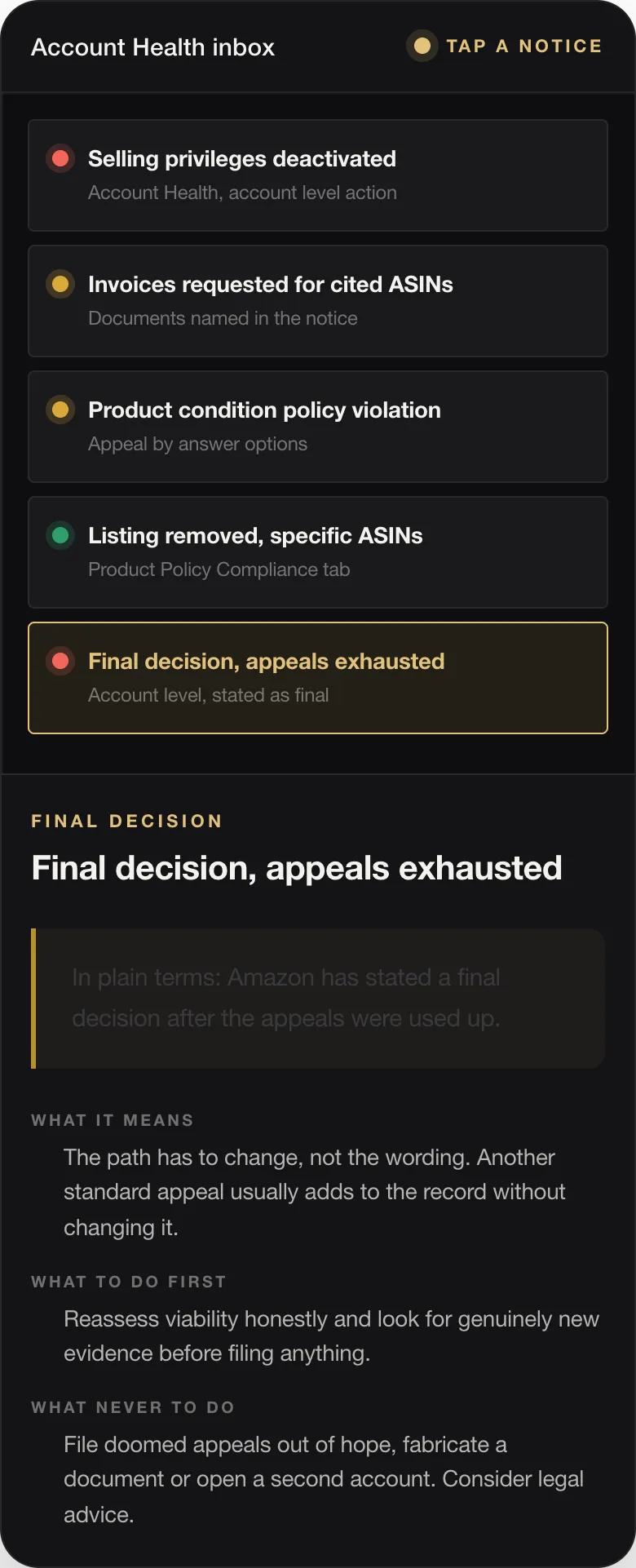
Not every notice wants a plan of action. Open yours.
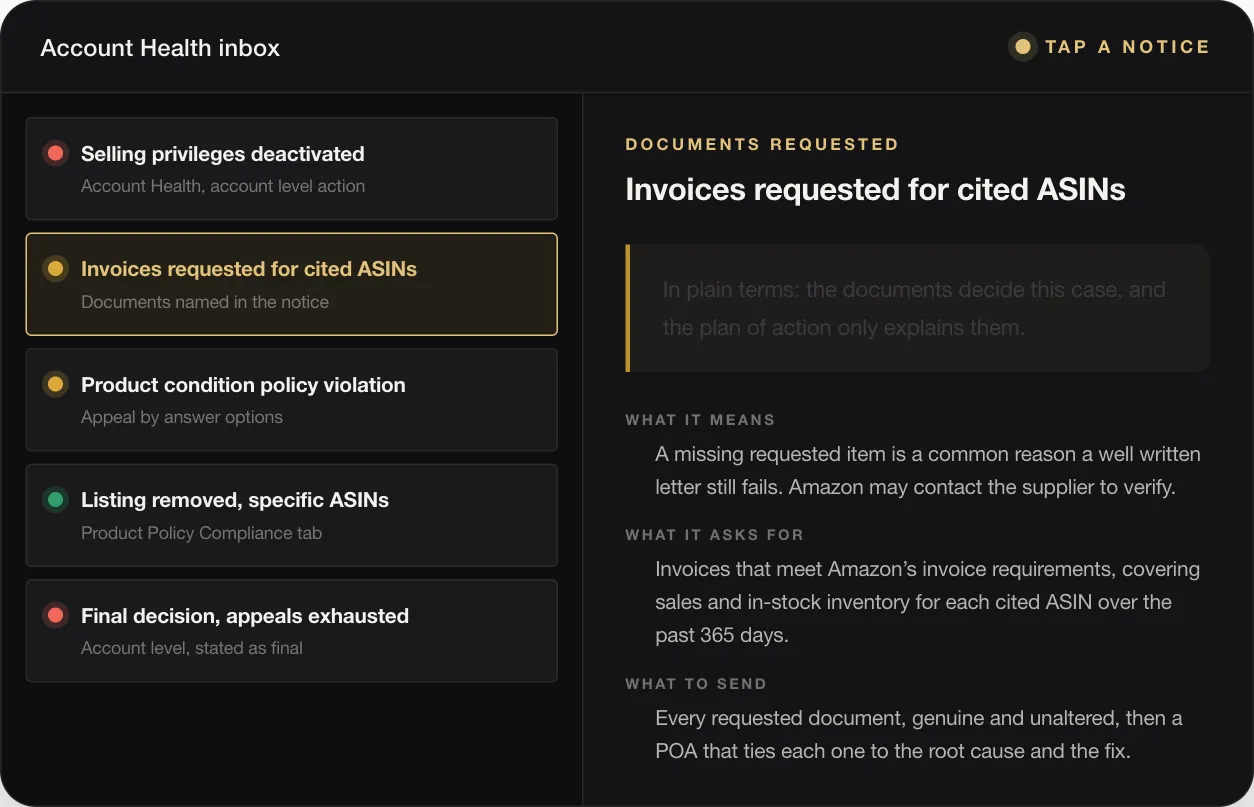
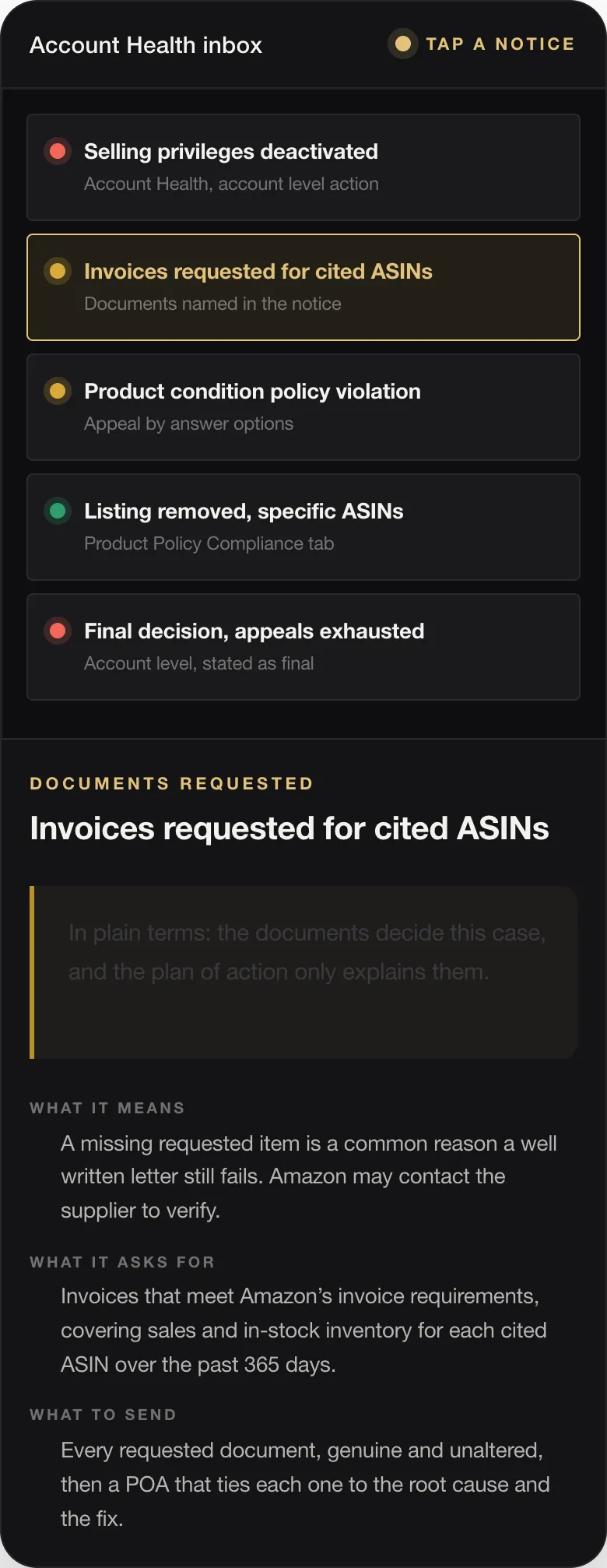
The format of your response is set by the notice and the appeal page, not by habit. Tap the notice that looks like yours to see what Amazon actually wants back.
Read the notice three times before you do anything
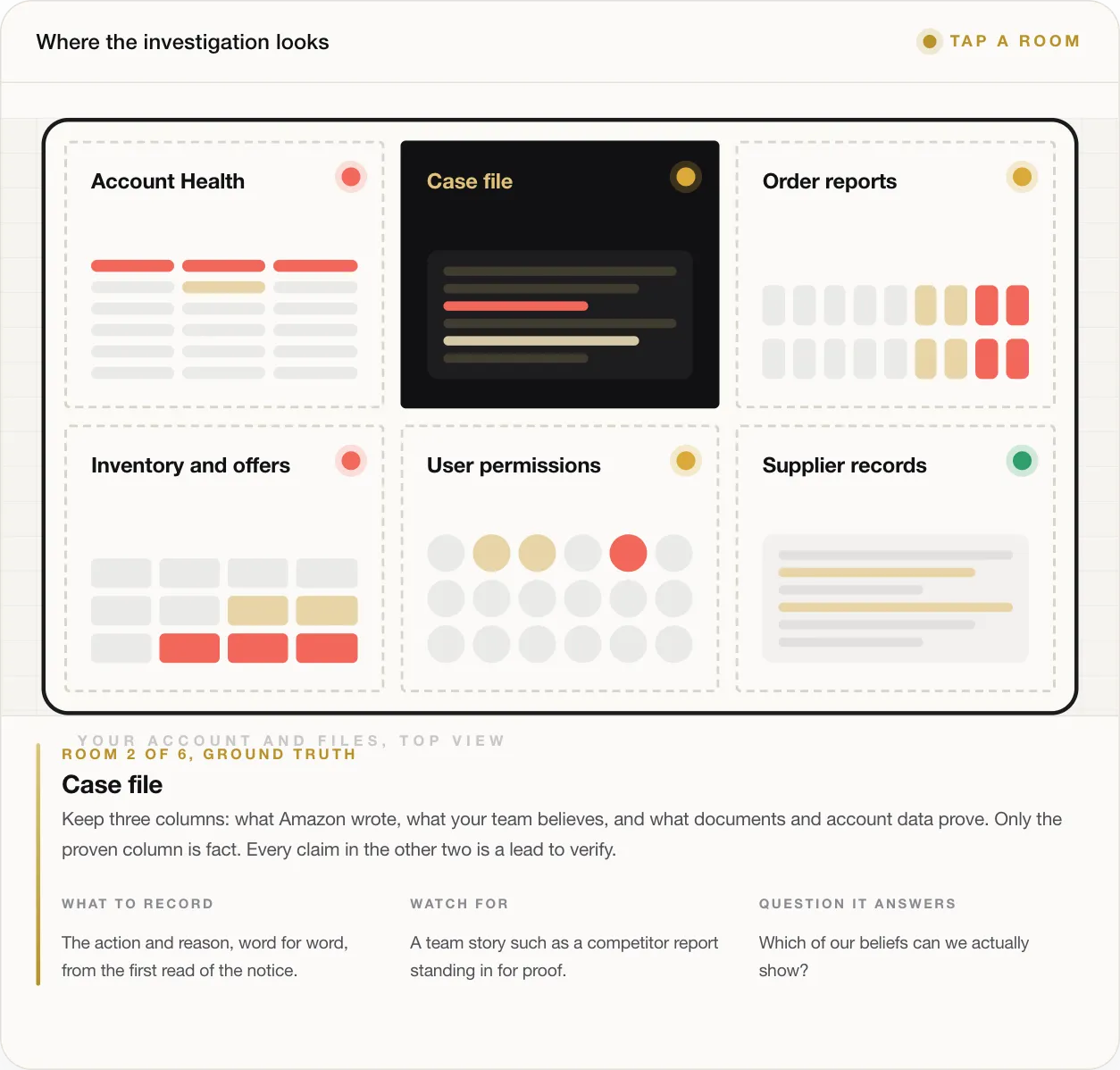
The notice is the first piece of evidence, and it is deliberately limited. Read it three times, extracting something different each pass.
First read: the stated reason
Write down, word for word, the action and the reason. “Deactivated” is not “listing removed.” “Concerns about the authenticity of items” is not “a customer complaint.” Precise words tell you the severity and where the evidence must focus: an authenticity notice is won or lost on sourcing records, not on service metrics.
Second read: what Amazon asked you to do
List each requested item: explanation, POA, invoices, authorization letter, safety documents, verification. Note the ASINs named and the route. A missing requested item is a common reason a well-written letter still fails.
Third read: what the notice leaves out
Ask what it does not say: which complaints, over what period, what drew attention, and what your own records will show when compared. A notice naming one issue may be the visible edge of several. These gaps become your investigation list.
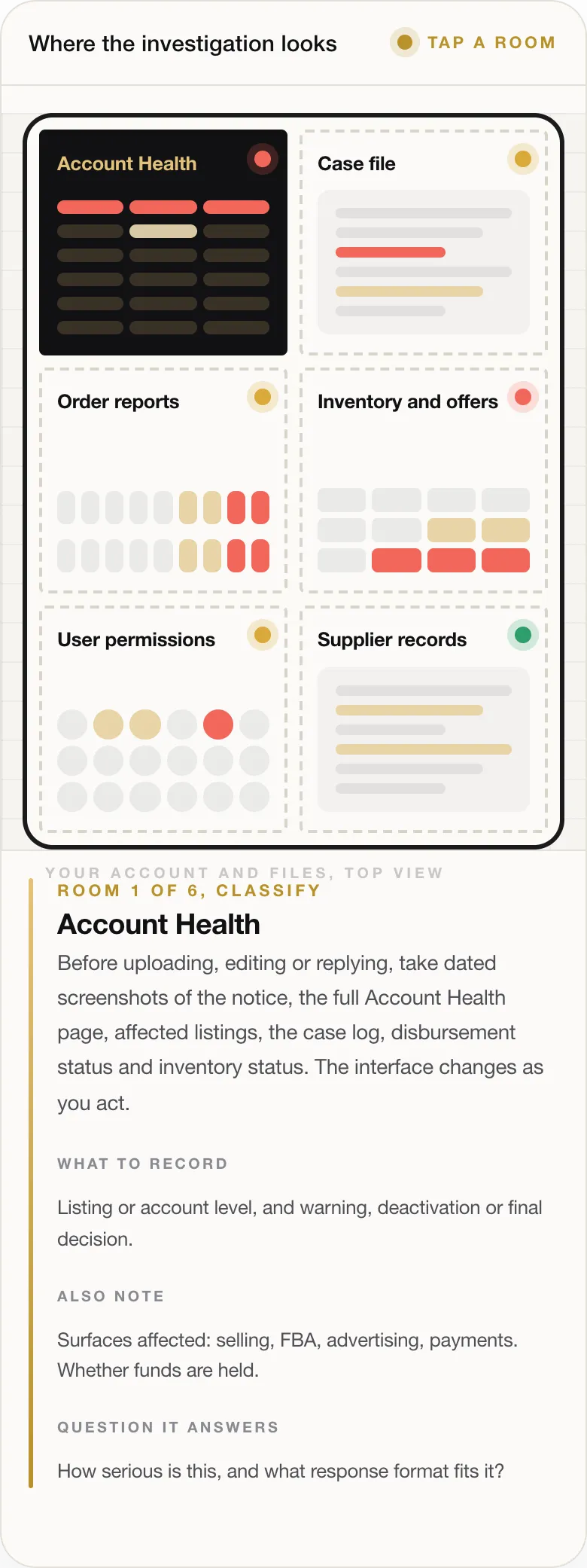
Before uploading, editing or replying, take dated screenshots of the notice, the full Account Health page, affected listings, the case log, disbursement status and inventory status. The interface changes as you act, and the original state cannot be recreated. For help with notice wording, see our breakdown of Amazon suspension notice language.
Investigate before you write a single sentence
The investigation is the real work; the POA only records what it found. Sellers who jump from notice to letter end up arguing the trigger and leaving the cause untouched.
The letter records what you found. Search every room first.
Each step of the investigation happens in a specific place: a page in Seller Central or a file in your own records. Tap a room to see what to record there and what question it answers.

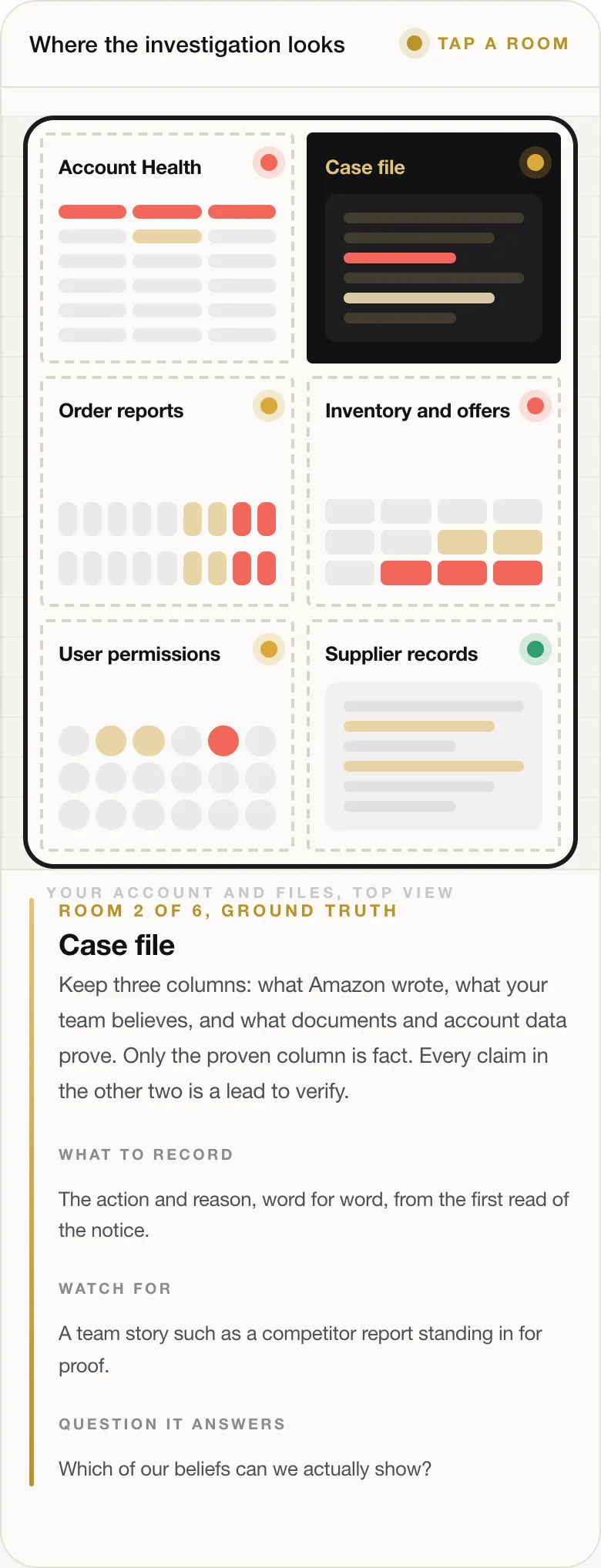

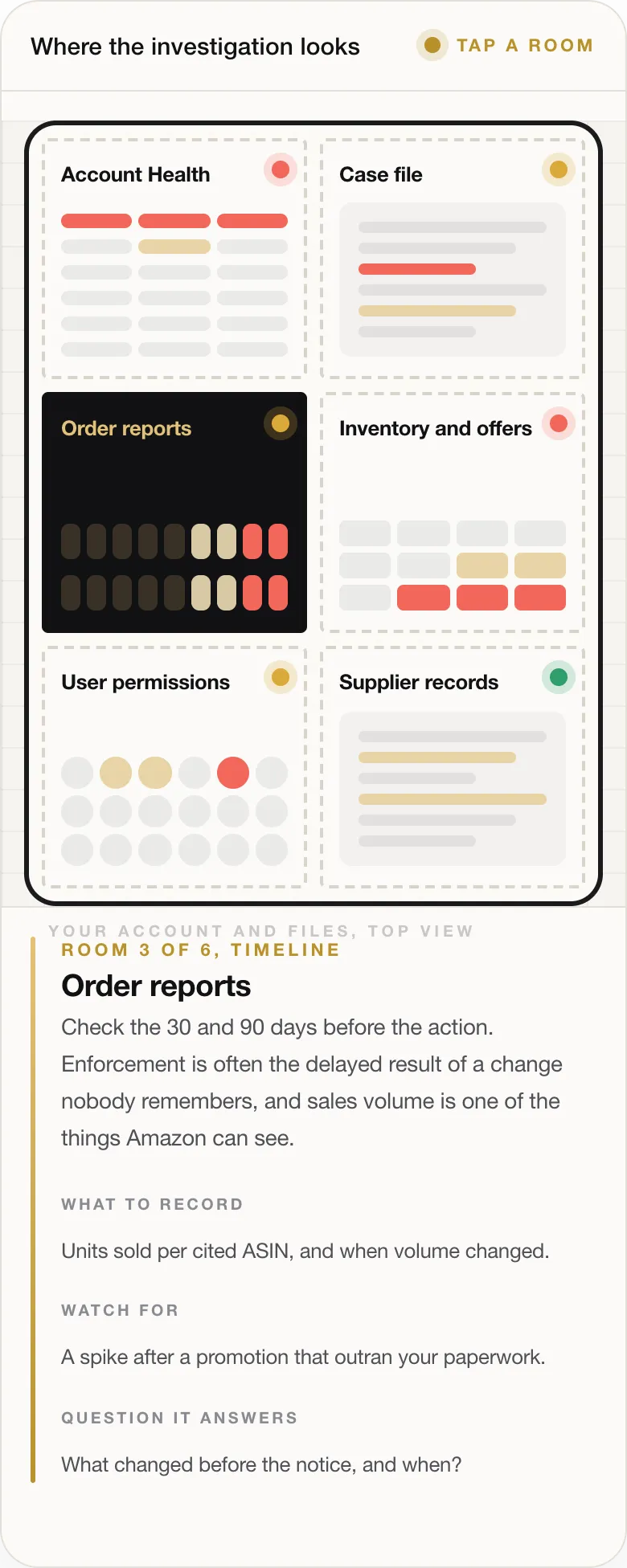
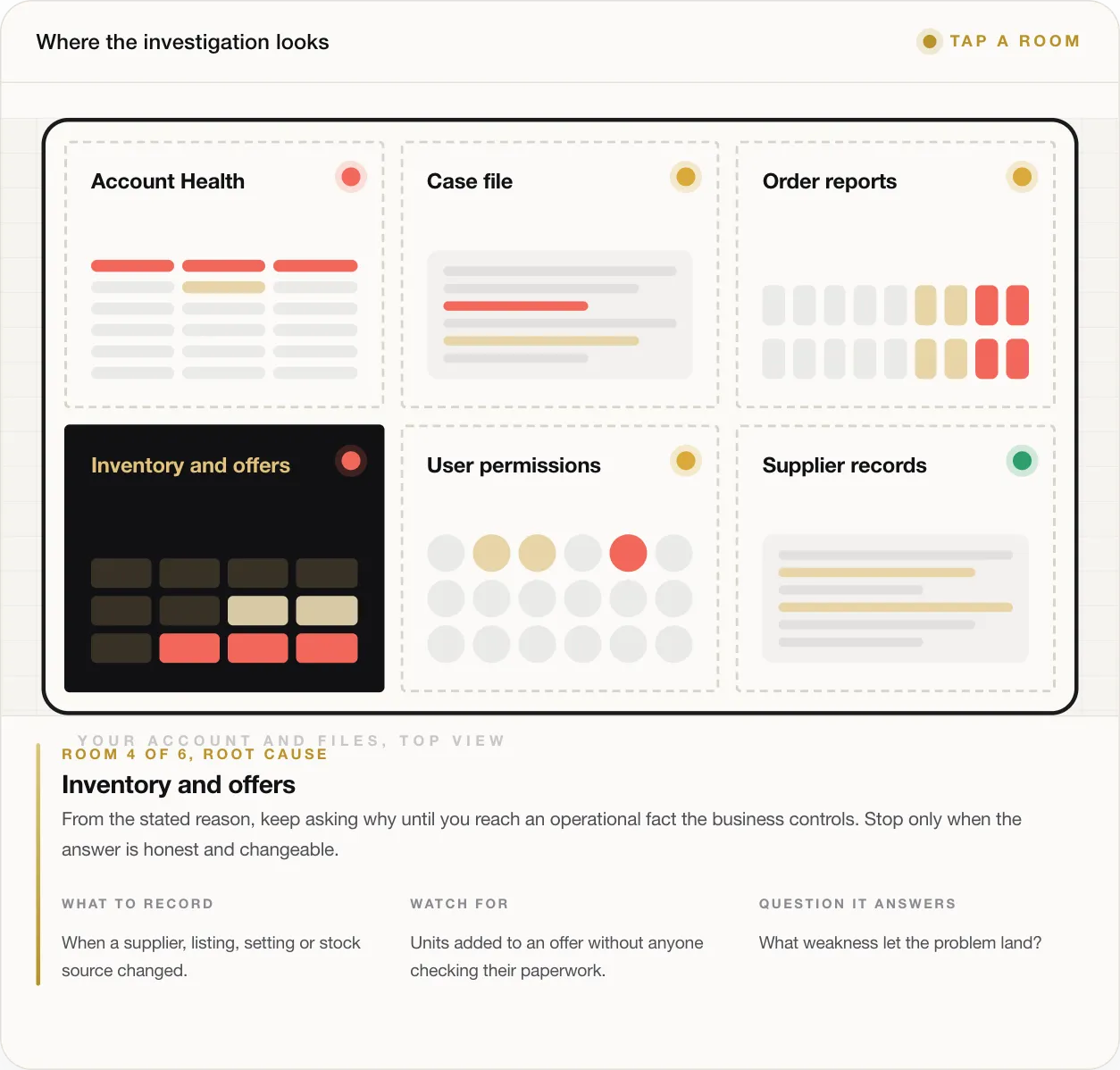
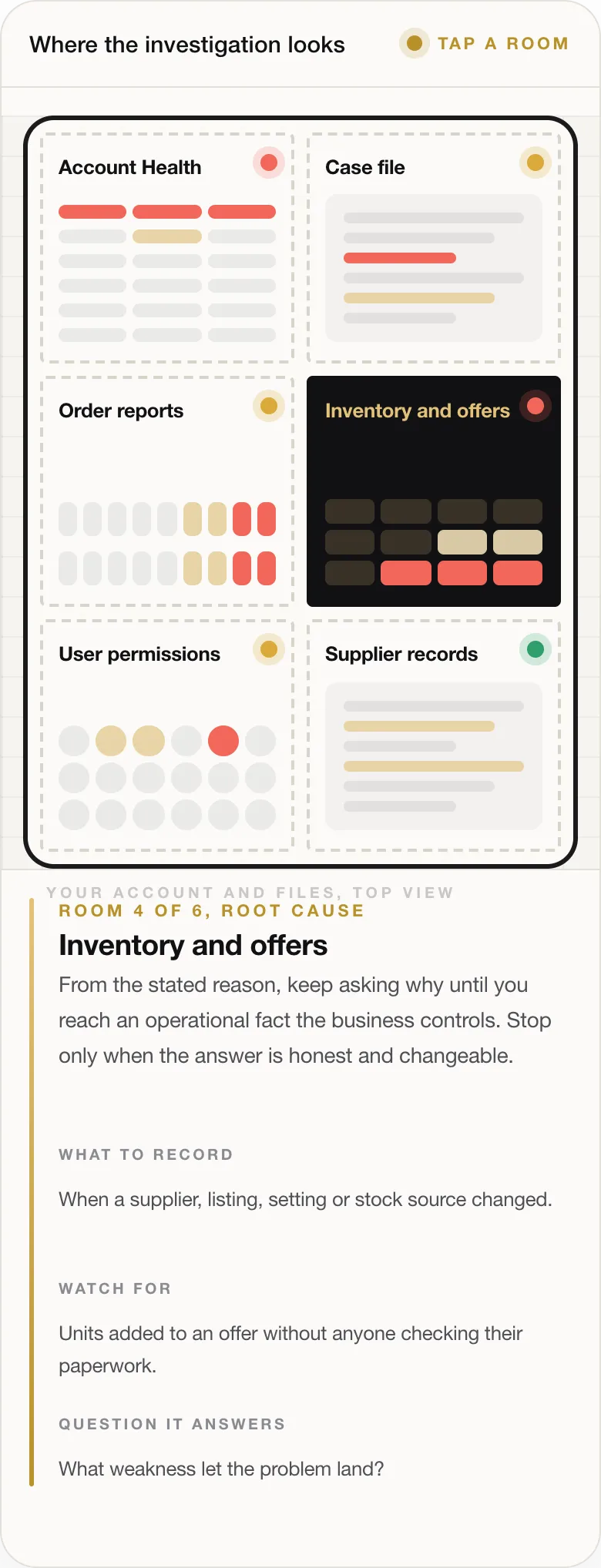

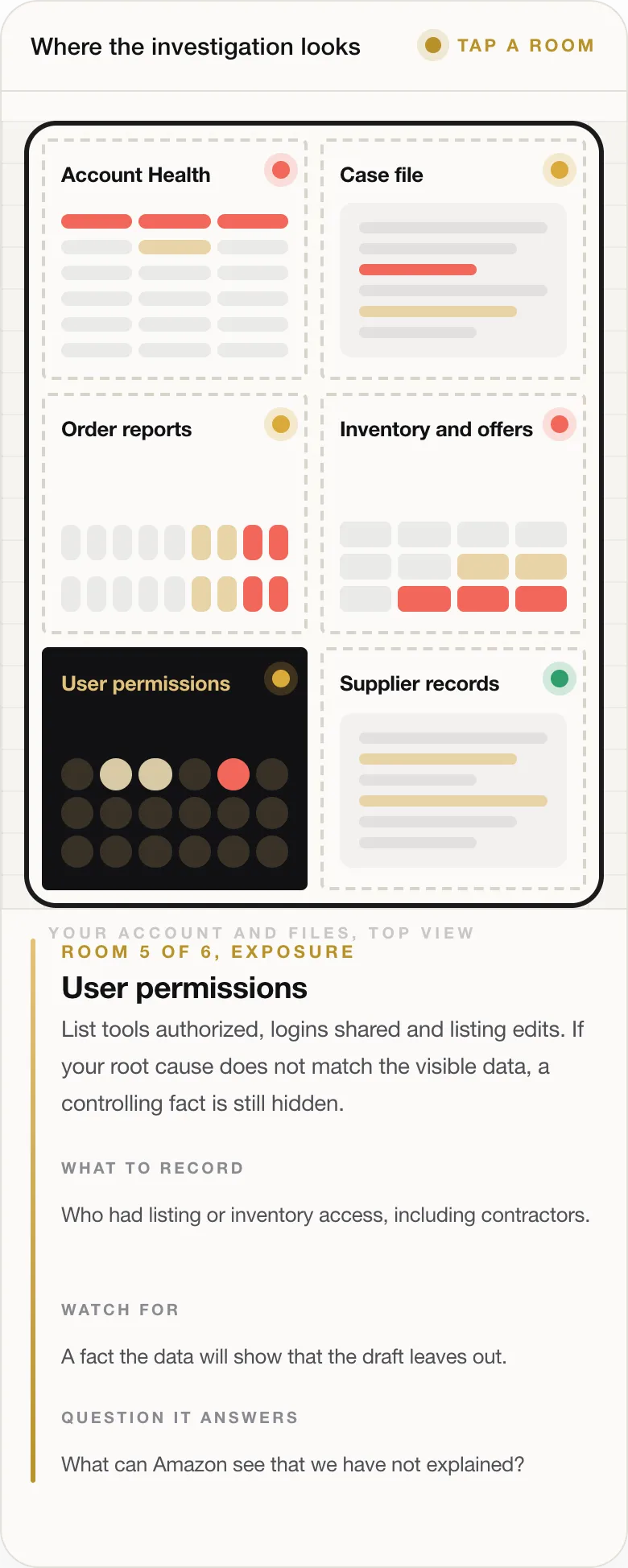

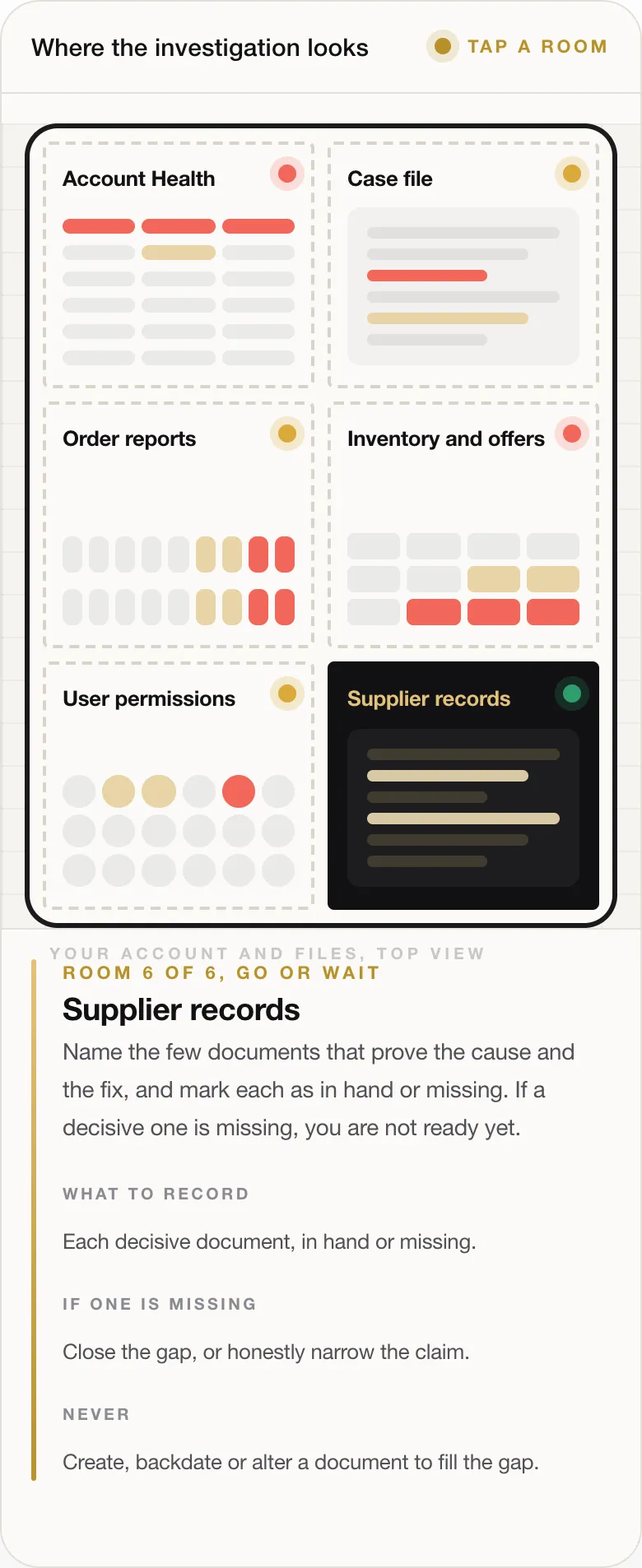
Look hardest for the fact nobody mentioned first, such as a second supplier or an assistant with listing permissions, and test every theory against the data. If your theory says the complaints were unfair but your invoices cover fewer units than you sold, the theory is incomplete.
Root cause versus symptom: where most POAs fail
The stated reason is a symptom. The root cause is the operational reality that produced it. Most denied POAs name the trigger (“a customer complained,” “a competitor reported us”) instead of the cause, which gives the reviewer no reason to believe the risk is gone.
A usable root cause is honest, because a convenient one collapses when the account data contradicts it, and controllable, because a cause you cannot change offers no credible fix. “A competitor attacked our listing” may be true but is not controllable. The usable root cause is the weakness that let the attack land, such as nobody monitoring listing content for unauthorized edits.
| Symptom sellers usually write | Question to keep asking | A root cause a reviewer can act on |
|---|---|---|
| “We received an inauthentic complaint.” | Why could we not immediately prove the item was genuine? | Some inventory for the cited ASIN came from a source we cannot document, and no rule required a supplier invoice before listing. |
| “Our late shipment rate went up.” | What changed that week? | Our handling time setting did not match real packing capacity after we added a product line, and nobody reviewed it. |
| “The customer said the item was used.” | Who inspects returns before resale? | Returns went back into sellable stock without a condition check. |
| “The listing broke a rule by mistake.” | Who wrote it, and who checked it? | A contractor created listings without a written guide, and nothing went through a second review. |
Some cases have two genuine causes; name both, each with its own corrective and preventive action. Listing every possible cause in the hope one is right reads as a seller who has not diagnosed the problem. And even when a buyer, carrier or competitor played a role, do not argue fairness. Reviewers assess risk, not fault.
Corrective actions: what you have already done, with proof
Corrective actions are finished, dated and supported. “We will review our listings” is a plan. “On the 4th we closed our offers on the two cited ASINs and created a removal order for the remaining 85 units, confirmation attached as Exhibit B” is a corrective action. Typical examples:
- Sourcing cases: closing offers on cited ASINs, removing stock you cannot document, gathering genuine supplier invoices.
- Listing cases: correcting the content and auditing every listing created by the same person or process.
- Condition cases: inspecting and quarantining stock, fixing packaging, completing a bin check where FBA handling may be involved.
- Metric cases: fixing the setting or process that created the defects and resolving open orders and claims.
If you cannot show an action with a dated exhibit, complete it before submitting or leave it out.
Preventive measures: owner, date, scope and proof
Preventive measures are durable controls, and they are where most POAs are weakest because sellers write intentions. A measure counts only when it names an owner (the role responsible), a date it took effect, a scope (all SKUs, all new suppliers, every listing before publication) and proof (a signed checklist, a log, a system setting, a scheduled audit with a record).
Compare “We will train our staff better” with “Effective the 10th, every new listing is reviewed by our operations manager against our written listing guide before publication; reviews are logged in our tracker (sample, Exhibit F), and the owner audits ten random listings on the first business day of each month.” The second tells the reviewer who does what, when, to which items, and how anyone could check.
Three good measures beat ten weak ones. Promise only what you will run, and connect each measure to the root cause.
Evidence and exhibit standards that survive a check
Appeals rarely fail because the writing was not persuasive enough. They fail because evidence was missing, weak, inconsistent or unverifiable. Build the evidence file first and write from it, so you can only say what you can prove. Test every sentence: what record backs this, and could the reviewer check it? “We source only from authorized distributors” is an assertion; the agreement and invoices are evidence.
What Amazon says about invoices
Amazon’s Invoice requirements page for appealing a policy violation sets the standard. Among its requirements:
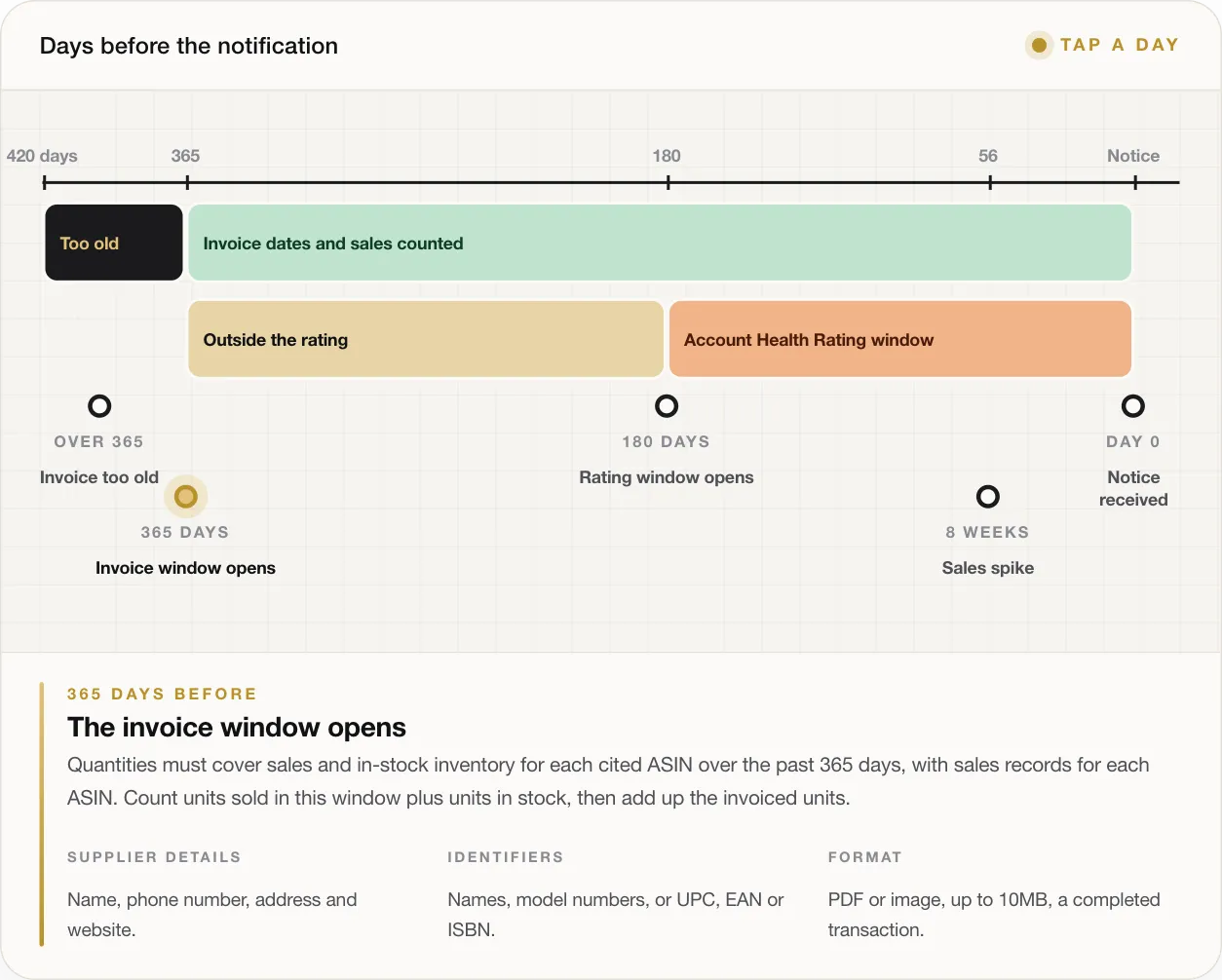
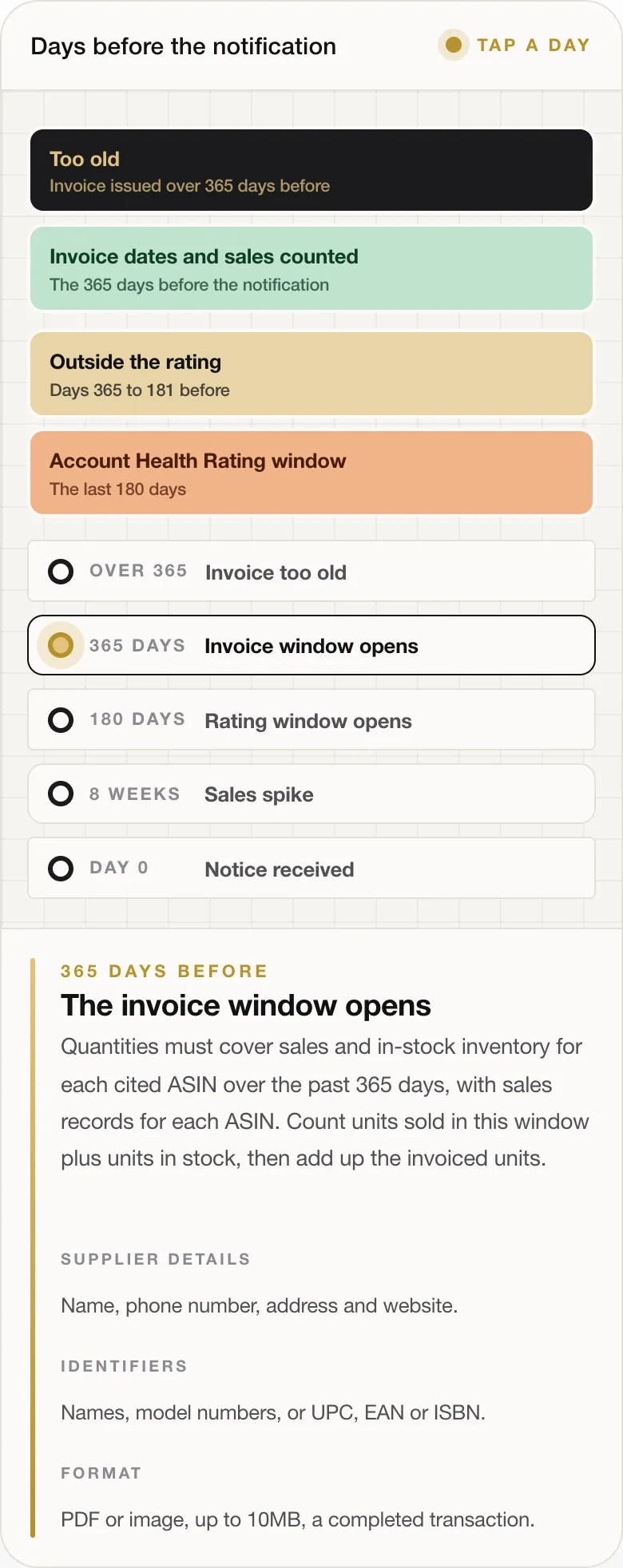
- Supplier name, phone number, address and website.
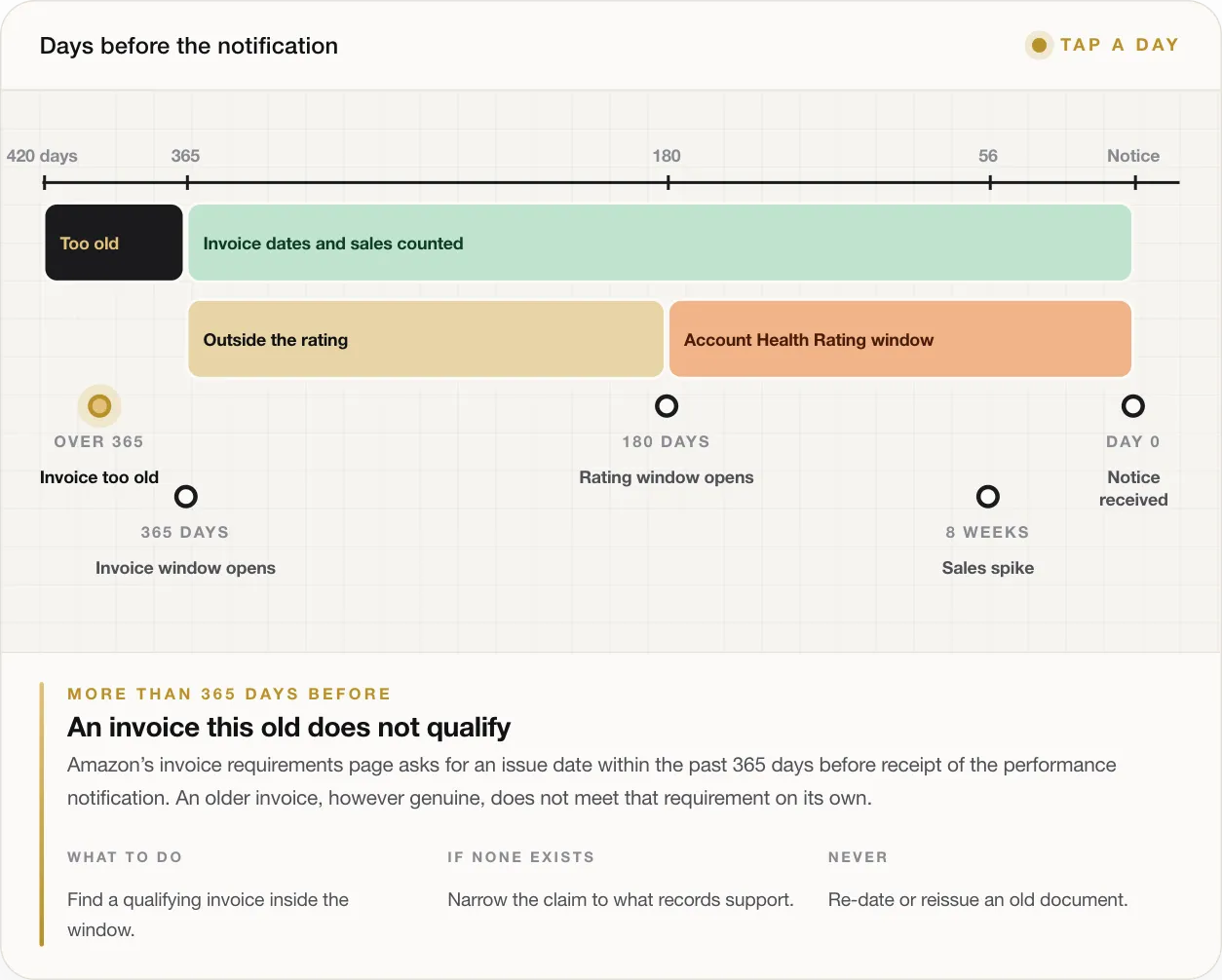
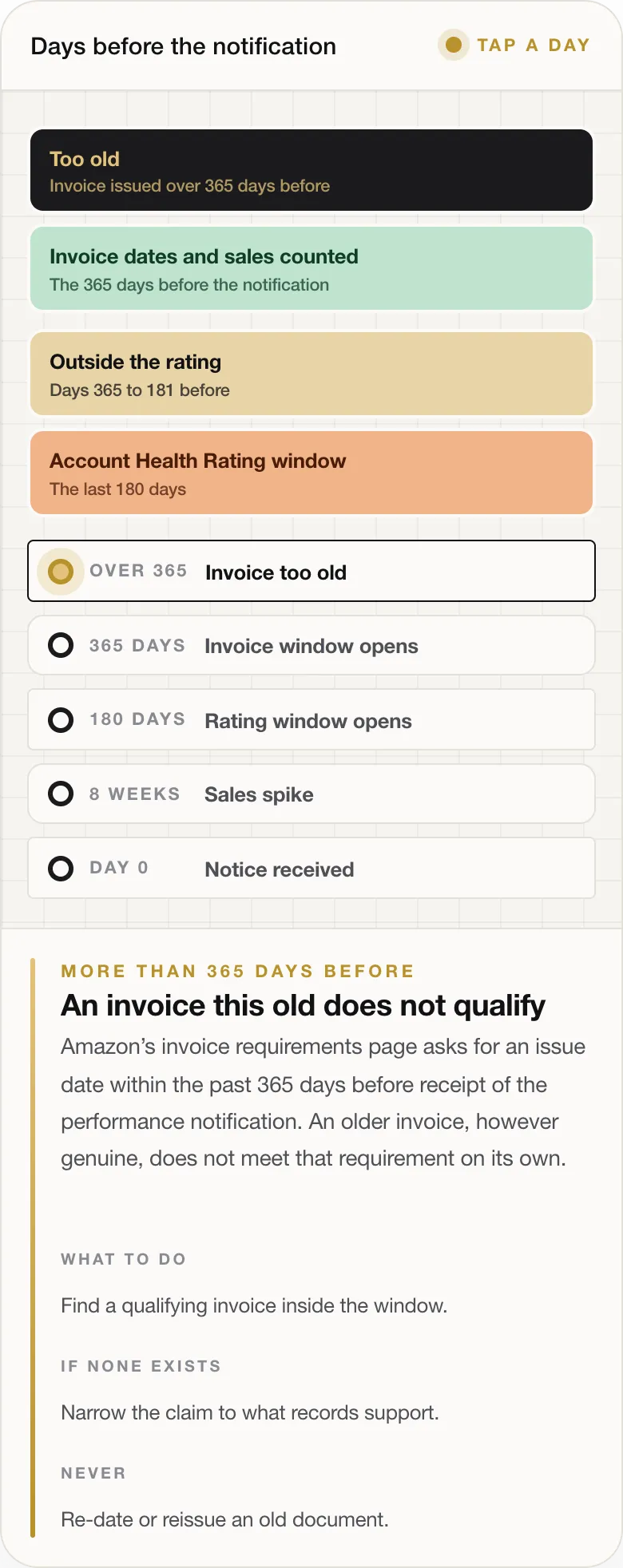
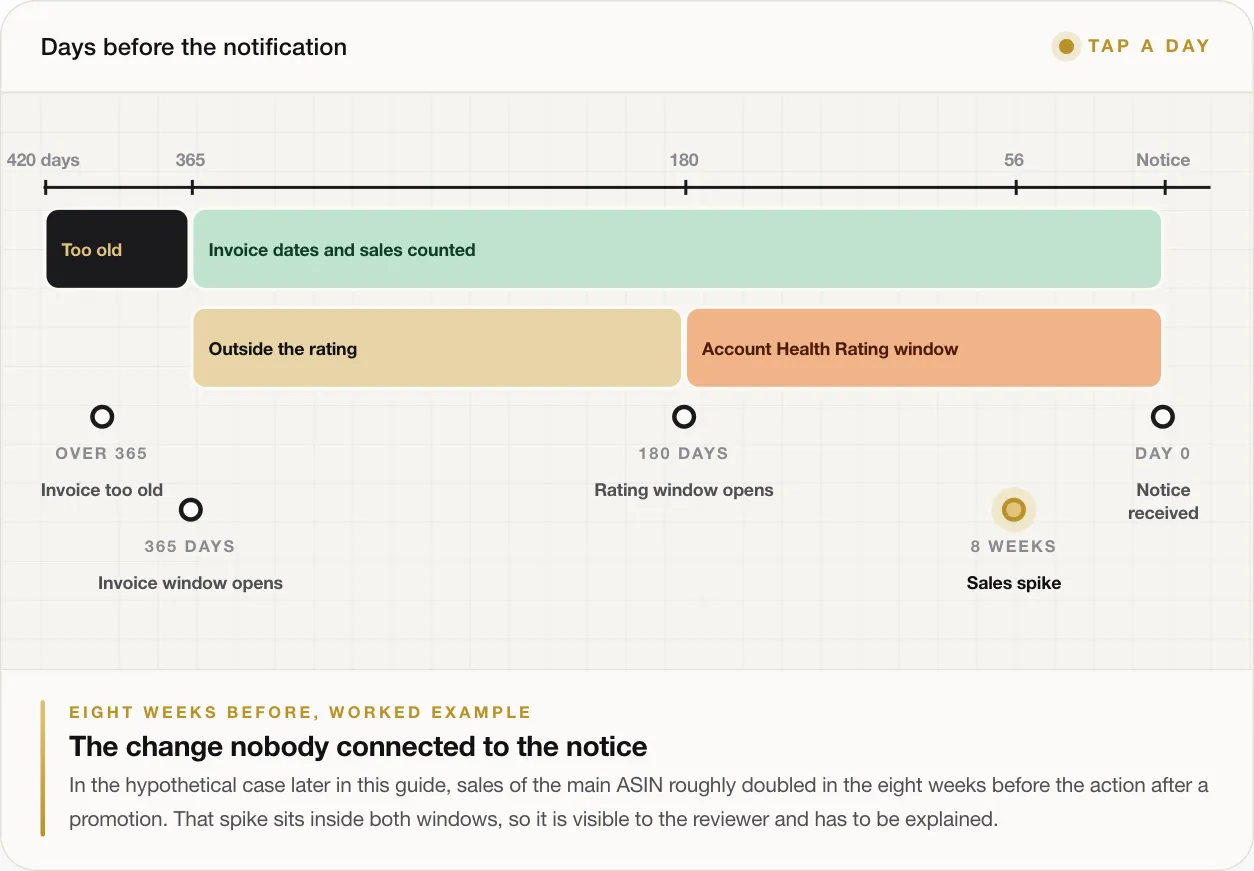
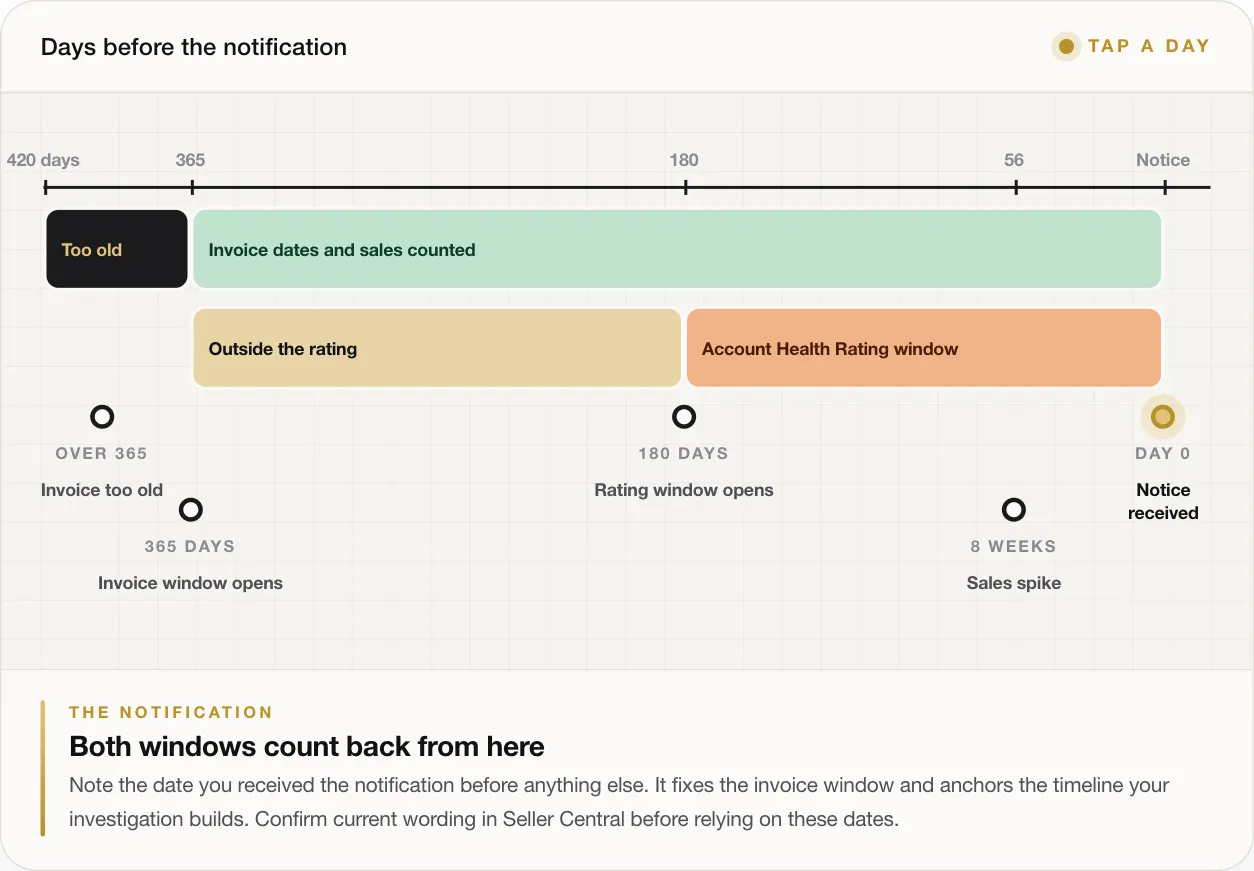
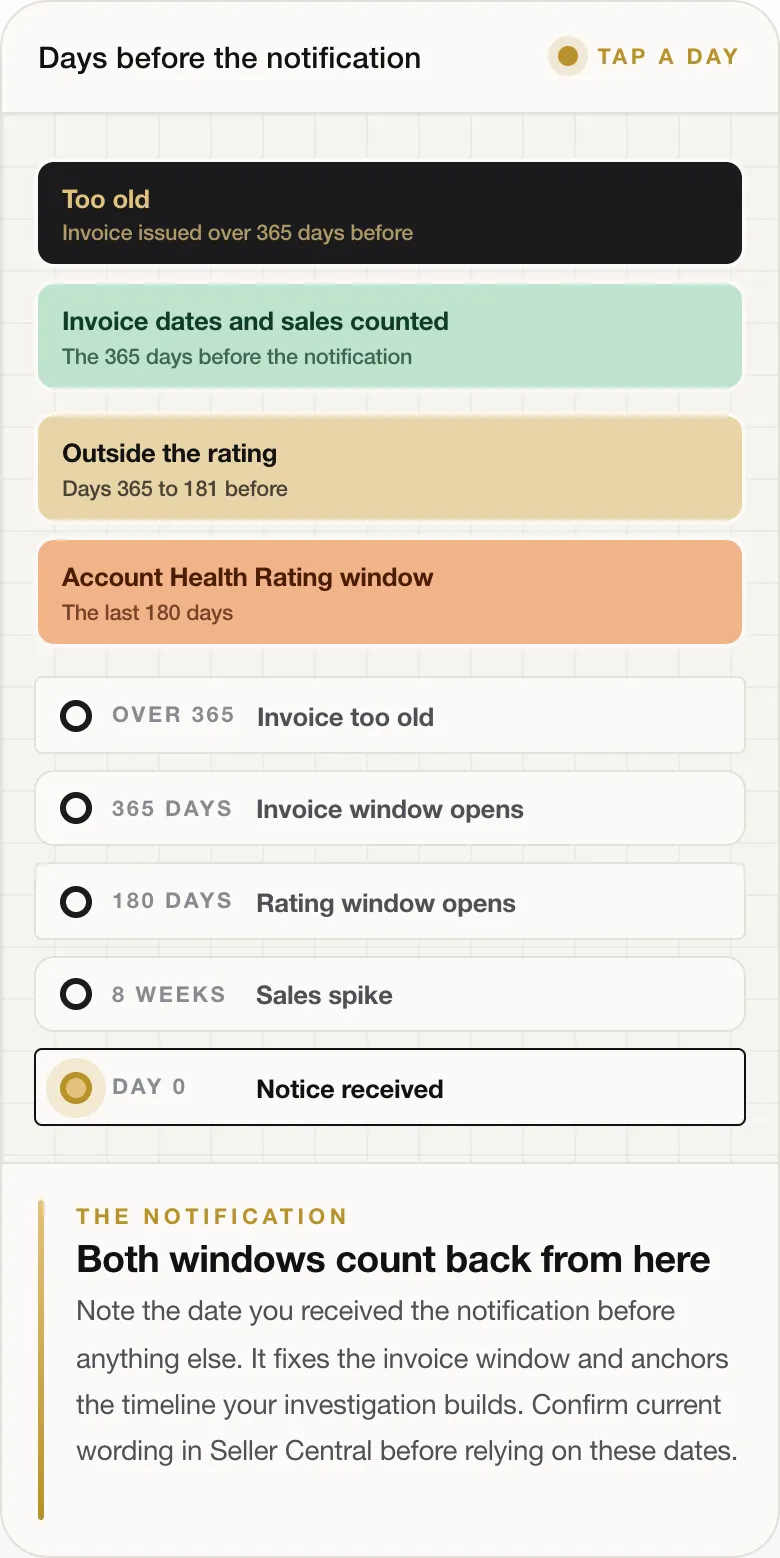
- An issue date within the past 365 days before receipt of the performance notification.
- Quantity sufficient to cover sales and in-stock inventory for each cited ASIN over the past 365 days, plus sales records for each ASIN.
- Clear product identifiers (names, model numbers, or UPC, EAN or ISBN), with variation and bundle details where relevant.
- PDF or image format, no larger than 10MB, documenting a completed and fulfilled transaction.
The page says Amazon will not accept invoices sent by email or third-party sharing, sales quotes or pro forma invoices, self-issued invoices, editable formats such as Excel or Word files, or illegible or inconsistent documents. Pricing may be removed. Documents must be authentic and unaltered, and Amazon says it may contact the supplier to verify them. Retail receipts usually fall short; see why Amazon does not accept receipts.
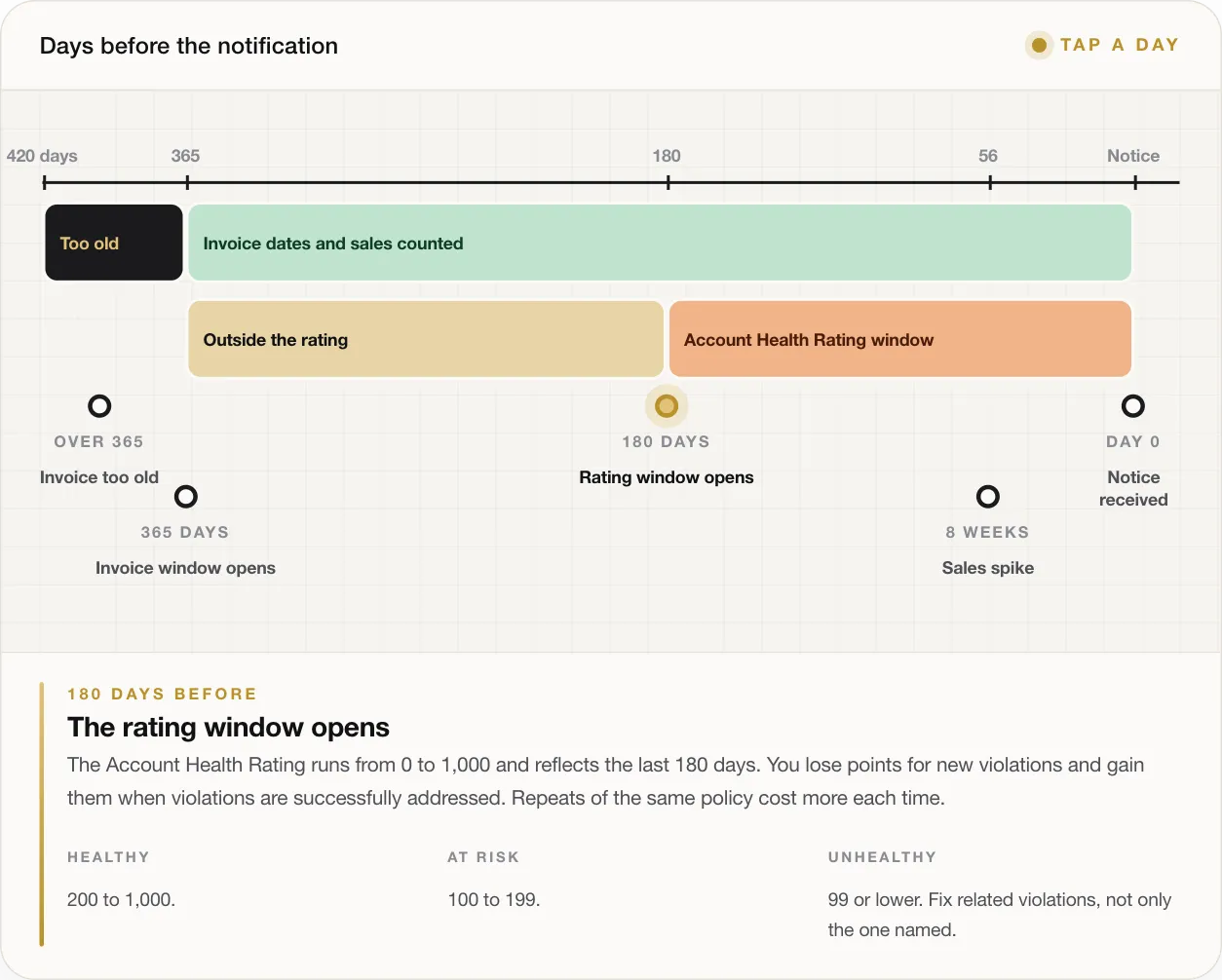
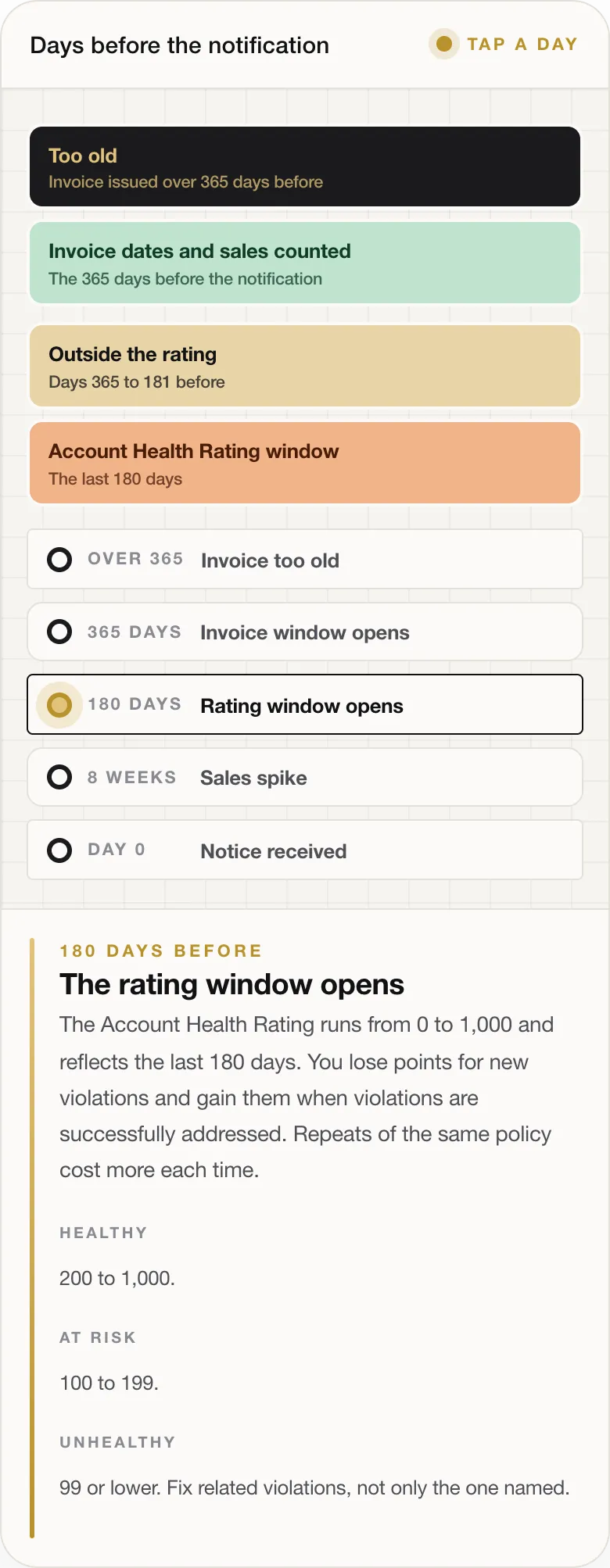
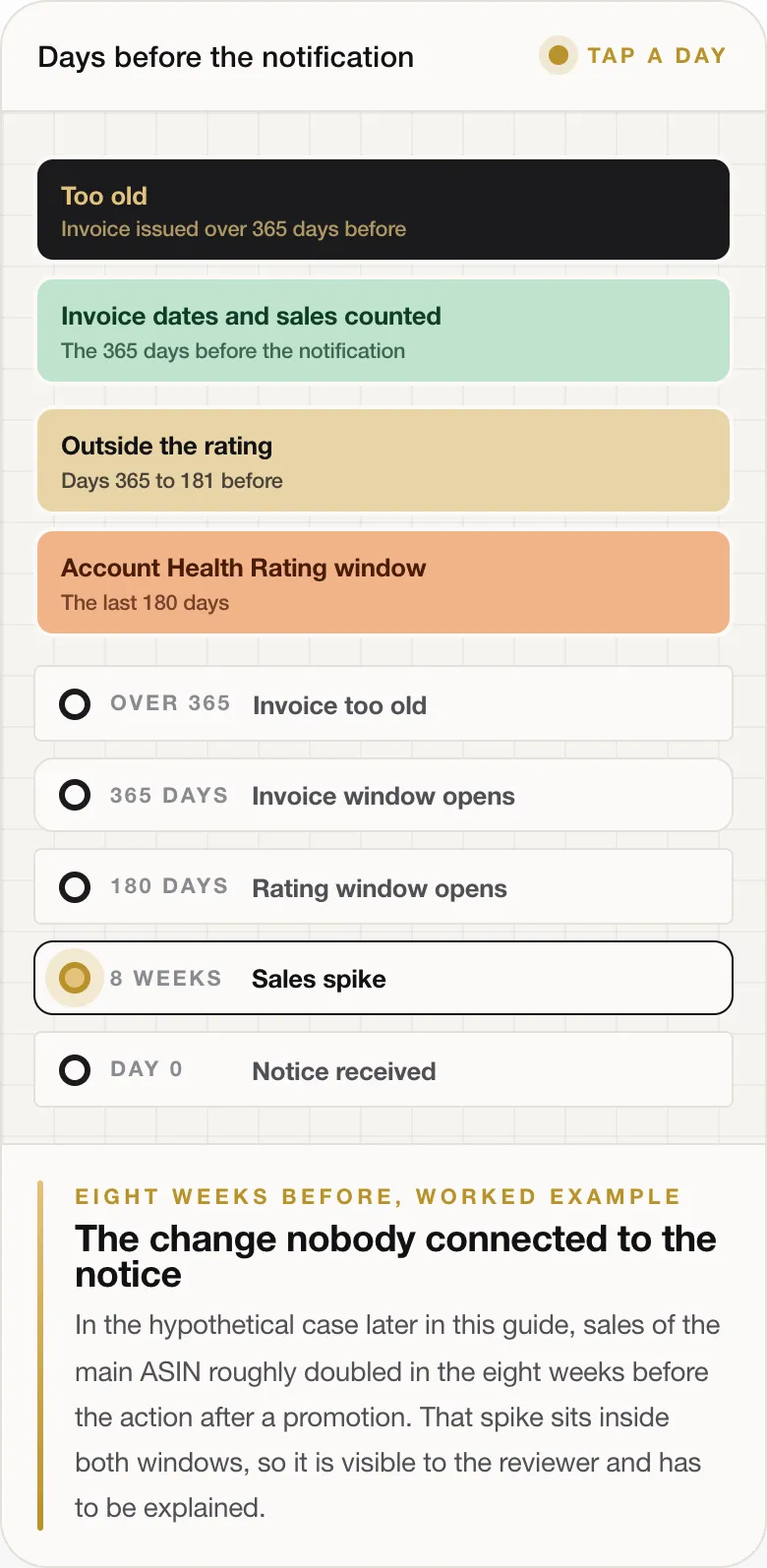
Amazon counts back from the notice. So should you.
Invoices are judged against the 365 days before you received the notification. Your Account Health Rating reflects the last 180 days. Tap a day to see what each line means for your file.
Verify every document before you submit it
Check each exhibit as a skeptical reviewer would. Do names, addresses and dates match your account and each other? Does the quantity reconcile to units sold? Can the supplier be found independently? To confirm a US supplier exists, search its state business registry (find your state’s office through the National Association of Secretaries of State) and compare the registered name and address with the invoice. Red flags include mismatched fonts, totals that do not add up, addresses that differ from the account, or a round-number invoice with no line detail. If you find one, do not submit the document; investigate it.
Never fabricate, alter or “tidy up” a document
Never create, backdate, edit or reconstruct an invoice, authorization letter or training record, and never ask a supplier to sign a statement that is not true. You never know which document will be checked, and one provable falsehood can turn a recoverable case into a permanent loss. See forged or manipulated documentation suspensions for what follows when that line is crossed.
When a genuine document cannot be obtained, change the plan: narrow the appeal to what your records support, remove listings or stock you cannot document, source future inventory only from suppliers who issue proper invoices, or accept that this part of the case cannot be won. Opening another account is not one of the paths. Amazon’s code of conduct allows one Seller Central account per region unless there is a legitimate business need and all accounts are in good standing.
Label each exhibit (A, B, C) with a one-line description and reference it wherever it supports a claim. Attach only what fits the risk in the notice.
| Question | Where to check | What to look for |
|---|---|---|
| What is the violation and what does Amazon want? | Account Health, the specific violation, and Performance Notifications | The exact policy, the ASINs cited, the requested documents or answer options. |
| Listing level or account level? | Account Health; Product Policy Compliance tab; Manage Inventory | Whether privileges are off or only specific ASINs are removed. |
| How serious is my standing? | Account Health Rating on the Account Health page | Healthy (200 to 1,000), At Risk (100 to 199) or Unhealthy (99 or lower), and which violations cost points. |
| Do my invoices cover what I sold? | Order reports for each cited ASIN over 365 days, against supplier invoices | Invoiced units at least equal to units sold plus units in stock, with matching identifiers. |
| Is the supplier real? | State business registry via nass.org; supplier website and address | An active entity whose name and address match the invoice. |
| Did FBA handling cause a condition complaint? | A bin check request on the same ASIN and SKU | A closed case you can cite by ID; Amazon will not accept one still under review. |
Tone, length and structure
A strong POA reads like an organized case file, not a speech. It states the root cause, ties it to evidence, lays out corrective and preventive actions with proof, and stops. It does not praise Amazon, plead hardship, or attack the buyer or a competitor. Hardship is real, but a risk reviewer cannot use it.
For every sentence, ask: could this exact sentence appear in another seller’s appeal about a different problem? If yes, it is doing no work. “We sincerely apologize for any inconvenience,” “we take this very seriously,” “this will never happen again” and “we are a reputable seller with years of experience” all fail. Rewrite them into something only your business could say, or delete them.
Match certainty to evidence: confident where proof is strong, narrow where it is partial. Get ahead of what the data will show. If a contractor had listing access or a second supplier was used, say so and explain the control now in place; disclosing a fact is always better than being caught leaving it out. Keep it as long as the three parts and the exhibit index need and no longer, with simple labels (Root cause, Corrective actions taken, Preventive measures, Exhibits), written in the account owner’s voice.
A worked example: the same POA, before and after
This case is hypothetical; the business, numbers and dates are invented. It shows reasoning, not wording to copy. A POA built from someone else’s sentences fails the boilerplate test by definition.
A kitchen goods seller receives an account deactivation citing authenticity concerns on two ASINs for a branded water filter, with invoices requested. The owner’s first story: “Our products are genuine and a competitor reported us.” The investigation finds that sales of the main ASIN roughly doubled in the eight weeks before the action after a promotion. Over the prior 365 days the seller sold 1,240 units. Authorized distributor invoices cover 900. The other 340 came from a liquidation lot backed only by a payment record, and 85 of those are still in FBA. A virtual assistant had added the lot to the existing offer without anyone checking its paperwork. The honest root cause is not the competitor; it is that the business listed undocumented inventory during a spike, with no rule requiring a qualifying invoice first.
Follow the units. See where the weak draft breaks.
The worked example as a flow of units: sold in the past 365 days, covered by invoices, claimed as genuine and still in FBA. Pick a draft and tap a red mark to see what a reviewer reads there.
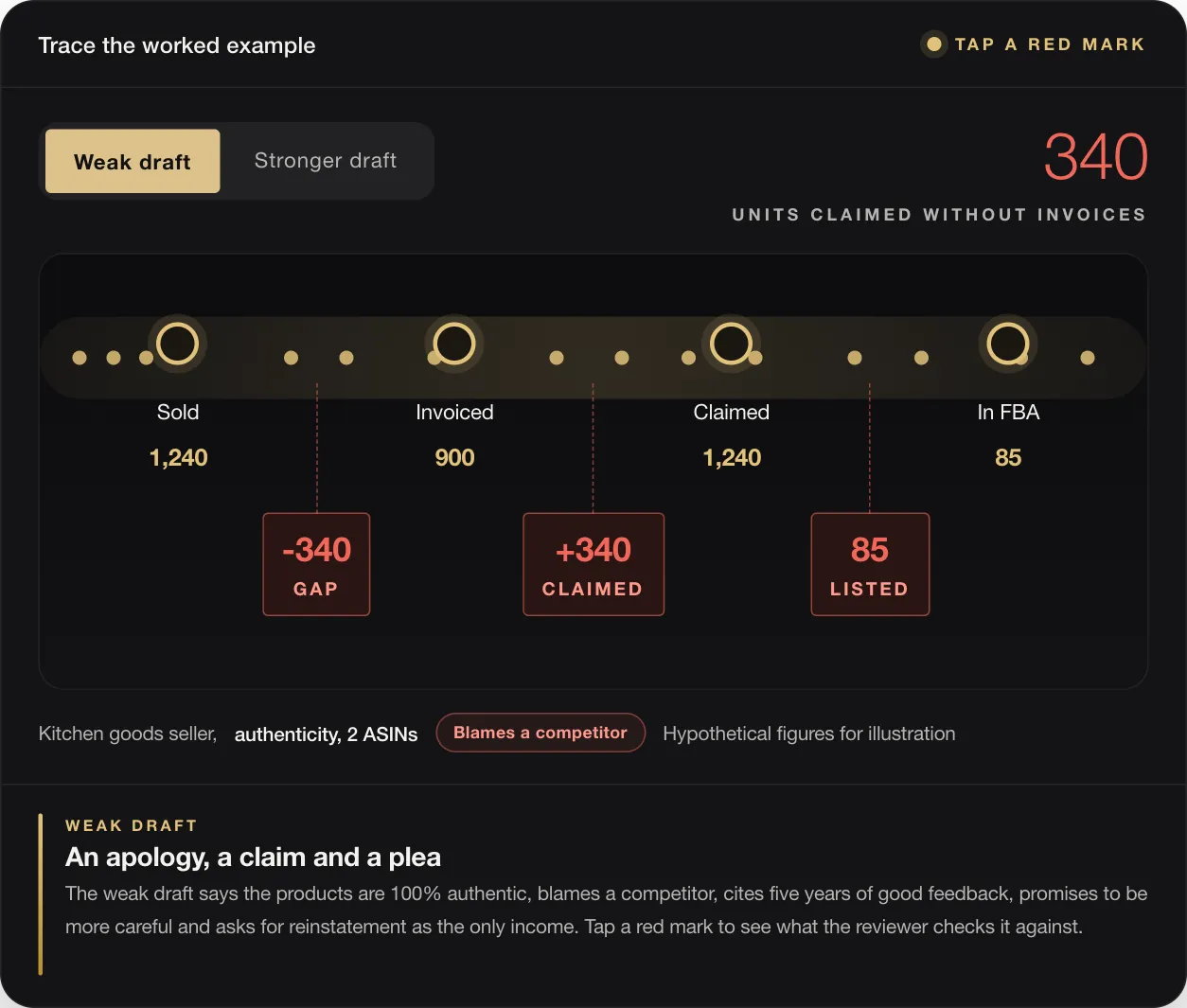
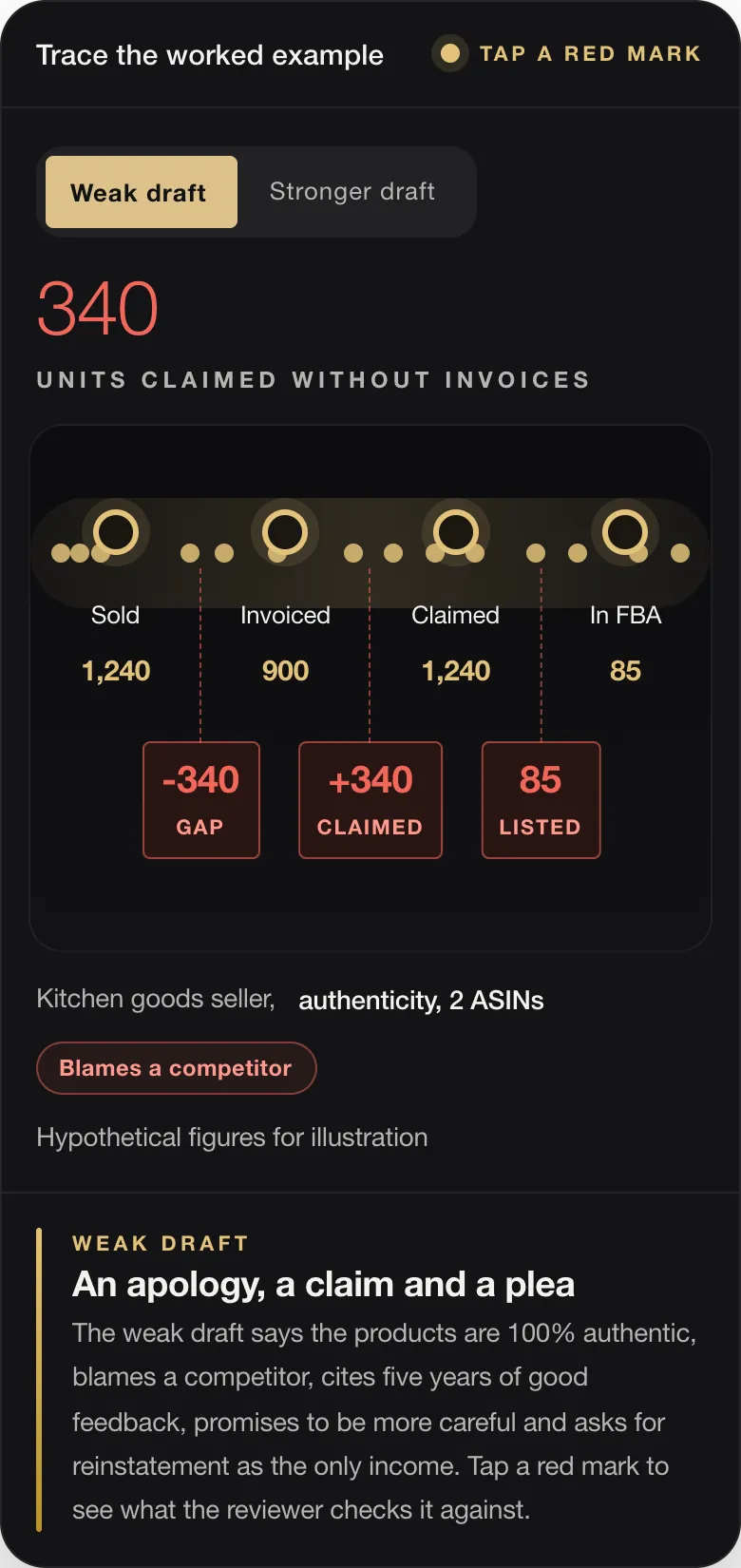
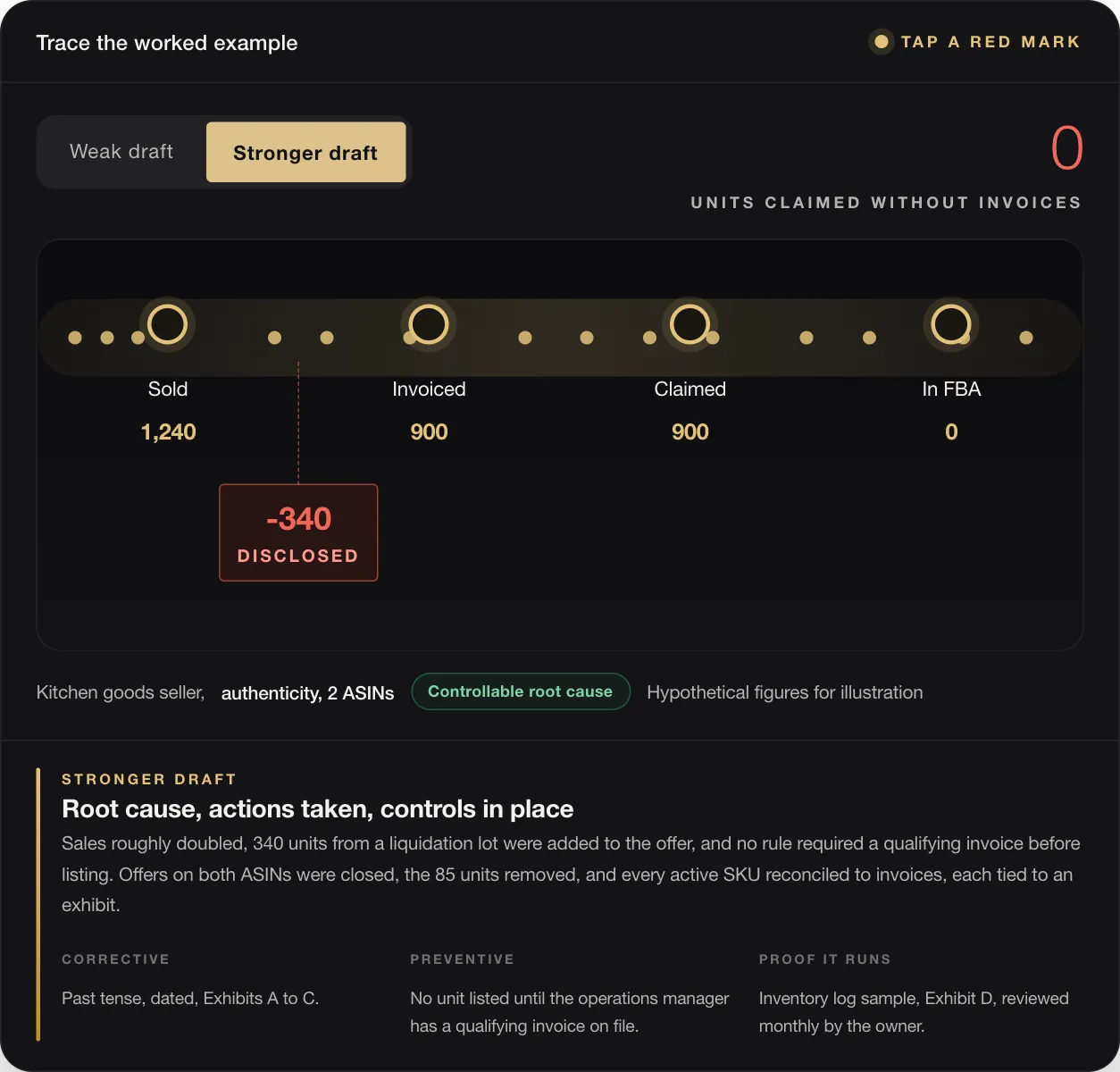
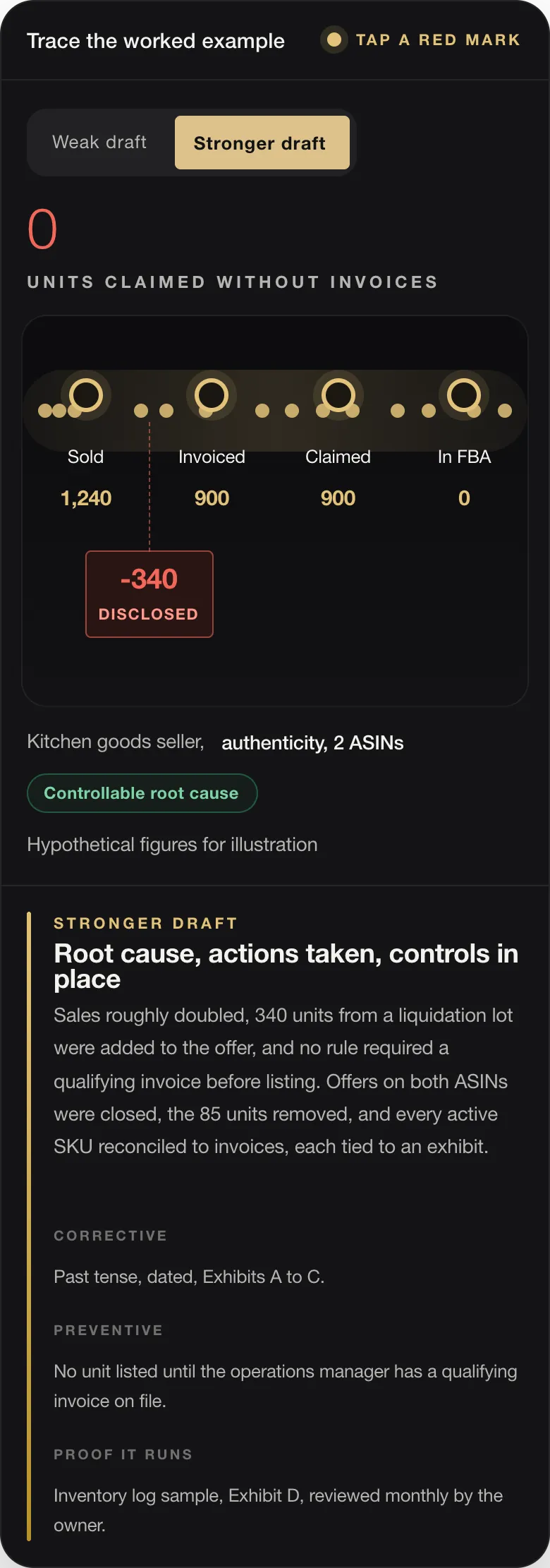
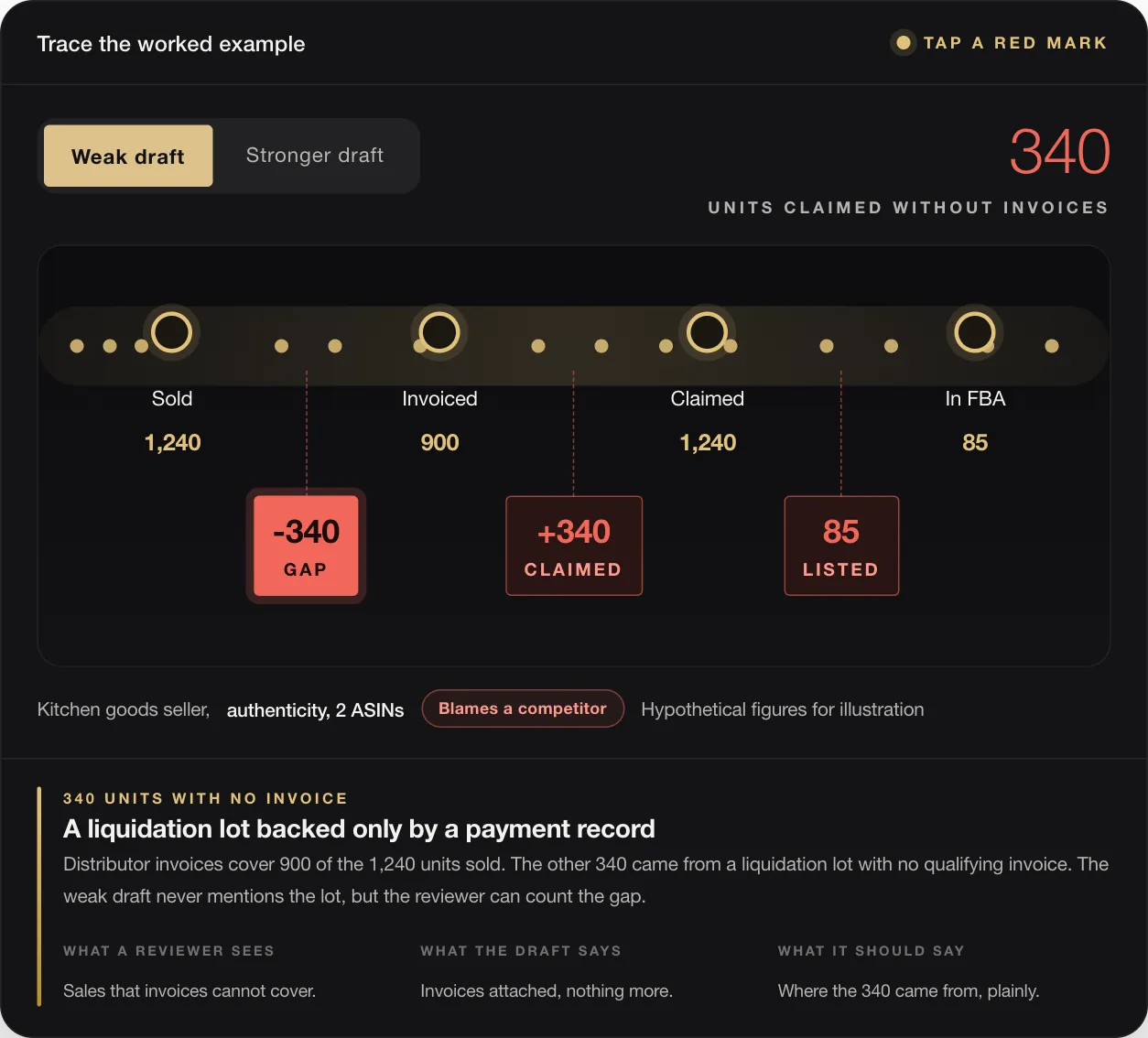
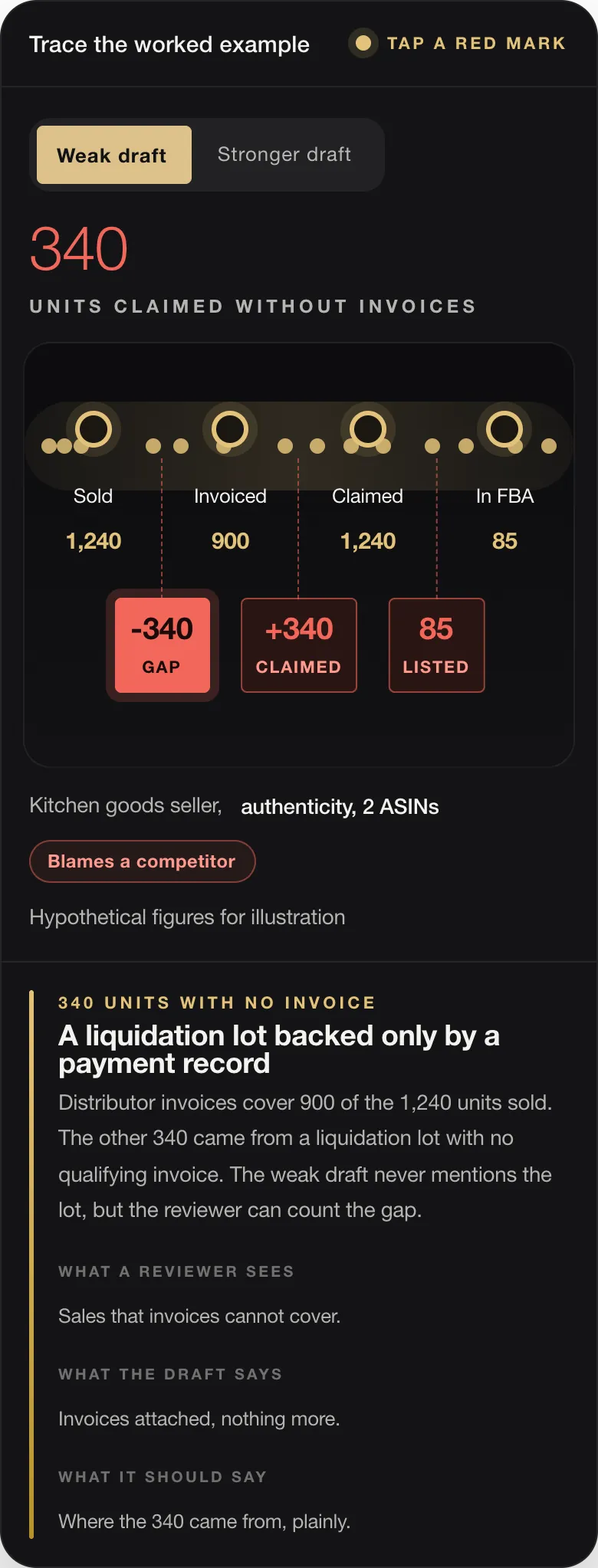
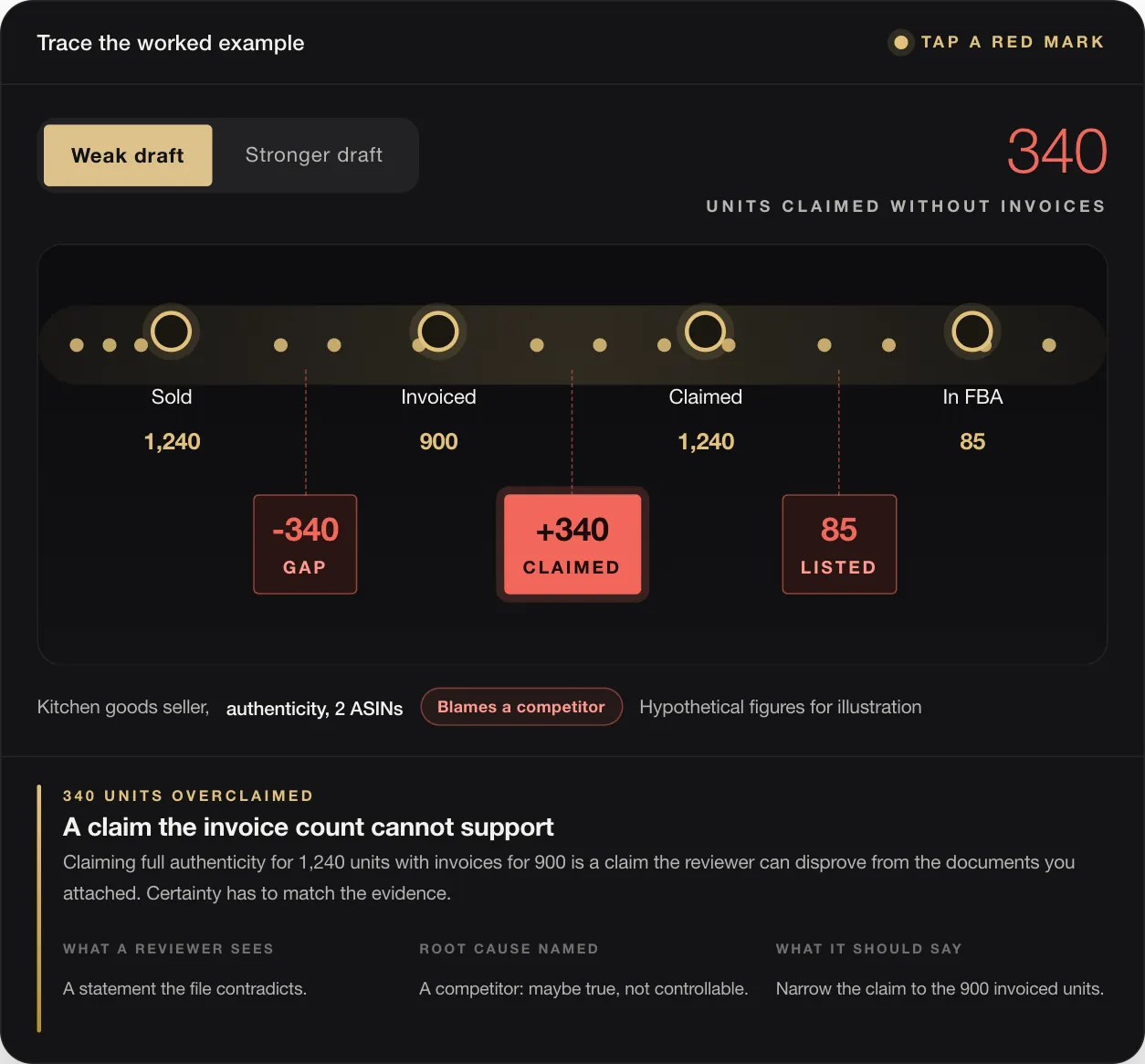
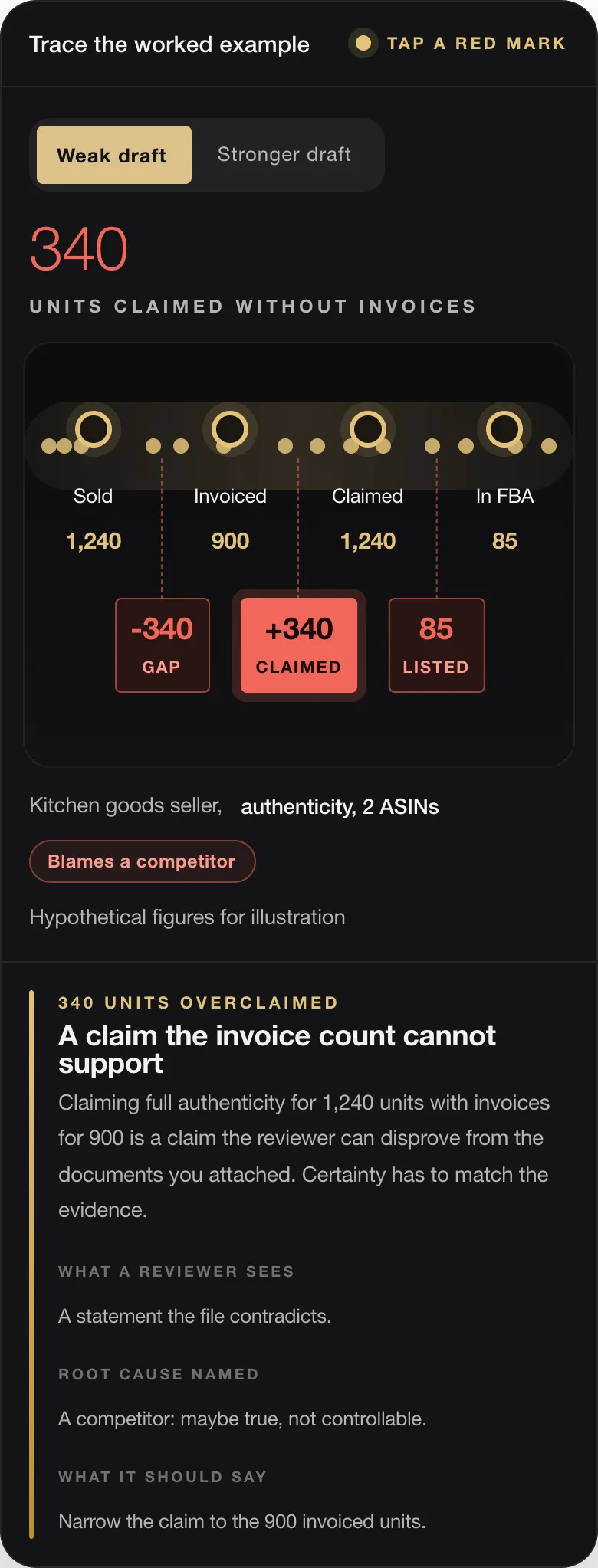
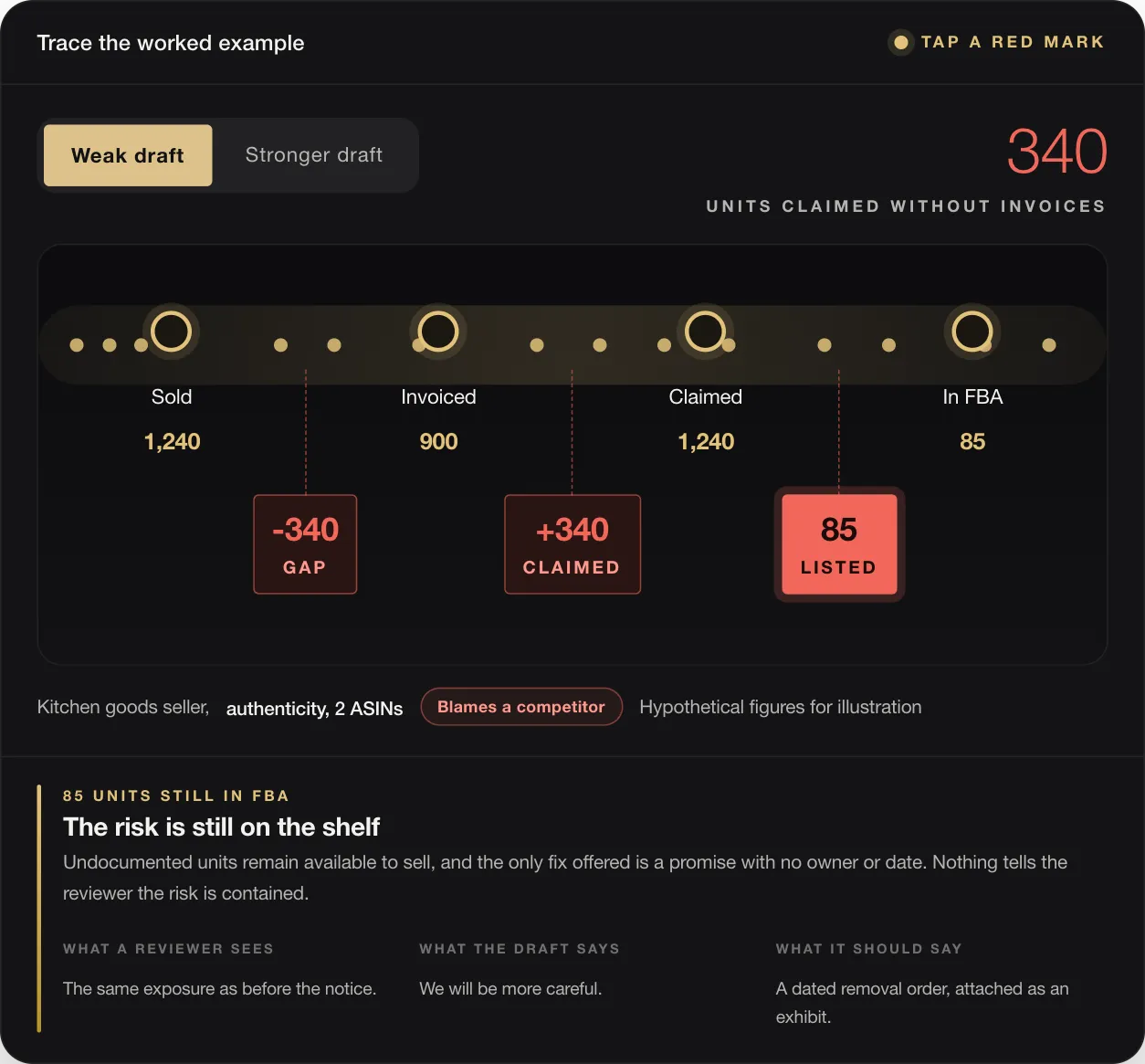
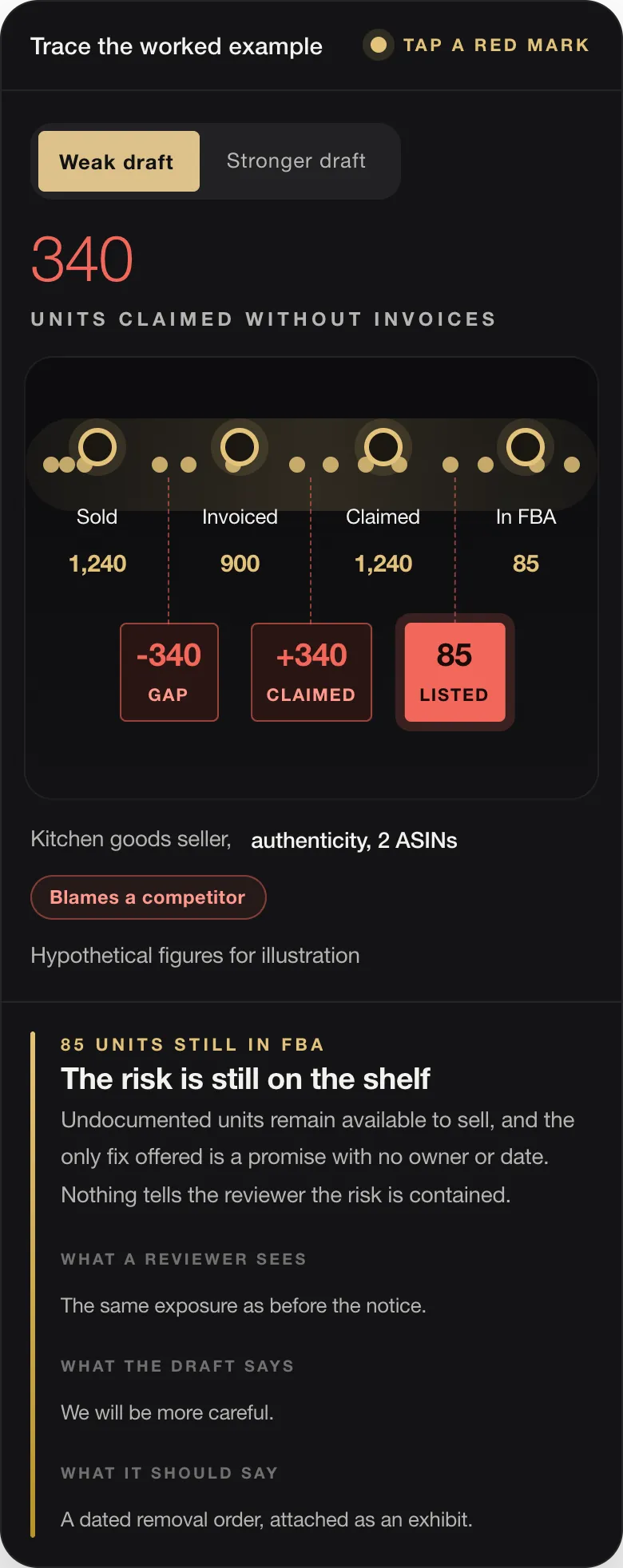
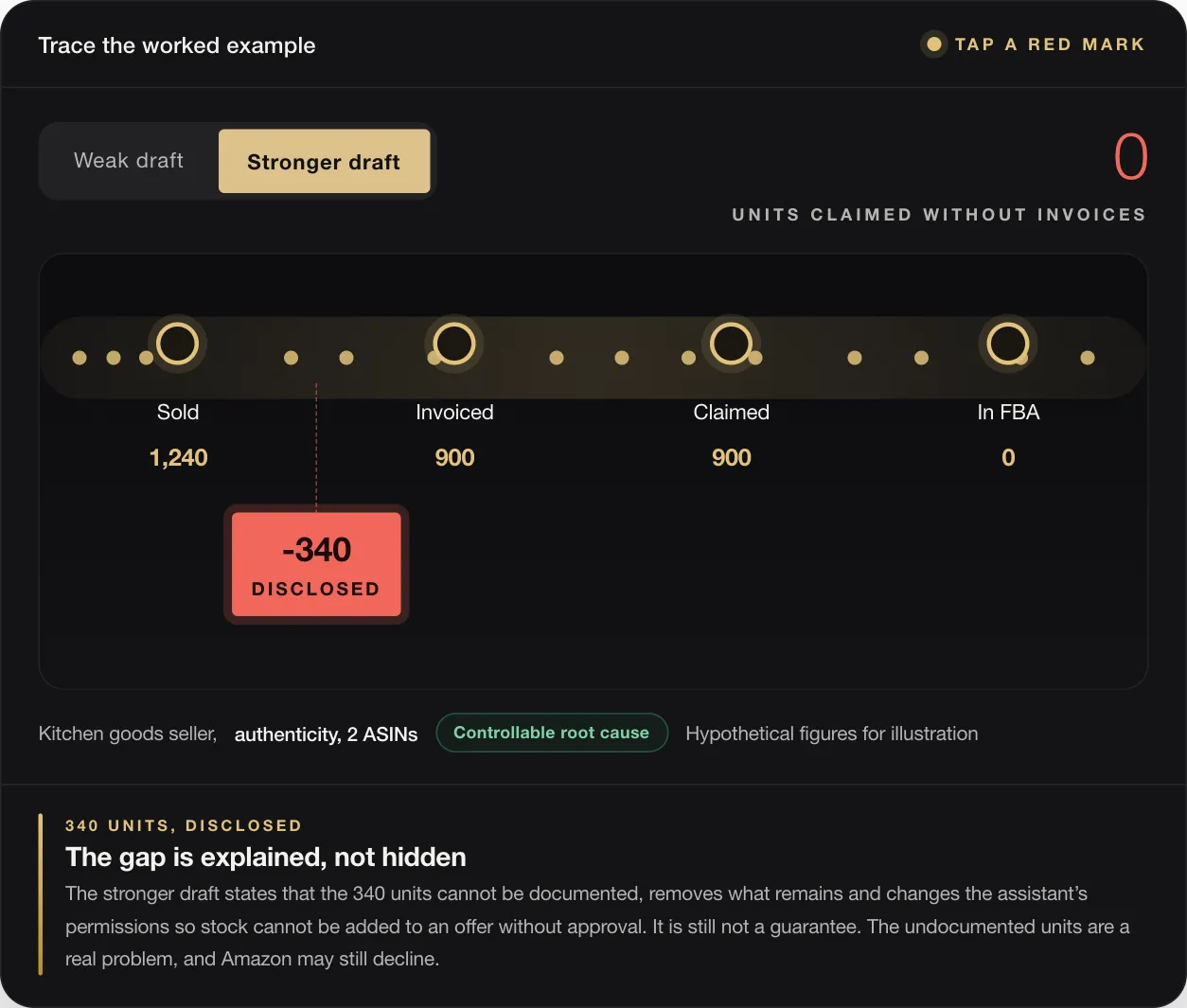
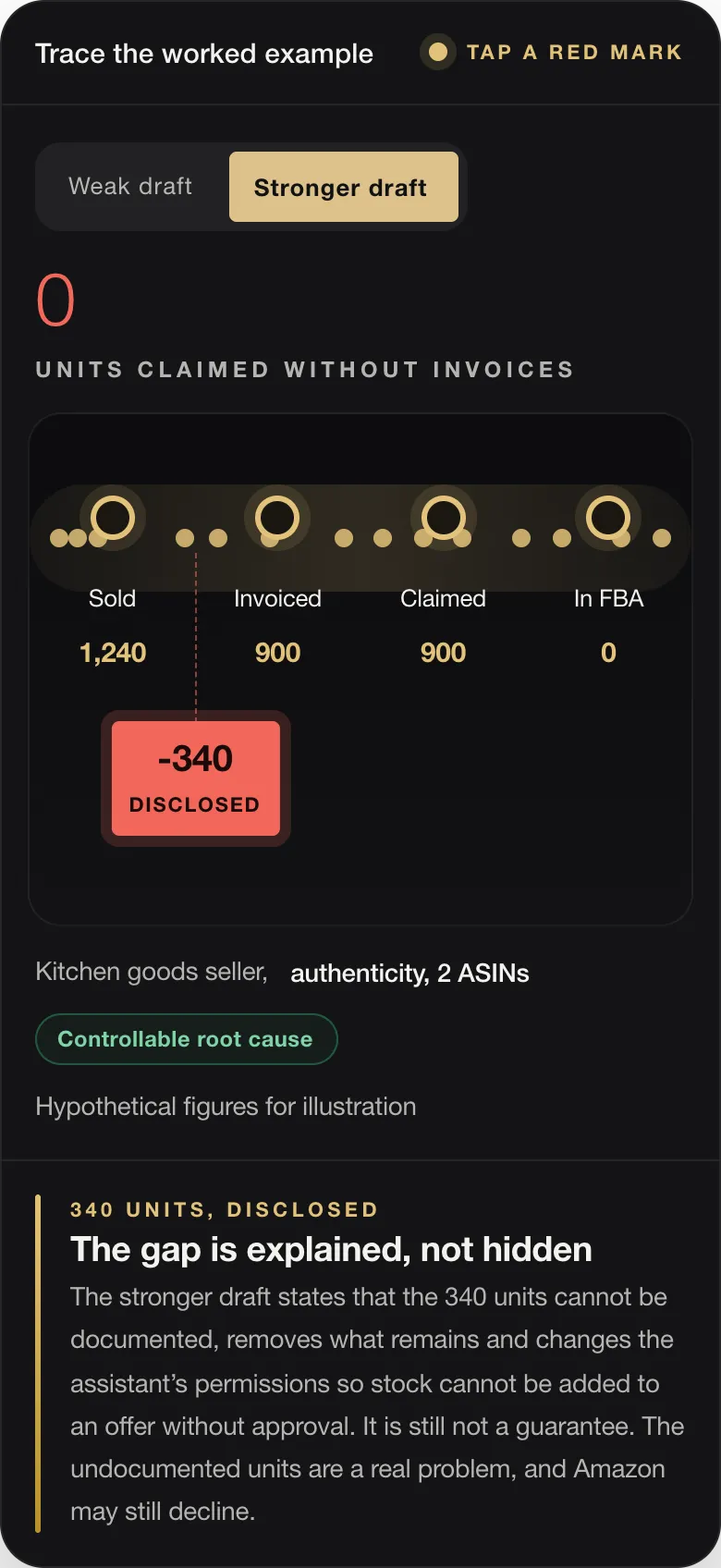
Notice what the stronger draft does not do. It does not claim the liquidation units were genuine, because the seller cannot prove it, and it does not fill the gap with a supplier statement written after the fact. It gets ahead of the mismatch the reviewer would find anyway and shows the condition that allowed it no longer exists. That is the most an honest appeal can do.
Not sure your draft will hold?
Send us the notice and your draft and we will read the case before anything goes to Amazon.
Run a readiness check before you submit
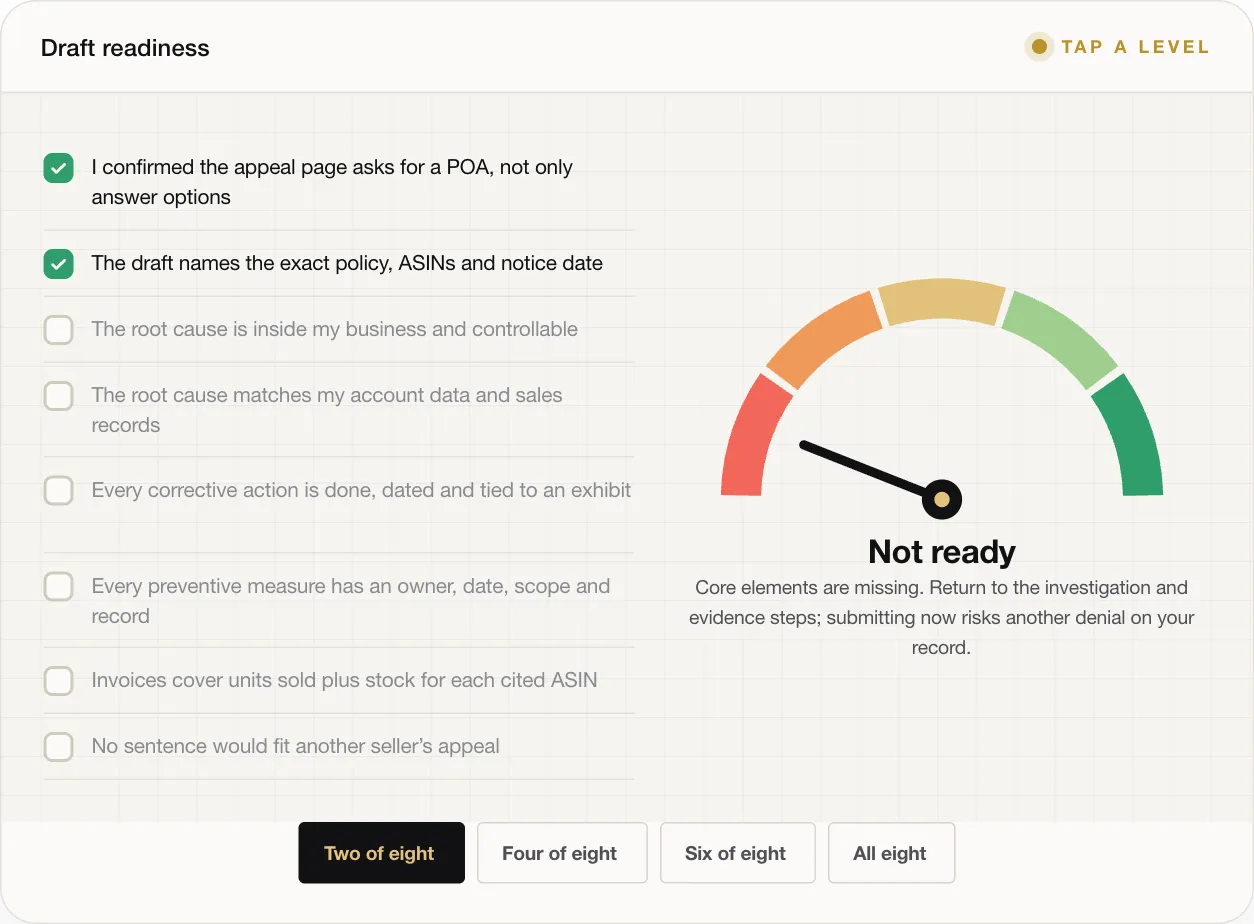
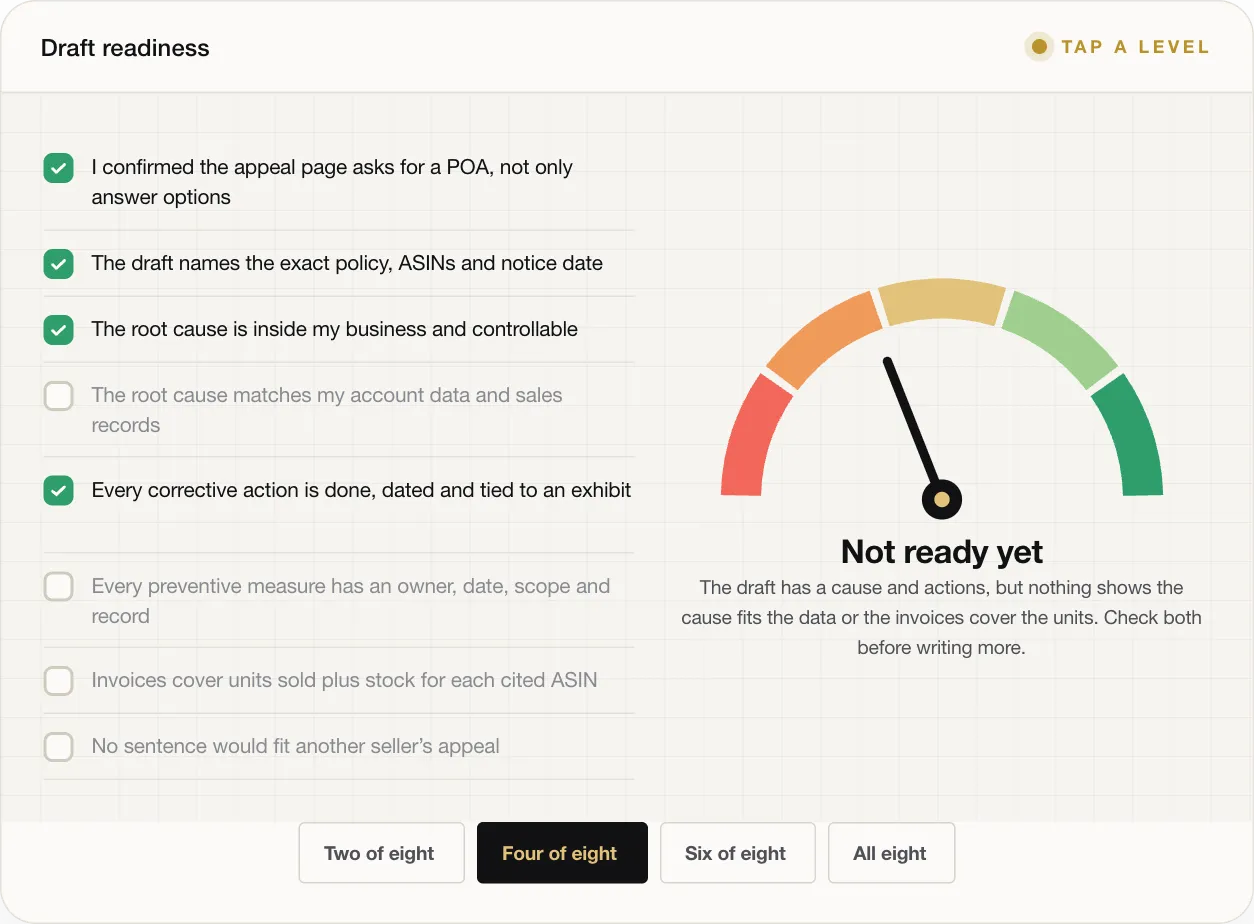
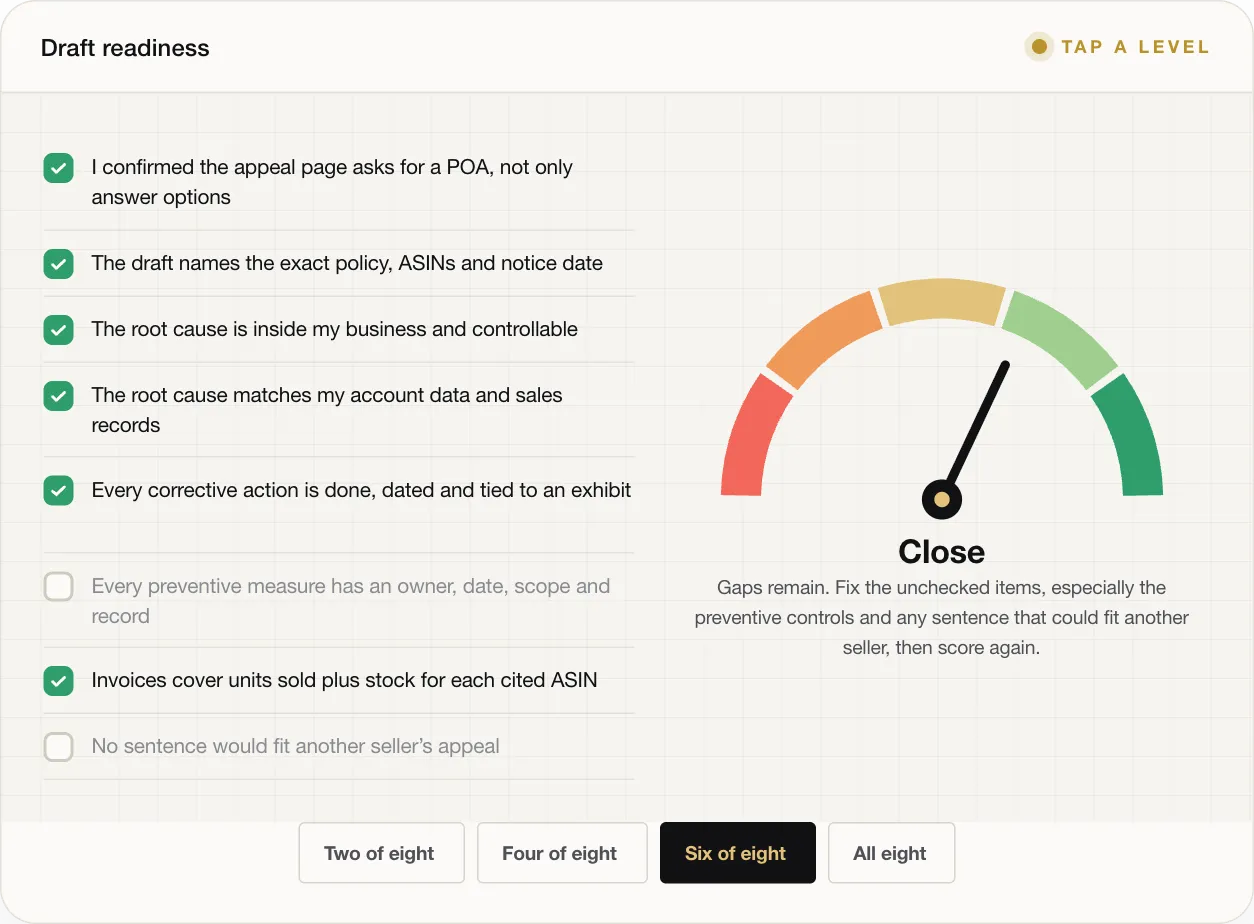
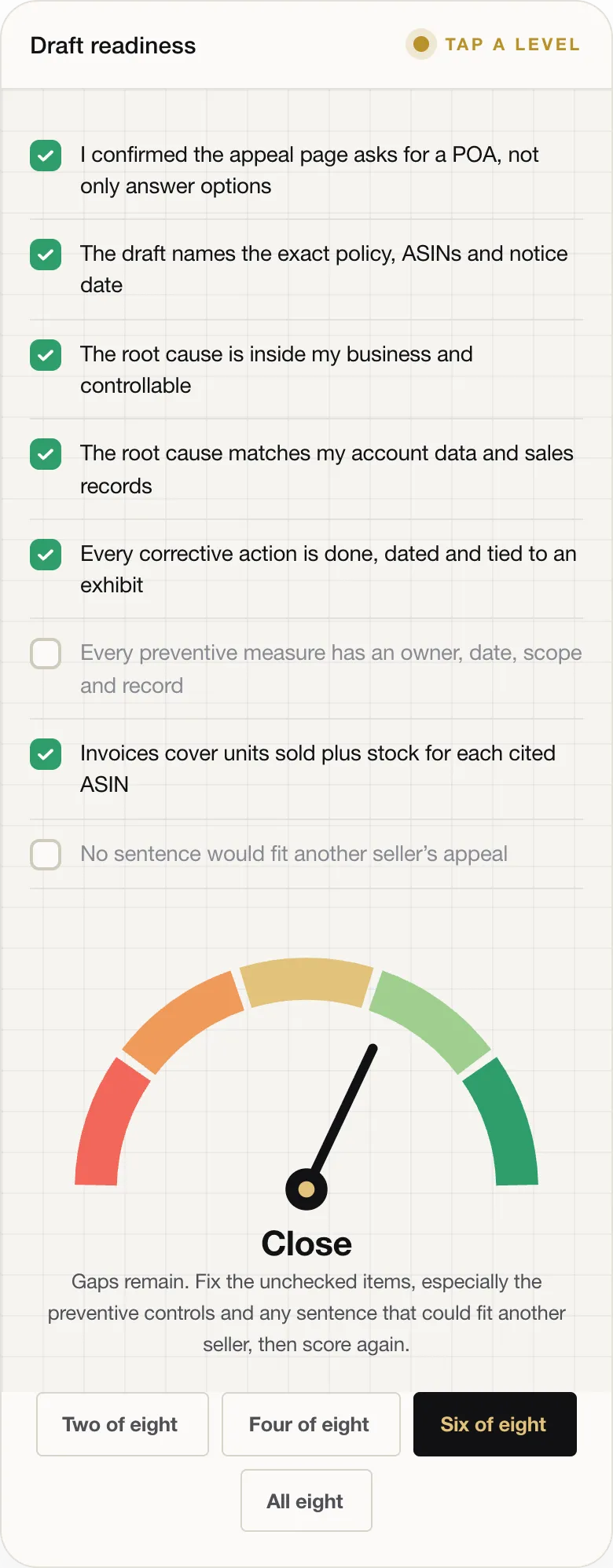
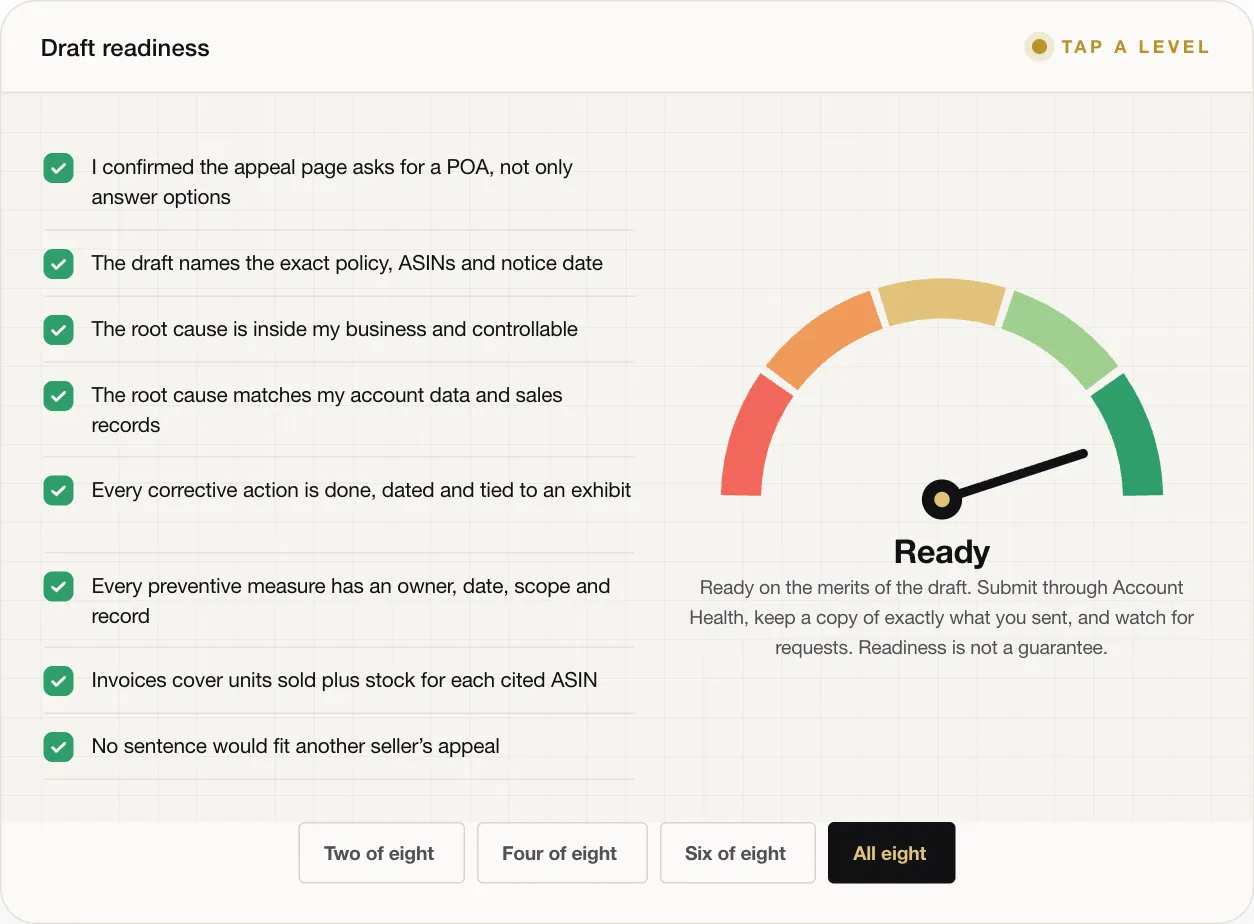
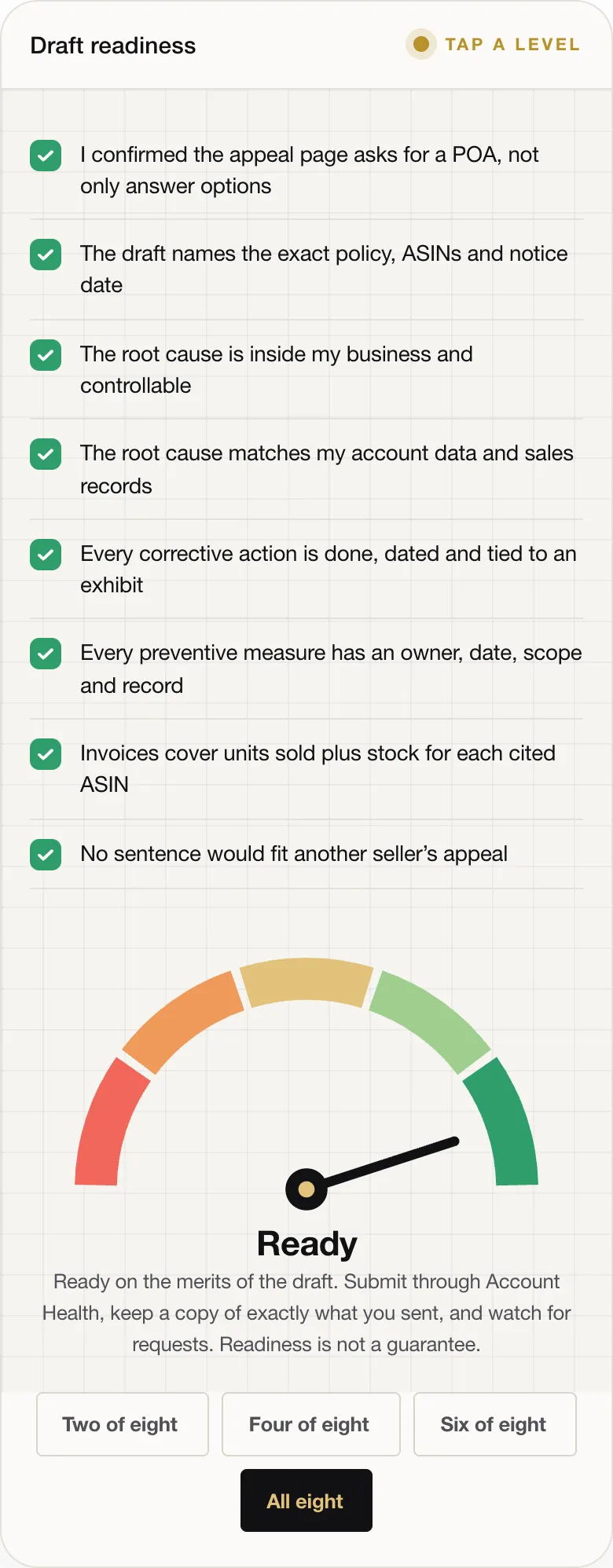
Read your draft once more as a hostile reviewer: hunt for the claim the data could contradict, the sentence that fits any seller, the promise without proof and the plea dressed as an argument. Then score it.
Is your plan of action ready to submit?
Read the draft as a hostile reviewer, then count what is genuinely true. Tap a level to see which checks a draft at that stage usually has, and what to do next.
Amazon’s appeal page says to monitor your email for a decision, to use View Appeal from Account Health if more information is requested, and to expect a reply within two days. Answer any request precisely, with only what was asked for, and keep a dated log. See how long Amazon appeals take for what to expect while you wait.
What to do after a denial
A denial is information. Changing a few words and resending the same file adds another denial to the record and tells the reviewer the account still does not understand its problem. Diagnose first.
| Cause of denial | How it shows up | What to change |
|---|---|---|
| Wording | Sound facts buried in boilerplate or overstated claims | Rewrite to the record, certainty matched to evidence. |
| Routing | Response did not match the flow or format requested | Re-read the notice and appeal page and answer in that format. |
| Evidence | A decisive document was missing, weak or non-compliant | Get the genuine document or narrow the claim; read any rejection reasons in Performance Notifications. |
| Exposure | Account data showed something the POA ignored | Disclose it and explain the control. |
| Framing | The POA answered the trigger, not the cause | Rebuild around the controllable root cause. |
| Viability | The facts do not support reinstatement as filed | Stop refiling; reassess the goal and get advice. |
Amazon’s invoice page says that if it rejects an appeal that included invoices, your Performance Notifications will identify why. Read that message with the same three-read discipline. For mistakes to avoid while a case is open, see ten things to never do after a suspension.
Watch your Account Health Rating while you work
Amazon’s Account Health Rating page says the score runs from 0 to 1,000 and reflects the last 180 days. You lose points for new violations and gain them when violations are successfully addressed. Repeat violations of the same policy cost more each time, and reaching the maximum repeats for one policy in 180 days, which Amazon says can be as low as two for higher severity violations, can put the account at immediate risk of deactivation. The policies counted include anti-counterfeiting, intellectual property, product condition, product safety, restricted products and the seller code of conduct, and Amazon says it combines machine learning with expert human review to detect non-compliance. A POA that fixes the named violation but ignores a related one can leave the account exposed.
Honest viability: when a better letter will not help
Some cases cannot be won as framed. The signs: a decisive document genuinely cannot be obtained and the claim cannot honestly be narrowed; the facts cannot be defended without misrepresentation; Amazon has stated a final decision after appeals were exhausted; an integrity issue exists that no writing can overcome; or a sound, well-evidenced case has been substantively denied more than once.
Recognizing this is not giving up. It may mean changing the goal, building a reconsideration on genuinely new evidence, or getting legal advice on options outside the standard appeal. It should never mean filing doomed appeals out of hope, fabricating, or opening a second account. This is educational information, not legal advice; if your case involves funds, contracts or legal exposure, speak with a qualified attorney.
A repeatable routine for every notice
- Capture the notice and the full Account Health page before acting.
- Read the notice three times and confirm the response format the appeal page asks for.
- Investigate: classify, separate stated from claimed from proven, build the timeline.
- Find the honest, controllable root cause and check it against the data.
- Complete corrective actions and set preventive measures, collecting proof of each.
- Verify and index every exhibit, write from the evidence, then run the checklist.
- Submit through Account Health, log it, and if denied, diagnose before acting.
Once healthy, keep the preventive measures running and keep their records; they are what you reach for if another notice arrives. When a case needs more than one person’s judgment, our Amazon suspension and reinstatement service handles this process every day.
Frequently Asked Questions
What are the three parts of an Amazon plan of action?
Root cause, corrective actions already taken, and preventive measures that stop recurrence, each specific to your case and tied to evidence a reviewer can check.
Does every Amazon policy violation need a plan of action?
No. Amazon’s appeals FAQ says a plan of action will not be accepted for product condition violations, which use answer options and evidence instead.
How long should an Amazon POA be?
As long as the three parts and an exhibit index require for your case, and no longer. Padding buries what the reviewer is looking for.
What is the difference between corrective and preventive actions?
A corrective action is already done, in the past tense with proof. A preventive measure is an ongoing control with an owner, a date, a scope and a record.
What invoice details does Amazon require?
Supplier contact details, an issue date within 365 days before the notification, quantities covering sales and stock for each cited ASIN over 365 days, clear product identifiers, and PDF or image format up to 10MB, per Amazon’s invoice requirements page.
What should I do if my POA is denied?
Diagnose whether the cause was wording, routing, evidence, exposure, framing or viability, and change that element. Resending the same file adds another denial.
Can I use a POA template?
A structure helps, but copied wording fails because reviewers see the same sentences constantly. Every sentence should belong only to your business and this incident.
What if I cannot get the documents Amazon asked for?
Never create or alter a document. Narrow the claim to what genuine records support, remove inventory you cannot document, and reassess honestly whether the appeal can succeed.
Get Help With Your Amazon Plan of Action
If your case involves invoices that do not reconcile, an account-level deactivation, a second denial or held funds, an outside review can keep a recoverable case from becoming a lost one. You can submit your case for our team to review, or book a consultation to talk through your notice, evidence and honest options before you file.
This article is general educational information about Amazon’s published seller policies, not legal advice. Amazon changes its policies and pages, so confirm current requirements in Seller Central before acting. The worked example is hypothetical. No outcome, timeline or reinstatement is guaranteed.
Sources
- Amazon Seller Central: Policy violation appeals FAQ
- Amazon Seller Central: Appeal an account deactivation or listing removal
- Amazon Seller Central: Invoice requirements for appealing a policy violation
- Amazon Seller Central: Account Health Rating program policy
- Amazon Seller Central: Policies included in Account Health Rating
- Amazon Seller Central: Selling policies and seller code of conduct
- National Association of Secretaries of State: business entity registration
