
Quick answer: There is no single fix for every Amazon listing problem, but there is a single method that works on all of them. First, find the exact status and reason in Seller Central: the Fix tab on the Manage Products page, the “Search suppressed” and “At-risk of search suppression” filters in Manage All Inventory, and the Account Health dashboard for policy removals. Second, classify the reason: a data or content problem (missing attributes, image, title), a catalog structure problem (duplicate ASIN, wrong category, bad variation), or a rights and safety problem (suspected IP, authenticity, compliance). Data and structure problems are fixed by editing the listing. Rights and safety problems need evidence and often an appeal. Then check every other listing for the same cause before you move on.
Most sellers meet listing problems one at a time: a best seller drops out of search, another SKU goes inactive, a third is removed with a message that names a policy but not the line that was broken. Each gets a quick edit and a hope. A quick edit that does not match the real reason leaves the listing down, and a listing problem that is really a rights or safety signal can grow into an account problem while the seller is changing bullet points.
This guide maps each status and message to the place in Seller Central where the real reason lives, the fix that matches it, the cases that need an appeal with evidence, and how to stop the problem coming back.
What a listing problem actually is
The detail page is not your property. Amazon’s catalog is shared: many sellers can offer the same ASIN, several contributors can submit data to it, and Amazon decides what is displayed. Amazon’s product detail page rules say the policies exist so “each product detail page covers a single unique item.” So ask three questions: which rule did this page break, who put that content there, and what does Amazon need to see before it shows the page again.
The statuses you will see
Amazon uses several words for a listing that is not selling normally, and they are not interchangeable.
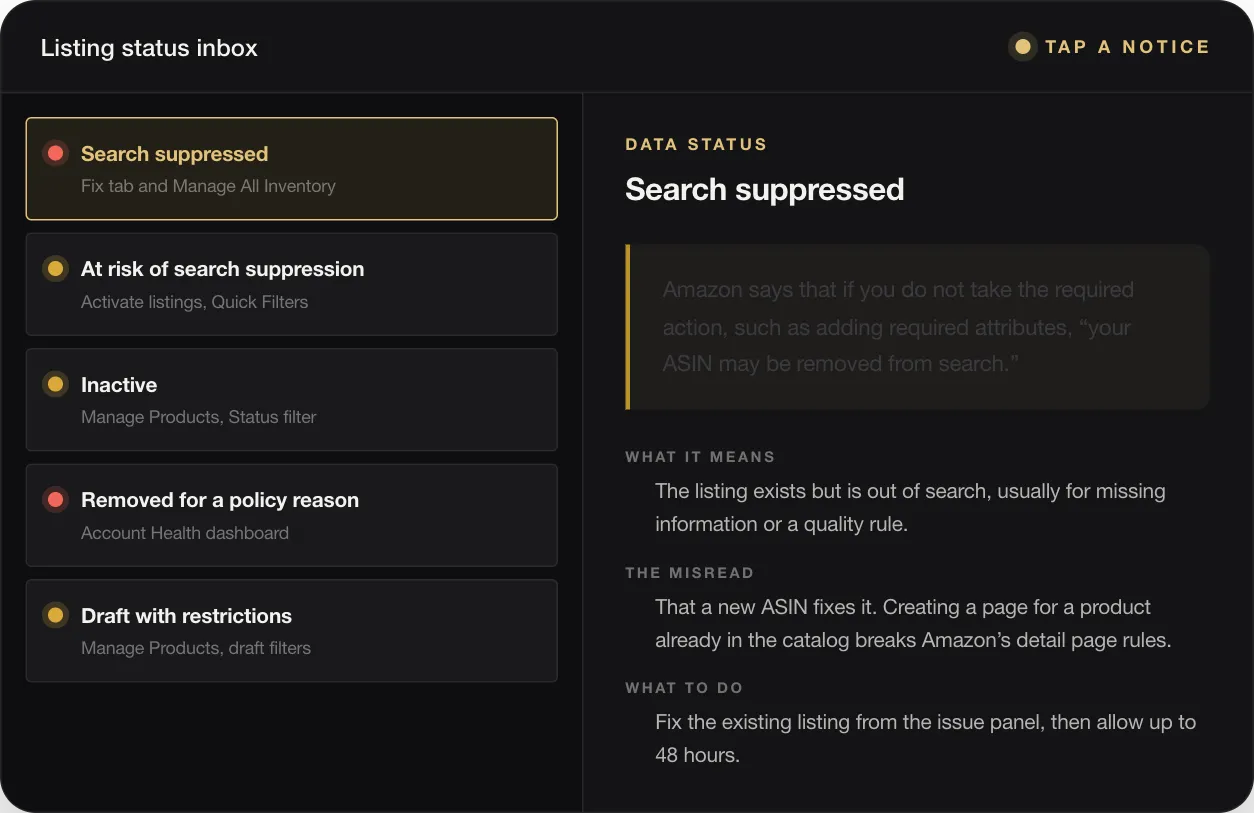
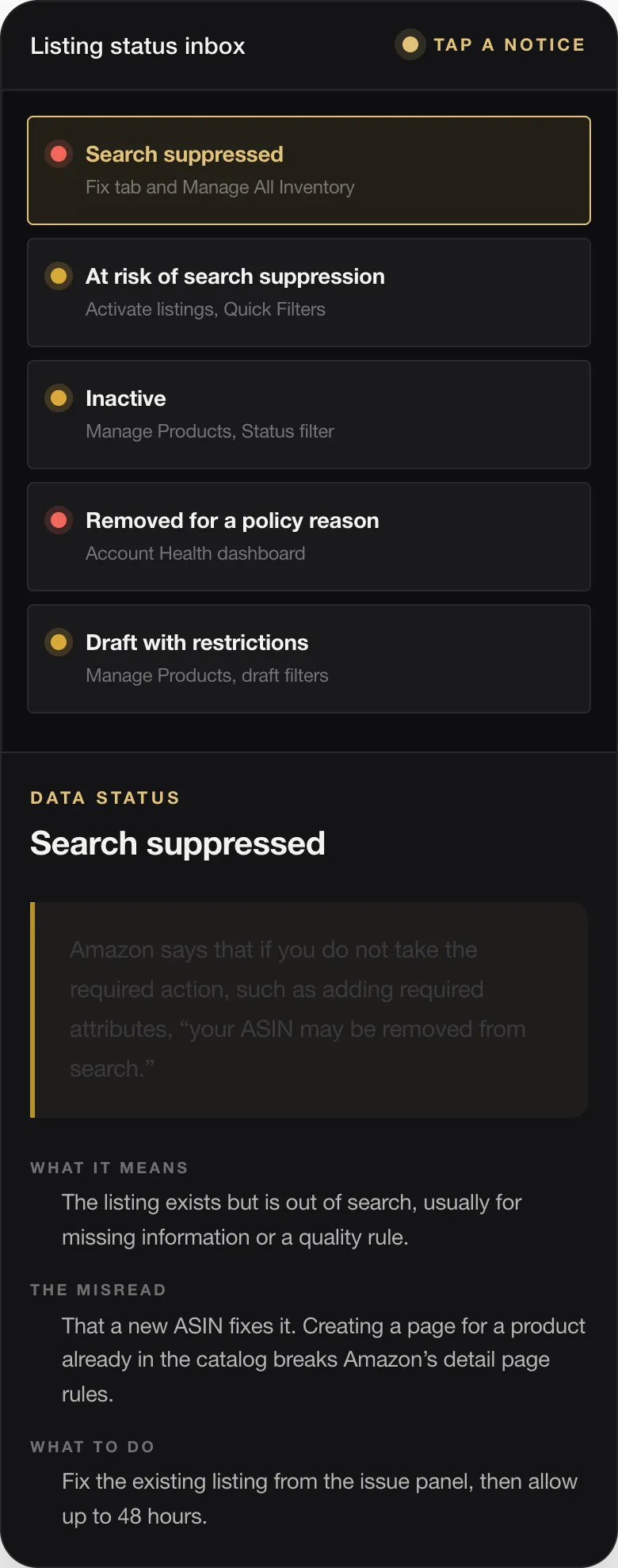
- Search suppressed: the listing exists but Amazon has removed it from search, usually because required information is missing or a quality rule is not met. Amazon says that if you do not take the required action, such as adding required attributes, “your ASIN may be removed from search.”
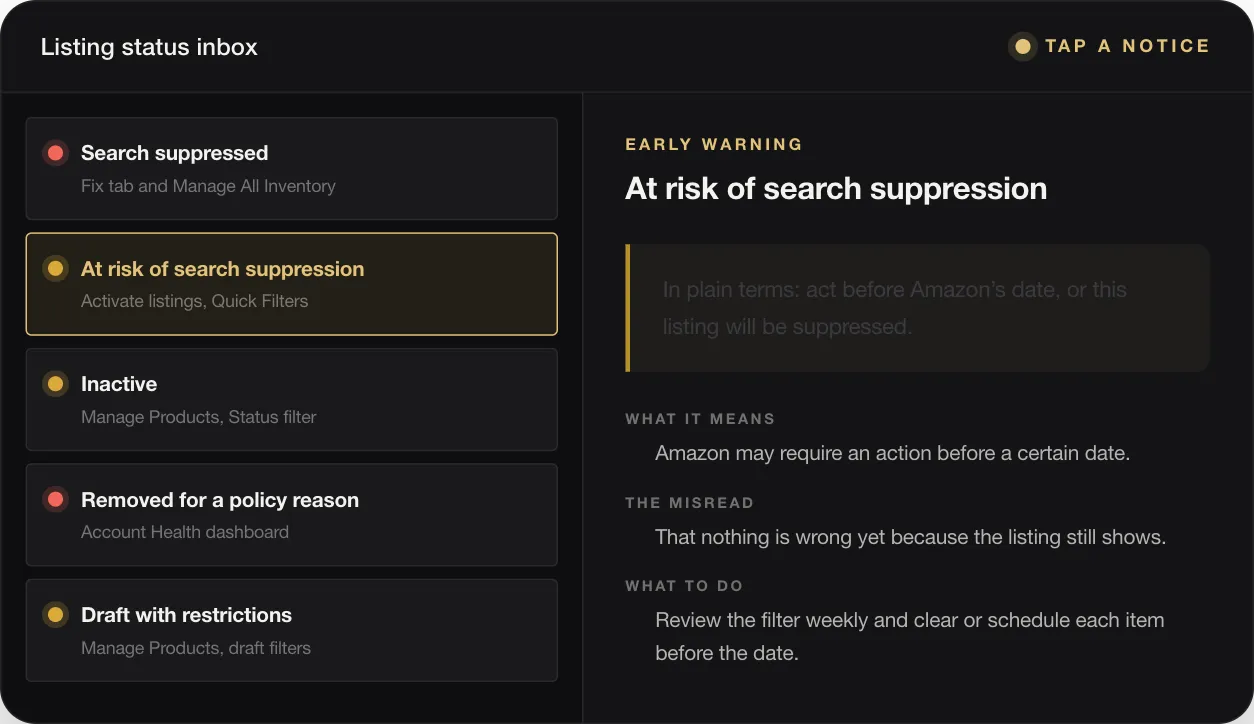
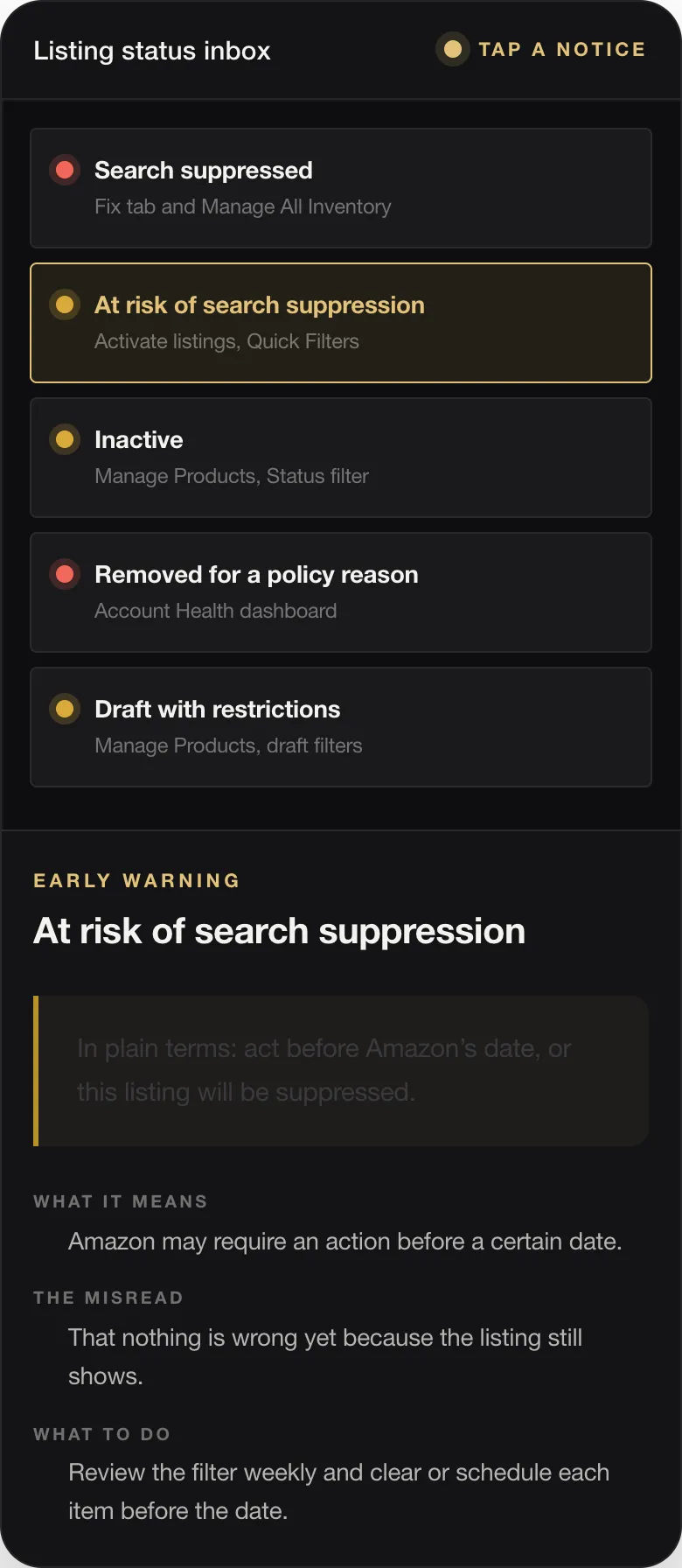
- At risk of search suppression: an early warning. Amazon may require you to act before a certain date, and the listing will be suppressed if you do not.
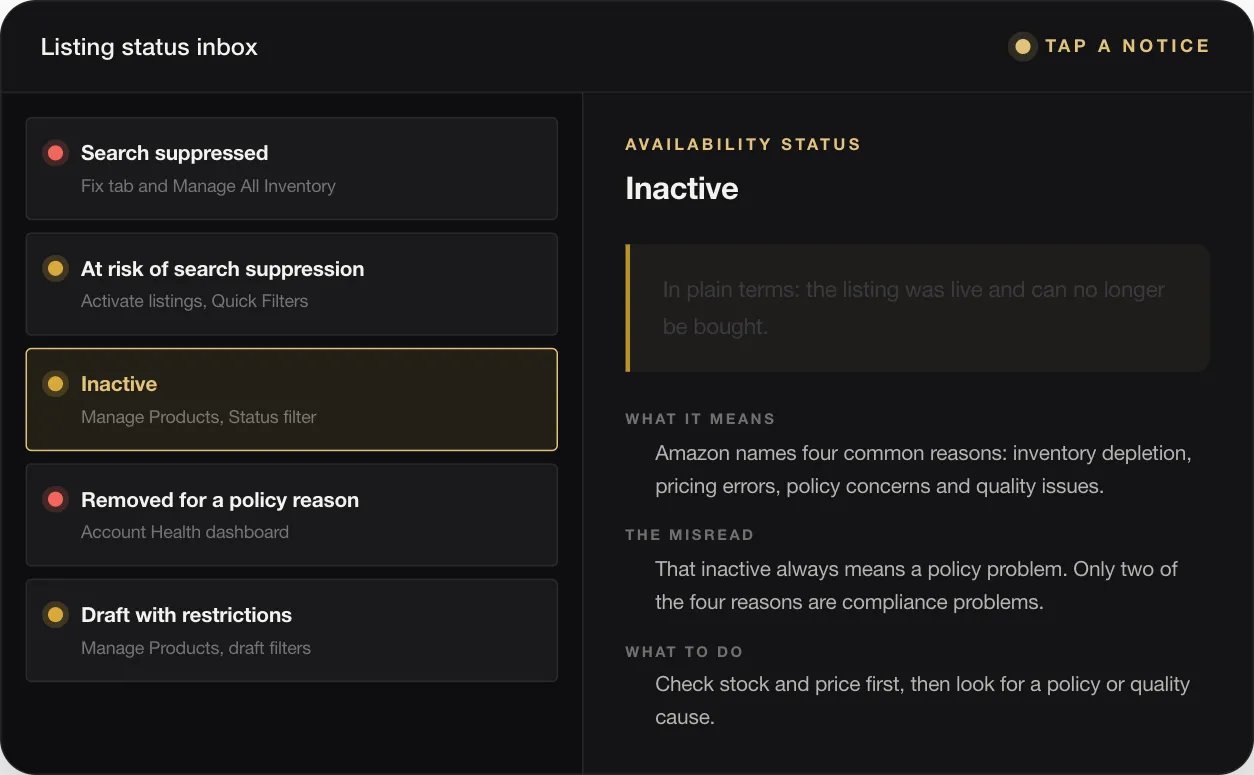
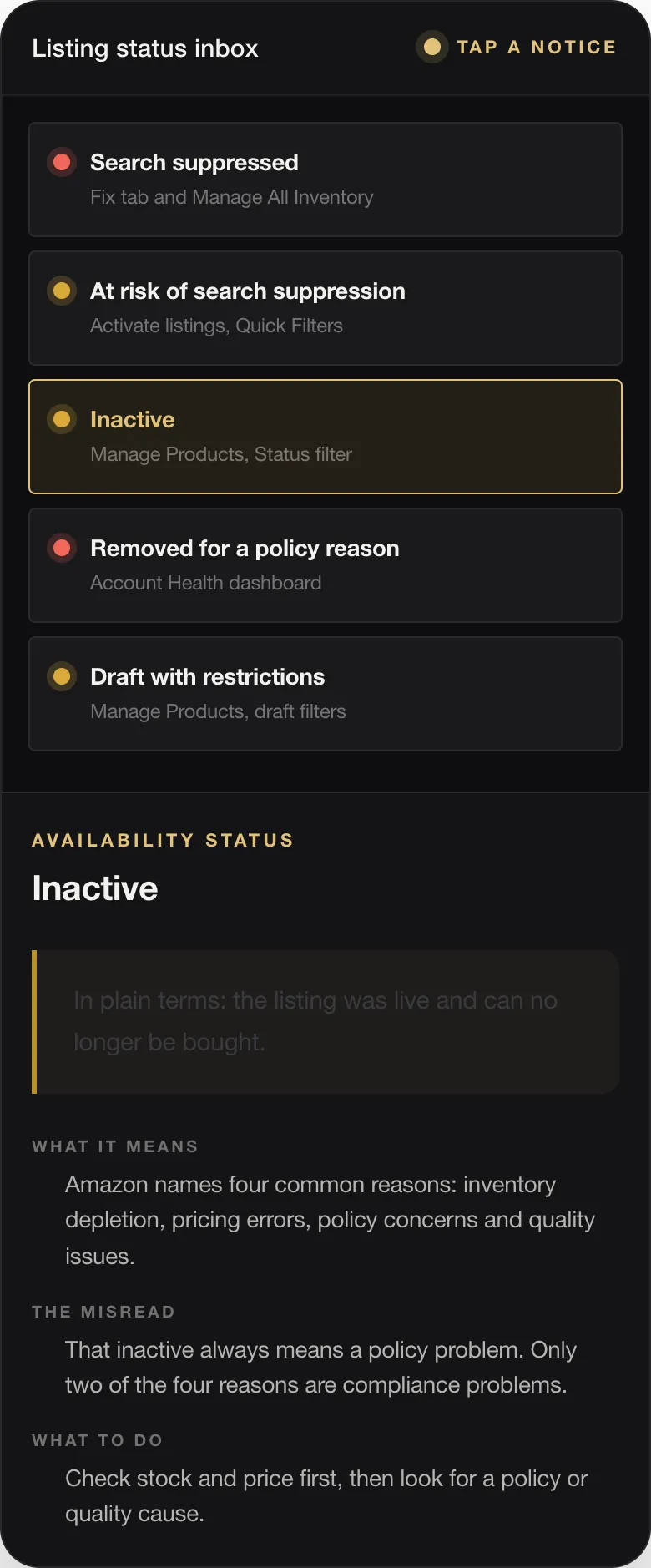
- Inactive: a listing that was live and is no longer available for purchase. Amazon’s Manage Products guide lists the common reasons as inventory depletion, pricing errors, policy concerns and quality issues. Only the last two are compliance problems.
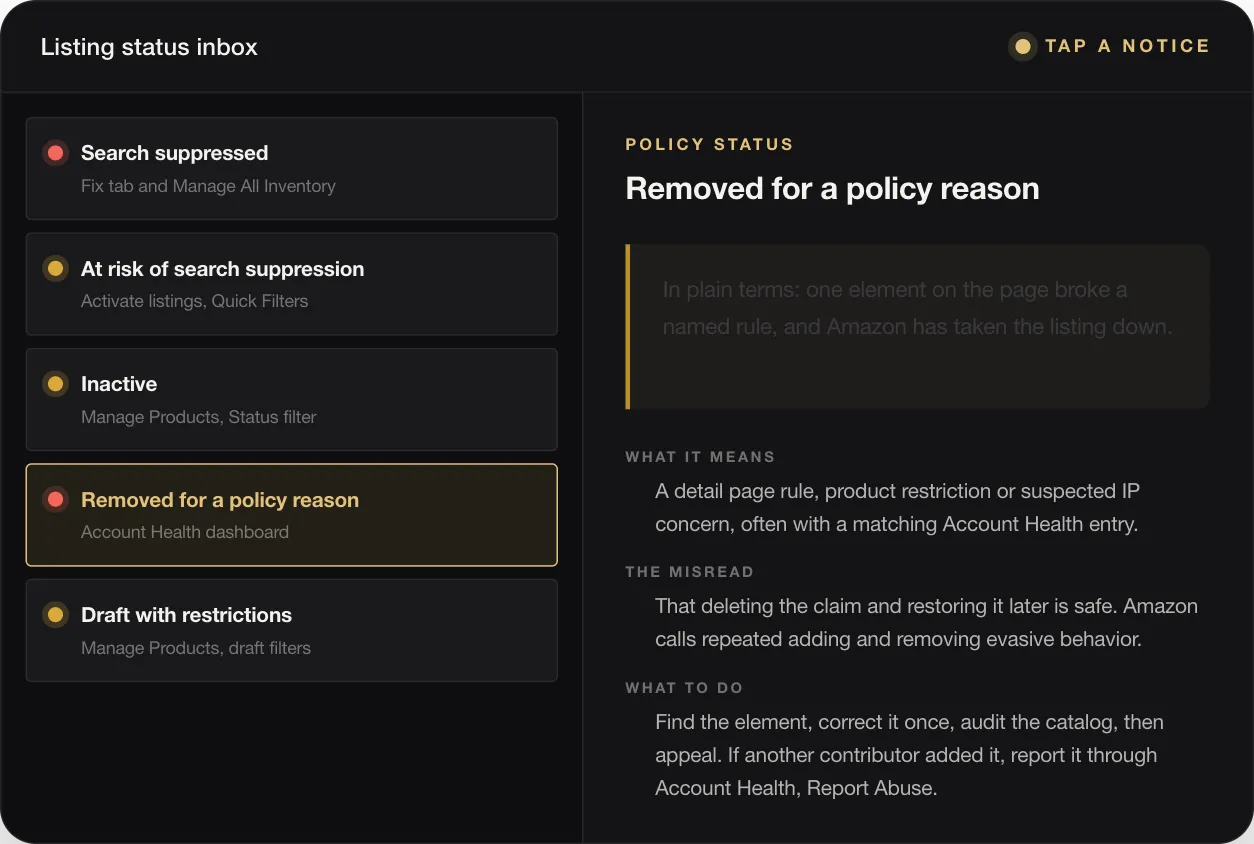
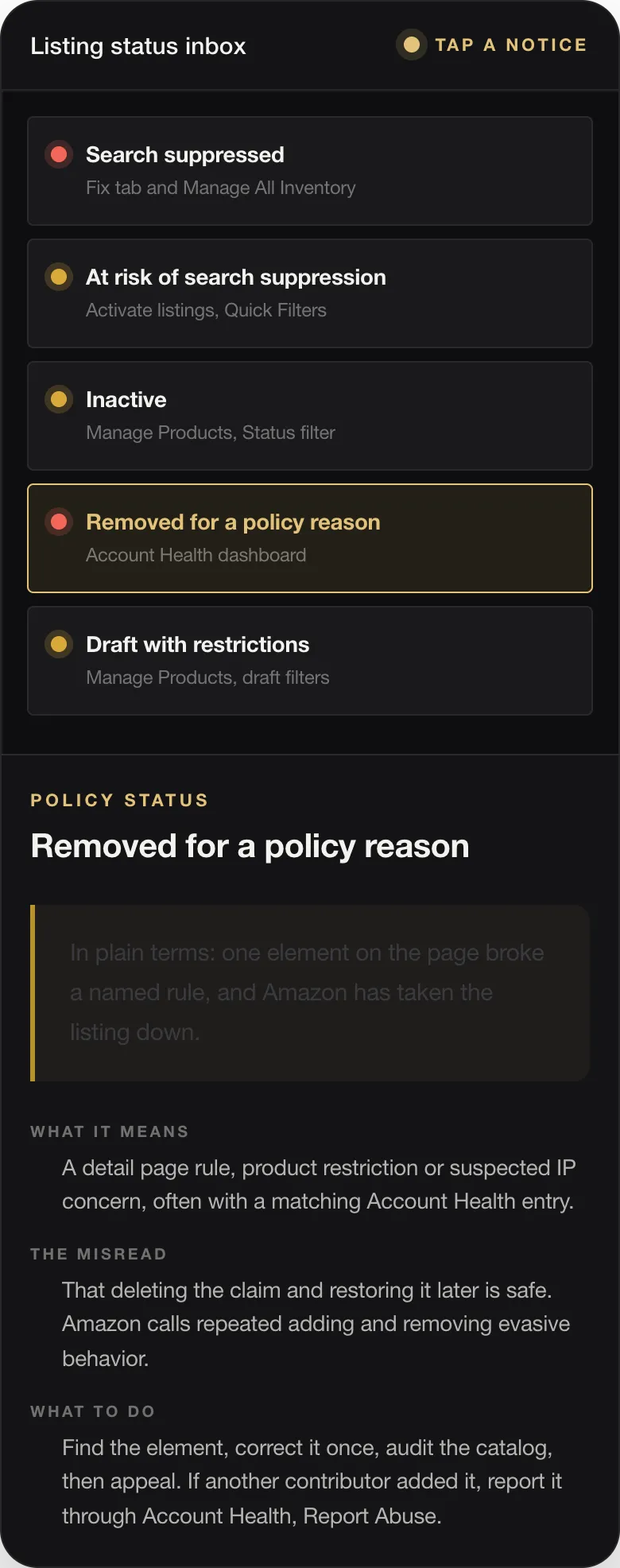
- Removed or deactivated for a policy reason: taken down under a detail page rule, a product restriction or a suspected intellectual property concern, often with a matching entry in the Account Health dashboard.
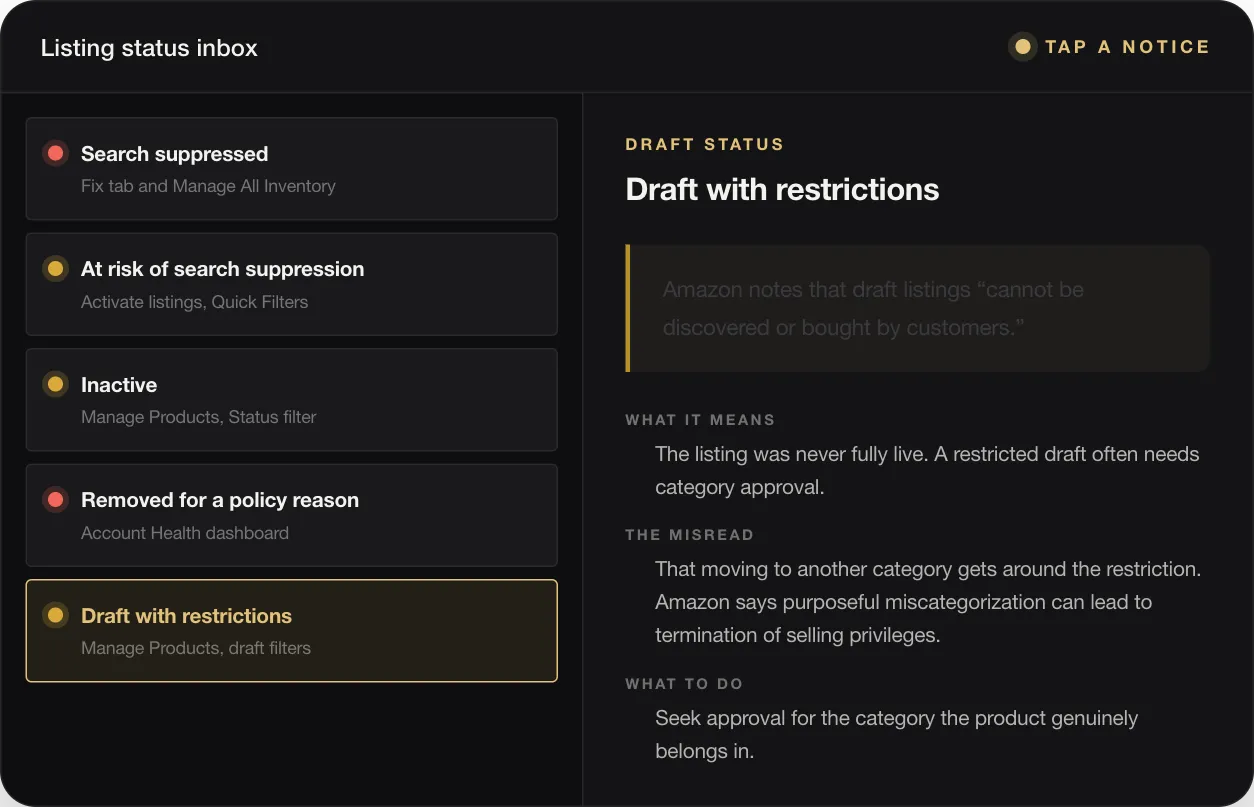
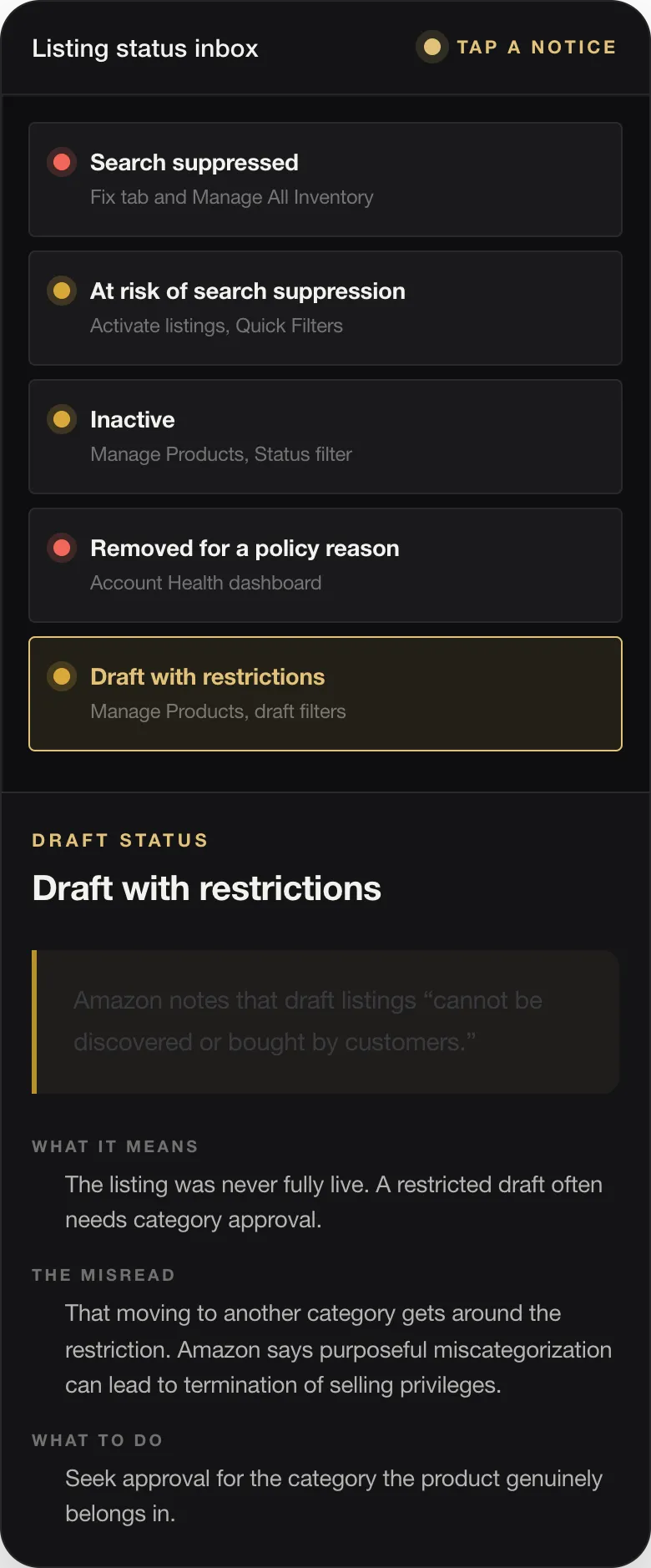
- Draft with missing details or restrictions: a listing that was never fully live. Amazon notes that draft listings “cannot be discovered or bought by customers.”
Where to find the exact reason in Seller Central
Amazon’s help pages describe two inventory views: the Manage Products dashboard and Manage All Inventory. Use whichever your account shows; the walkthrough covers both.
The status is on the surface. The reason is in a room.
Seller Central keeps the real reason for a listing problem in a few specific places. Walk them in order, and copy the wording before you change anything.
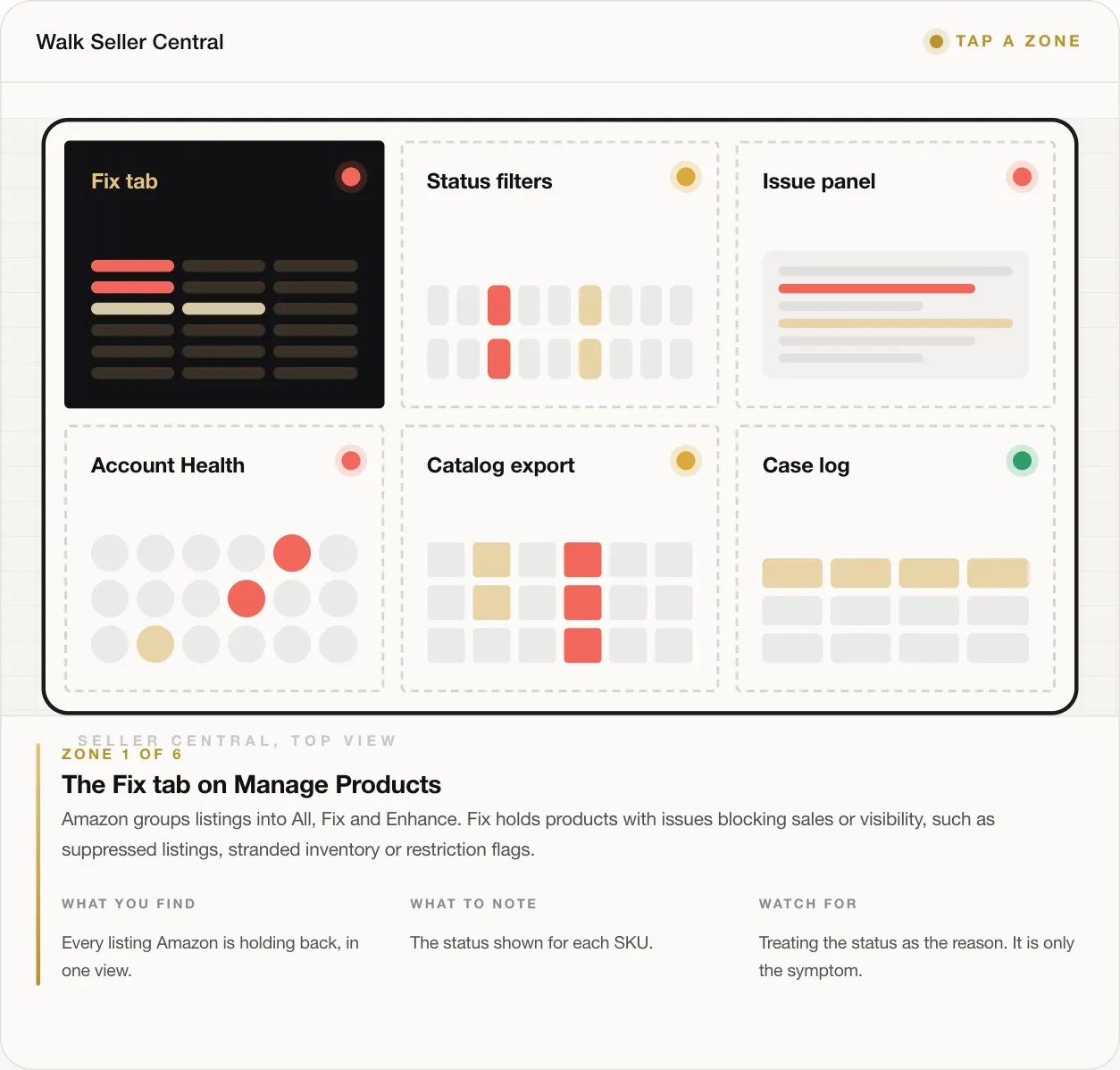
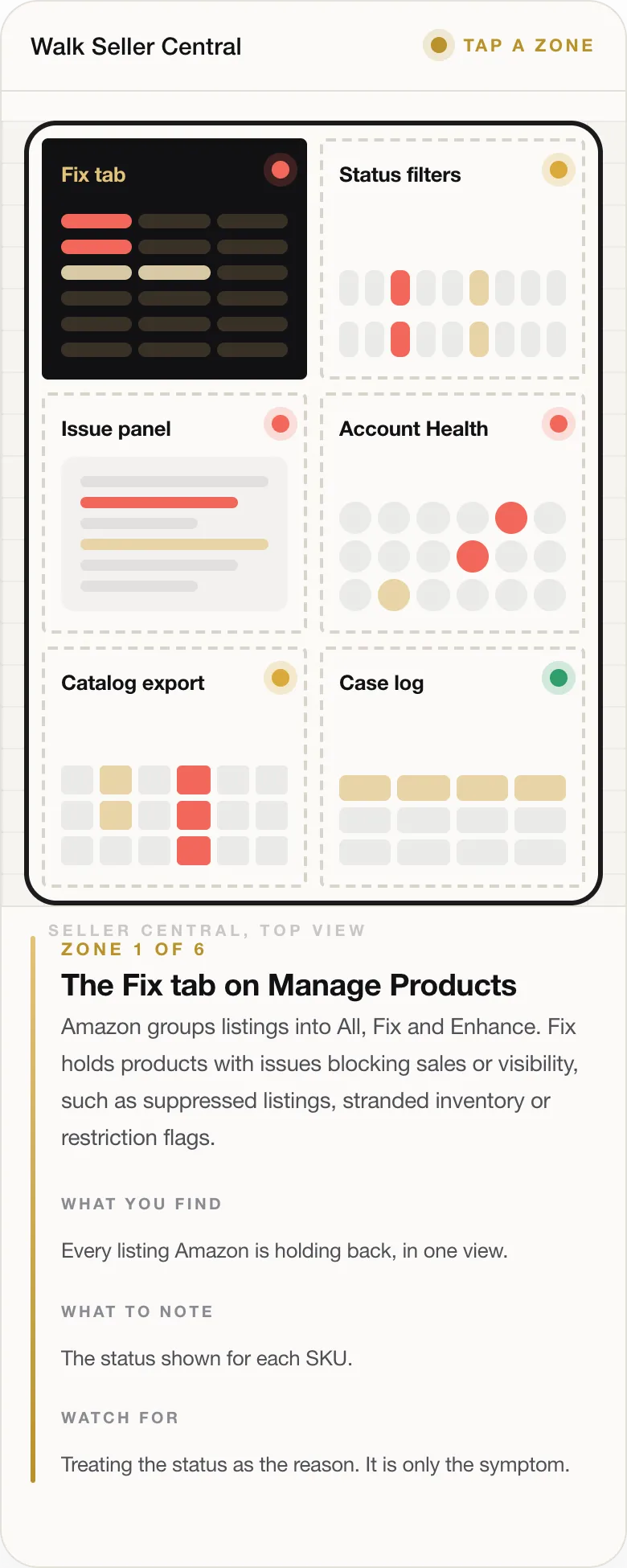
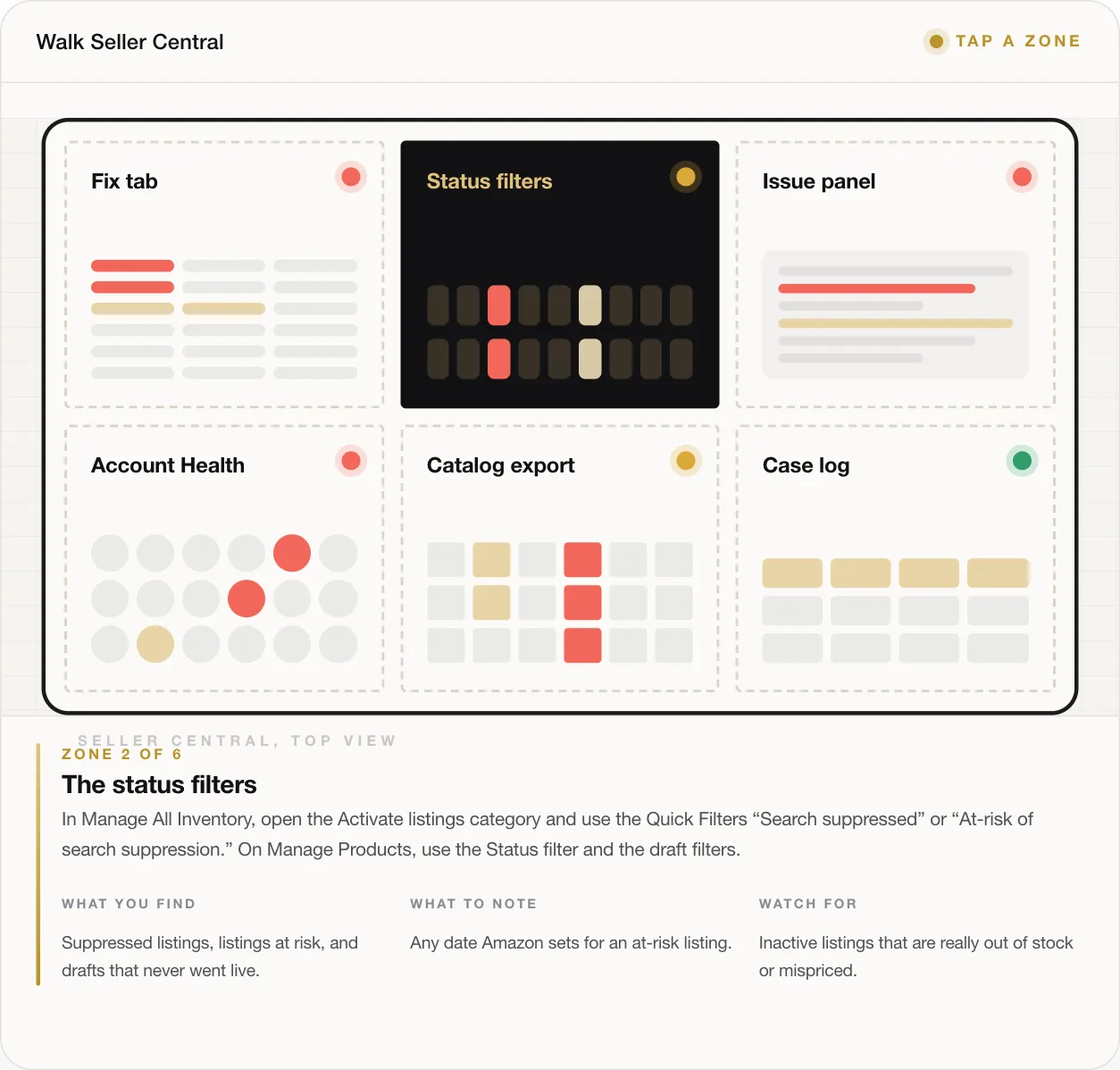
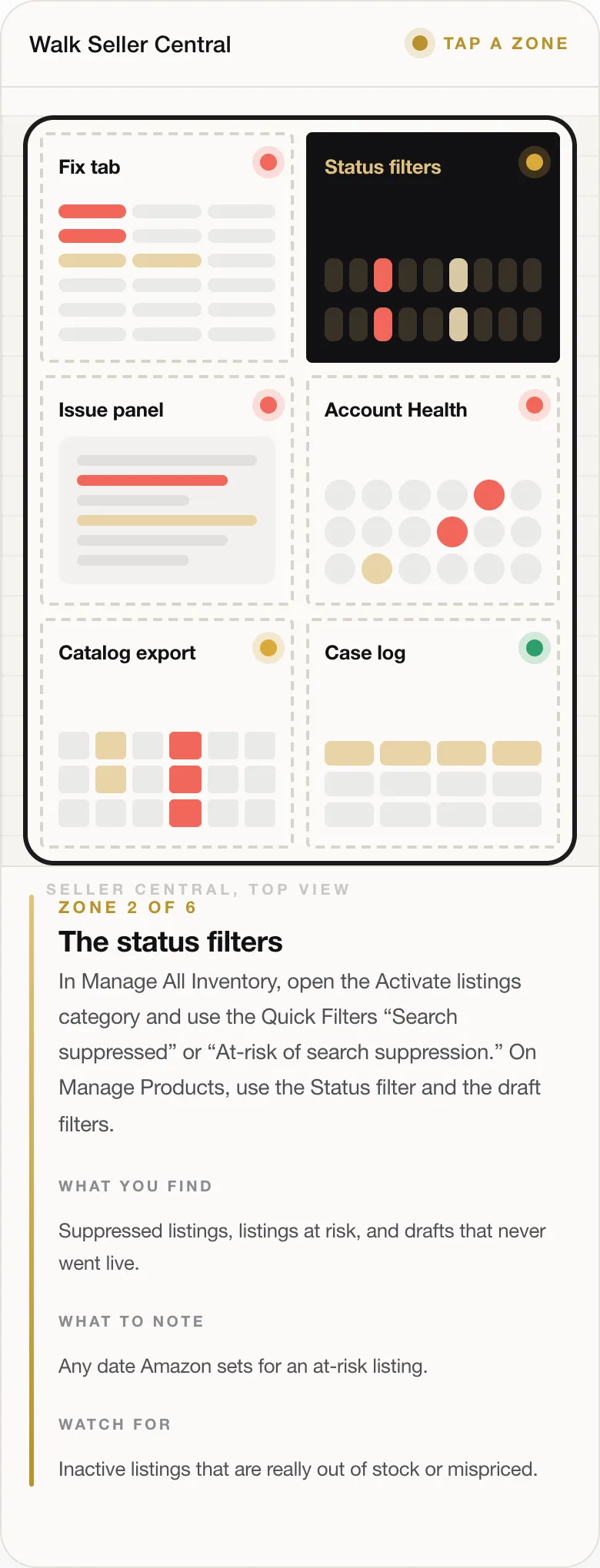
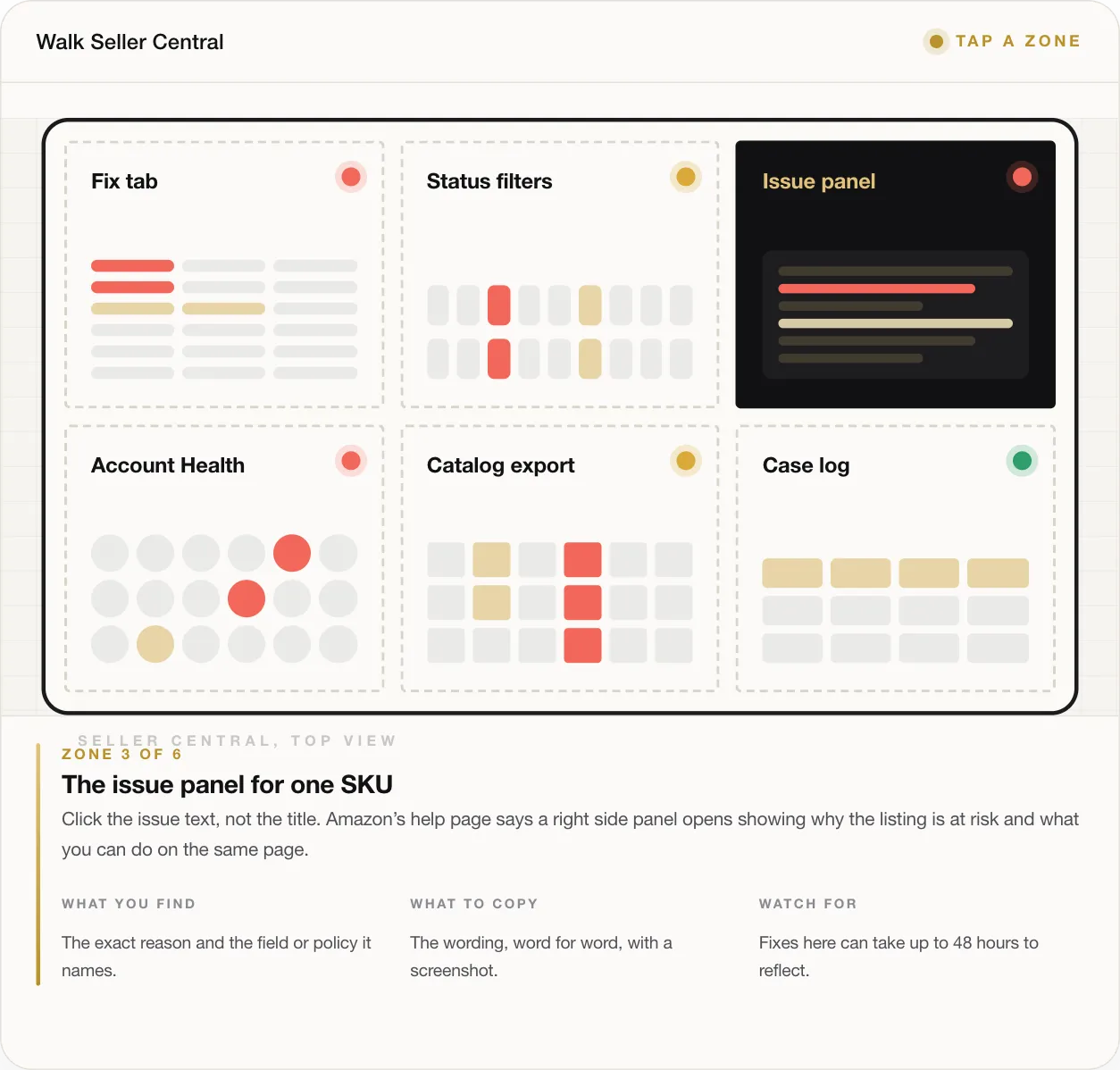
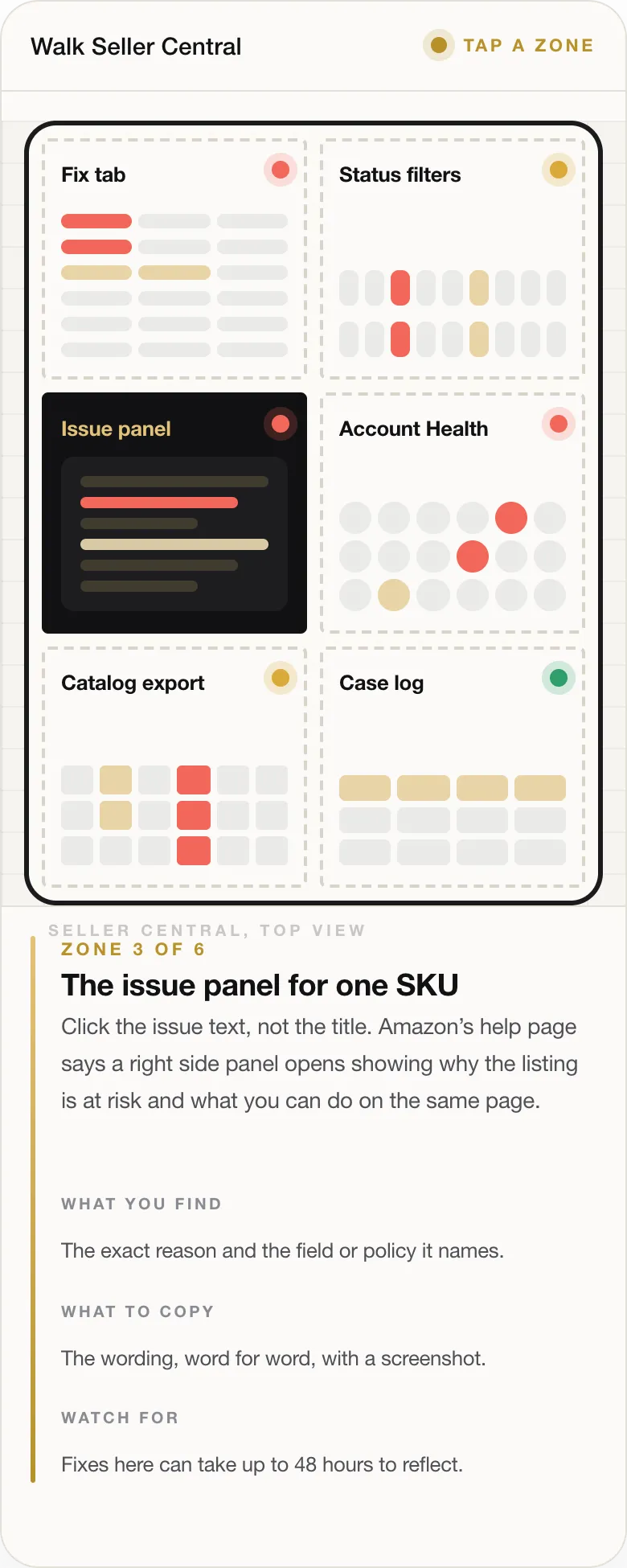
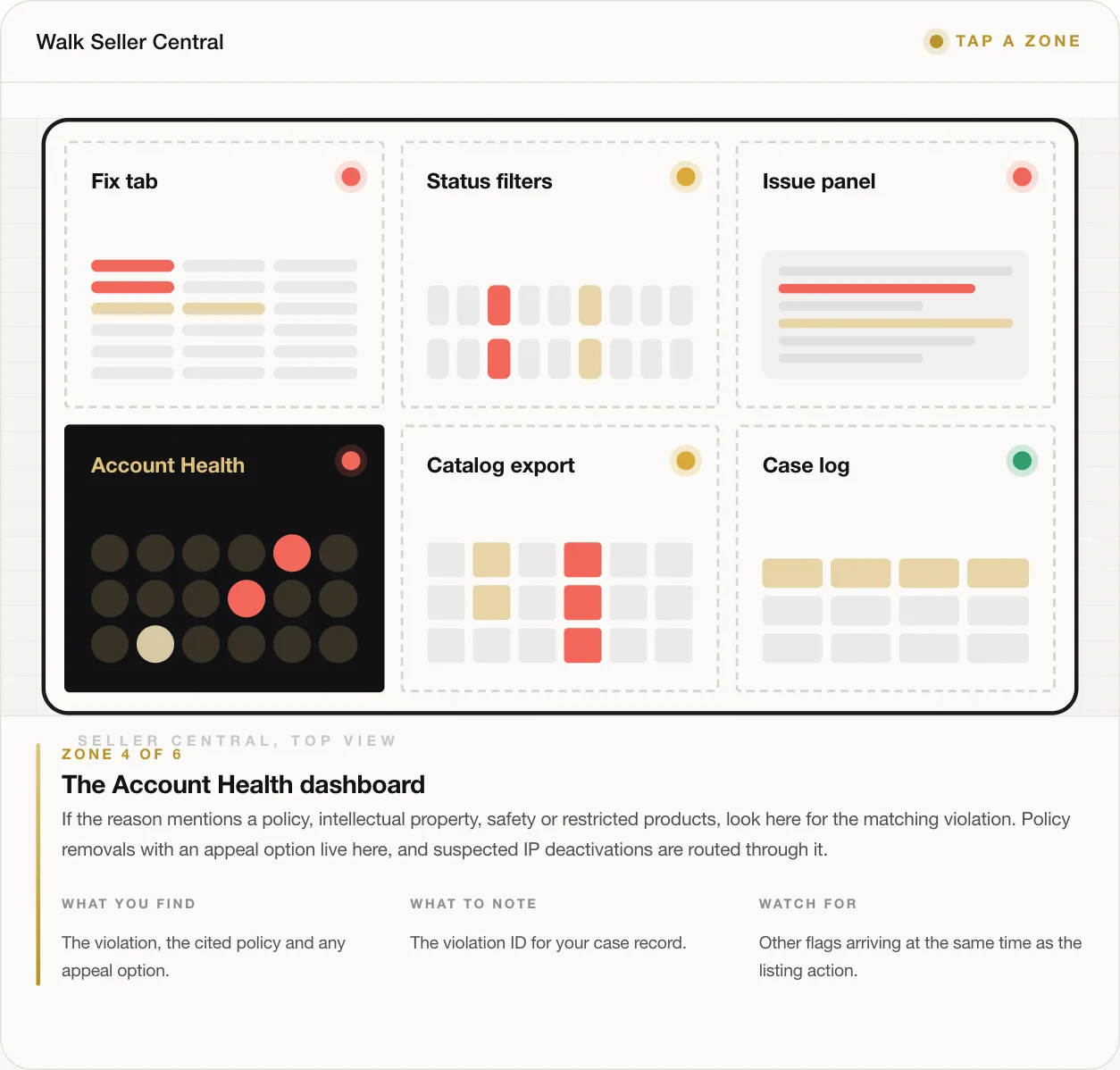
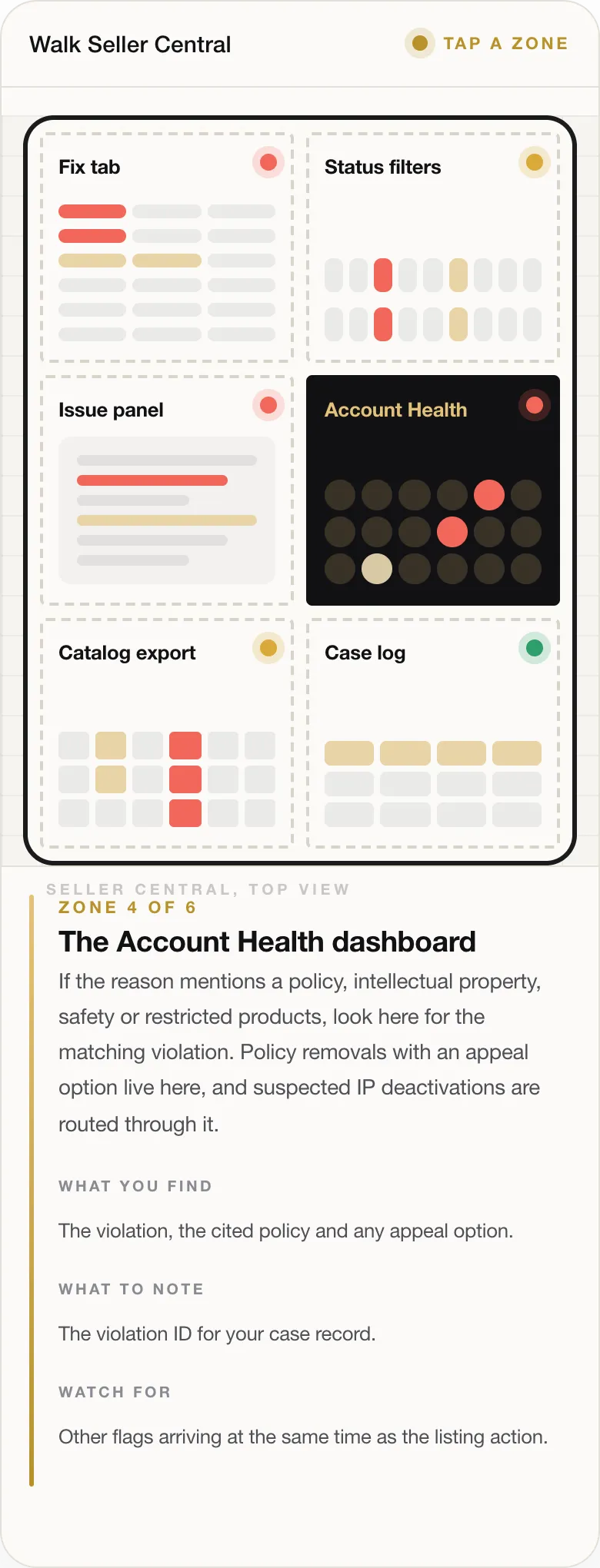
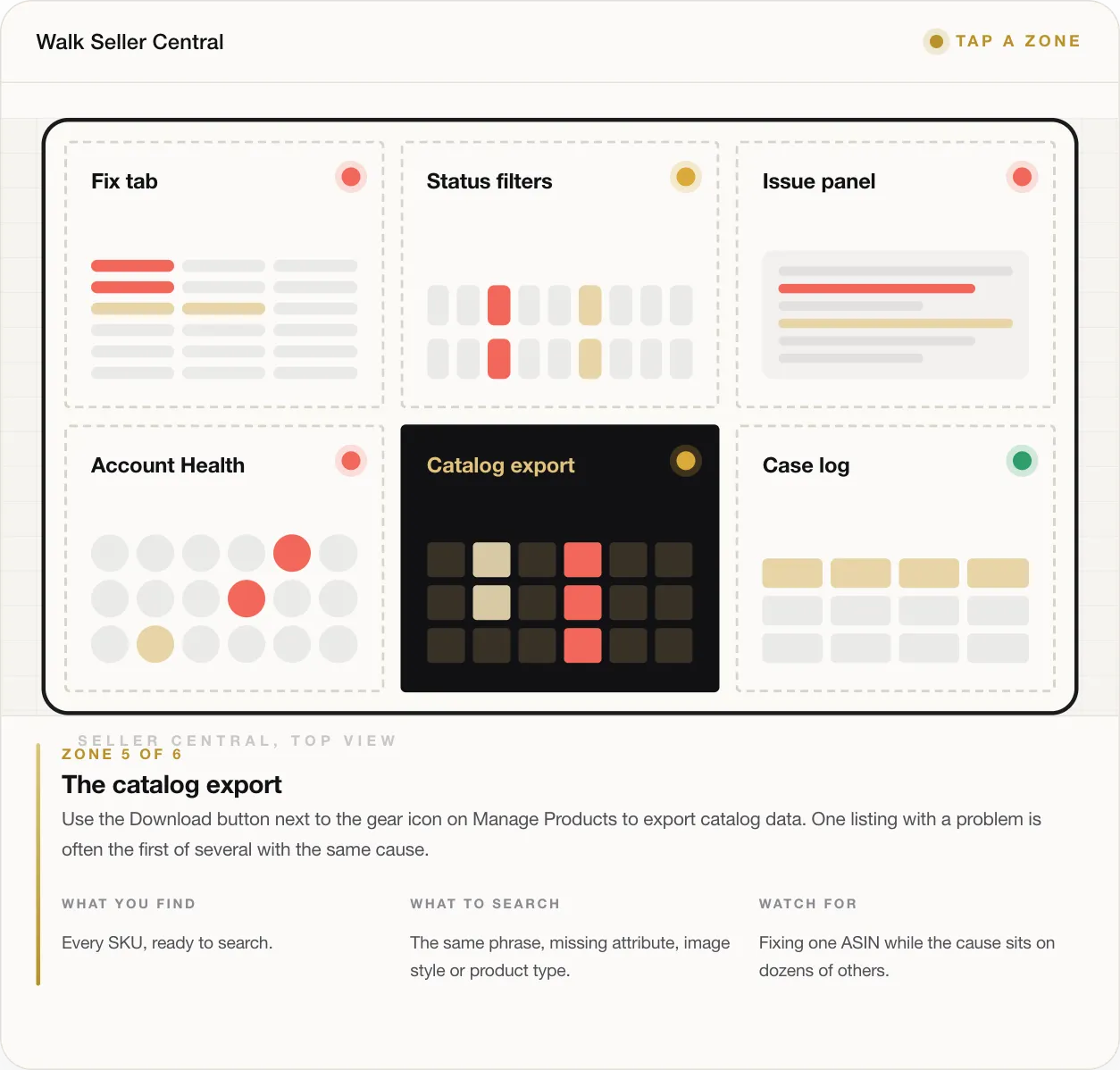
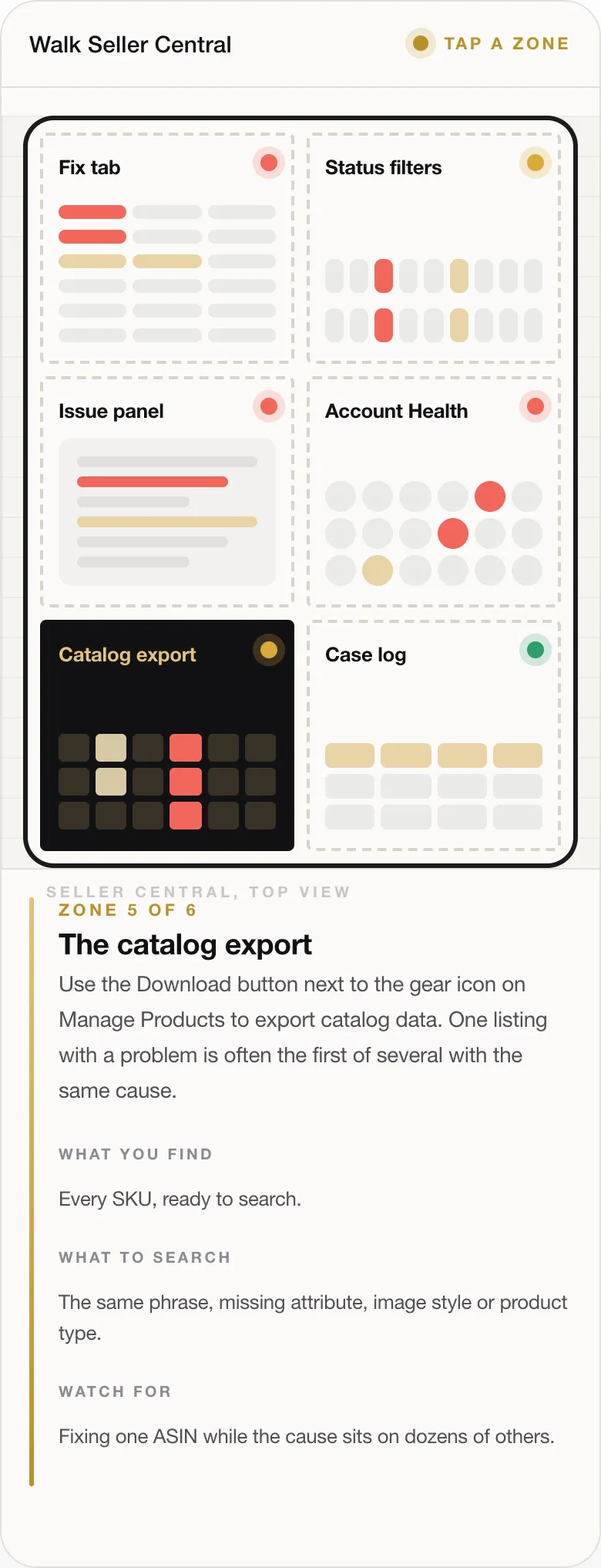
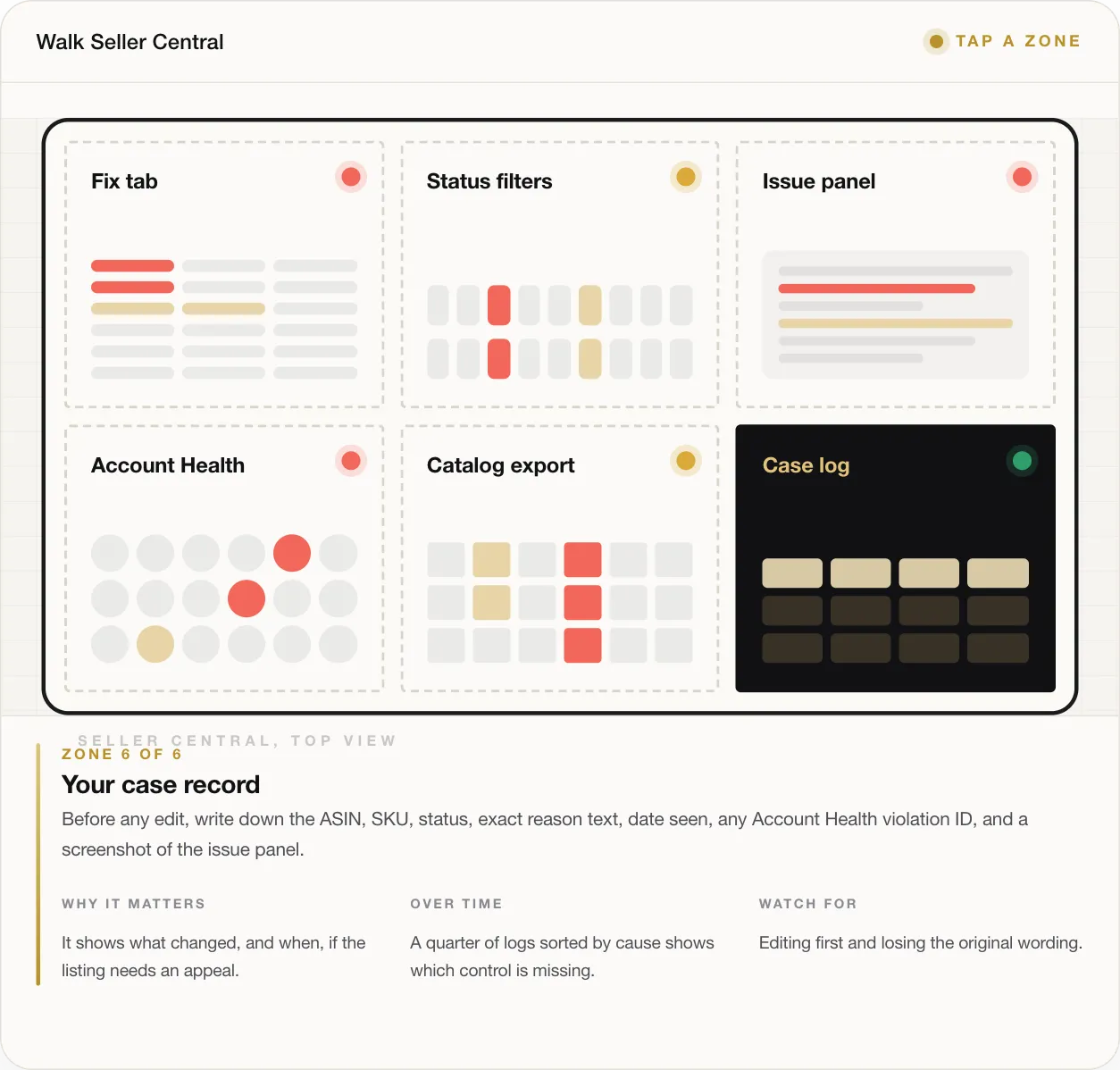
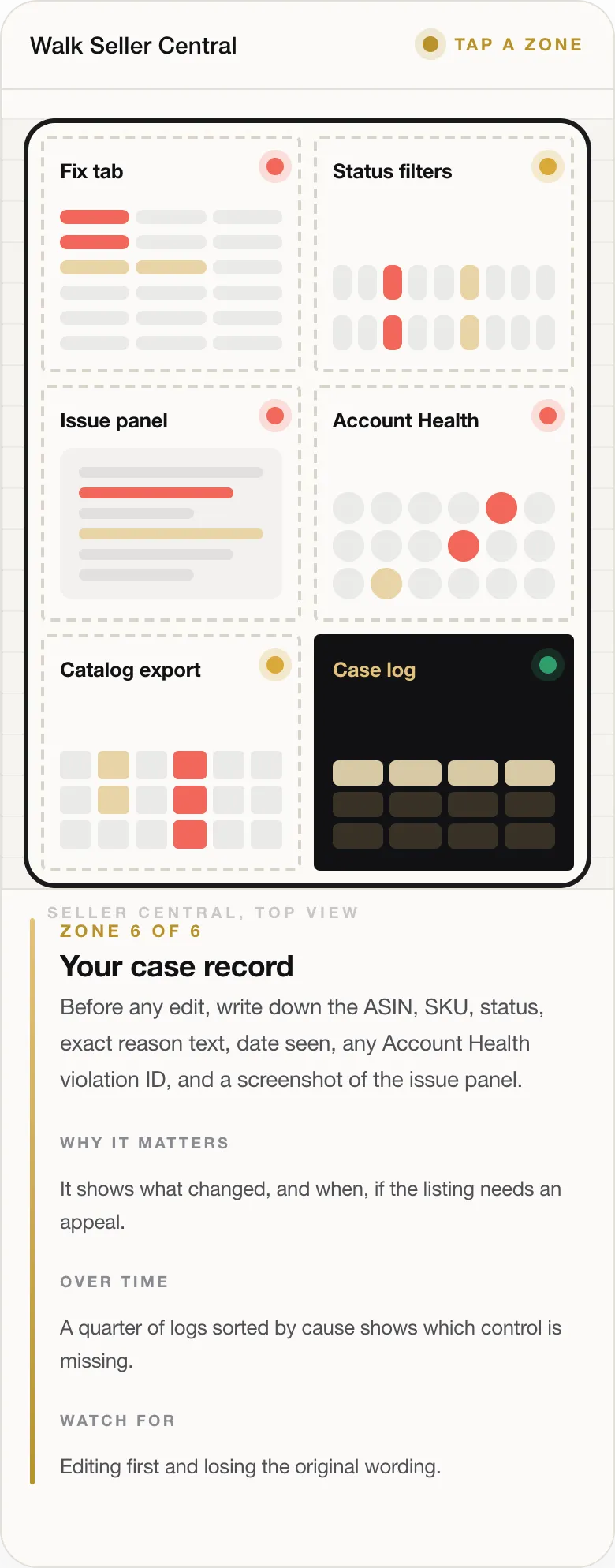
Amazon says changes made from the search suppression panel can take up to 48 hours to reflect. For images, its product image guide says a newly selected image can take up to 24 hours to appear on the detail page. Wait out those windows before deciding a fix failed.
Sort every reason into one of three families
Once you have the exact reason text, classify it. This decides whether you face a ten minute edit or an evidence file.
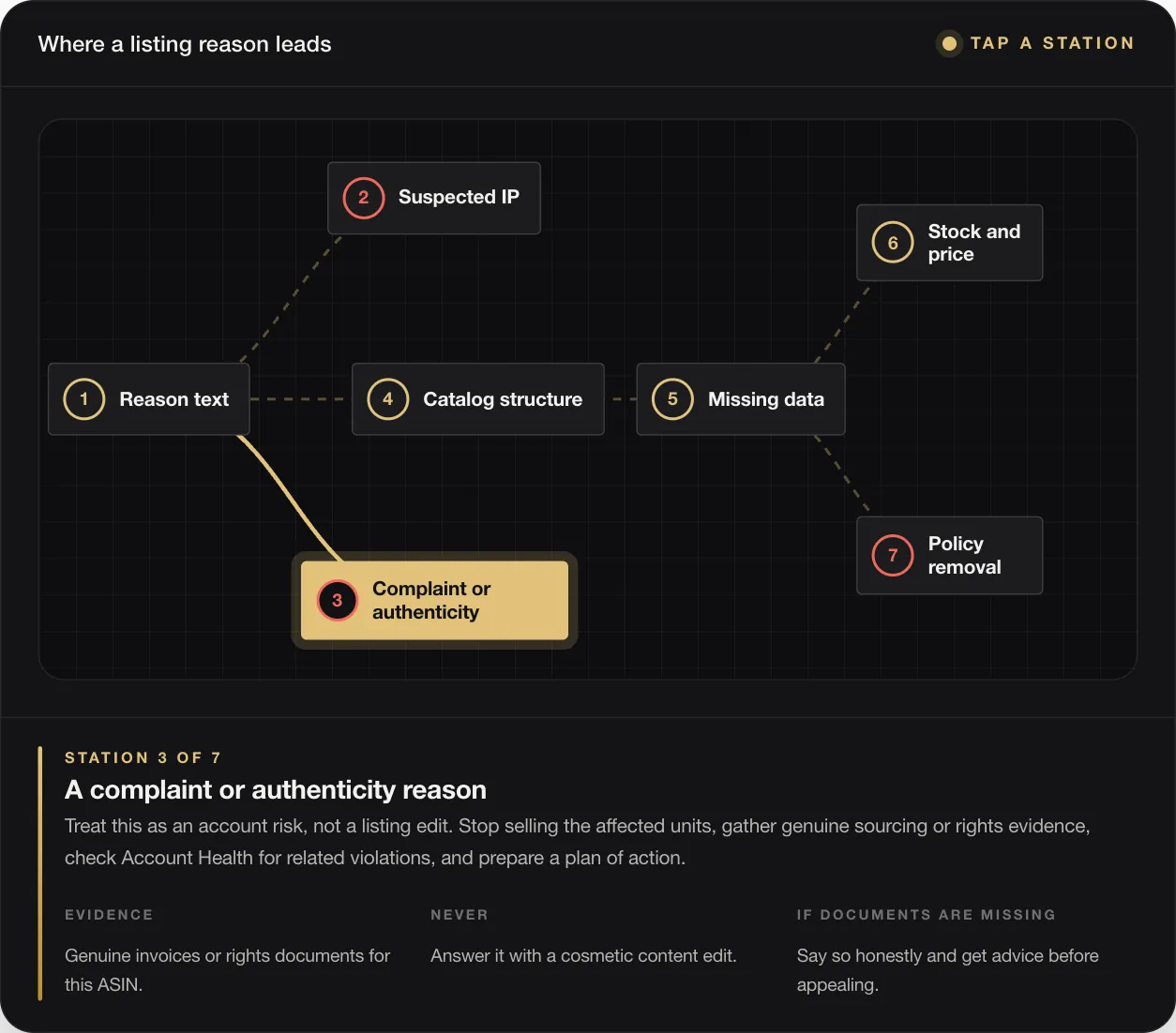
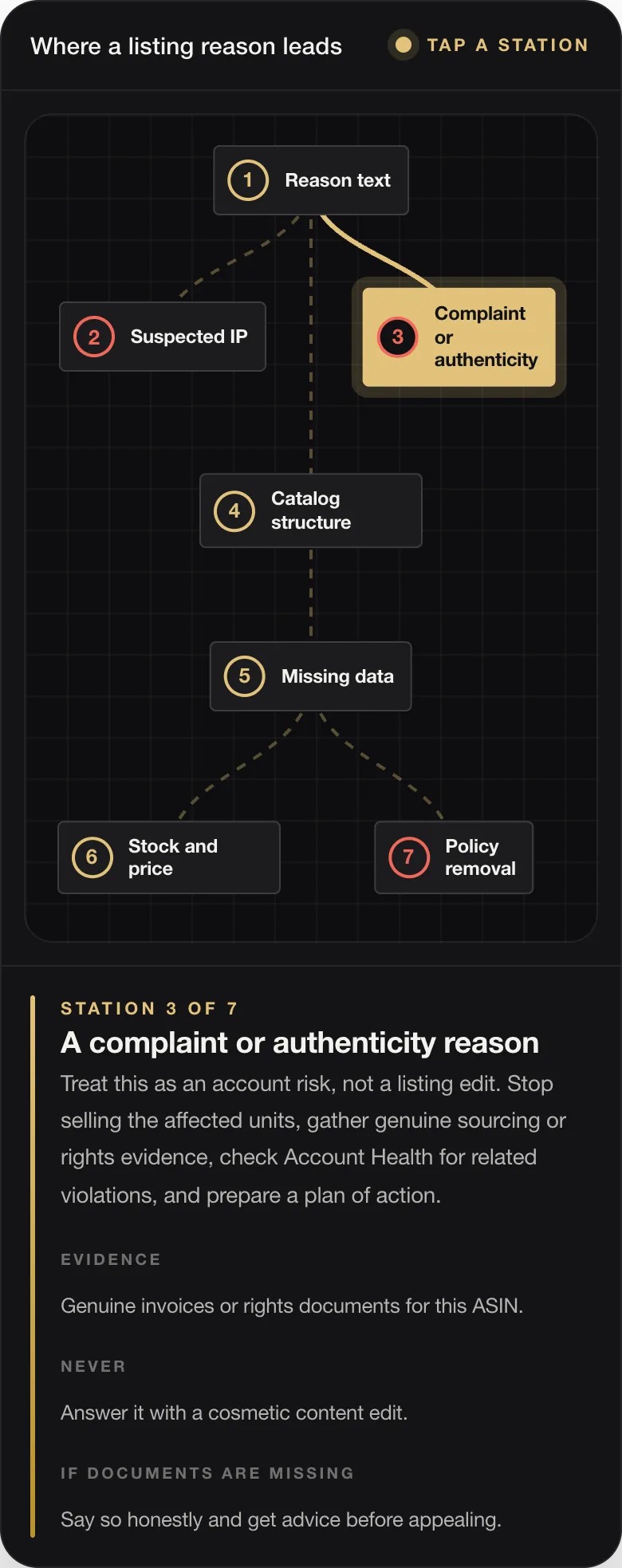
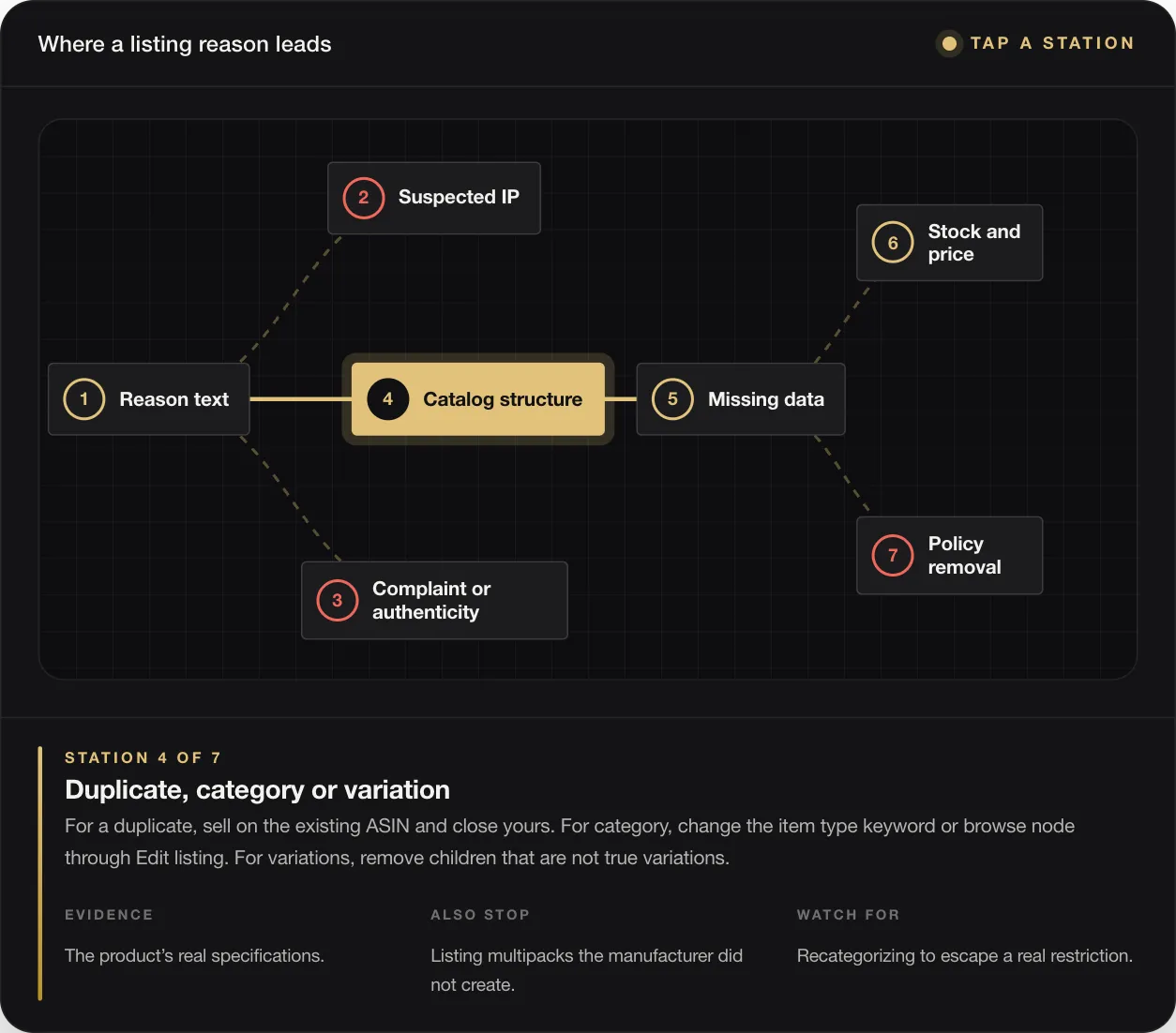
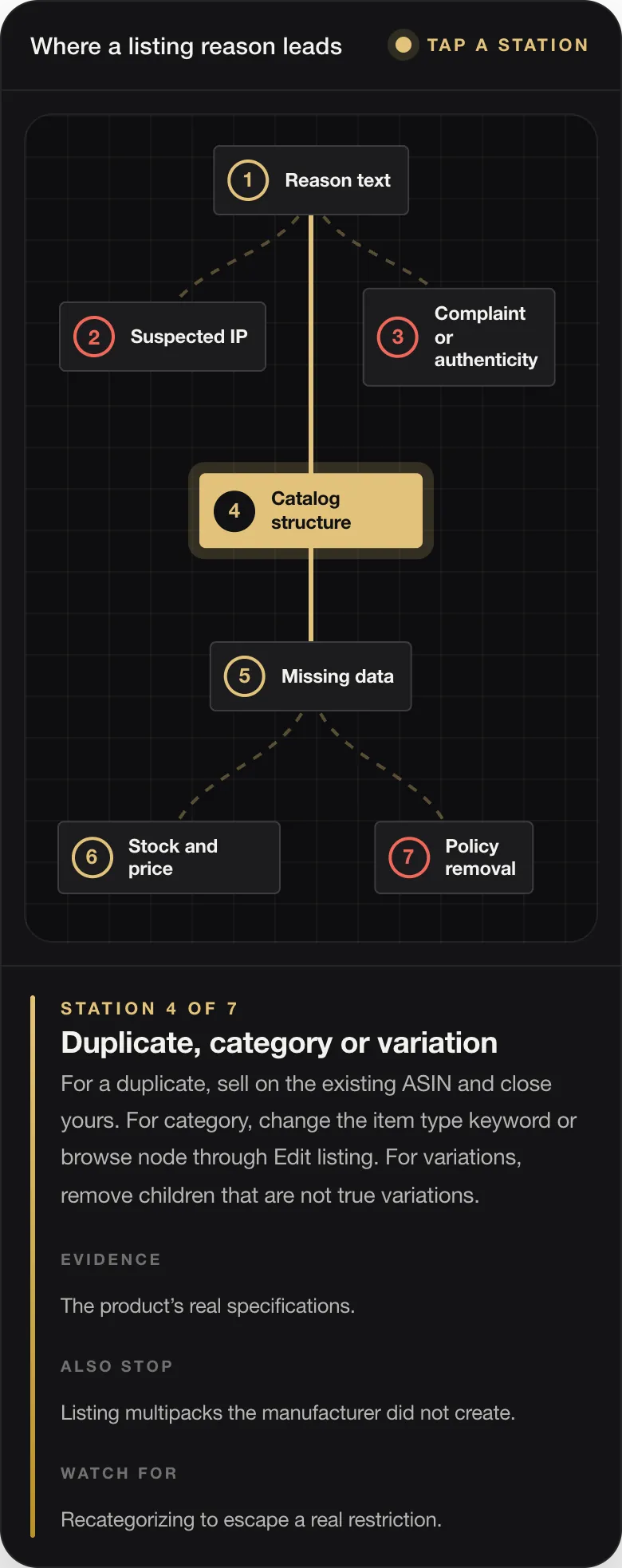
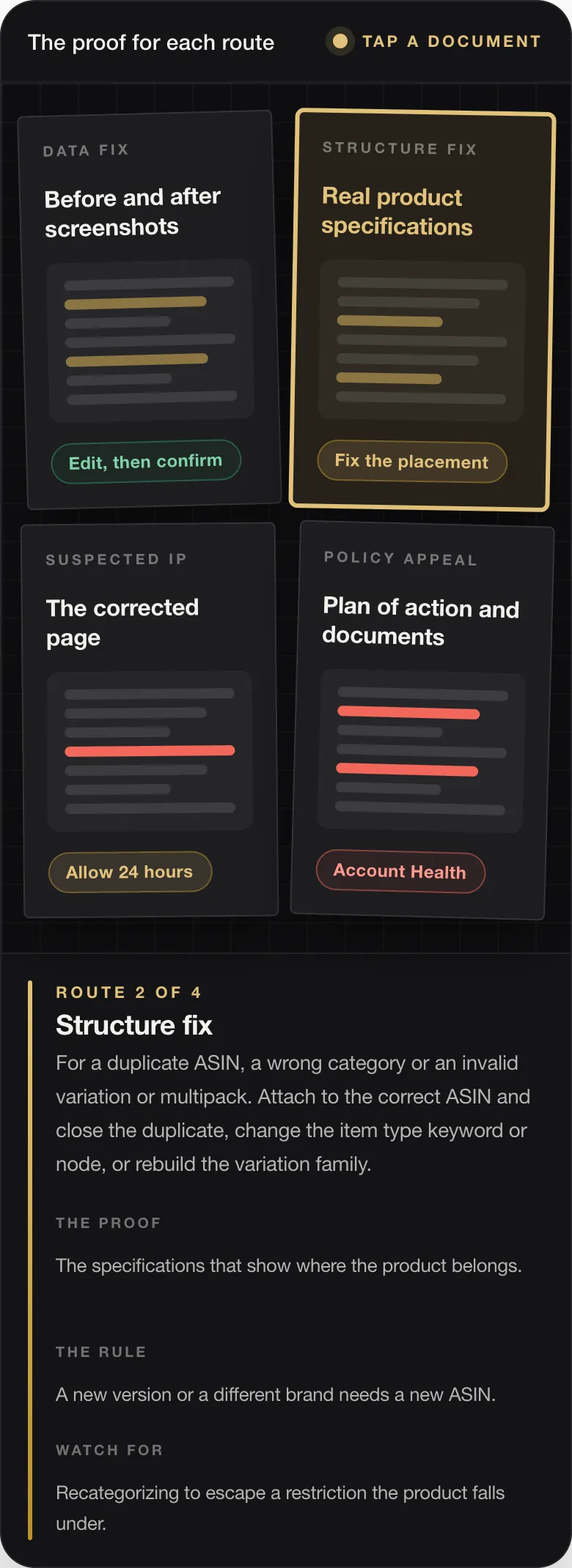
Data and content problems (missing attributes, main image, title format, prohibited wording) are fixed by editing the listing. Catalog structure problems (duplicate ASIN, wrong category, invalid variation or multipack) are fixed by correcting where and how the listing sits, sometimes by selling on the correct existing ASIN. Rights and safety problems (intellectual property, authenticity, product safety, restricted products) may present as one listing but are a signal about the account, and need evidence from outside your listing editor, usually routed through the Account Health dashboard.
Never answer a rights or safety reason with a cosmetic content edit. It misreads the case and leaves the real risk on the account.
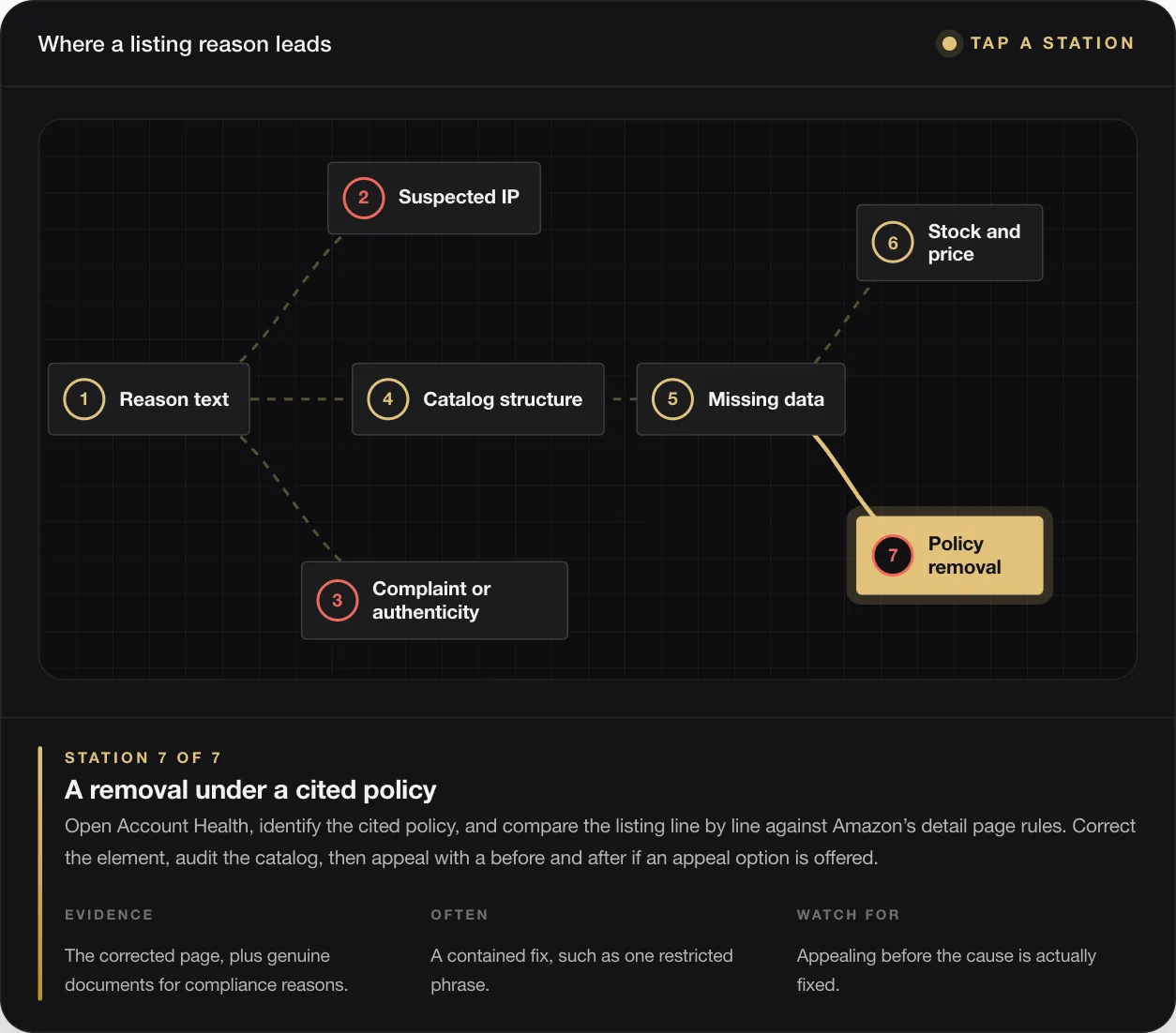
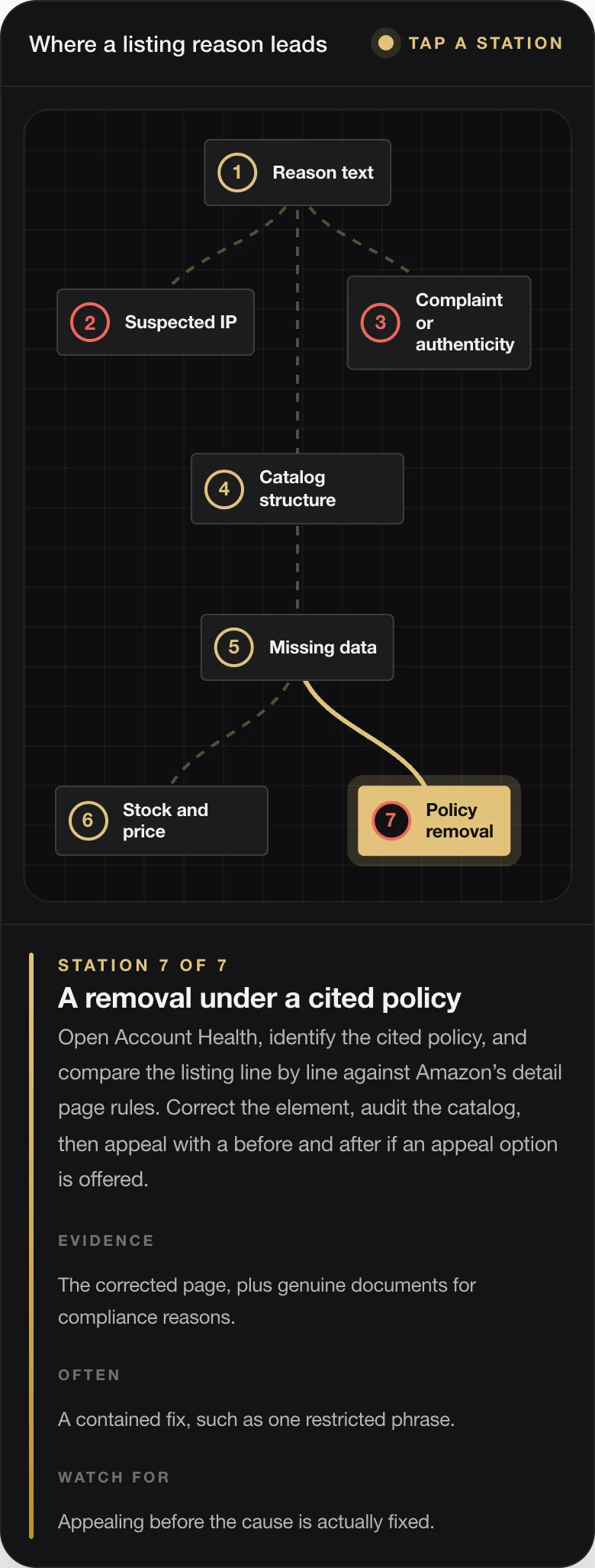
Triage tool: route your listing to the right fix
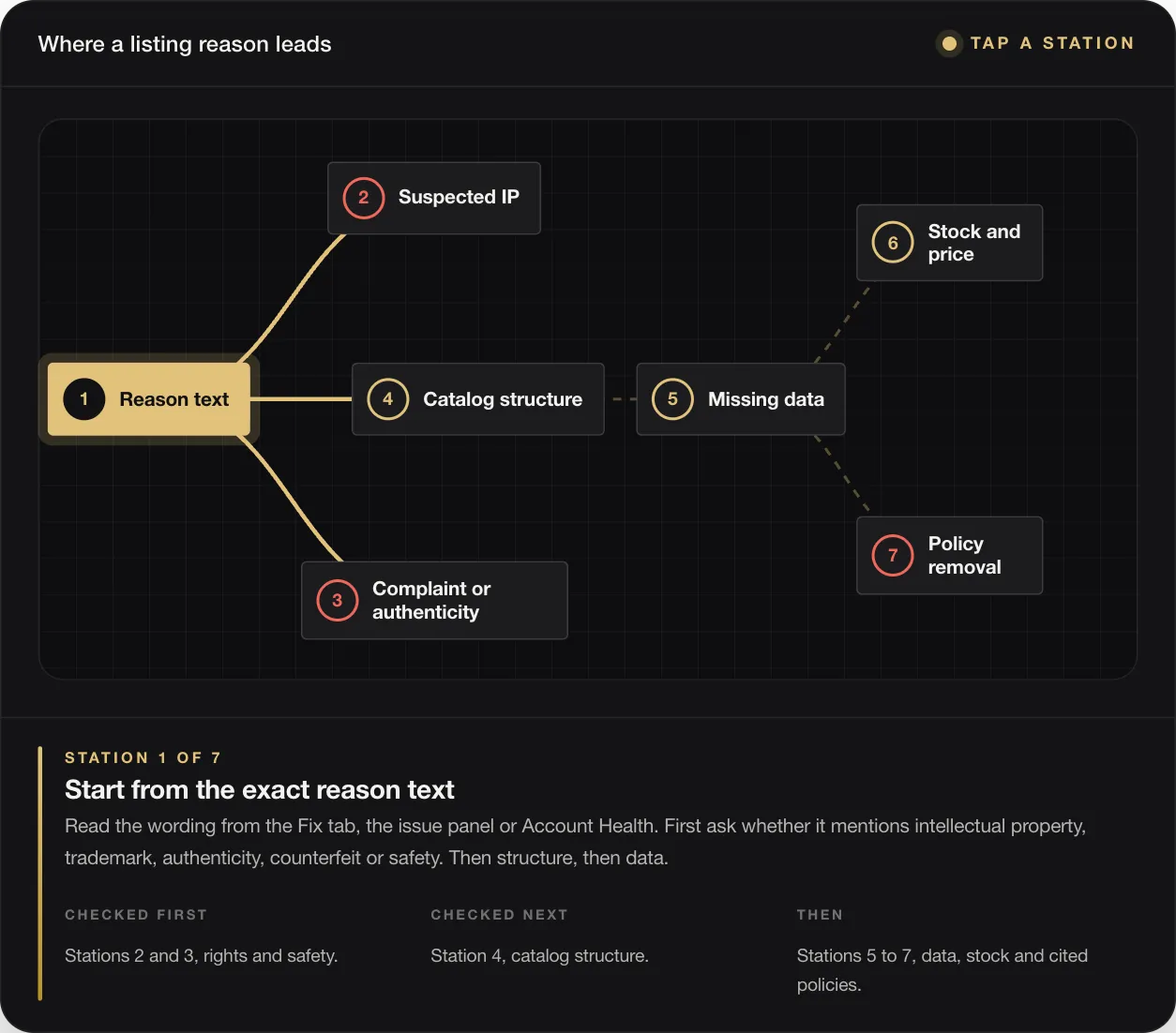
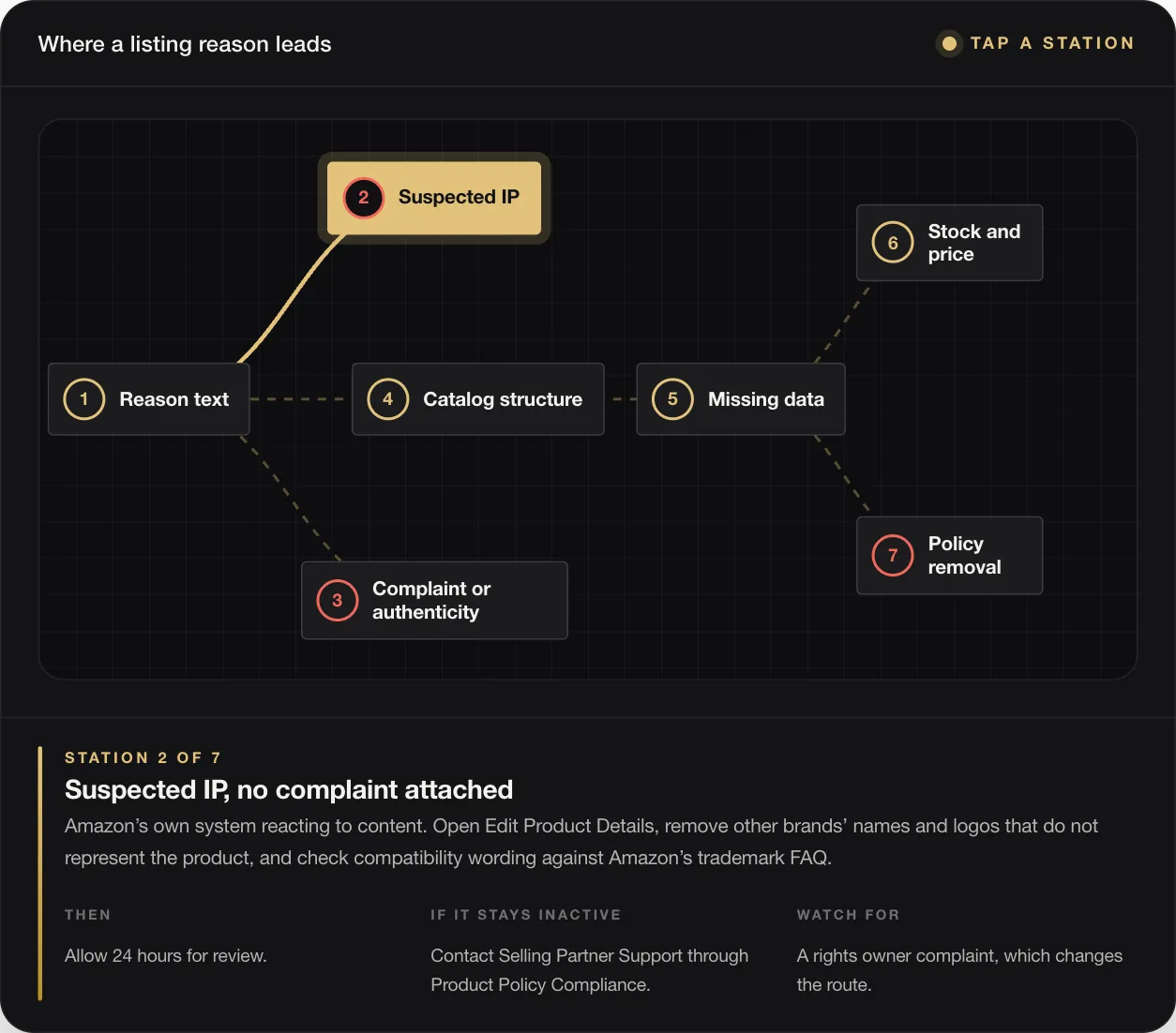
Use the tool with the exact reason text in front of you. It checks severity first, then structure, then content.
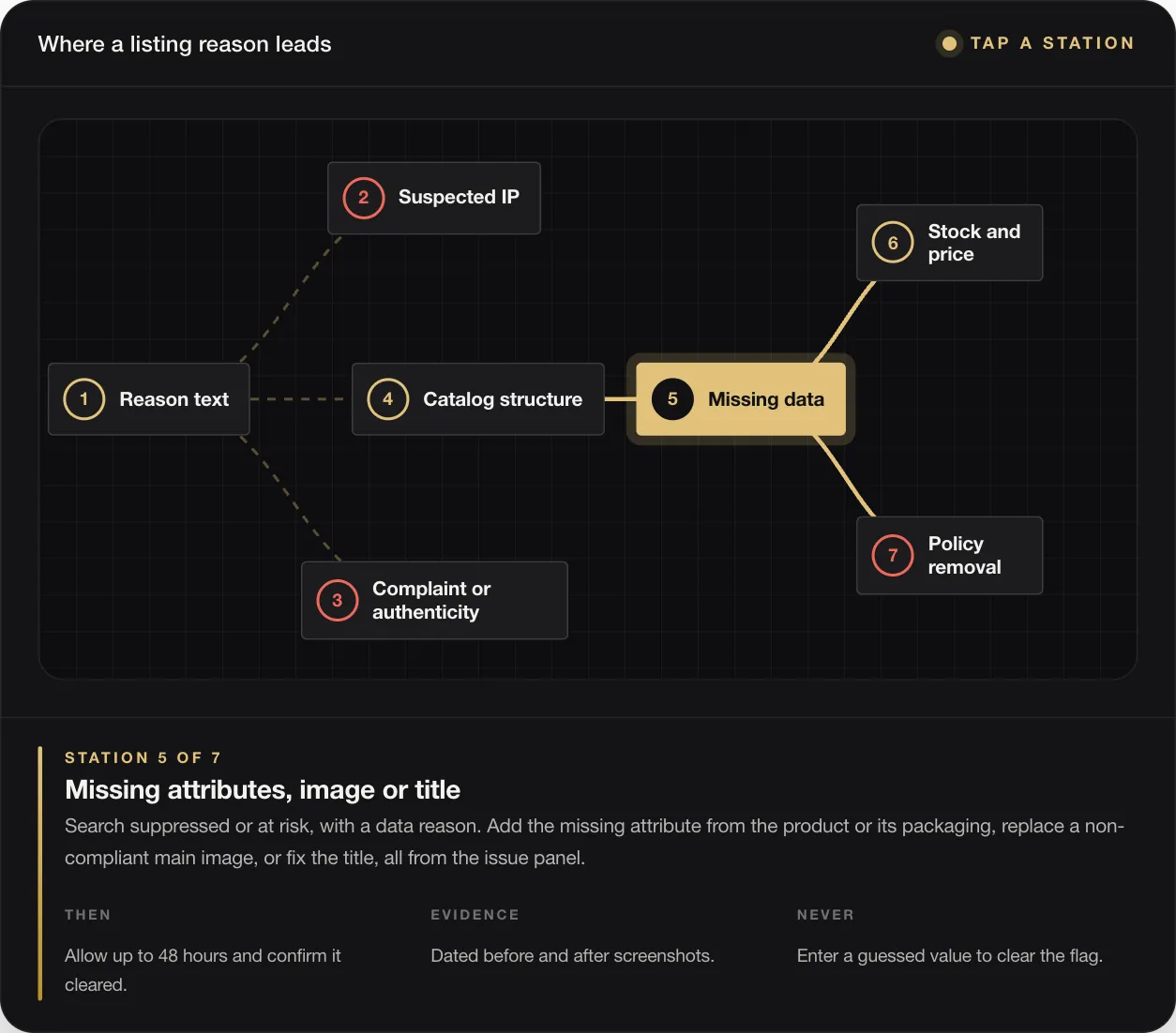
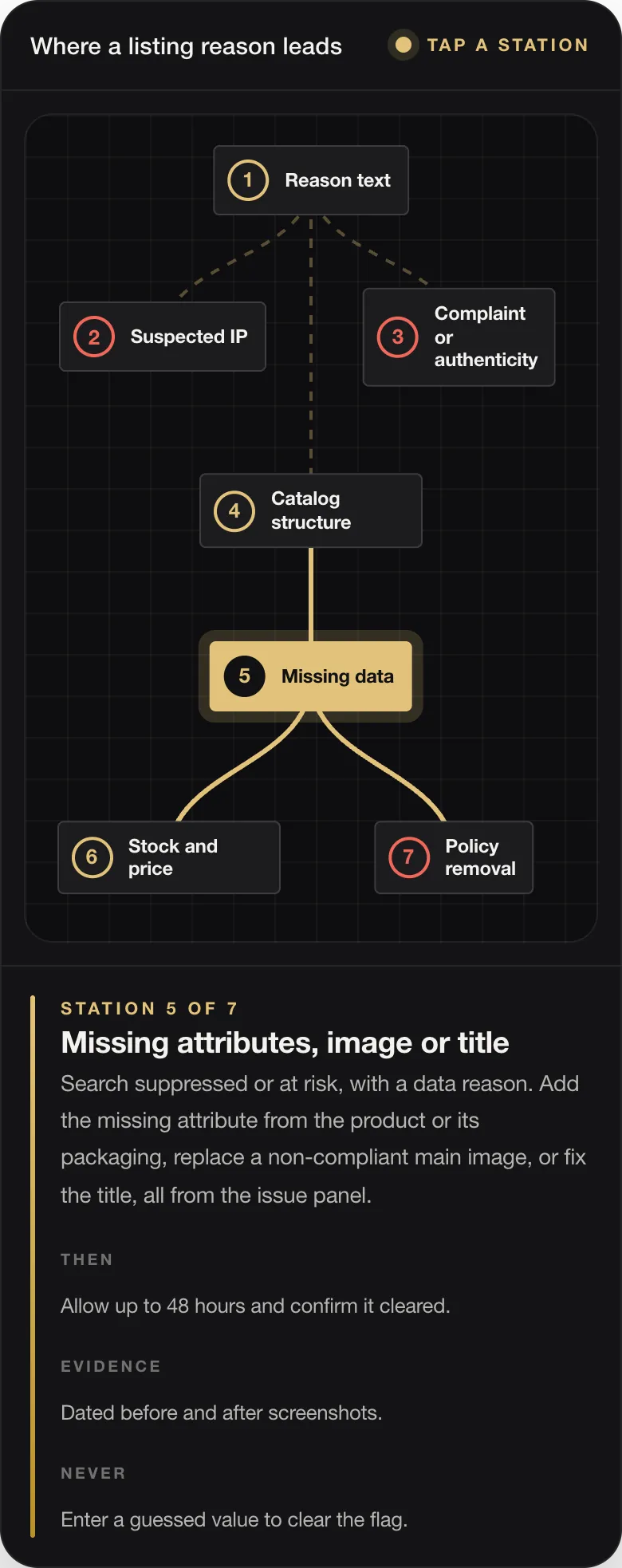
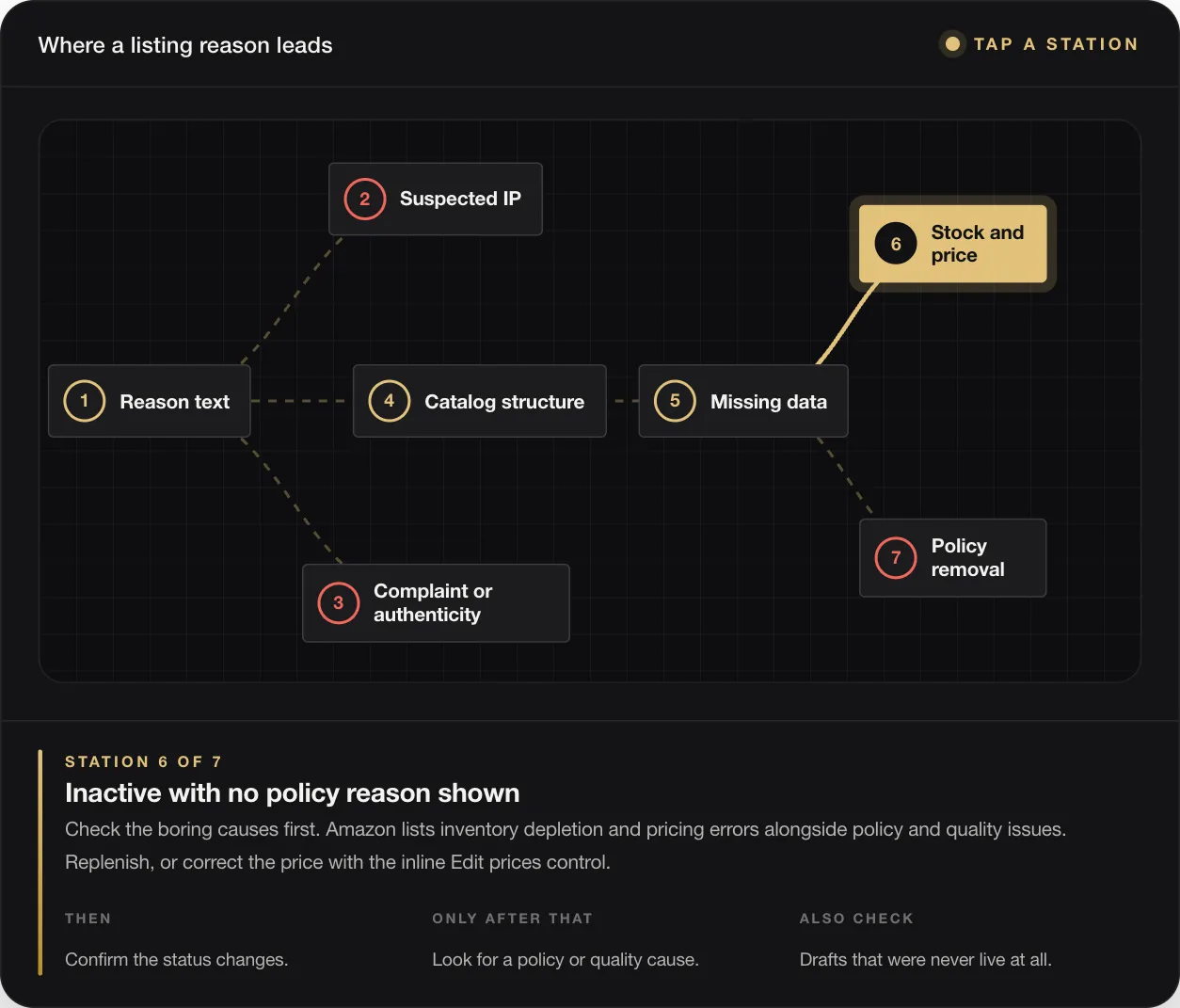
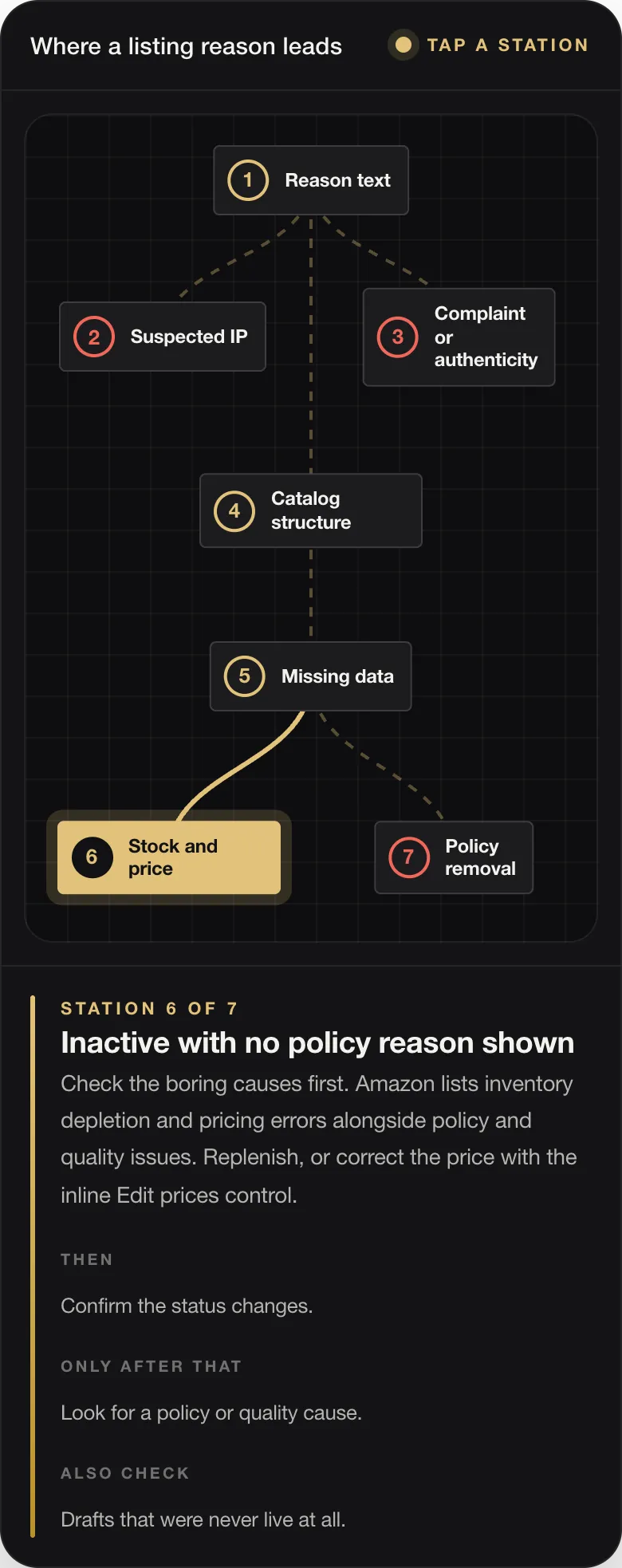
One reason text. Six different destinations.
The same symptom can belong to any family, so the exact reason decides where the case goes. Check severity first, then structure, then content.
Fixing search suppressed and at-risk listings
Search suppression is usually a data problem: the listing exists, but Amazon has decided it is not complete or compliant enough to show in search.
Missing or wrong attributes
Amazon’s listing quality guidelines name seven components of a quality listing: title, bullet points, attributes, images, video, A+ Content and search. Attributes are the facts that drive search and filtering, and the issue panel usually names the missing field. Fill it with an accurate value from the product or its packaging, never a guess entered to clear the flag, because a wrong attribute becomes a detail discrepancy later.
Main image problems
Amazon’s product image guide is explicit: if there is no main image that meets the requirements, Amazon “may temporarily remove the product listing from search until a compliant main image is provided.” The main image standards Amazon lists include:
- A pure white background, RGB 255, 255, 255.
- The product filling 85 percent of the image, shown in full, shown once, as one unit.
- No placeholders, no props or accessories that are not included, no mannequins.
- At least 500 pixels on the longest side to upload at all, with 1,000 pixels or more recommended so zoom works, and no more than 10,000 pixels.
- JPEG, TIFF, PNG or non-animated GIF, with JPEG recommended.
Category exceptions exist, such as adult clothing on a standing model and a single shoe facing left at 45 degrees, so check category guidance before reshooting.
Title and text formatting
Amazon’s detail page rules cap titles at 75 characters including spaces for all product types except media, with item highlights allowed up to 125 characters. They also prohibit all capital letters throughout an attribute and emojis or symbols at the start of each word. A title that worked for years can break when a rule like this changes.
A worked example
Hypothetically, a seller with 140 kitchen storage SKUs finds 11 search suppressed. The issue panels show two causes: 8 lack a required material attribute and 3 have main images on a light grey background. The seller adds the material from the manufacturer’s spec sheet, reshoots 3 images on pure white, and logs the date. Within Amazon’s stated 48 hour window, 10 clear; the eleventh now shows a second missing attribute, which the seller also fixes. Then the catalog export reveals 19 more SKUs of the same product type missing the material attribute but not yet suppressed. Fixing those 19 is the work that actually protects sales.
Inactive listings: rule out the boring causes first
Amazon’s Manage Products guide names four common reasons a live listing goes inactive: inventory depletion, pricing errors, policy concerns and quality issues. Check the two operational causes first, because they are fastest to confirm.
Stock and price
If the listing went inactive when quantity hit zero, replenish and confirm. If a pricing issue is shown, correct it with the inline Edit prices control. Only then move to policy and quality causes.
Drafts that never went live
Some “inactive” listings were never live. Amazon’s draft filters separate “Drafts: unsubmitted,” “Drafts: missing details” and “Drafts: restrictions.” A restricted draft often needs category approval, which our guide to restricted products on Amazon covers.
Policy removals and detail page rule violations
For a policy removal, find which rule and which element broke it. Amazon’s product detail page rules are the reference most removals trace back to.
What the rules prohibit on the page
Amazon says none of the following may appear in titles, descriptions, bullet points or images: obscene or offensive content; phone numbers, addresses, emails or URLs; availability, price or condition details; links to other sites or alternative shipping offers; reviews, testimonials or requests for positive reviews; adverts, promotions or watermarks; time-sensitive information; another brand’s intellectual property on a generic listing; and restricted phrases such as “FSA/HSA eligible.” HTML and other code are not allowed except line breaks in the description. Product information must not mislead customers, and the page must outline additional items essential to the product’s function.
The evasive editing trap
Amazon’s detail page rules say you may not repeatedly add and remove prohibited claims, images, disclaimers or content to get around policy controls. Amazon calls this “evasive behavior” and says it “does not have a path to reinstatement unless you provide valid proof of your adherence to all applicable laws and Amazon policies.” Deleting a claim, waiting, and restoring it turns a fixable listing problem into an account problem.
A worked example
Hypothetically, a seller’s listing is removed for content that violates policy. The seller assumes a serious accusation and starts gathering invoices, but a line by line read shows the second bullet says “FSA/HSA eligible,” a restricted phrase Amazon names directly. It is a contained content fix: remove the phrase, keep before and after screenshots, then search the catalog export, which finds the phrase on 6 more listings, corrected the same day. Any appeal states the phrase, the removal date, the 6 other corrections and the new pre-publication check for restricted phrases.
ASIN creation problems and catalog structure
Structure problems come from how a listing was created or attached, not from what it says.
Duplicates and attaching to the right page
If the product is already on Amazon, add an offer to the existing ASIN; Amazon says you “must not create a product detail page for a product already in Amazon’s catalog.” Duplicates usually happen by oversight, such as a different title or barcode on the same item. Confirm the existing ASIN genuinely matches, sell on it, close the duplicate, and require a recorded catalog search before anyone creates a new ASIN.
When you must create a new ASIN
The opposite mistake also gets listings removed. Amazon says you must not use an existing listing for a new version, including changes in color, size, material, features and product name, and must create a new ASIN when selling under a different brand rather than editing the brand on an existing one. Re-branding beyond minor corrections such as typos or capitalization is not supported on an existing ASIN.
Product IDs and GTINs
Amazon says you must only use GTINs you own or are authorized to use, purchased directly from GS1 or with explicit authorization from the prefix owner, and submissions with unauthorized GTINs will be blocked. Unless a listing was created with a GTIN exemption, its product ID cannot be edited. If you are unsure where your barcodes came from, check them with GS1 and read our guide to barcodes and account risk.
Variations, multipacks and bundles
Amazon’s ASIN creation policy says a new ASIN must be an active product, in a configuration created by the brand owner or manufacturer, and sellers should not list non-standard multipacks the manufacturer did not create. Bundles follow the separate product bundling policy. Prohibited variation practices include changing a parent or child page to become fundamentally different, adding children that are not true variations or are newer models, and adding non-manufacturer multipacks to an existing parent. Sellers without a selling role from the brand owner are limited from creating ASINs under a brand enrolled in Brand Registry.
The creation limit is not a violation
Error 8571 is Amazon’s ASIN creation limit, not a policy finding. Amazon states a weekly creation limit of 2,000 ASINs, says it may limit new listings until you build sales history, and says a temporary suspension of creation lifts automatically at 00:00 GMT each Sunday. A catalog full of non-selling listings can also restrict creation until you reduce it.
Category and browse path errors
Sometimes a listing breaks no rule but sits in the wrong category, which triggers requirements or restrictions the product should never face. Before defending against a requirement that seems absurd for the product, check the premise.
How Amazon classifies a product
Amazon explains that a browse node is a named location in its category hierarchy, that a node can have several browse paths, and that you move a product by changing its item type keyword or recommended browse node. Amazon notes that the title, bullet points and description are key attributes for classification, so weak text alone can misplace a product.
How to change it
Amazon’s self-service route: in Manage All Inventory, find the listing, click Edit listing, open Product Details (or “Suggest changes to product information”), click Edit, and change the browse path and node in the Item Type Keyword field. Professional sellers can do this in bulk through an inventory file upload. Download the category’s browse tree guide first. Amazon says the product must be listed and active before you request a change, and multiple browse nodes are not supported except for media ASINs and items such as unisex items.
When recategorization is the wrong answer
Recategorization is a correction, not a workaround. Amazon says purposefully miscategorized listings meant to get around restrictions can lead to termination of selling privileges. Request a change only when the product genuinely belongs there, and keep the specifications that prove it.
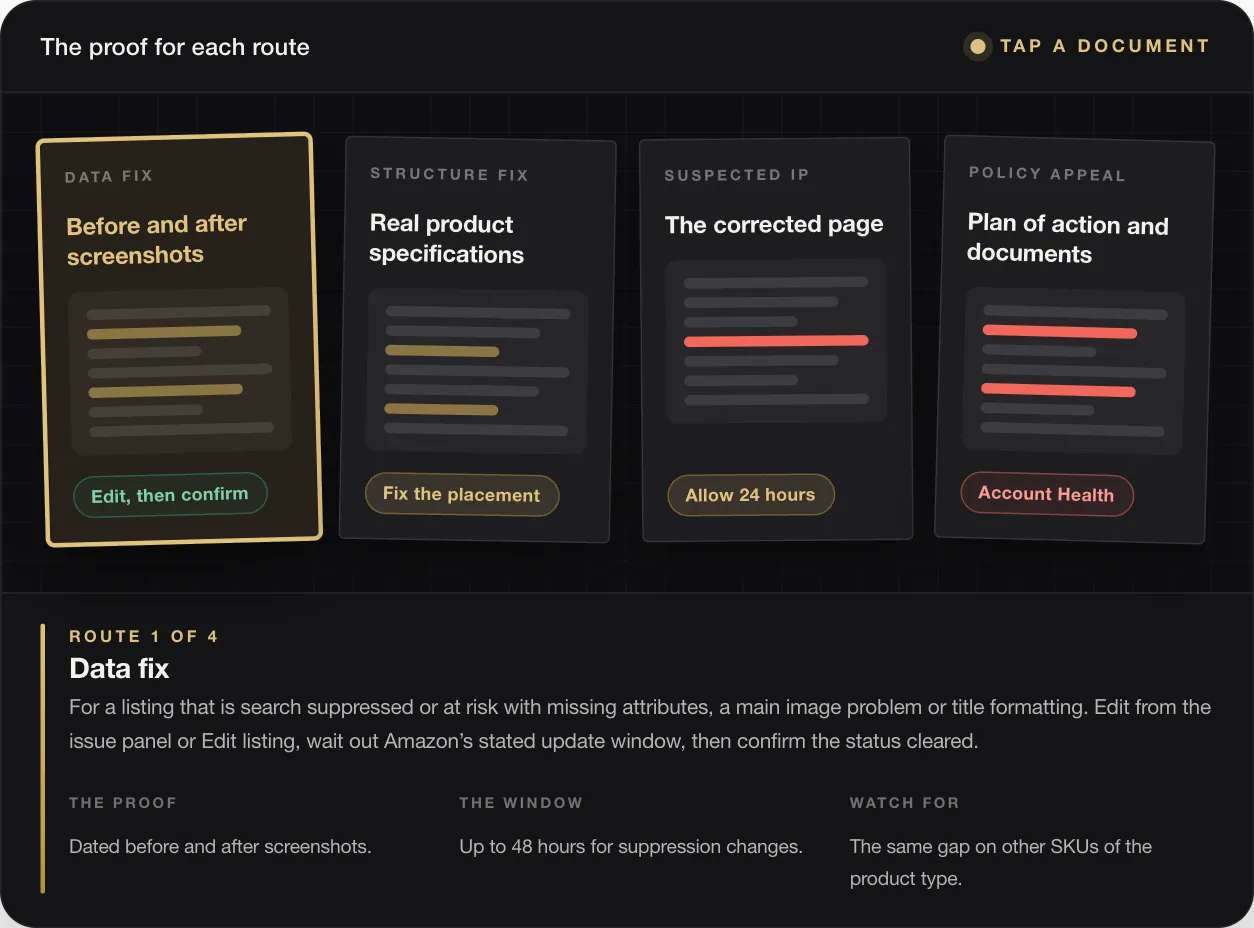
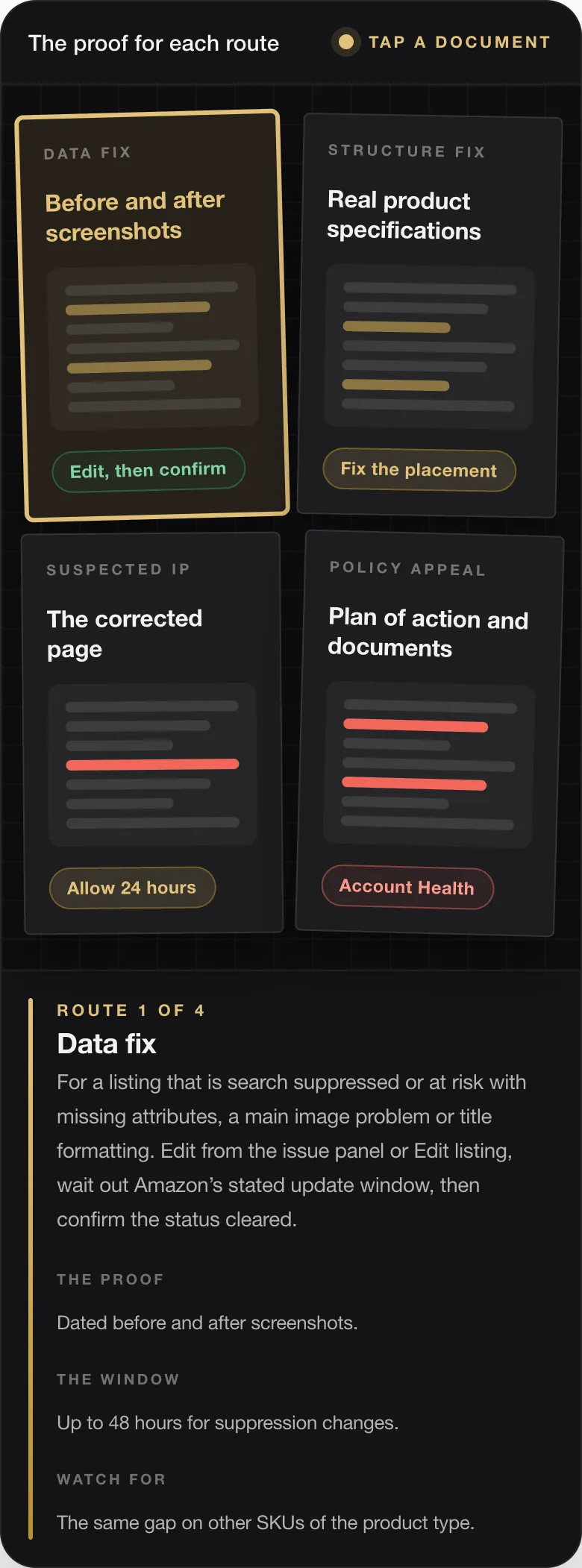
Fix it or appeal it: choosing the route
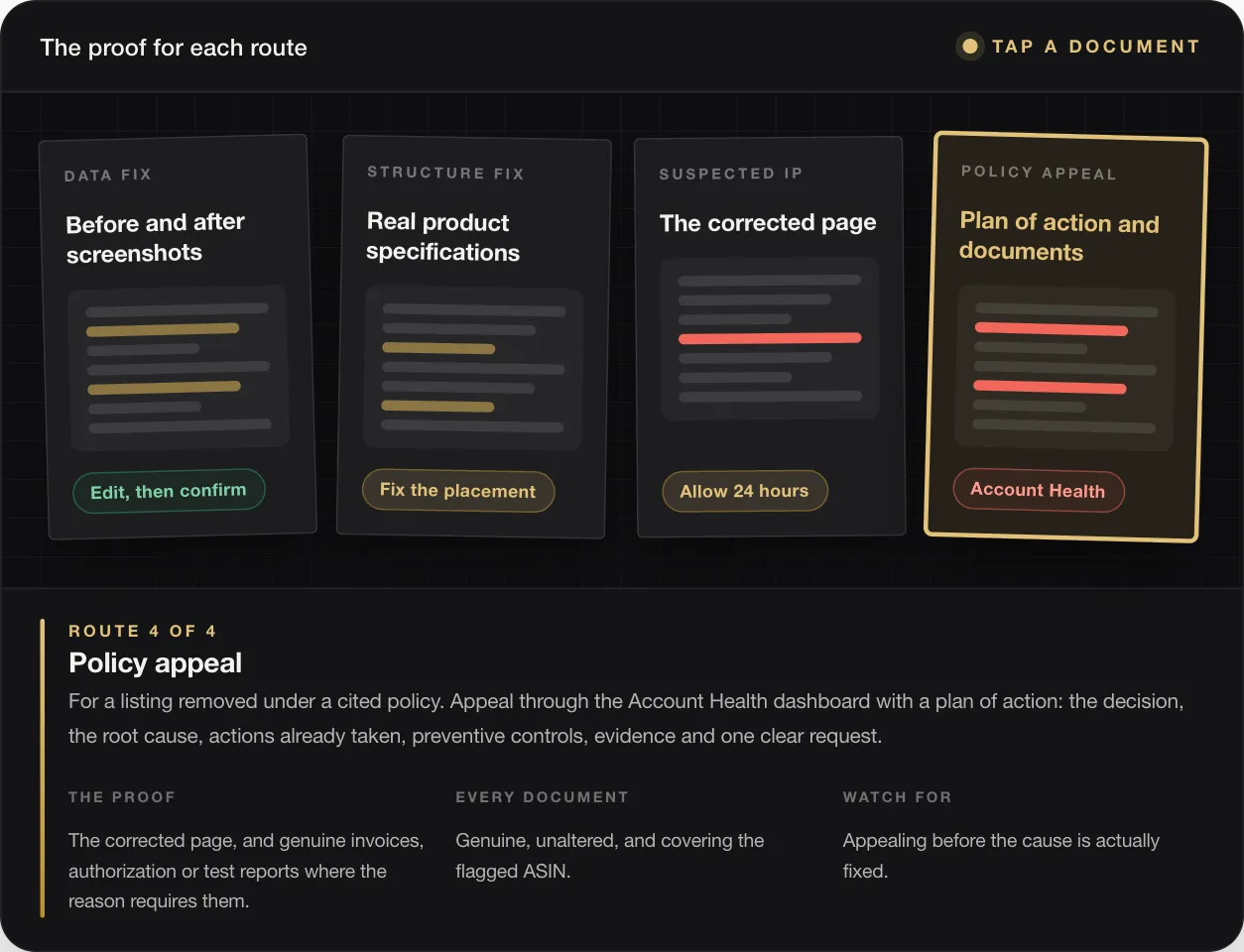
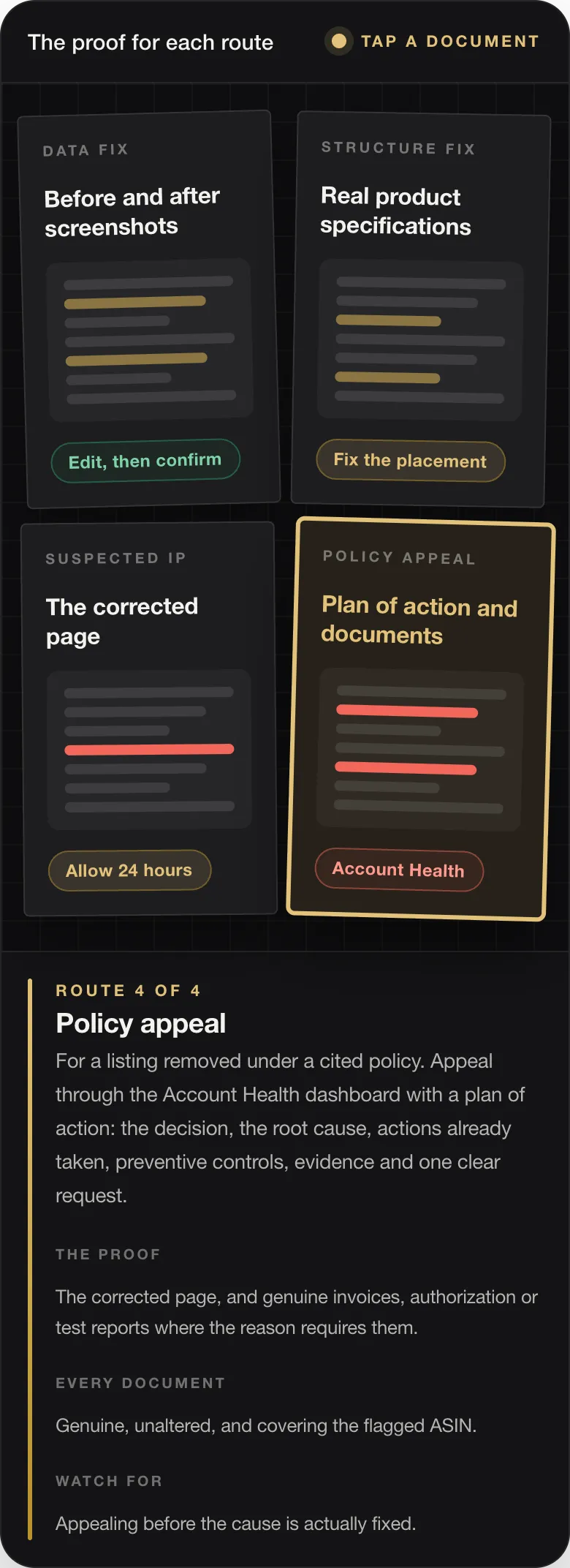
Every listing problem ends in one of two routes: correct it yourself and confirm the status clears, or submit evidence and ask Amazon to review.
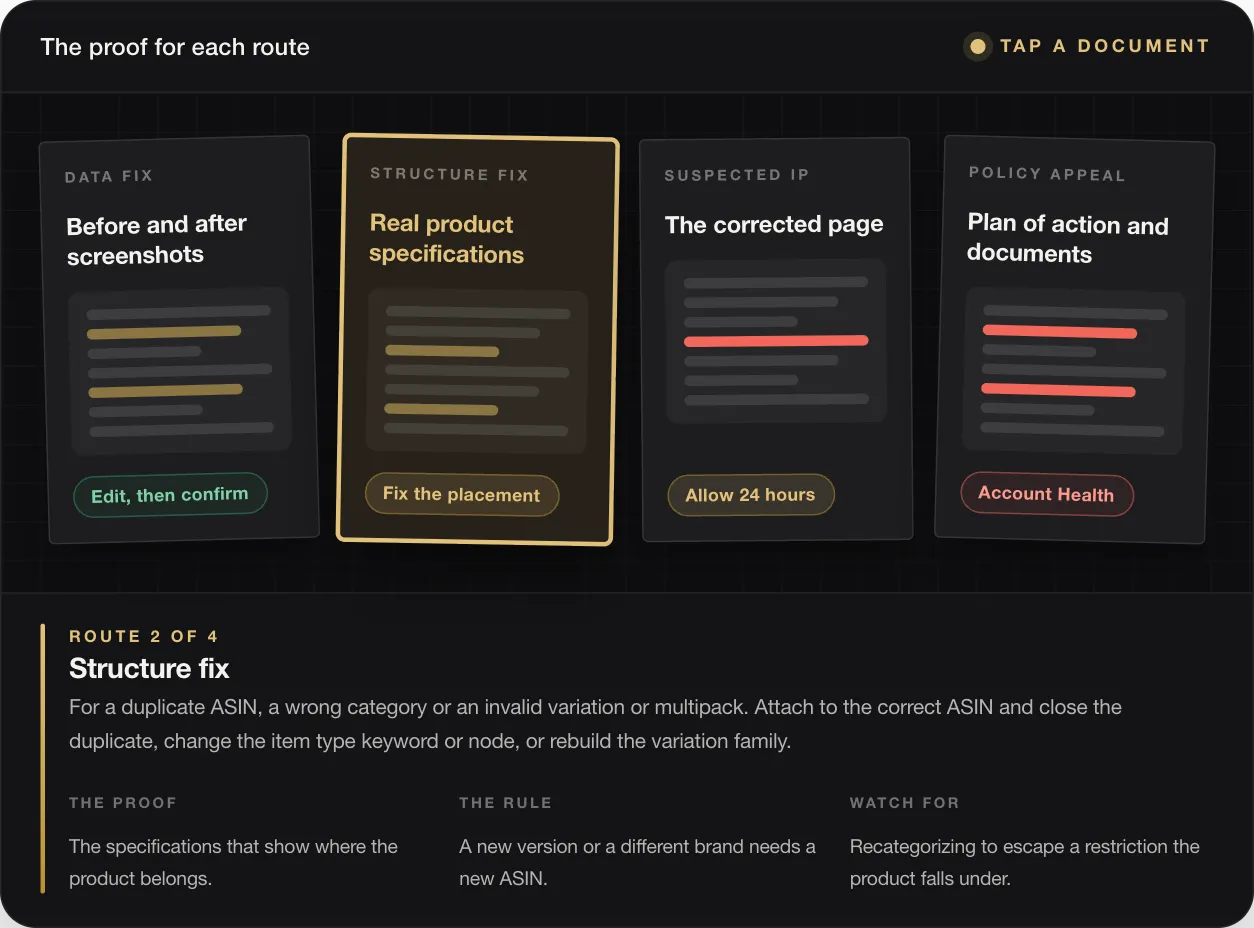
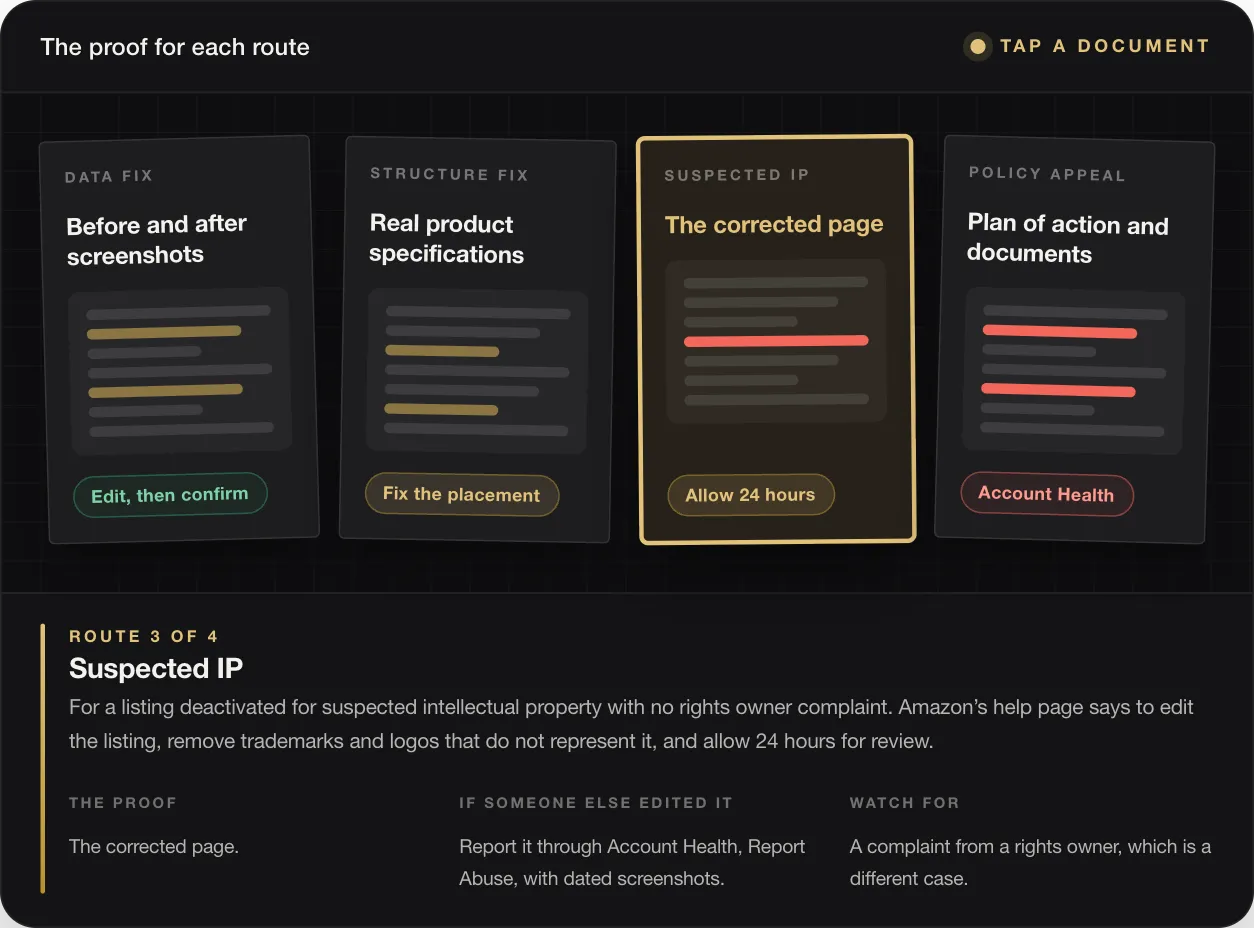
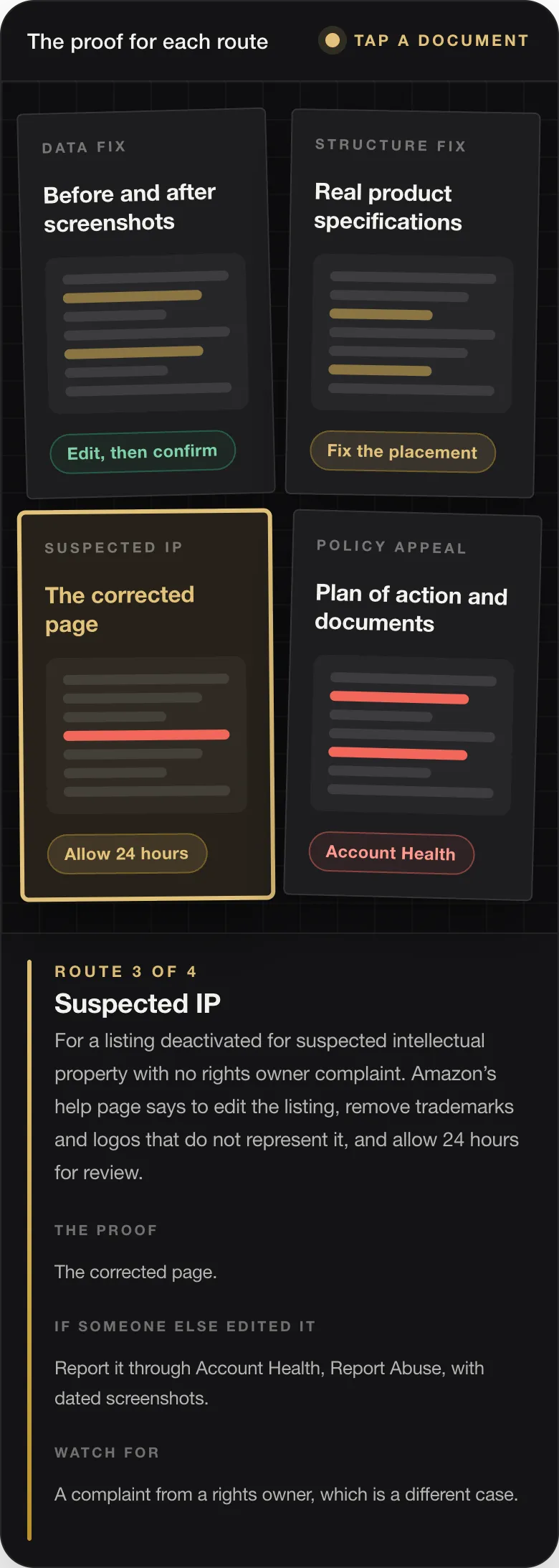
Four routes. Four different files of proof.
Every listing problem ends with a correction you confirm yourself or evidence you ask Amazon to review. The proof on the desk has to match the route.
Suspected IP versus a rights owner complaint
A suspected IP deactivation is Amazon’s own system reacting to content. A rights owner complaint is a third party alleging infringement, with a different route and evidence; see our explainers on intellectual property complaints and blocked ASIN complaints. This is educational information, not legal advice; if a rights owner alleges infringement, consider a qualified attorney.
When someone else changed the page
A listing can be flagged for content you never added. Amazon’s rules say that when several authorized brand users contribute to an attribute, its systems may choose which to display, that Amazon will not mediate between contributors, and that incorrect information on a Brand Registry ASIN should be reported through Account Health, Report Abuse. Keep dated before and after screenshots; our guide to defending listings from hijacking covers the rest.
Listing still will not come back?
Send us the reason text and we will help classify the cause before you edit or appeal again.
How to verify each step
A fix is only real when you can see it in Amazon’s systems.
| Question | Where to check | What to look for |
|---|---|---|
| Why is this listing down? | Manage Products, Fix tab, or Manage All Inventory issue panel | The exact reason text and the field or policy it names |
| Which listings are about to be suppressed? | Manage All Inventory, Activate listings, “At-risk of search suppression” | Required actions and any date Amazon sets |
| Is this a policy removal with an appeal? | Account Health dashboard | A matching violation, the cited policy, and an appeal option |
| Did my edit clear the status? | Same filter, after Amazon’s stated window (up to 48 hours for suppression) | The SKU no longer appears under the suppressed filter |
| Is my main image compliant? | Amazon product image guide, compared against the image file | Pure white background, 85 percent fill, size and format |
| Are my barcodes legitimate? | GS1 lookup and your purchase records | The prefix is licensed to you or you hold written authorization |
| Is the category right? | Category browse tree guide from inventory file templates | A node that matches the product’s real type and use |
| Does the same cause sit elsewhere? | Catalog export from the Download button on Manage Products | Same phrase, missing attribute, image style or product type on other SKUs |
Building an appeal that actually gets read
Reviewers look for a specific, owned answer. “We made a mistake” and “we will be more careful” are the most common reasons listing appeals fail.
The structure
- The decision and your position: name the notice, the ASIN and the exact policy cited, then state in one sentence whether the action rested on an error the evidence rebuts or on a real gap that is now closed.
- Root cause: the specific element that broke the rule and how it got there. For example, “the second bullet included a restricted phrase added during a content refresh by our listing contractor.”
- Corrective actions already taken: what you have already done, with dates and numbers. The element removed, the listings audited, the units pulled.
- Preventive controls: the check that now runs before a listing is published, who owns it, and how often the catalog is reviewed.
- Evidence: before and after screenshots, and for compliance or authenticity reasons, the genuine documents that answer the reason.
- One clear request: reinstate the listing, or confirm which element is still at issue.
Evidence standards
Match the evidence to the reason. A content reason is answered by the corrected page, a compliance reason by the required document, and an authenticity reason by supplier invoices that match the product, brand and quantities, plus receiving records. Every document must be genuine and cover the flagged ASIN. Never alter or recreate a document. If you cannot obtain a genuine one, say so plainly, describe what you did instead, such as removing the inventory and changing supplier, and accept that the listing may stay down while you source properly.
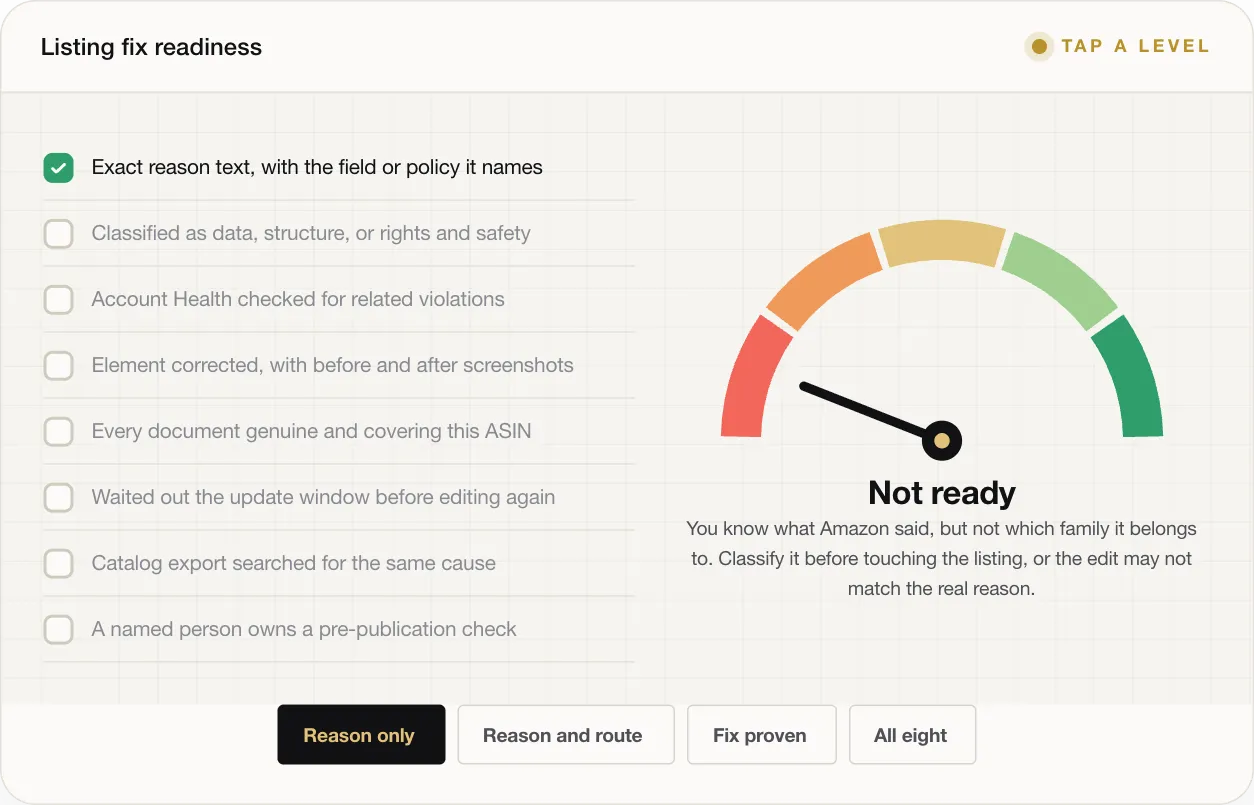
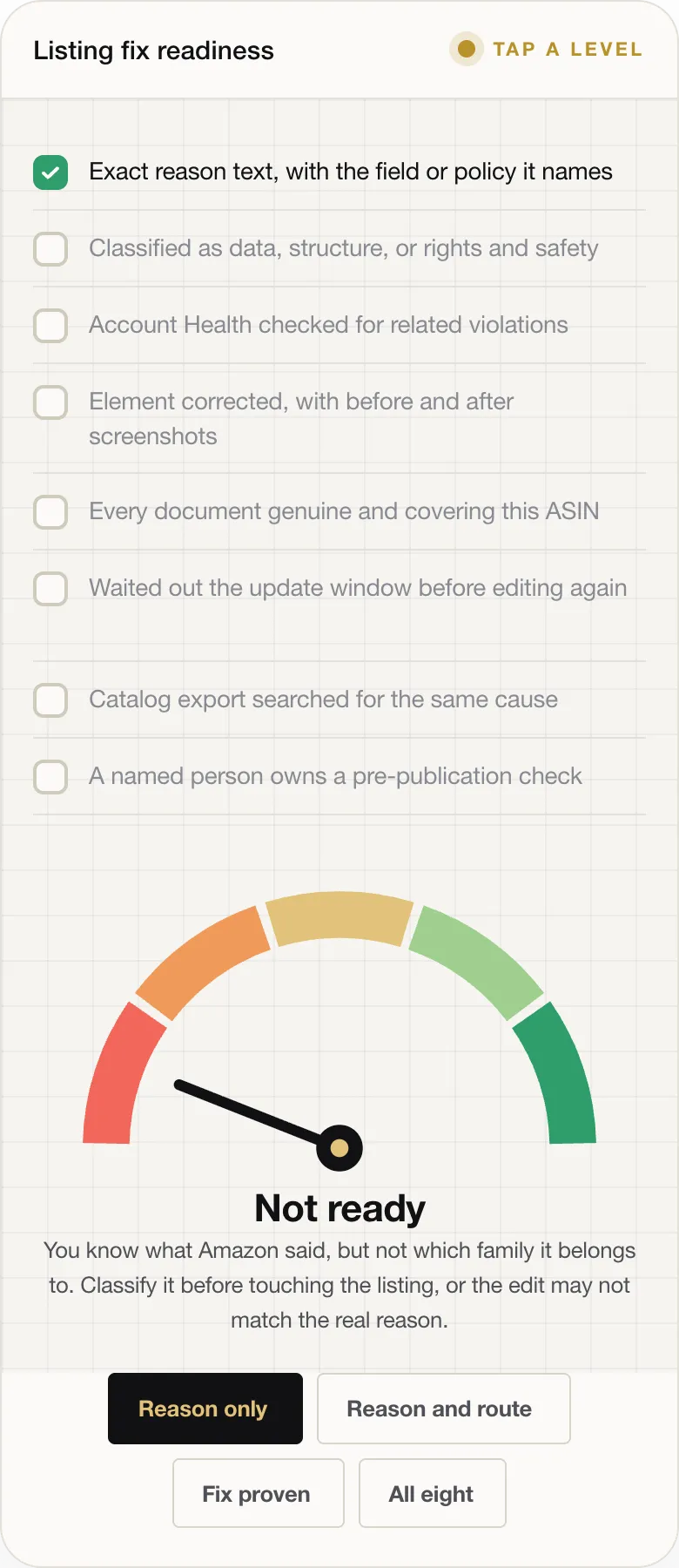
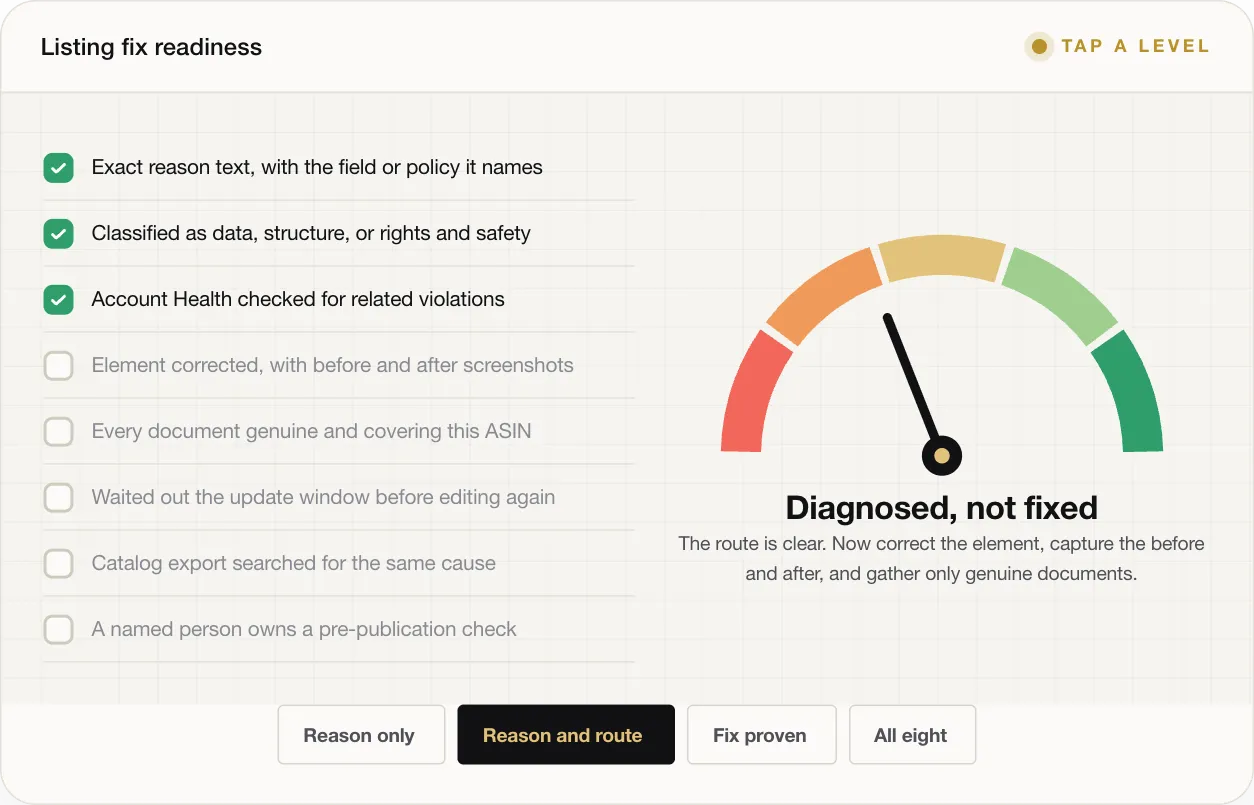
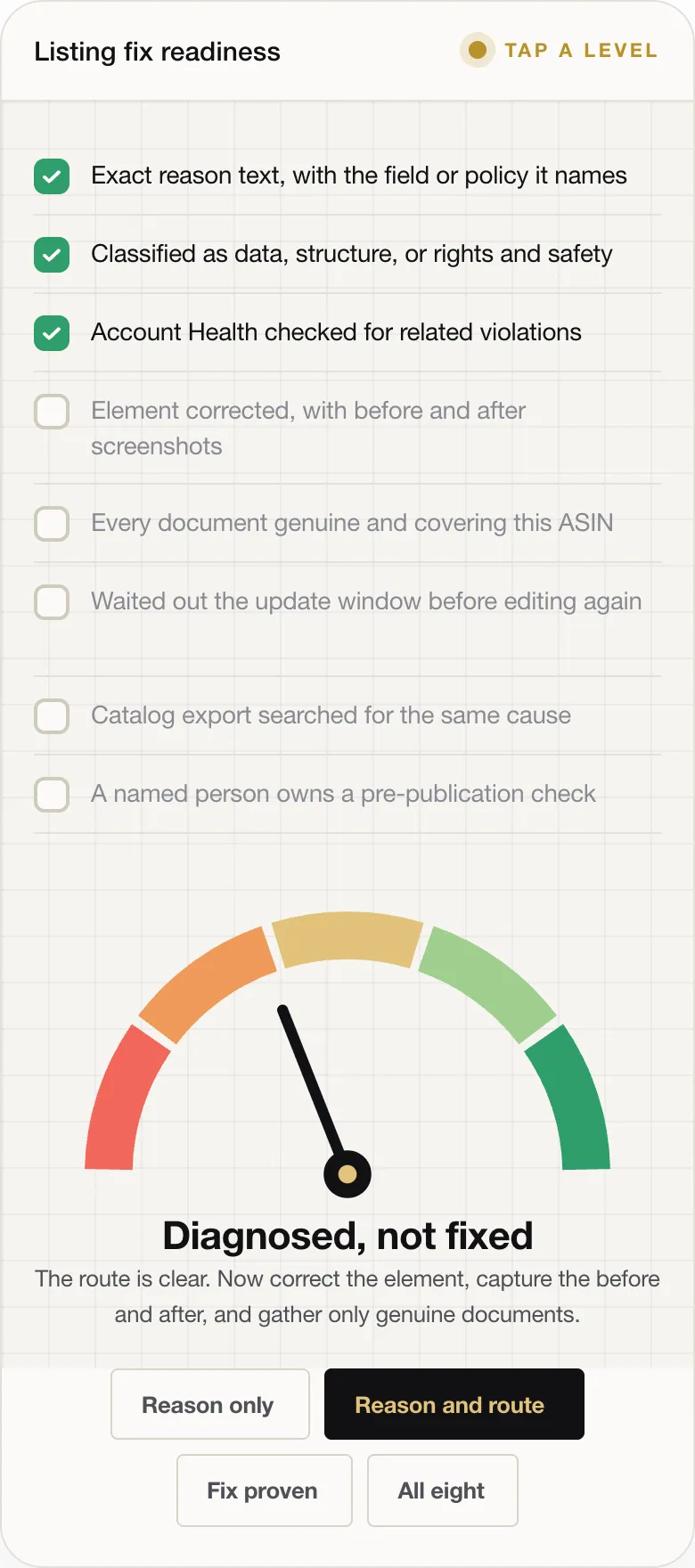
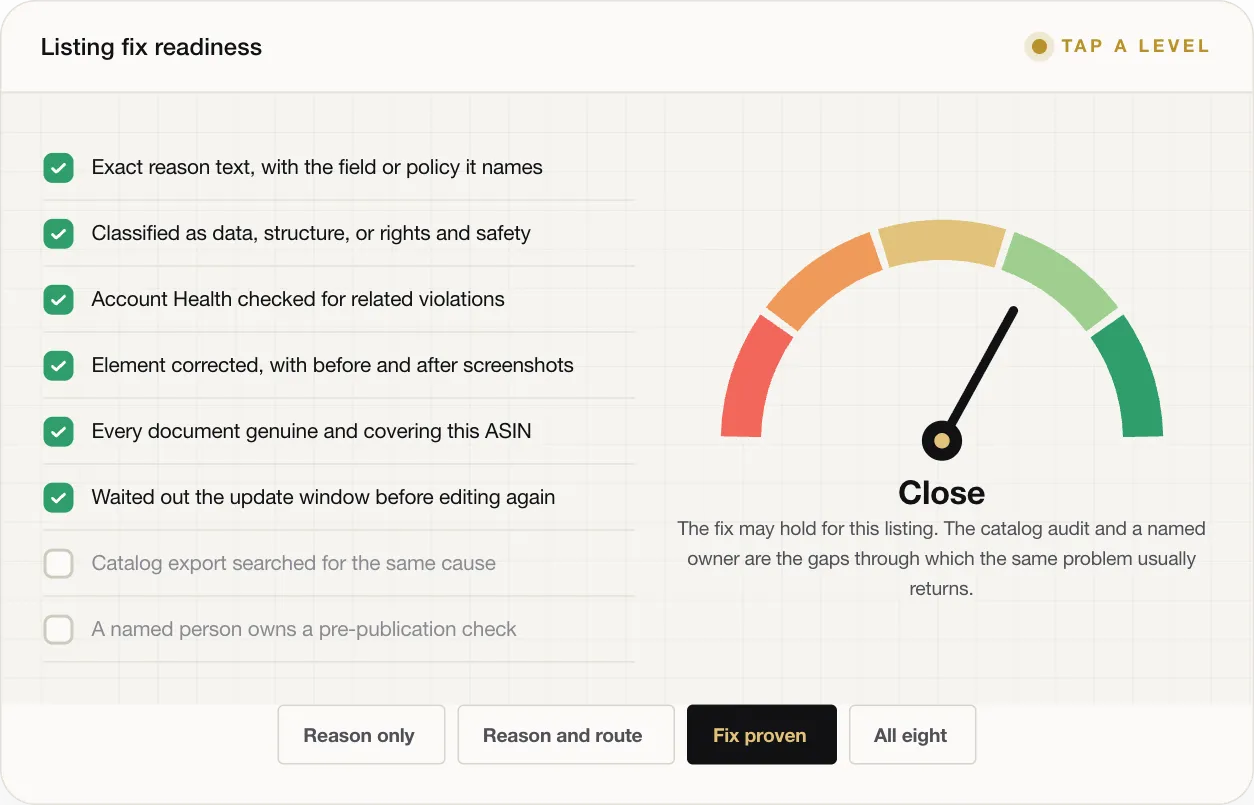
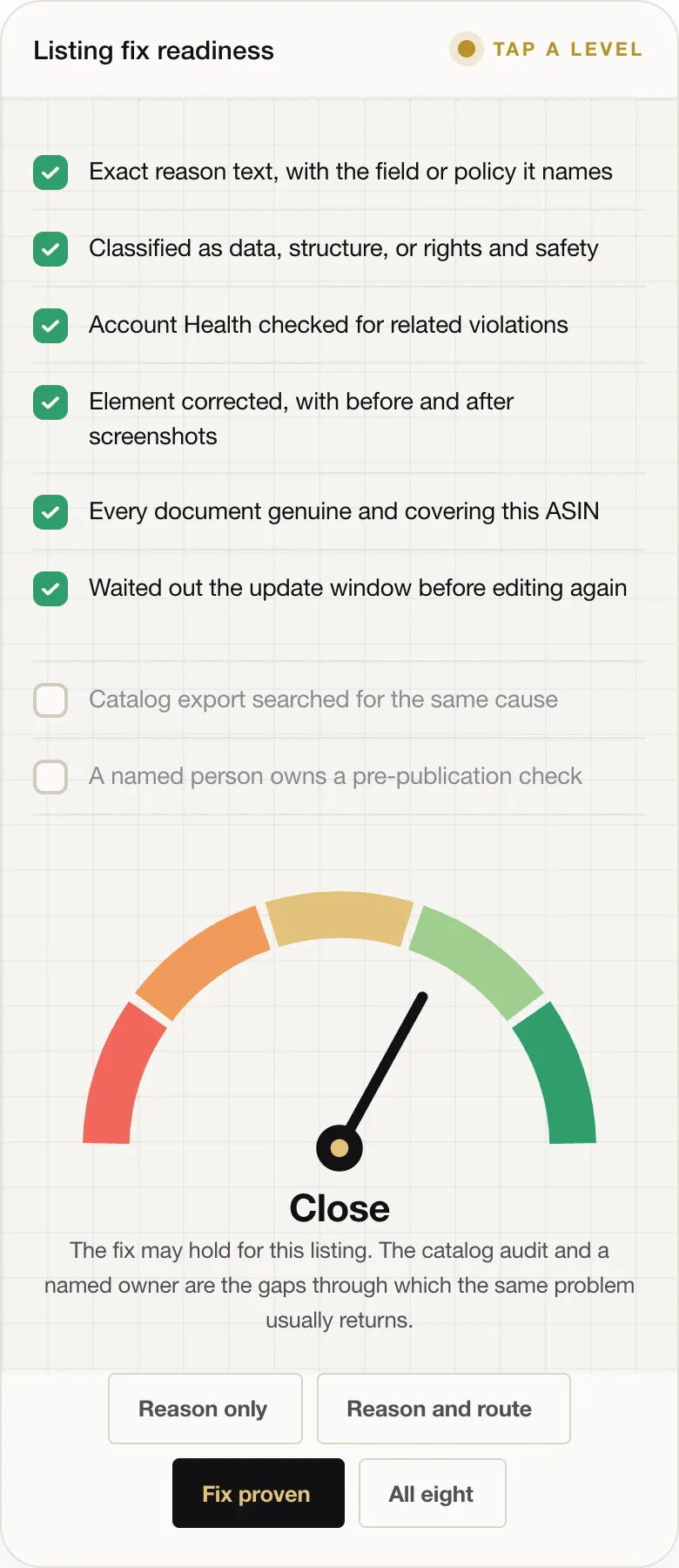
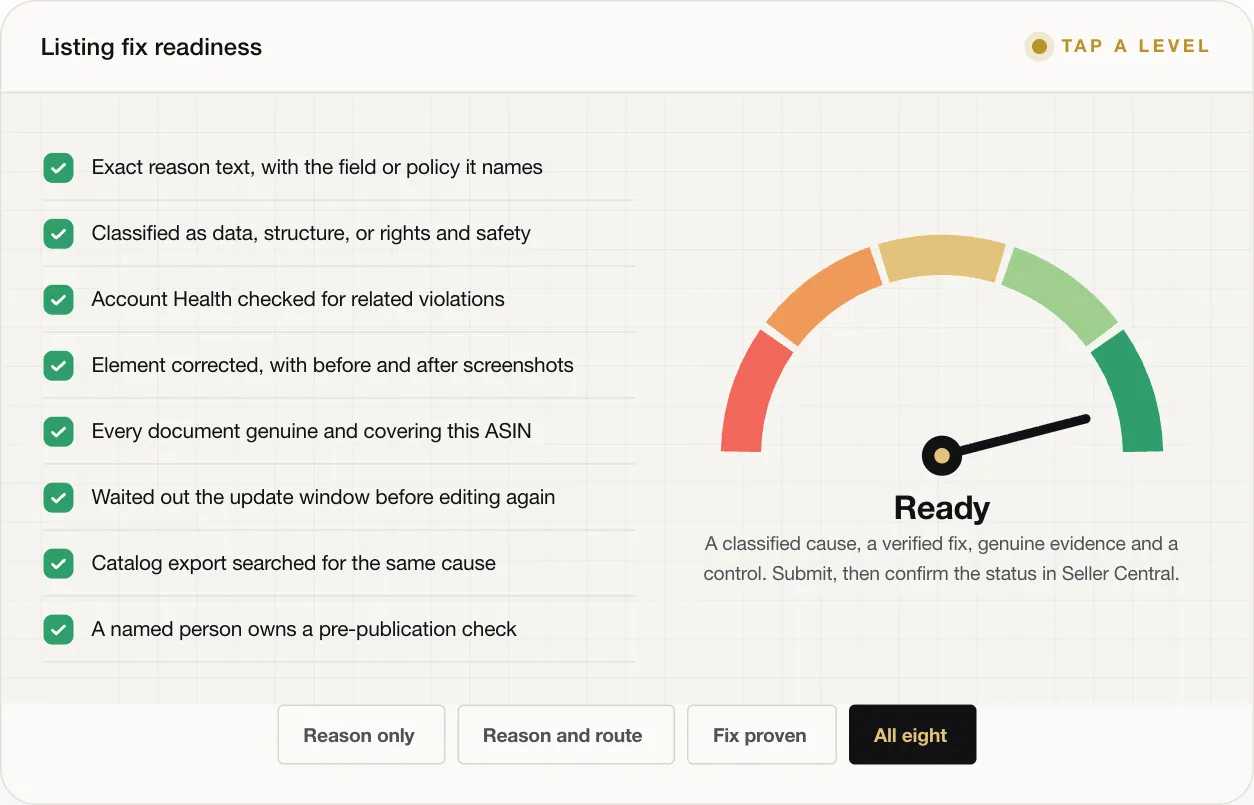
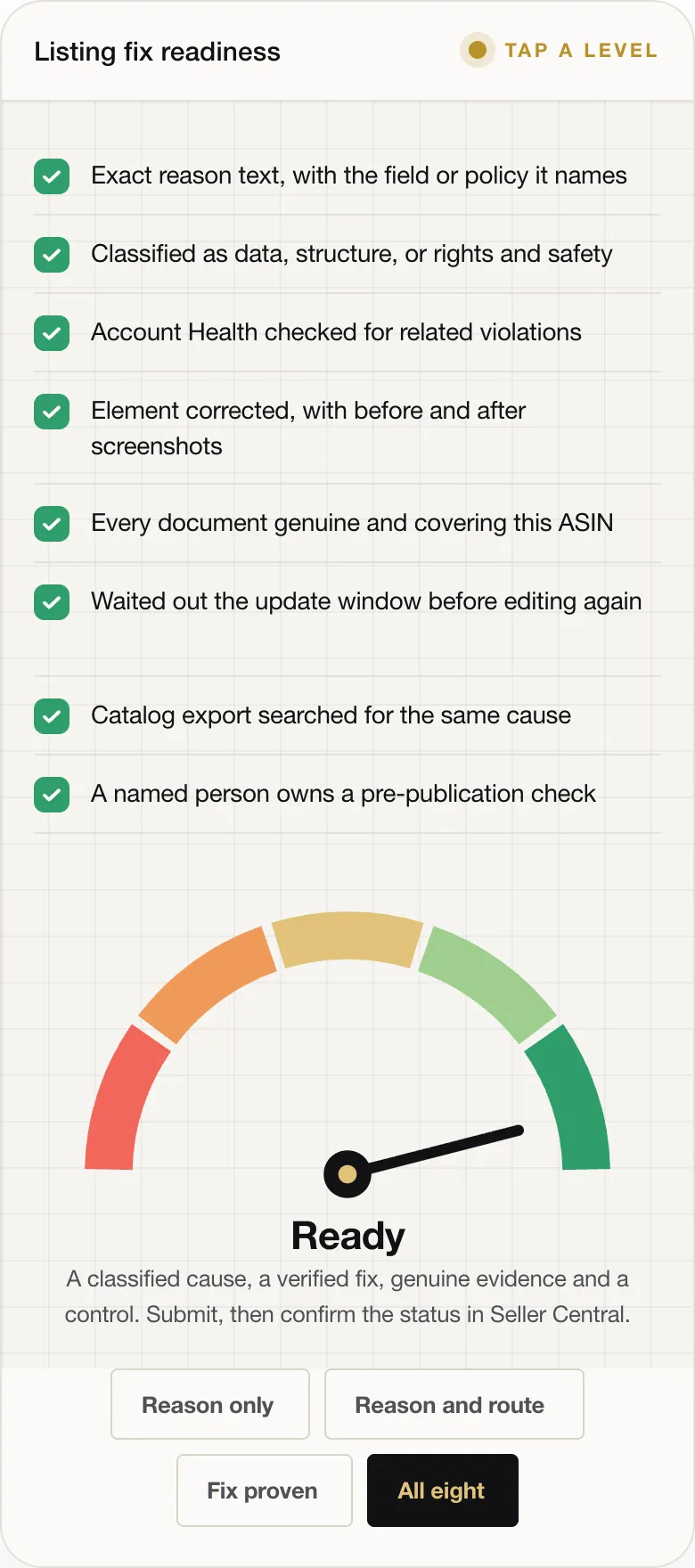
Is your fix or appeal ready to go?
The heavy items are the reason, the classification and the evidence. Without them, any edit or appeal is a guess. Tap a level to see what is still missing at that stage.
Common mistakes that keep listings down
Most listings that refuse to clear share one of five errors: fixing a field other than the one the reason names, answering an authenticity or safety reason with a content tweak, fixing one ASIN while the same cause sits on dozens of others, editing a claim out and back in, and re-editing before Amazon’s update window has passed. The cards below cover the beliefs behind them.
Five statuses. Five ways to misread them.
Most listings that refuse to clear were read wrong at the start. Open each status to see what it actually means and the belief that keeps it down.
A weekly routine that prevents repeat issues
Sellers who rarely have listing problems run a short routine with a named owner and output for each step.
| When | Action | Owner | Output |
|---|---|---|---|
| Daily | Open the Fix tab and the search suppressed filter | Catalog lead | New issues logged with reason text |
| Weekly | Review the “At-risk of search suppression” filter and act before Amazon’s date | Catalog lead | At-risk list cleared or scheduled |
| Weekly | Check Account Health for listing policy violations | Account owner | Any violation classified and routed |
| Before publishing | Check title length and format, restricted phrases, main image standard, category node, GTIN source | Whoever creates or edits listings | Signed pre-publication checklist |
| Monthly | Export the catalog and search for any cause seen that month | Catalog lead | Pattern report and fixes |
| On every new contractor | Require proof of rights for supplied images and copy | Account owner | Rights file per vendor |
Turn your log into controls
After a quarter of logging, sort issues by cause. Mostly missing attributes means your listing template is incomplete; mostly images means your photography brief needs the main image standard; content issues from one contractor mean the control belongs in that contractor’s process. A control with an owner and a start date is what a reviewer wants to see in a future appeal.
Know when it is no longer a listing problem
Escalate your thinking when you see any of these: the same reason across several ASINs, a reason touching authenticity, safety or intellectual property, a listing action arriving alongside other Account Health flags, or a warning that cites evasive behavior. At that point the listing is the visible edge of an account risk, and it should be worked with the account in view. Our guide to reading Amazon’s suspension codes helps with those notices.
Frequently Asked Questions
Why is my Amazon listing search suppressed?
Usually because required information is missing or a quality rule is not met, such as a required attribute, a compliant main image, or title formatting. Click the issue on the SKU to see the exact reason.
How long does it take for a suppressed listing to come back after I fix it?
Amazon says changes made to address search suppression can take up to 48 hours to reflect.
What is the difference between inactive and suppressed?
A suppressed listing is removed from search but still exists, usually for a data or quality reason. An inactive listing is not available for purchase, often because of stock, price, policy or quality.
Should I fix the listing or appeal?
Fix it yourself when the reason is data, content or catalog structure, then confirm the status clears. Appeal through Account Health when the listing was removed for a cited policy, with evidence.
What should I do if my listing was deactivated for suspected IP?
Edit the listing to remove trademarks and logos that do not represent your product and check any compatibility wording. Amazon says to allow 24 hours for review and then contact Selling Partner Support through Product Policy Compliance if the listing stays inactive.
How do I change my product’s category on Amazon?
Go to Manage All Inventory, click Edit listing, open Product Details, and change the browse path and node in the Item Type Keyword field.
Can another seller’s edit get my listing removed?
Yes. Detail pages are shared, and another contributor’s change can introduce non-compliant content. Keep dated screenshots and report incorrect information through Account Health, Report Abuse.
Get Help With Amazon Listing Problems
If a listing will not come back, the reason touches intellectual property or authenticity, or the same problem keeps spreading, our team can help classify the cause, build the evidence and prepare the correction or appeal. See our listing recovery service, submit your case, or book a consultation. Amazon makes the final decision, so we cannot promise an outcome or timeline, but we can make sure what you submit is accurate and matched to the real reason.
This article is educational information about Amazon’s published seller policies and is not legal advice. Amazon updates its policies and Seller Central tools regularly, so confirm current requirements on the linked Amazon help pages before acting. Got Suspended? is not affiliated with Amazon.
Sources
- Amazon Seller Central: Listing quality guidelines
- Amazon Seller Central: Product detail page rules
- Amazon Seller Central: ASIN creation policy
- Amazon Seller Central: Keep your listings discoverable
- Amazon Seller Central: Troubleshoot listings deactivated due to suspected intellectual-property violations
- Amazon Seller Central: Change a product’s category or browse path
- Amazon Seller Central: Product image guide
- Amazon Seller Central: Manage Products dashboard guide
