
Quick answer: Amazon tells sellers to assume higher order volume in the holiday season even without a planned deal, and to protect account health by shipping and confirming every order on or before the ship-by date, using valid tracking from integrated carriers or Amazon Buy Shipping, keeping inventory synchronized across channels, staffing for the peak, and checking A-to-z claims daily. The risks that hurt accounts in Q4 are predictable: late shipments and cancellations when volume outruns capacity, unanswered buyer messages and return requests that turn into granted A-to-z claims, an extended returns window that keeps refunds and claims arriving through January, and FBA inventory that ages into surcharges after the season. A written week-by-week routine from October to the end of January, with a named owner for each check, keeps those risks from compounding.
Every Q4 we see the same pattern. A seller has a strong November, the order count doubles, and the operation that worked at normal volume starts to slip in small ways: a batch of orders confirmed a day late, a carrier pickup missed, a support inbox nobody cleared over a weekend, stock that sold out on the seller’s own website but still showed as available on Amazon. None of those feels like an emergency on the day it happens. By mid December they have become a cluster of late shipments, cancellations, and A-to-z claims, and by January the seller is reading an Account Health warning during the slowest weeks of the year.
This guide is built around how Amazon actually measures what goes wrong in the holiday season, using Amazon’s own Seller Central help pages. It covers each risk, how to verify where you stand, what to do when a metric slips mid season, and a routine that keeps the account clean from October through the end of the returns window. If you want a team to run that monitoring for you, our Amazon account health maintenance service is built for exactly this period.
What Amazon Itself Says About Holiday Preparation
Amazon publishes a Seller Central page called Prepare for the Holiday Season, aimed mainly at seller-fulfilled orders. Its most important line is easy to skim past: even if you have no deal planned, Amazon says you should assume higher than normal volume because of increased traffic to Amazon. Holiday risk is not something you opt into by running a promotion. It arrives with the season.
The page asks sellers to ship and confirm on or before the ship-by date, use Buy Shipping or integrated carriers with matching tracking, work orders daily from Seller Central and the Seller app instead of relying on “Sold, ship now” emails, never ship orders still in Pending status, cancel orders that carry an official buyer cancellation request, keep inventory accurate across channels, plan staffing, set Order Handling Capacity, review shipping templates, hand packages over the same day the label is bought, tell customers about delays, remove listings temporarily if the account cannot be managed, and check A-to-z claims daily. Every one of those lines maps to a metric or a claim trigger, and the rest of this guide takes them in turn.
How Account Health Is Scored, and Why Q4 Mistakes Linger
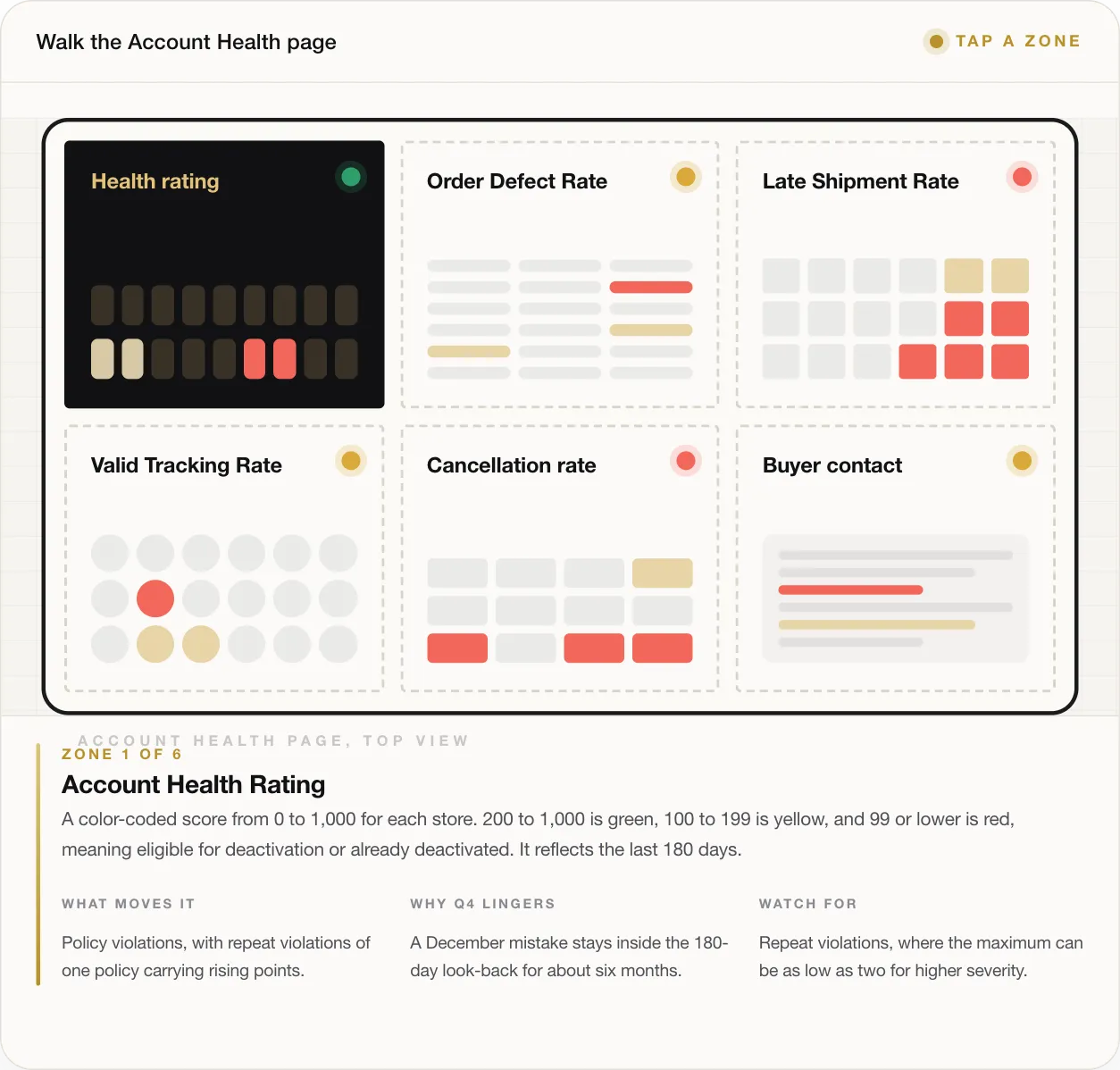
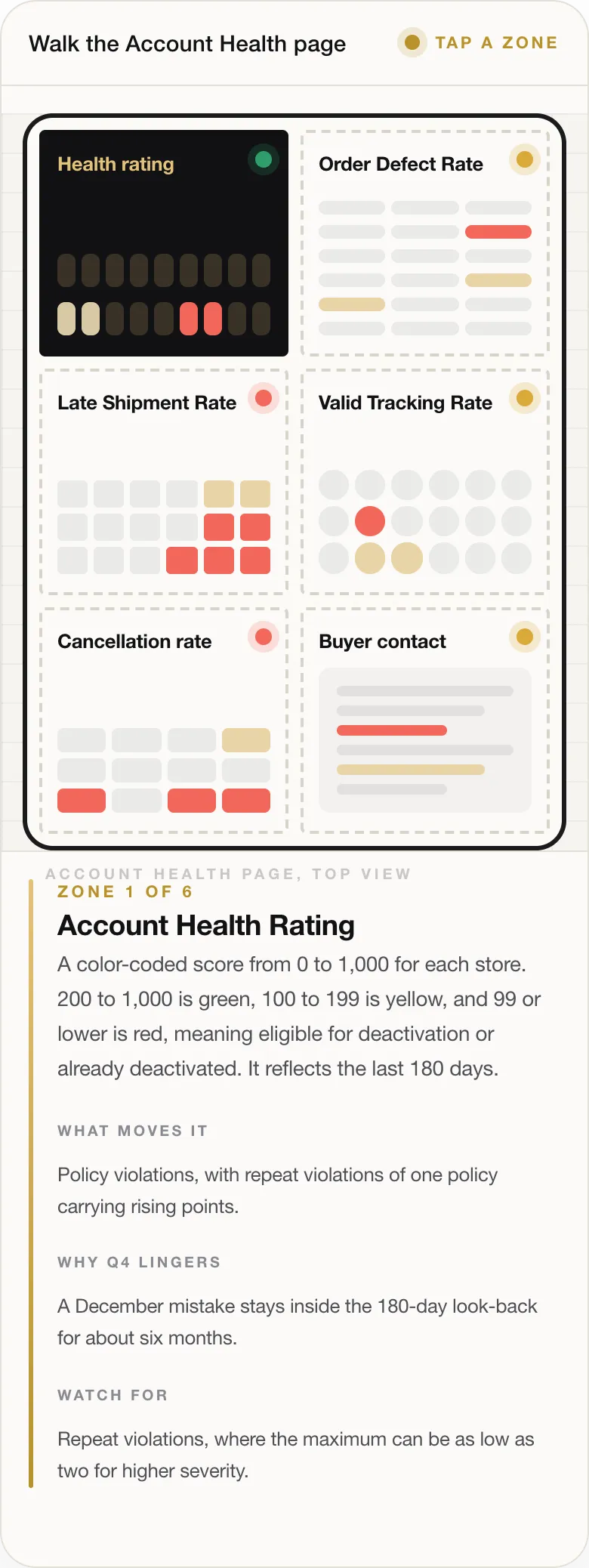
Amazon’s Account Health Rating (AHR) is a color-coded score from 0 to 1,000 on the Account Health page for each store you sell in. Amazon describes it as indicating the account’s risk of deactivation for non-compliance with certain selling policies. A score of 200 to 1,000 is green (Healthy), 100 to 199 is yellow (At Risk), and 99 or lower is red (Unhealthy), meaning eligible for deactivation or already deactivated. Amazon says the score reflects policy adherence and selling activity over the last 180 days.
That 180-day look-back is why holiday mistakes matter long after the holidays. Amazon also states that repeat violations of the same policy carry rising point values, and that an account may be at immediate risk of deactivation when it reaches the maximum number of repeat violations for one policy within 180 days, which can be as low as two for higher severity violations. Regardless of score, Amazon may deactivate immediately where it suspects fraudulent, deceptive, illegal, or harmful activity.
Read the components, not just the score
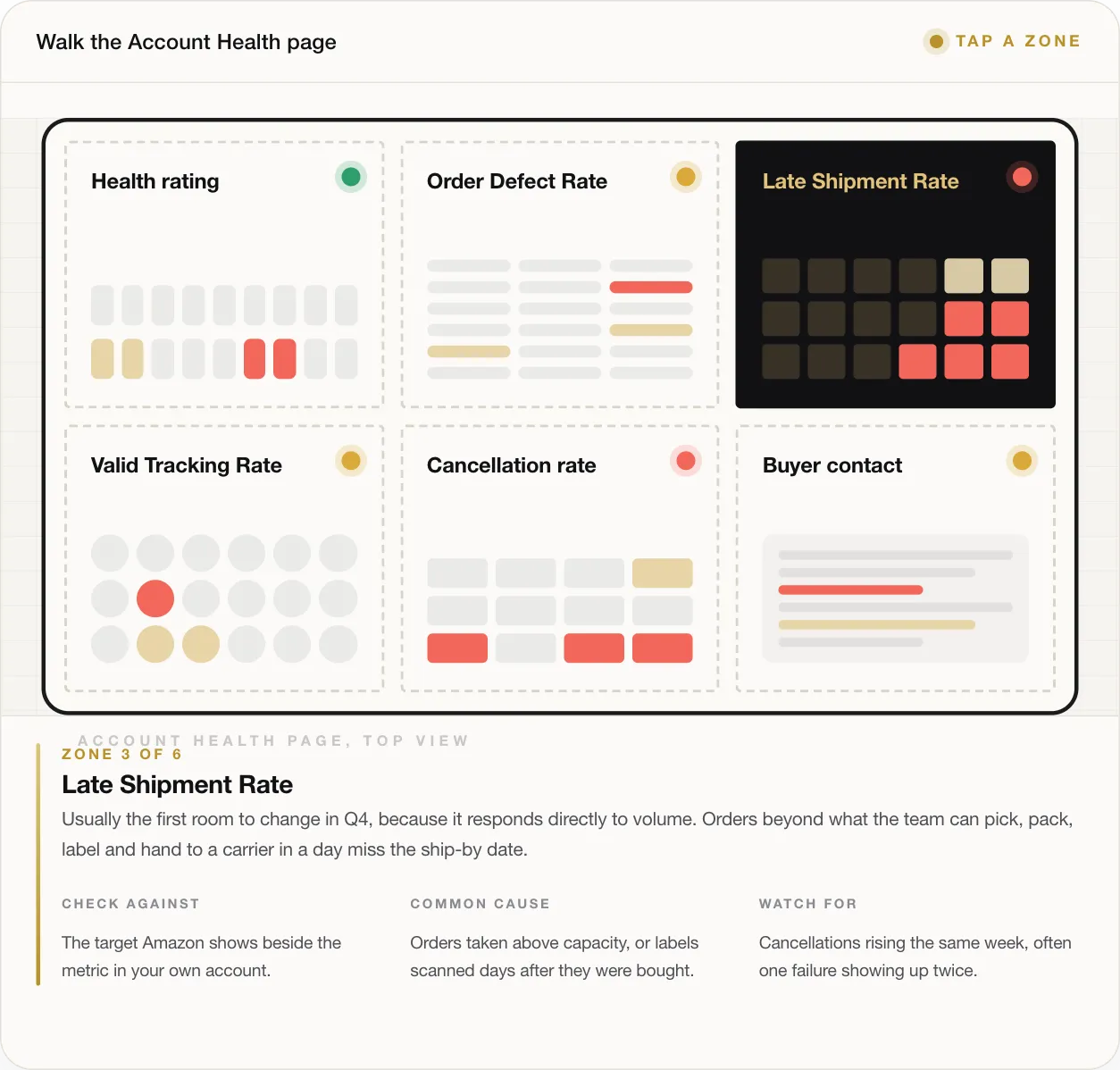
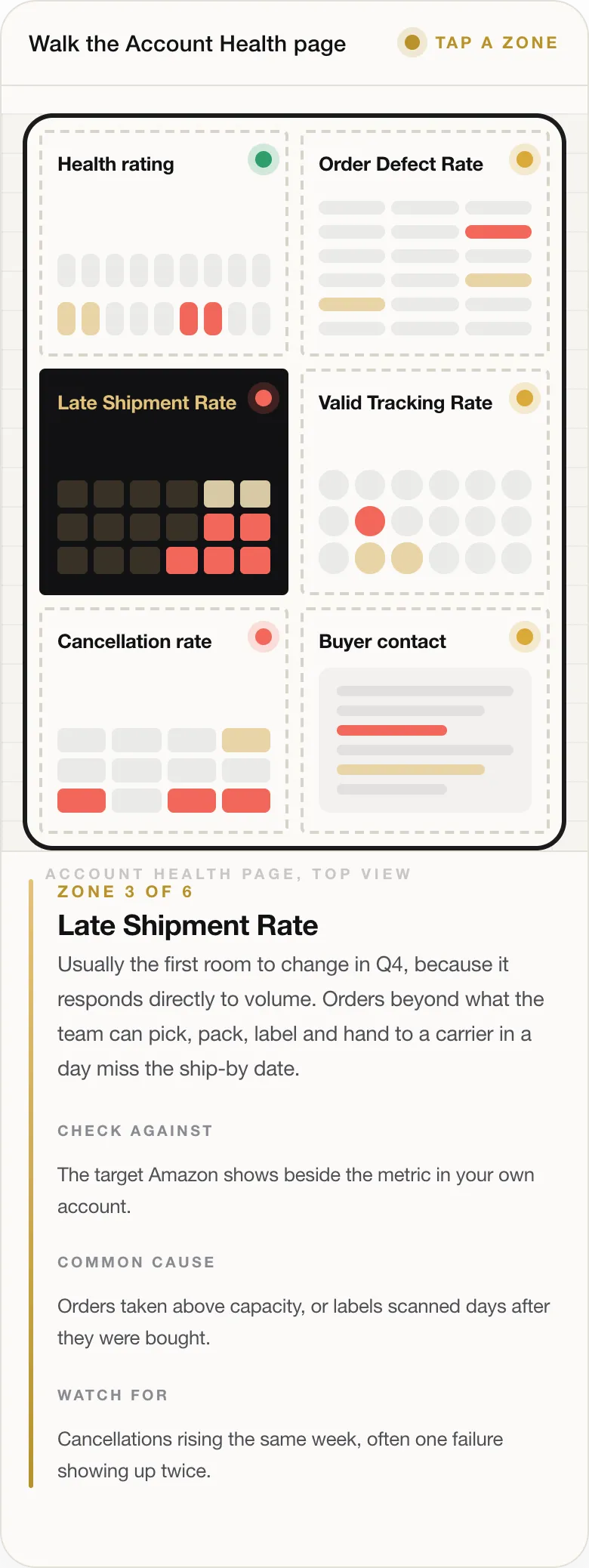
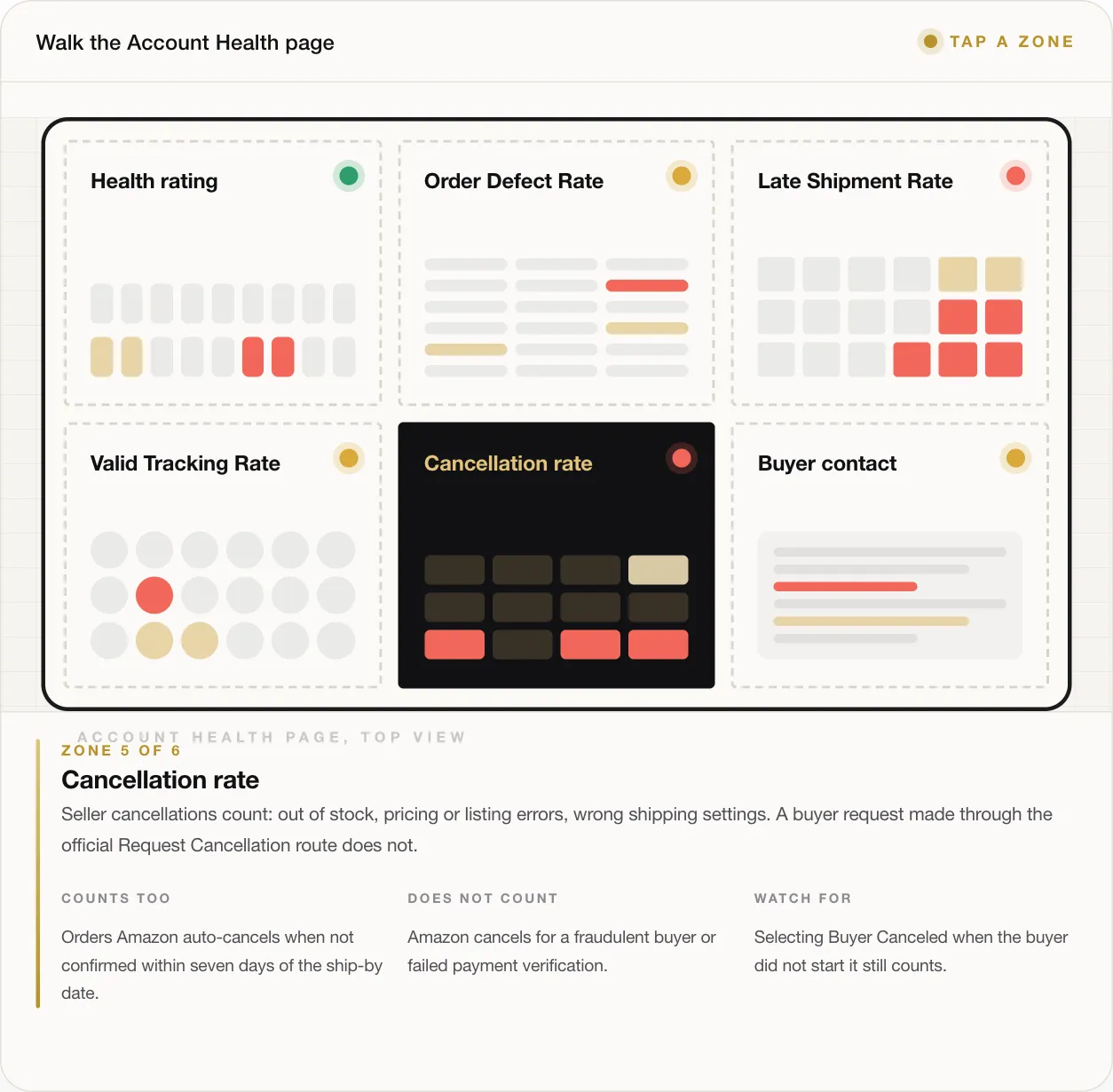
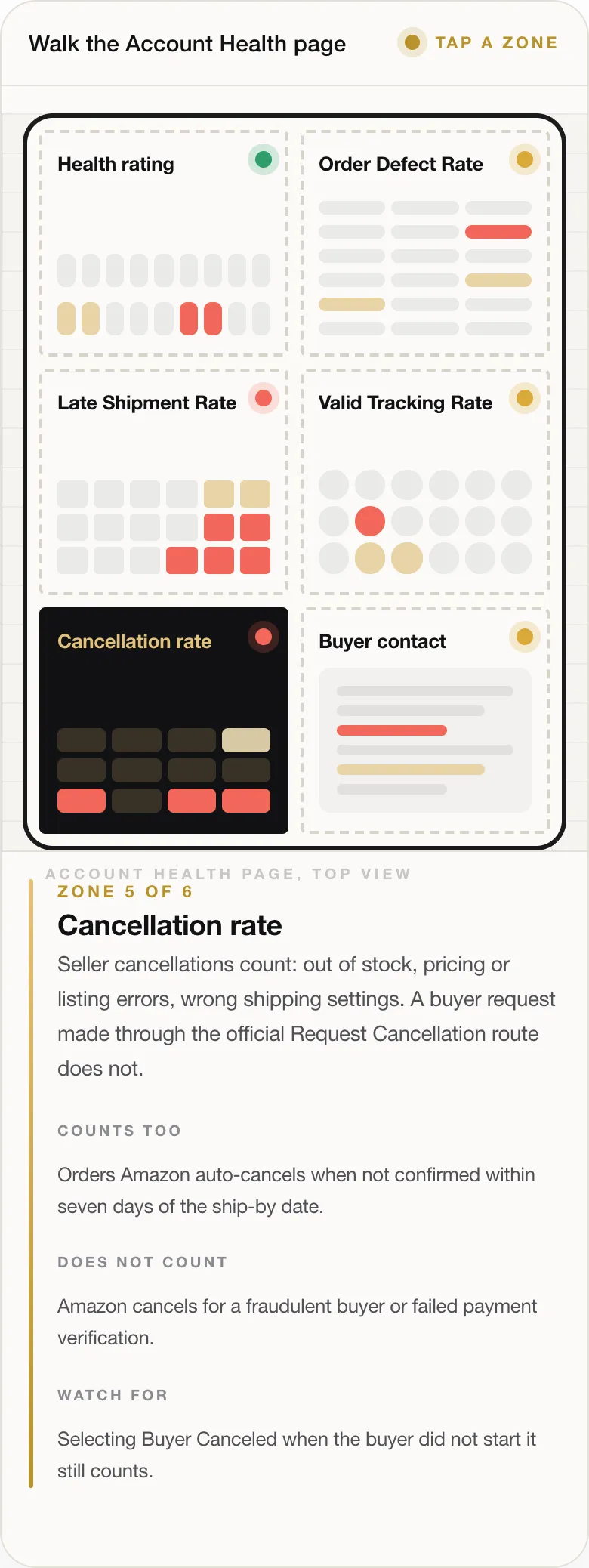
The Account Health page separates policy compliance from performance metrics such as Order Defect Rate, Late Shipment Rate, Valid Tracking Rate, and cancellation rate. In the holiday season the performance side usually moves first, because those metrics respond directly to volume. Read past the headline score to each component, note which ones carry a warning or sit close to their target, and look for items that share a cause. A late shipment problem and a rising cancellation rate in the same week are often one operational failure showing up twice.
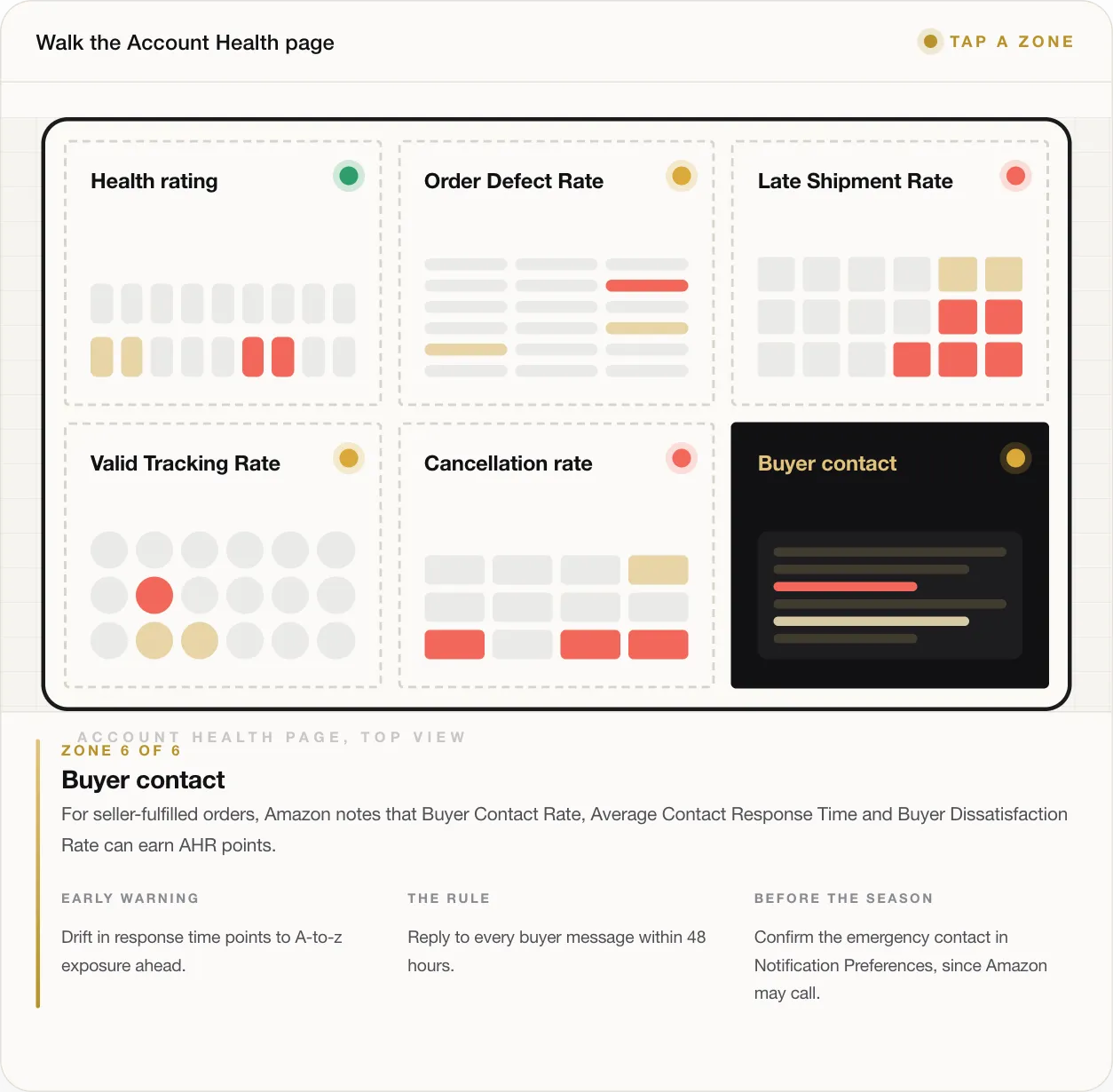
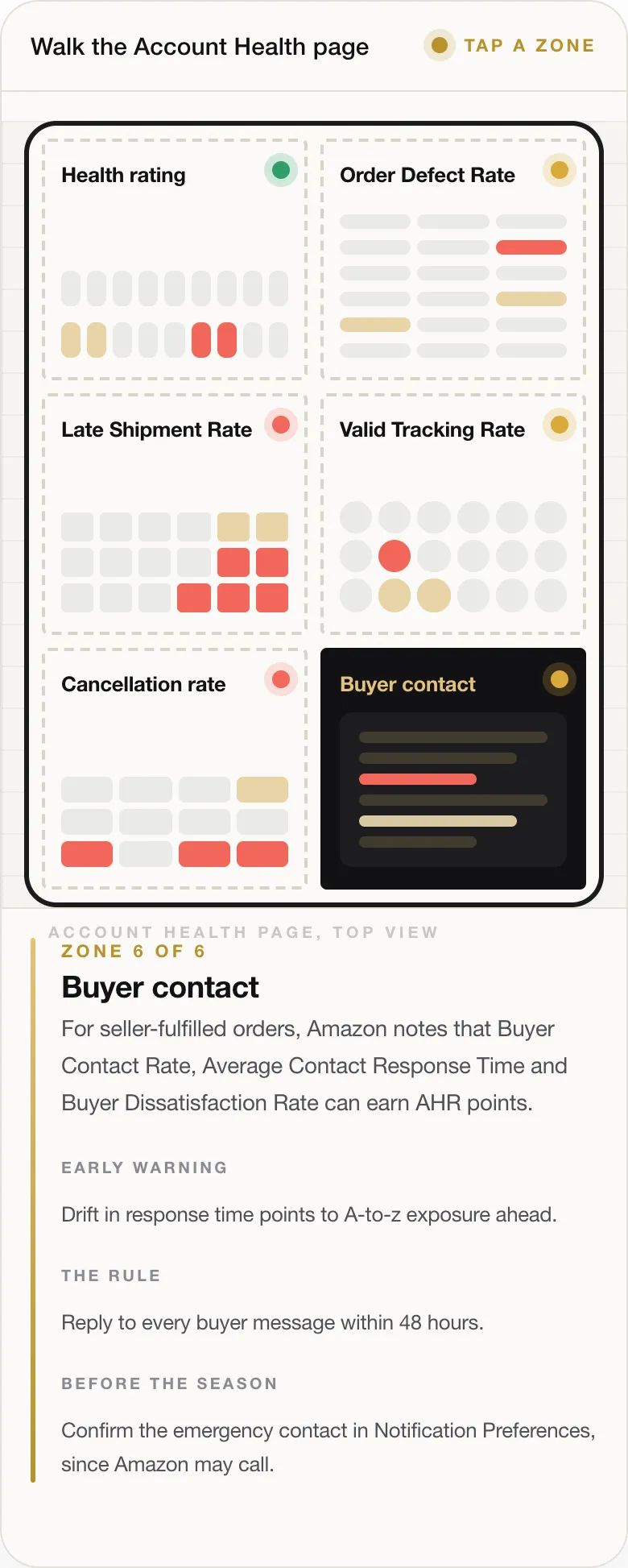
Amazon shows the current target beside each metric on the Account Health page. Use the figure displayed in your own account rather than a number remembered from last year. Amazon also says it may call sellers whose account health degrades, so confirm the emergency contact number under Notification Preferences before the season starts. For FBM sellers, Amazon notes that Buyer Contact Rate, Average Contact Response Time, and Buyer Dissatisfaction Rate can earn AHR points; treat any drift in response time as an early warning of the A-to-z exposure covered below.
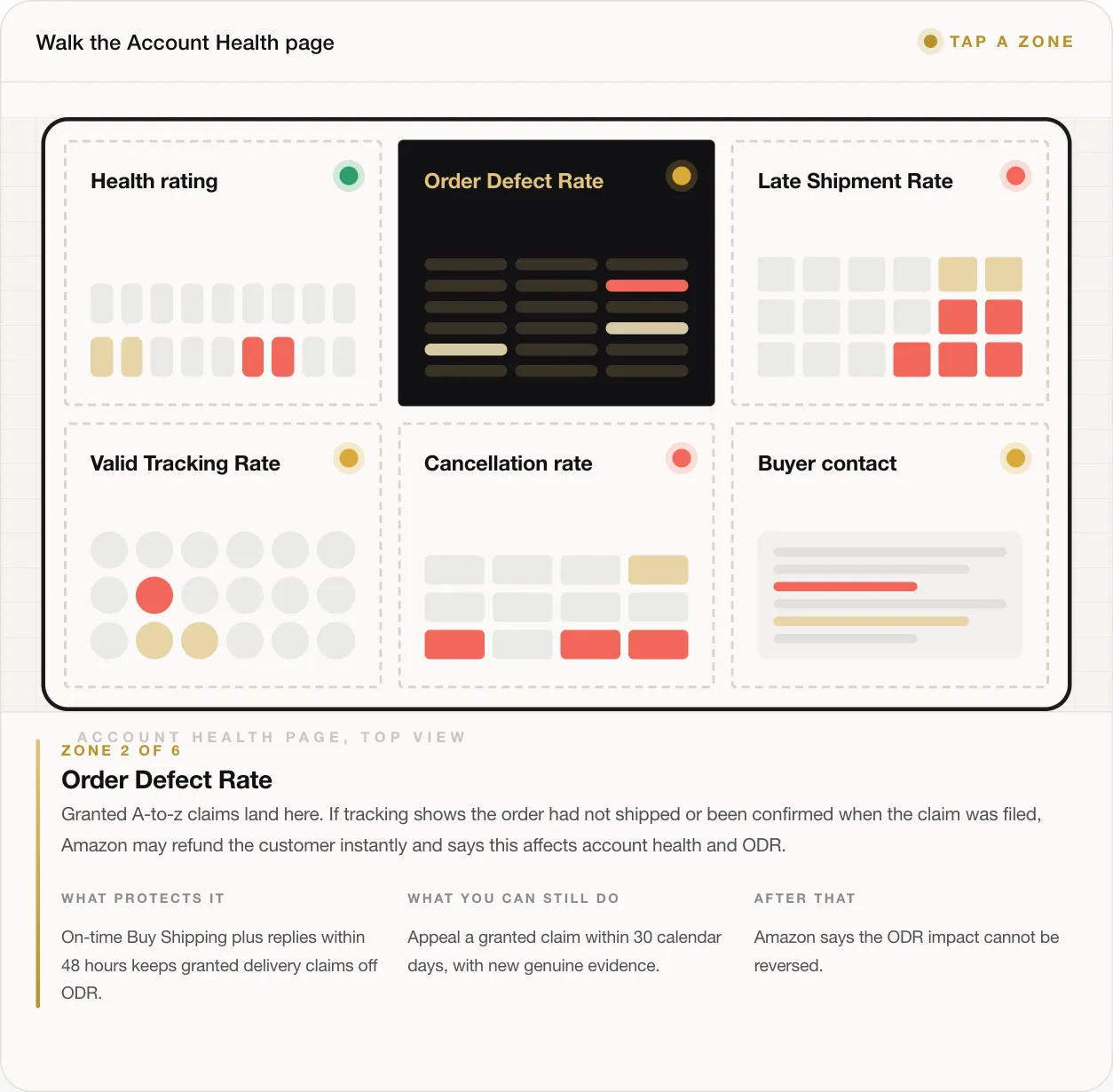
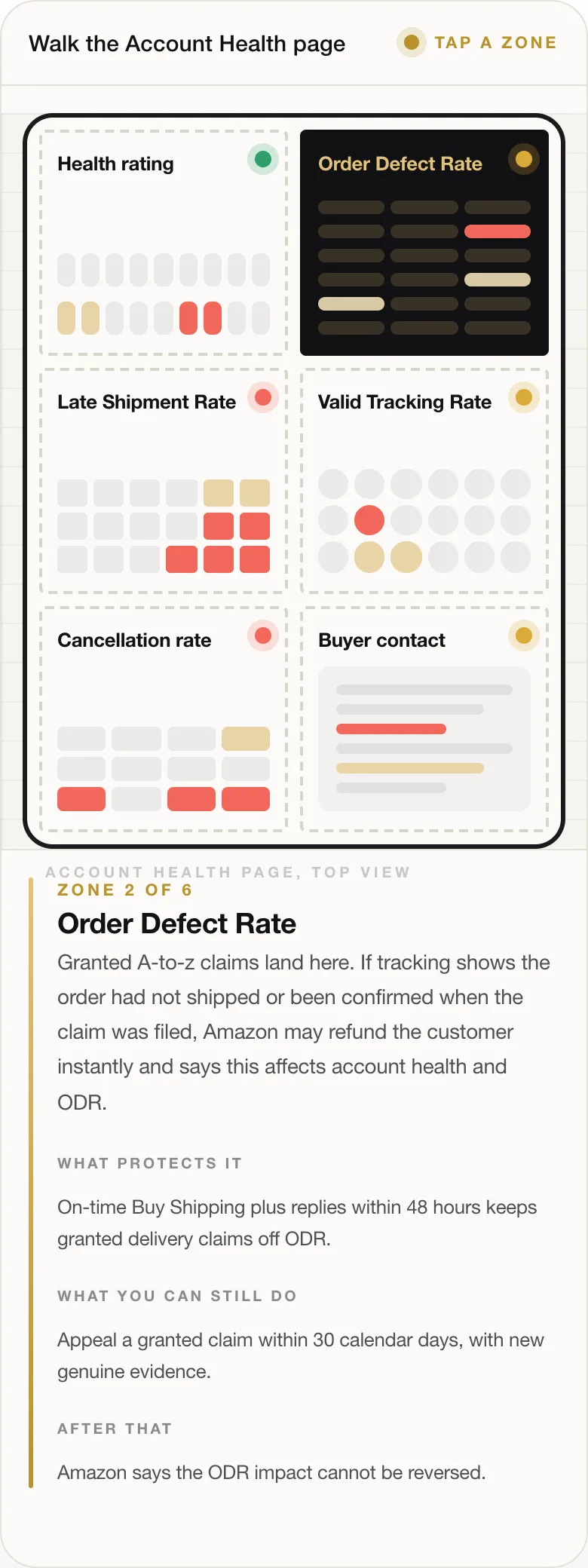
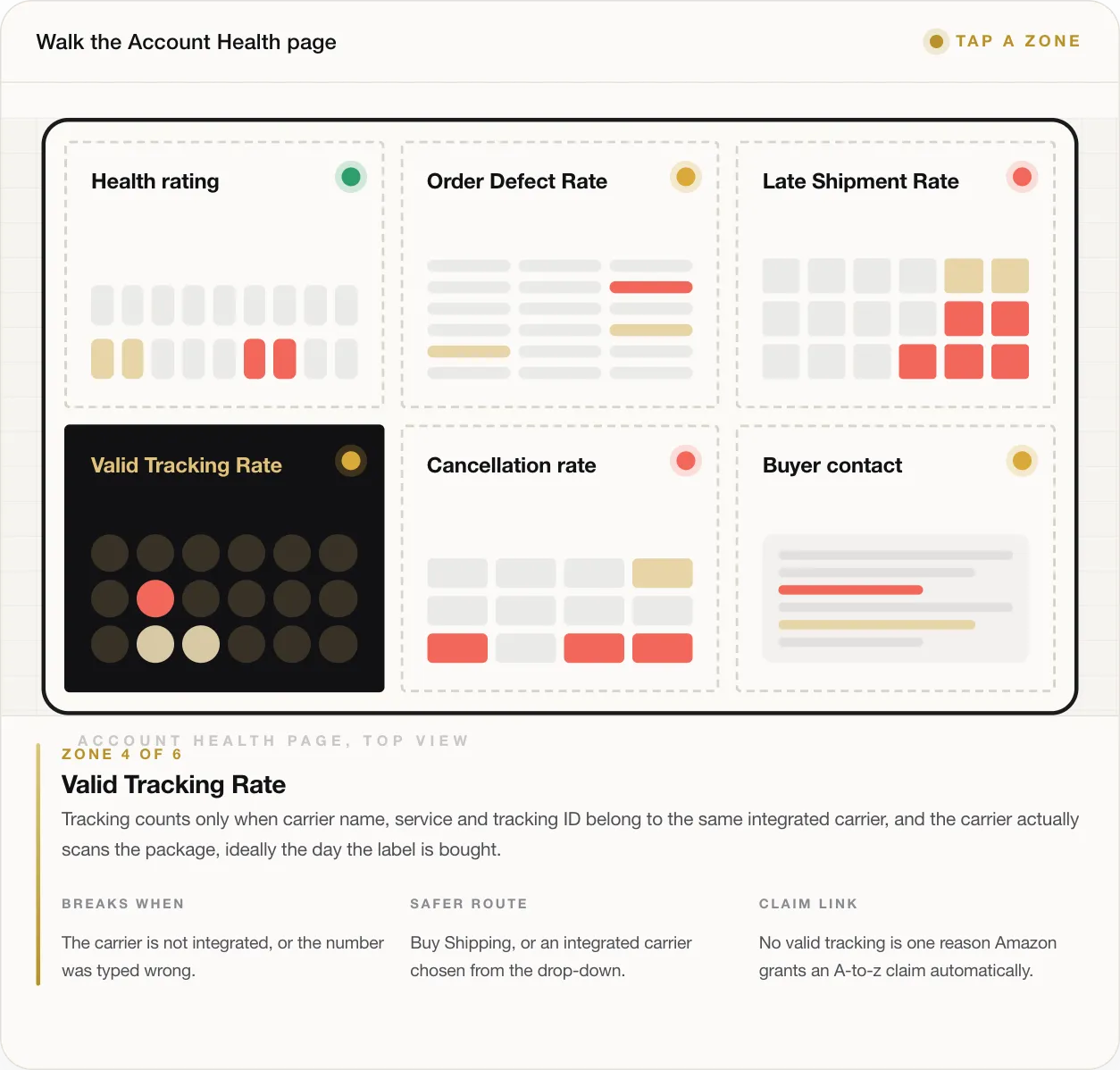
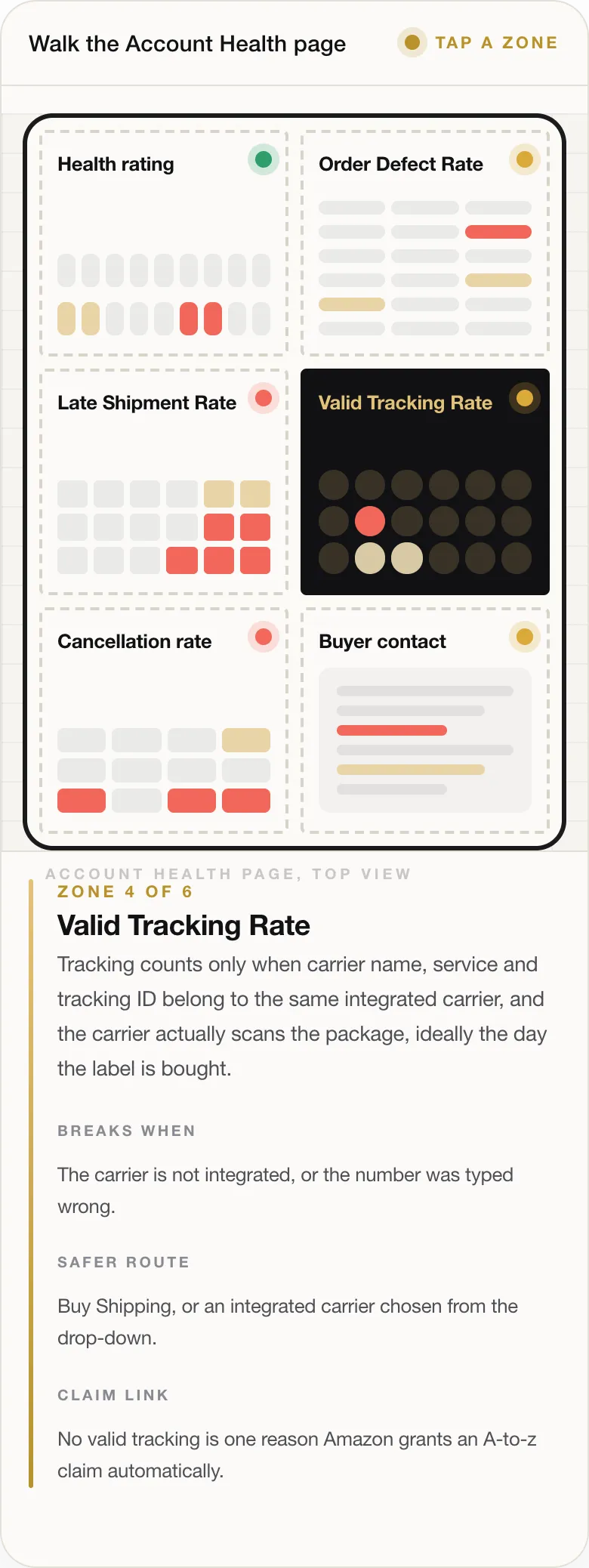
One score on top. Six rooms underneath.
In the holiday season the performance metrics usually move before the headline score does. Tap a room to see what it measures, what moves it at volume and what to watch.
Late Shipments and Valid Tracking at Holiday Volume
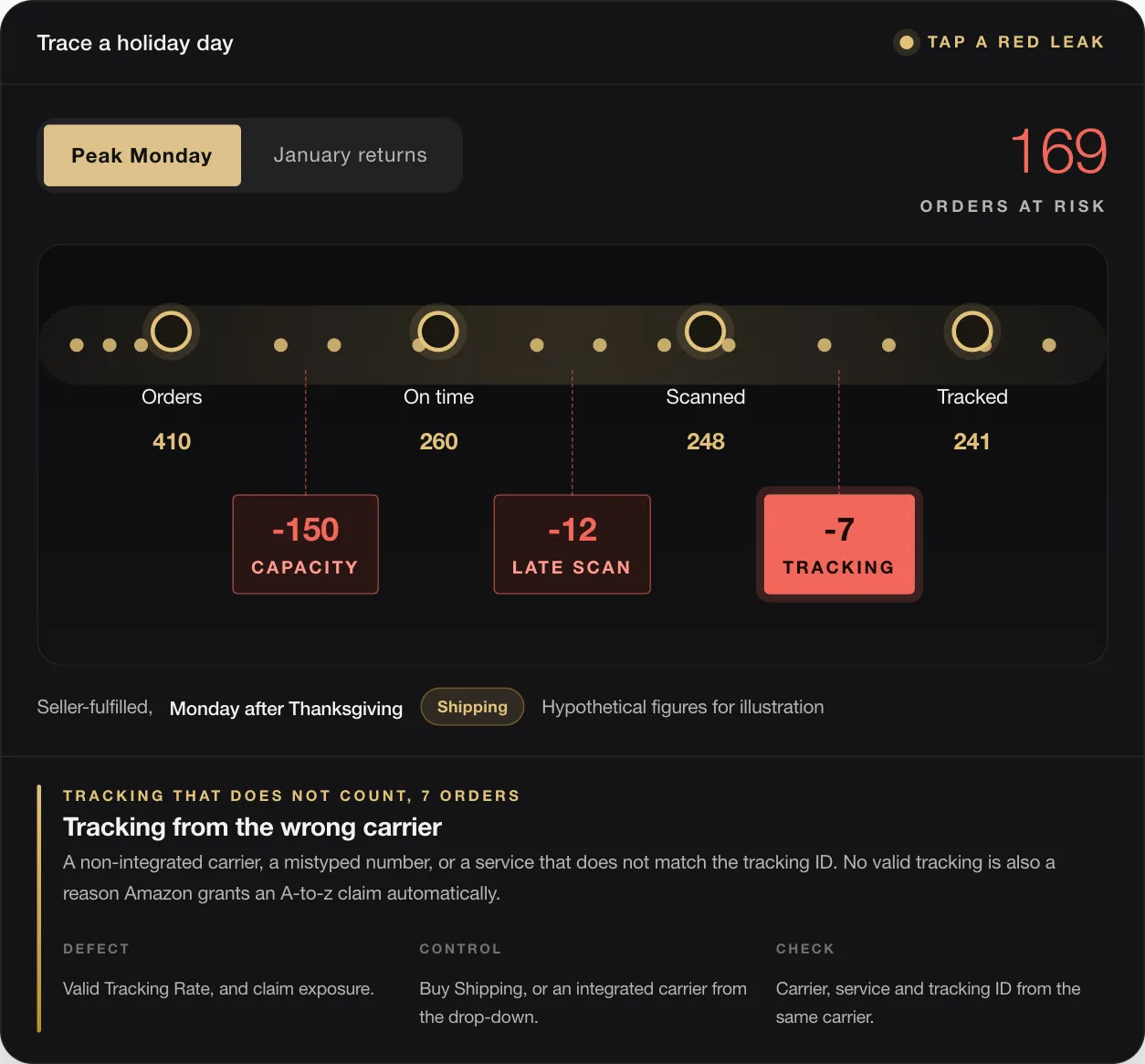
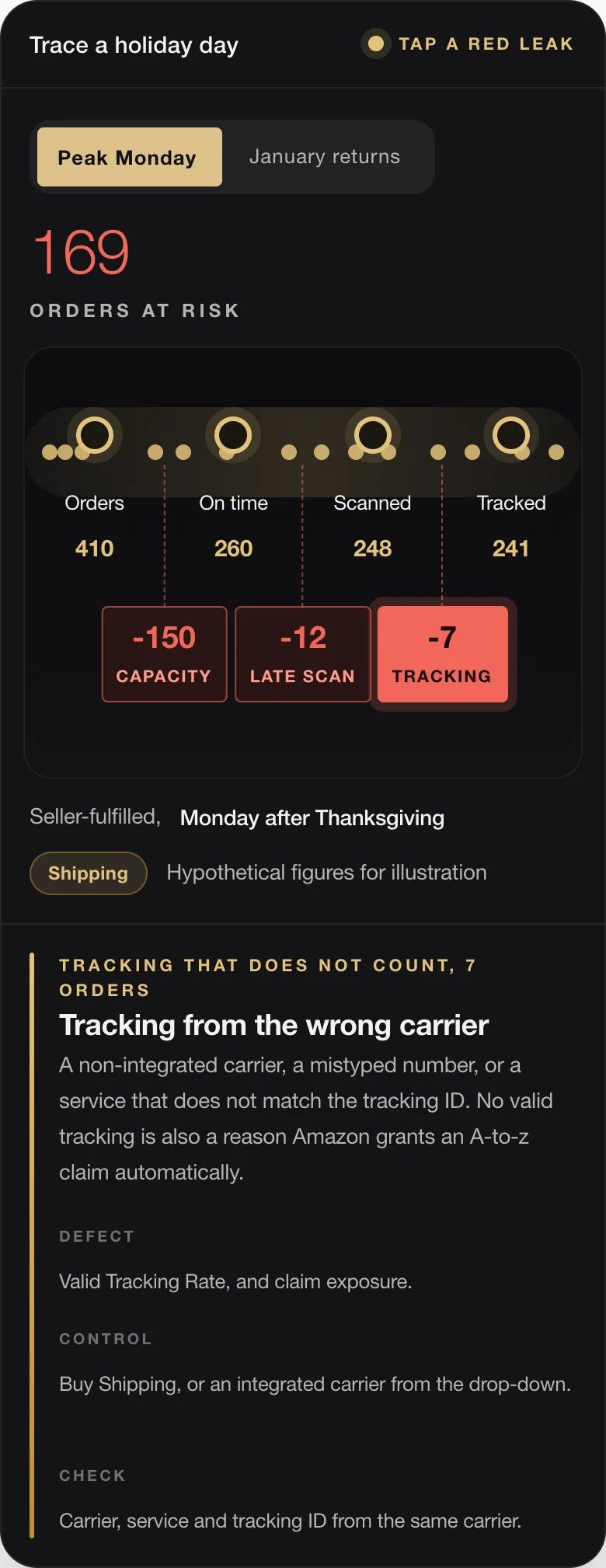
For seller-fulfilled orders, the most common holiday failure is simple: volume exceeds what your team can pick, pack, label, and hand to a carrier in a day, so orders miss their ship-by date. The second is tracking that does not count, because the carrier is not integrated, the number was typed wrong, or the carrier and service do not match the number.
Capacity is a setting, not just a staffing question
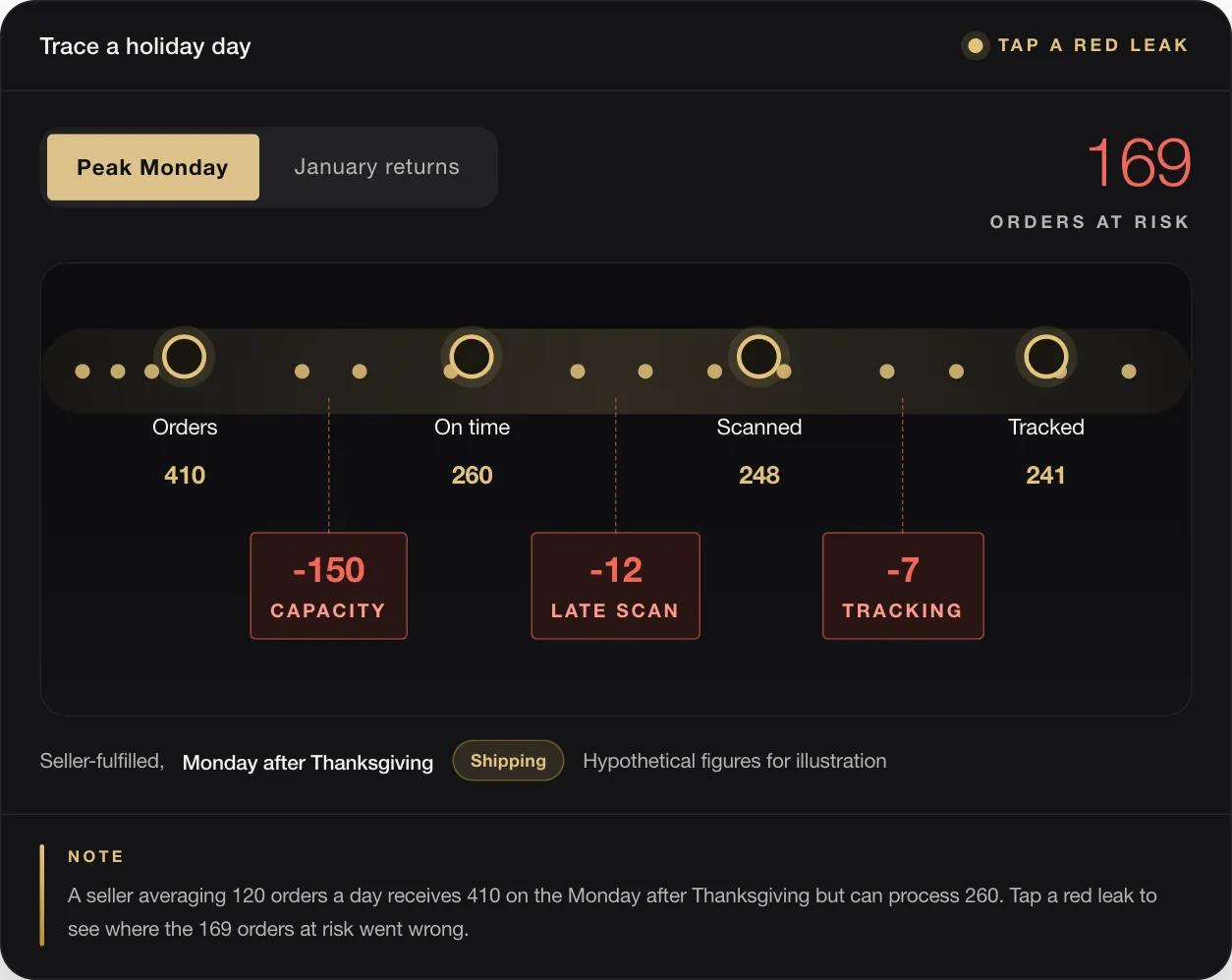
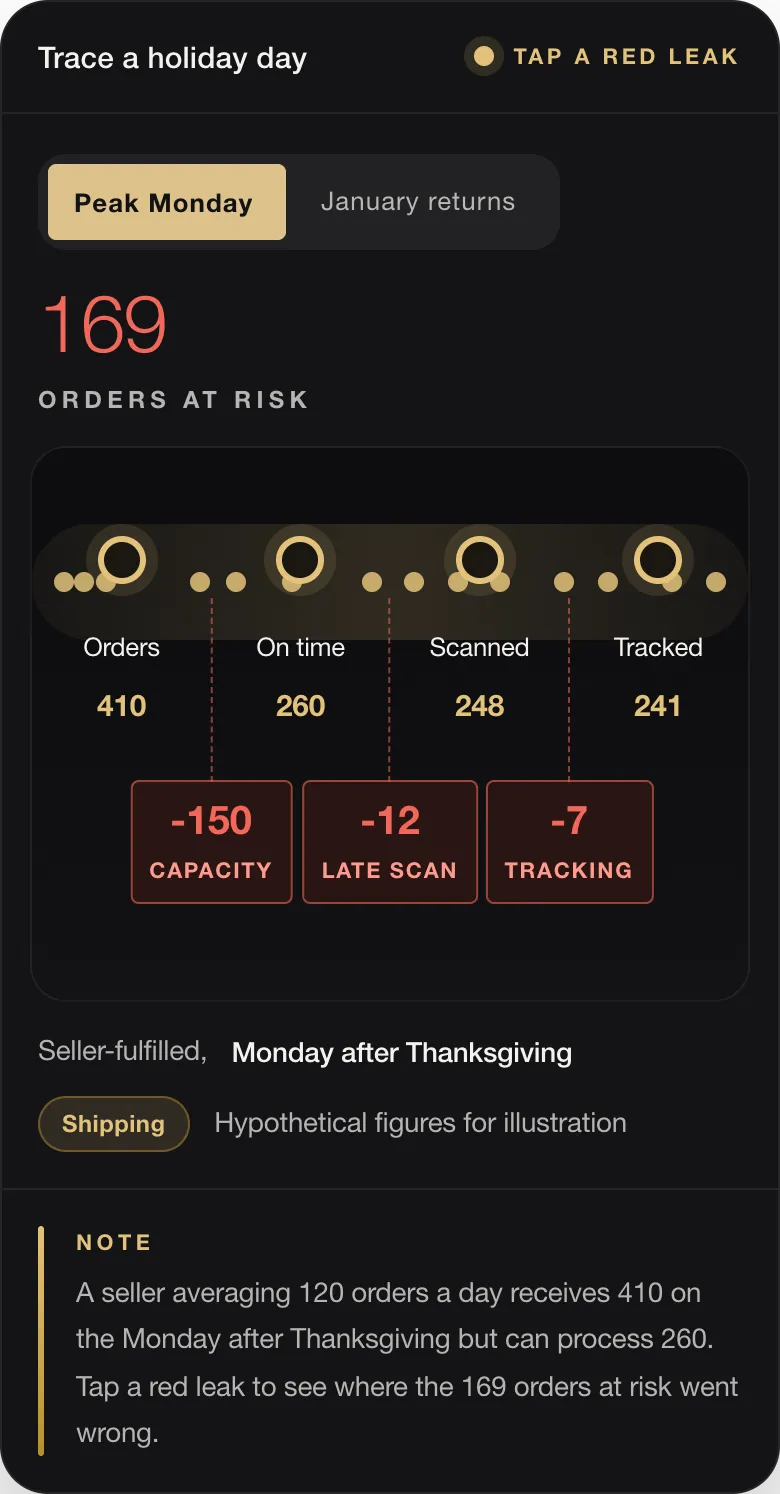
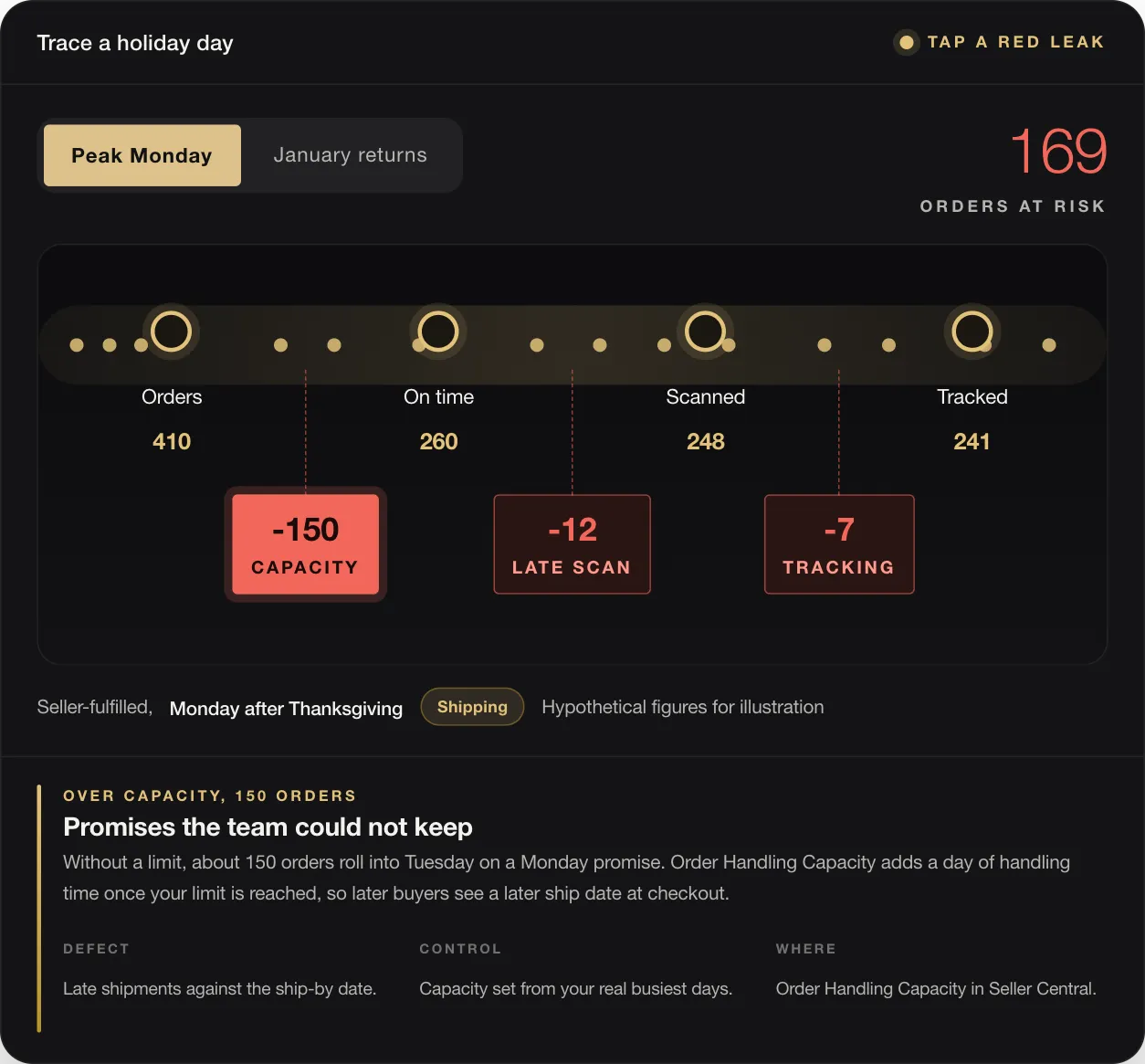
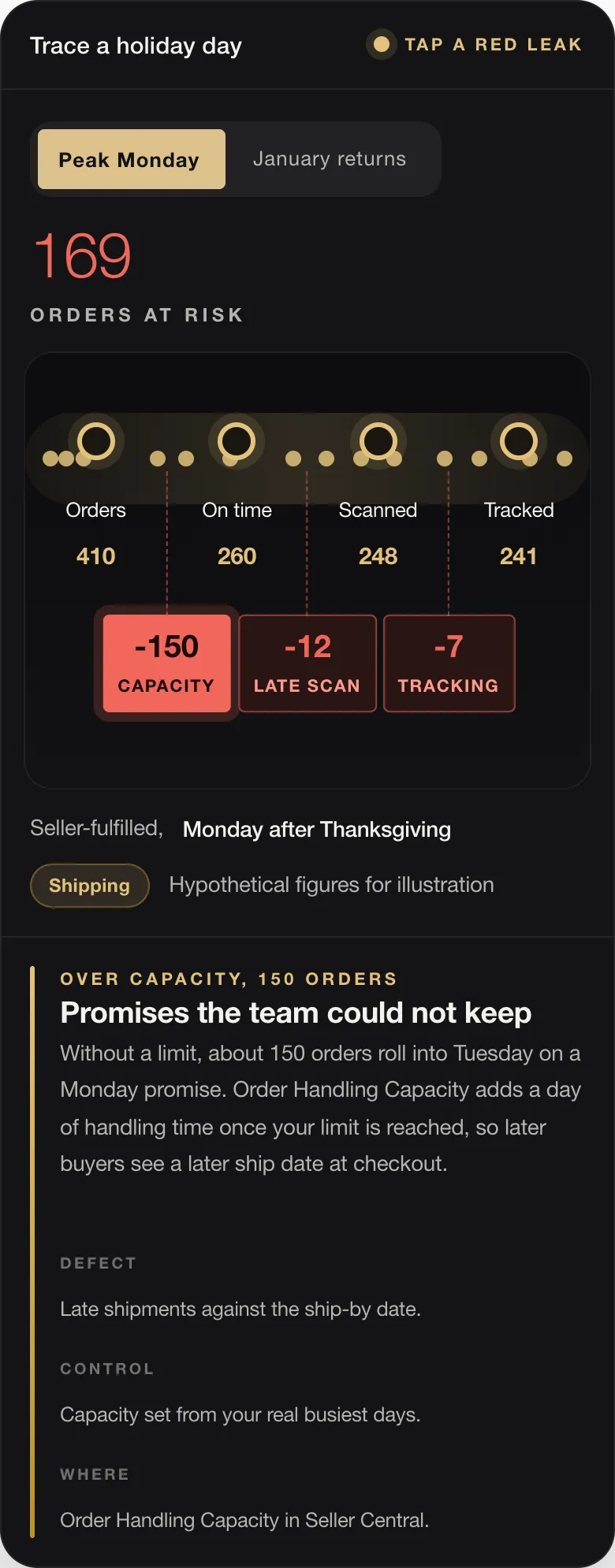
Amazon’s holiday page points to Order Handling Capacity, which adds a day of handling time once your limit is reached. The ship-by date a customer sees is built from your handling time and shipping template, so taking more orders than you can process creates promises you cannot keep. In a hypothetical example, a seller averaging 120 FBM orders a day receives 410 on the Monday after Thanksgiving but can process 260. Without a capacity limit, about 150 orders roll into Tuesday on a Monday promise. With capacity set at 260, the customers beyond it see a later ship date at checkout and the seller can meet it.
Getting tracking right on every package
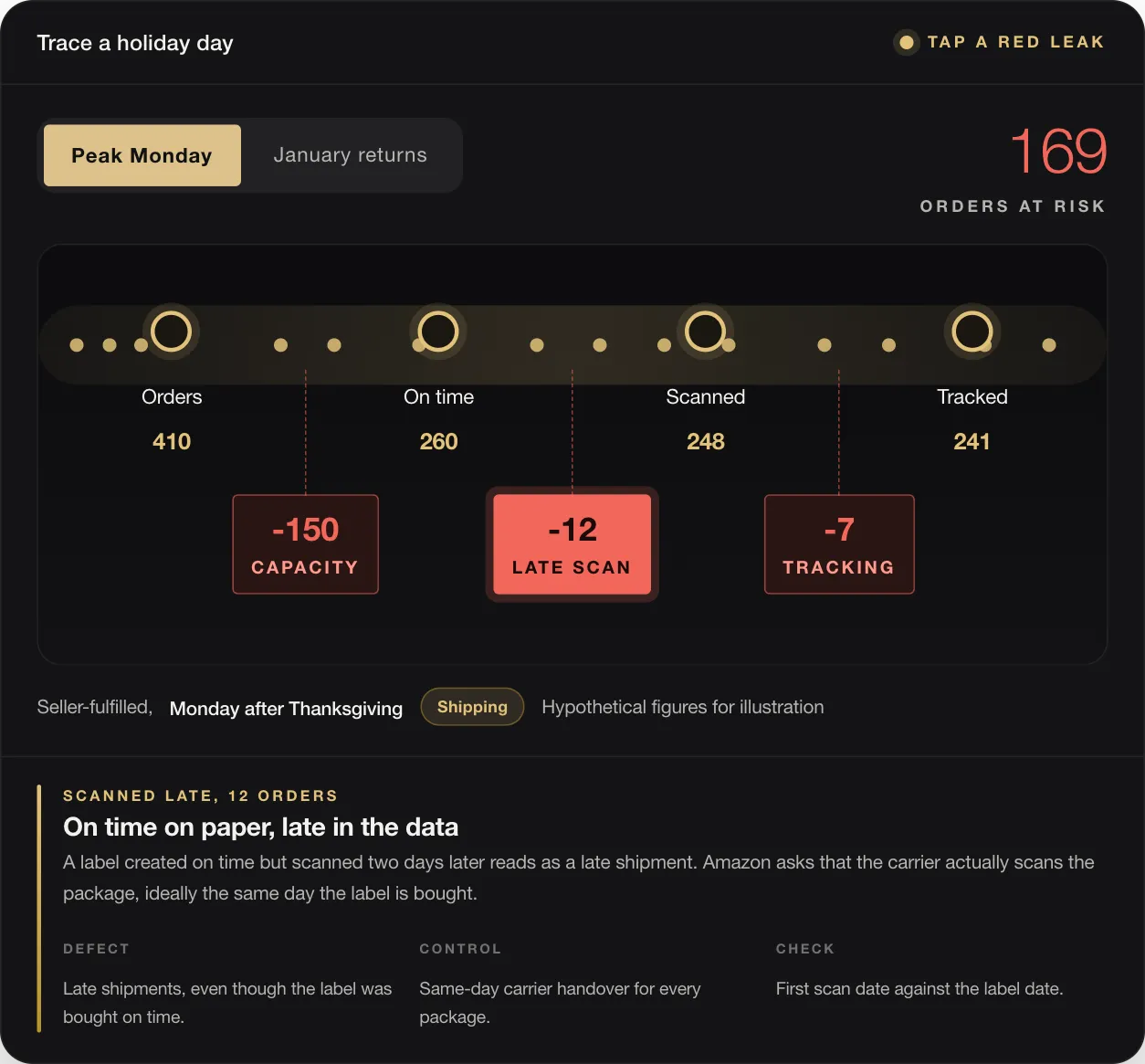
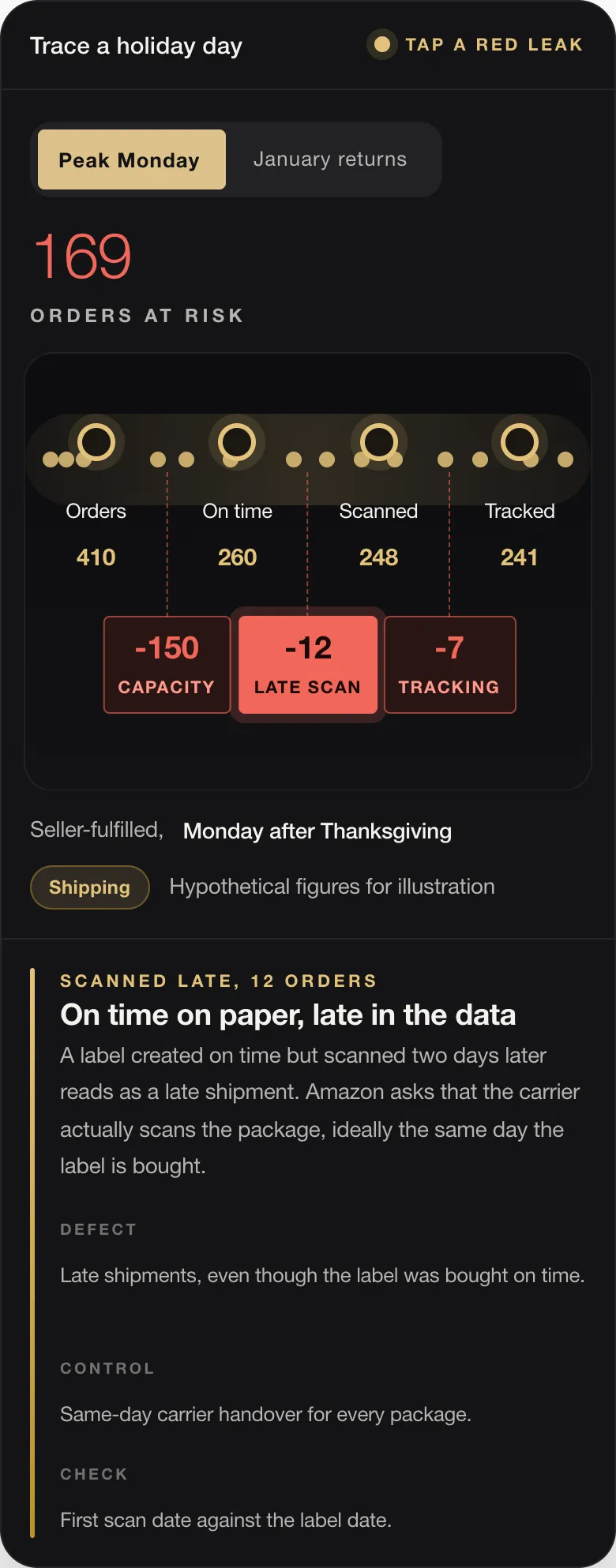
If you buy labels outside Buy Shipping, Amazon asks you to choose an integrated carrier from the drop-down, check that carrier name, service, and tracking ID belong to the same carrier, and make sure the carrier actually scans the package, ideally the same day the label is bought. A label created on time but scanned two days later reads as a late shipment.
Buy Shipping carries a specific protection. Amazon says that when you ship on time using Buy Shipping, granted delivery-related claims have no impact on account health or Order Defect Rate as long as you respond to customer inquiries within 48 hours, though you may still have to reimburse the customer. Amazon also recommends carriers that can provide proof of delivery, such as signature confirmation, because a signed proof attached to a prompt reply makes a claim less likely to be granted.
Carrier cutoffs and holiday schedules
Carriers publish their own holiday deadlines, pickup closures, and service changes each year. Check them directly at usps.com, ups.com, and fedex.com once published, and compare them with the transit times in your shipping templates. If a carrier’s window is longer than your template promises, change the template before orders arrive.
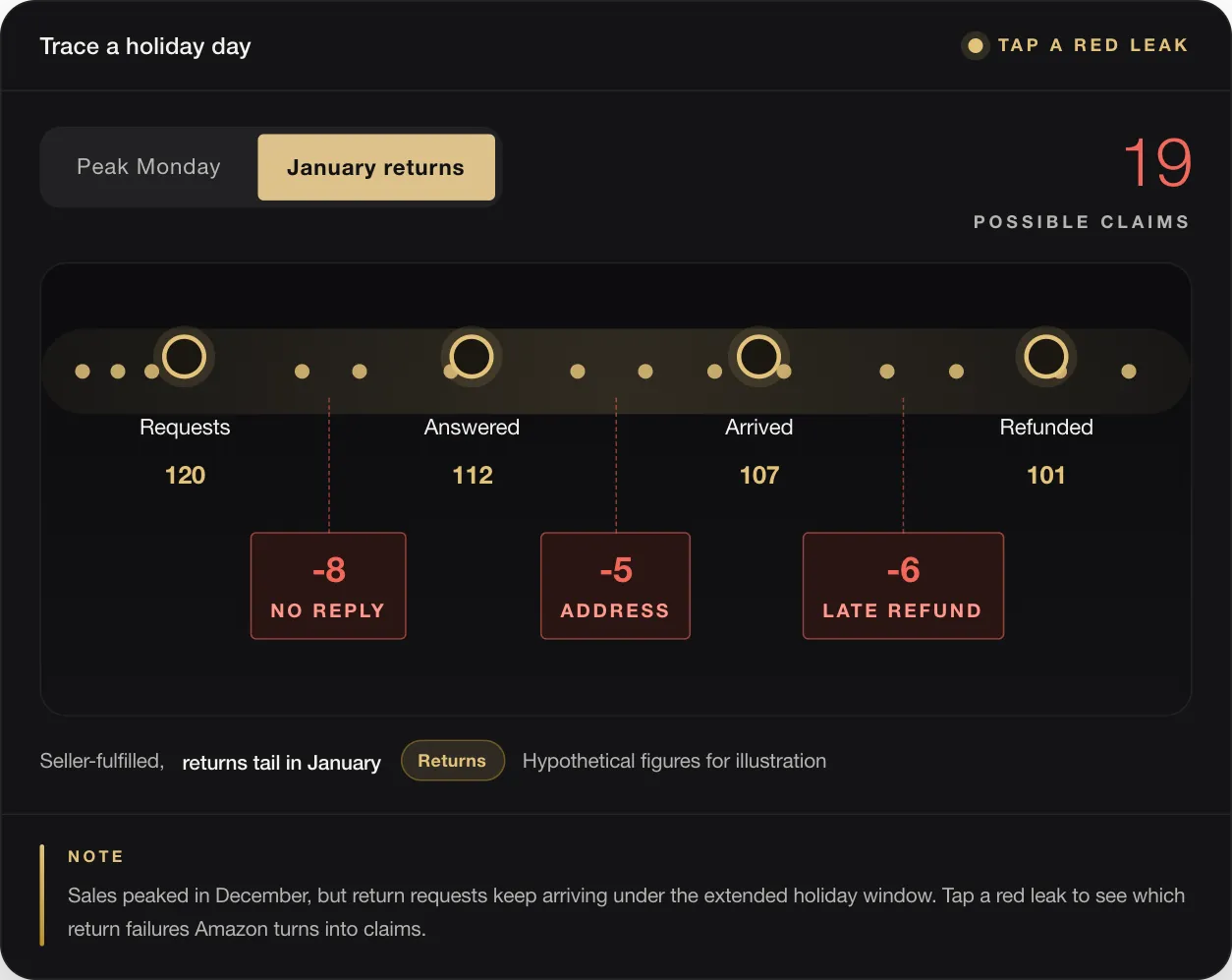
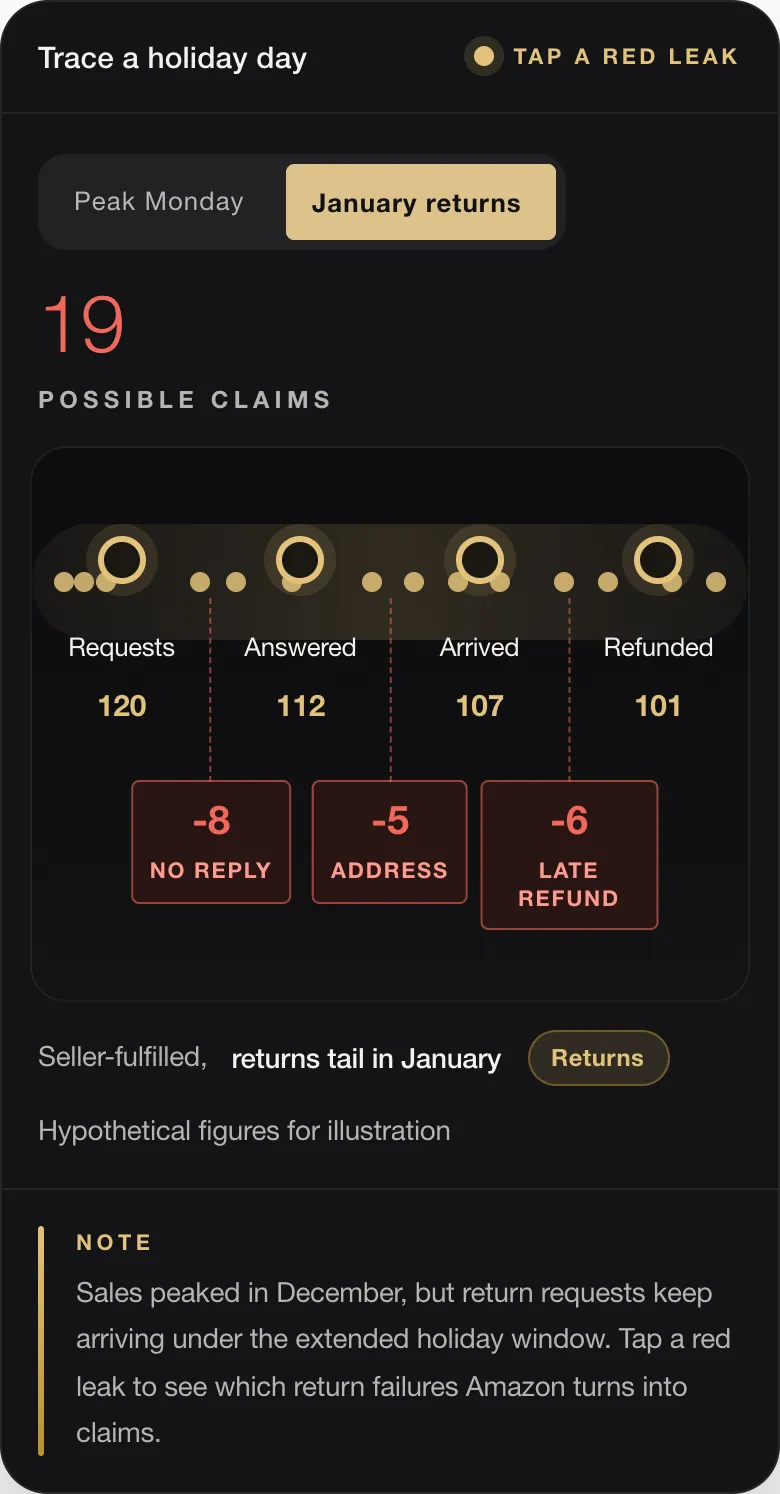
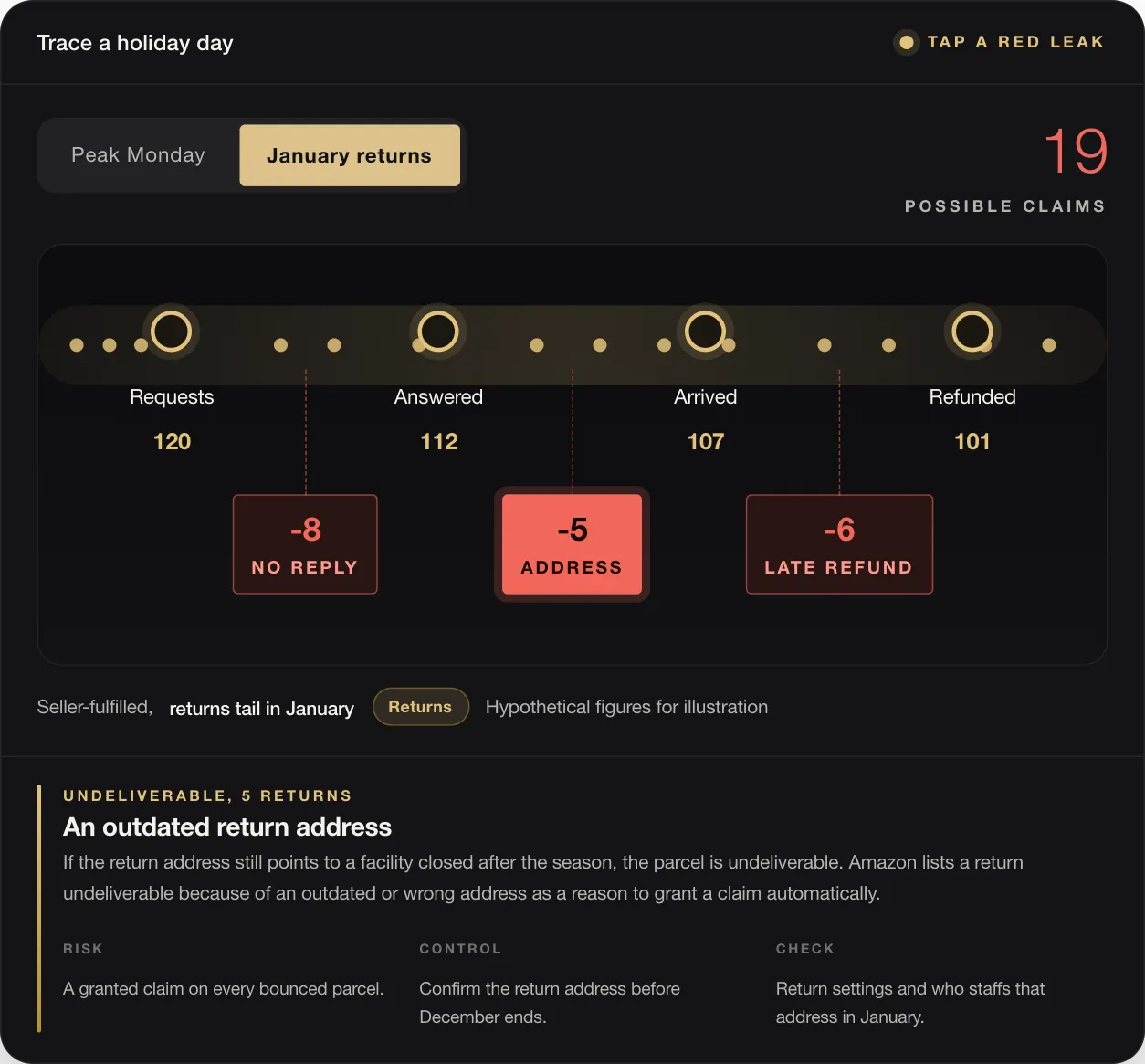
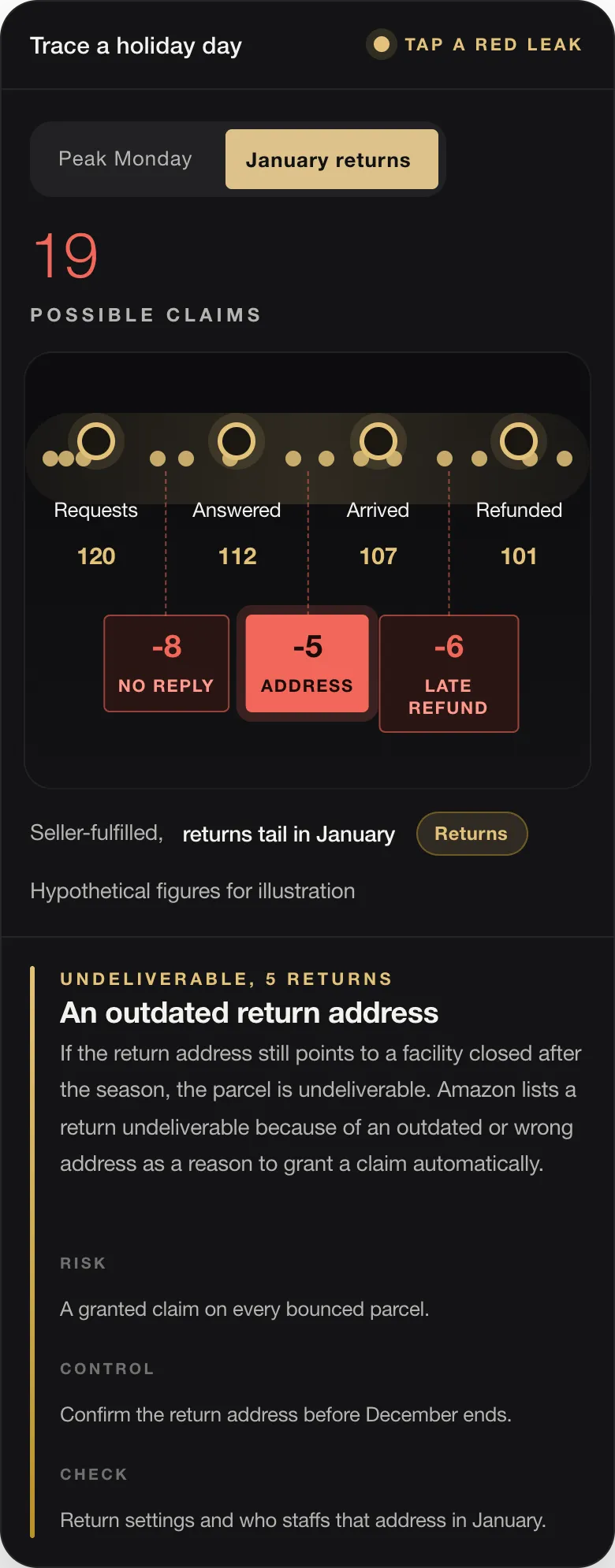
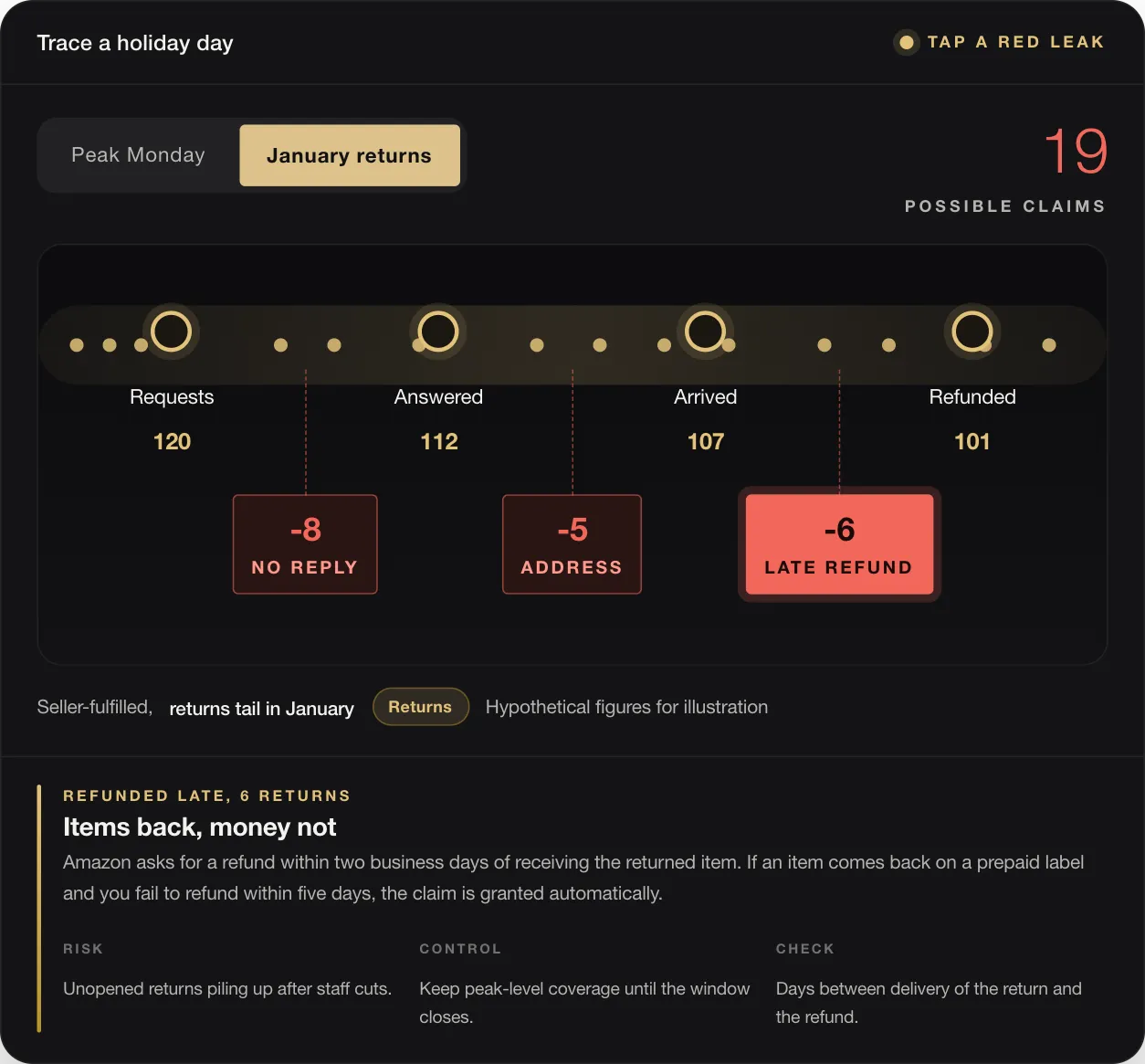
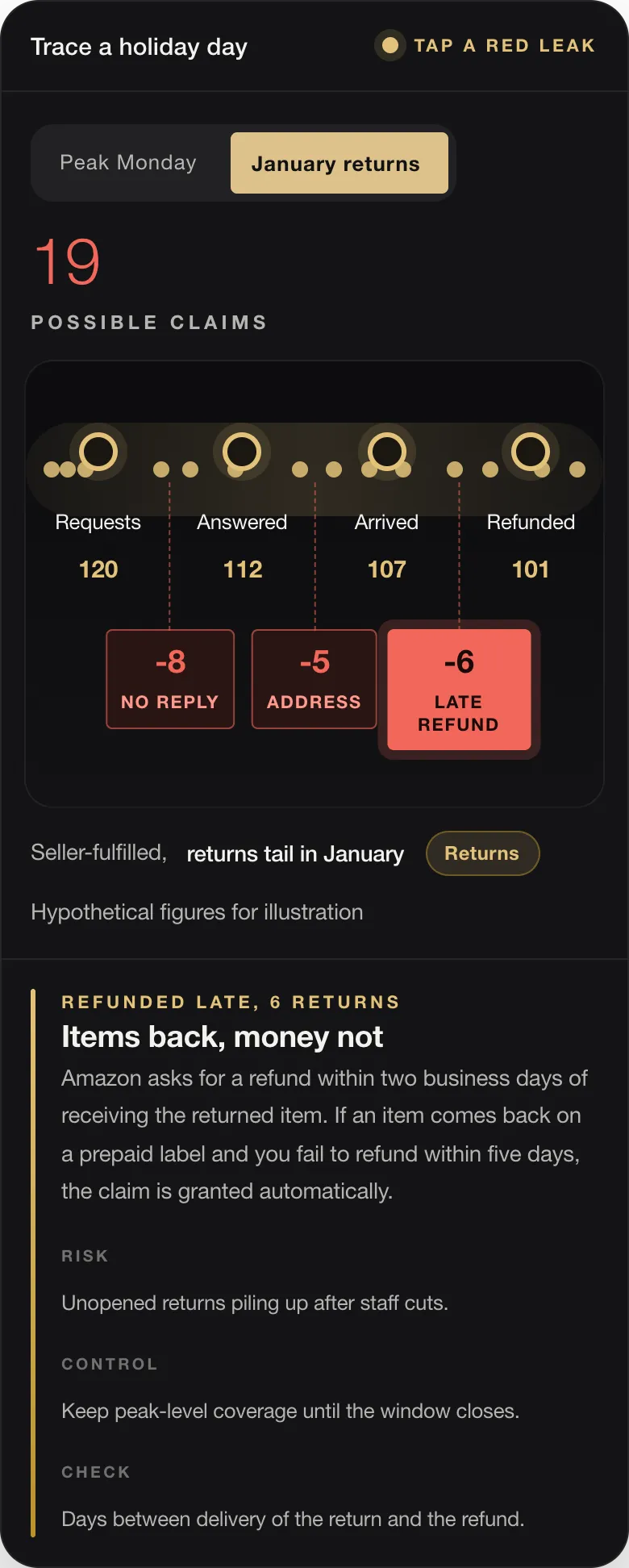
Follow the orders. Find where the promise breaks.
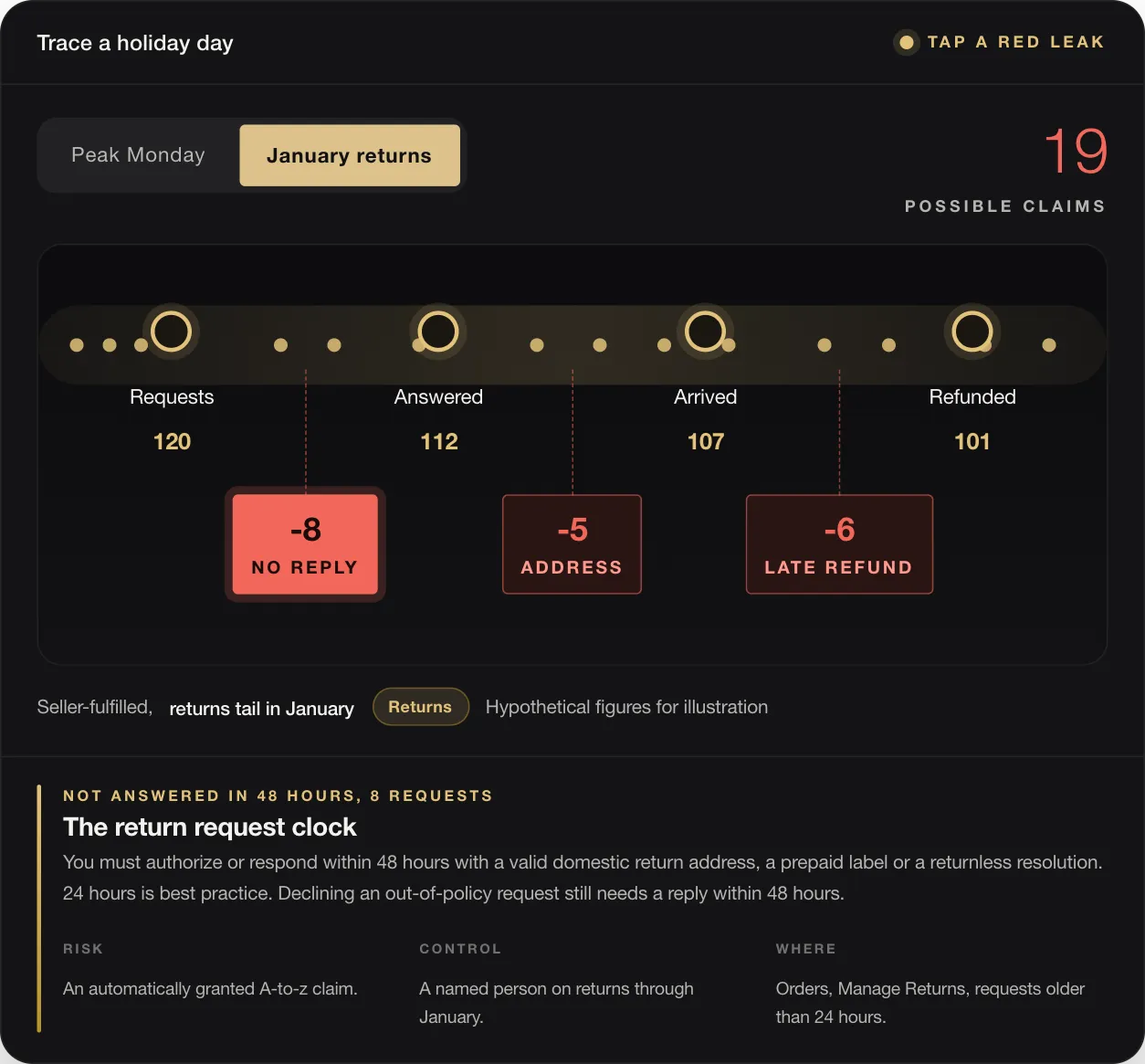
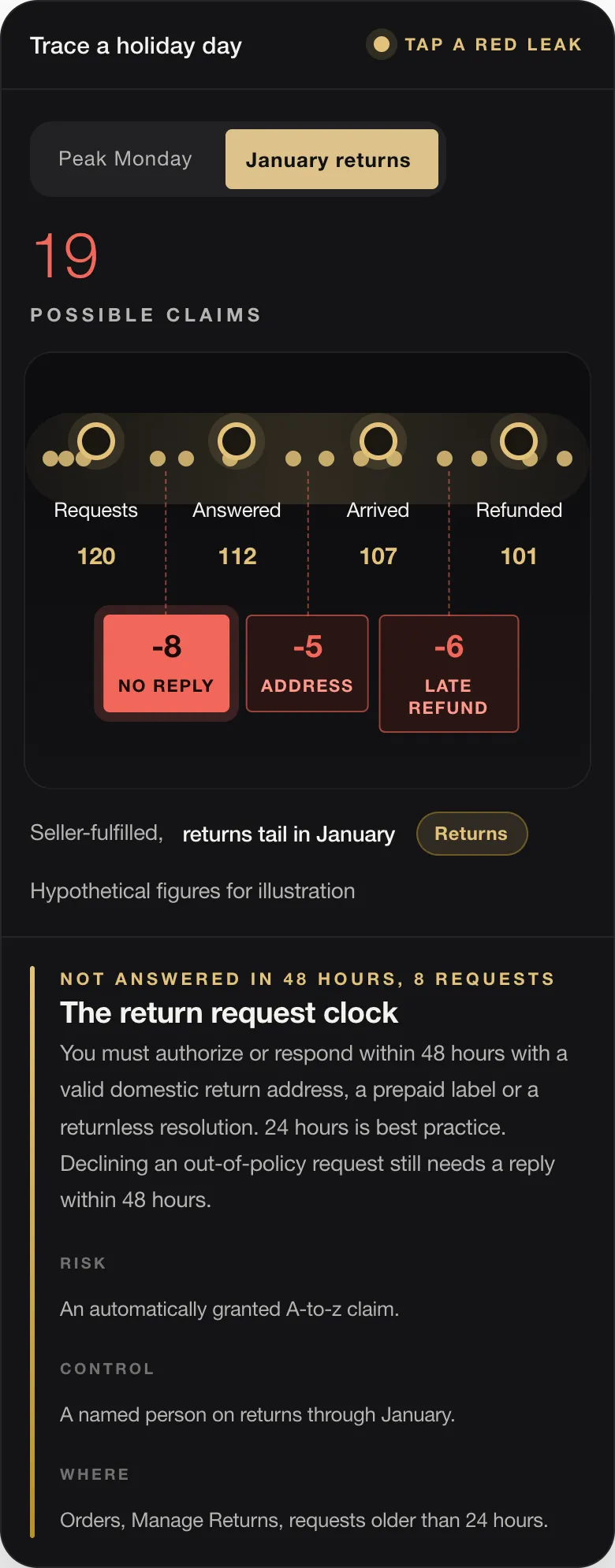
Every holiday order passes the same stations, and each failure leaves a defect or a claim behind. Pick a day and tap a red leak to see what caused it and what control closes it.
Cancellations: Which Ones Count Against You
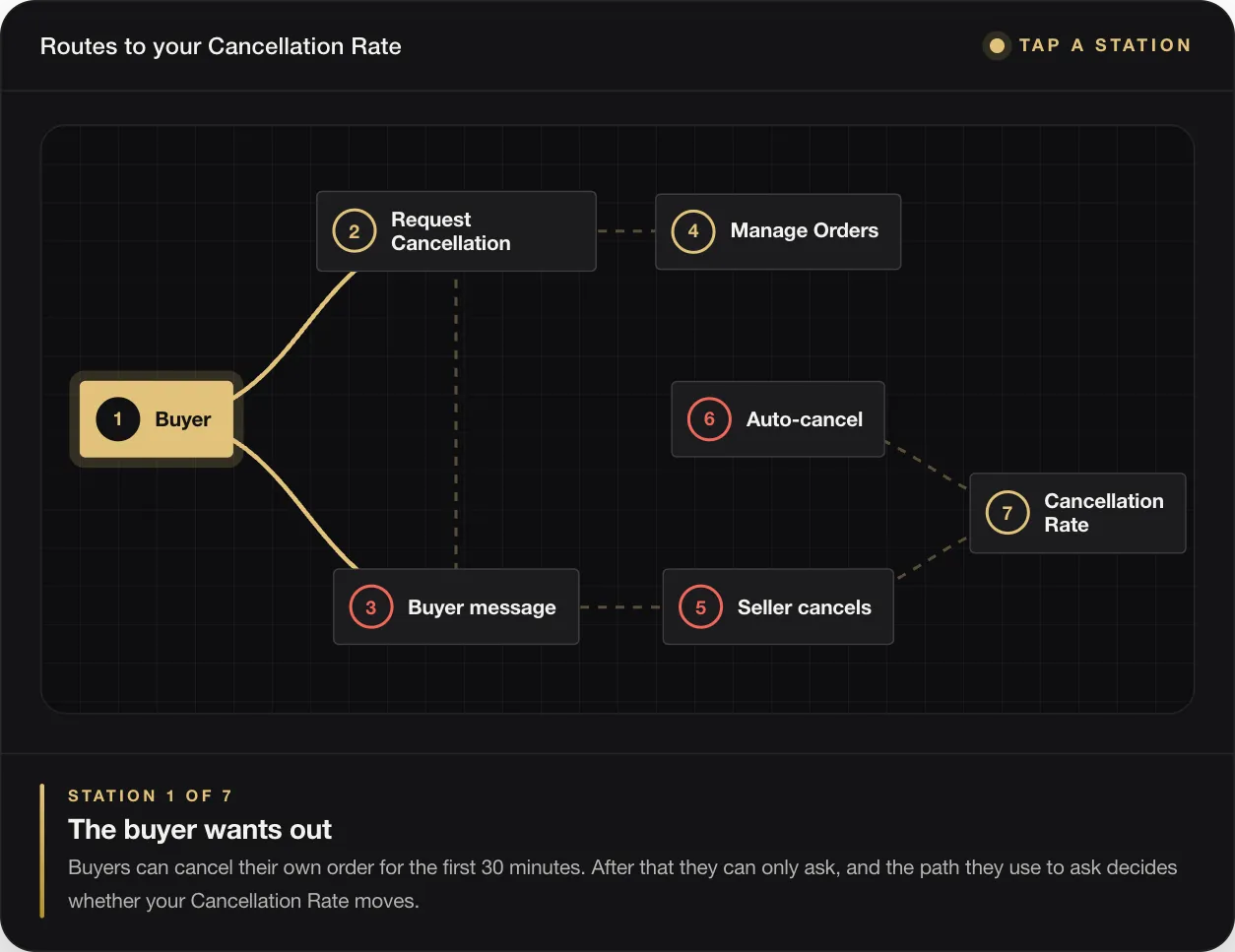
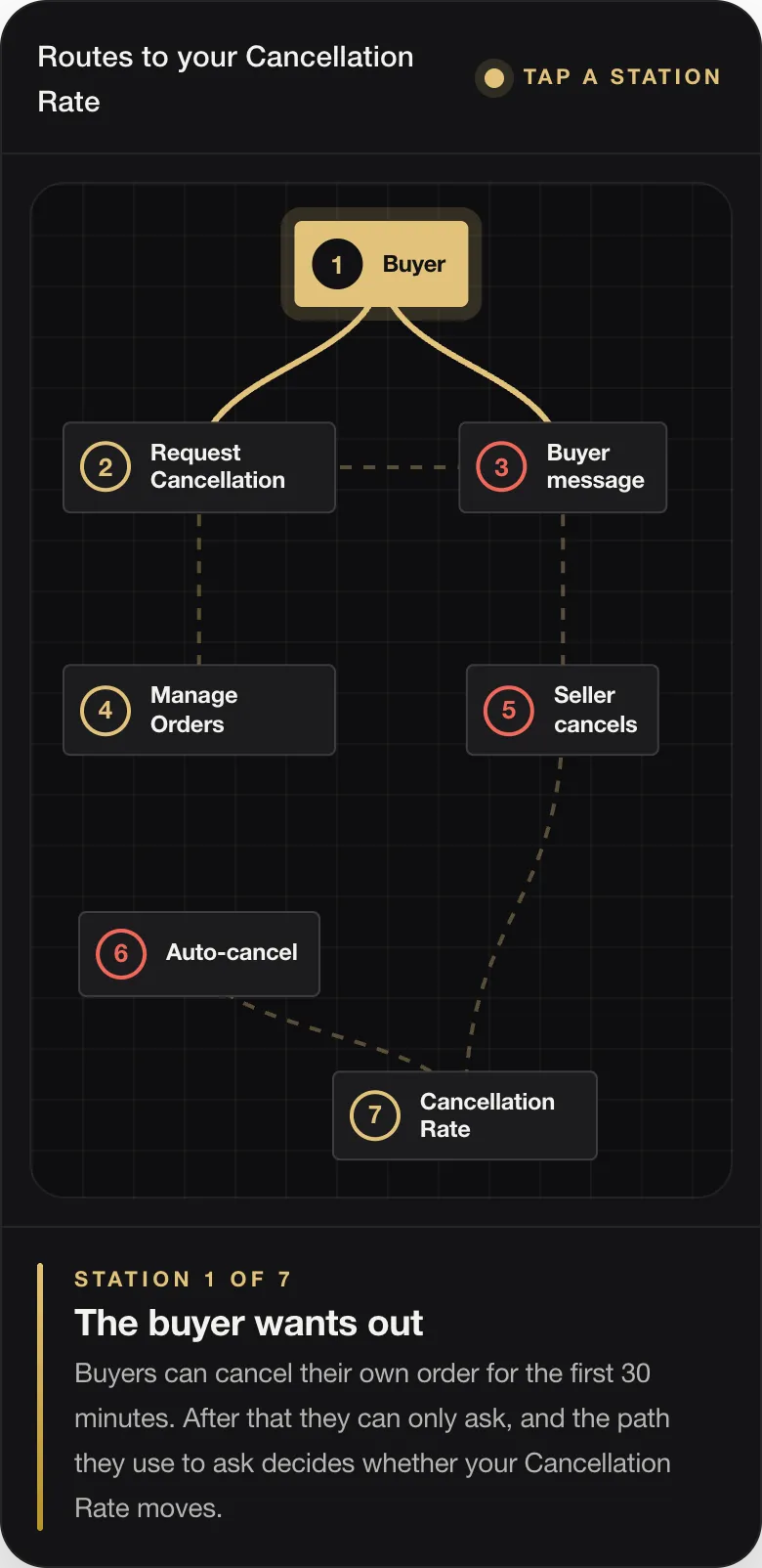
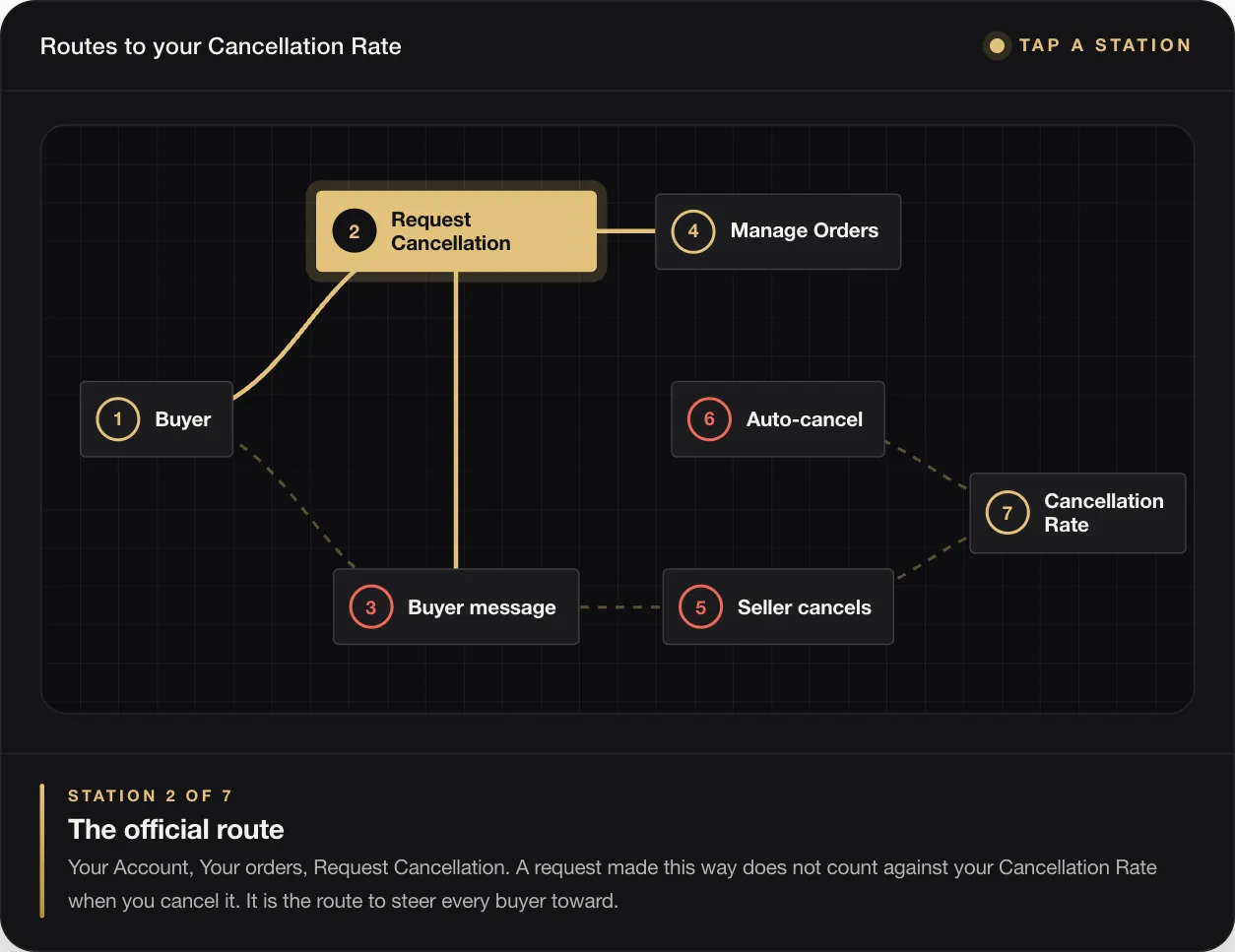
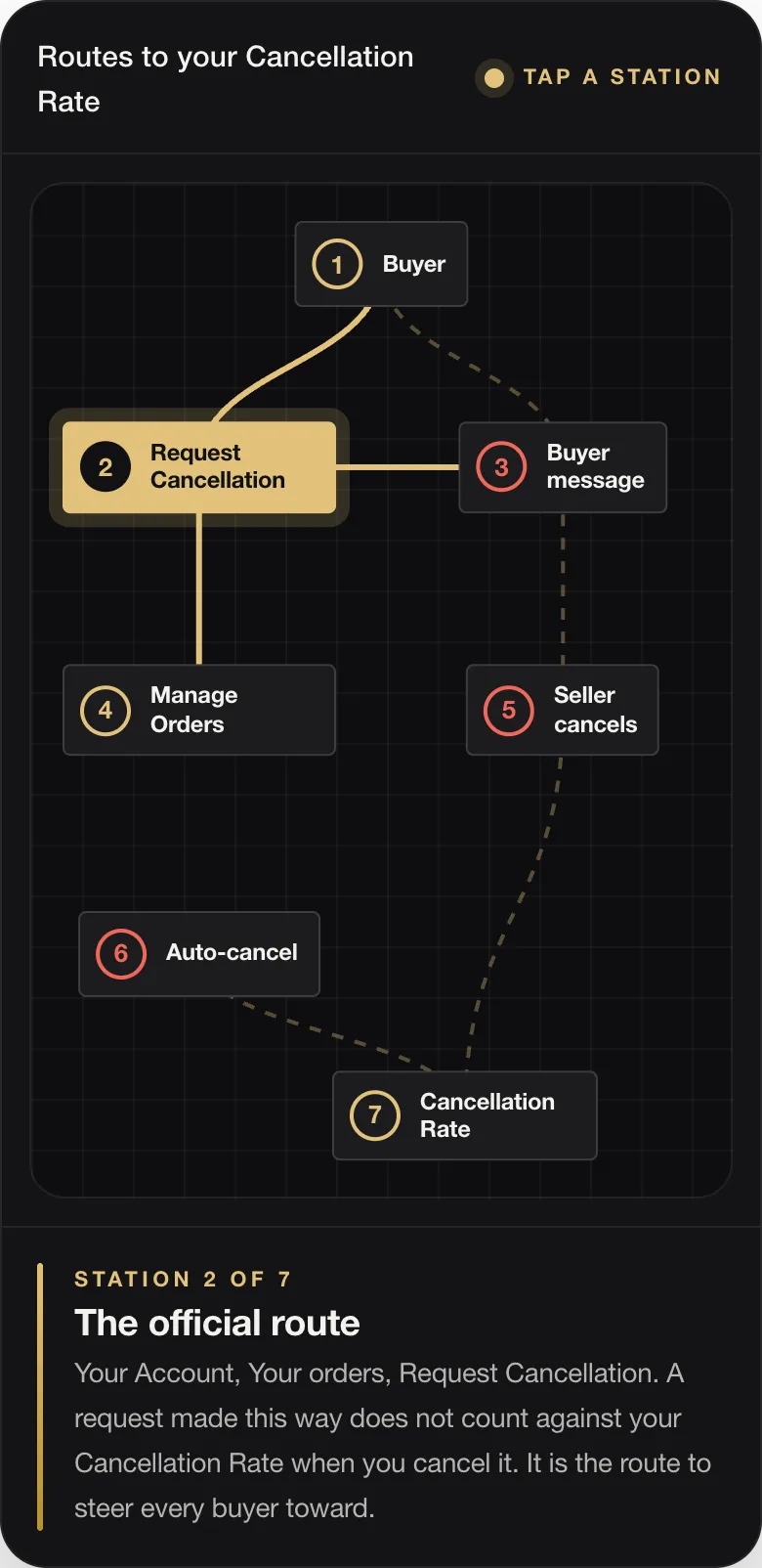
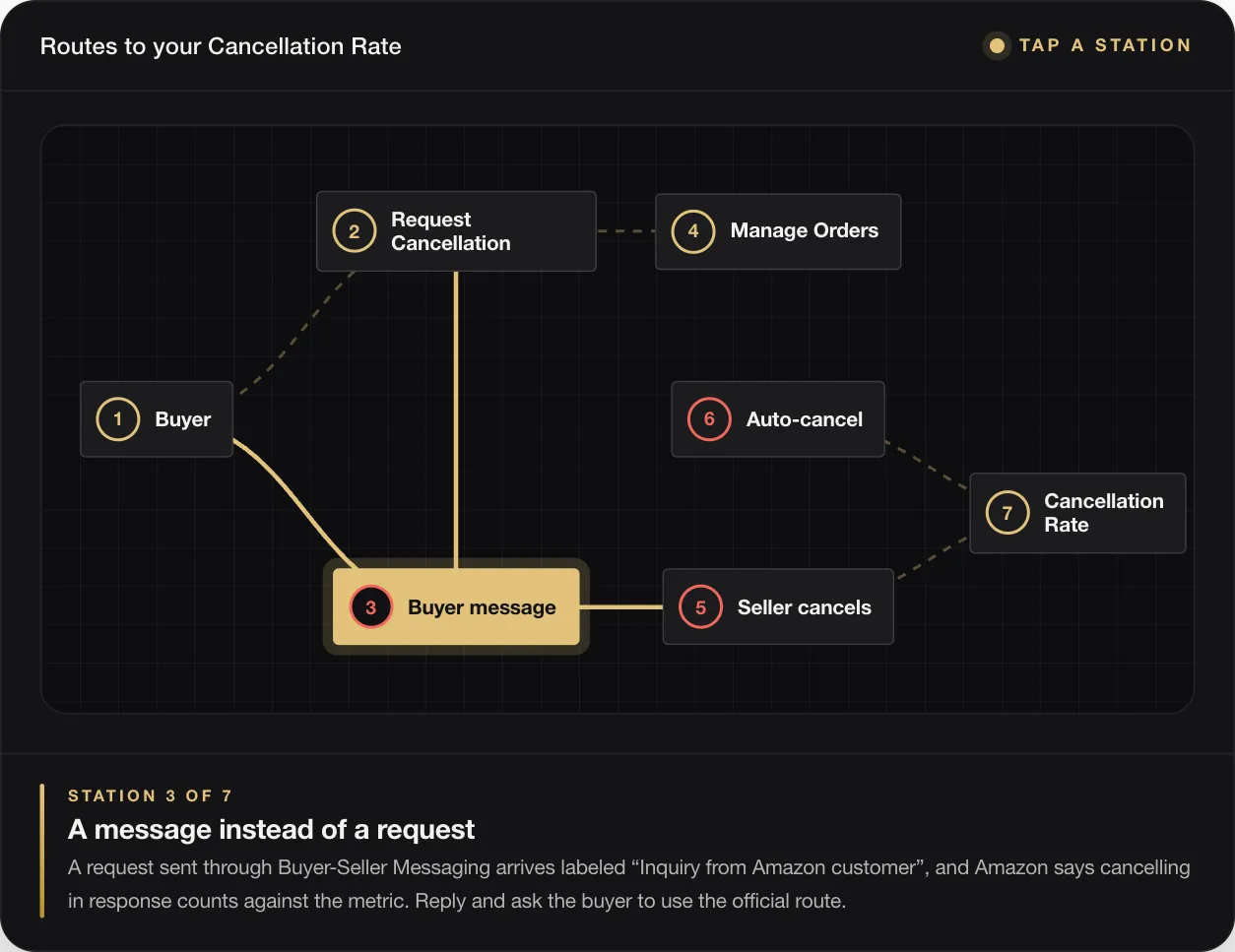
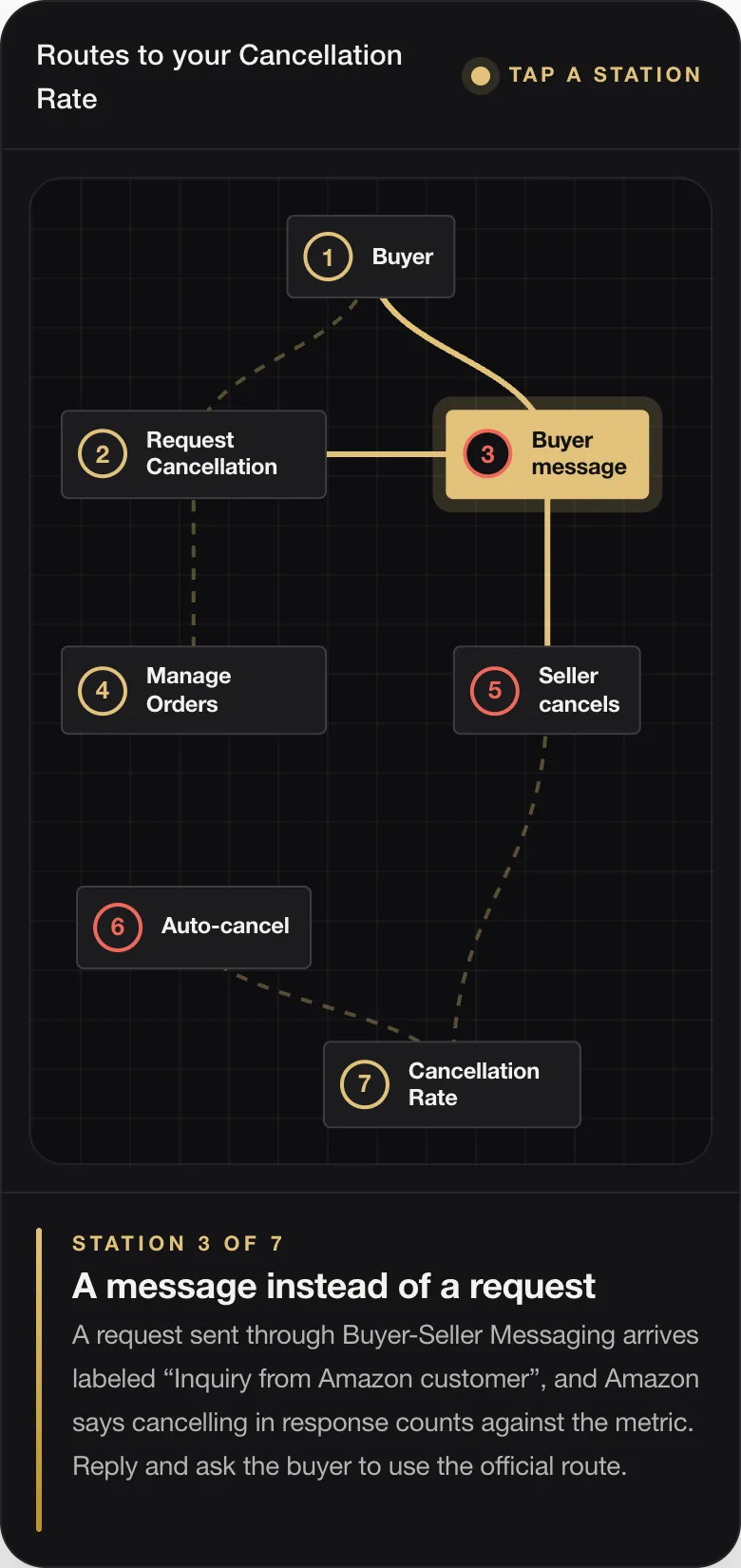
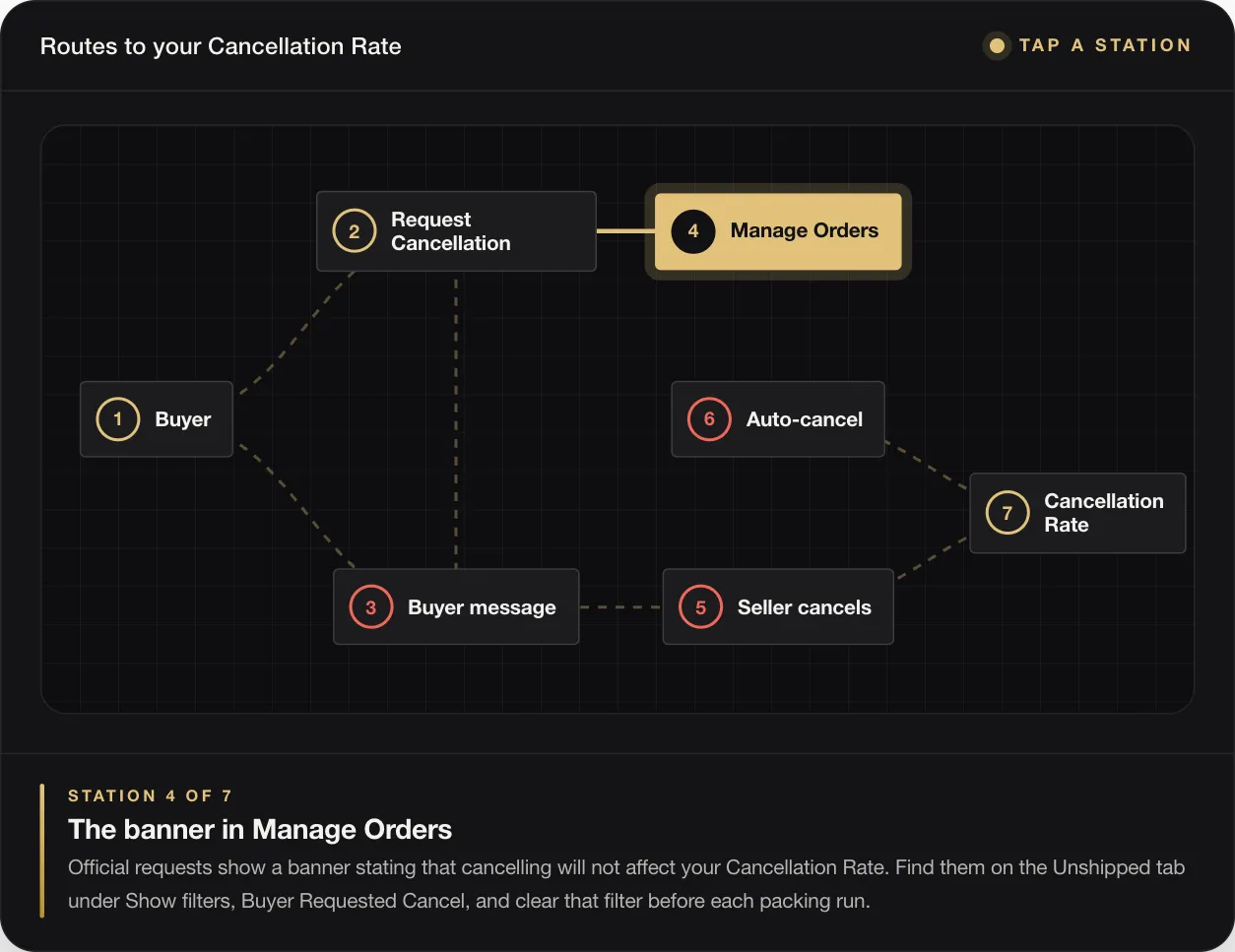
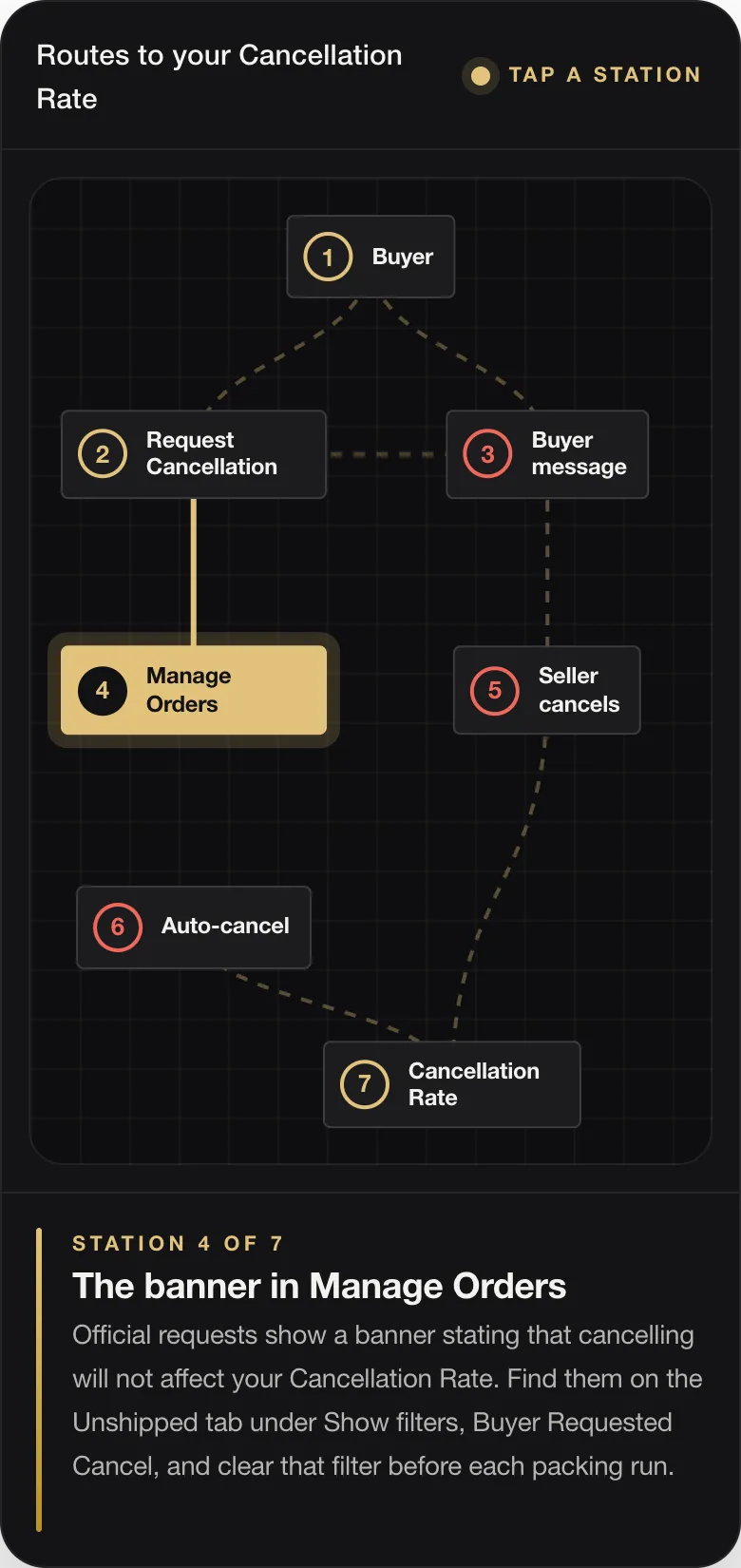
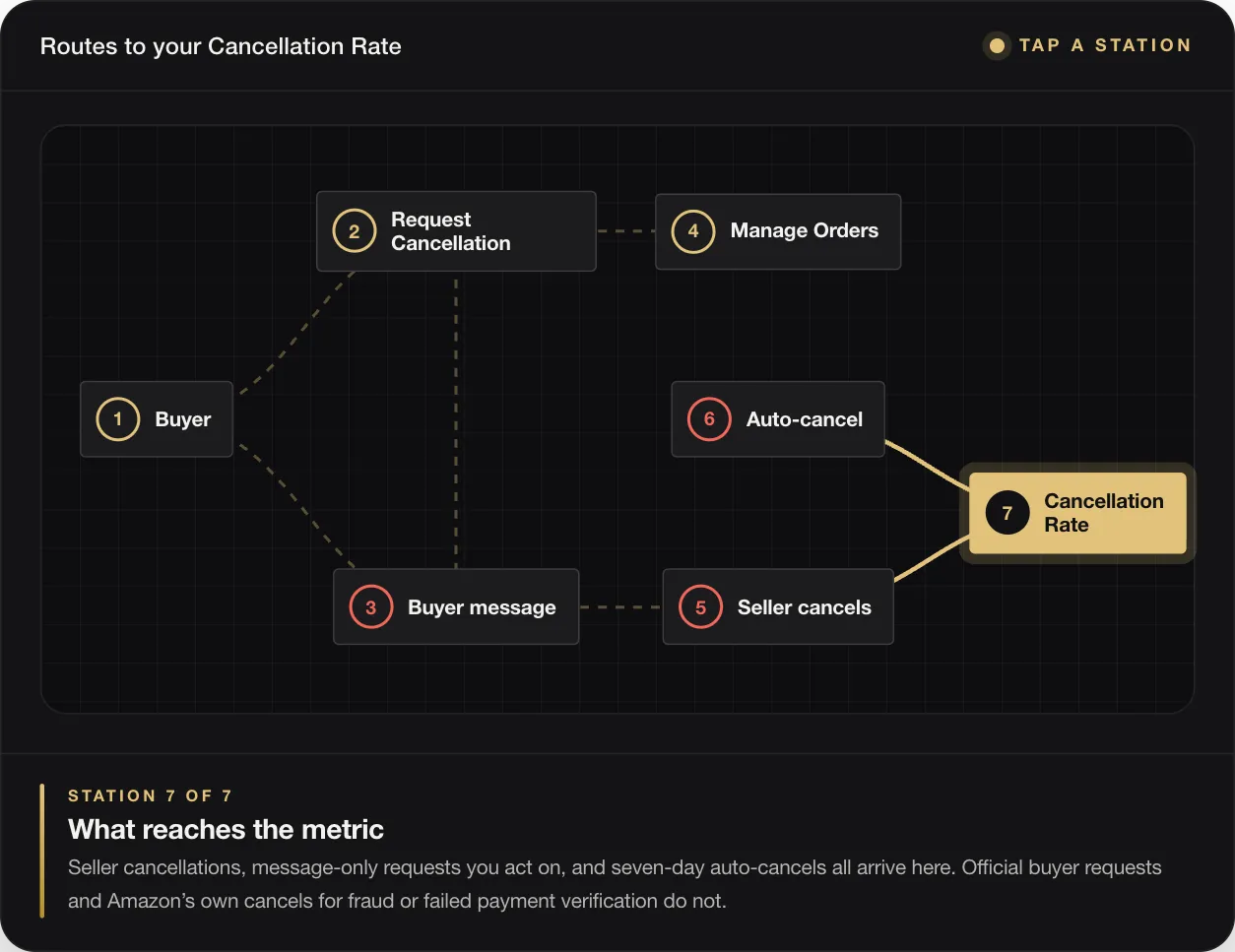
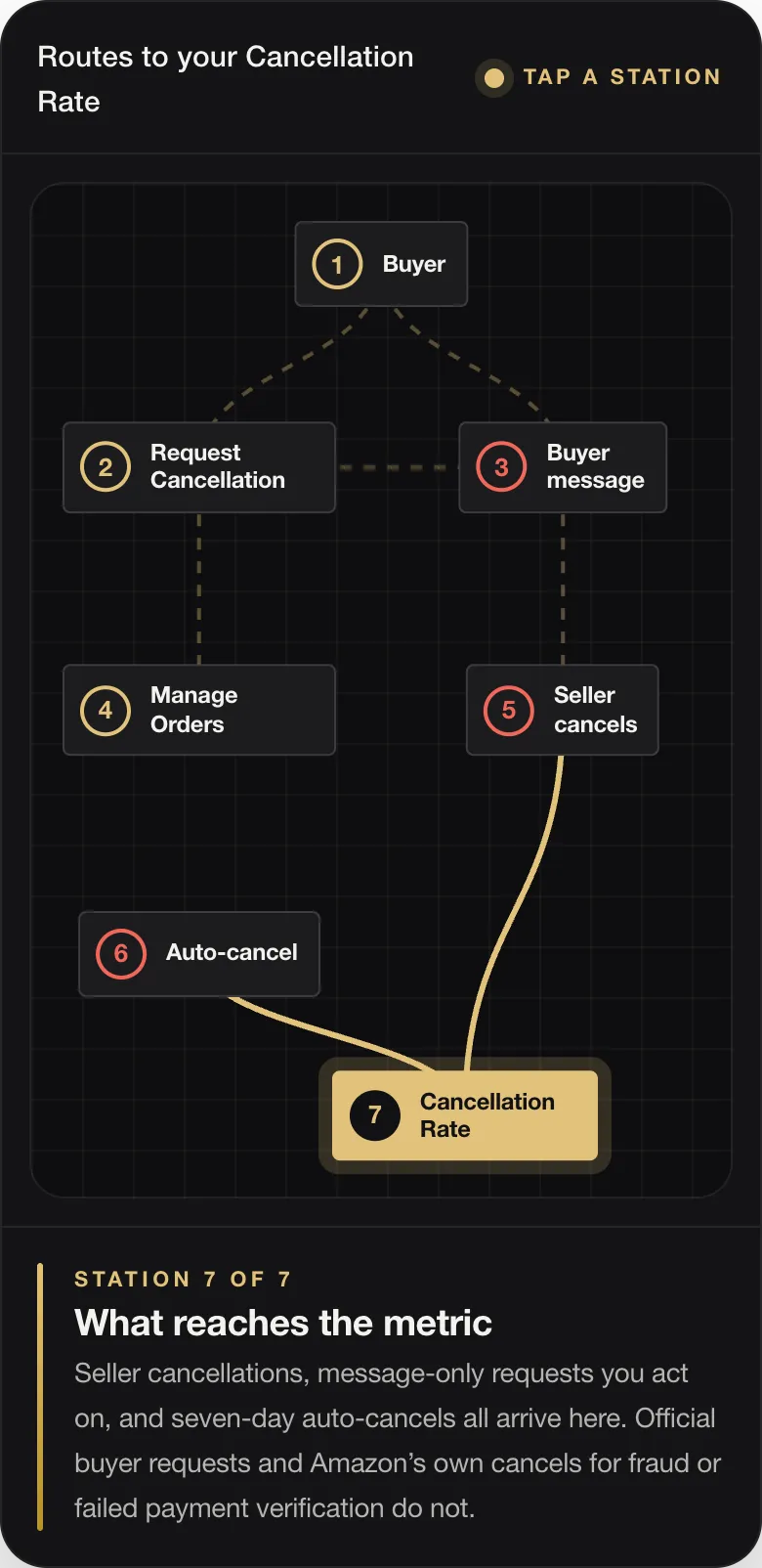
Amazon’s Order cancellations page says buyers can cancel their own order for the first 30 minutes. After that they can only submit a request through Your Account, Your orders, Request Cancellation. When a buyer uses that route, Manage Orders shows a banner stating that cancelling will not affect your Cancellation Rate. When a buyer instead asks through Buyer-Seller Messaging, the message is labeled “Inquiry from Amazon customer”, and Amazon says cancelling in response will count against the metric. Amazon’s suggested approach is to reply and ask the buyer to use the official route.
| Who cancels | Scenario (from Amazon’s help page) | Counts against Cancellation Rate? |
|---|---|---|
| Buyer | Official request submitted through Your orders | No |
| Buyer | Request sent only by message (“Inquiry from Amazon customer”) | Yes |
| Seller | Out of stock, pricing or listing error, wrong shipping settings, or vacation settings not turned on | Yes |
| Seller | Undeliverable address, or buyer unresponsive | Yes |
| Amazon | Auto-cancelled because shipment was not confirmed within seven days of the ship-by date | Yes |
| Amazon | Fraudulent buyer detected, or payment verification failed | No |
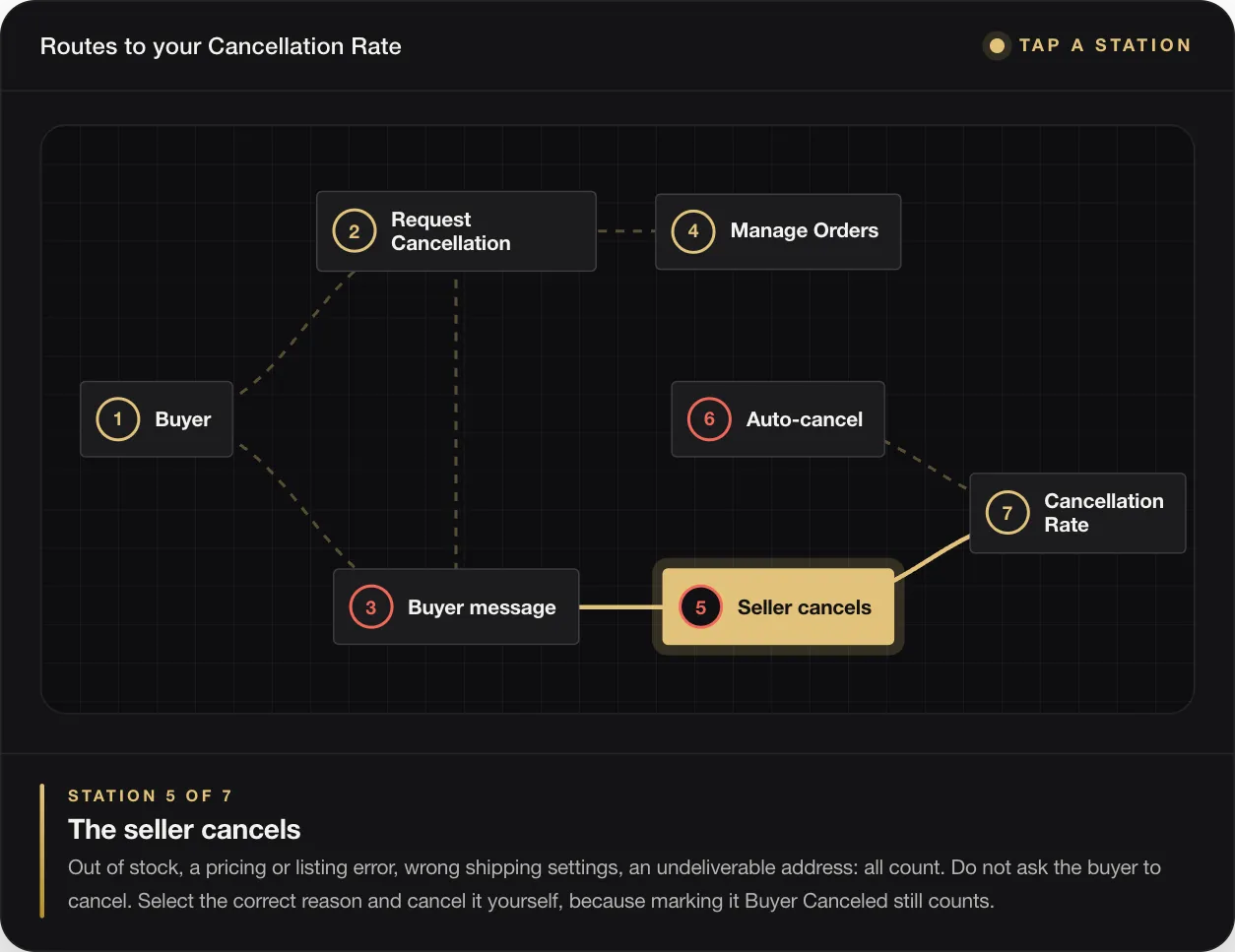
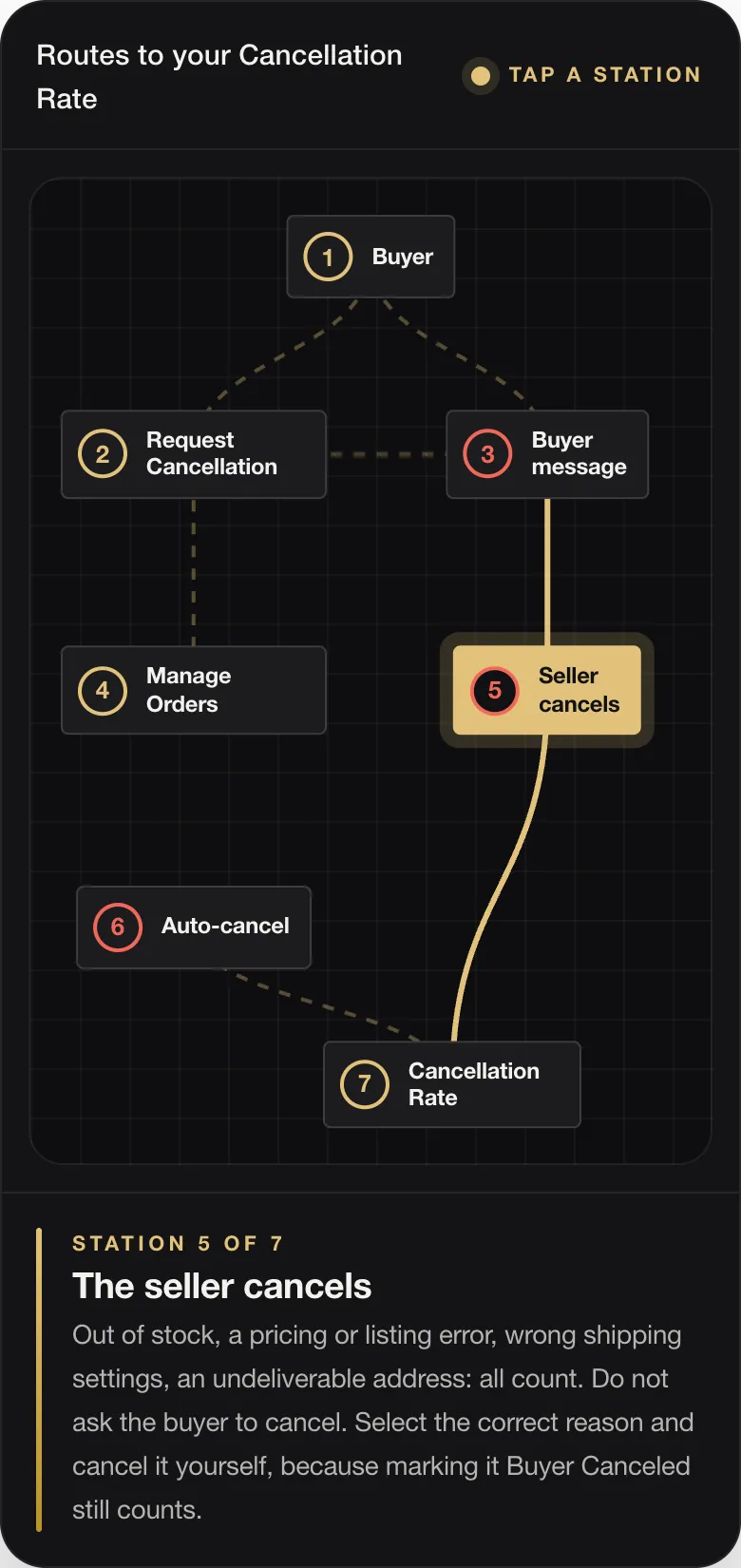
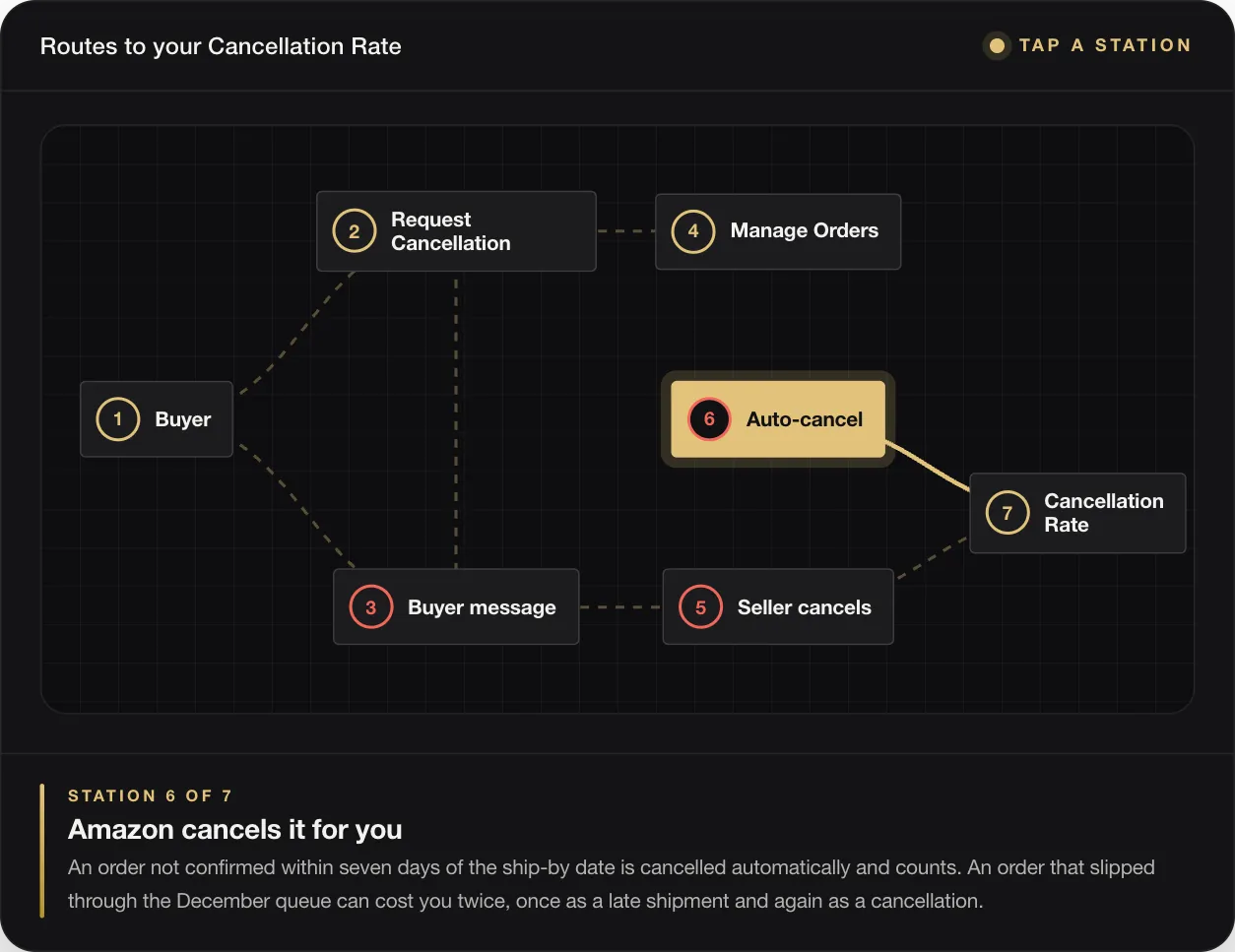
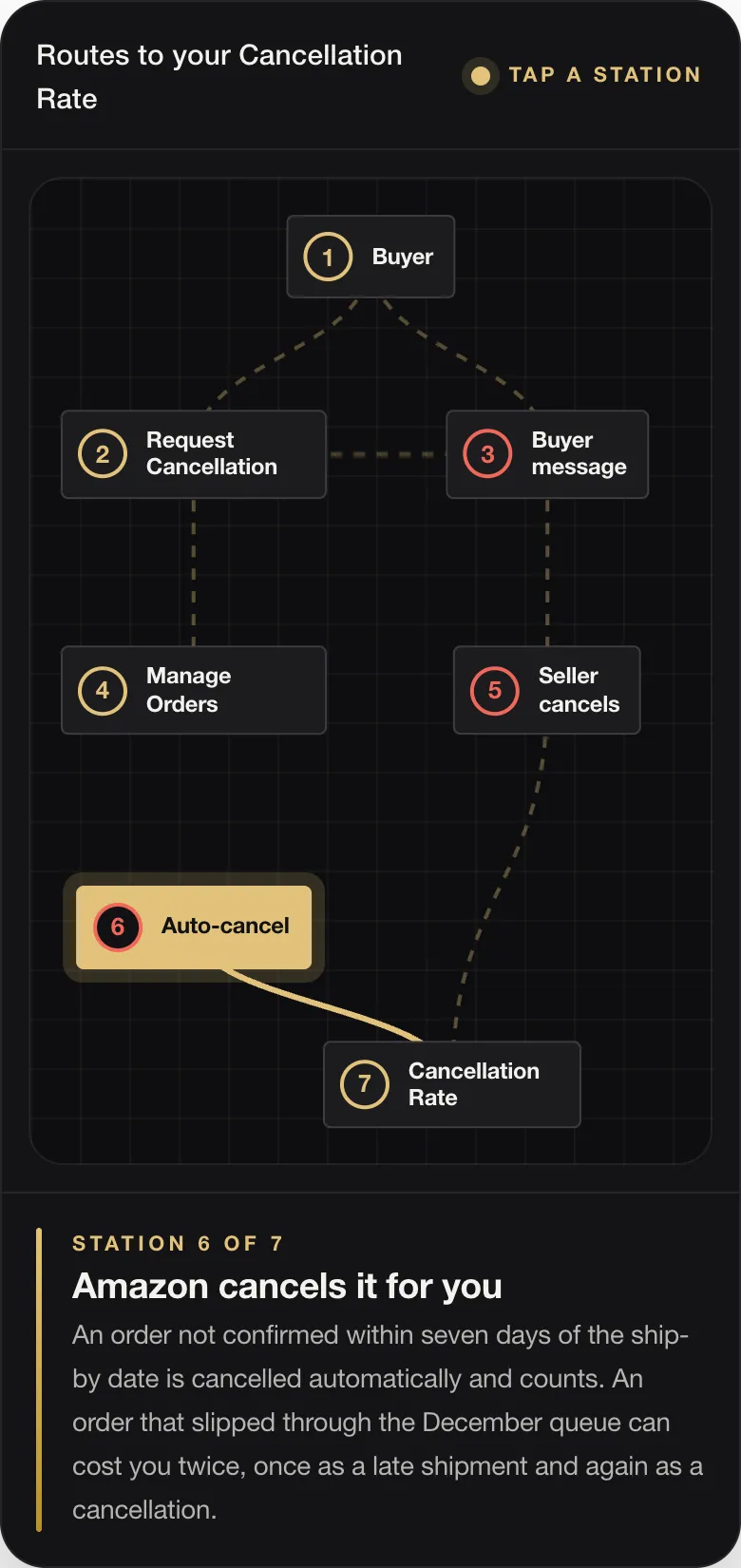
Two more rules matter at volume. Amazon says selecting “Buyer Canceled” for a cancellation the buyer did not start still counts, so mislabeling does not help and misstates what happened. And if you cannot fulfill because of low stock or a pricing or settings error, Amazon says not to ask the buyer to cancel; select the correct reason and cancel it yourself. The seven-day automatic cancellation means an order that slipped through the queue in December can cost you twice, once as a late shipment and again as a cancellation.
The buyer’s wish is the same. The route decides the metric.
A cancellation can reach your Cancellation Rate by several paths, and only some of them count. Tap a station to see what happens there and what Amazon says to do.
The Extended Holiday Returns Window and Why Claims Arrive in January
Amazon runs an Extended Holiday Returns policy each year. The version live on Seller Central at the time of writing is the 2025 policy: items bought between November 1 and December 31, 2025 are returnable through January 31, 2026, except Apple brand products, returnable through January 15, 2026. Amazon states that it applies to seller-fulfilled, FBA, and Amazon retail orders, and that returns eligibility otherwise stays the same. Check the page for the current season’s dates rather than assuming they repeat.
For seller-fulfilled sellers this changes the shape of the season. Sales peak in December, but return requests keep arriving well into January, and Amazon says you must authorize all eligible returns, meaning those requested within the standard 30-day window or the extended window.
The return request clock
Amazon’s A-to-z Guarantee page says you must authorize or respond to a return request within 48 hours with a valid domestic return address, a prepaid return label, or a returnless resolution, and that 24 hours is best practice. Declining an out-of-policy request still requires a response within 48 hours explaining why. Amazon’s prevention page asks you to refund within two business days of receiving the returned item, and the claims page says a claim is granted automatically if an item comes back on a prepaid label and you fail to refund within five days, or if the return is undeliverable because your return address was outdated or wrong.
In January, warehouse staff are often reduced after the peak, returns pile up unopened, and those deadlines are missed without anyone deciding to miss them. If the return address still points to a facility that closed after the season, every returned parcel becomes a potential automatic claim. Check return settings before December ends.
A-to-z Claims: How They Are Triggered and How to Prevent Them
The A-to-z Guarantee covers timely delivery and item condition for seller-fulfilled orders. For delivery problems, Amazon directs the buyer to message you first and to wait three days past the maximum estimated delivery date. You must respond and try to resolve the issue within 48 hours of the buyer’s first message. Once both periods pass without resolution, the buyer can file.
When Amazon grants the claim automatically
Amazon lists circumstances in which it will grant a claim automatically and debit your account. The holiday-relevant ones are: no response to a delivery issue within 48 hours, no response to a return request within 48 hours, not shipping by the expected ship date, no valid tracking, not delivering by the maximum estimated delivery date, and tracking showing the order as undeliverable. If tracking shows the order had not shipped or been confirmed when the claim was filed, Amazon may refund the customer instantly, and says this affects account health and ODR. Where Amazon investigates instead, it says an unanswered information request after 72 hours may lead to the claim being granted. A granted claim can be appealed within 30 calendar days; after that, Amazon says the ODR impact cannot be reversed.
Prevention, line by line
Amazon’s prevention page reads like a holiday checklist: valid tracking on every delivery, shipment confirmed and first-scanned before the expected ship date, delay notices to customers, accurate listings and honest condition notes, prompt cancellation of out-of-stock orders with an explanation, replies to every message within 48 hours, and a prompt refund when a customer asks so they do not need to file. If you cannot fulfill because of illness, weather, a carrier strike, or any other disruption, Amazon says you must suspend selling and set return preferences so requests are still answered. A seller who closes the warehouse over Christmas without changing listing status is still taking orders with ship-by dates inside the closure. Our guides to vacation mode and listing status and handling A-to-z Guarantee claims go further.
FBA Capacity, Inventory Age, and the Aged Inventory Surcharge
For FBA sellers, Q4 risk is mostly inventory: enough stock in Amazon’s network at the peak, and not too much left once demand falls. Check your current inventory limits and capacity in Seller Central before planning shipments rather than relying on last year’s numbers.
Amazon’s help page states that the aged inventory surcharge applies to units stored 181 days or longer, on top of monthly storage fees. Inventory is assessed on a snapshot taken on the 15th of each month, and the surcharge is typically charged between the 18th and 22nd. Age is counted first-in, first-out across the whole network, so every sale is deducted from your oldest units.
| Inventory age | Rate from January 16, 2026 (per Amazon’s help page) |
|---|---|
| 181 to 210 days | $0.50 per cubic foot (excludes clothing, shoes, bags, jewelry and watches) |
| 211 to 240 days | $1.00 per cubic foot (same exclusions) |
| 241 to 270 days | $1.50 per cubic foot (same exclusions) |
| 271 to 300 days | $5.45 per cubic foot |
| 301 to 330 days | $5.70 per cubic foot |
| 331 to 365 days | $5.90 per cubic foot |
| 366 to 455 days | $6.90 per cubic foot or $0.30 per unit, whichever is greater |
| 456 days or more | $7.90 per cubic foot or $0.35 per unit, whichever is greater |
Confirm the current table before acting, since Amazon updates it. Stock sent in early for a peak that did not materialize keeps aging through January and February. The FBA Inventory tool shows which ASINs are subject now or will be within 60 days. Amazon says a removal or disposal order submitted by 11:59 p.m. Pacific on the 14th avoids that month’s surcharge even if the units have not physically left, and points to Outlet deals, with a minimum 20 percent discount, as a way to sell through older stock. See also our article on Amazon inventory management mistakes.
Warnings already on your Account Health page?
Send us what you see and we will read the account before the season makes it worse.
Sudden Sales Growth and How It Can Draw a Review
A good holiday is a sudden change in an account’s behavior, and sudden change is what marketplace risk systems watch. Amazon does not publish what triggers these reviews, so what follows comes from our case work and should be read as preparation, not prediction. The reviews that follow fast growth are usually not about wrongdoing. They ask whether the growth is real, whether the seller can supply what it sold, and whether the same business still controls the account. Signals that tend to attract attention include a sales jump far above the account’s history, a burst of new listings, a sudden move into new categories or price bands, and changes to bank, login, or contact details during the spike.
Prepare the documentation before the spike
The decisive evidence is a sourcing record that matches the volume. If a hypothetical seller sold 3,000 units of a product in December against a normal month of 800, the invoices on file should show at least 3,000 genuine units bought from a traceable supplier, dated before or during the sales. File invoices by ASIN as you buy. Avoid changing bank or access details mid peak unless necessary, and keep a dated record if you must. If genuine documents cannot be obtained, never recreate or alter paperwork; stop selling that stock, move future purchasing to suppliers who invoice properly, and get advice before answering any review that asks for documents you do not have.
What to Do When a Metric Slips Mid Season
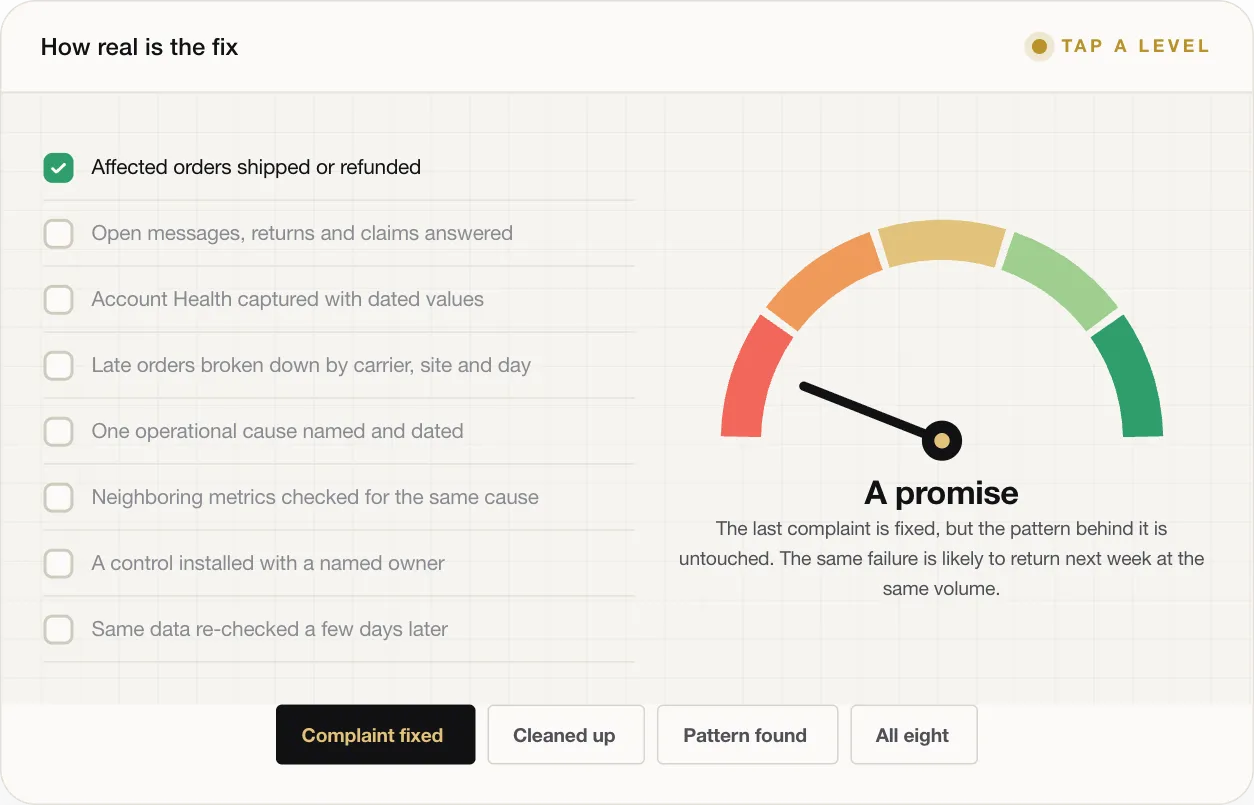
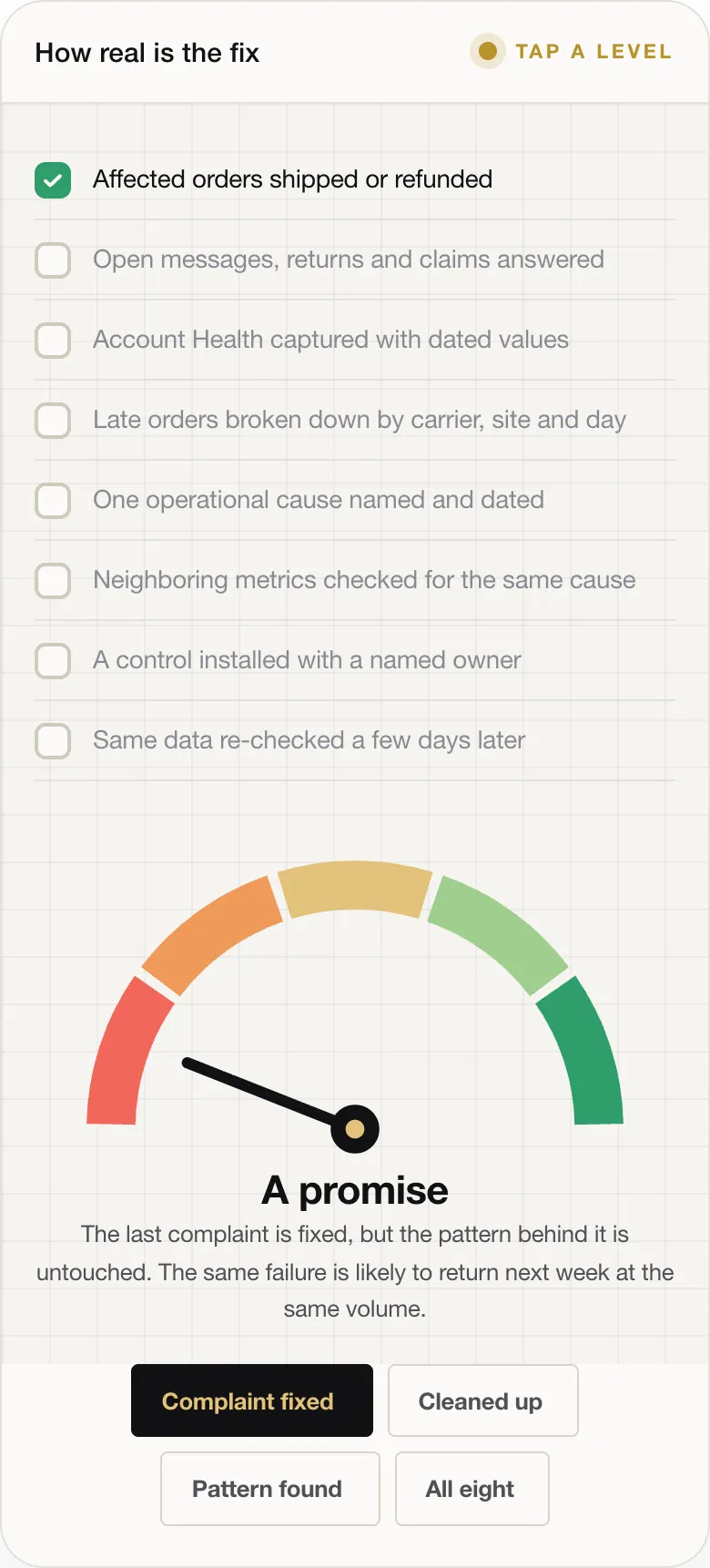
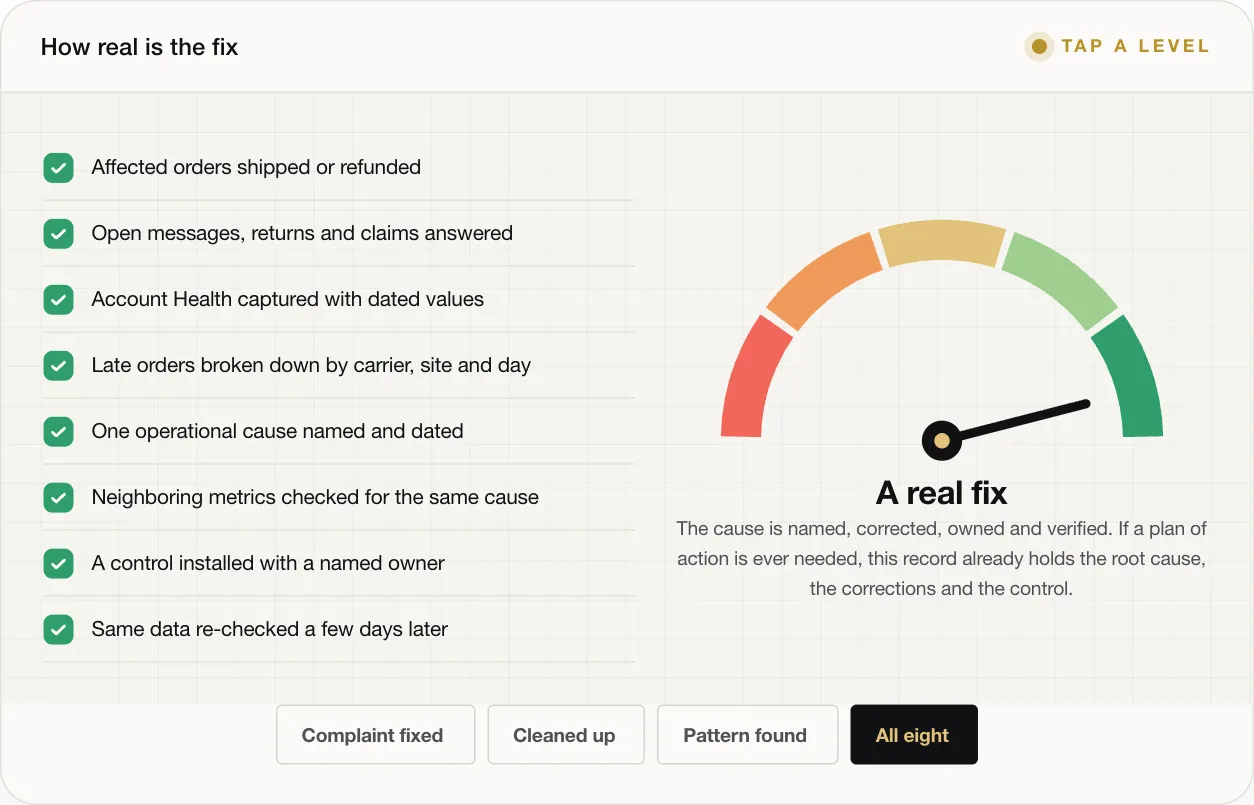
Even well prepared sellers have a bad week in December. What decides the outcome is how fast the slip is diagnosed and whether the fix is a real change to the operation or a promise to try harder. The method below is the same one used when an account health warning arrives, applied early enough that it never needs to become an appeal.
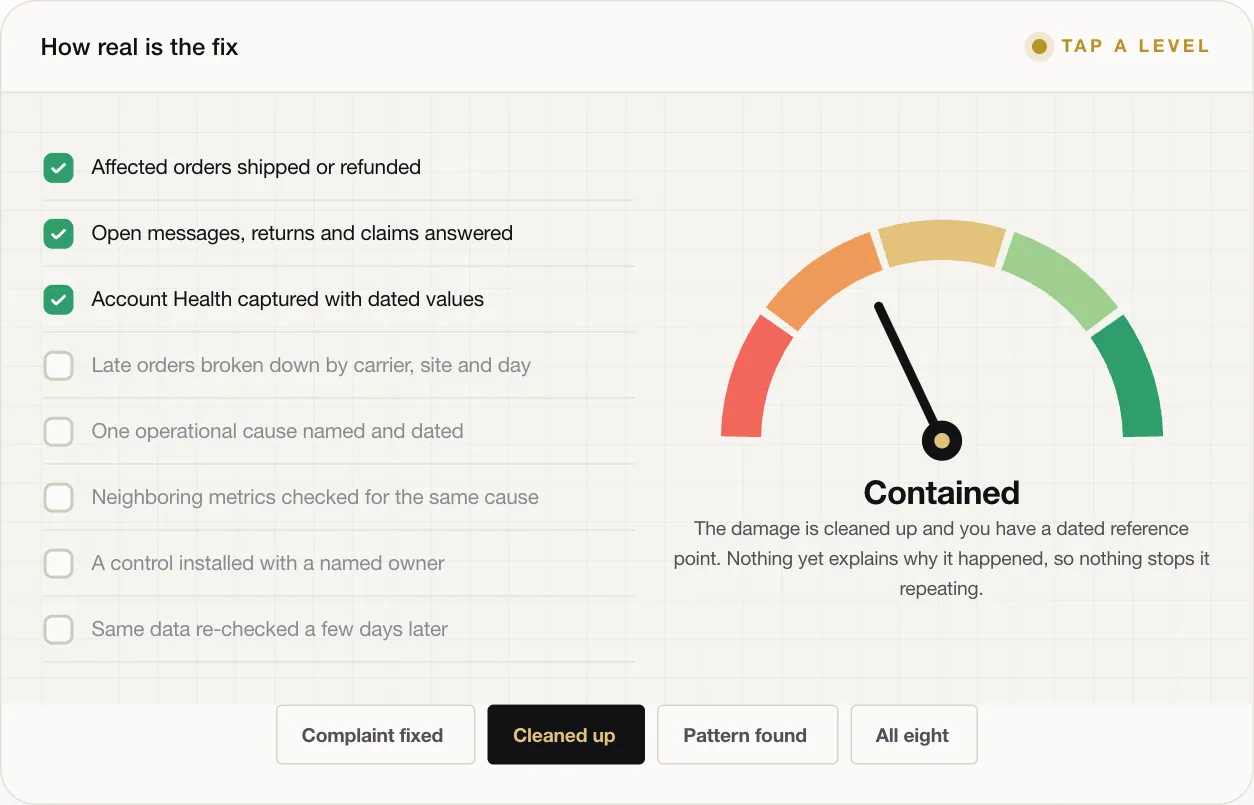
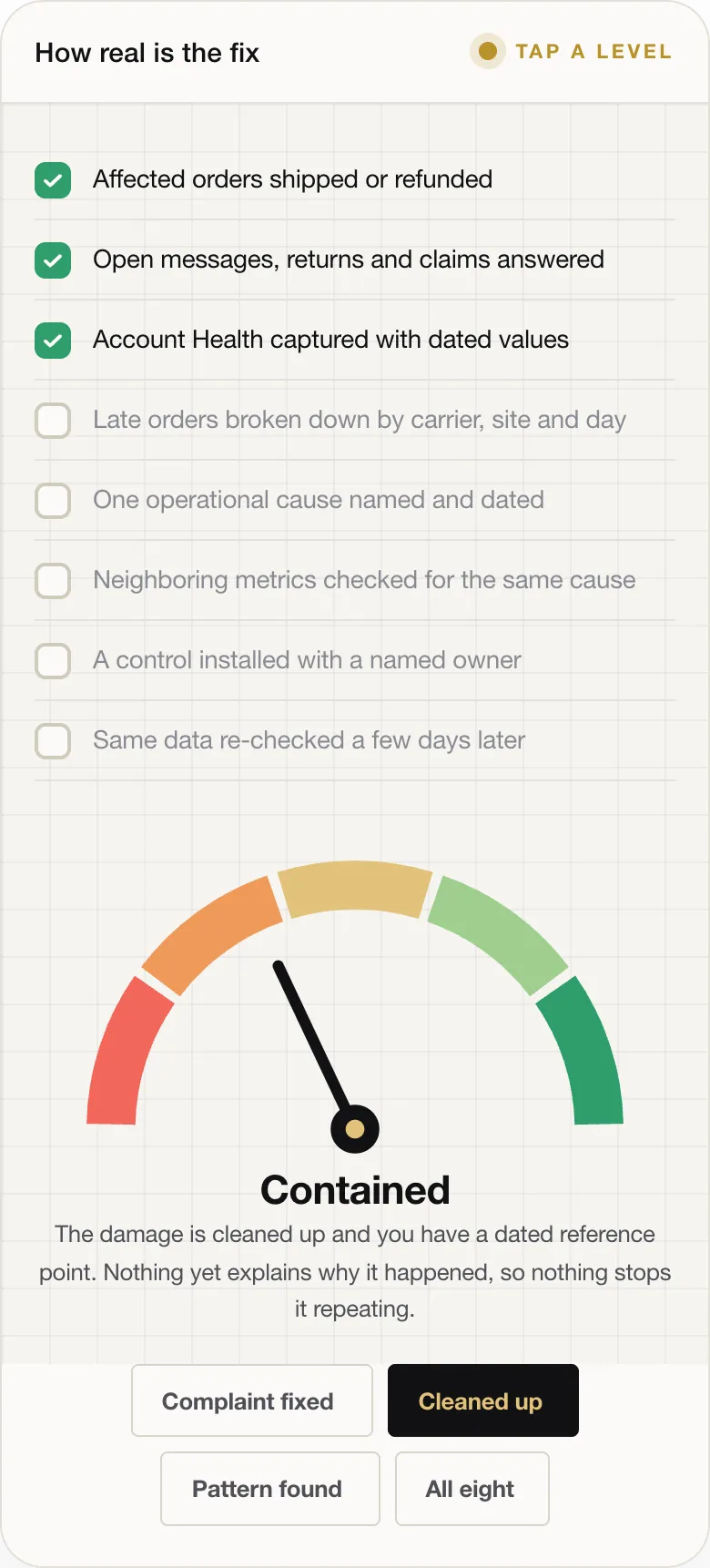
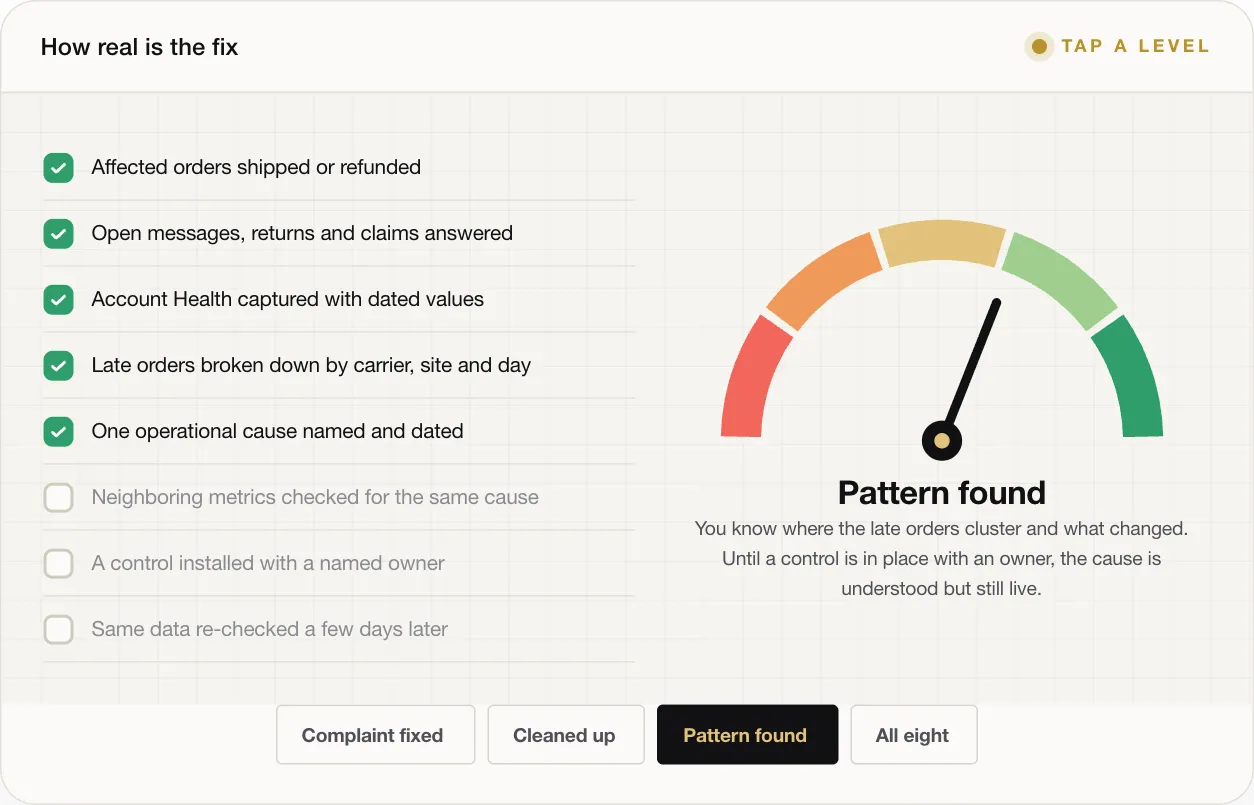
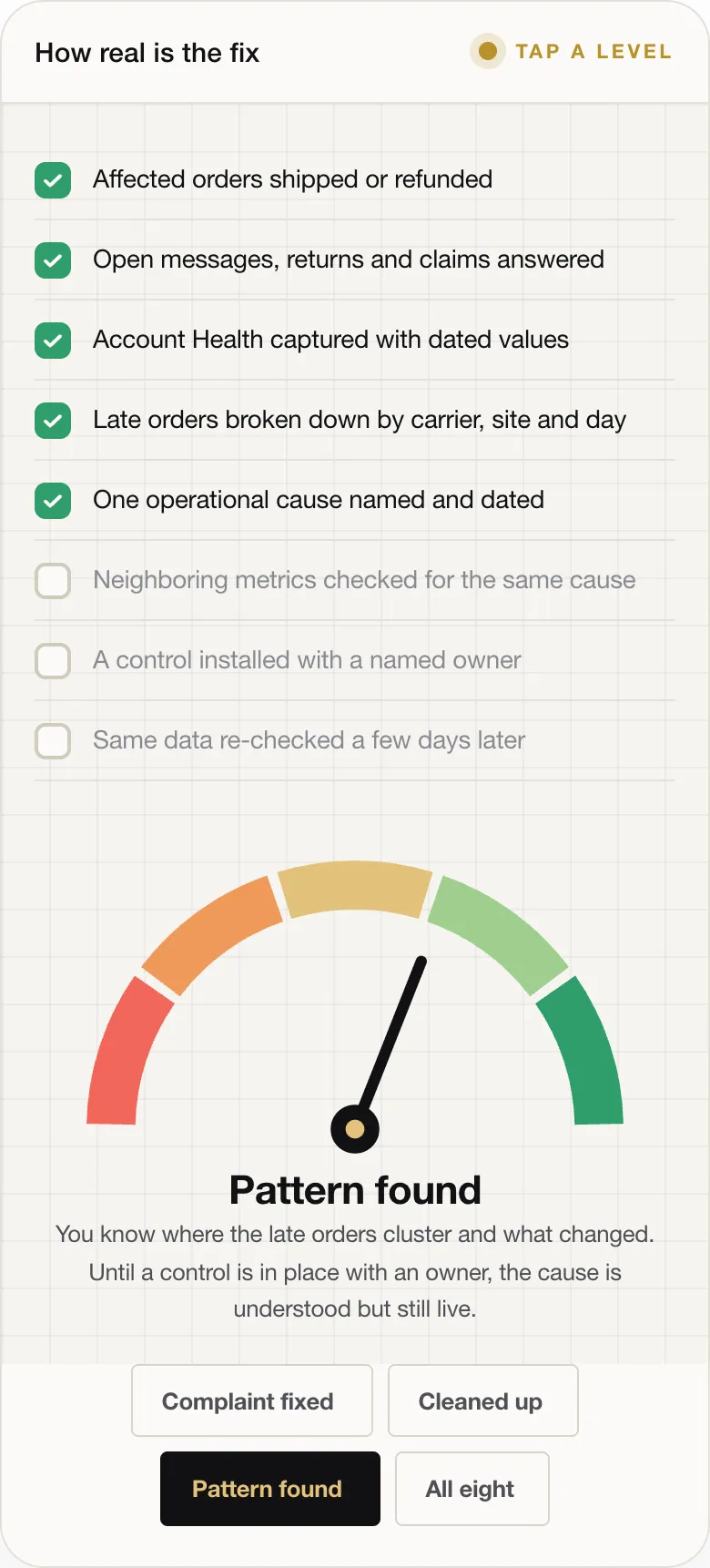
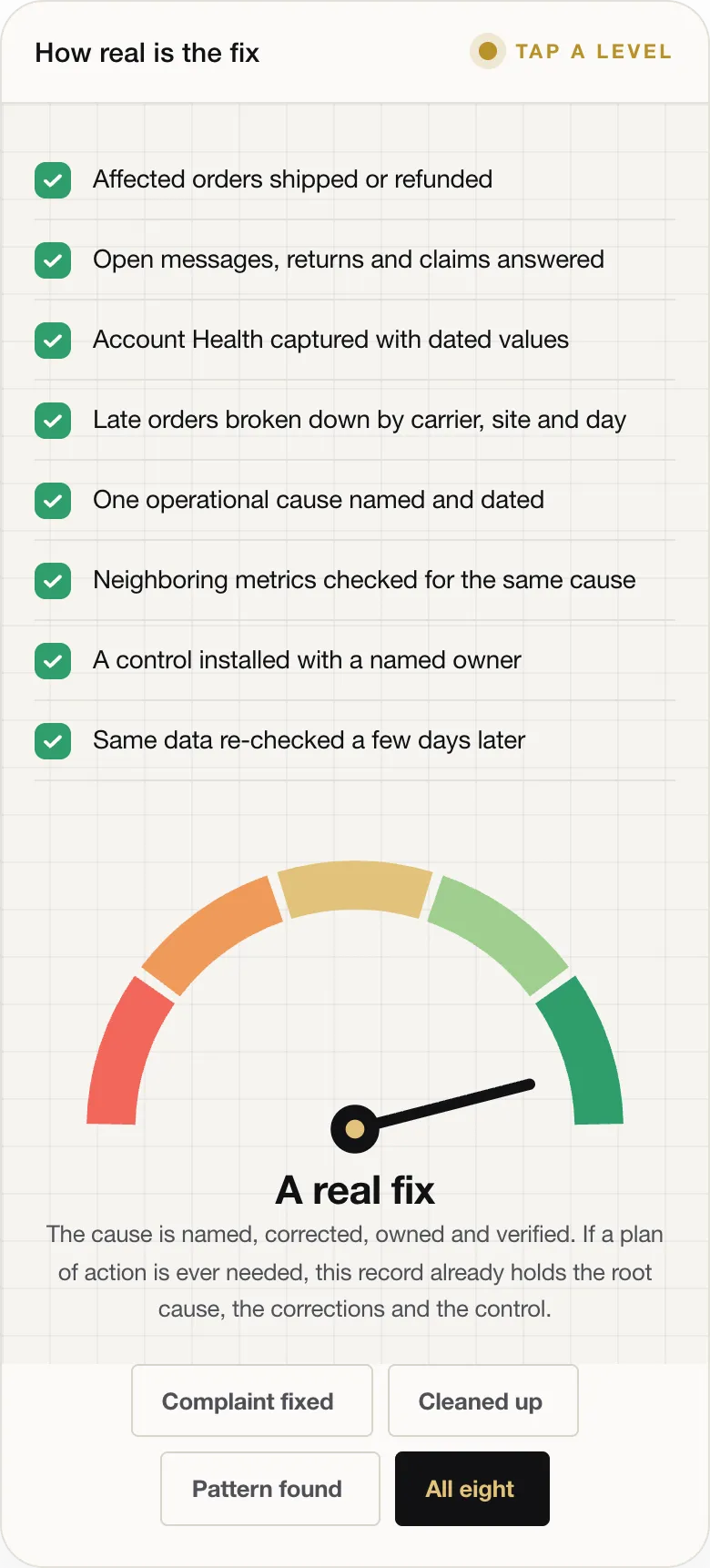
A promise to try harder or a real fix?
When a metric slips in December, what decides the outcome is whether the fix changes the operation. Tap a level to see which steps a seller at that stage has actually taken.
Common holiday mistakes
- Fixing the last complaint instead of the pattern behind it.
- Relabeling seller-initiated cancellations as buyer cancellations, which Amazon says still count.
- Arguing that defects were unfair instead of showing control over the process that caused them.
- Fixing one metric while the shared weakness breaks a neighboring one next week.
- Cutting staff in January while December’s returns and claims are still arriving.
For more on the individual metrics, see our explainers on how Order Defect Rate is graded, late shipment suspensions, and pre-fulfillment cancellation rate.
Where to Verify Your Holiday Readiness
| Question | Where to check | What to look for |
|---|---|---|
| Is my account at risk right now? | Performance, Account Health | AHR color and score, each metric against its displayed target, policy warnings, recent changes |
| Are official cancellation requests waiting? | Manage Orders, Unshipped tab, Show filters, Buyer Requested Cancel | Orders with the banner saying cancellation will not affect Cancellation Rate |
| Is tracking valid on every shipment? | Manage Orders order details and carrier tracking | Carrier, service and tracking ID from the same carrier, first scan on the label date |
| Are A-to-z claims waiting on me? | Performance, A-to-z Guarantee claims | New claims, 72-hour information requests, granted claims inside the 30-day appeal window |
| Are return requests answered in time? | Orders, Manage Returns | Requests older than 24 hours, correct return address, prepaid labels with valid tracking |
| Which FBA units will hit the surcharge? | FBA Inventory tool, Aged Inventory Surcharge report | ASINs subject now or within 60 days, and the 14th removal deadline |
| What are this year’s holiday return and carrier dates? | Extended Holiday Returns policy page; usps.com, ups.com, fedex.com | Current purchase and return-by dates; published deadlines and pickup closures |
A Week by Week Q4 Routine From October Through January
The routine follows the checks Amazon’s own pages call for and deliberately avoids fixed dates for things that change every year, such as deal events, carrier deadlines, and the returns window. Fill those in from the official sources each season.
October: build the baseline
Capture the full Account Health page with dated values. Set Order Handling Capacity from what your team has actually shipped on its busiest real days. Review shipping templates against carrier transit times. Test inventory sync by simulating a fast sell-through on a shared SKU. Write the staffing rota through January, naming who covers messages, returns, and claims on weekends and holidays. File holiday purchase invoices by ASIN, and for FBA, review inventory age and plan removals before the next 14th.
November: run the daily loop
Work orders from Seller Central and the Seller app daily, and never ship Pending orders. Clear the Buyer Requested Cancel filter before each packing run. Hand every package over the day the label is bought. Answer messages within 48 hours and return requests within 24 where possible. Weekly, compare Account Health with your October baseline and investigate anything that moved.
December: protect the promise
Match shipping templates to published carrier deadlines. Set listing status and return preferences before any closure. Notify buyers of delays as soon as you see them, check the A-to-z page daily, and confirm the return address will be staffed in January.
January: work the returns tail
Keep return and message coverage at peak level until the holiday returns window closes. Refund within two business days of receiving returns. Review granted claims inside the 30-day appeal window and appeal only with new, genuine evidence such as signed proof of delivery. Clear aging FBA stock before the 14th, then write a short post-season review of what slipped, why, and which control prevents it next year.
Frequently Asked Questions
Do I need to prepare for the holidays if I am not running a deal?
Yes. Amazon tells sellers to assume higher than normal volume during the holiday season even without a planned deal, because overall traffic to Amazon increases.
How long is Amazon’s holiday return window?
It is set each year. The 2025 policy made items bought November 1 to December 31, 2025 returnable through January 31, 2026, with Apple products through January 15, 2026; check Seller Central for the current season.
Does the extended returns window apply to seller-fulfilled orders?
Yes. Amazon states that it applies to seller-fulfilled, FBA, and Amazon retail orders.
Will cancelling a holiday order hurt my Cancellation Rate?
Cancelling an official buyer request does not count. Cancelling because a buyer asked by message, or because you ran out of stock or made a pricing error, does.
How fast must I answer buyer messages and return requests?
Within 48 hours for delivery issues and return requests, with 24 hours recommended for returns. Missing 48 hours can lead to an automatically granted A-to-z claim.
When can a buyer file an A-to-z claim for a late holiday package?
After contacting you, waiting three days past the maximum estimated delivery date, and getting no resolution within 48 hours of their first message.
Can I appeal an A-to-z claim Amazon granted in December?
Yes, within 30 calendar days of the grant. After that, Amazon says the ODR impact cannot be reversed.
When is the aged inventory surcharge assessed?
On the 15th of each month for units aged 181 days or more, typically charged between the 18th and 22nd. Removal orders submitted by 11:59 p.m. Pacific on the 14th avoid that month’s charge.
Can a sudden holiday sales spike trigger a review?
Amazon does not publish its triggers, but rapid changes in volume, listings, categories, or account details can draw one. Keep genuine supplier invoices that match your sales volume, organized by ASIN.
Get Help With Holiday Account Health
If your Account Health page already shows warnings, or you want a team watching metrics, claims, and returns through the busiest months, we can help. Submit your case if Amazon has already acted on the account, or book a consultation to review your Q4 plan before volume arrives.
This article is educational information based on Amazon’s published Seller Central help pages at the time of writing, not legal advice. Amazon updates its policies, dates, fees, and metric targets, so confirm the current version in Seller Central before acting. Got Suspended? does not guarantee any outcome or timeline with Amazon.
Sources
- Amazon Seller Central: Prepare for the Holiday Season
- Amazon Seller Central: Extended Holiday Returns policy
- Amazon Seller Central: Order cancellations
- Amazon Seller Central: Aged inventory surcharge
- Amazon Seller Central: Amazon’s A-to-z Guarantee claims
- Amazon Seller Central: Prevent an A-to-z Guarantee claim
- Amazon Seller Central: Account Health Rating program policy
