
Quick answer: On Amazon, seller customer service is an account health system, not a courtesy. Every buyer message left unanswered, every return not authorized or refunded on time, and every frustrated buyer pushed away can become negative feedback, an A-to-z Guarantee claim or a chargeback, the defects behind your Order Defect Rate. To protect the account, answer through Buyer-Seller Messaging from an authorized address, send only messages Amazon treats as necessary, respond to manual return authorizations within 24 hours, refund within two business days of receiving a return, and never pressure or pay a buyer to remove feedback. Then review defects weekly, trace each cluster to a cause, and fix the process behind it.
Most sellers do not lose accounts to one dramatic violation. They lose them to a slow buildup of small service failures: an inbox nobody checked during a busy week, a return request left in the queue, a polite message that asked a buyer to “update” their feedback. Each looks minor. Together they move a metric, and the metric produces a notice asking for a root cause and a plan.
This guide covers how Amazon’s customer service tools work for seller-fulfilled orders, which messages you may send, how returns and feedback connect to your defect rate, when Customer Service by Amazon makes sense, and how to run a daily routine that stops defects from accumulating. Every window and threshold here comes from Amazon’s Seller Central help pages listed in the sources. Where Amazon shows a live value only inside your account, we tell you where to find it rather than quoting a number from memory.
Why customer service decides your defect rate
Your Order Defect Rate is built from negative seller feedback, A-to-z Guarantee claims and service chargebacks. Almost every one of those starts as a buyer with a problem who could not reach you, got no useful answer, or got an answer that made things worse. Amazon says it keeps a record of buyer-seller messages so its dispute team can review that correspondence when deciding A-to-z claims and chargebacks. Your message history is evidence, for you or against you.
A worked example with hypothetical numbers
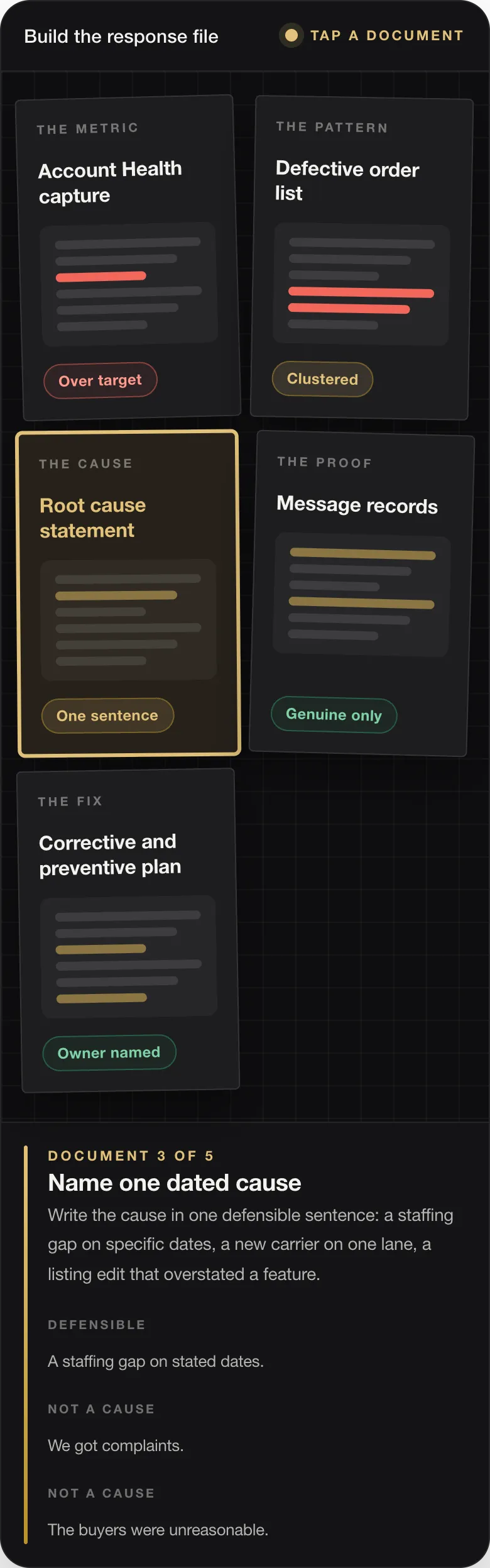
A seller ships 1,500 seller-fulfilled orders in the period Amazon measures. During a two-week staffing gap, about 40 messages about wrong items and refunds go unanswered. Suppose 9 of those buyers open A-to-z claims, 5 leave one-star feedback and 3 dispute the charge. That is 17 defective orders out of 1,500, about 1.1 percent. No product failed. Nobody answered. Compare your own figures with the target Amazon displays on your Account Health page, and see our guide on how you are graded for Order Defect Rate for how each defect is counted.
How Buyer-Seller Messaging works
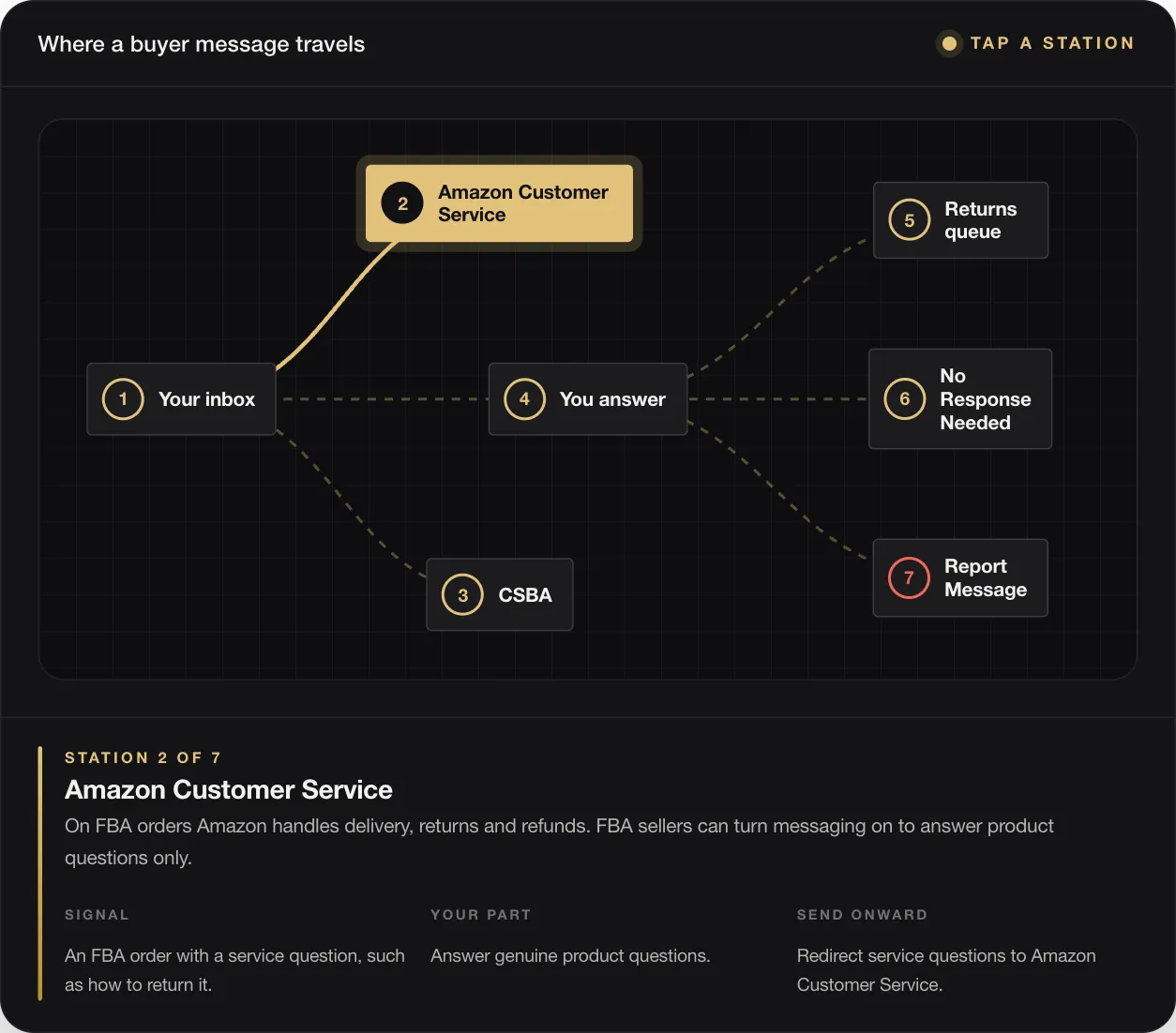
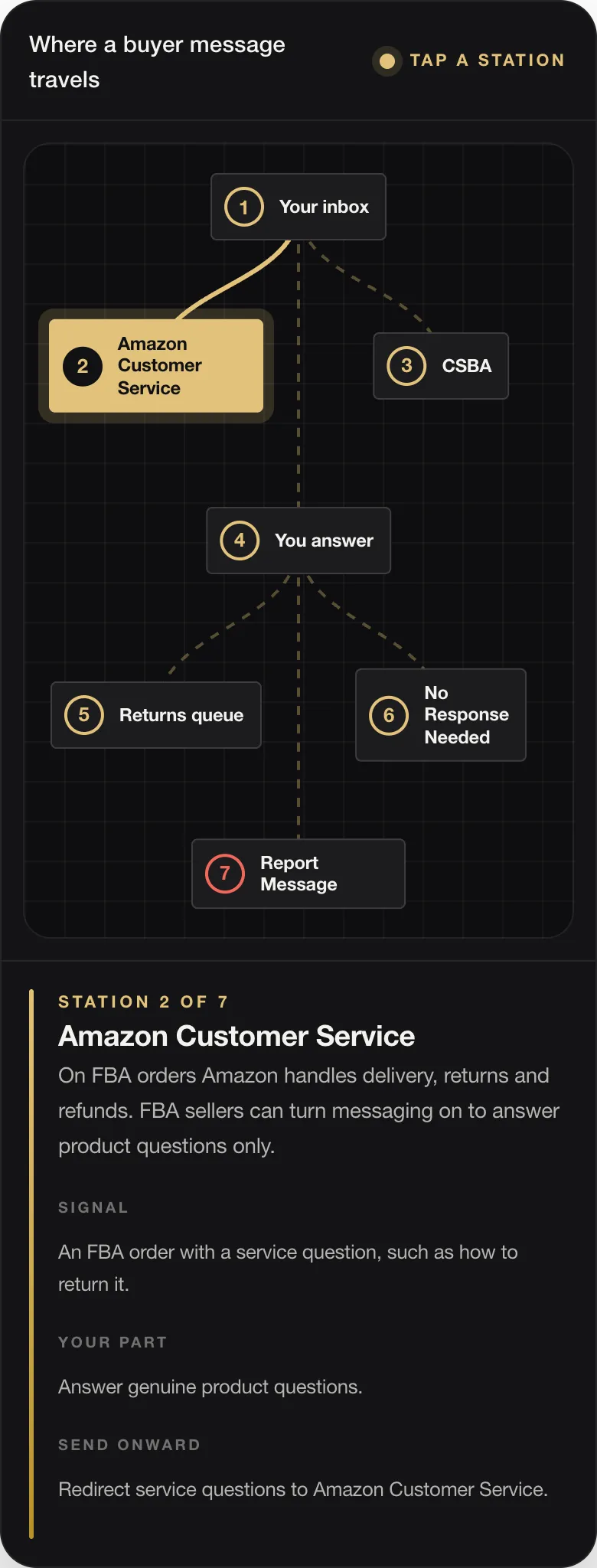
Buyer-Seller Messaging gives each buyer an encrypted alias for each seller relationship, routes messages through it, and records every message whether you reply in Seller Central or from your own email client. It is on by default if you fulfill your own orders. FBA sellers can turn it on to answer product questions only; Amazon says service questions on FBA orders, such as how to return an item, should be redirected to Amazon Customer Service.
Who on your team can send
Use the Messaging Permissions page to approve or block the addresses that may message buyers. Amazon rejects messages from any address other than the account’s registered Buyer-Seller Messaging address or an authorized one, and they must be resent after approval. Two consequences follow. Approve a new agent’s or help-desk tool’s sending address before it goes live, or replies will bounce. And because an address cannot be deleted once approved or blocked, treat the list as a permanent access log and block departed staff promptly.
Daily limits, cases and the buyer survey
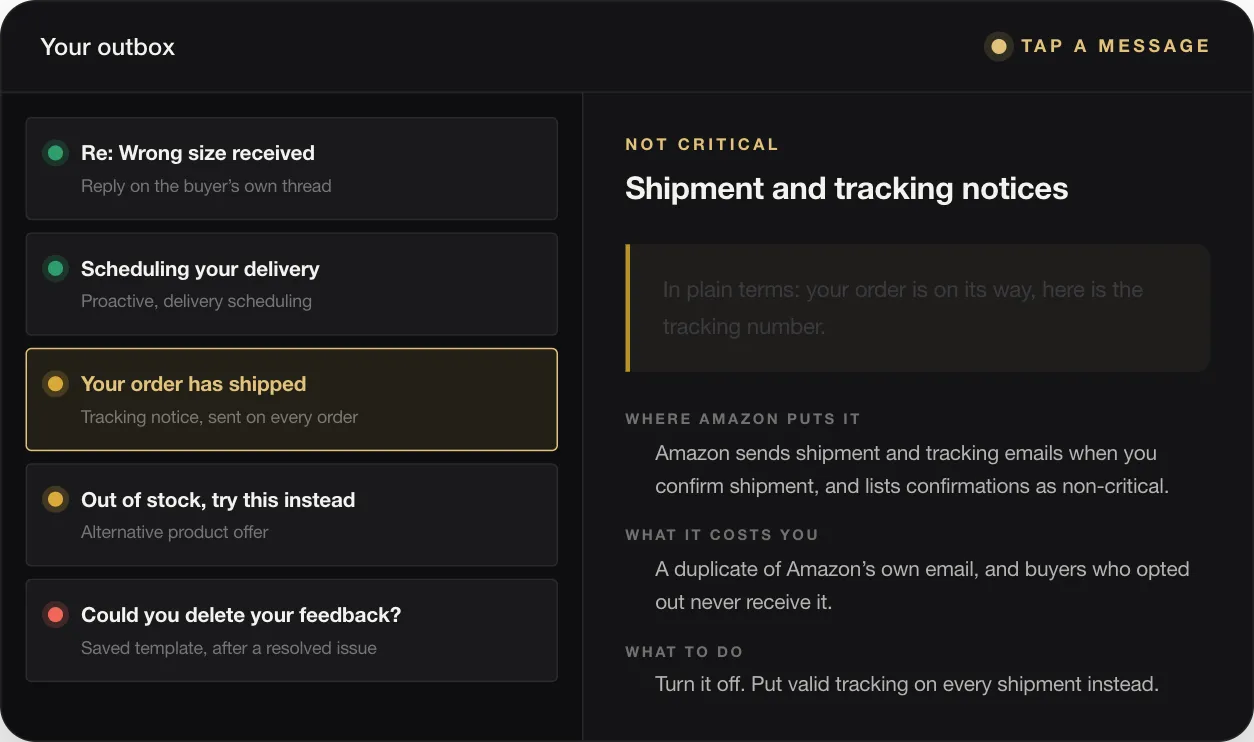
Amazon caps daily messages at five times your average daily order volume plus 600. It also says you need not send shipment notices or tracking, because Amazon sends those when you confirm shipment. Messages about one service event are grouped into a case that moves from opened to resolved to closed; once closed, email on it is rejected and you must start a new case with a proactive message. Each reply carries a survey asking whether it solved the problem. A “No” flags the case as Buyer Reported Unresolved. Amazon says this is currently not an account health factor, but it is a free signal showing which replies are failing.
Which messages you may send
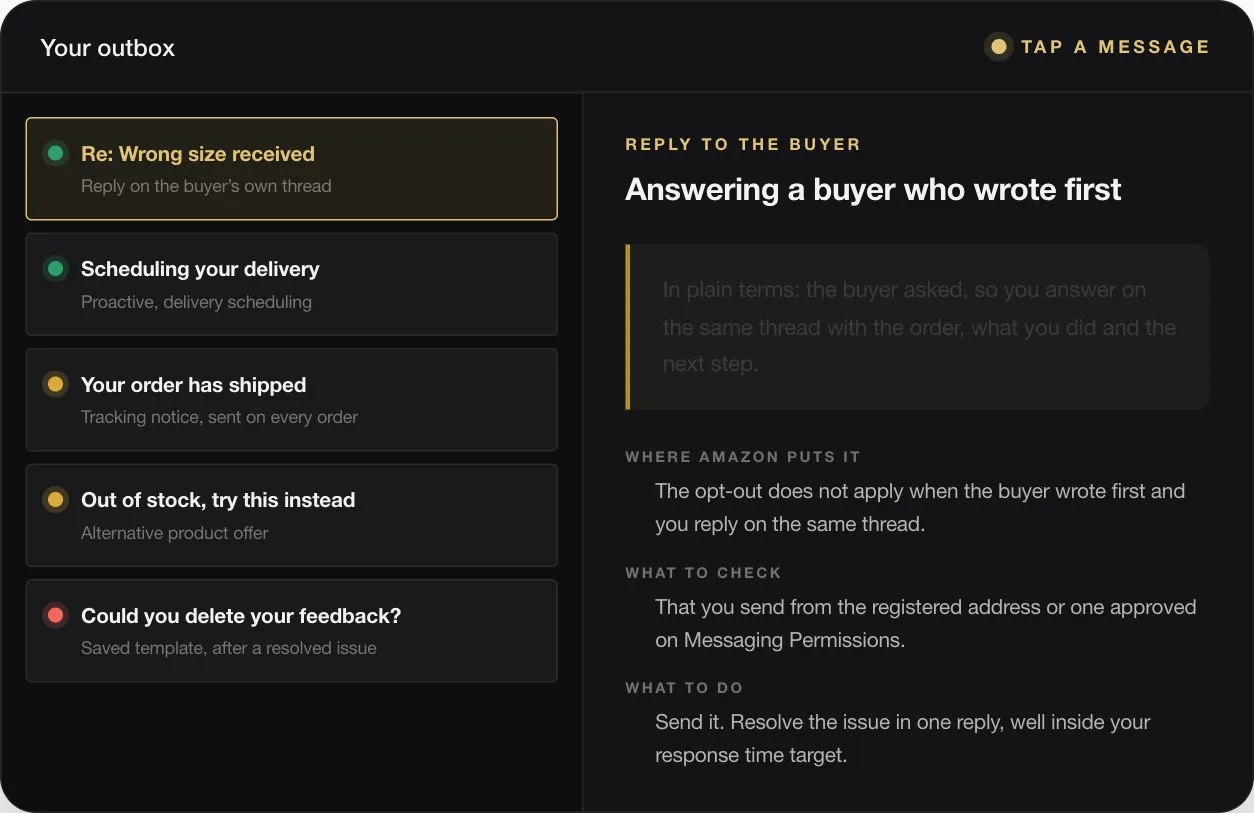
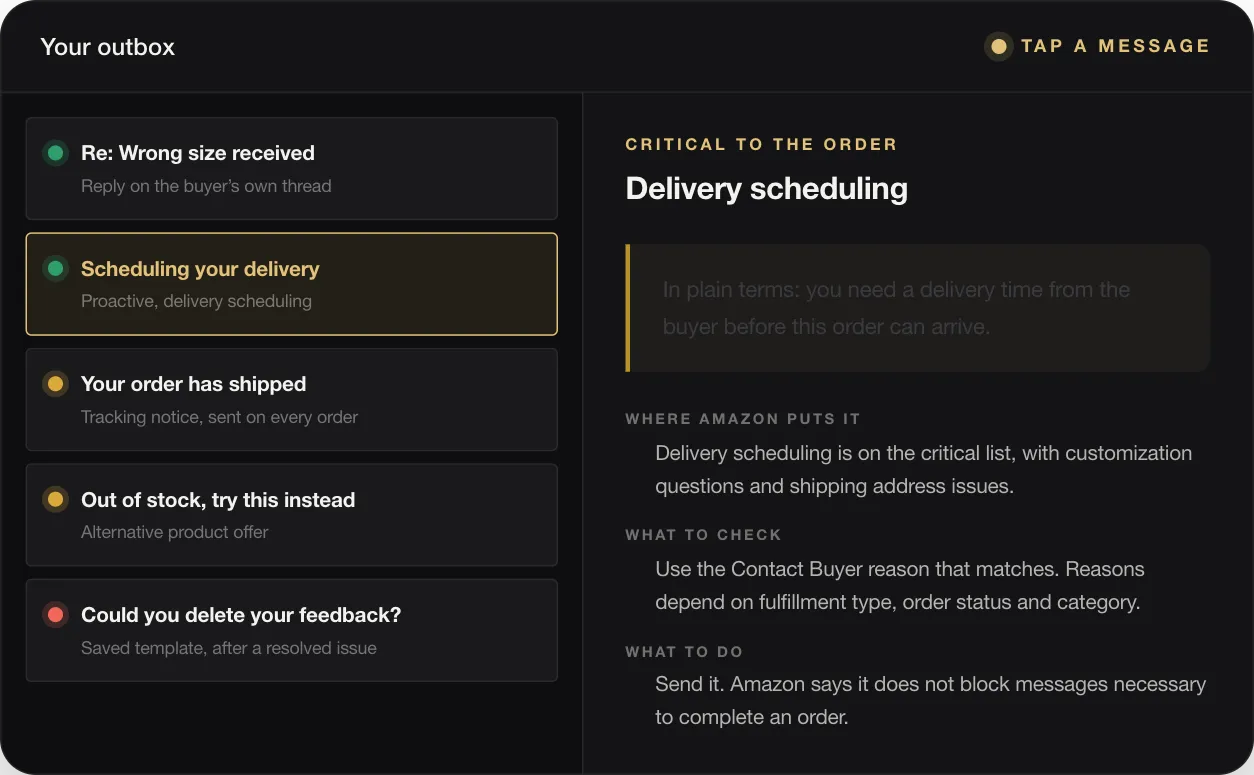
The most common messaging mistake is treating the channel as marketing. Buyers can opt out of unsolicited seller messages. The opt-out does not apply when the buyer wrote first and you reply on the same thread, or when you use one of Amazon’s critical proactive templates. Amazon says it does not block messages necessary to complete an order.
| Amazon treats as critical to an order | Amazon treats as not critical |
|---|---|
| Product customization questions | Requests for seller feedback or buyer reviews |
| Delivery scheduling | Order, shipment, delivery or refund confirmations, which Amazon already sends |
| Issues with a shipping address | Proactive service: manuals, usage tips, FAQ answers, “if something goes wrong” suggestions |
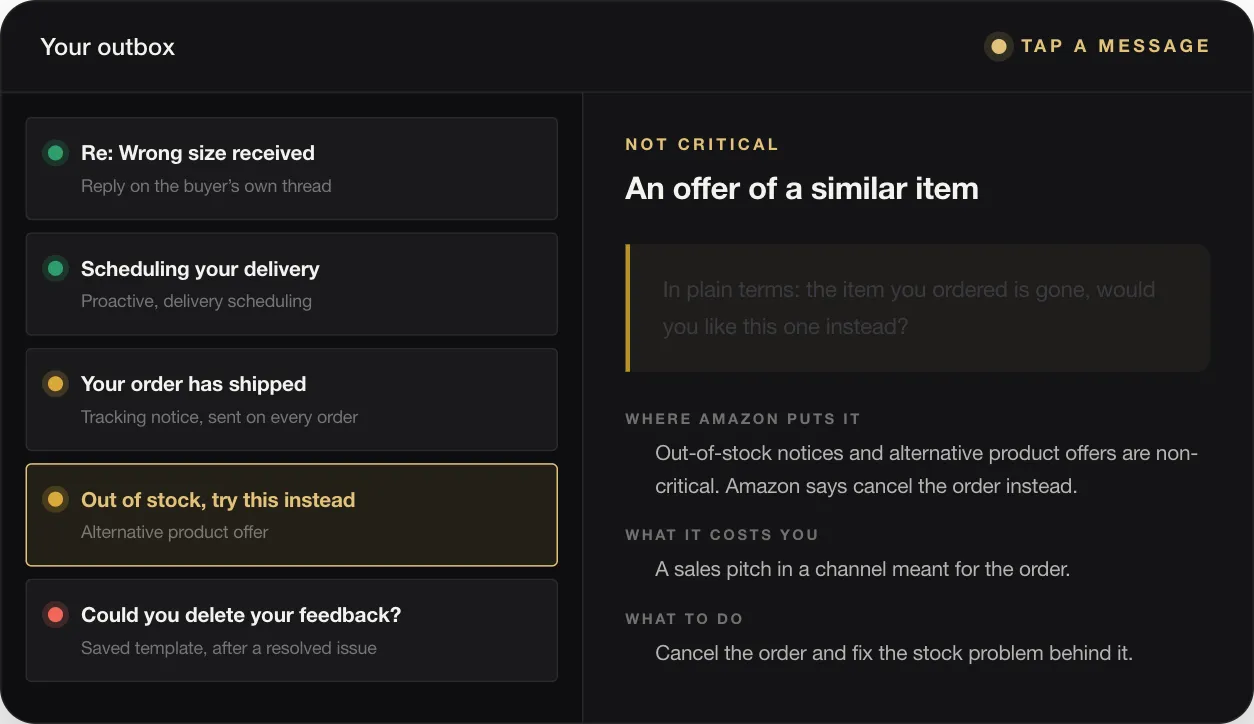
| Out-of-stock or delay notices, or offers of alternative products (Amazon says cancel the order instead) |
Several items in the right column feel helpful, which is exactly why sellers send them. The test for every outbound message: is it necessary for this buyer to receive this order, or a reply to something the buyer asked? If neither, do not send it.
Templates and attachments
The Contact Buyer page offers contact reasons that depend on fulfillment type, order status and category, so a return conversation is not available before the order is complete. Amazon-managed templates are translated automatically into the buyer’s store language, and any automation is identified on each template. You can also save your own templates under Manage Email Templates. Seller templates are where violations hide, because one sentence written once is sent hundreds of times; review every saved template against the rules here. HTML email and attachments are supported. Use attachments that resolve the issue, such as receipts or supporting documents, which Amazon names as examples.
What never belongs in a buyer message
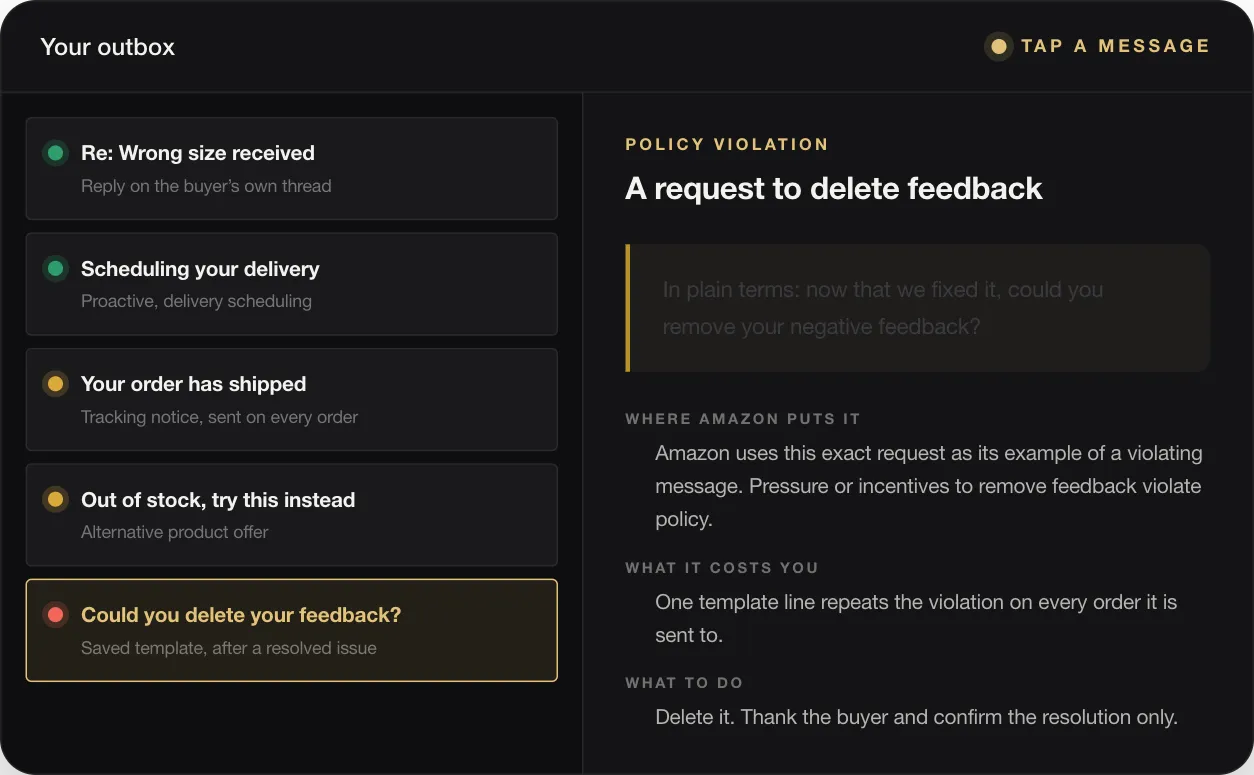
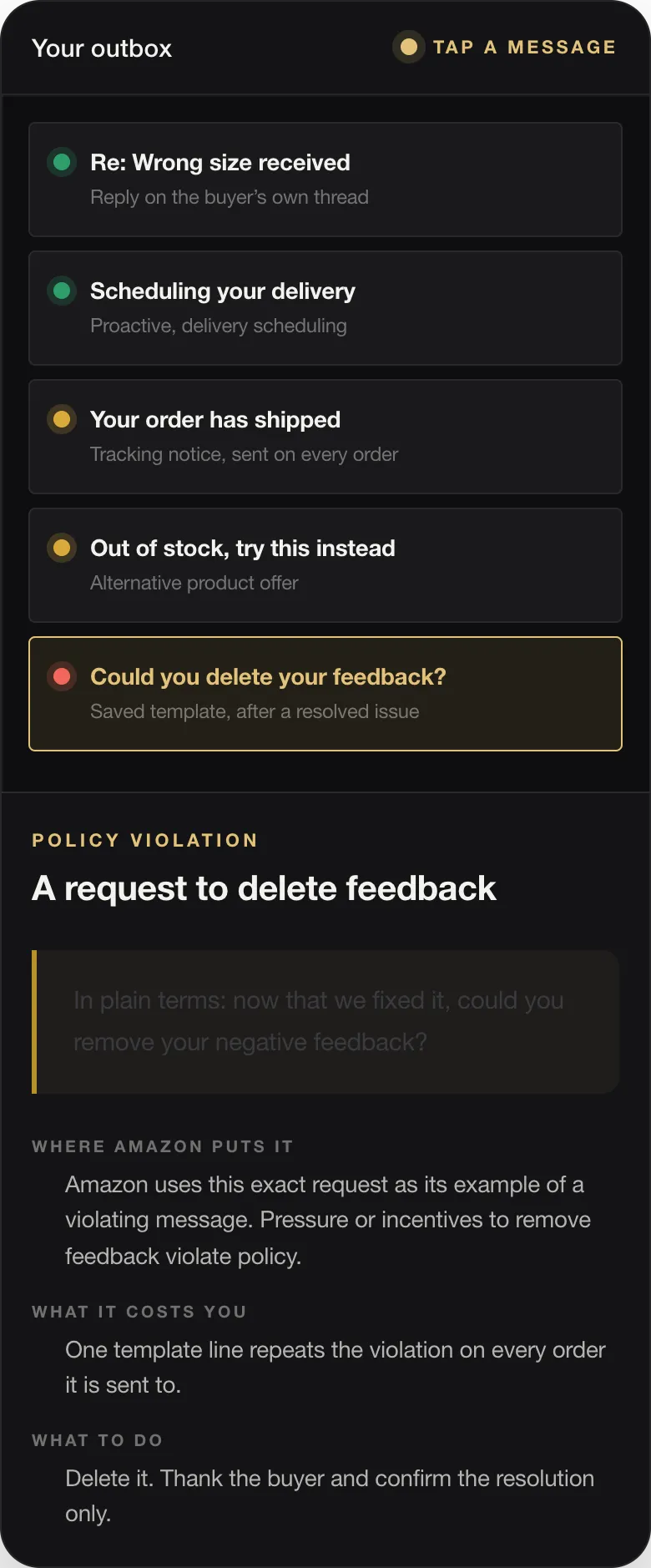
Amazon says pressuring or incentivizing a buyer to remove or modify negative feedback violates its policies, and that you must not offer compensation or incentives for positive feedback or removal. Its own example of a violating message asks a buyer, after resolving their issue, whether they can delete their feedback. Amazon also says not to give a buyer’s alias to your carrier and not to contact other sellers through the storefront “Ask a question” feature. Amazon keeps a fuller list of prohibited content in its communication guidelines in Seller Central; read the current version before writing any template.
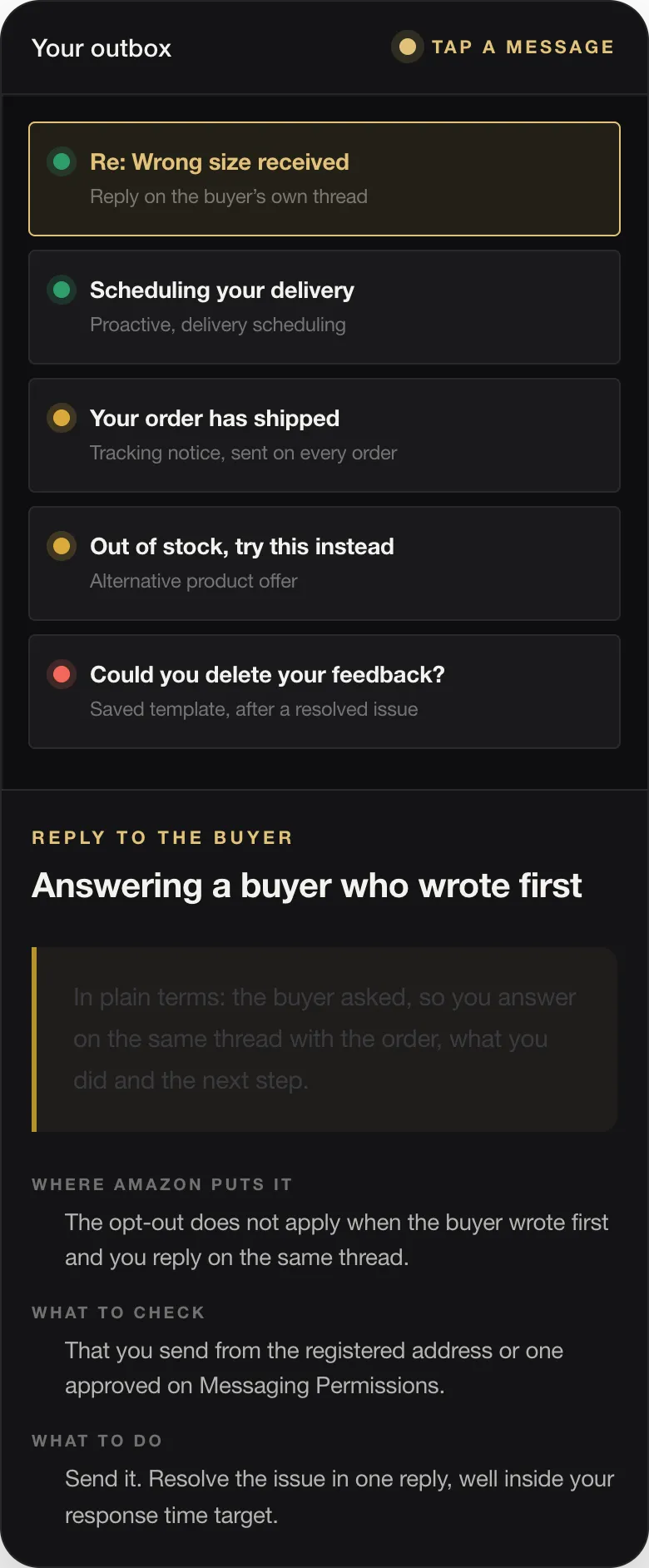
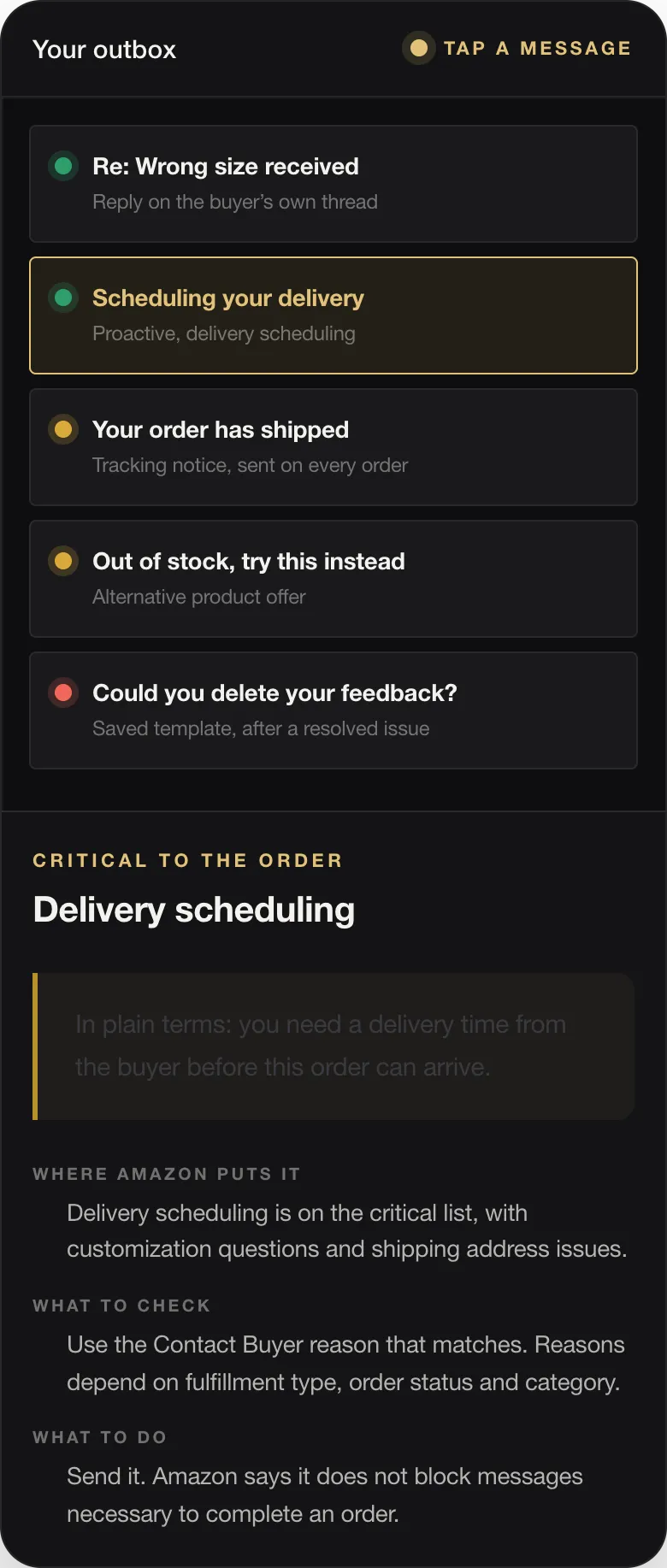
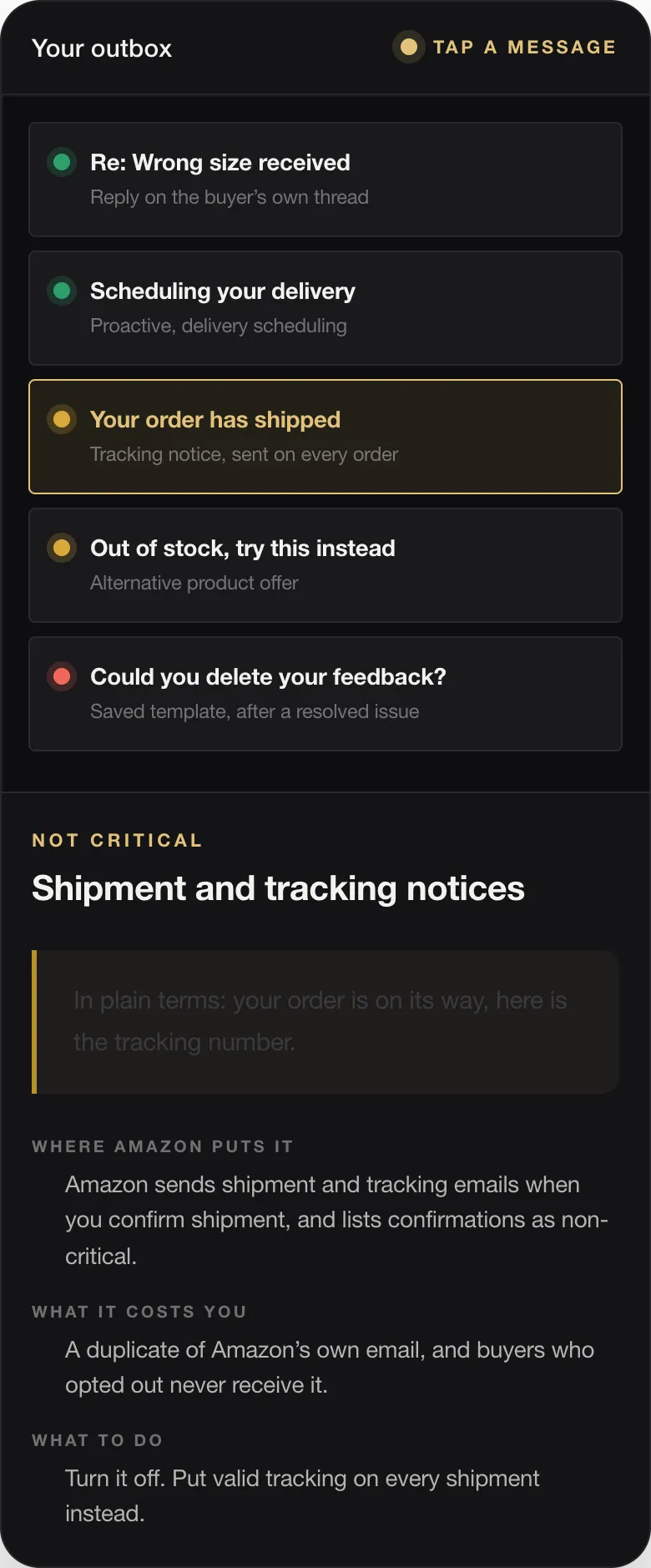
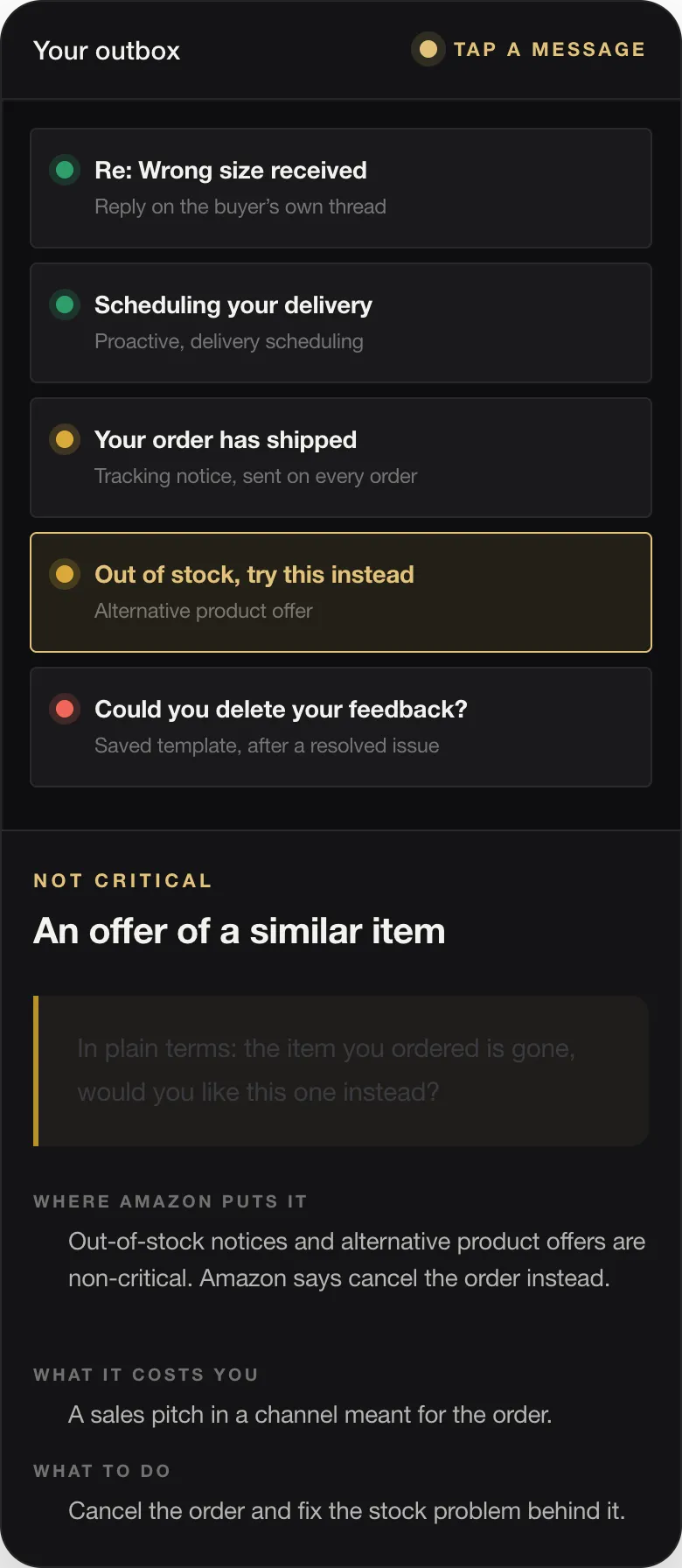
Five drafts in the outbox. Which ones should go?
Amazon sorts seller messages into those needed to complete an order and those that are not. Tap a draft to see where it falls and what to do with it.
Answering buyer questions well and on time
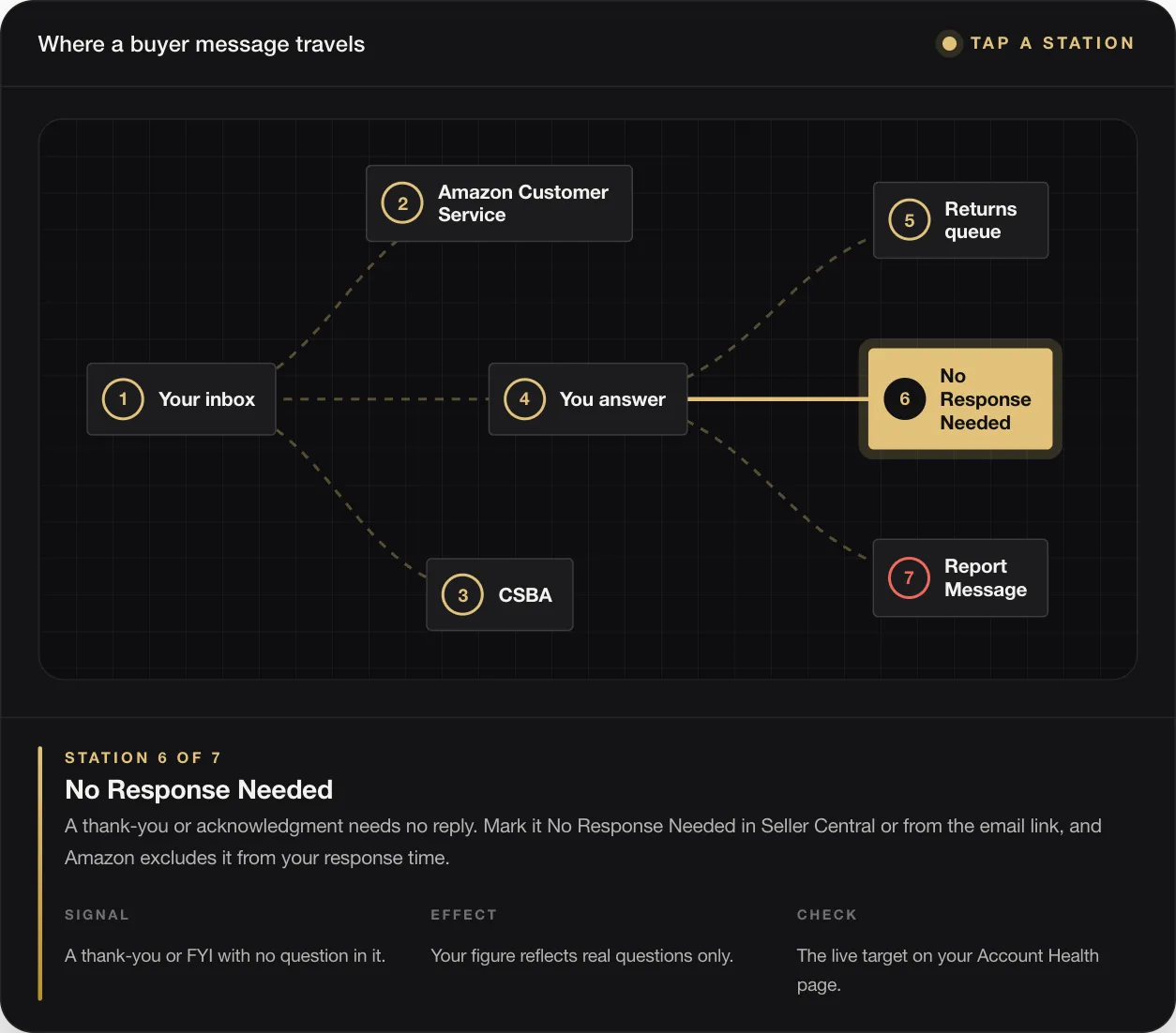
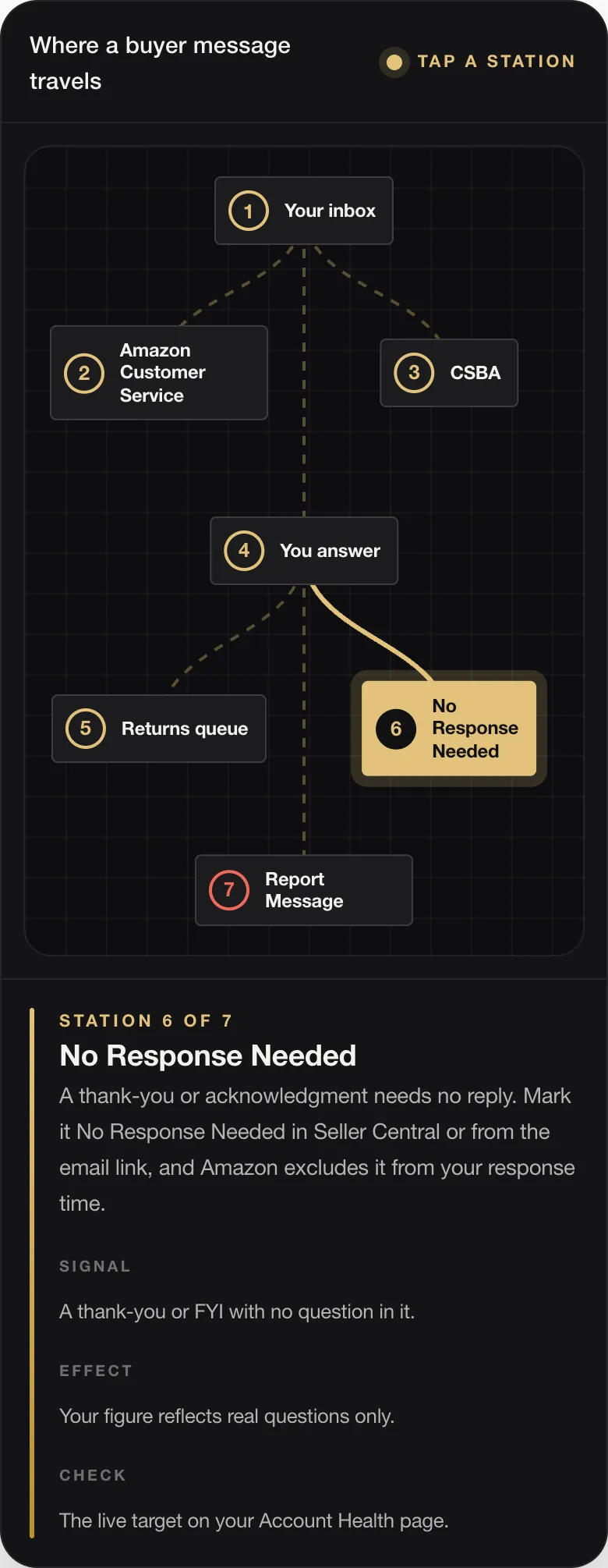
Amazon calculates your response time to buyer messages. Unanswered messages appear under the Response Needed filter by default. A thank-you or acknowledgment needs no reply; mark it No Response Needed in Seller Central or from the link in the email, and Amazon excludes it from the calculation. The response time target and your current figure appear in the customer satisfaction section of your Account Health and performance pages. Use that live value rather than a number you heard elsewhere.
What a good answer contains
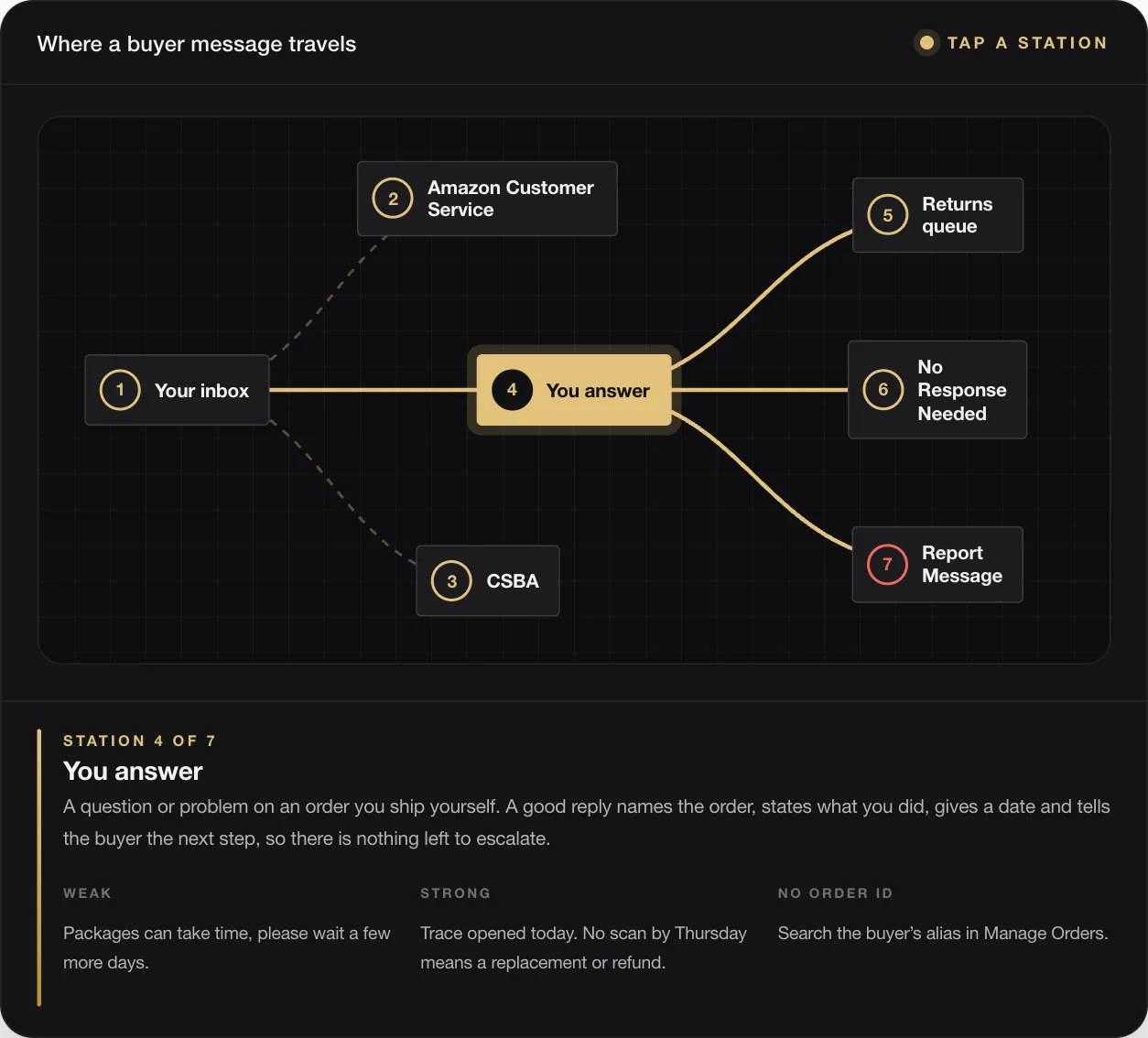
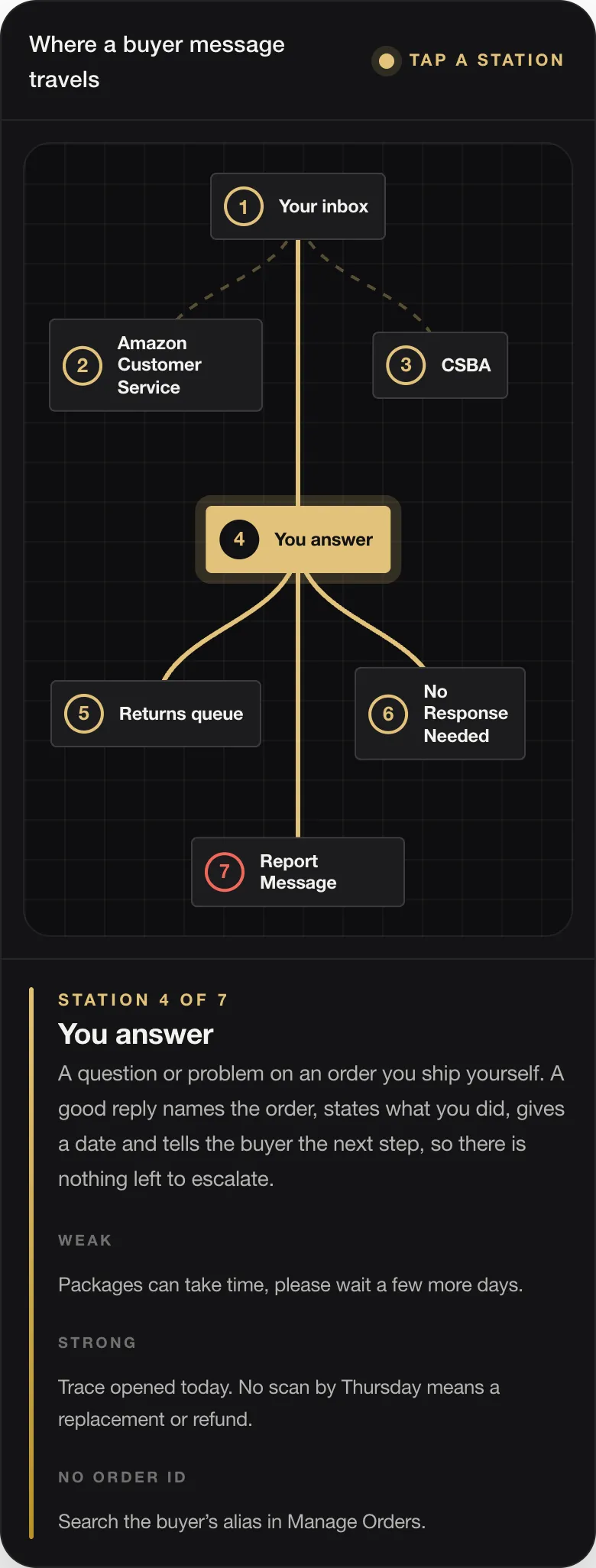
A good reply resolves the issue in one message: it names the order, states what you did, gives a date, and tells the buyer the next step. For a package with no carrier scan for five days, compare:
- Weak: “Sorry for the delay, packages can take time. Please wait a few more days.”
- Strong: “Your order shipped on the 3rd and has not been scanned since the 4th. We opened a carrier trace today. If there is no scan by Thursday, we will send a replacement or a full refund, your choice. Just reply with which you prefer.”
The strong version removes the buyer’s reason to file a claim and leaves a record showing you acted before they escalated. If a message arrives without an order ID, Amazon says to search the buyer’s alias from the From field in Manage Orders; because the alias stays the same for that buyer, it also shows their past orders and conversations.
Abusive, suspicious and extortion messages
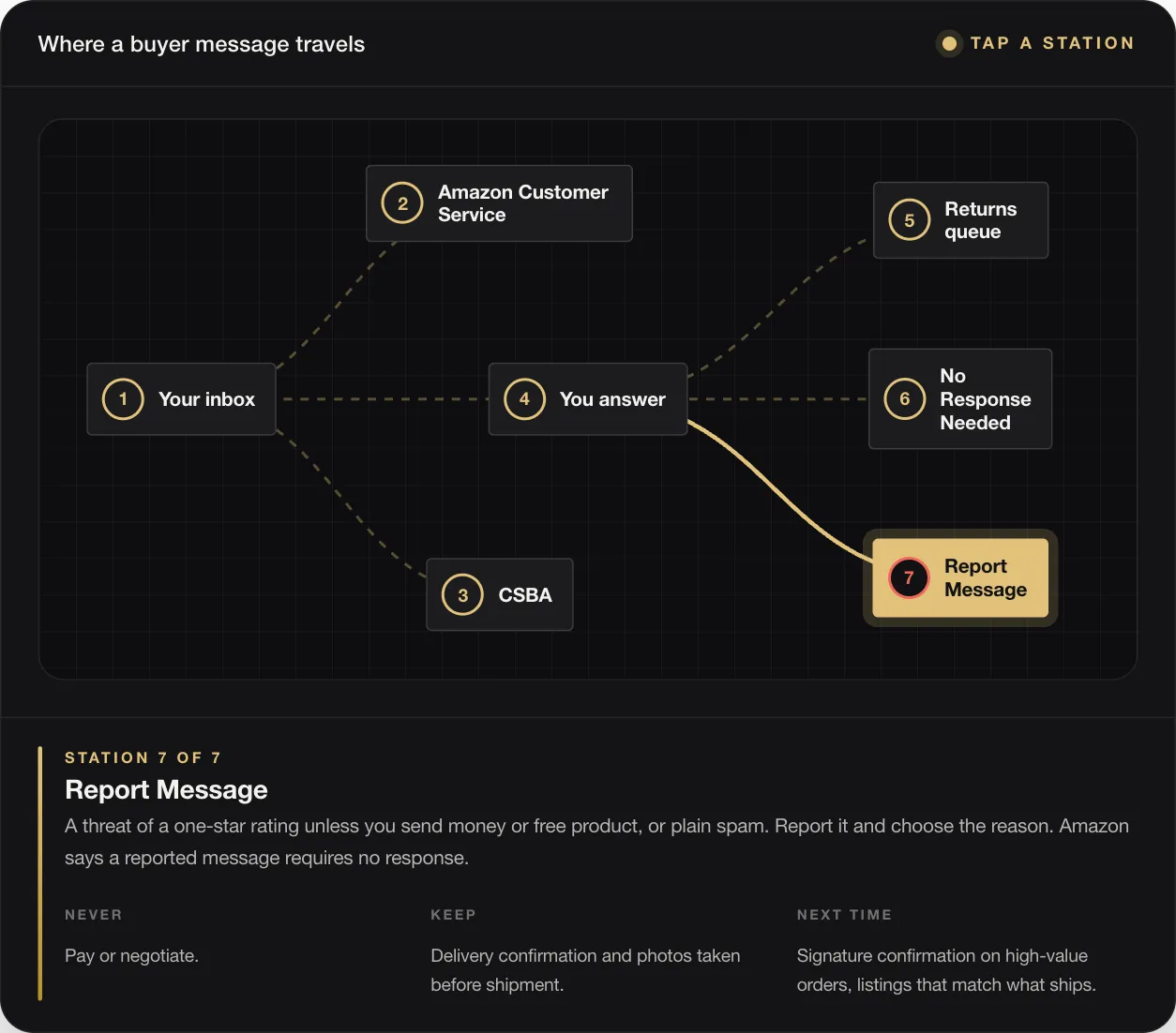
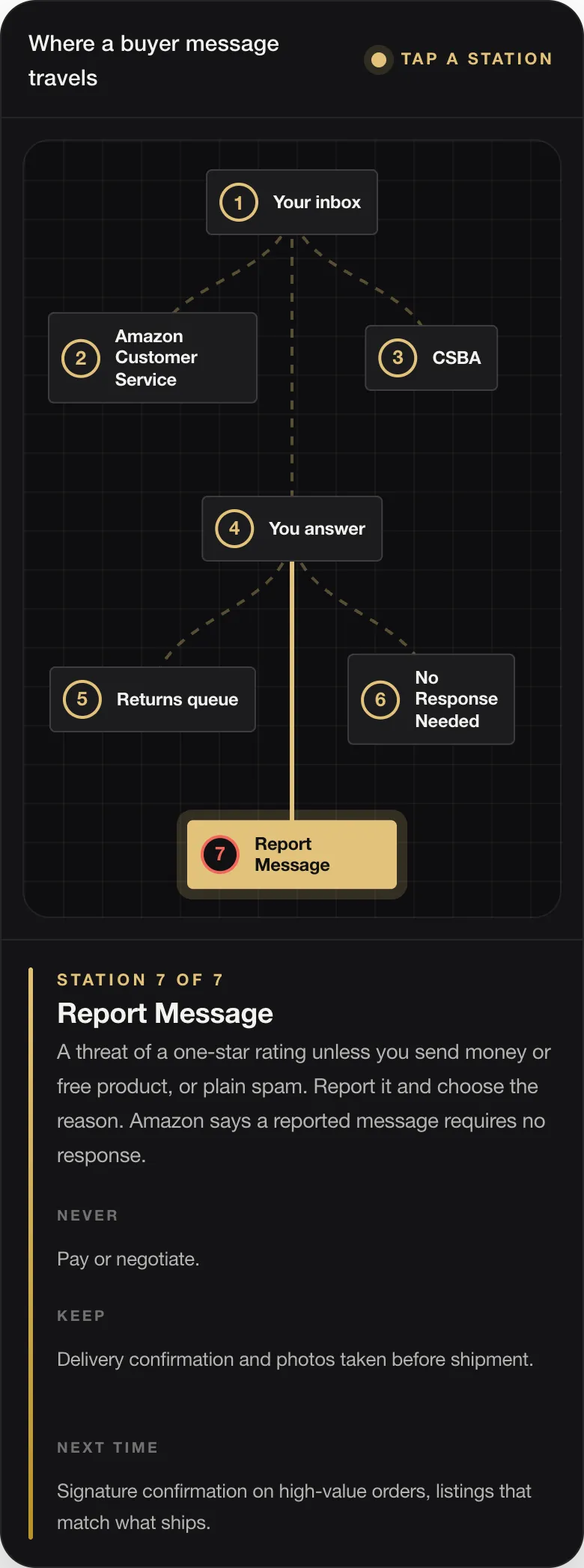
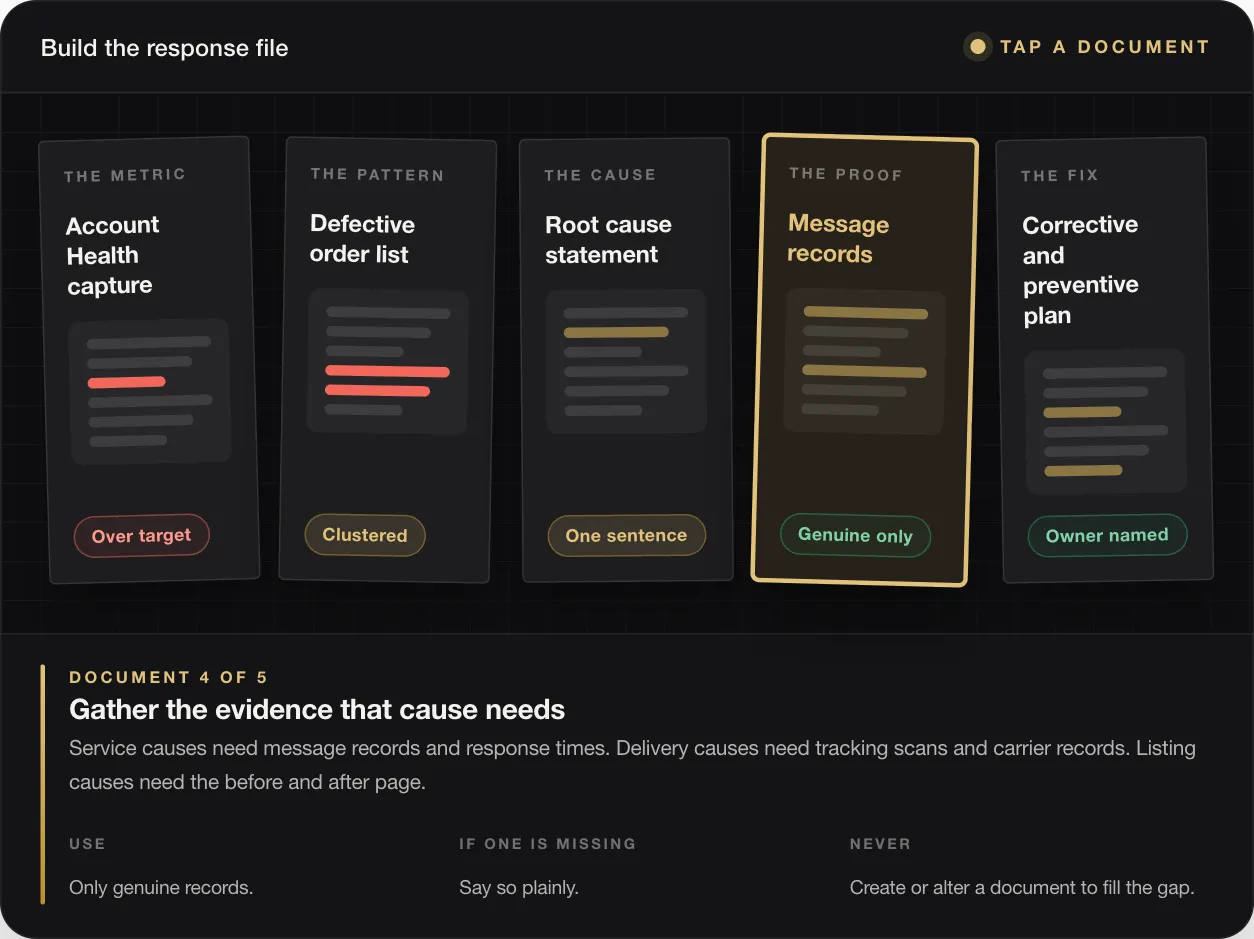
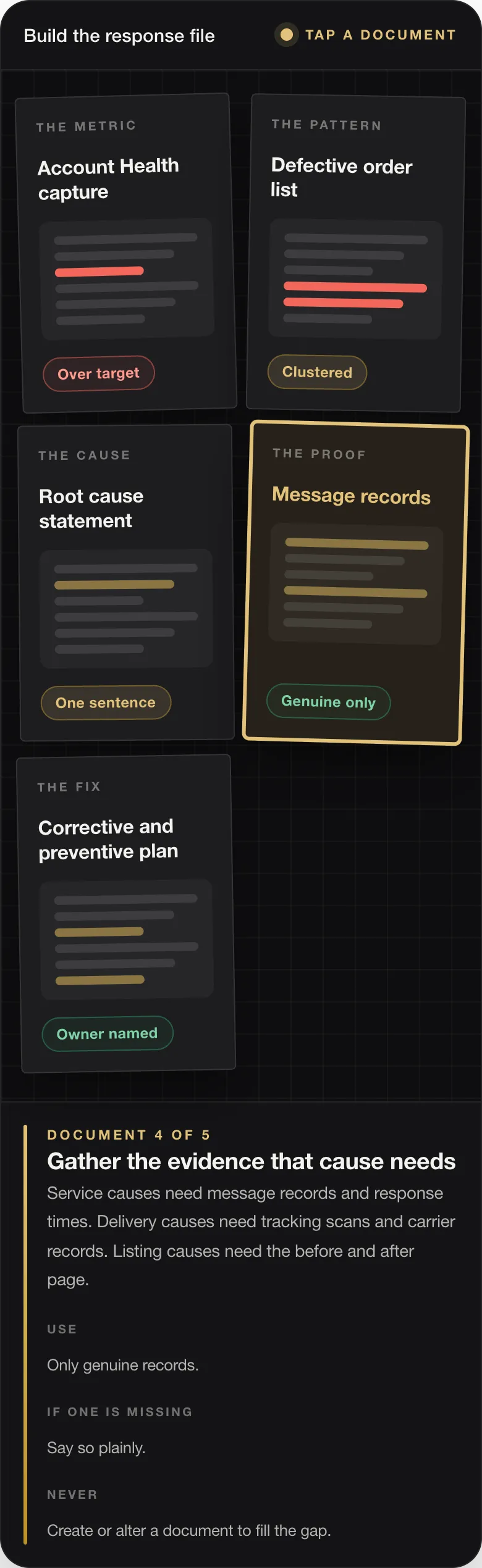
Some messages are not genuine requests: a buyer threatening a one-star rating unless you send money or free product, or spam. Use Report Message and choose the reason; Amazon says a reported message requires no response. Do not pay and do not negotiate. Because Amazon generally acts on what the buyer files, “the buyer lied” is never enough by itself. You overcome a false claim with records that contradict it, such as delivery confirmation or photos taken before shipment, and you reduce exposure by removing pretexts, for example signature confirmation on high-value orders and listings that match exactly what ships. Our article on weathering A-to-z Guarantee claims covers that evidence.
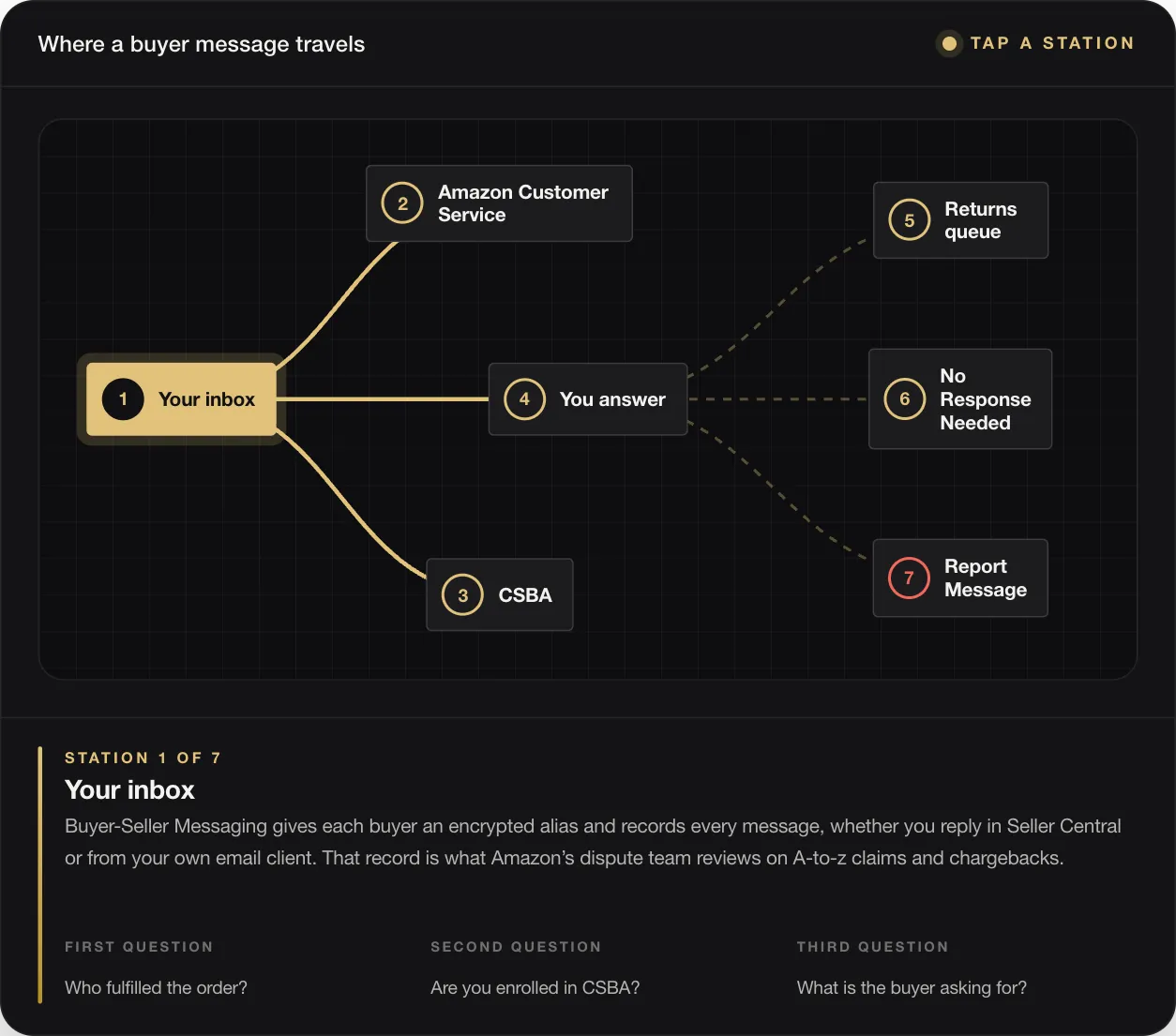
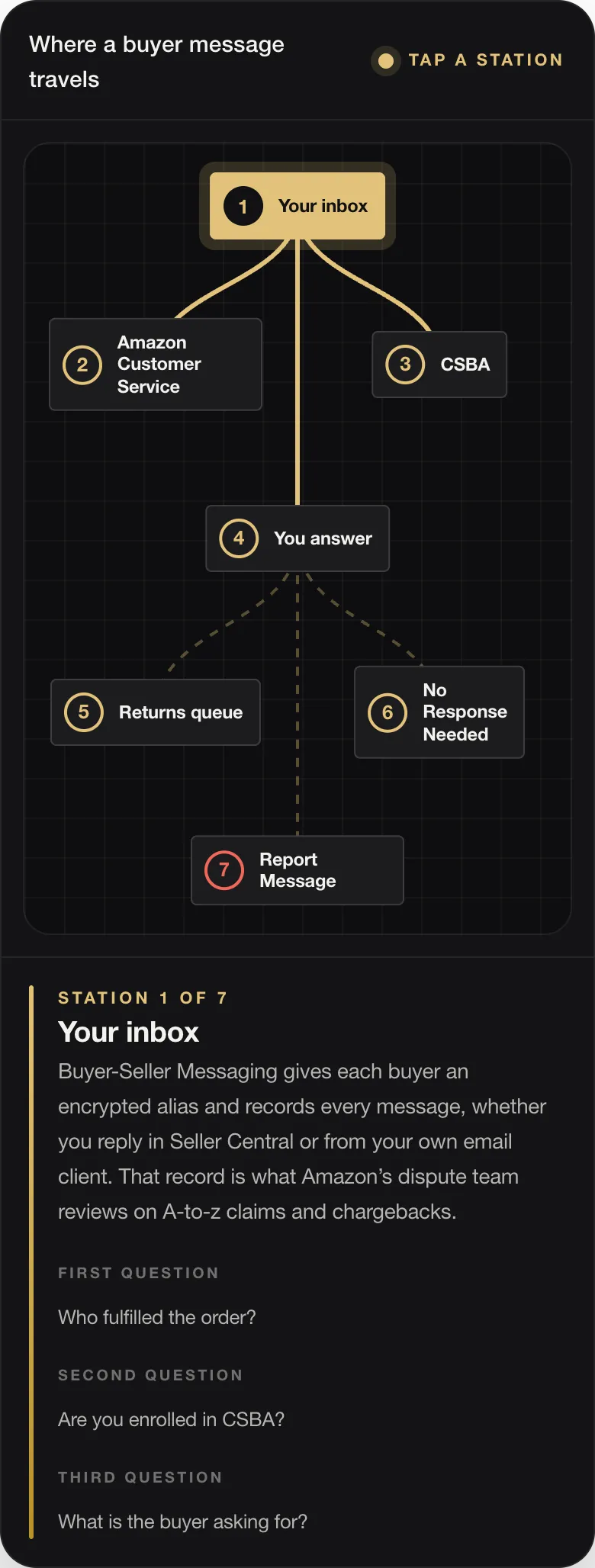
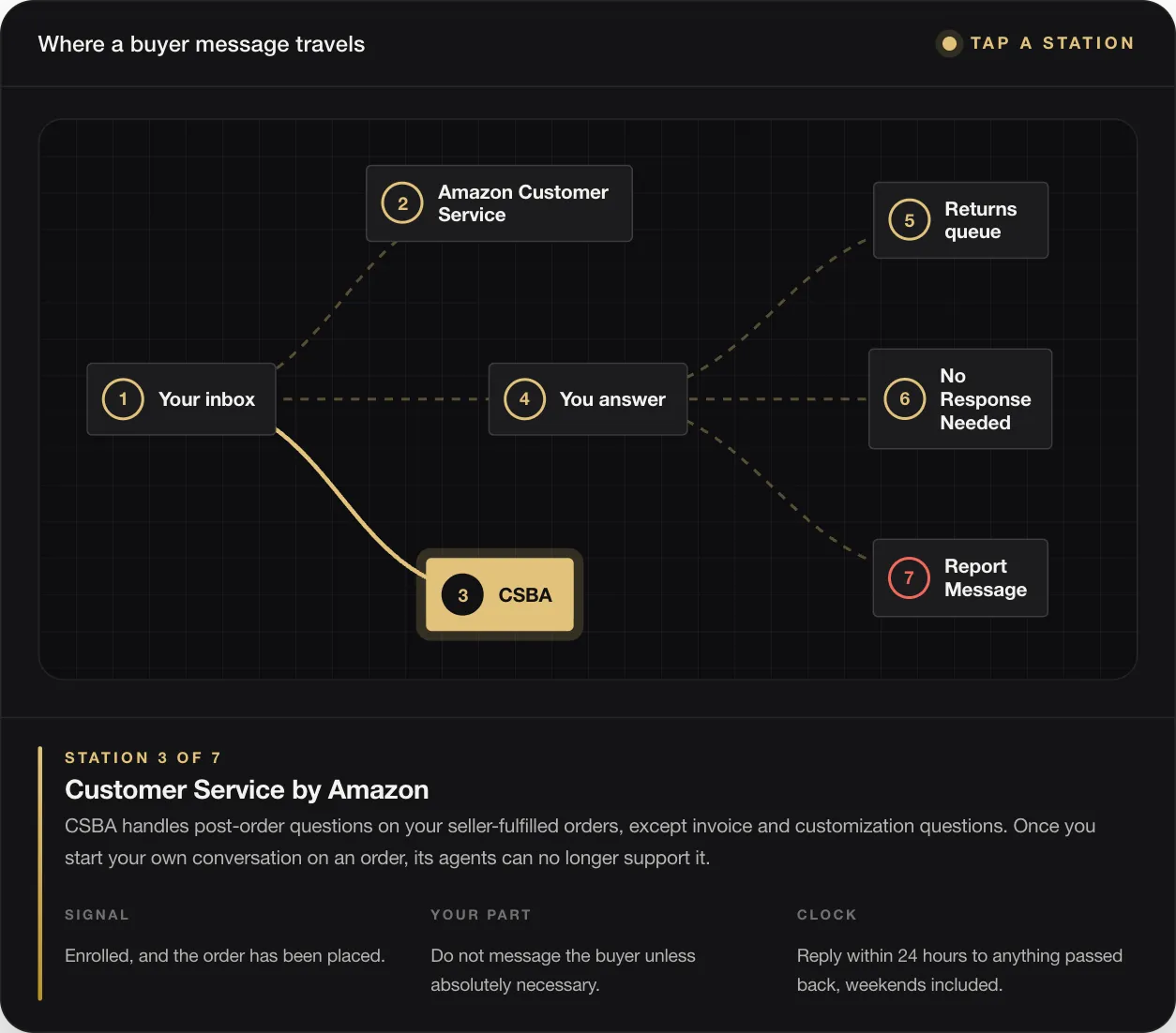
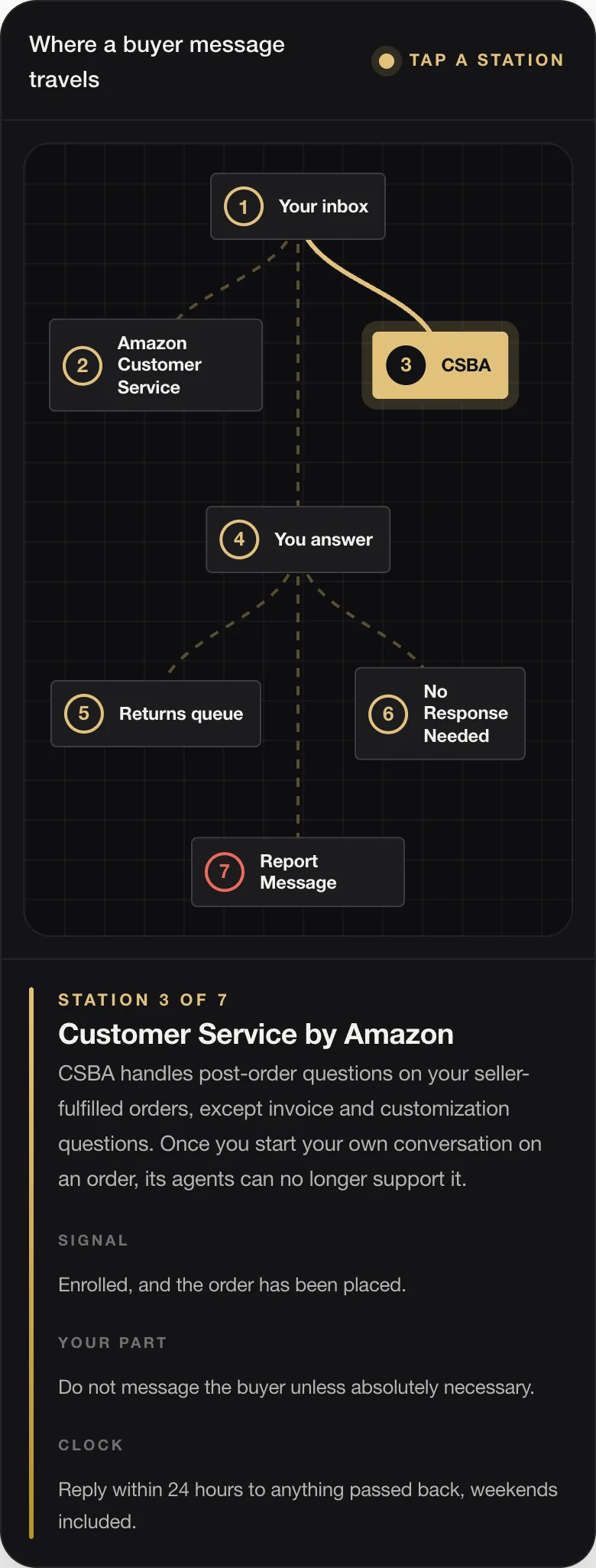
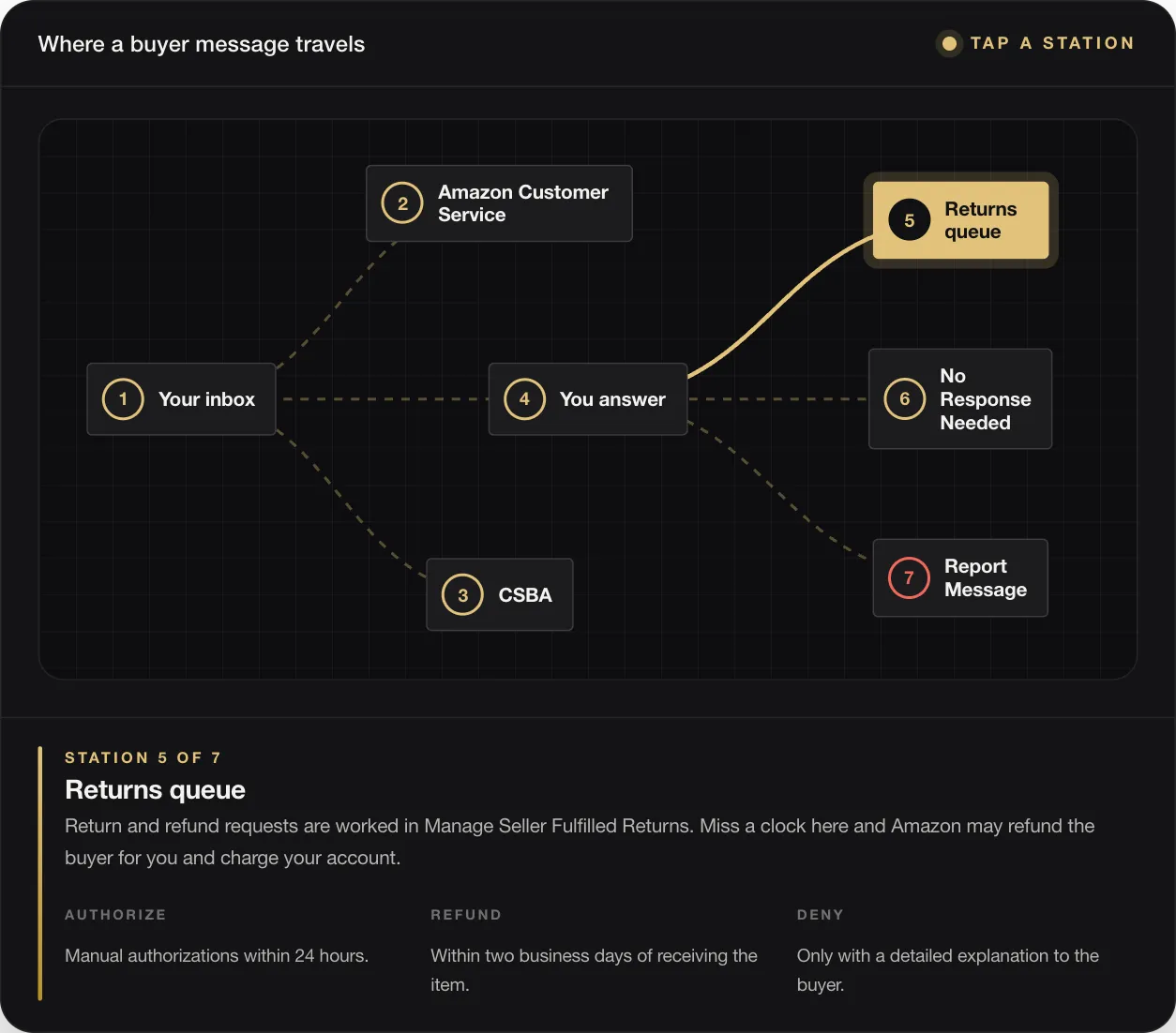
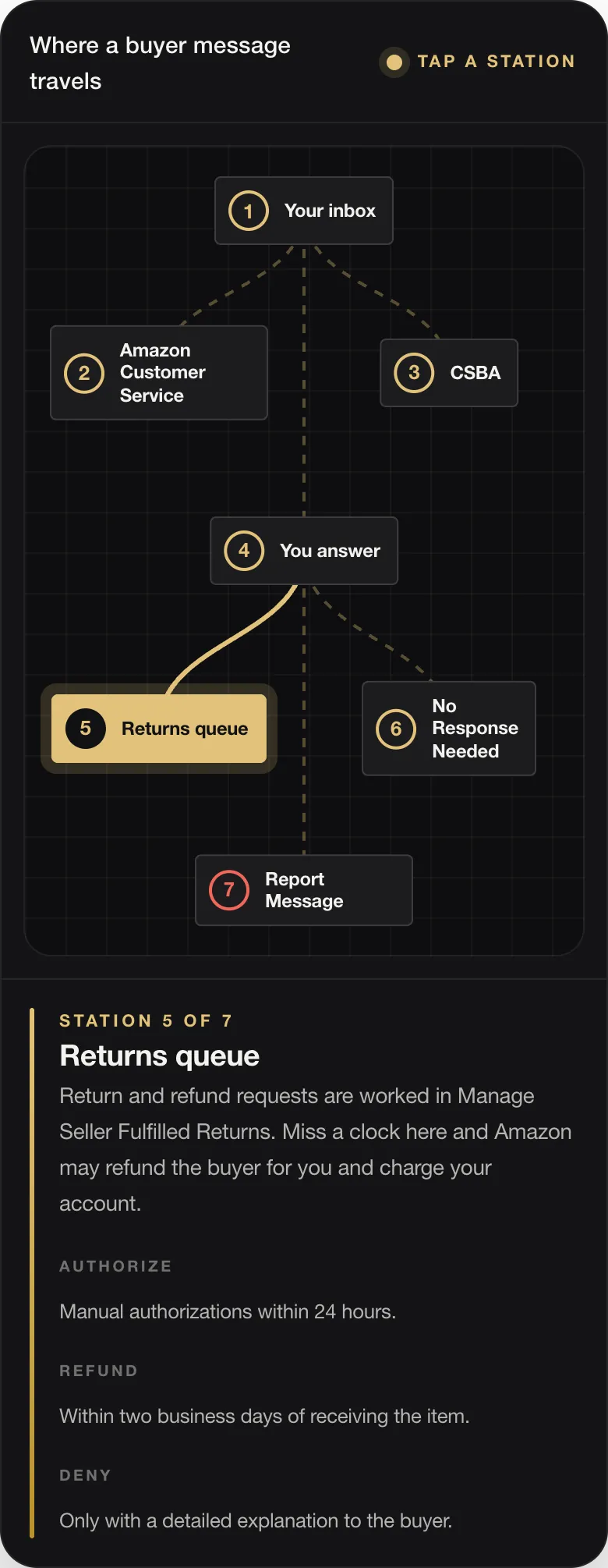
A buyer message just arrived. Where does it go?
The right handler depends on who fulfilled the order, whether you use Customer Service by Amazon and what the buyer wants. Tap a station to see its rule.
Returns, refunds and concessions on seller-fulfilled orders
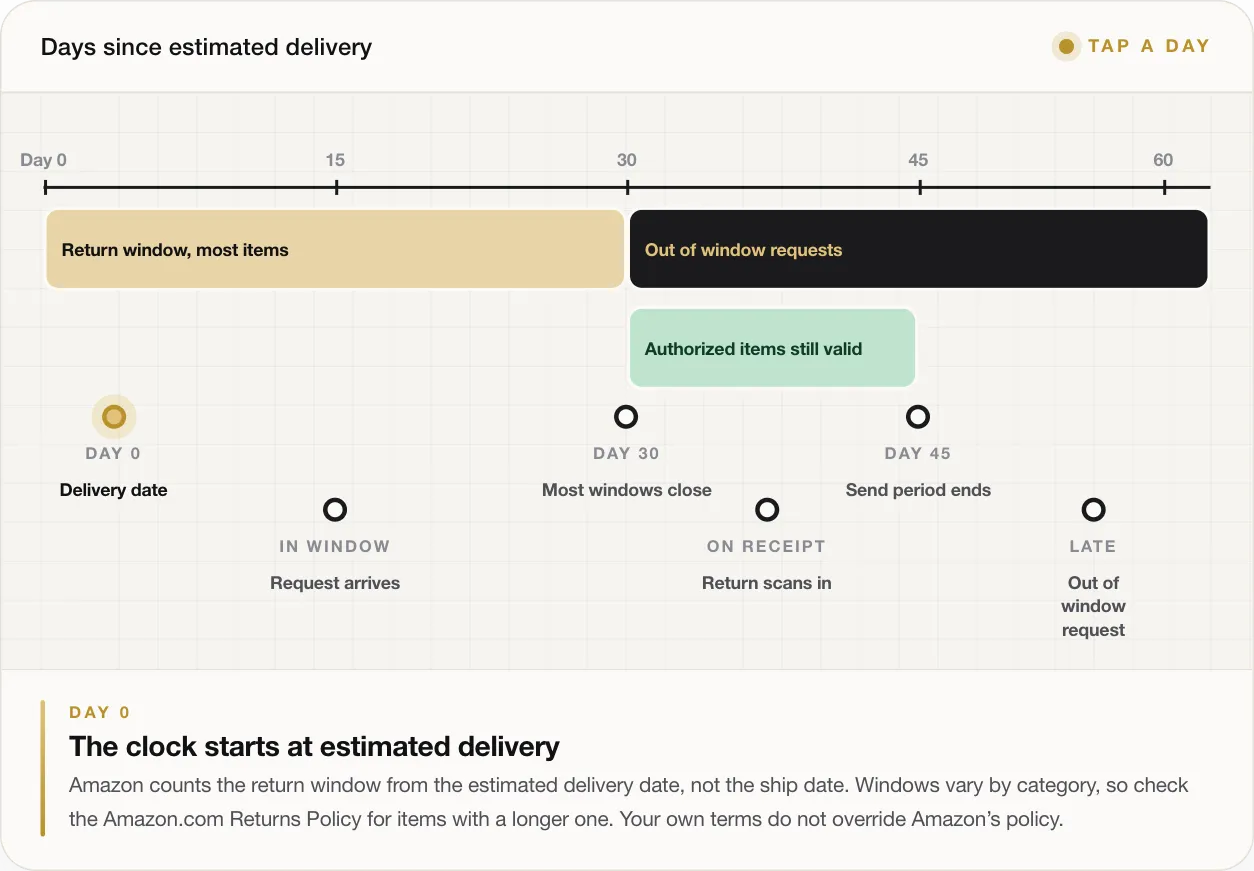
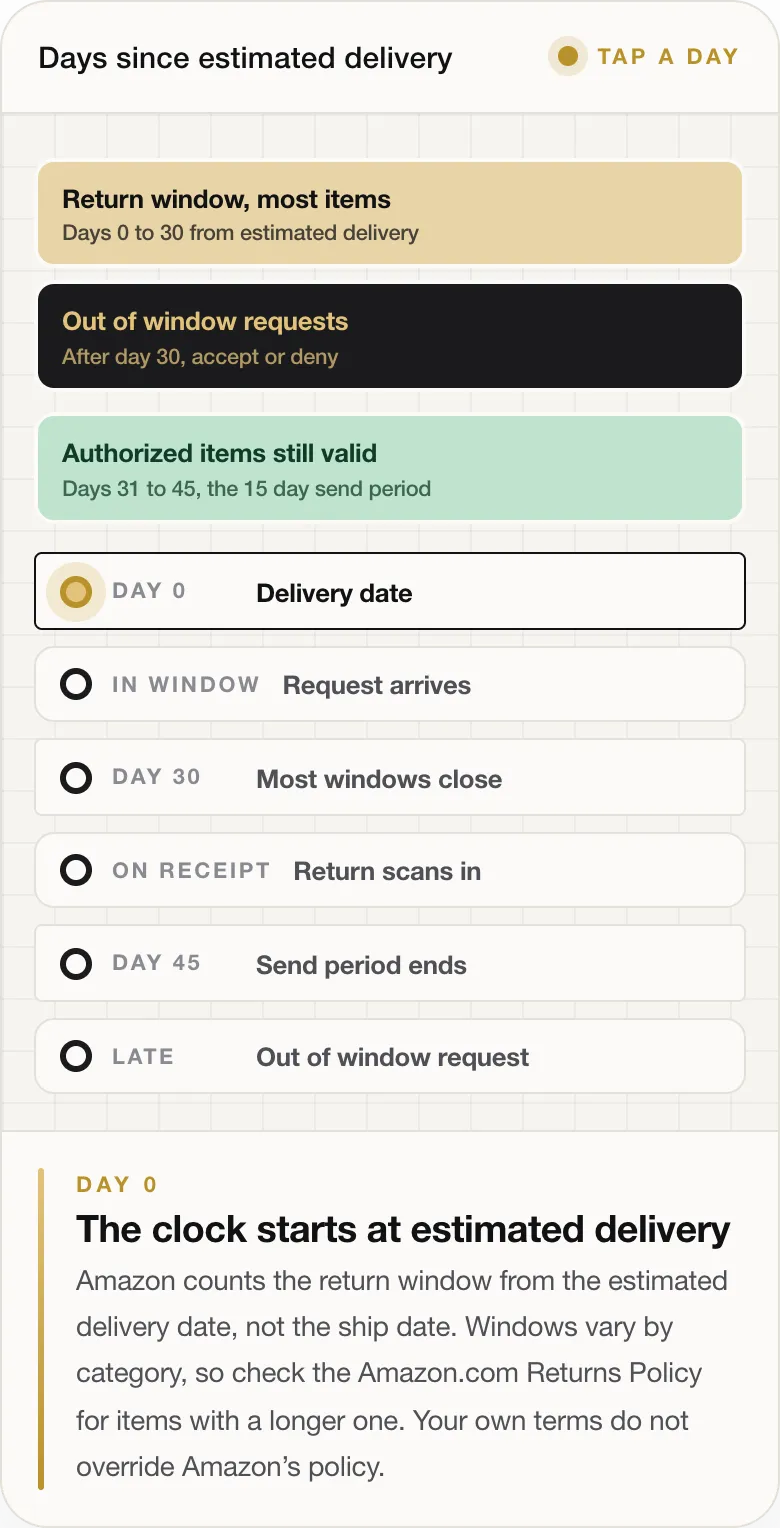
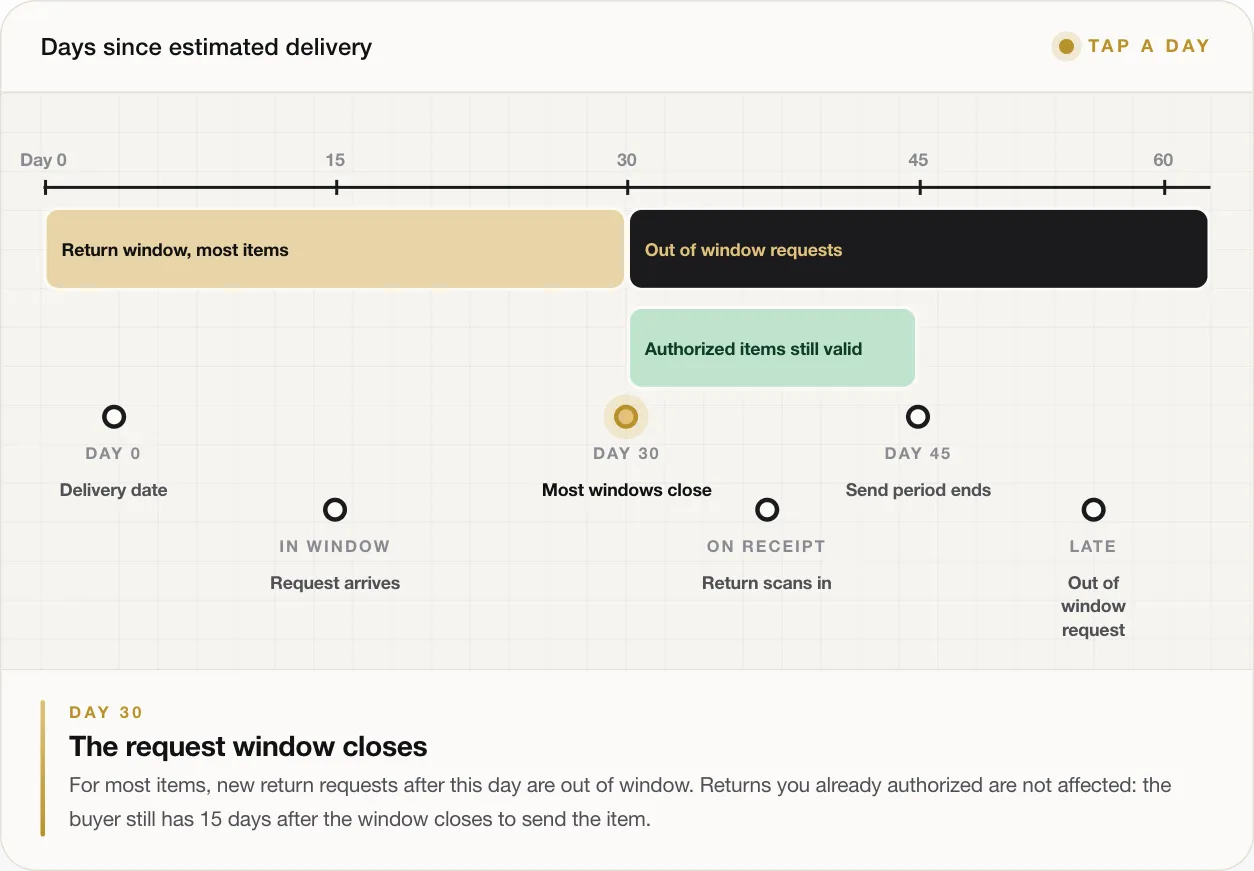
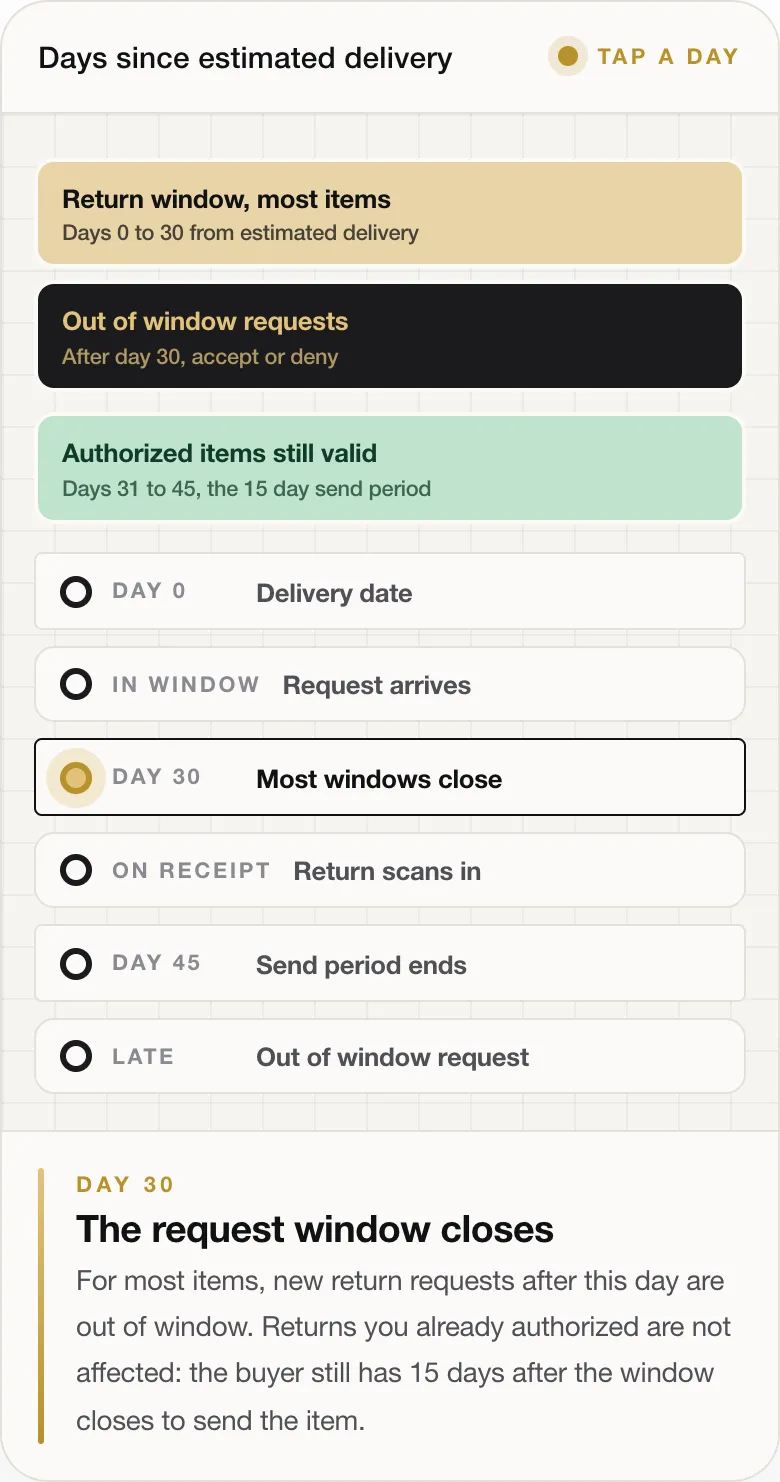
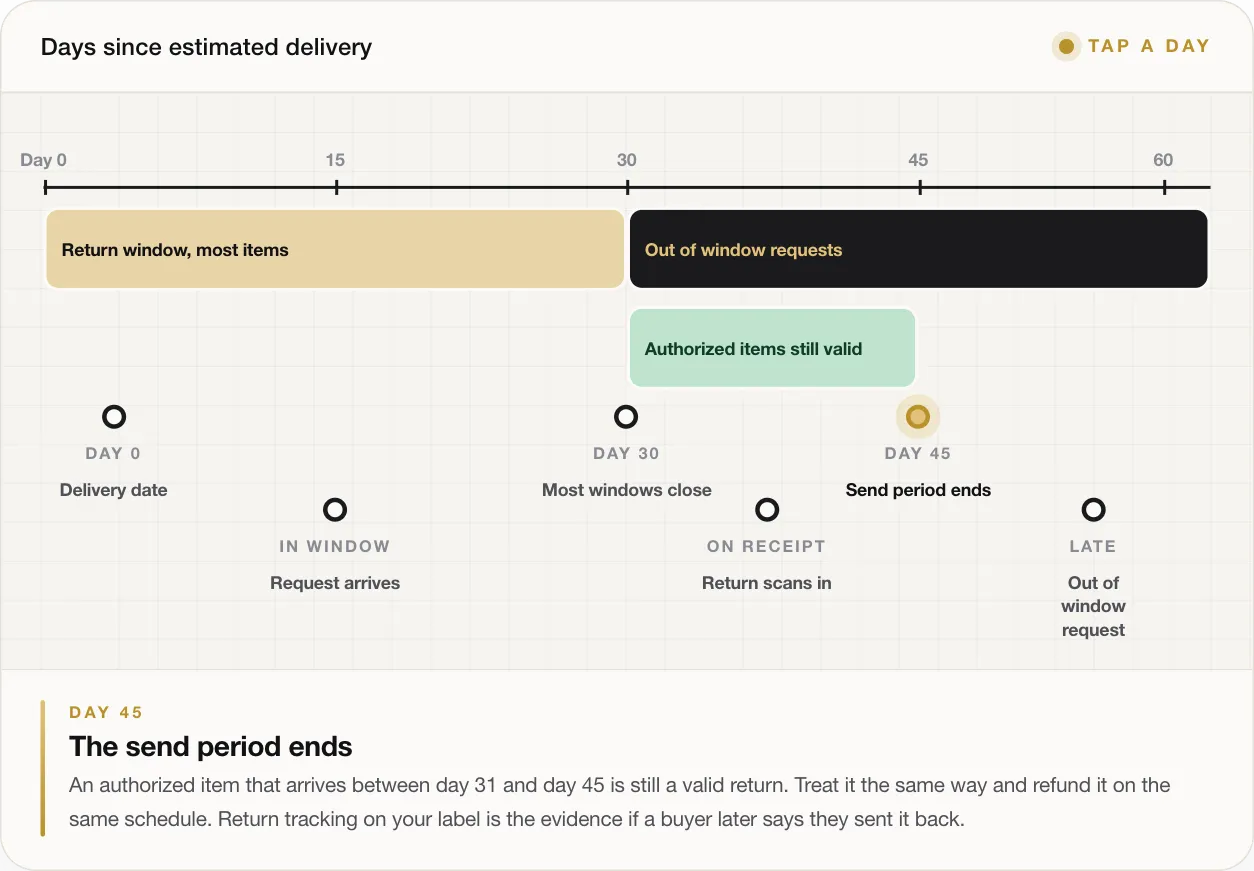
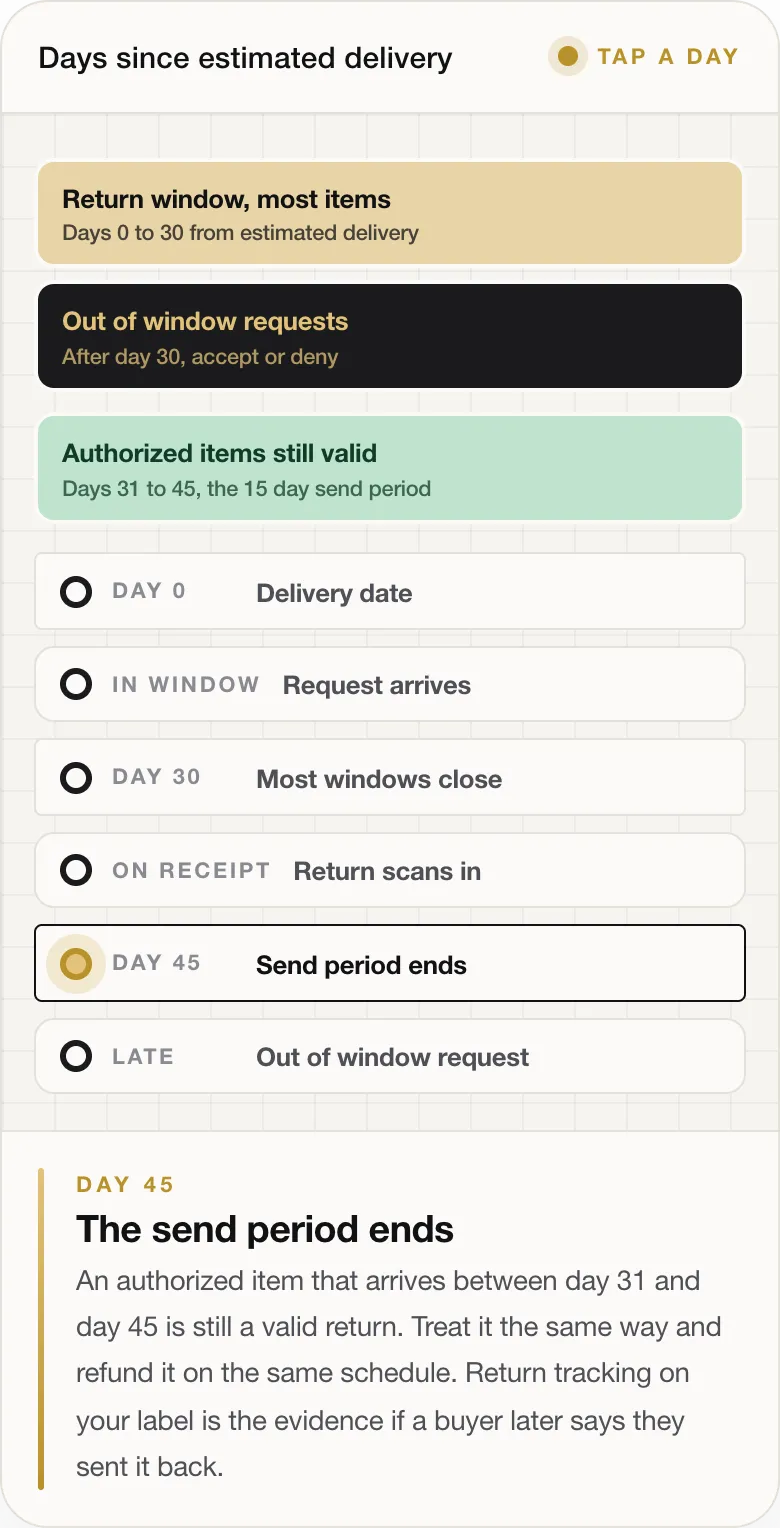
Amazon requires sellers to follow its return and refund policies regardless of their own terms. Most items can be returned within 30 days of the estimated delivery date, though windows vary by category; Amazon points sellers to the Amazon.com Returns Policy to check for longer ones.
| Event | What Amazon says | Risk if missed |
|---|---|---|
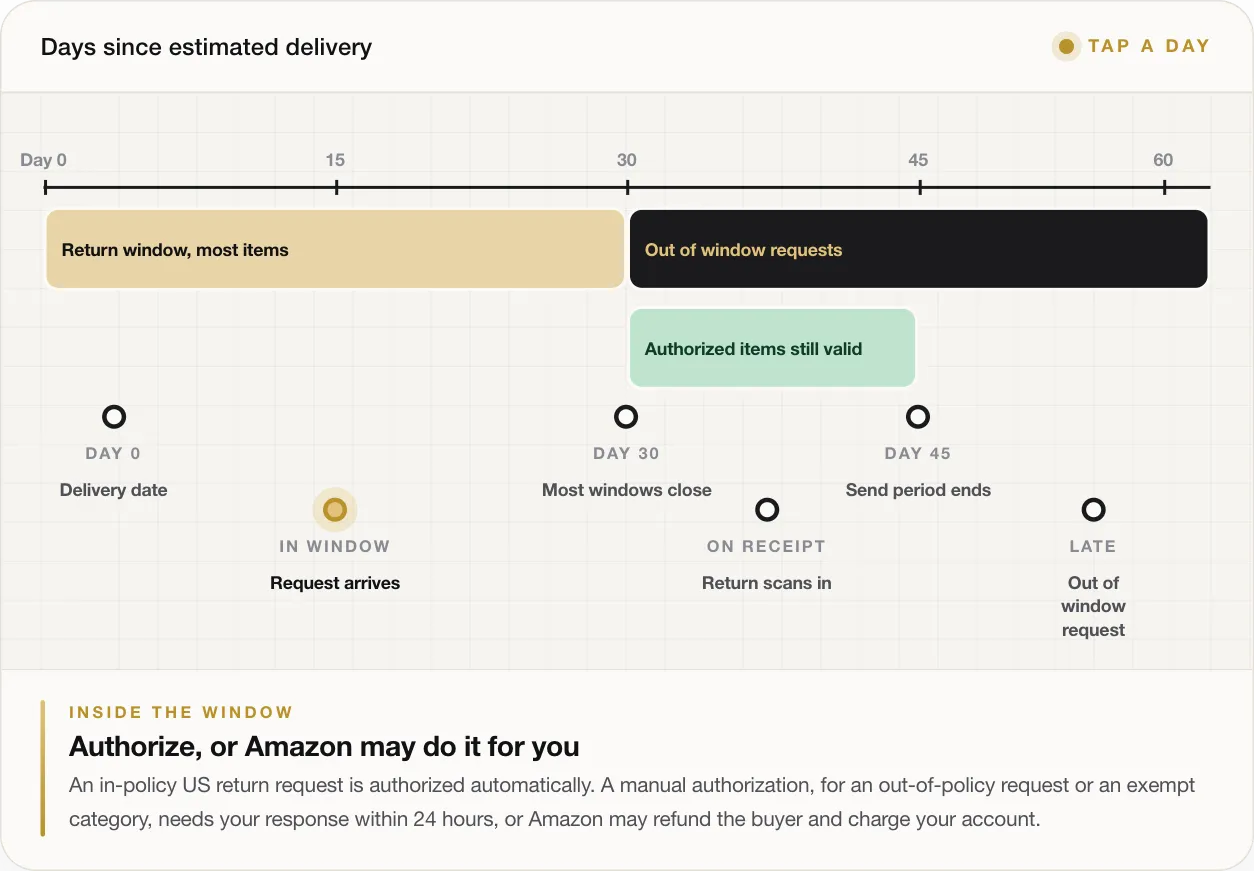
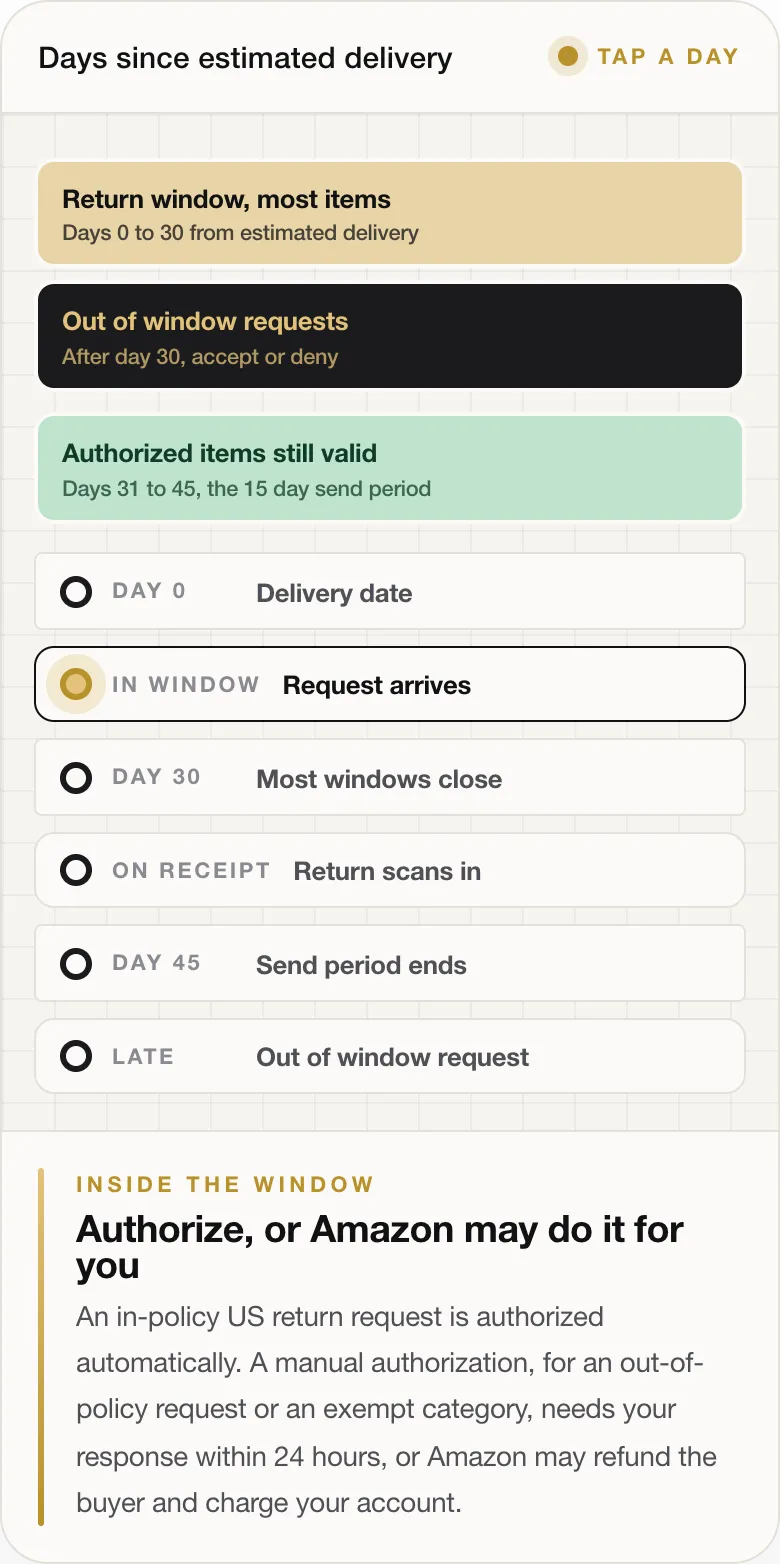
| In-policy US return request | Authorized automatically | None; receive and refund |
| Manual authorization (out of policy or exempt category) | Respond within 24 hours | Amazon may refund for you and charge your account |
| After authorization | Buyer has 15 days after the window closes to send the item | Late arrivals in that period remain valid |
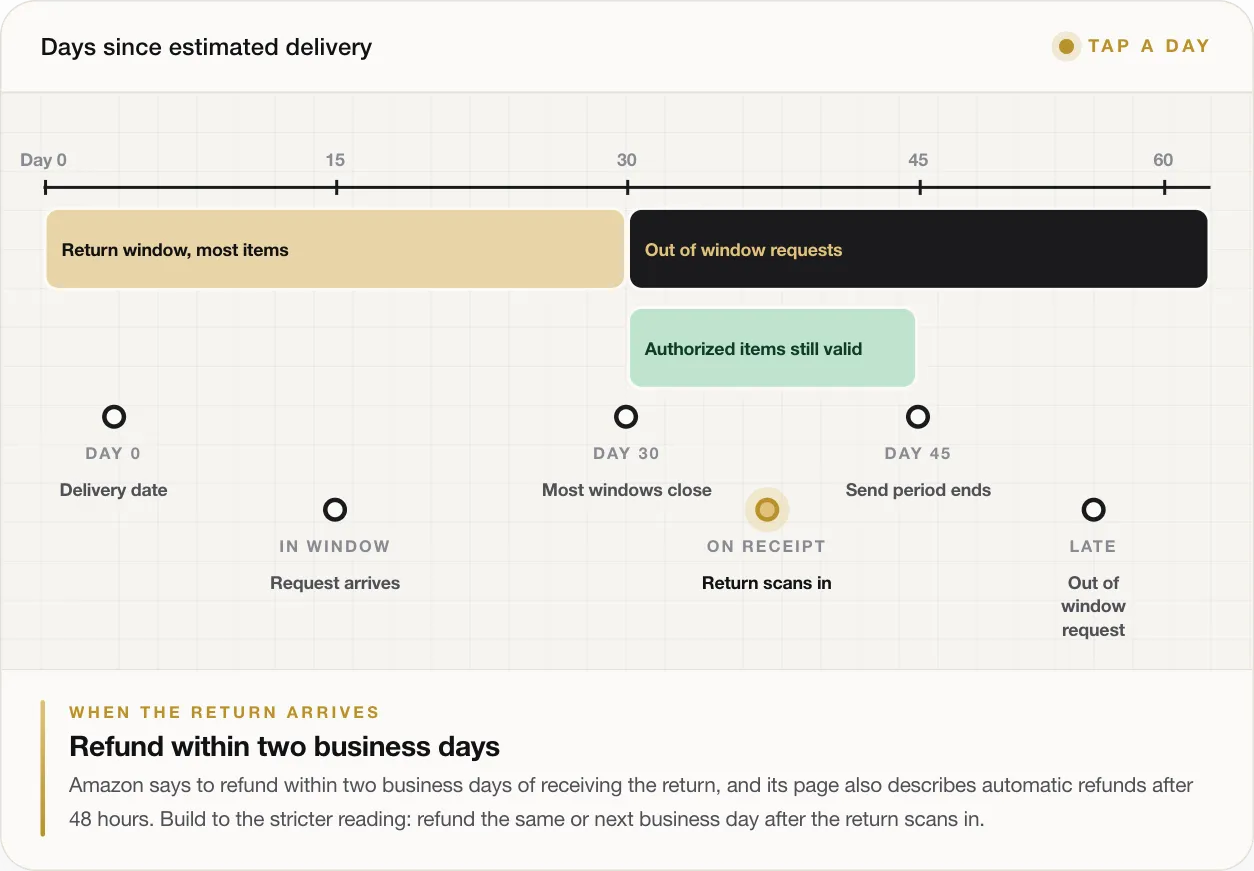
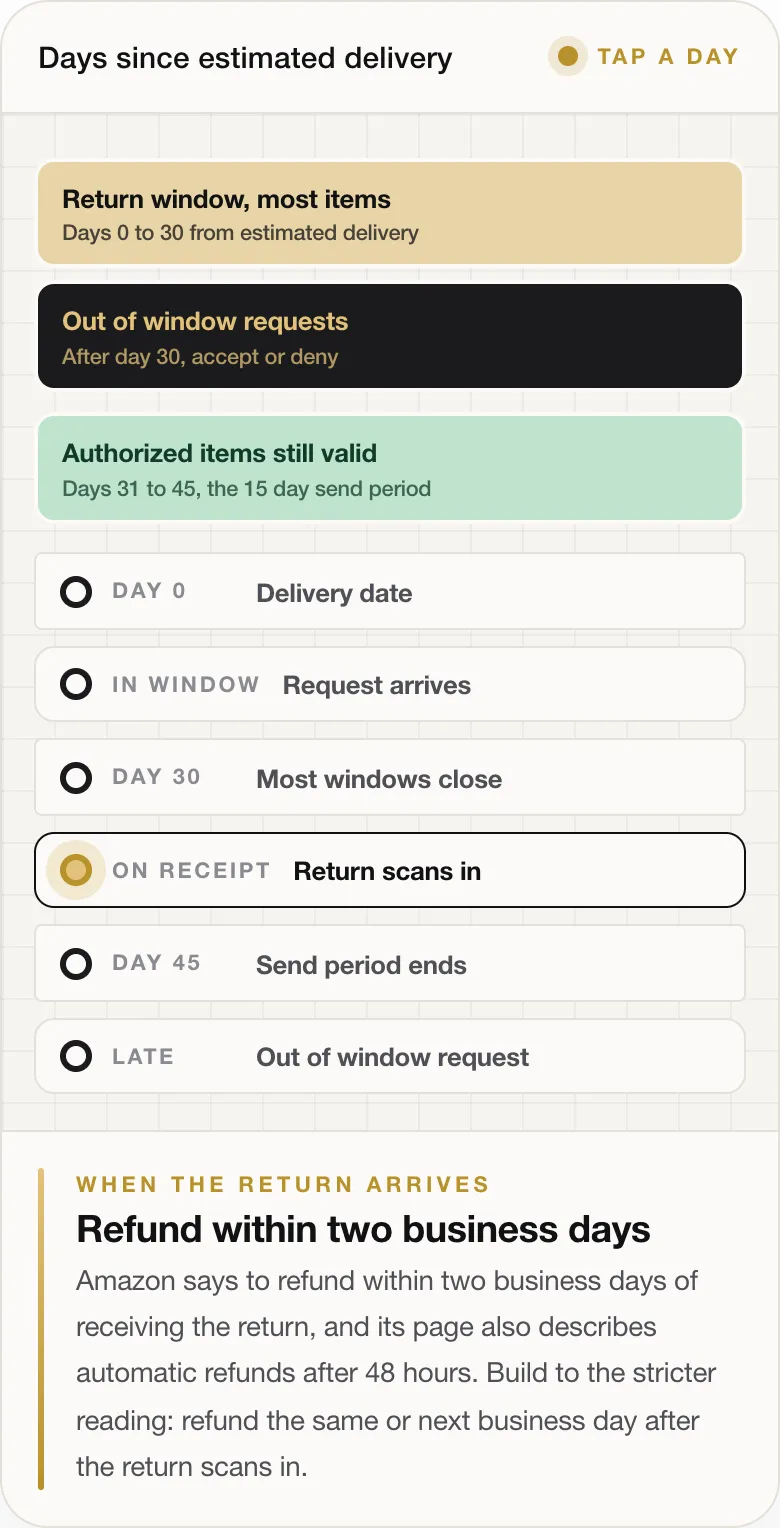
| Return received | Refund within two business days | Amazon may refund for you and charge your account |
| International return (non-US address) | Prepaid label within 2 days, a returnless refund, or a valid US return address | Buyer escalation |
| CSBA inquiry passed to you | Reply within 24 hours, weekends and holidays included | CSBA decides using its own judgment |
Amazon’s page also describes automatic refunds made because the seller did not refund within 48 hours of receiving the return. Build your process to the stricter reading and refund the same or next business day after the return scans in.
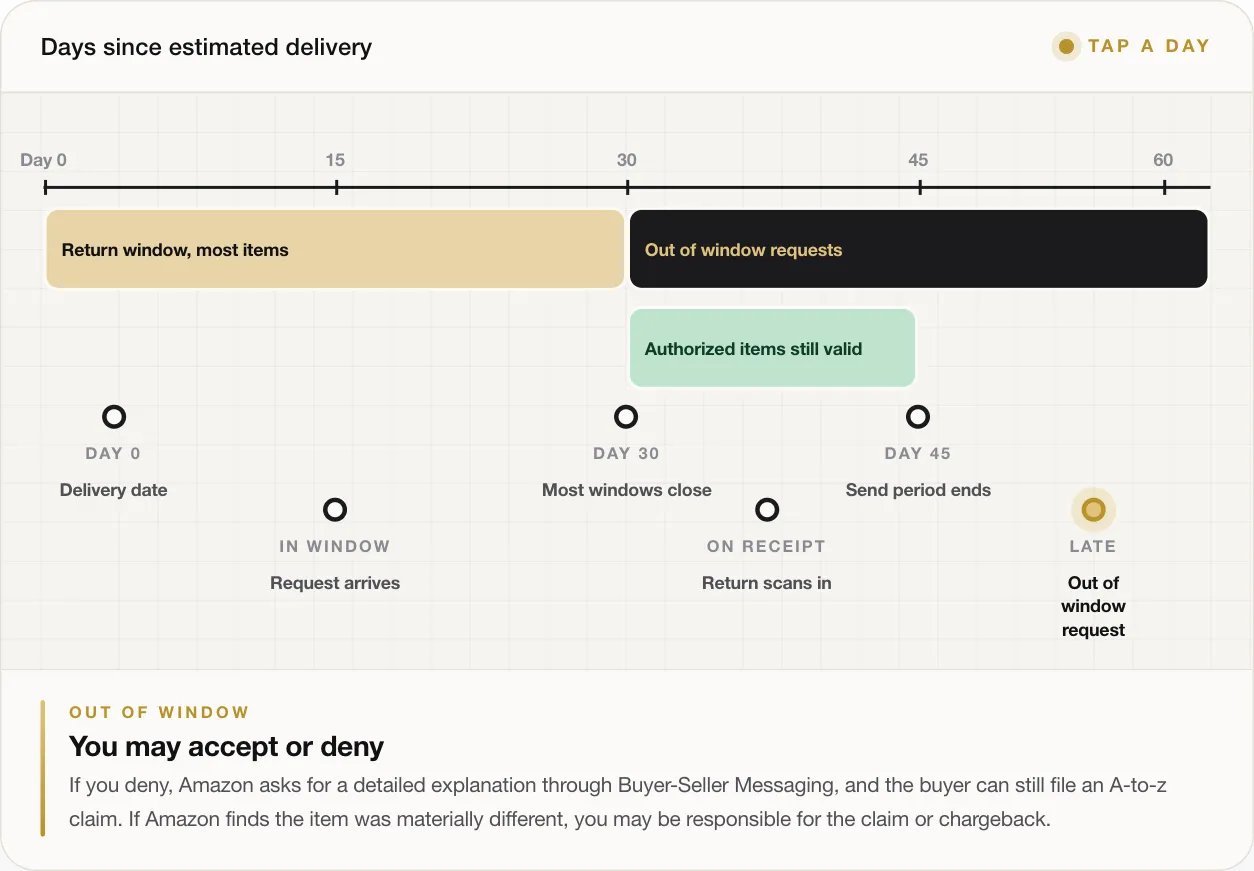
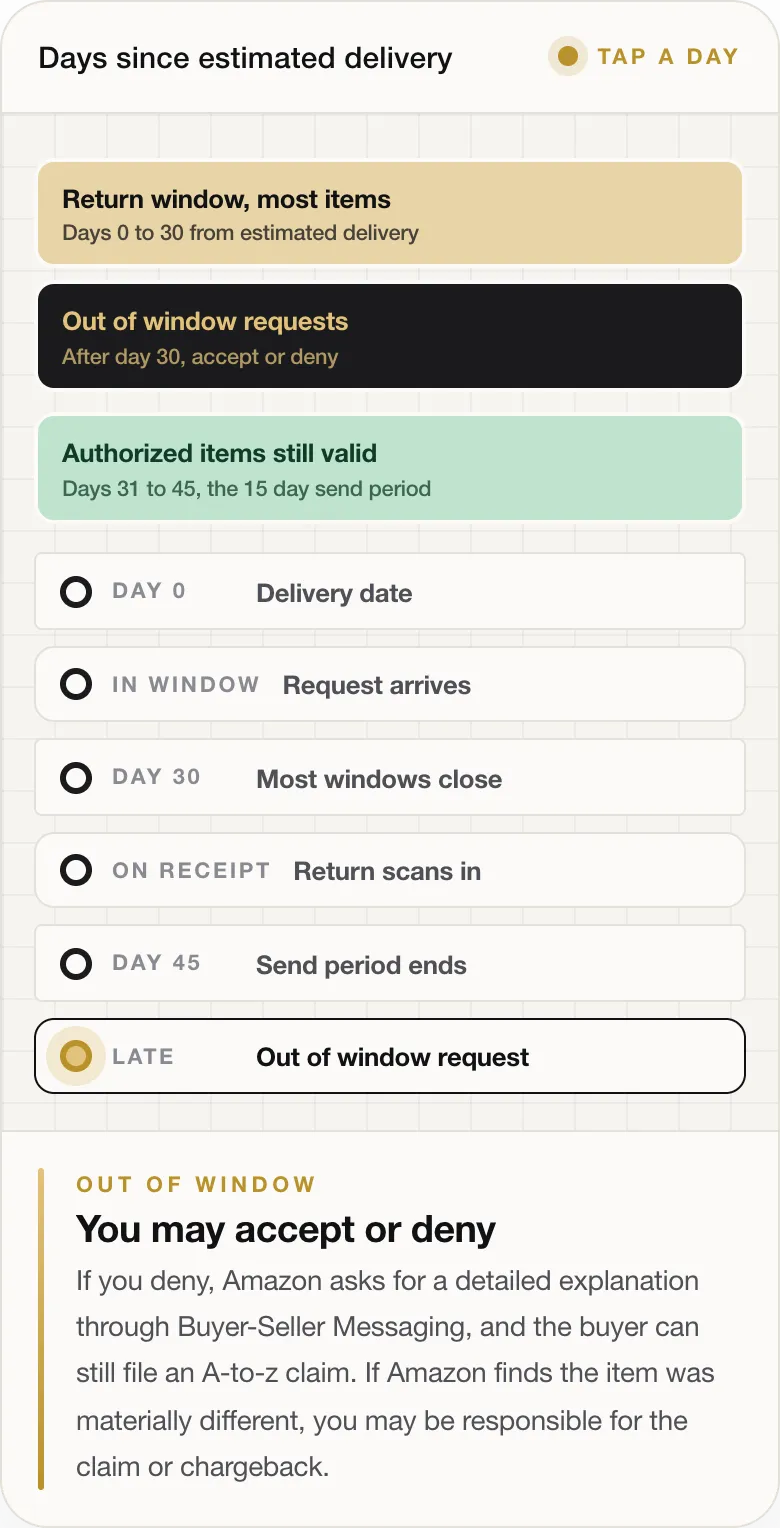
Most returns run on two clocks. Know which one is running.
Most items can be returned within 30 days of the estimated delivery date, and an authorized return then has 15 more days to be sent. Tap a day to see what Amazon expects from you at that point.
Prepaid labels and special situations
US sellers are automatically enrolled in prepaid returns for seller-fulfilled orders, with labels through Buy Shipping. You can request exemptions for certain SKUs and still provide a seller-paid label, which Amazon recommends include tracking; return tracking is your evidence if a buyer later says they sent it back. If a buyer returns the wrong item, Amazon’s guidance is to contact them, ask whether they want it back, and tell them they can return the correct item for a refund. Agree on who pays shipping first, and consider giving the benefit of the doubt if the buyer says they received the wrong item originally. If no resolution is possible, Amazon notes the option of a 100 percent restocking fee under its restocking fee guidelines.
Out-of-window requests may be accepted or denied; if you deny, Amazon asks for a detailed explanation through Buyer-Seller Messaging and reminds sellers that the buyer can still file an A-to-z claim. Amazon also warns that if you refuse a return and it determines the item was materially different, you may be responsible for any resulting claim or chargeback. A denial is defensible only if you can explain it clearly and accept that risk.
Concessions and refunds Amazon issues for you
A concession, such as a partial refund for a cosmetic flaw, is often the cheapest way to end a dispute, and Amazon provides a process for refunds and concessions on seller-fulfilled orders. Offer one to fix a real problem, never in exchange for feedback or reviews, and log the reason against the order and ASIN, because repeated concessions on one product are a signal. If Amazon refunds a buyer and you think it was unjustified, Amazon describes the routes: appeal the A-to-z claim, file a SAFE-T reimbursement claim for qualifying US domestic returns, appeal a chargeback, or use the loss or damage coverage process for carrier damage. Each needs evidence.
Preventing A-to-z claims from the inbox
Amazon’s returns page states it directly: always try to resolve issues with buyers before claims are filed. Most preventable claims fit a few patterns, each with a service control. For a package not moving, open a carrier trace and tell the buyer what you will do and by when, before they ask Amazon. For an item not as described, offer the return or replacement in the first reply, then fix the listing. For a return not refunded, refund as soon as it scans in. For no reply at all, the most avoidable cause, staff the inbox every day.
Amazon calls a valid tracking number on every shipment the best way to keep buyers from contacting customer service at all. It also says that if you buy a “claims protected” label through Buy Shipping or Veeqo, you do not need to manage SAFE-T claims for delivery-related refunds, because Amazon reimburses those automatically.
Seller feedback: removal, replies and the line you cannot cross
Every negative rating counts against you unless removed. Amazon gives you three legitimate tools: request removal of feedback that meets its criteria, resolve the problem with the buyer, and post one public reply. Amazon notes that all policies for customer product reviews also apply to seller feedback.
Feedback Amazon will remove
Amazon removes feedback that contains profanity or obscenity, hate speech, or personal information such as email addresses, full names or phone numbers; that refers to a product sold by a different seller; that refers to a product for which you are the brand owner or authorized reseller; or that is entirely a product review. In Feedback Manager, select Request review next to the order ID, choose the matching reason, add comments explaining why the feedback breaks policy, and track it under Manage Review Requests.
Triage first. Before treating negative feedback as a performance problem, test it against those criteria. “Smaller than I expected” may be a pure product review and belong in a removal request. “Took two weeks and nobody replied” does not qualify, however unfair it feels; fix the shipping and resolve with the buyer. Our article on feedback, public replies and removal has more examples.
Resolving with the buyer, within the rules
Amazon encourages contacting the buyer to resolve the problem, through Manage Orders or the Contact customer action in Feedback Manager. Buyers may remove their own feedback at their discretion within 60 calendar days of leaving it. You may not pressure or incentivize them. Amazon’s acceptable example thanks the buyer and hopes the issue is resolved; its violating example asks for deletion. The compliant message is about the buyer’s problem; the violating one is about your rating.
Posting a public reply
If the feedback stays, you can post a public response in Feedback Manager through Respond to Feedback. Amazon advises keeping it brief and professional, explaining how you corrected the problem, and not using it to talk to the buyer. It does not change your rating. You cannot edit it; you can delete it, but then cannot post another, and it disappears if the buyer removes their feedback. Write it once, in a tone a future customer would trust.
Customer Service by Amazon for seller-fulfilled orders
Customer Service by Amazon (CSBA) is a paid service in which Amazon handles post-order service for your seller-fulfilled orders by phone, instant message and email, around the clock. Amazon says new Amazon.com sellers are enrolled by default and first-time enrollees get a 90-day free trial. After that, it charges a fee per seller-fulfilled shipped unit based on contacts per unit, and says the service stays free if contacts per unit remain below 3 percent. You can opt out any time from the CSBA home page.
What CSBA covers and what stays with you
- CSBA covers post-order inquiries except invoice and product customization questions. Pre-order questions and FBA product questions stay with you in Buyer-Seller Messaging.
- When CSBA needs you, it summarizes the contact in your Response Needed inbox and expects a reply within 24 hours, including weekends and holidays; otherwise it decides on its own judgment.
- Avoid starting conversations about orders unless absolutely necessary. Amazon says once you do, its agents can no longer support that order and it becomes yours.
- Your return policy must be at least as favorable as Amazon’s. You must be a Professional seller in good standing.
- Amazon does not share CSBA conversation history with you. If you disagree with a refund, Amazon points to Selling Partner Support and SAFE-T.
- Coverage starts within an hour of opting in and does not apply to earlier orders. After opting out, new seller-fulfilled orders are yours; existing ones stay with Amazon.
The CSBA Insights dashboard shows your quarterly fee rate, a customer satisfaction score and top contact reasons. Only the primary user sees it by default; grant view access under User permissions in the Performance section. Because CSBA answers product questions from the detail page, accurate listings directly reduce how often it needs you.
CSBA takes most of the floor. Some desks stay yours.
Customer Service by Amazon answers post-order questions on seller-fulfilled orders, but not every question. Green desks are Amazon’s, amber ones hand work back to you and red ones never leave you. Tap a desk.
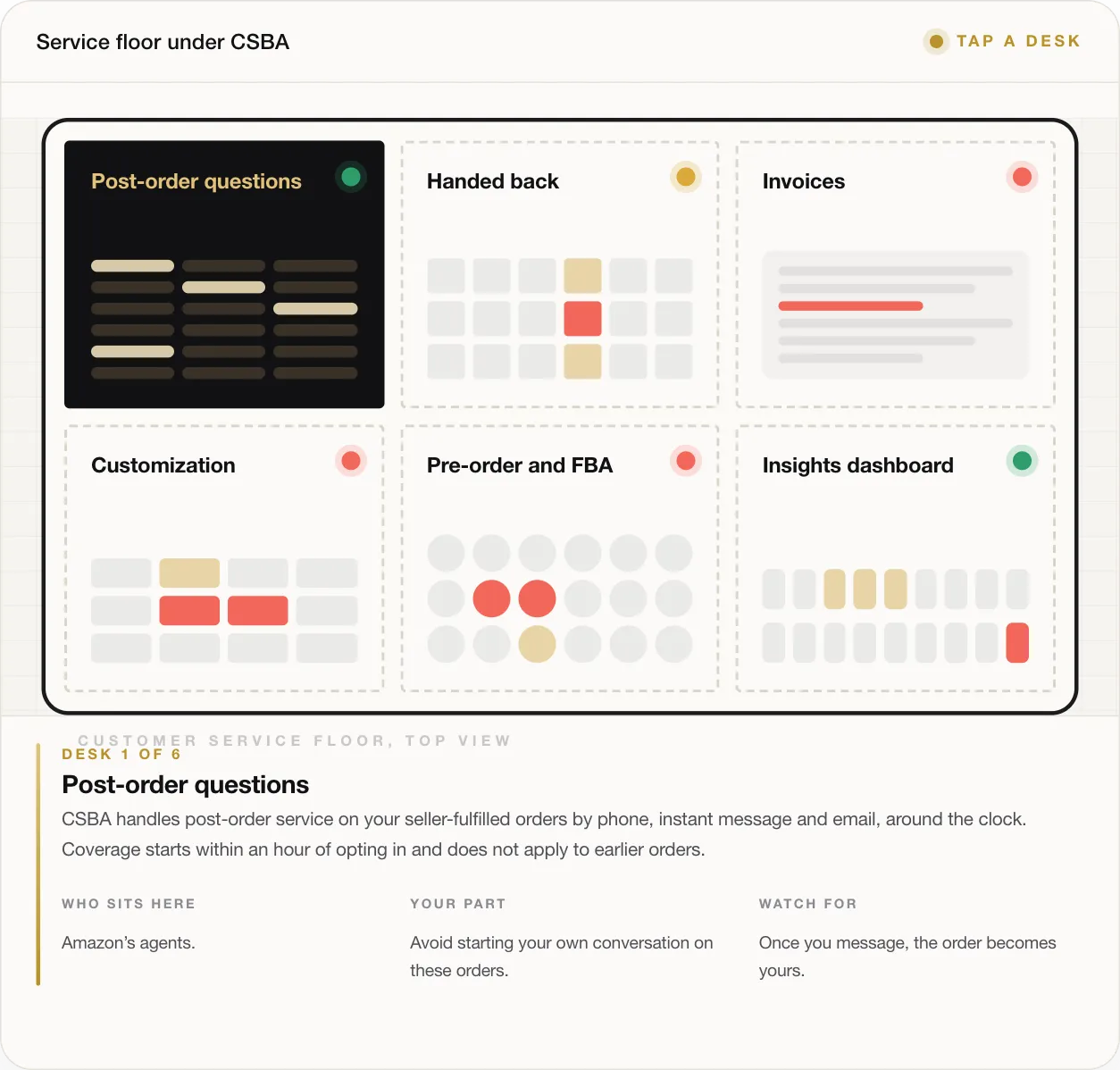
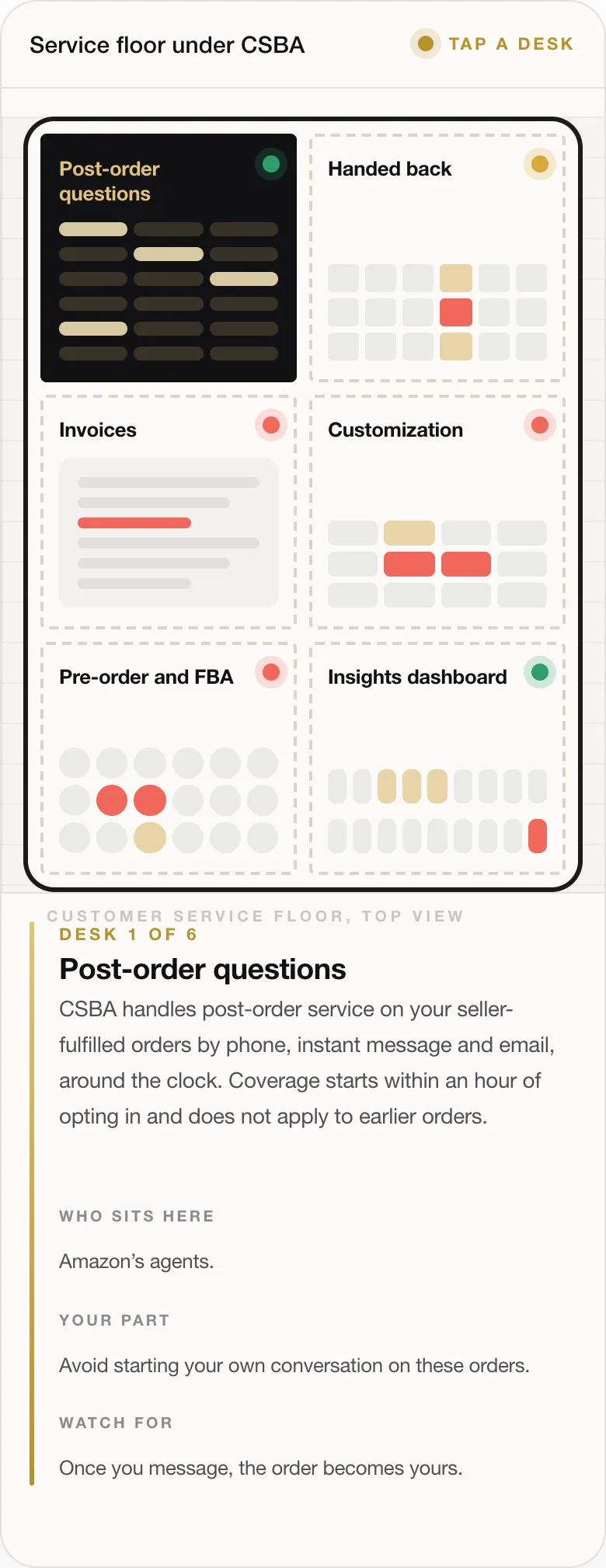
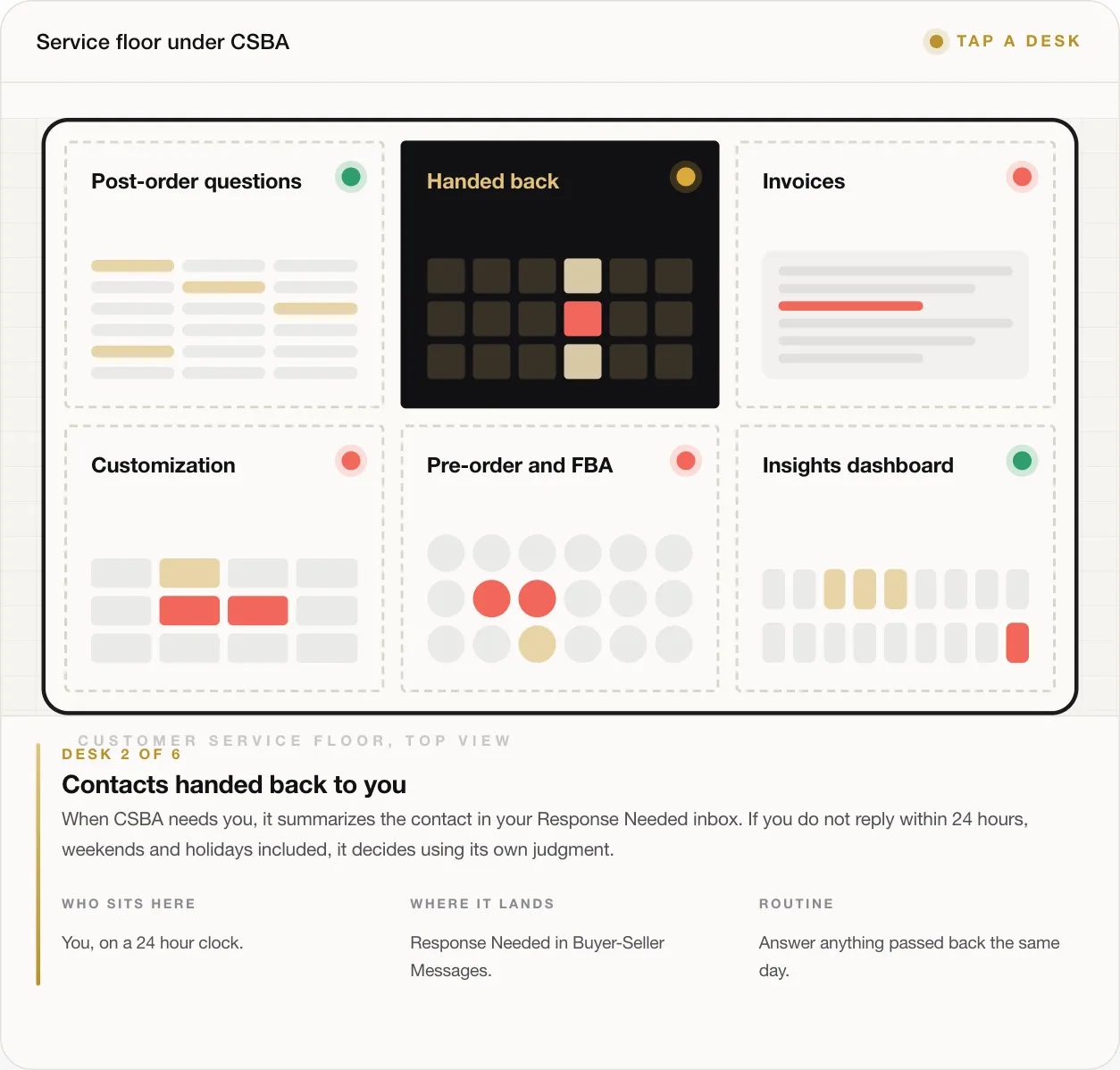
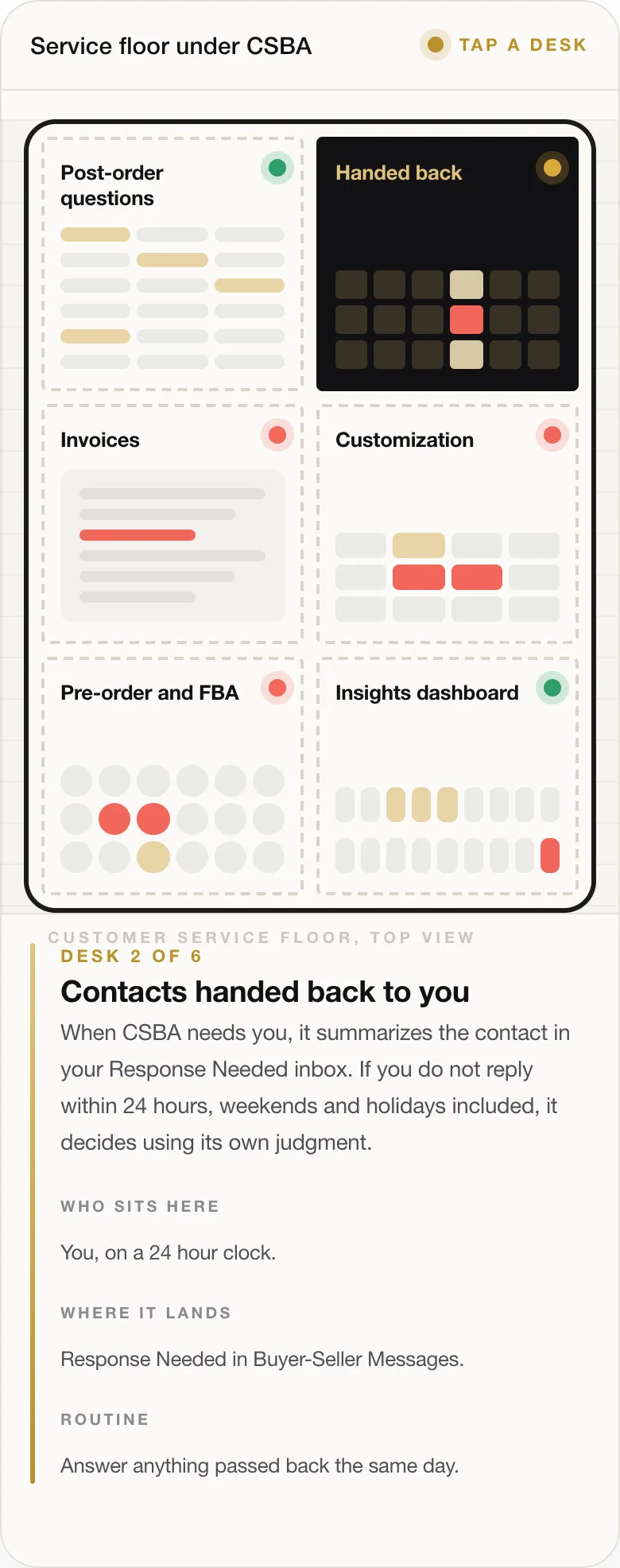
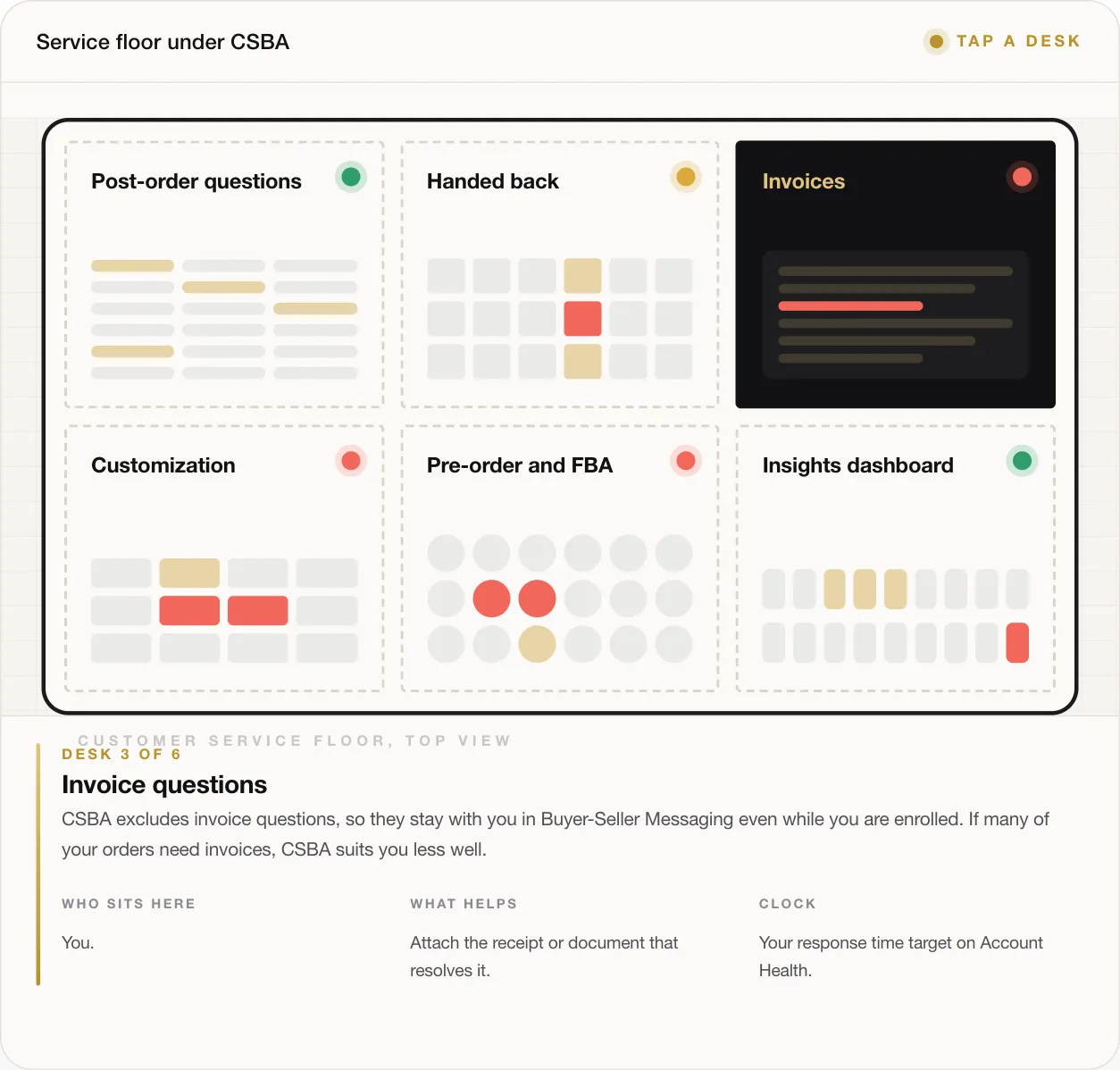
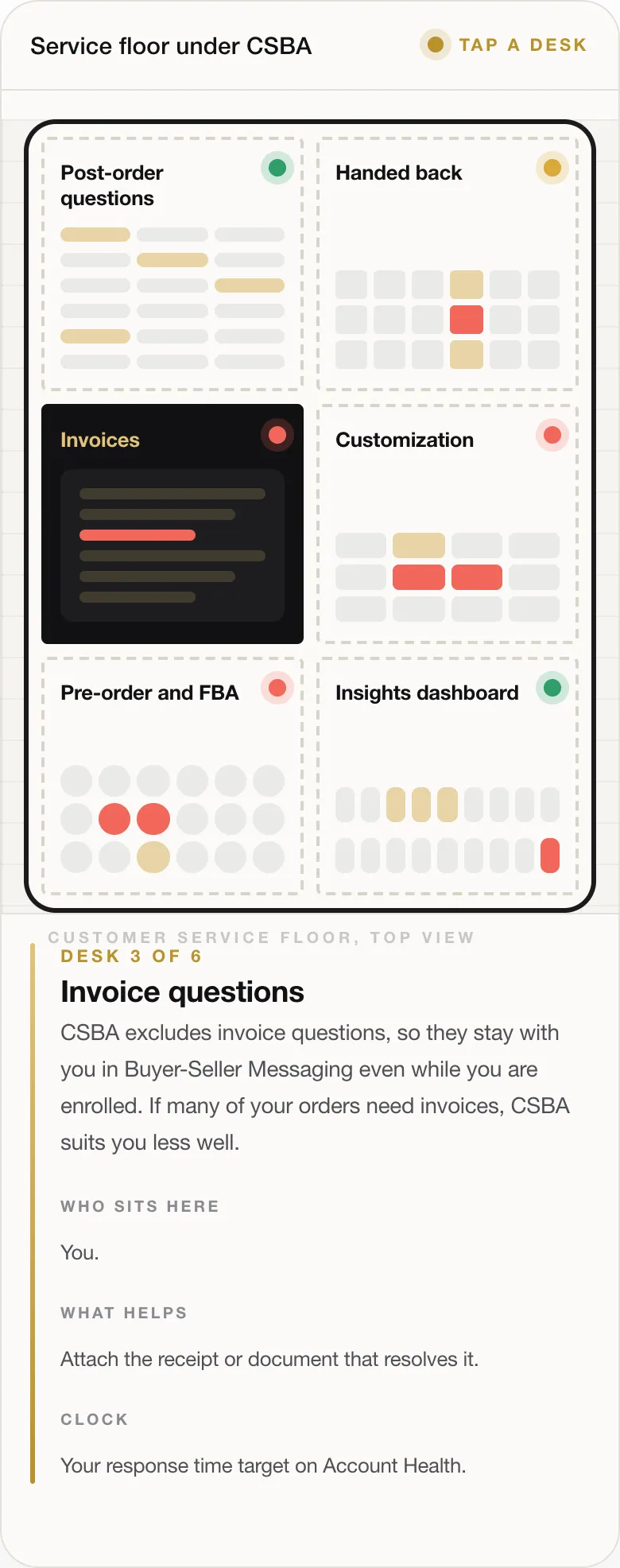
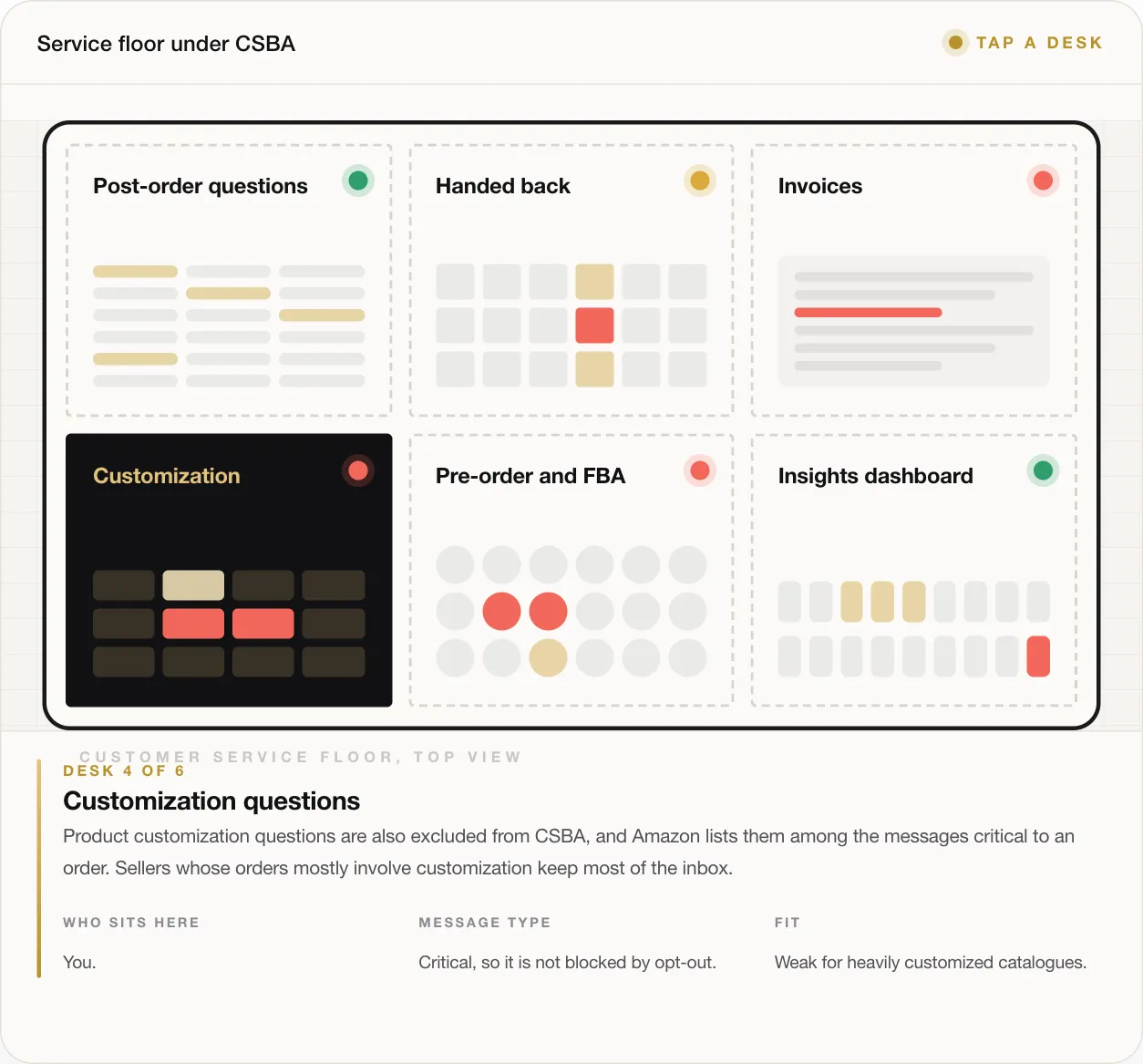
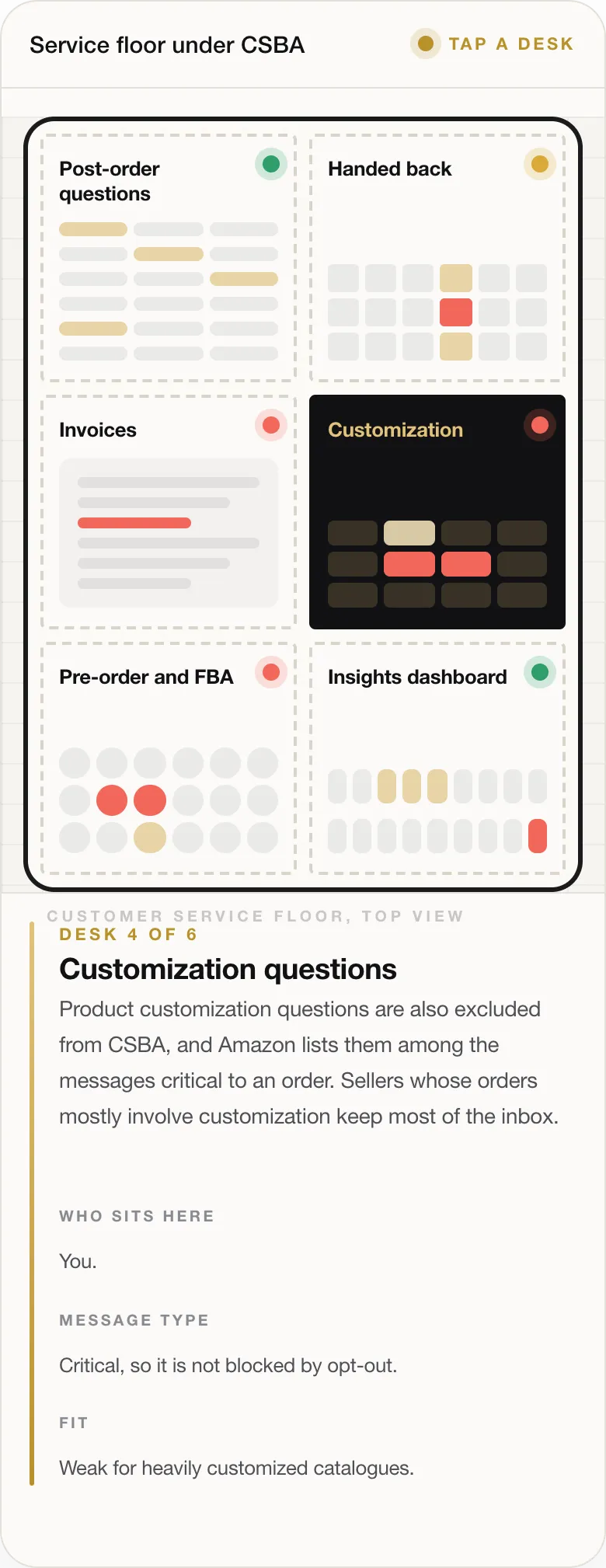

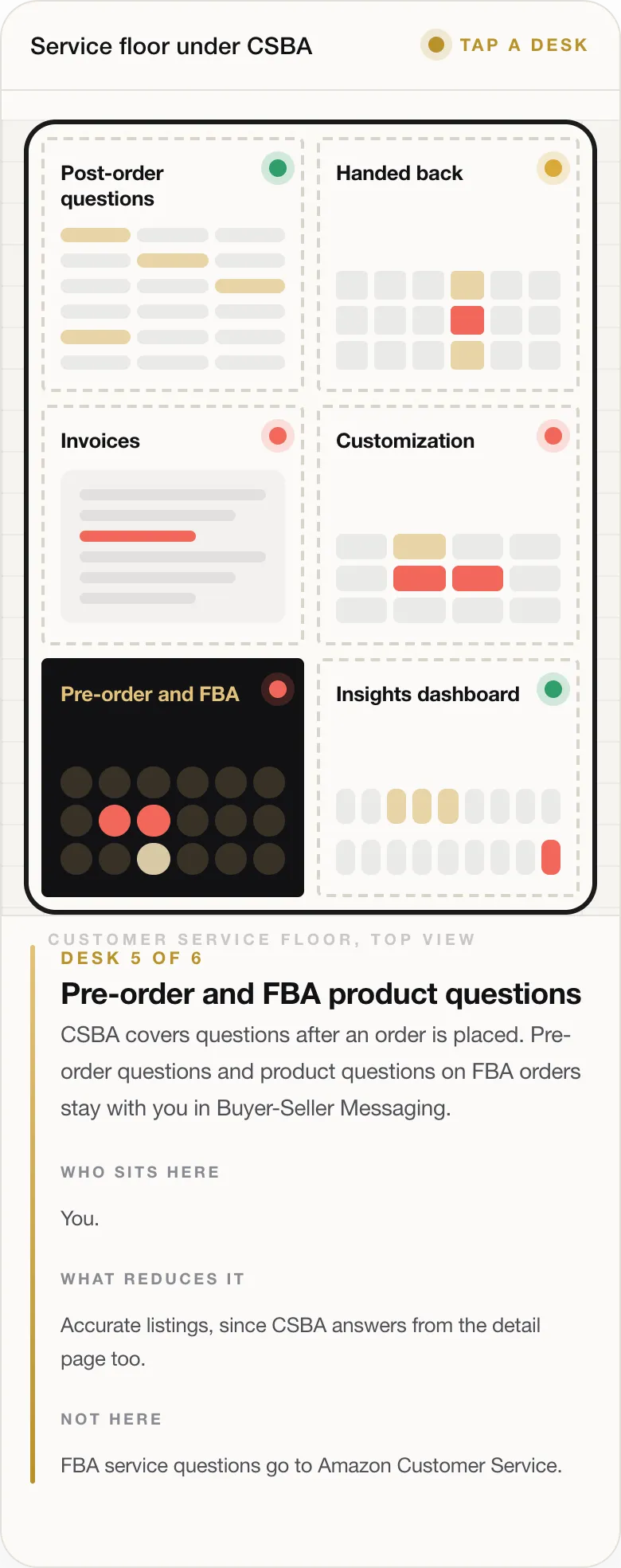
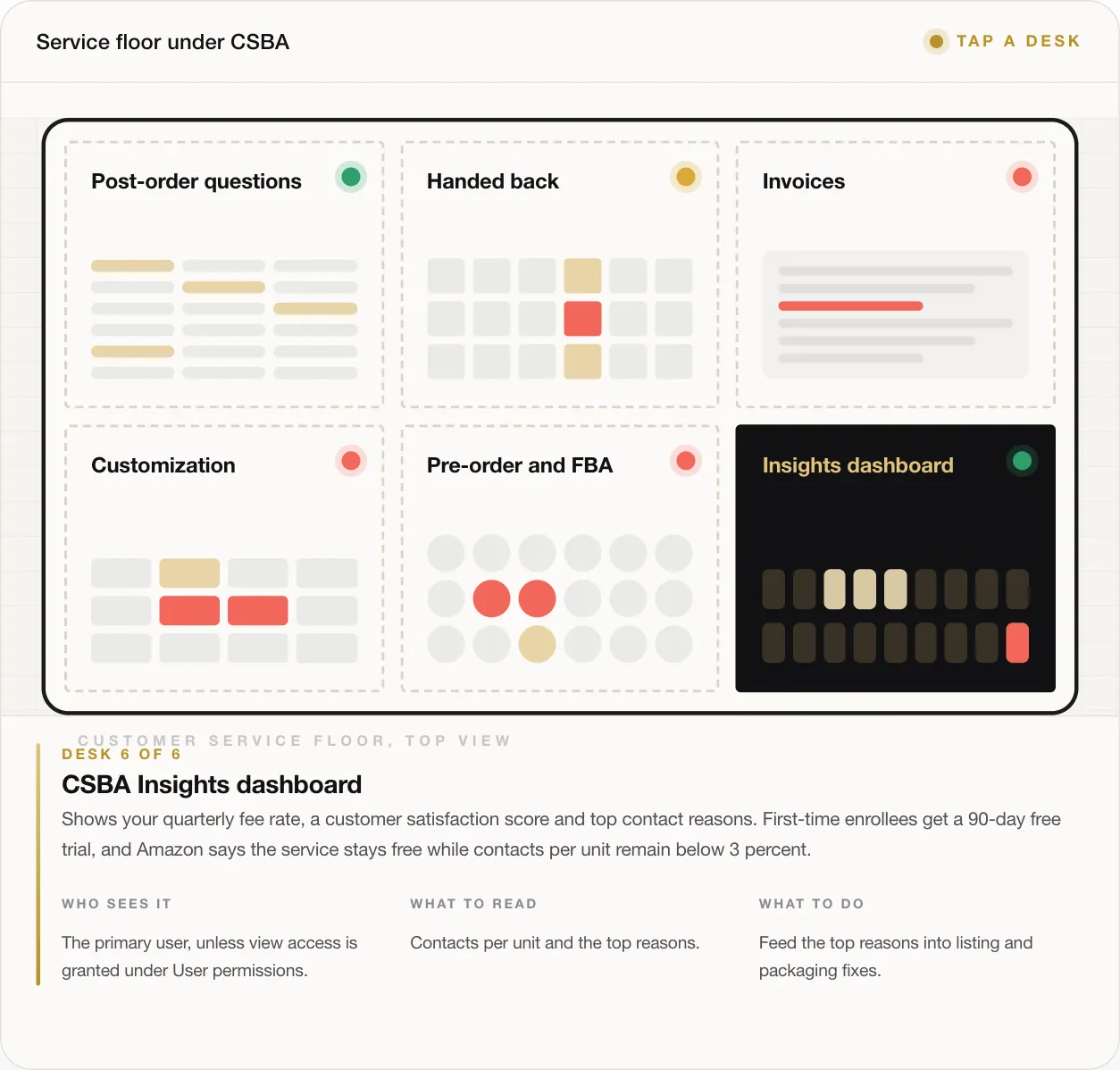
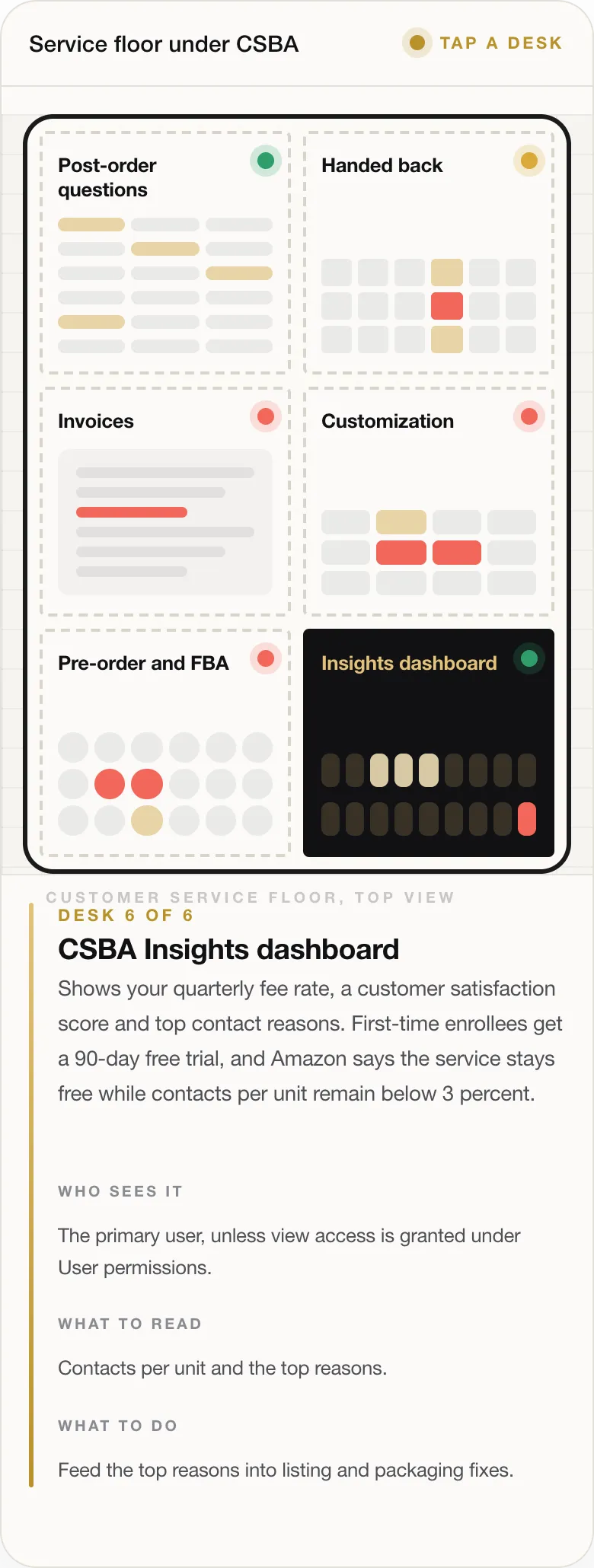
CSBA suits sellers with standard products, clear listings and reliable tracking who cannot staff an inbox seven days a week. It suits less well when many orders involve customization or invoices, which it excludes. Either way it does not replace fixing causes: a high contacts per unit figure says the same thing a rising defect rate does.
Where to verify every number and setting
Amazon changes thresholds and page layouts. Confirm every figure, including those in this article, in your own account.
| Question | Where to check | What to look for |
|---|---|---|
| Is my defect rate within target, and what drives it? | Performance, Account Health, customer service performance | Current target, your rate, and the split between feedback, A-to-z claims and chargebacks |
| What is my response time and the target? | Account Health customer satisfaction metrics | Your figure against the live target |
| Which messages still need a reply? | Buyer-Seller Messages, Response Needed filter | Oldest unanswered message; Buyer Reported Unresolved cases |
| Did my message reach the buyer? | Sent messages filter; bounce-back emails | Delivered messages and opt-out bounces |
| Who can message buyers for me? | Messaging Permissions page | Approved and blocked addresses; former staff blocked |
| Which returns need action? | Manage Seller Fulfilled Returns; Return reports | Pending authorizations; received but unrefunded returns |
| Which feedback qualifies for removal? | Feedback Manager; Manage Review Requests | Comments matching removal criteria; request status |
| Am I in CSBA and what does it cost? | CSBA home page and Insights dashboard | Enrollment, contacts per unit, fee rate, top contact reasons |
Defect rate climbing or a notice already in?
Send us the notice and we will read the case before you pay anything.
When service failures become a performance notice
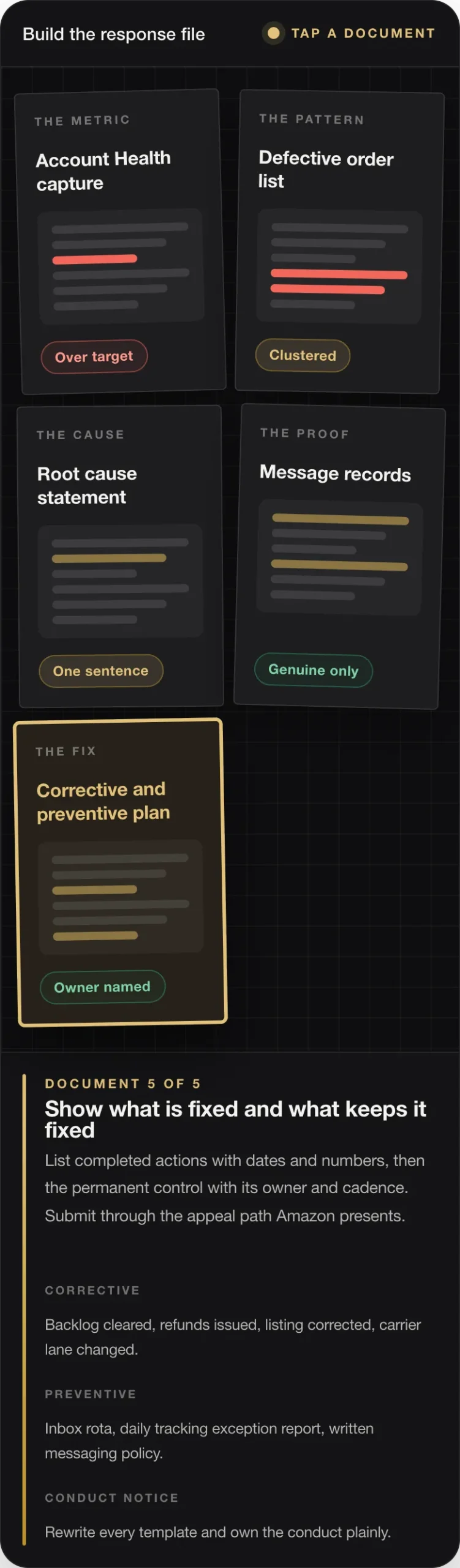
If your defect rate has crossed the target or you have a warning, the response follows one method, whether the cause is fulfillment, product, listing or service. Amazon wants to see that you understood the pattern, fixed it, and installed a control that would catch it again.
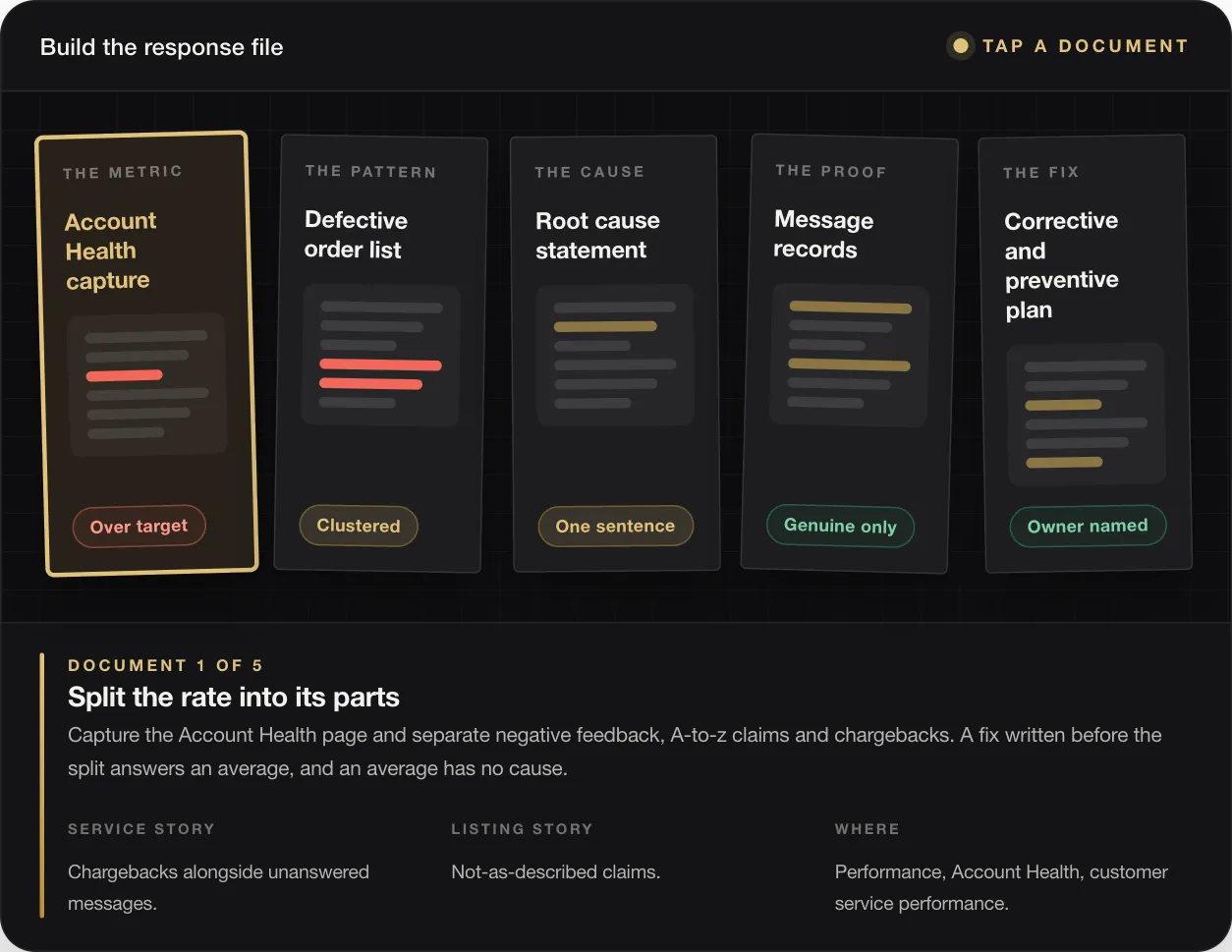
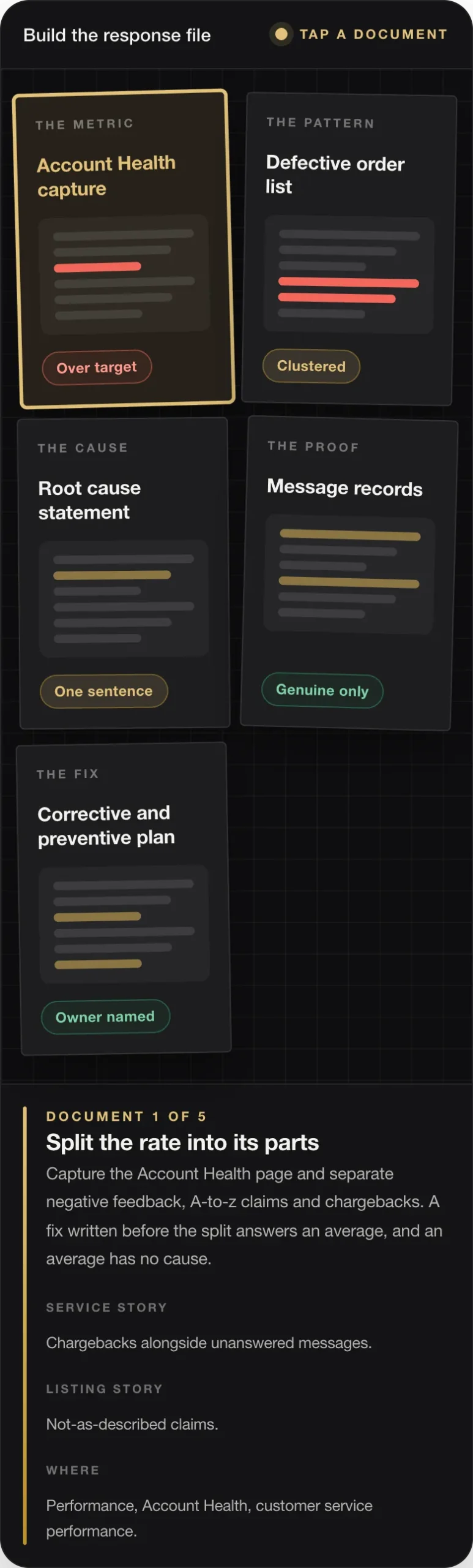
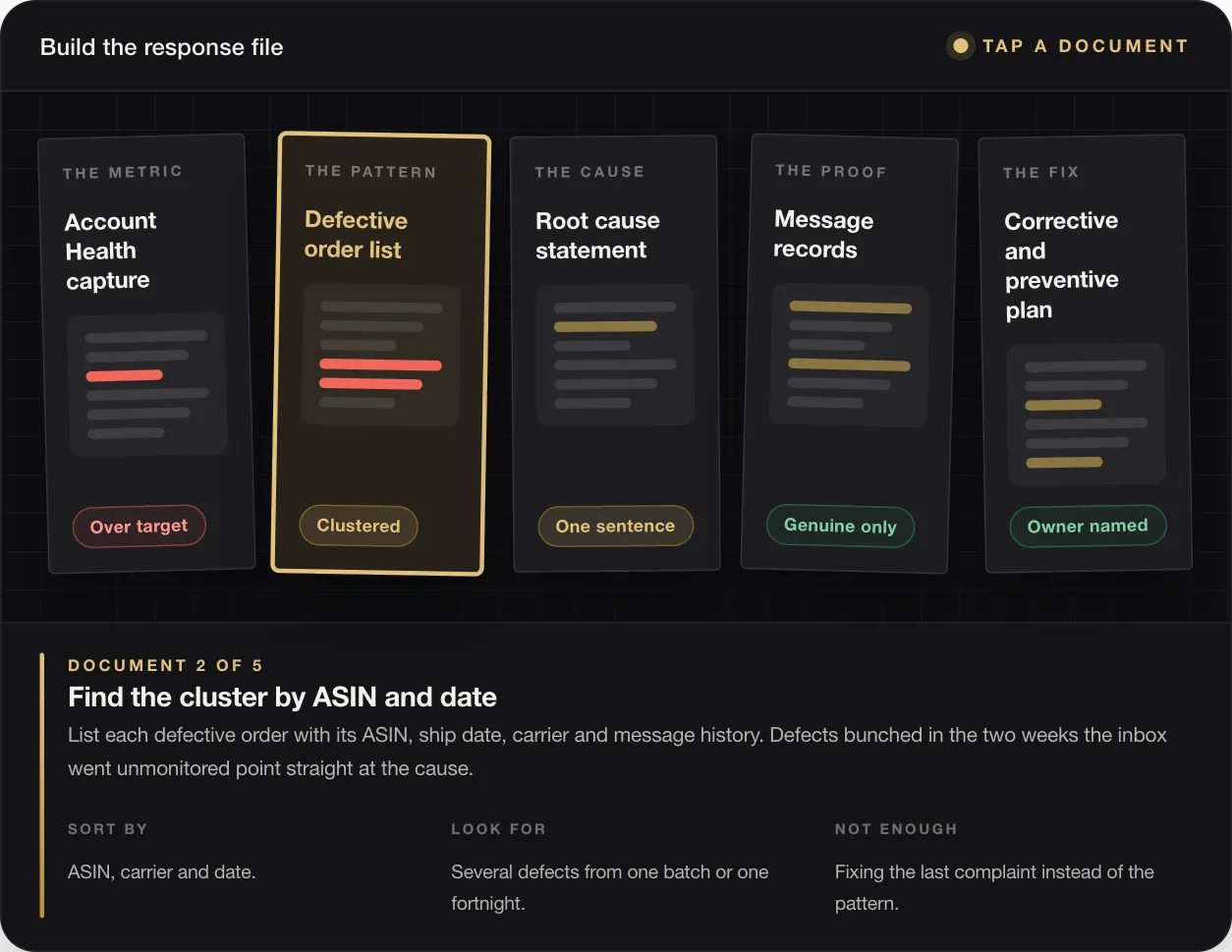
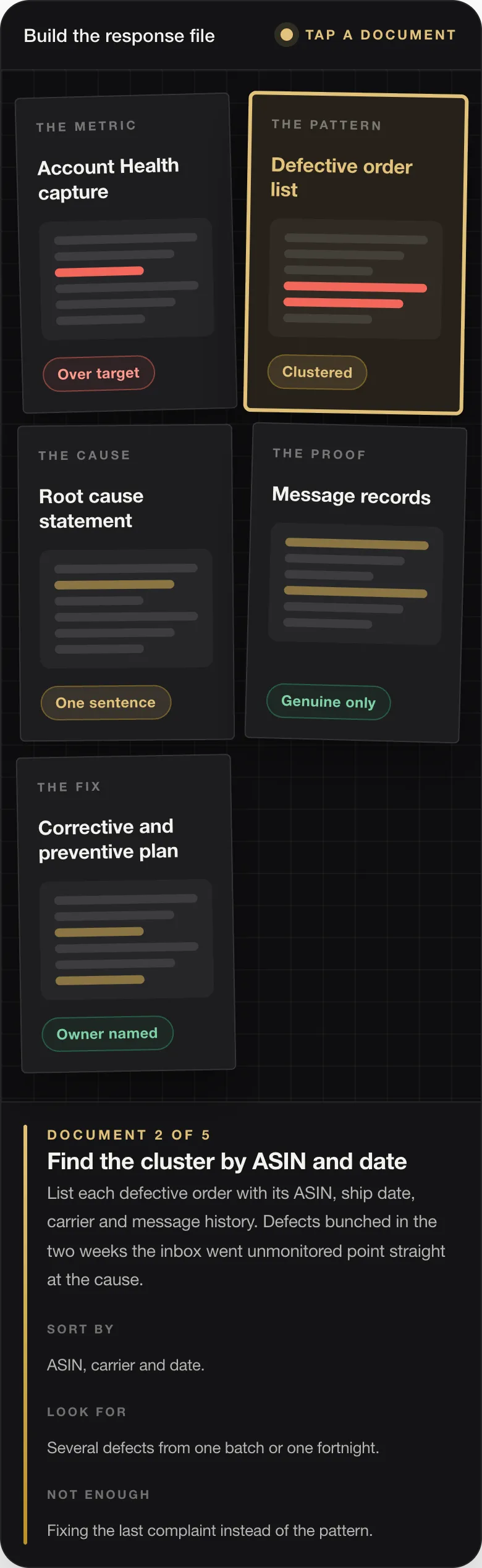
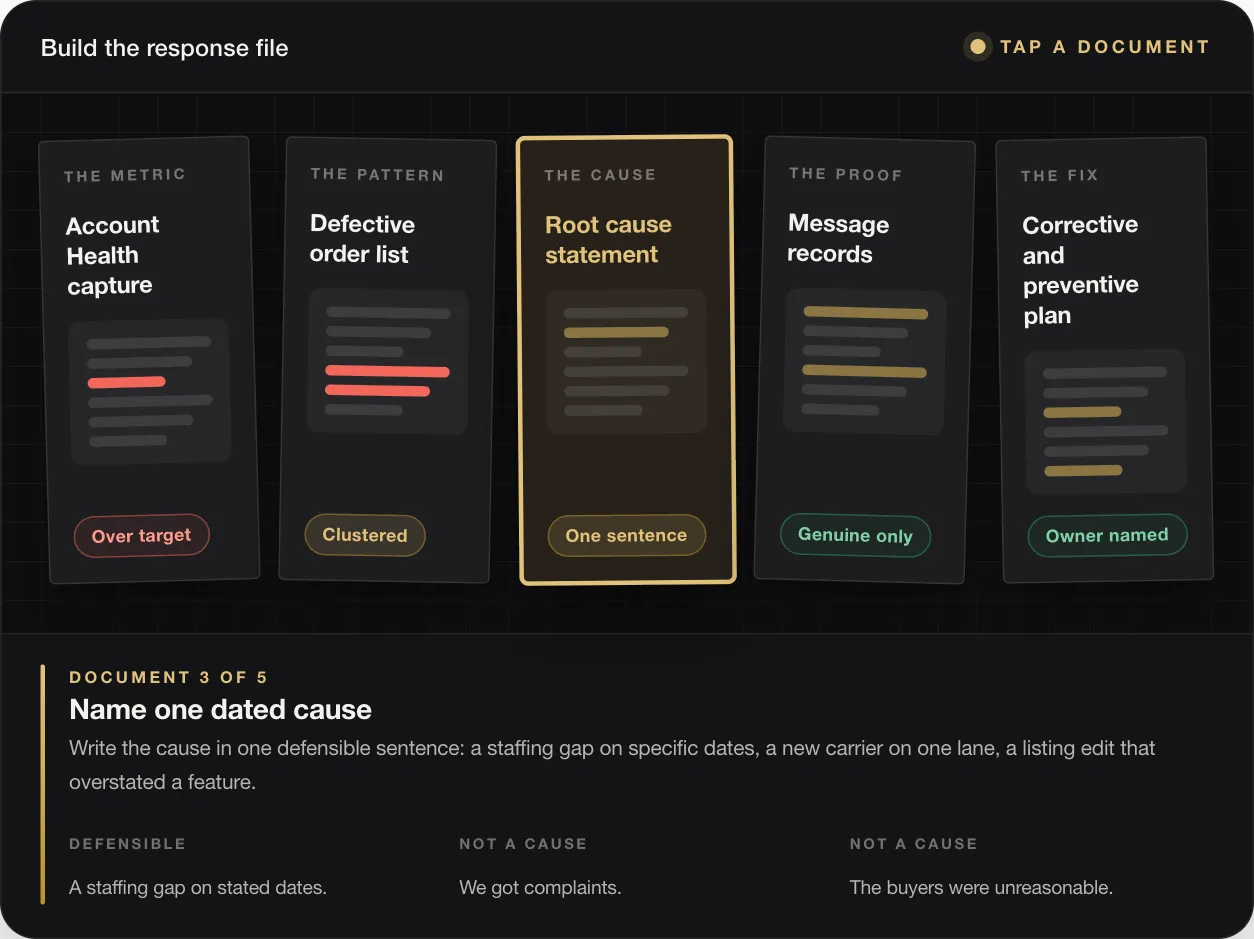
Five papers on the desk. Each one depends on the last.
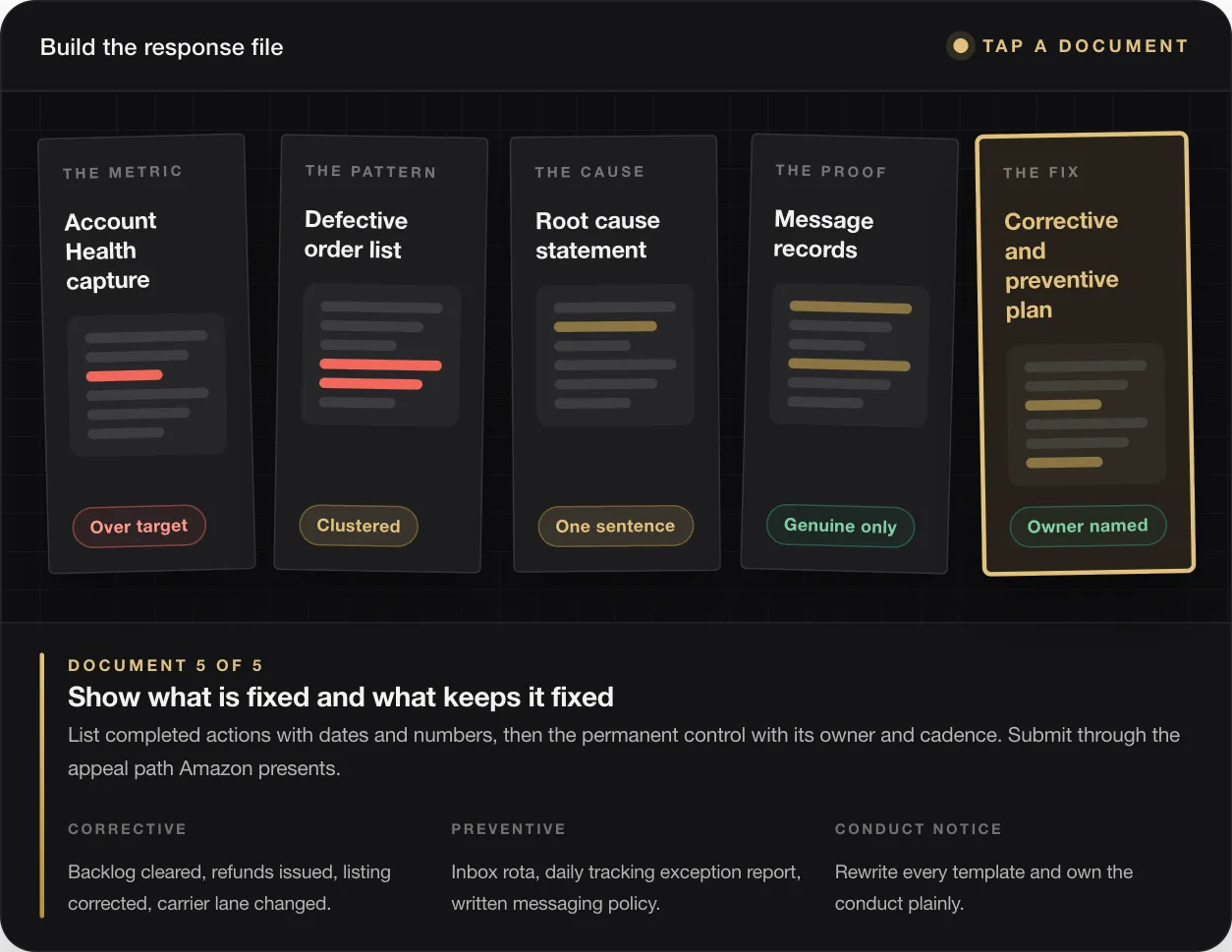
A service-driven defect problem is answered the same way as any other: split the rate, find the pattern, name one cause, prove it, then show the fix. Tap a document to see what it has to contain.
Why blaming buyers fails
Amazon acts on the buyer-facing signal. An appeal built on “the buyers lied” reads as a seller who will not take responsibility and does not explain why the pattern will stop. Show evidence contradicting any false claims, such as delivery confirmation against non-receipt, then show the controls that remove the pretext next time. If extortion or coordinated complaints were involved, report and document them honestly, but still show what you changed.
When the notice cites conduct, not metrics
If the notice cites the Seller Code of Conduct or prohibited seller activities, the problem may be your message content, such as a template asking buyers to change feedback. Identify the specific messages, stop them, rewrite every template, adopt a written messaging policy with a named reviewer, and own the conduct plainly; do not deny what the records show. Our guide to the Amazon Code of Conduct suspension explains these notices. This is educational information, not legal advice; where a notice raises legal exposure, consult a qualified attorney.
The mistakes we see most often
- Messaging as marketing. Review requests, product tips and cross-sell offers are non-critical at best and violations at worst.
- Templates nobody re-reads. One sentence asking a buyer to “update” feedback becomes hundreds of violations.
- Unauthorized sending addresses. An unapproved help-desk tool means buyers never get your replies.
- Aging returns. Missed authorizations and slow refunds invite Amazon to refund for you and the buyer to escalate.
- Arguing in public replies. They cannot be edited and every future buyer reads them.
- Fixing the last complaint, not the pattern. Refunding the angriest buyer does nothing if a carrier lane or listing keeps producing the problem.
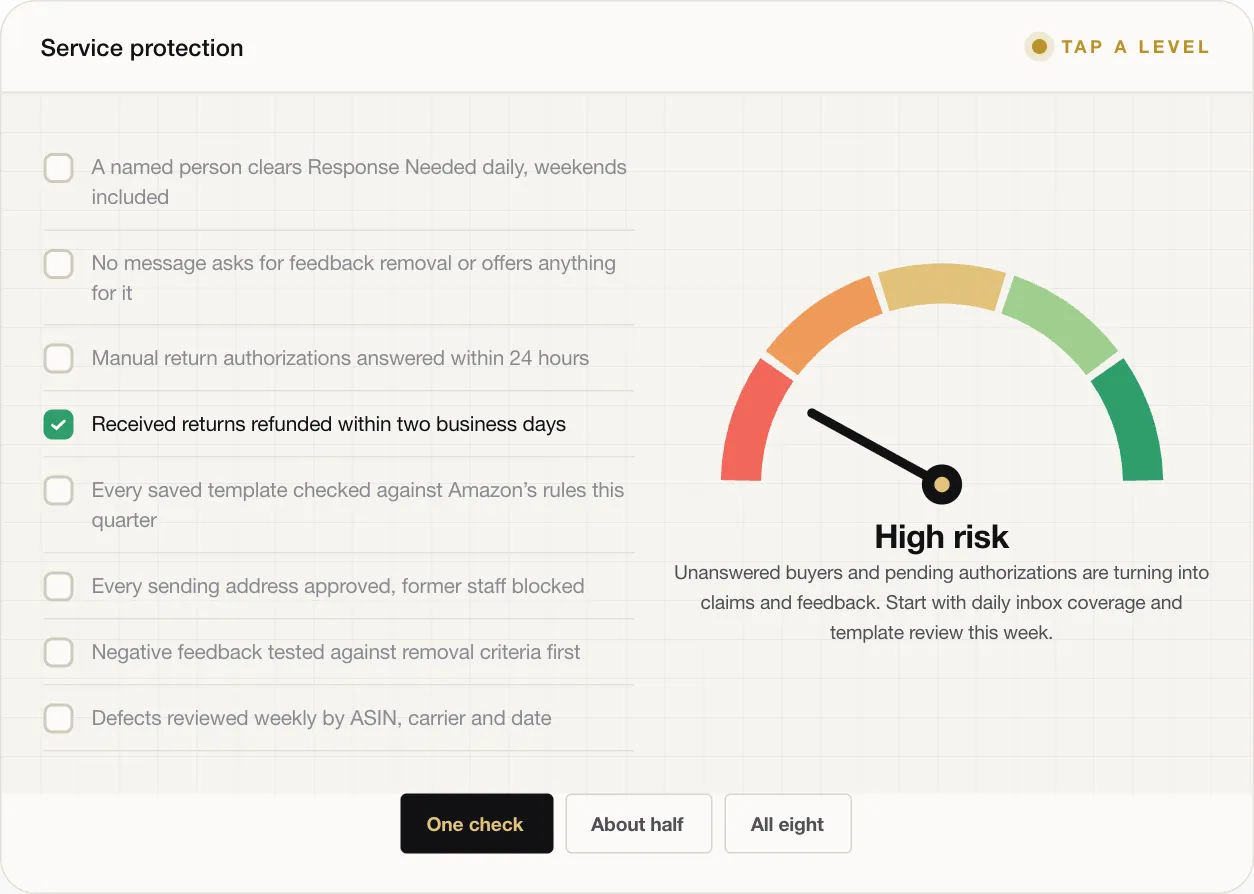
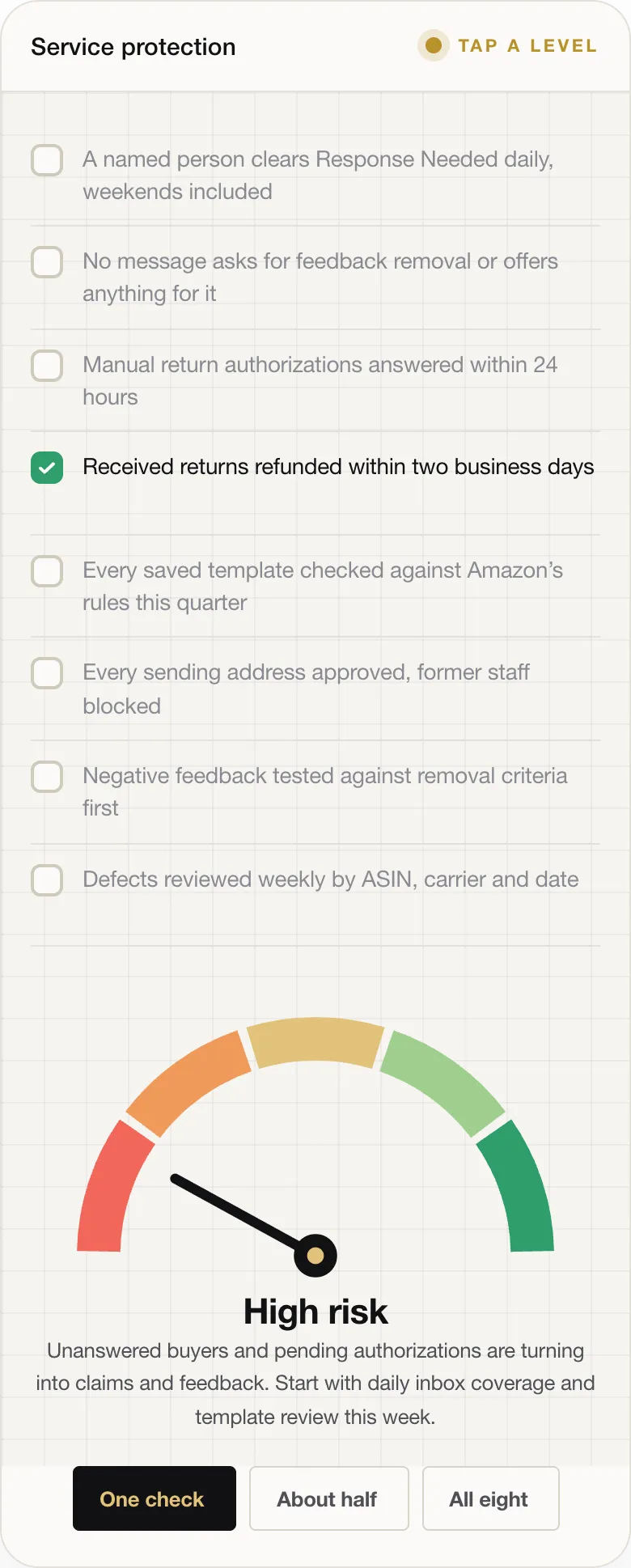
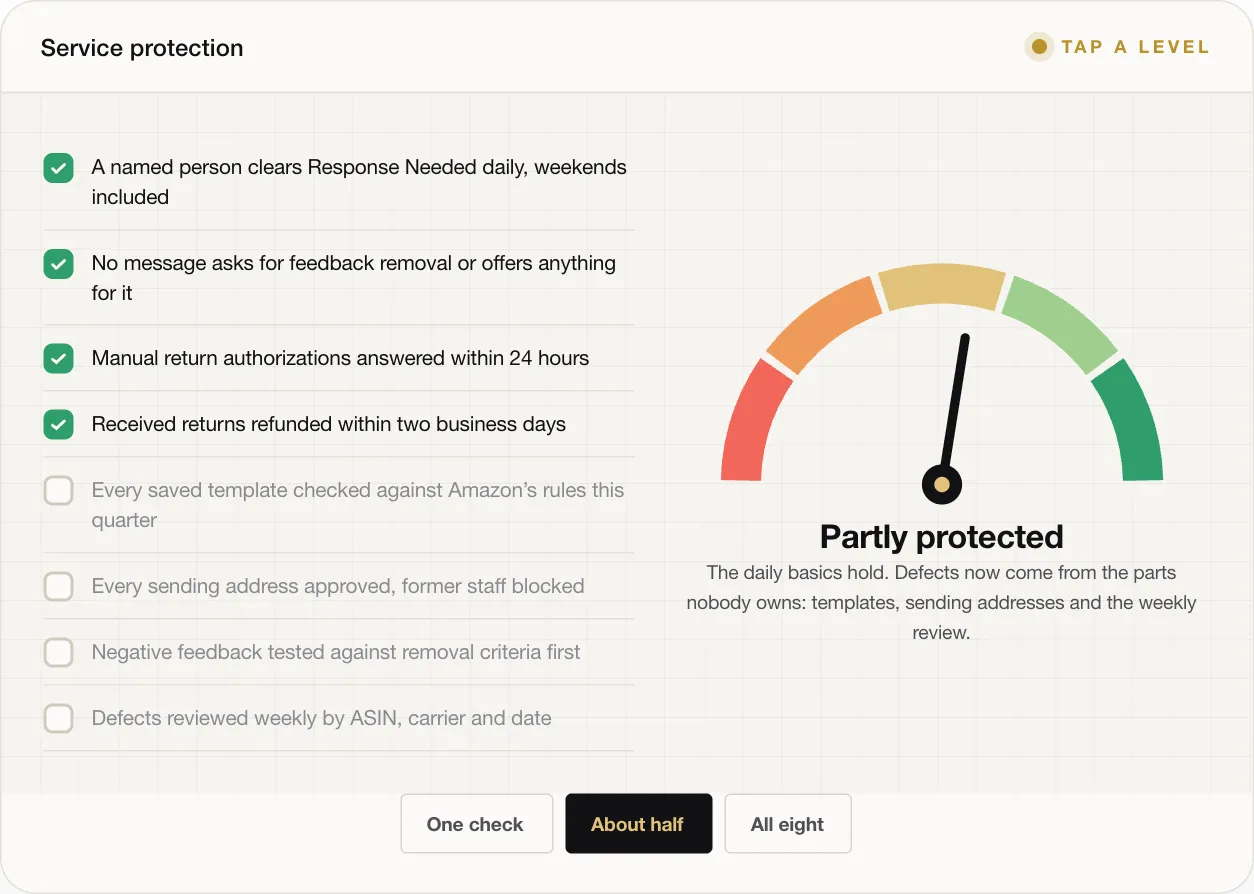
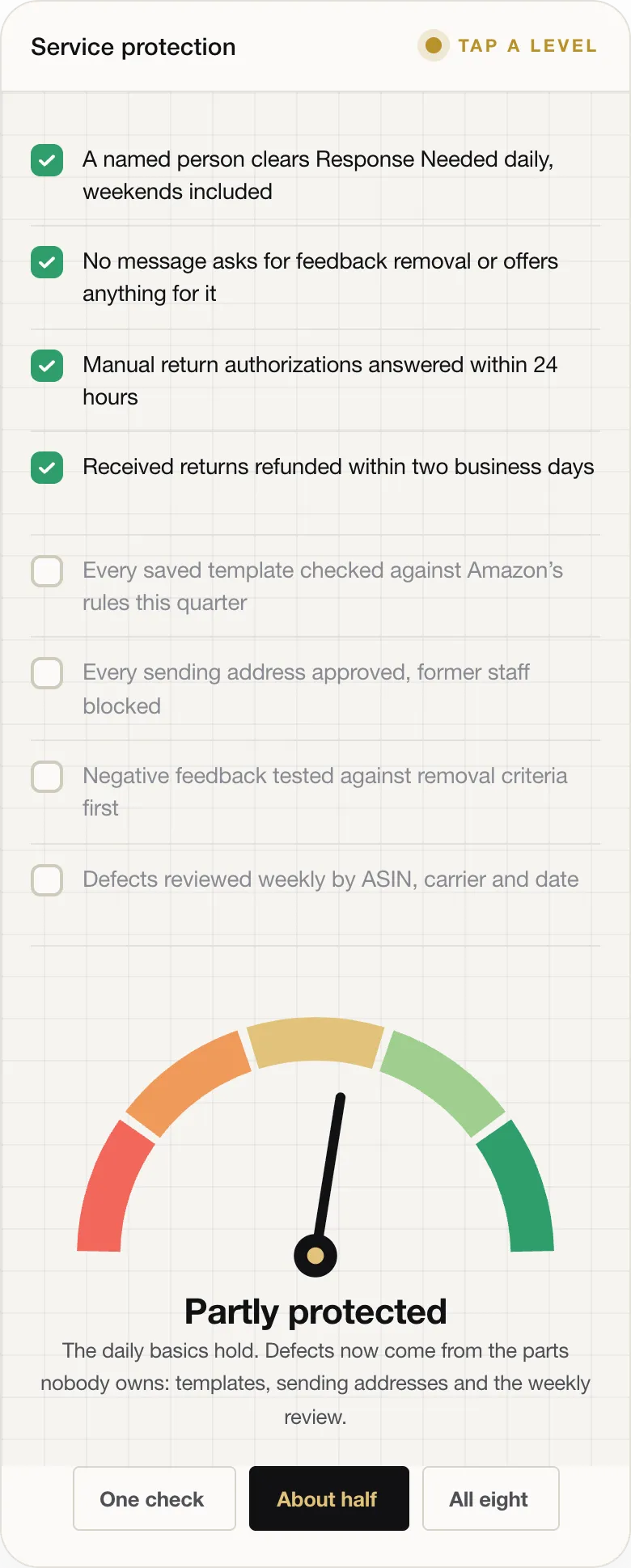
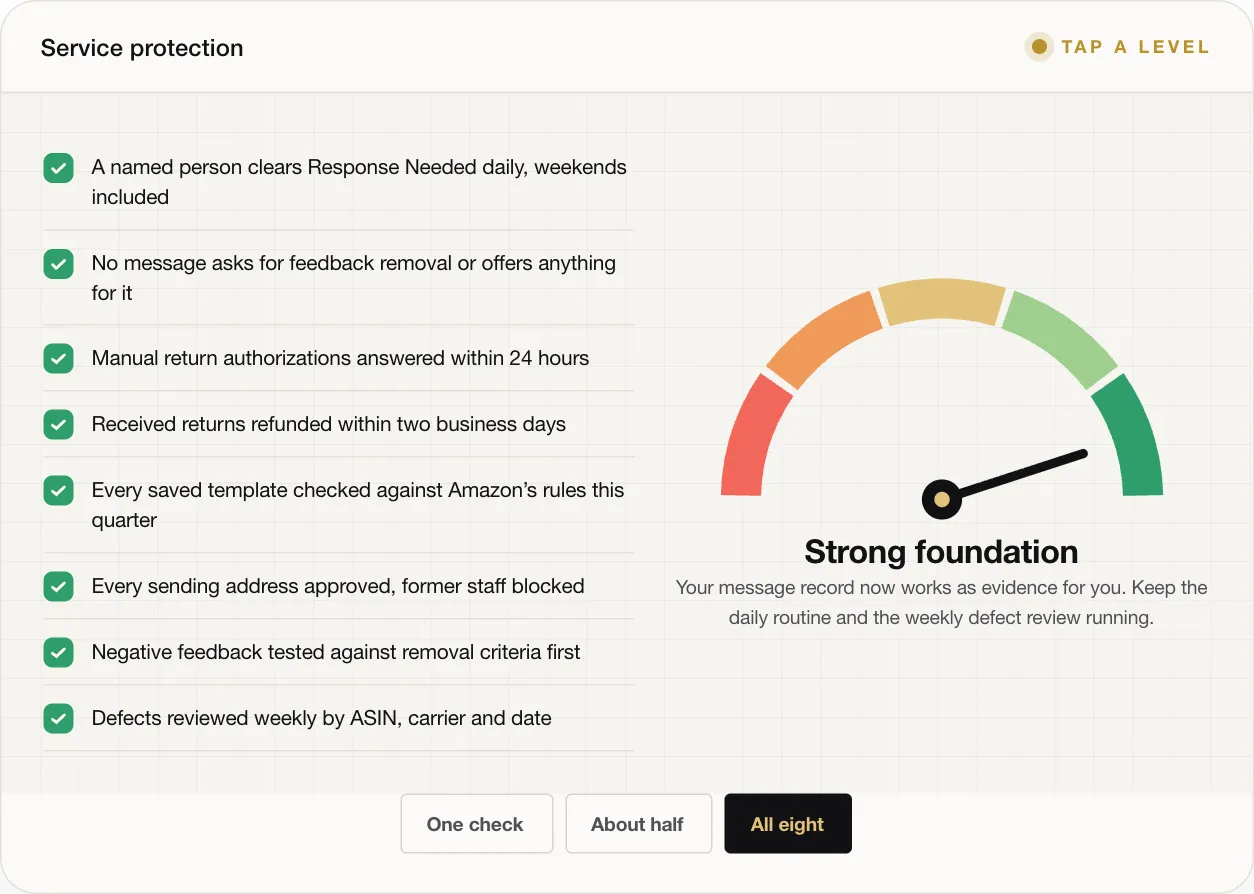
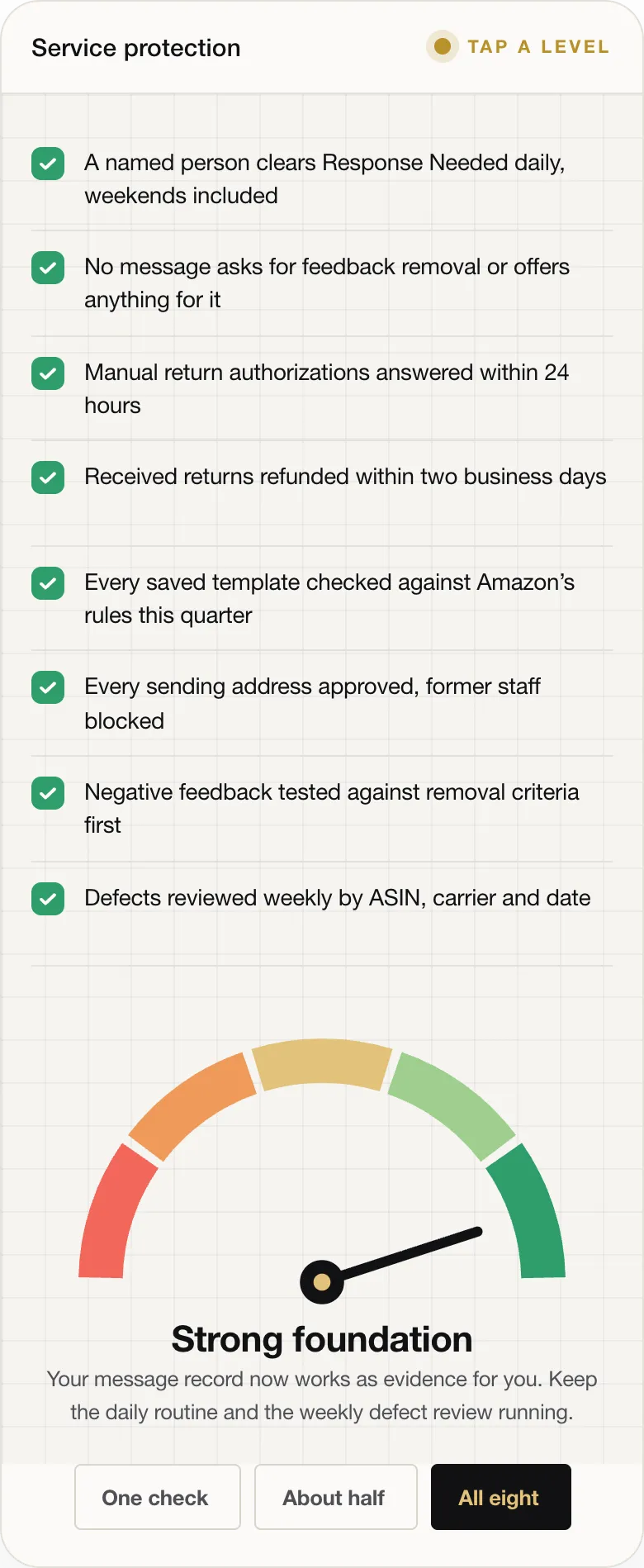
Is your customer service protecting the account?
Each line below closes off one route from a buyer problem to a defect or a conduct notice. Tap a level to see which checks sellers at that stage usually have in place.
A daily customer service routine that holds up
This routine makes sure every buyer problem is seen within a business day and every defect is traced within a week. Assign each block to a named person.
Every morning
- Work Response Needed oldest first; mark genuine no-reply messages No Response Needed.
- Review Buyer Reported Unresolved cases for a better solution.
- In Manage Seller Fulfilled Returns, clear pending authorizations and refund arrived returns.
- If in CSBA, answer anything passed back the same day.
- Trace any shipment with no carrier movement beyond normal transit, and message the buyer first.
Every afternoon
- Second pass on Response Needed so nothing waits overnight.
- Triage new negative feedback: request review where it qualifies, resolve with the buyer where it does not.
- Log every concession, refund reason and complaint theme against order ID and ASIN.
Every week
- Pull the defect breakdown and note which component moved.
- Sort complaints, concessions and defects by ASIN, carrier and date; give any cluster an owner and fix date.
- Re-read templates edited that week and confirm Messaging Permissions matches your team.
- If in CSBA, feed the top contact reasons into listing and packaging fixes.
The weekly review is the diagnostic method applied before Amazon asks. If most complaints this month came from one ASIN with an unclear size chart, you fix the page and the problem ends without a notice. If your account already shows warning signs, our Amazon account health maintenance service can run this review with you.
Frequently Asked Questions
Does slow customer service affect Amazon account health?
Yes. Unresolved buyer problems become negative feedback, A-to-z claims and chargebacks, which count as order defects, and Amazon also calculates your response time to buyer messages.
How fast must I answer buyer messages?
Check the live response time target on your Account Health page. Amazon separately requires replies within 24 hours to CSBA inquiries and manual return authorizations.
Can I ask buyers for positive feedback?
Amazon classes feedback and review requests as non-critical messages and prohibits incentives for positive feedback. Never ask a buyer to remove or change negative feedback.
What feedback will Amazon remove?
Feedback with profanity, hate speech or personal information, feedback about another seller’s product or a product you own the brand of or are authorized to resell, and feedback that is entirely a product review.
How long can a buyer remove their own feedback?
Amazon says buyers can remove seller feedback within 60 calendar days of leaving it, at their discretion.
How quickly must I refund a seller-fulfilled return?
Amazon says within two business days of receiving the return; otherwise Amazon may refund the buyer and charge your account.
Is Customer Service by Amazon free?
Amazon gives first-time enrollees a 90-day free trial and says it stays free with contacts per unit below 3 percent; above that it charges per seller-fulfilled unit.
Why are my messages bouncing?
Either the buyer opted out of non-critical seller messages, or you sent from an address not approved on Messaging Permissions. Reply on the buyer’s original thread, or approve the address and resend.
Get Help With Amazon Customer Service and Account Health
If your defect rate is climbing, a template drew a warning, or you received a performance notice, our team can help you split the metric, find the cause and build the corrective and preventive plan Amazon expects. Submit your case for review or book a consultation to talk it through.
This article is educational information about Amazon’s published seller policies and is not legal advice. Amazon policies, thresholds and page names change; confirm current requirements in Seller Central. Got Suspended? cannot guarantee any outcome, timeline or decision by Amazon.
Sources
- Amazon Seller Central: Buyer-Seller Messaging Service overview
- Amazon Seller Central: Buyer-Seller Messaging Permissions
- Amazon Seller Central: Buyer-Seller Messages FAQ
- Amazon Seller Central: Buyer-Seller Messaging templates
- Amazon Seller Central: Customer Service by Amazon for seller-fulfilled orders
- Amazon Seller Central: Manage seller-fulfilled returns
- Amazon Seller Central: Resolve or respond to buyer feedback
- Amazon Seller Central: When buyers want to remove feedback
