
Quick answer: The Amazon policies behind most enforcement fall into five groups: account conduct (the seller agreement and the Seller Code of Conduct), catalog and listings (ASIN creation, product detail page rules, brand name rules), products (intellectual property, anti-counterfeiting, restricted products, product safety), pricing (the Marketplace Fair Pricing policy) and reviews (the customer product reviews policies). Amazon measures many of them through the Account Health Rating, a score from 0 to 1,000 that drops when a violation is detected and recovers when you address it. Amazon says 200 or more is Healthy, 100 to 199 is At Risk, and 99 or lower means the account is eligible for deactivation or already deactivated. Check Account Health weekly, read each violation in Amazon’s own words, and fix the cause, not just the listing.
Most sellers do not get into trouble because they never read a policy. They get into trouble because Amazon publishes well over a hundred policy pages, the ones that matter are scattered across Seller Central, and nobody explains which rules are measured, how a violation turns into points, or which ones can end an account without warning. So every notice gets the same treatment: delete the listing, send an apology, move on. That works until the same policy is violated again and the score falls faster than it did the first time.
This guide is a working map organised by how sellers actually get caught: account conduct, the catalog, the products, pricing and reviews. For each, you will see what the policy requires, the typical violation, how it shows up in Account Health, and how to check your own account. If you already face an account-level action, our Amazon suspension service page explains how we work those cases.
How Amazon’s policy rules fit together
Amazon’s Program Policies page states that the products you offer must comply with your seller agreement, including all applicable Amazon policies, and all applicable laws and regulations. That sentence describes three layers. The top is your contract, the Amazon Services Business Solutions Agreement, which is the source of Amazon’s authority to restrict, deactivate or withhold. The middle is the program policies, grouped into General Policies, Intellectual Property, Product and Listing Requirements, Shipping, Tax, Optional Programs and FBA. The bottom is law: the Restricted Products page says that even a product shown as a permitted example must still comply with applicable laws. A notice usually cites a policy, but the authority comes from the agreement and the standard includes the law.
Measured policies and unmeasured ones
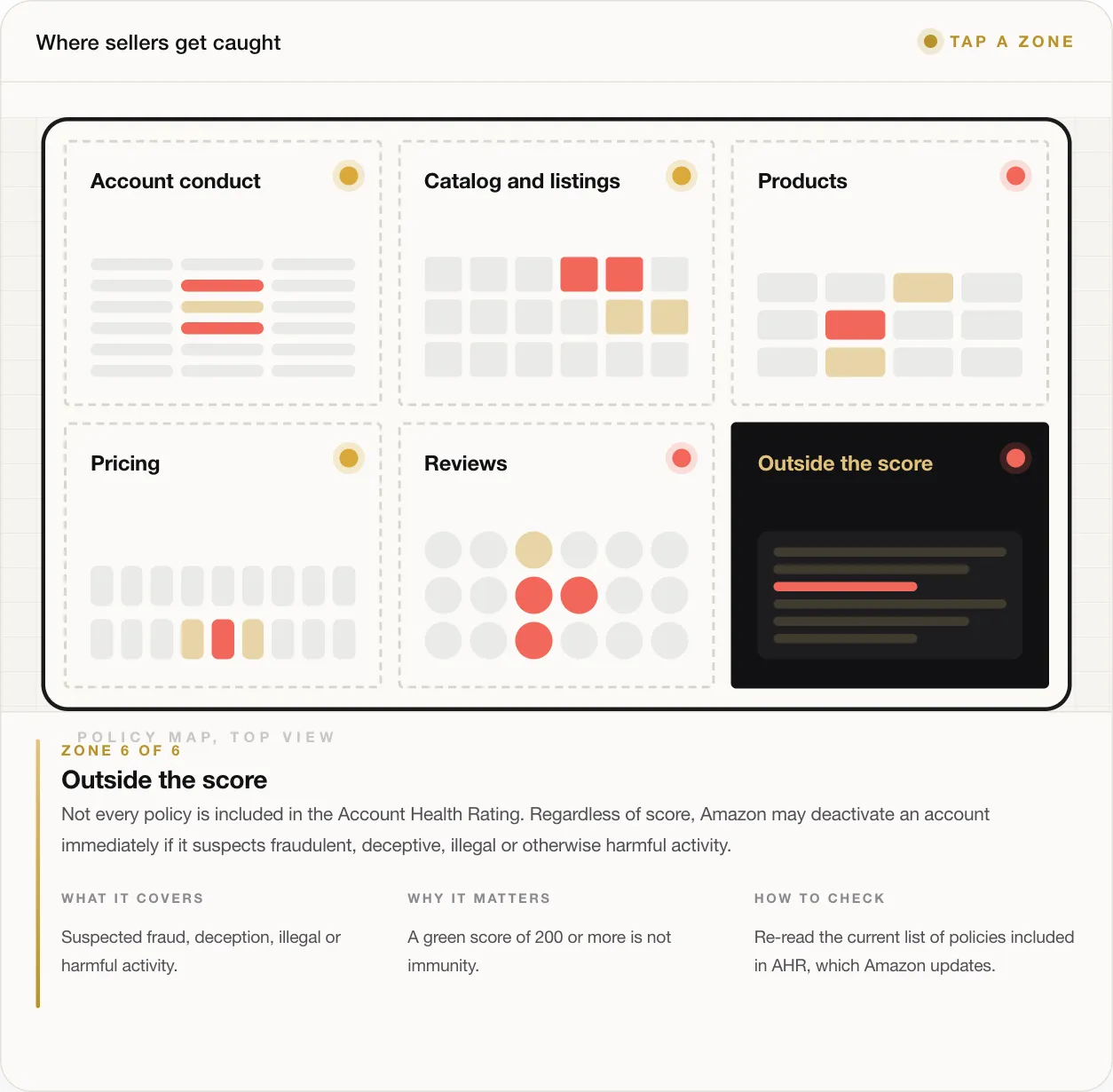
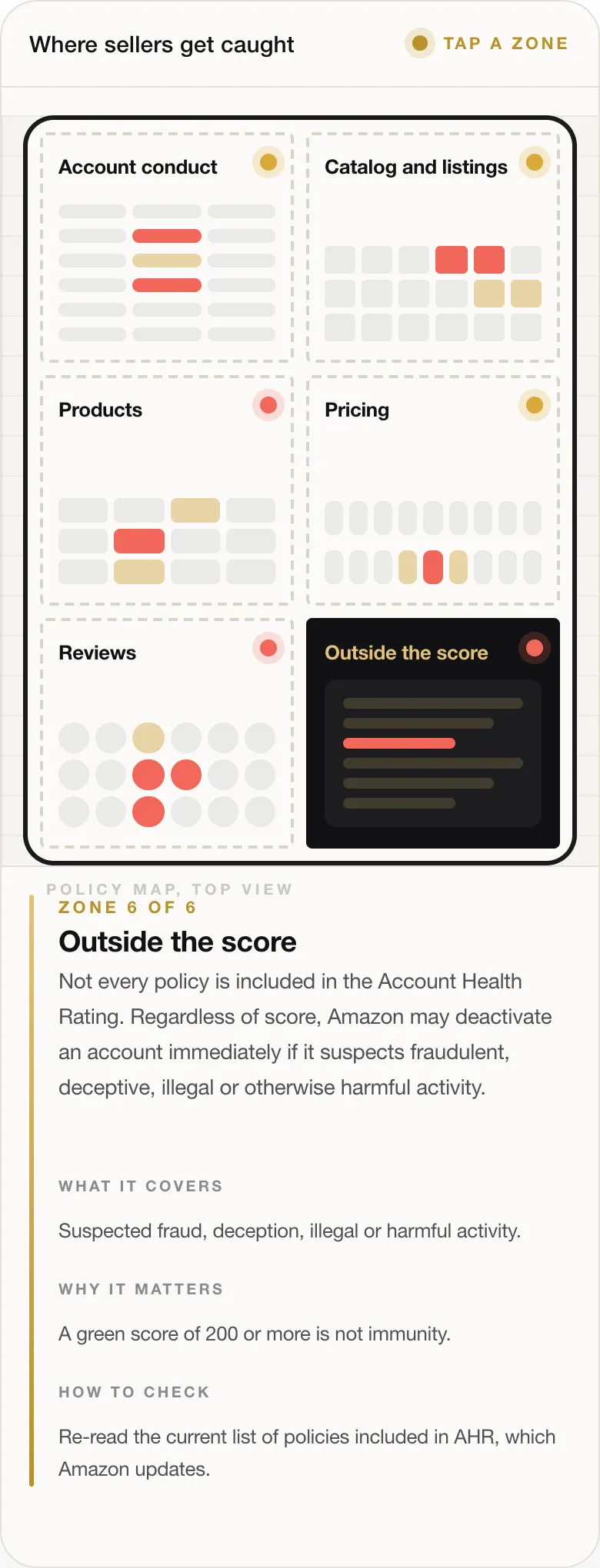
Amazon’s page on policies included in the Account Health Rating says not all of its policies are currently included in AHR. Some violations therefore appear on your Account Health page with a visible point impact, and others can lead to action without the score ever turning yellow. The AHR policy page states that regardless of score, Amazon may deactivate an account immediately if it suspects fraudulent, deceptive, illegal or otherwise harmful activity.
How the Account Health Rating measures you
Amazon describes the AHR as a color-coded score from 0 to 1,000, shown on your Account Health page separately for each store. You lose points when a new violation is detected and gain points when you successfully address violations. Points are also granted when a minimum number of orders are filled, so health is judged against the size of your business. New sellers start at 200, and the score reflects policy adherence and selling activity over the last 180 days. Fulfilled by Merchant sellers can also earn points from Buyer Contact Rate, Average Contact Response Time and Buyer Dissatisfaction Rate; Amazon says it will not restrict selling privileges for below-average performance on those three.
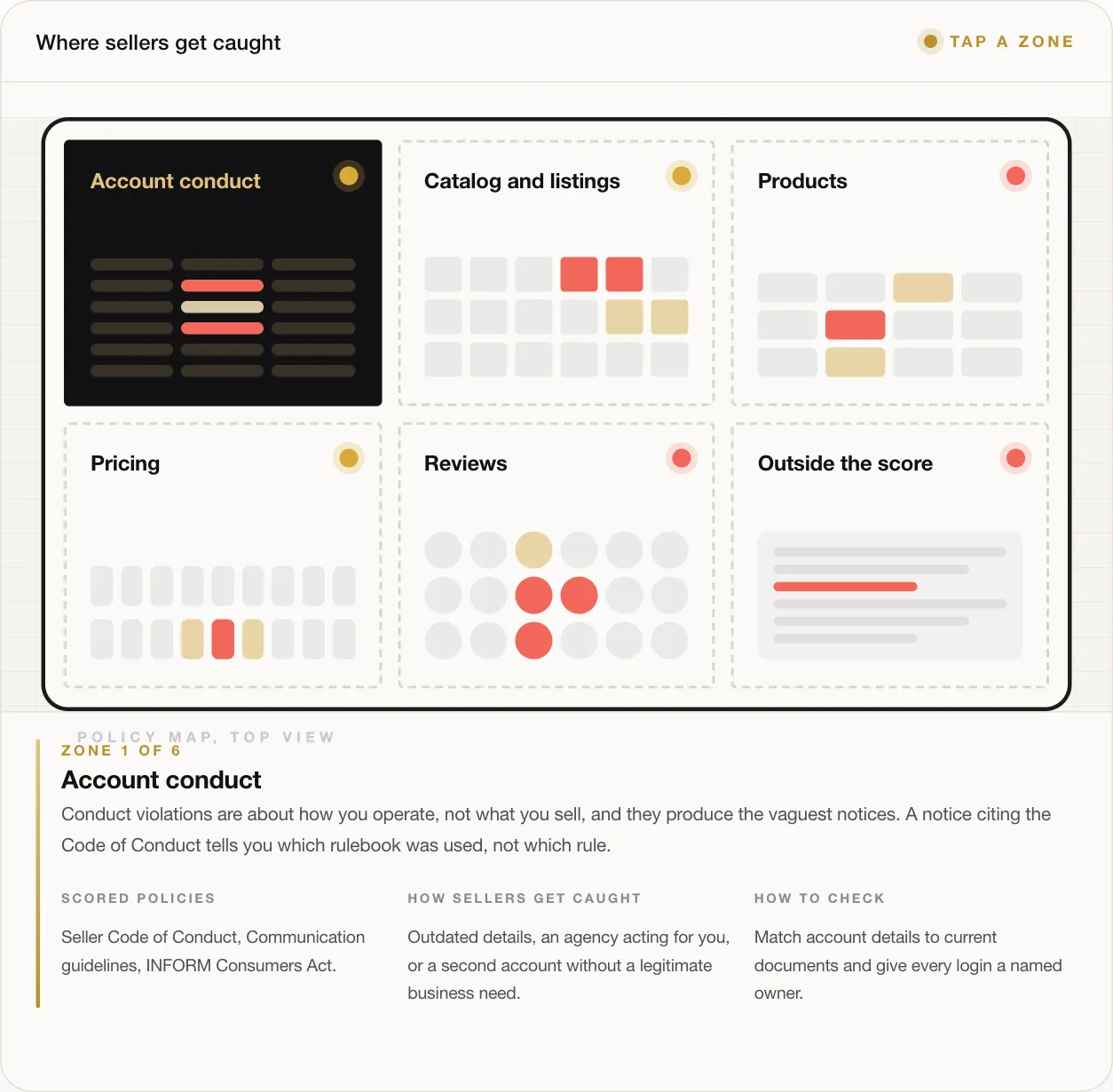
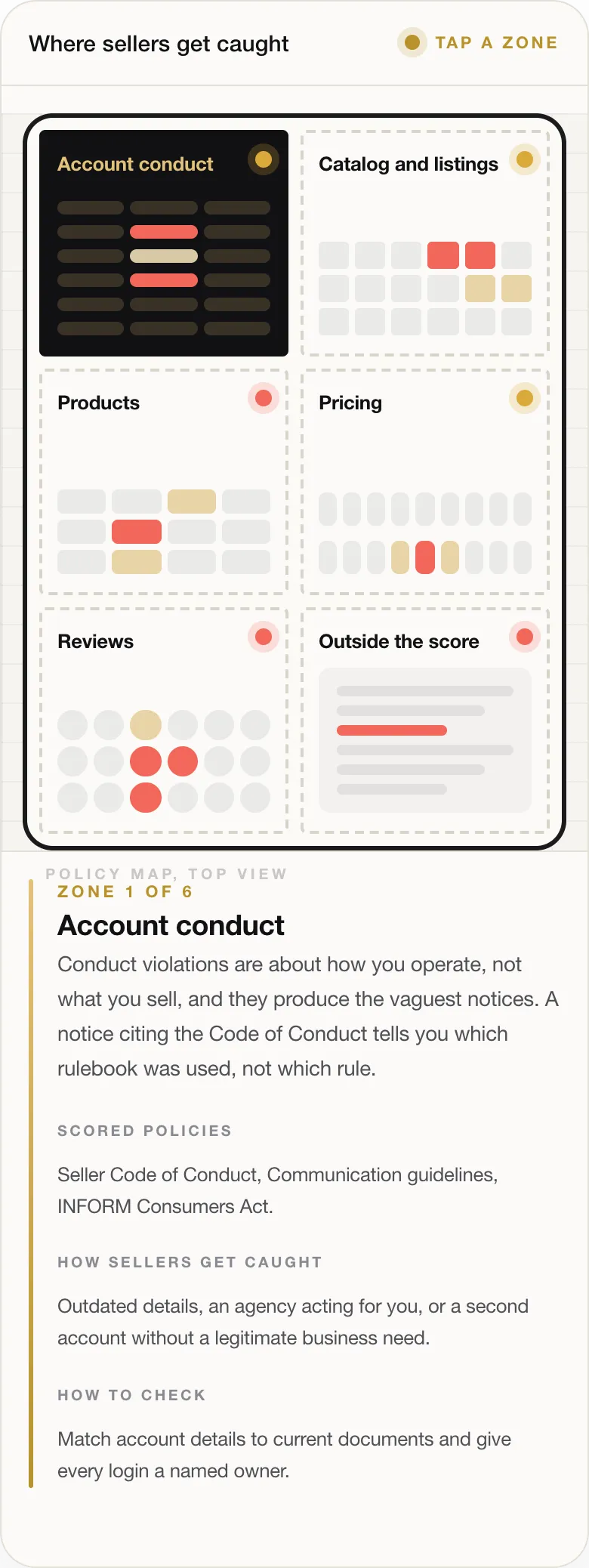
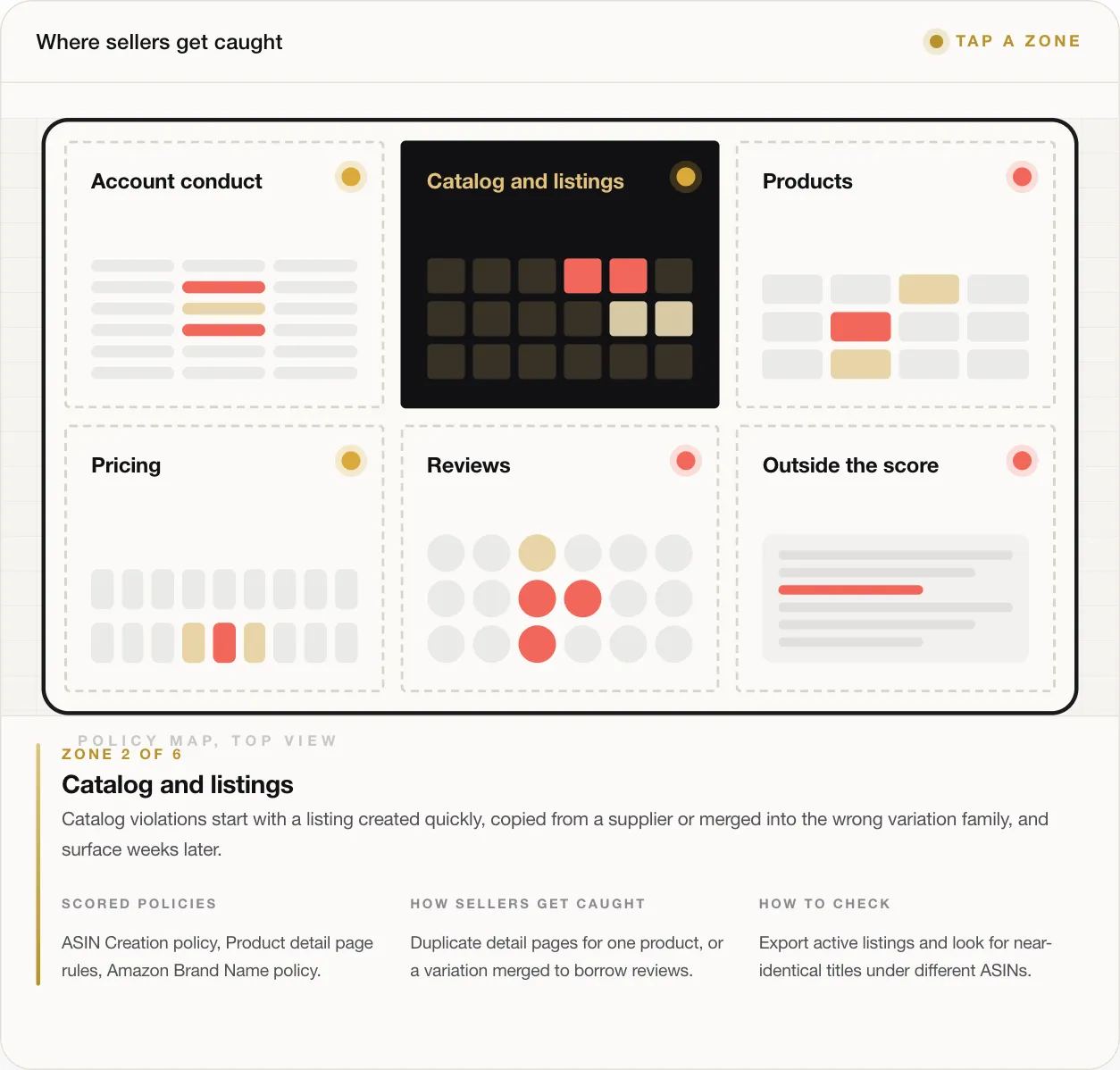
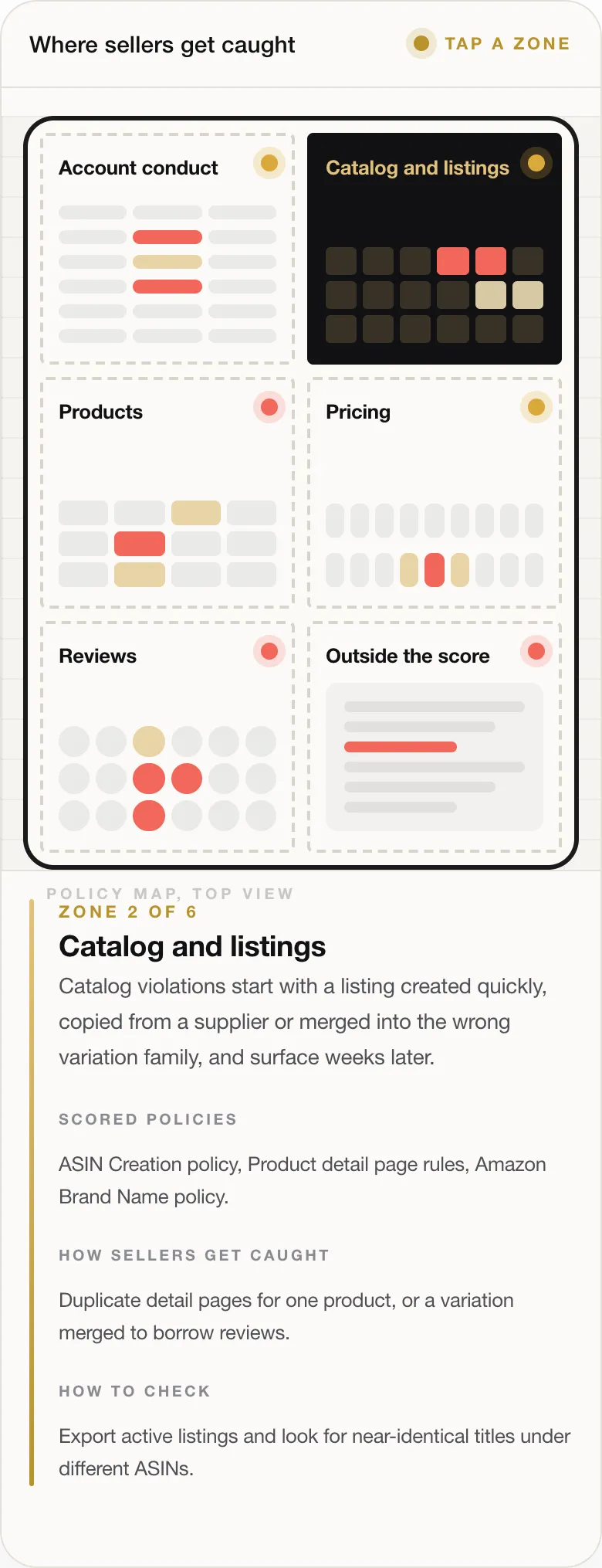
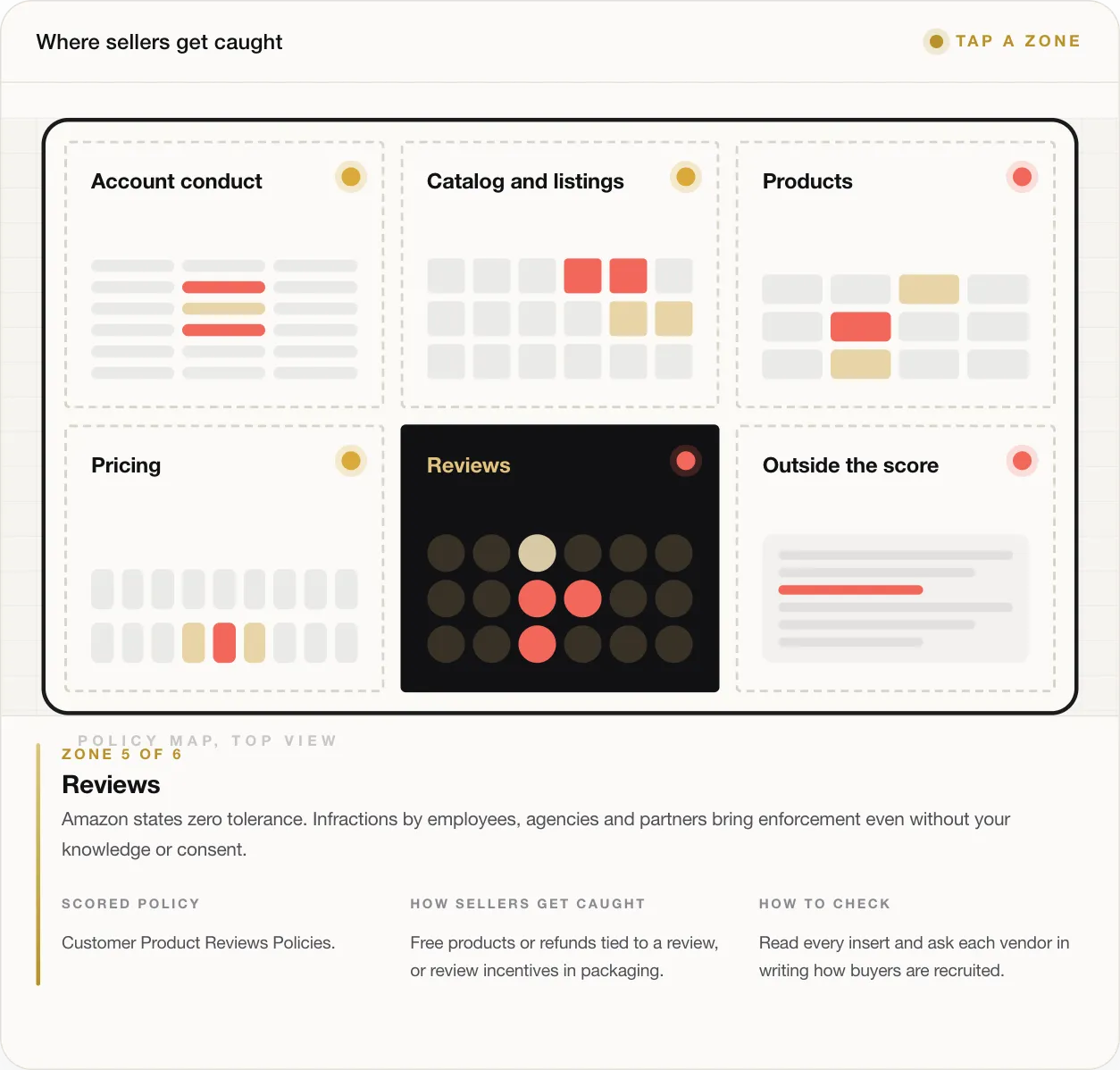
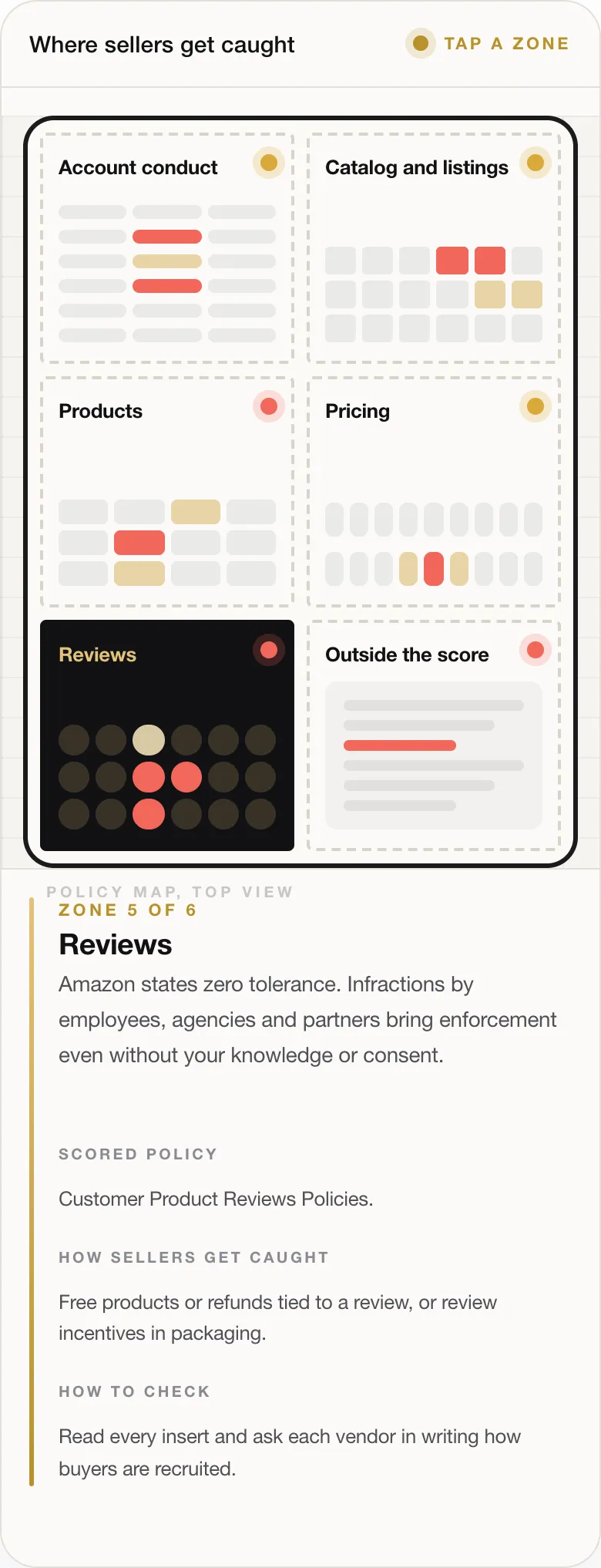
Five groups feed one score. Walk the map.
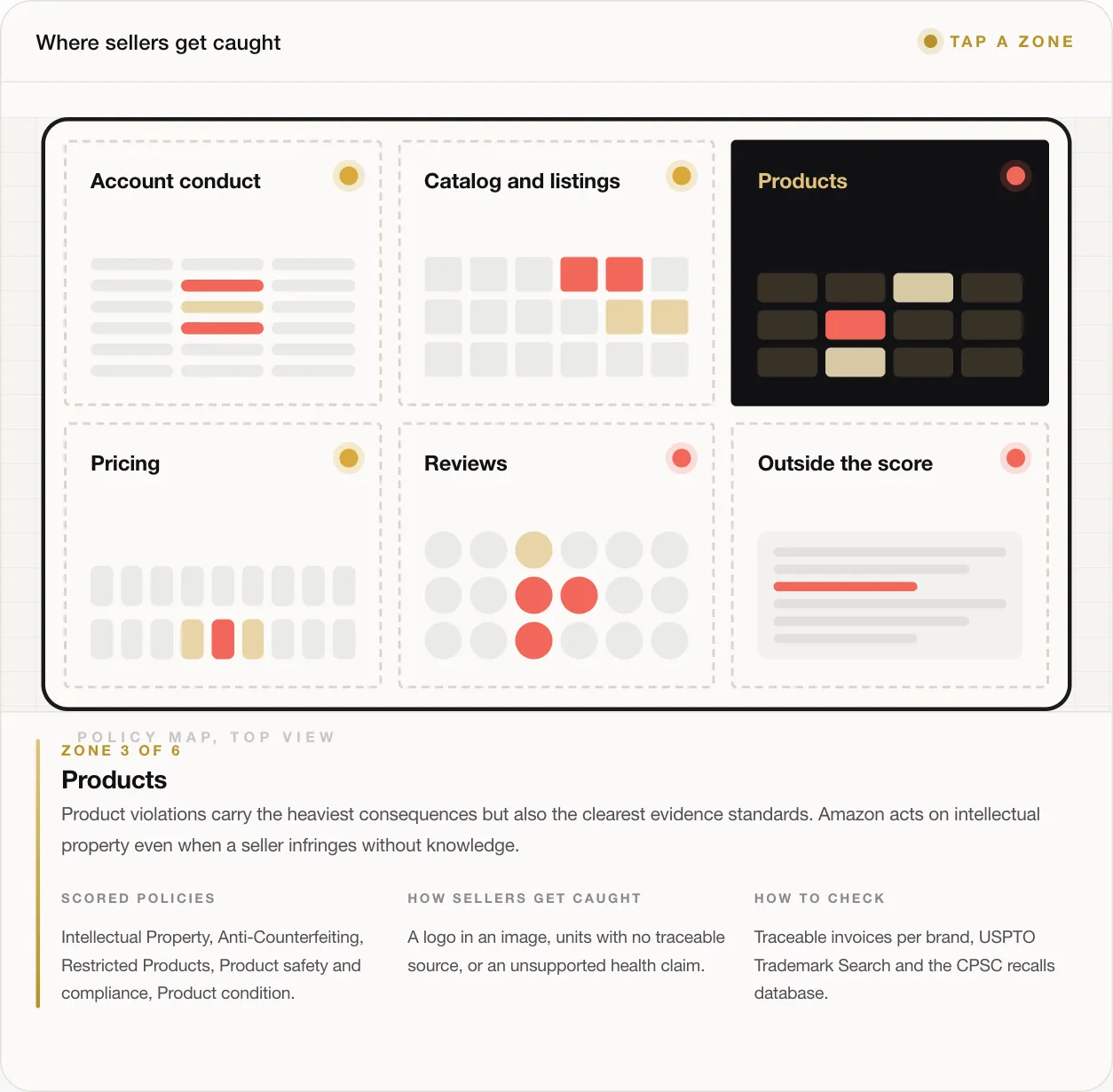
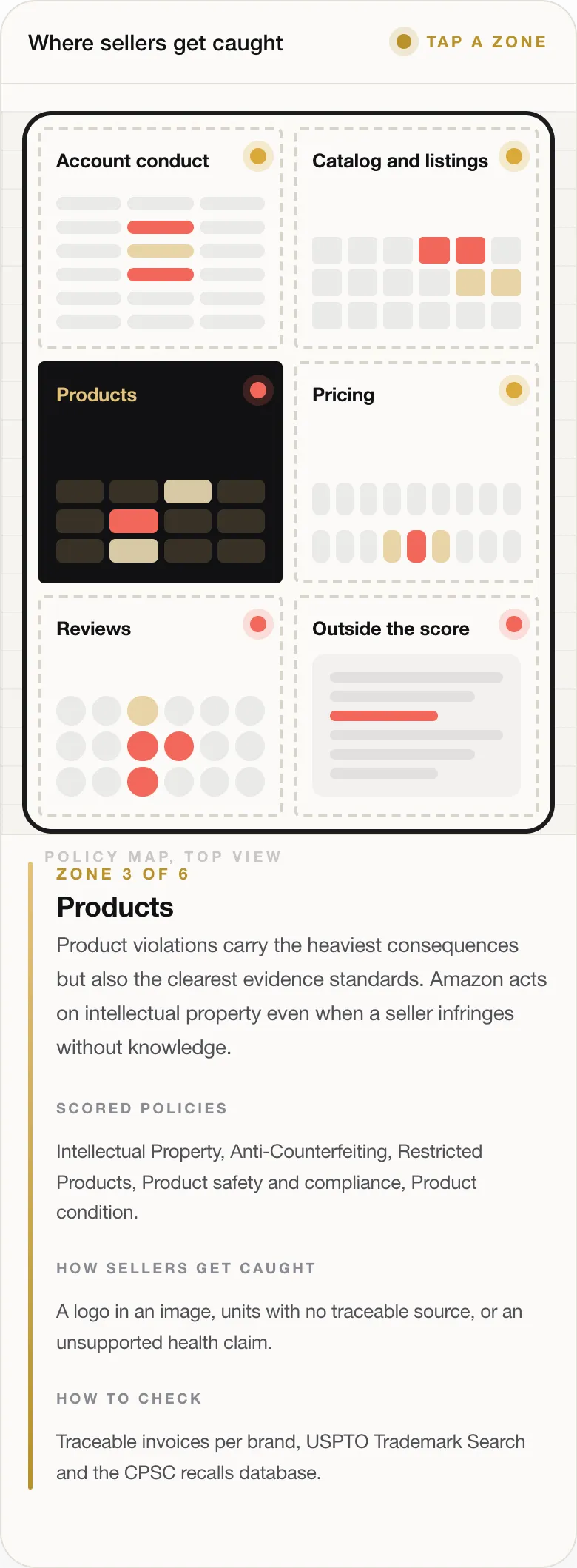
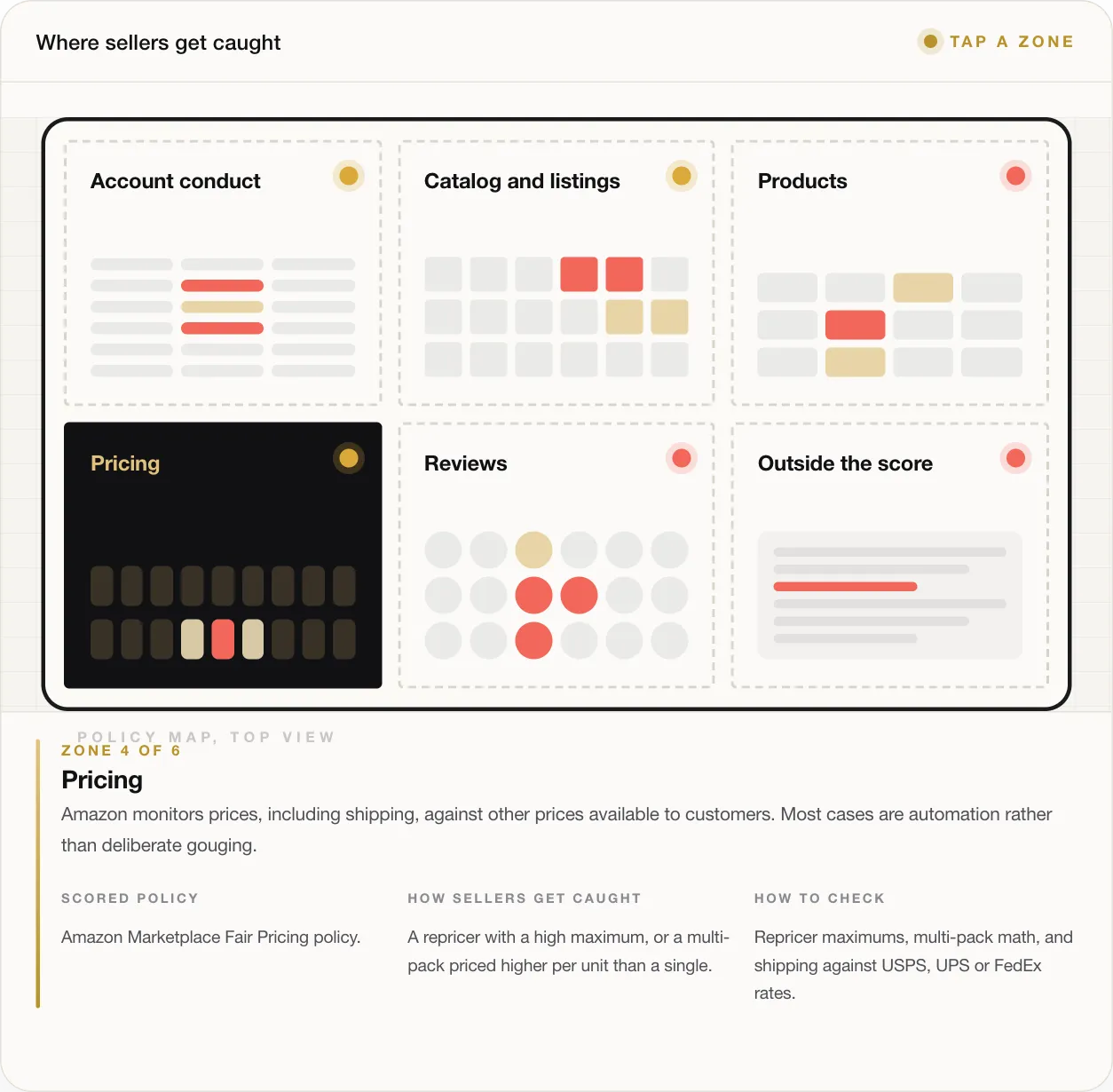
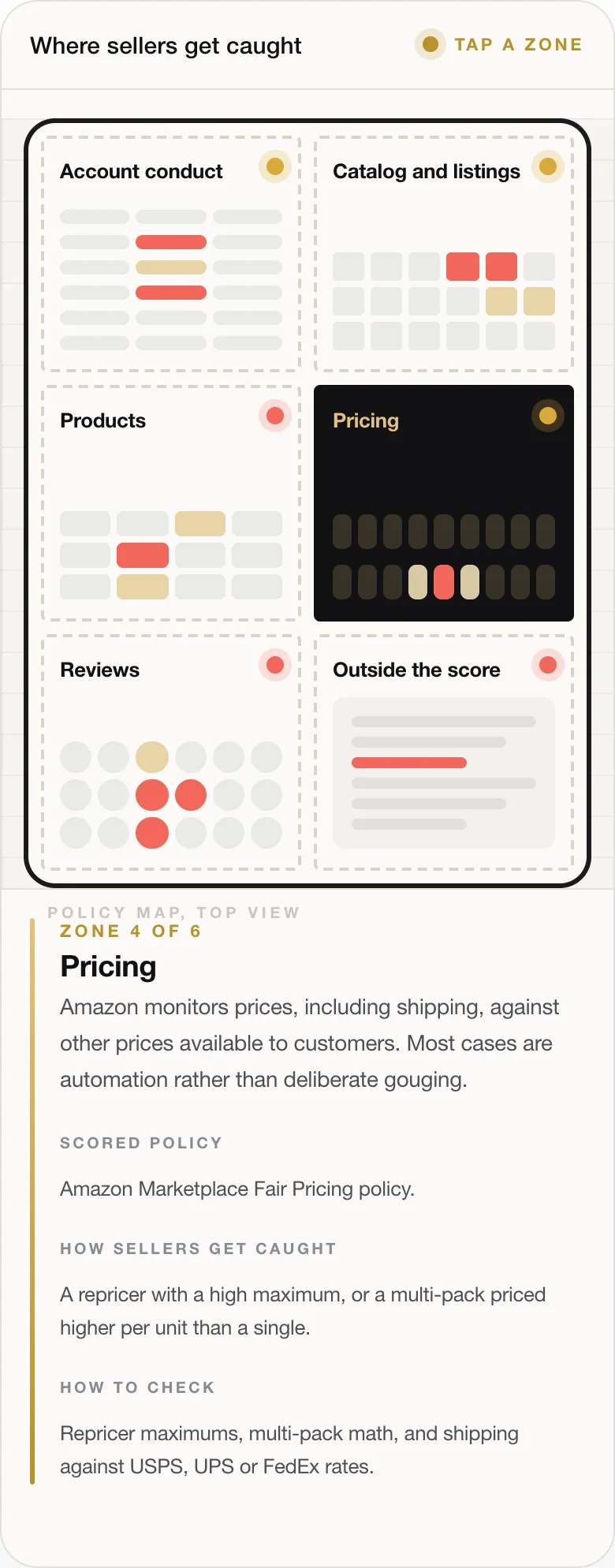
The Account Health Rating runs from 0 to 1,000 and drops when a scored policy is violated. Tap a zone to see which policies sit there, how sellers get caught and how to check your own account.
Severity and repeat violations
Amazon assigns points by four severity levels: critical, high, medium and low. Critical violations can lead to immediate enforcement. Amazon weighs how much a violation harms customers and whether it breaks applicable laws. Repeats hurt twice: the point value rises each time the same policy is violated, and Amazon says the account may be at immediate risk of deactivation if it reaches the maximum number of repeat violations for one policy within 180 days, a maximum that can be as low as two for higher-severity violations. That is the strongest reason to fix causes rather than listings.
A worked example
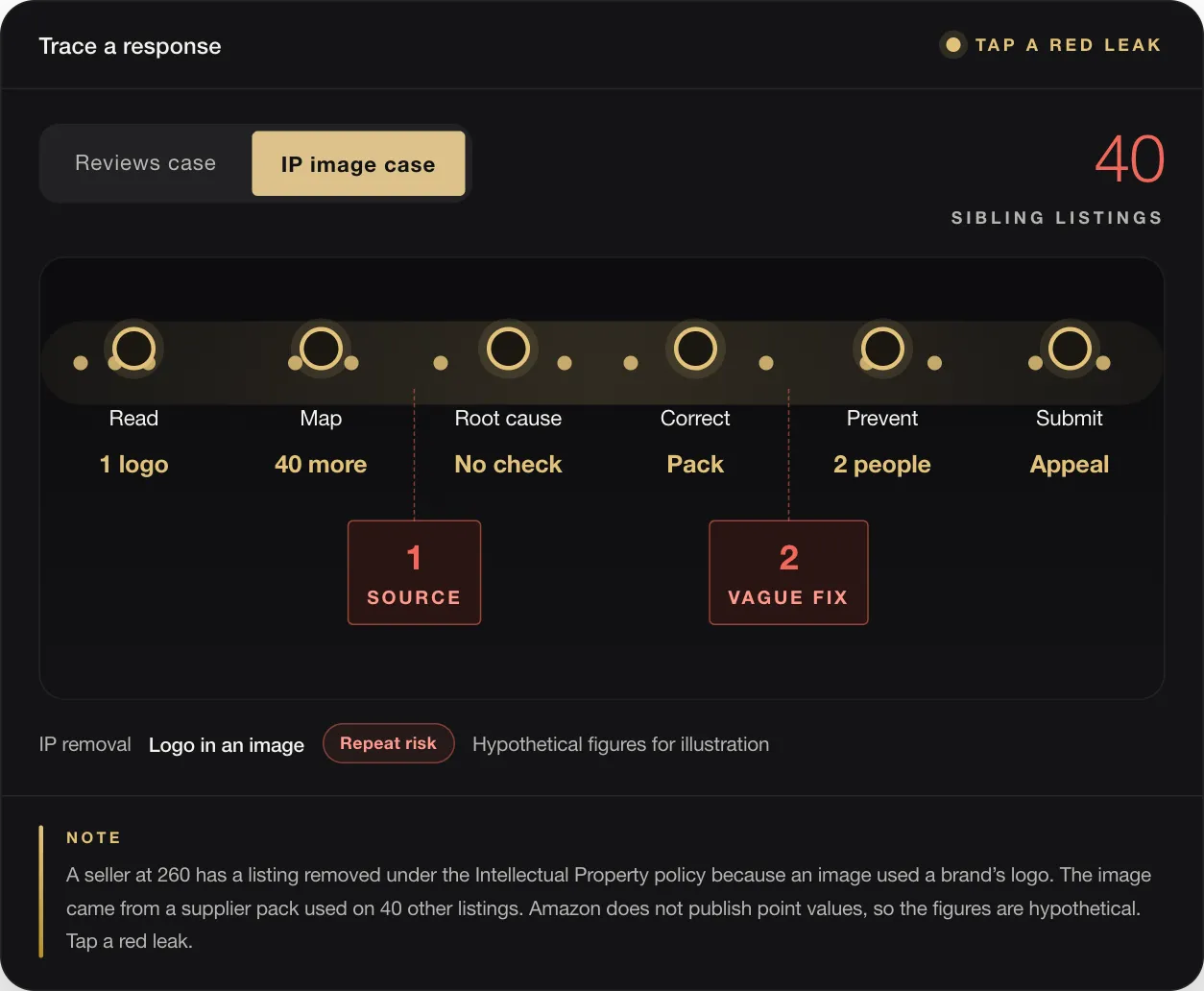
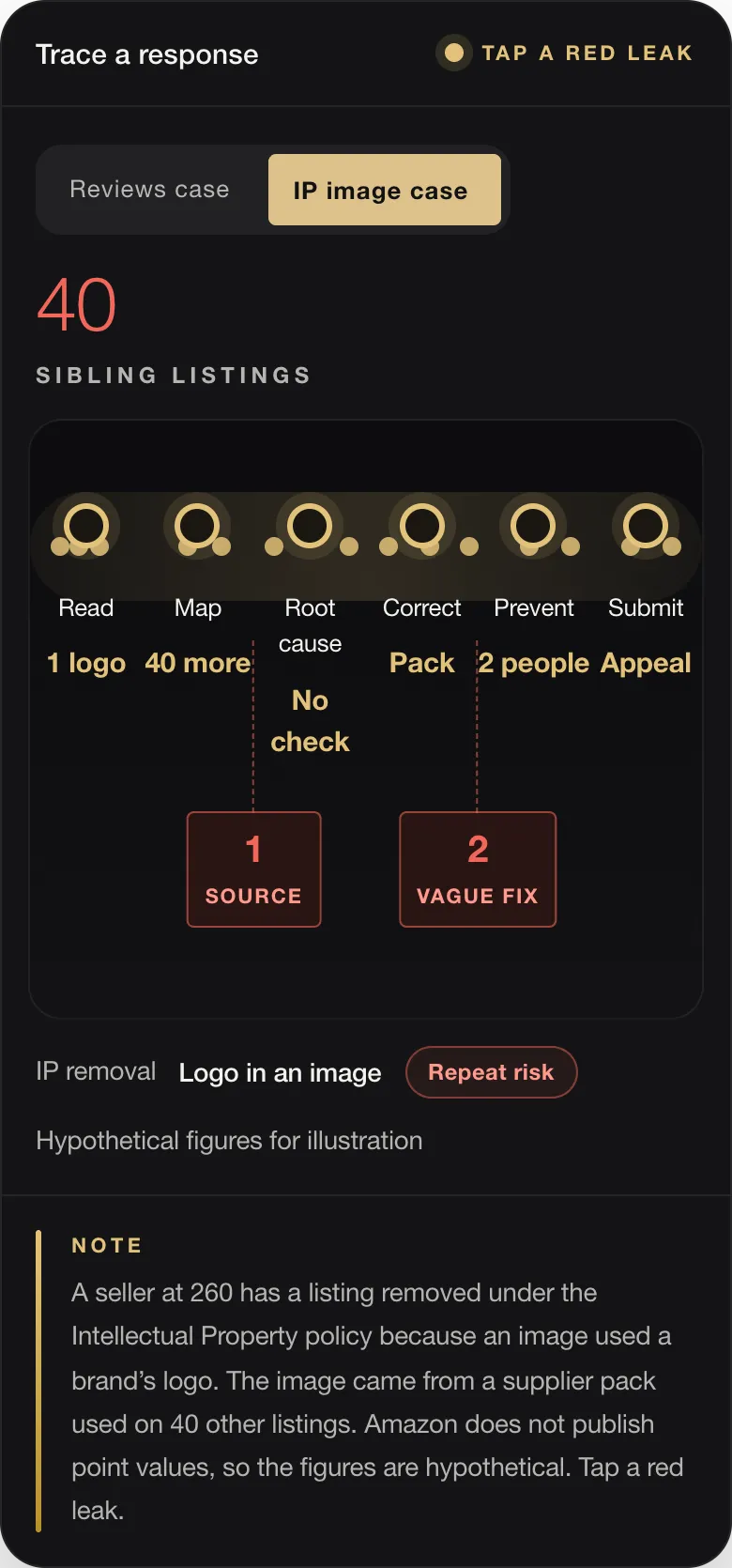
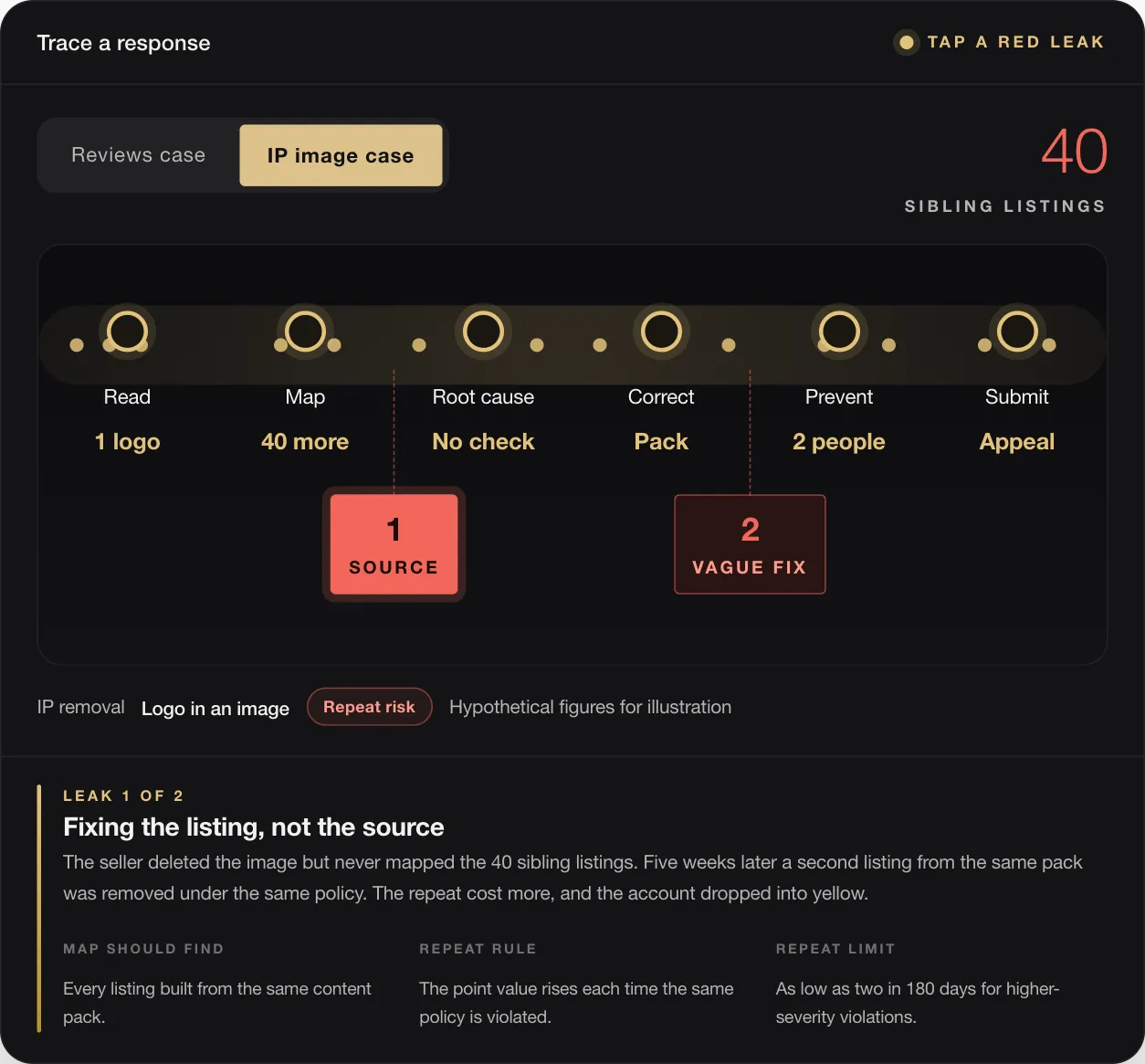
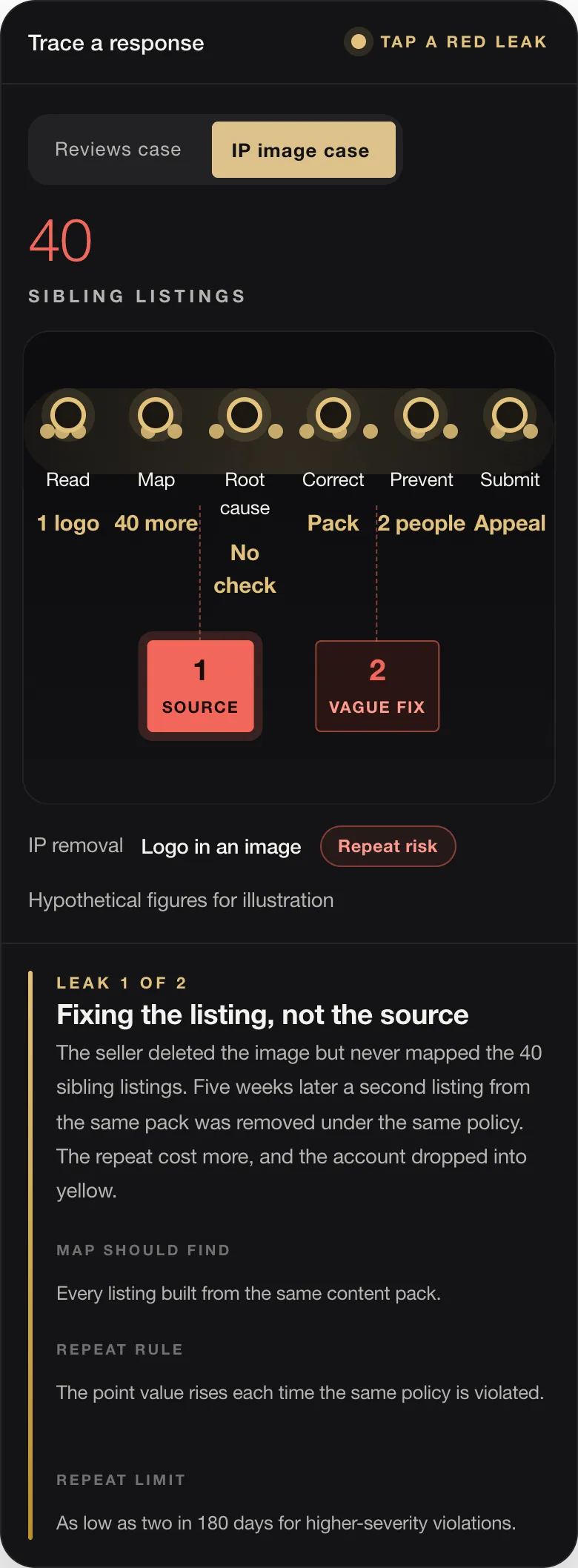
Amazon does not publish per-violation point values, so these numbers are hypothetical. A seller sits at 260. A listing is removed under the Intellectual Property policy because an image used a brand’s logo. The seller deletes the image but does not check the 40 other listings built from the same supplier image pack. Five weeks later a second listing from that pack is removed under the same policy. The repeat costs more than the first, and the account drops into yellow. The fix that would have prevented it was an audit of every listing from the same source.
The policies the score includes
Amazon’s current list, which it says will be updated as policies are added, is below, grouped by how sellers get caught.
| Enforcement group | Policies included in AHR |
|---|---|
| Account conduct | Selling policies and seller code of conduct; Communication guidelines; INFORM Consumers Act |
| Catalog and listings | ASIN Creation policy; Product detail page rules; Amazon Brand Name policy |
| Products | Intellectual Property; Anti-Counterfeiting; Restricted Products; Product safety and compliance; Product condition guidelines; guidelines for adult products and for selling software |
| Pricing | Amazon Marketplace Fair Pricing policy |
| Reviews | Customer Product Reviews Policies |
Amazon says it uses machine learning, automation and expert human review to find non-compliance, and that its tools learn daily. Assume detection is continuous, not complaint-driven only.
Account conduct: the agreement and the Seller Code of Conduct
Conduct violations are about how you operate, not what you sell, and they produce the vaguest notices. A notice citing the Code of Conduct tells you which rulebook was used, not which rule. The work is narrowing it to the specific conduct before writing anything.
What the Code of Conduct requires
Amazon’s code says sellers must provide accurate information, act fairly, not damage other sellers, not influence ratings or reviews, not send unsolicited communications, contact customers only through Buyer-Seller Messaging, not circumvent the sales process, not run more than one account without a legitimate business need, and not violate price fixing laws. Its examples of unfair activity include creating multiple detail pages for the same product, manipulating sales rank with paid or externally refunded orders, raising a price after an order is confirmed, inflating traffic with bots or paid clicks, keyword manipulation, and allowing others to act on your behalf in a way that violates policy.
The typical violations
Three patterns cover most cases. Information accuracy: a business name that does not identify the business, a product in the wrong category, or details left outdated. Third-party conduct: an agency or “ranking service” did something prohibited, and the code is explicit that letting others act for you in a violating way is your violation. Multiple accounts: Amazon allows one account per region unless there is a legitimate business need and all accounts are in good standing, with examples such as separate businesses for separate brands, and says that if any account is not in good standing it may deactivate all of them. Amazon also says sellers who file infringement notices as a brand’s agent to benefit their own selling account may be terminated. Our guide to Code of Conduct suspensions covers the appeal side.
How to check your account
- Compare legal name, address, contacts and bank details in your account settings with current registration documents.
- List every user login and connected tool, each with a named owner and a current reason for access. Remove the rest.
- Read a sample of your Buyer-Seller Messages and inserts for anything promotional or anything pointing buyers off Amazon.
Catalog and listings: how detail pages get you caught
Catalog violations rarely start with a dramatic notice. They start with a listing created quickly, copied from a supplier or merged into the wrong variation family, and surface weeks later.
Duplicate pages, accuracy and the brand field
The ASIN Creation policy and Product detail page rules are both scored, and the Code of Conduct names creating multiple detail pages for the same product as misleading. Sellers do it to escape an old listing, to avoid old reviews, or because a tool created a new ASIN instead of matching. All produce the same violation.
The Restricted Products page requires accurate categorisation and description, then adds a sharper warning: listings that are purposefully inaccurate, miscategorised or deceptively described to get around category, product and listing restrictions may lead to immediate termination. Moving a restricted item into another category to avoid a gate is not a listing error; it is circumvention. The Brand Name policy is scored too, and the IP policy explains that Amazon treats a brand as a name shared by products through a common name, logo or mark on the product or packaging. A brand field that does not match the item is an accuracy problem with brand consequences.
Variations and reviews
Amazon’s reviews policies list creating a variation relationship to manipulate reviews and boost star rating through review aggregation as a violation. Merging a new product into an established parent to borrow its reviews is a reviews case as well as a catalog one.
How to check your catalog
- Export active listings and look for near-identical titles under different ASINs you created.
- Confirm every variation child is the same product differing only by an attribute such as size or colour.
- When one listing from a supplier content pack is flagged, check every listing from that pack.
Products: intellectual property, counterfeits and restricted items
Product violations carry the heaviest consequences, but they also have the clearest evidence standards, which helps if your sourcing is genuine.
Intellectual property
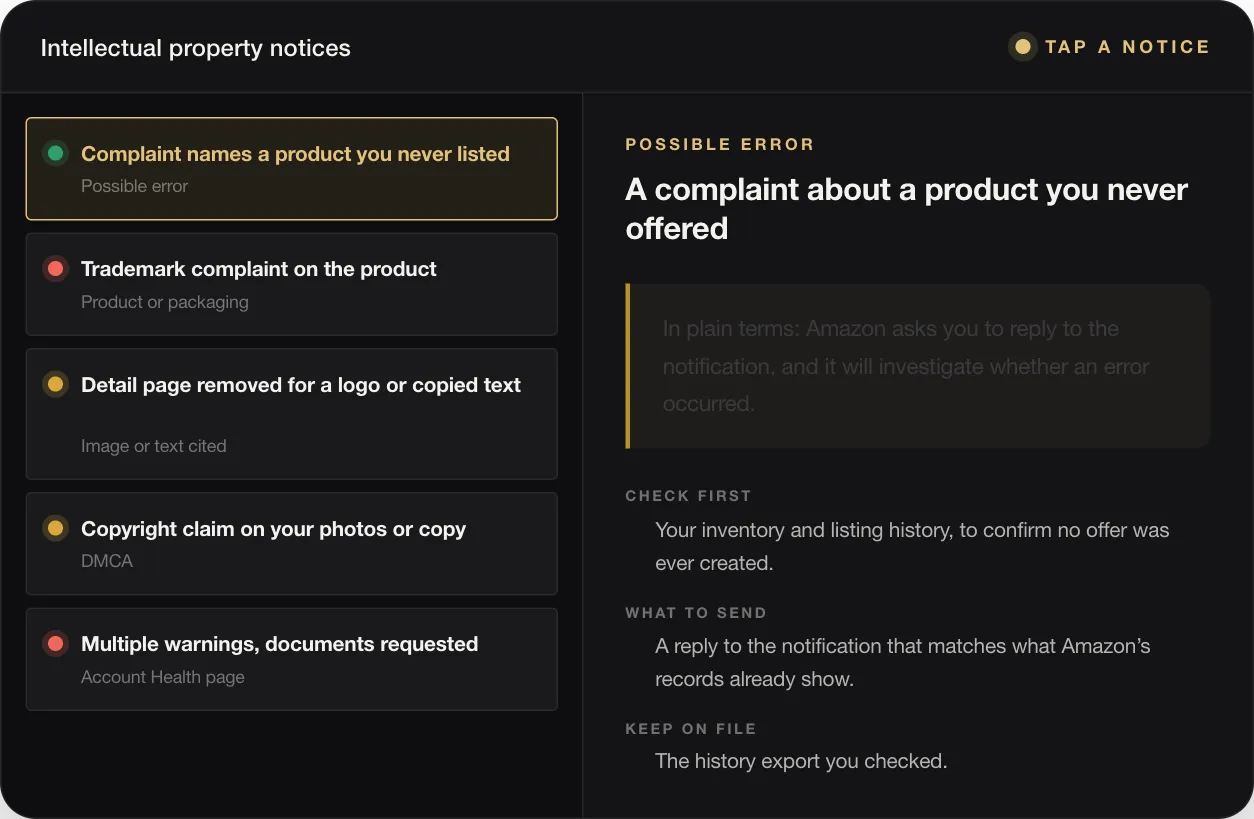
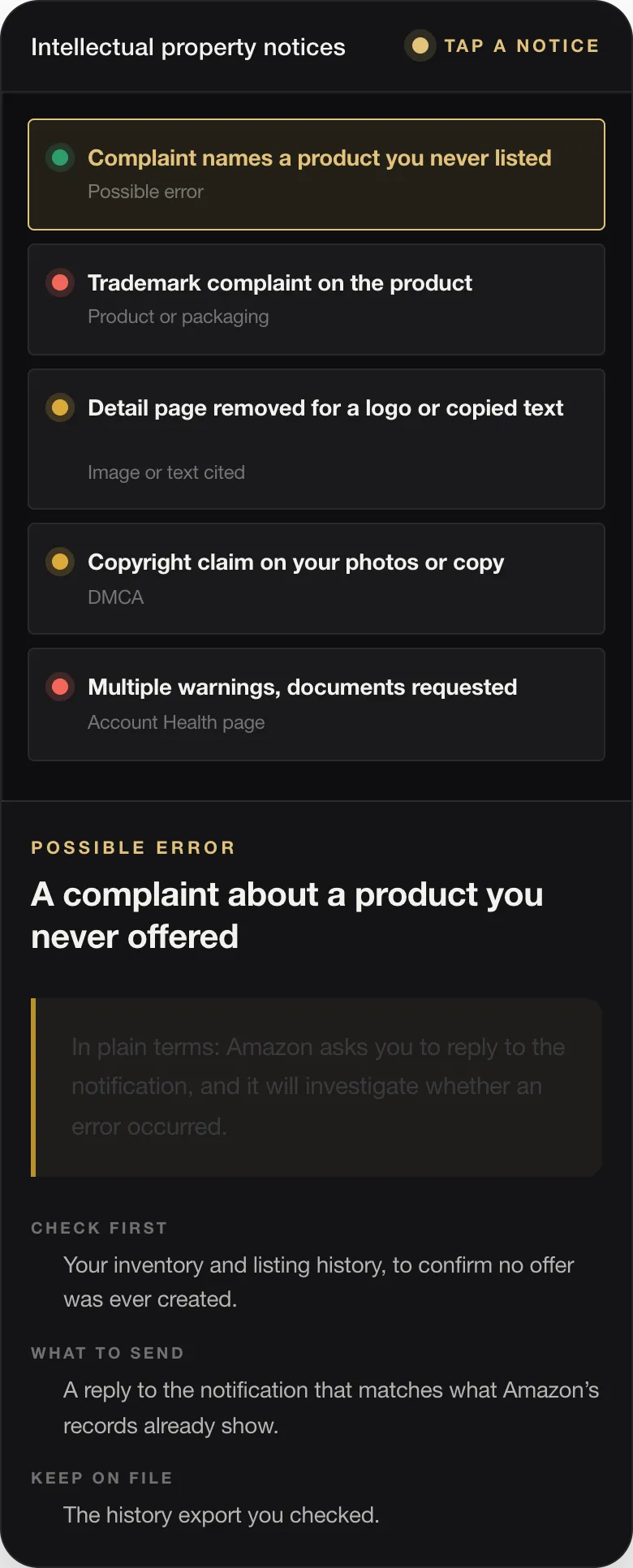
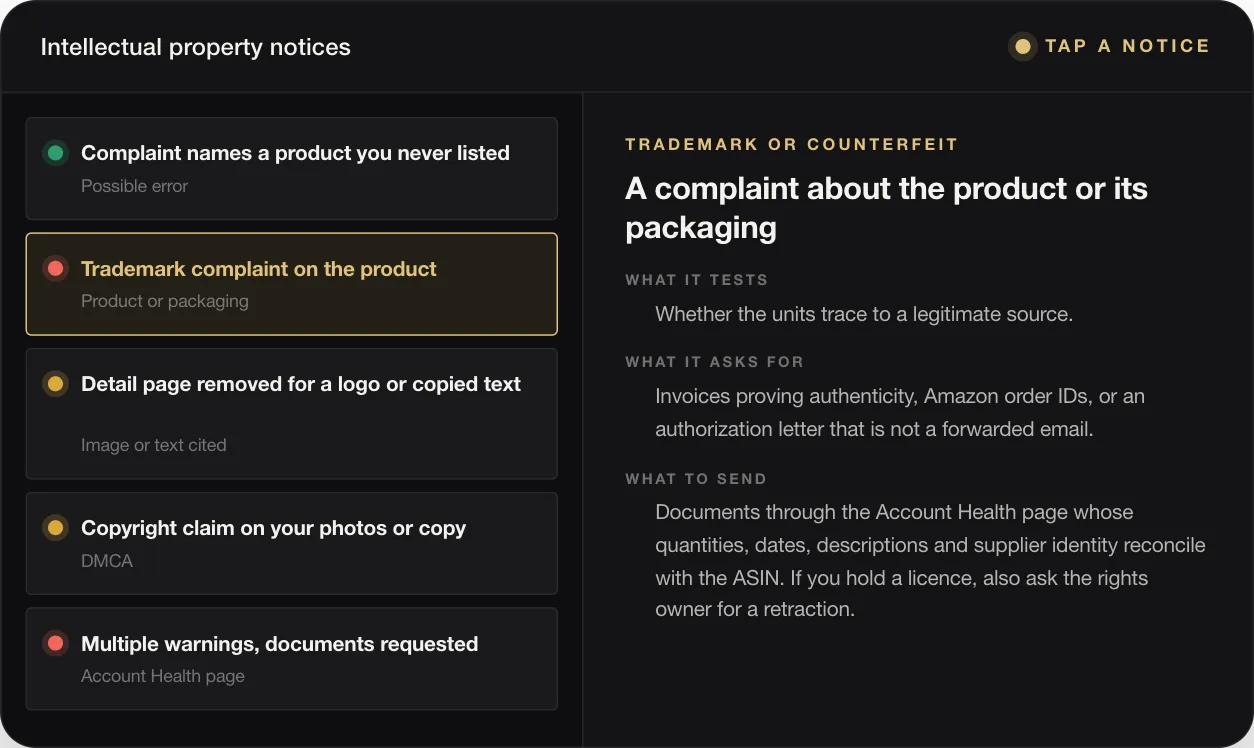
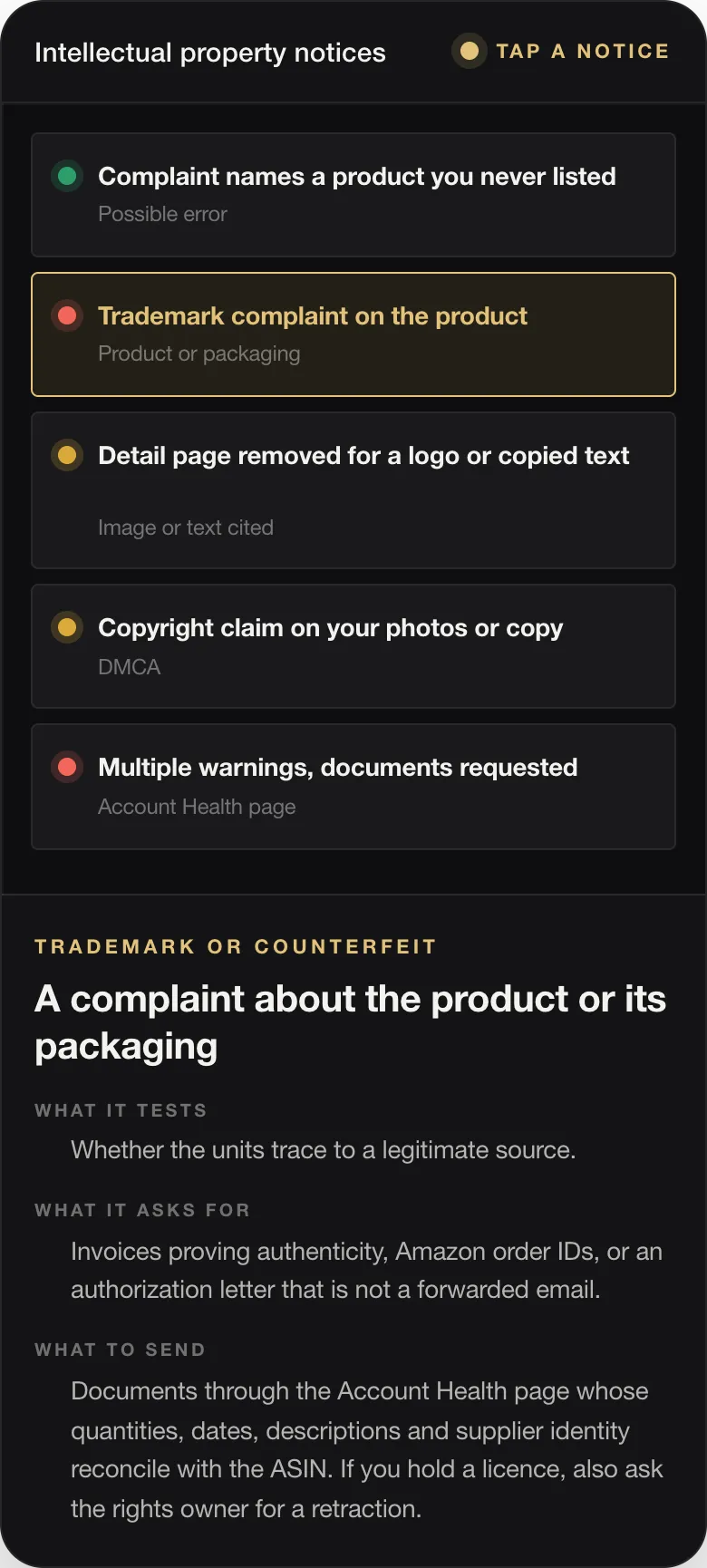
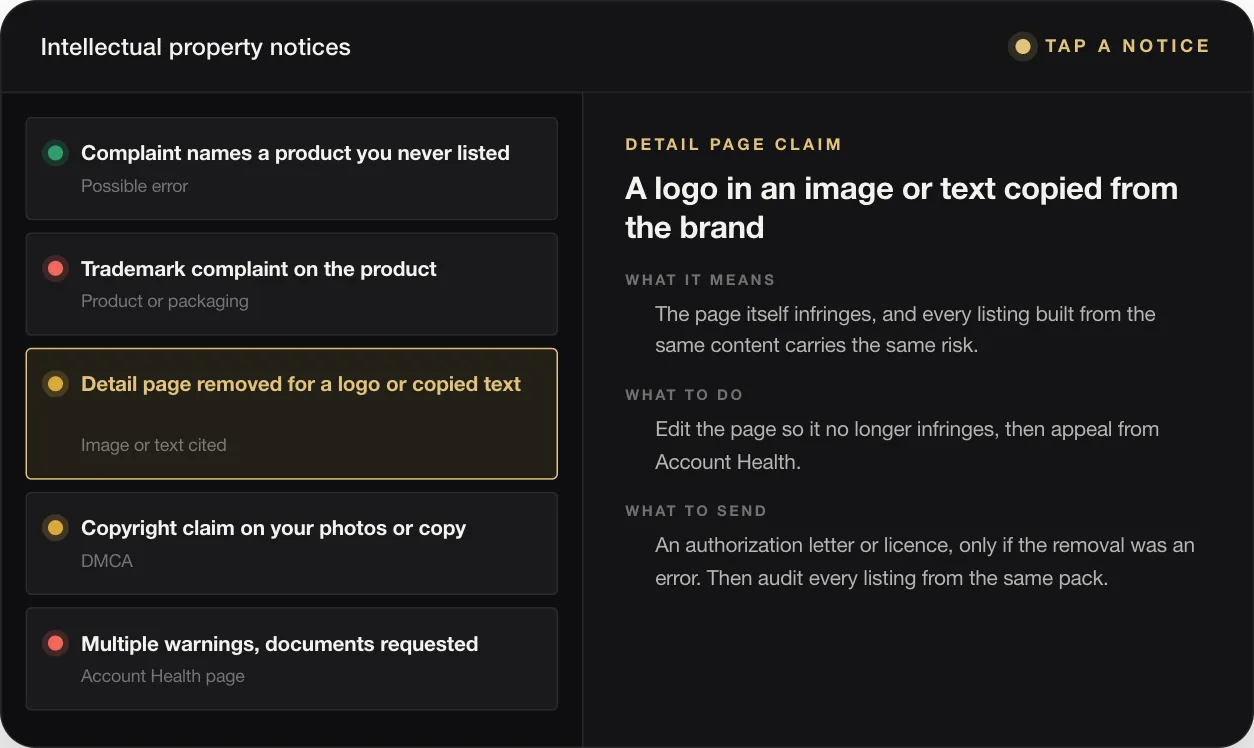
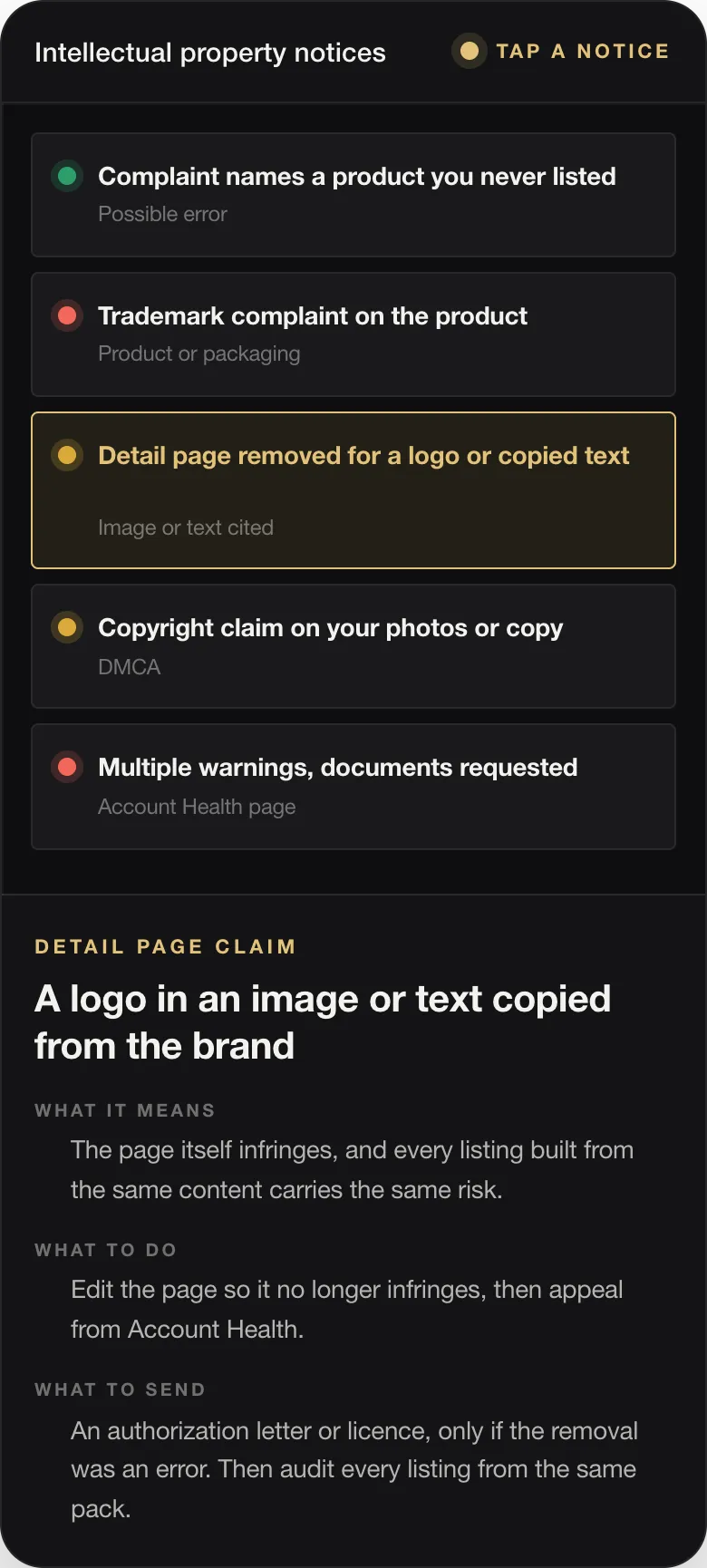
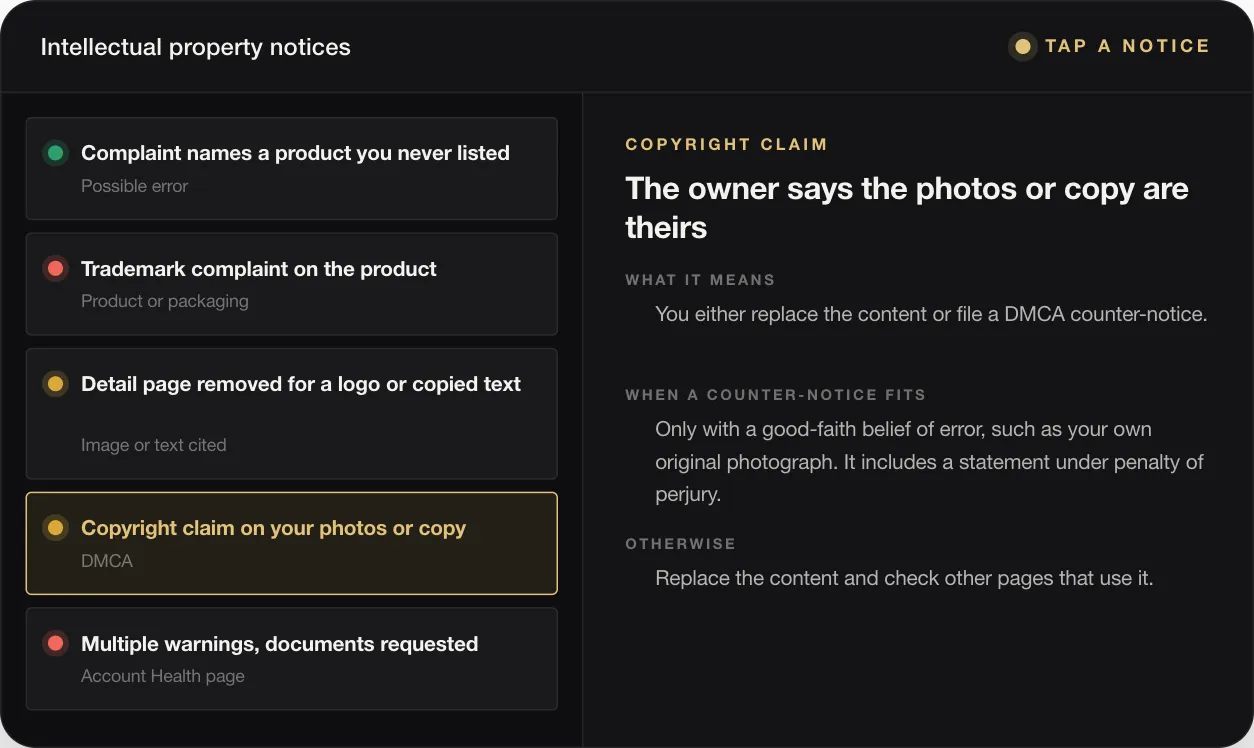
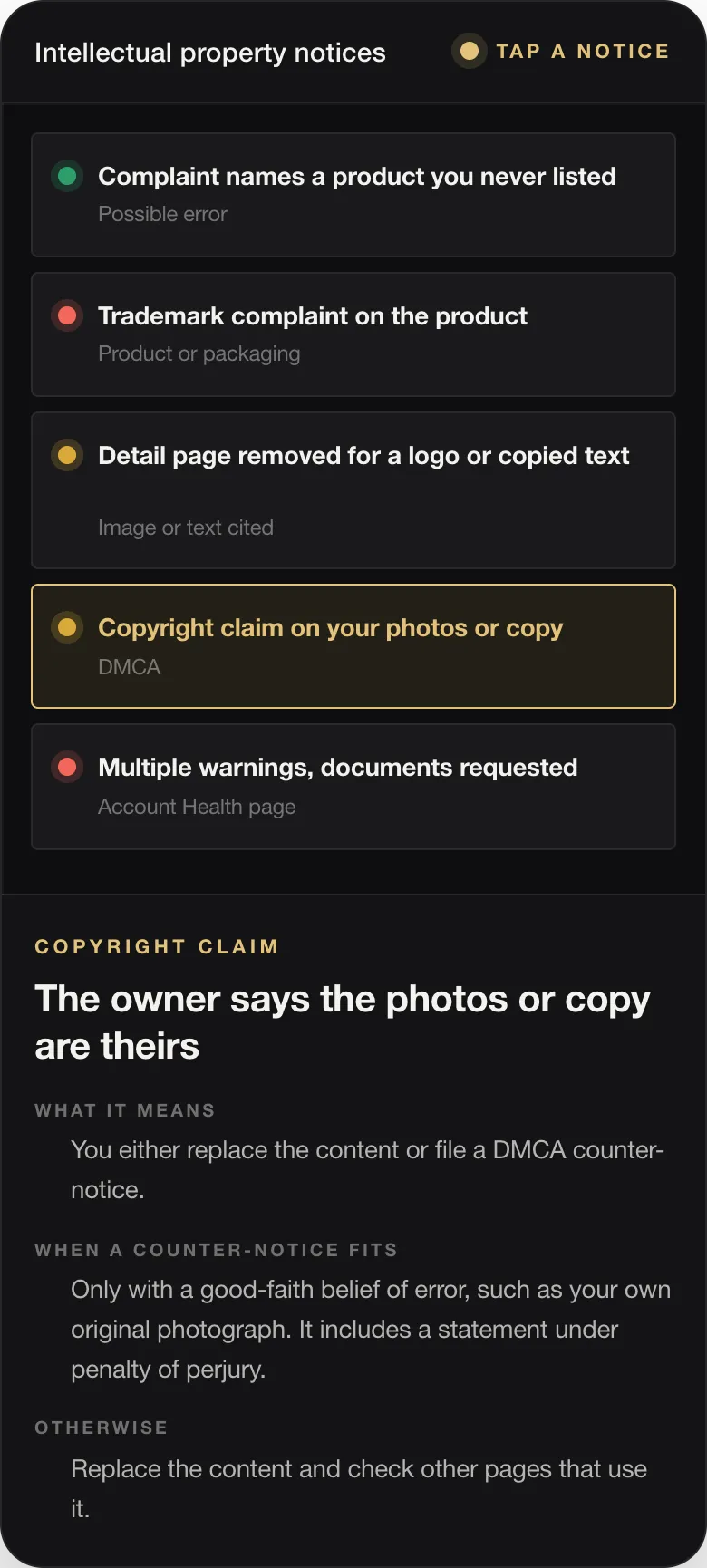
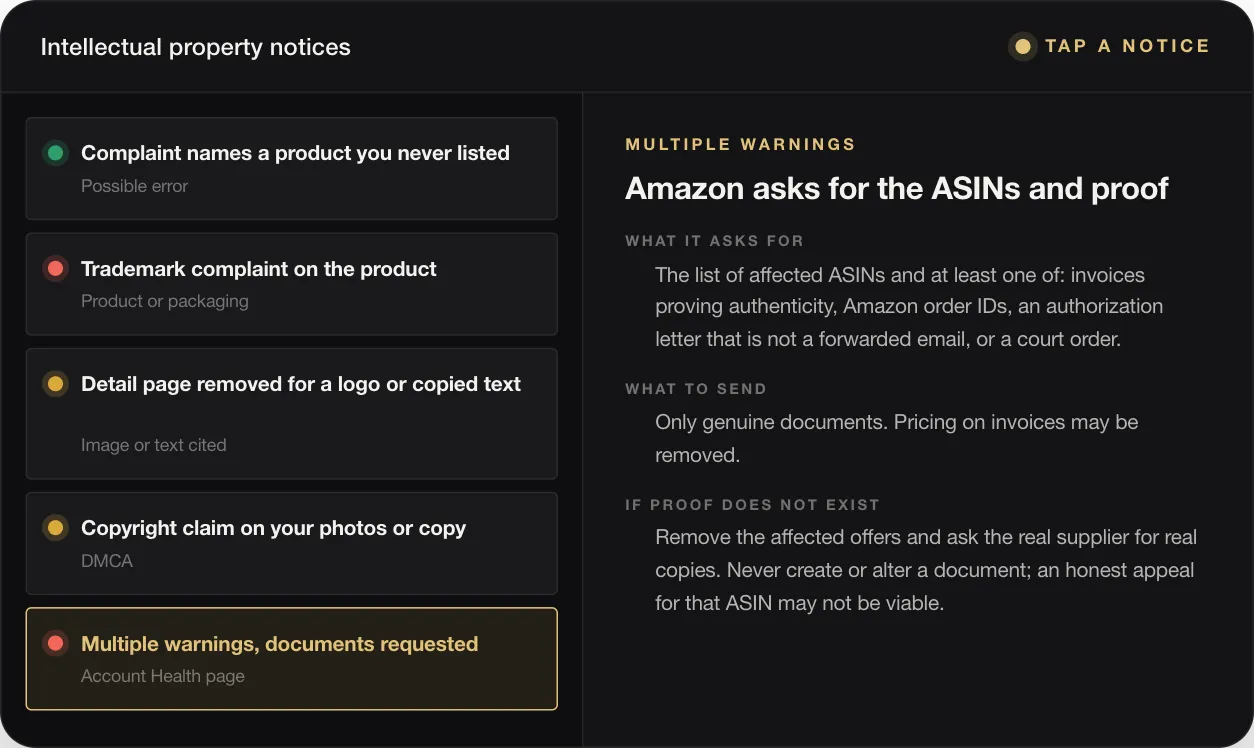
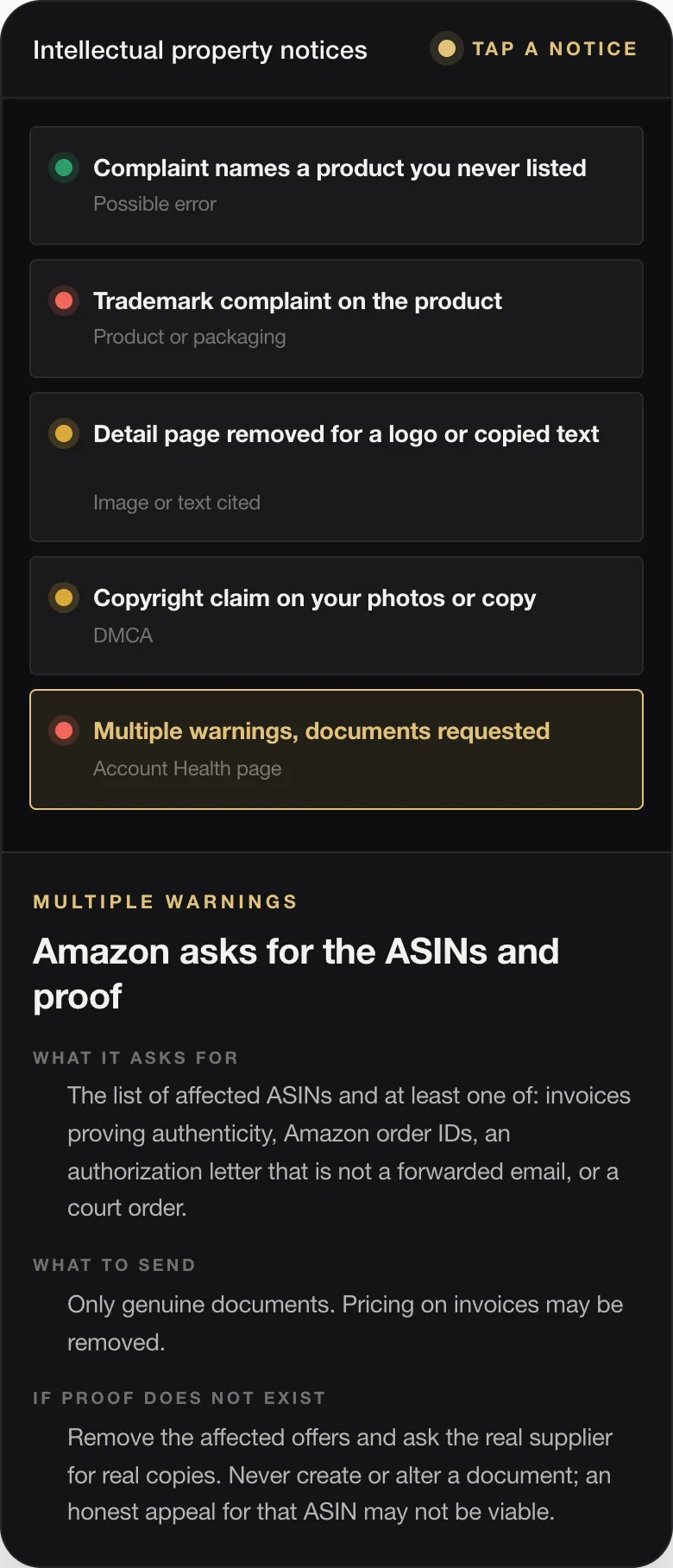
Amazon’s IP policy covers copyrights, trademarks and patents, and says violations may result in loss of selling privileges or other legal consequences. Amazon acts even when a seller infringes without knowledge, and terminates repeat infringers in appropriate circumstances. For multiple warnings, Amazon asks for the list of ASINs and at least one of: invoices proving authenticity (pricing may be removed), Amazon order IDs, an authorization letter from the rights owner that is not a forwarded email, or a court order. The response depends on the notice type, so use the path below. This is educational information, not legal advice; Amazon’s own policy recommends a lawyer for specific IP questions. For more, see what an intellectual property complaint actually is.
Five IP cases, one inbox. Open yours.
The right response depends on whether you listed the product, which right is cited and what documents you genuinely hold. Notice subjects here are paraphrased, not Amazon’s wording.
Anti-counterfeiting
The Anti-Counterfeiting policy is scored separately. A counterfeit allegation questions whether your goods are genuine at all, so the evidence is supply-chain proof: invoices from a source traceable to the brand or its authorized distribution, covering what you sold. Program Policies also lists a page on invoice requirements for appealing a policy violation; read its current version before submitting. See our article on the anti-counterfeiting policy.
Restricted products
The Restricted Products page prohibits illegal, unsafe or other restricted products, including prescription-only items. Listed consequences include immediate suspension or termination, destroying fulfillment center inventory without reimbursement, and permanently withholding payments, with possible civil and criminal penalties. Restricted areas include dietary supplements, cosmetics, food and beverage, medical devices, pesticides, prohibited product claims, recalled products and products needing an EPA Certificate of Conformity, among many others. Some categories need pre-approval, FBA sellers must also check FBA Product Restrictions, and “FDA Cleared” or “FDA approved” claims carry additional requirements. Our guide to restricted products you cannot sell walks through the categories.
Restricted product problems often come from claims rather than the item itself. A product may be legal to sell, but a listing that adds an unsupported health, safety or regulatory claim can turn it into a restricted listing. The same listing can also drift into trouble when a supplier changes a formula or packaging and the detail page is never updated, which is why the page content, the physical product and your compliance documents should be checked together rather than one at a time.
How to check your products
- For each brand you resell, confirm you hold traceable invoices covering units sold.
- Look up each brand in the USPTO Trademark Search system to see who owns the mark.
- Search the CPSC recalls database by category and date, and read your category’s restricted products and prohibited claims pages against each listing.
Pricing: the Fair Pricing policy
Amazon agrees sellers set their own prices, but its Fair Pricing policy says it regularly monitors prices, including shipping, against other prices available to customers. Practices that harm customer trust include a misleading reference price, a price significantly higher than recent prices on or off Amazon, multi-packs priced higher per unit than a single, and excessive shipping fees, judged against current public carrier rates, reasonable handling and buyer perception. Actions run from removing the Featured Offer or the offer, or suspending the ship option, up to suspension or termination in serious or repeated cases.
Most cases we see are automation, not deliberate gouging: a repricer with a high maximum follows a competitor out of stock, a multi-pack price is never revisited, or an old shipping template no longer matches carrier rates. See the pros and cons of automated pricing. To check: confirm every repricer rule has a sensible maximum, divide each multi-pack price by its unit count, and compare shipping charges with published USPS, UPS or FedEx rates.
Reviews: the policy Amazon calls zero tolerance
Amazon’s reviews policies state zero tolerance. Possible actions include permanent withdrawal of selling privileges and withholding of funds, removal of all the product’s reviews, permanent delisting, legal action and referral to authorities, and publicly disclosing the seller’s name.
What the policy prohibits
Examples include reviewing your own or a competitor’s product; compensation or free products for reviews, including through review services or social media groups; refunds tied to changing or removing a review; review clubs; reviews by family or employees; diverting negative reviews elsewhere while sending positive ones to Amazon; variation manipulation; review requests or incentives in packaging; and using a customer account to write reviews. “Seller” includes employees and third-party partners, and Amazon says their infractions bring enforcement even without your knowledge or consent. The Code of Conduct permits neutral review requests to your own customers, but not incentives, positive-only requests, or asking only happy customers.
Federal law points the same way. The FTC’s Rule on the Use of Consumer Reviews and Testimonials, 16 CFR Part 465, covers fake reviews, buying positive or negative reviews, undisclosed insider reviews, company-controlled review sites and review suppression. See our article on faking reviews.
How to check your review practices
- Read every insert and template for any review mention beyond a neutral request.
- Ask every marketing or launch vendor, in writing, how buyers are recruited and whether anything is free, discounted or refunded around a review.
- Confirm no employee, relative or contractor has reviewed your products or a competitor’s.
Unsure which policy is really at issue?
Send us the notice and we will read the case before anything is submitted.
How Amazon announces policy changes
The AHR policy page says that as new policies launch, Amazon updates its Help pages and tries to share policy or account health changes via Account Health News whenever possible. Note “tries” and “whenever possible”: individual notice is not promised, so staying current is your job. Amazon also says that if account health degrades toward deactivation it may call to offer support, and asks sellers to keep the emergency contact number current under Notification Preferences. Keep a dated list of the policy pages for your categories, re-read them monthly, and log any change and the listings it affects.
Where to verify each policy in your account
| Question | Where to check | What to look for |
|---|---|---|
| What is my risk level? | Account Health page, each store | Score, band and every open violation by policy |
| Am I near a repeat limit? | Account Health policy list | Two or more violations of one policy within 180 days |
| Which policies are scored? | Policies included in AHR help page | The current list |
| Is my information accurate? | Account settings | Details matching current documents |
| Who can act on my account? | User permissions and connected apps | A named owner and reason for each |
| Can I prove authenticity? | Supplier invoices, Amazon order records | Traceable source, matching descriptions and quantities |
| Who owns this brand? | USPTO Trademark Search | Registered owner and goods covered |
| Is my product recalled? | CPSC recalls search | Matches by category, hazard and date |
| Are my prices fair? | Repricer rules, pricing, shipping templates | Spikes, multi-pack math, shipping against carrier rates |
| Did a policy change? | Account Health News, policy pages | Edits affecting your categories since your last check |
When a violation lands: diagnose before you respond
Amazon protects the buyer’s trust; it does not weigh whether a seller is a good person. Appeals arguing fairness or years of good history do not move it. Evidence that the risk has been found, contained and controlled does.
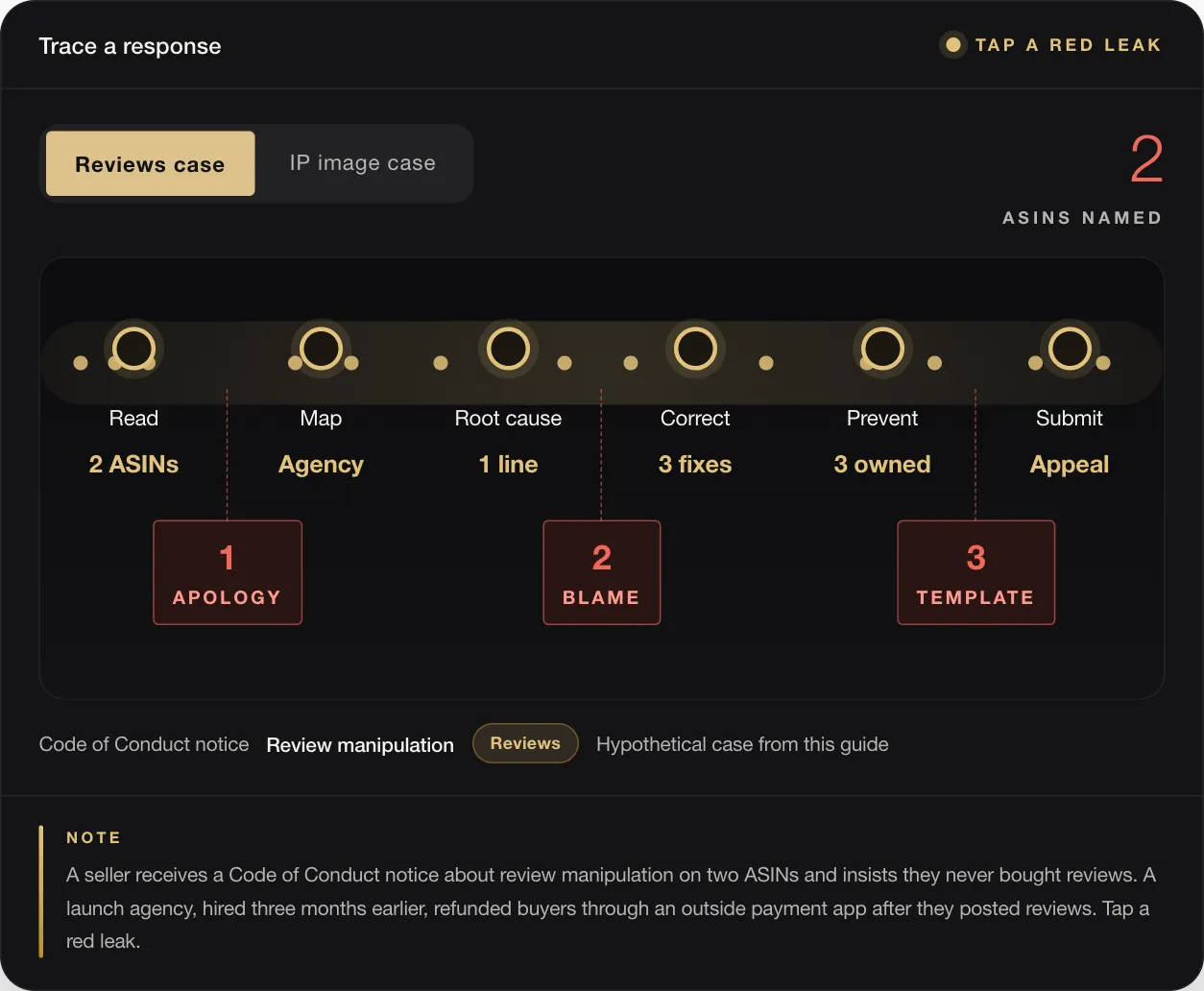
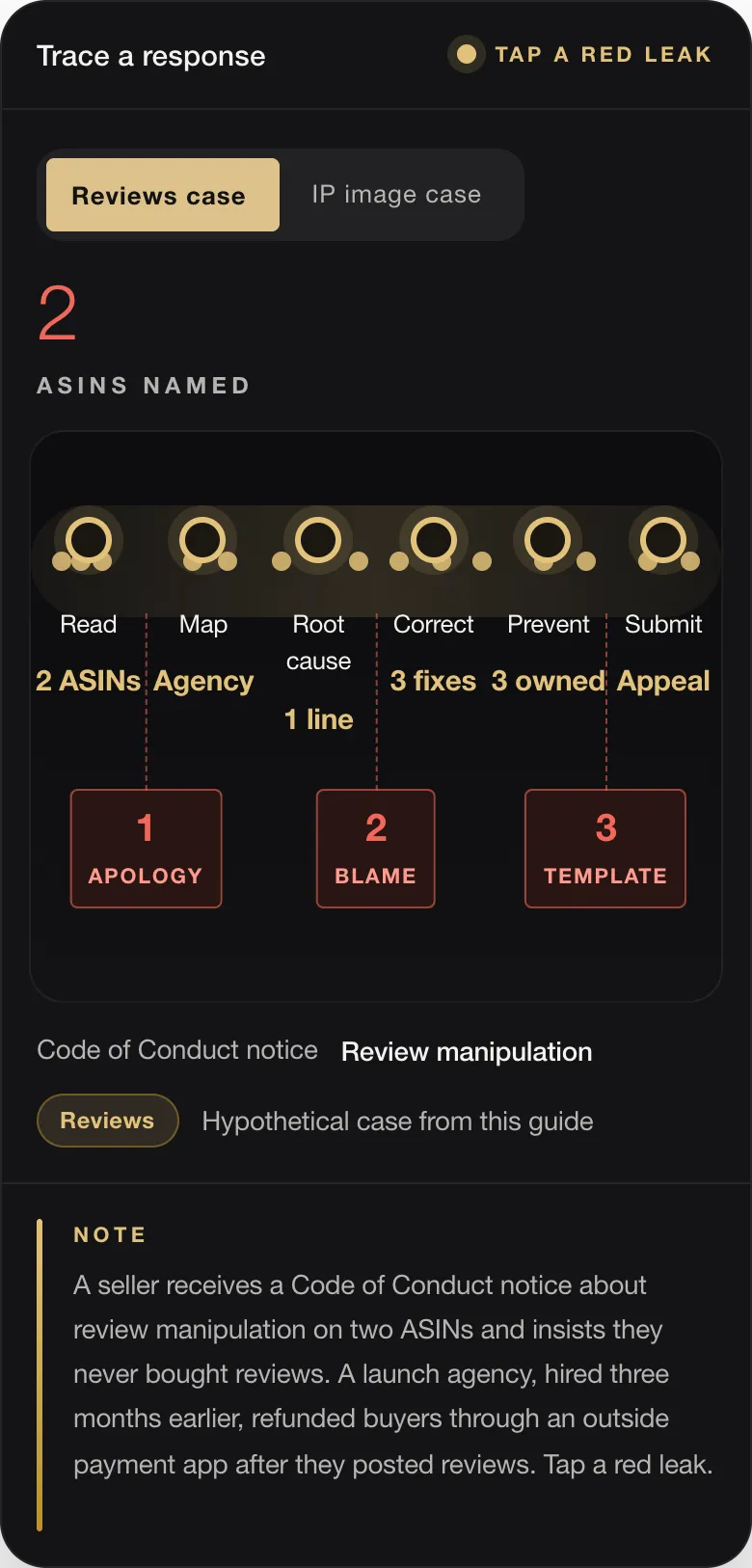
Six stages to an appeal. Find where it fails.
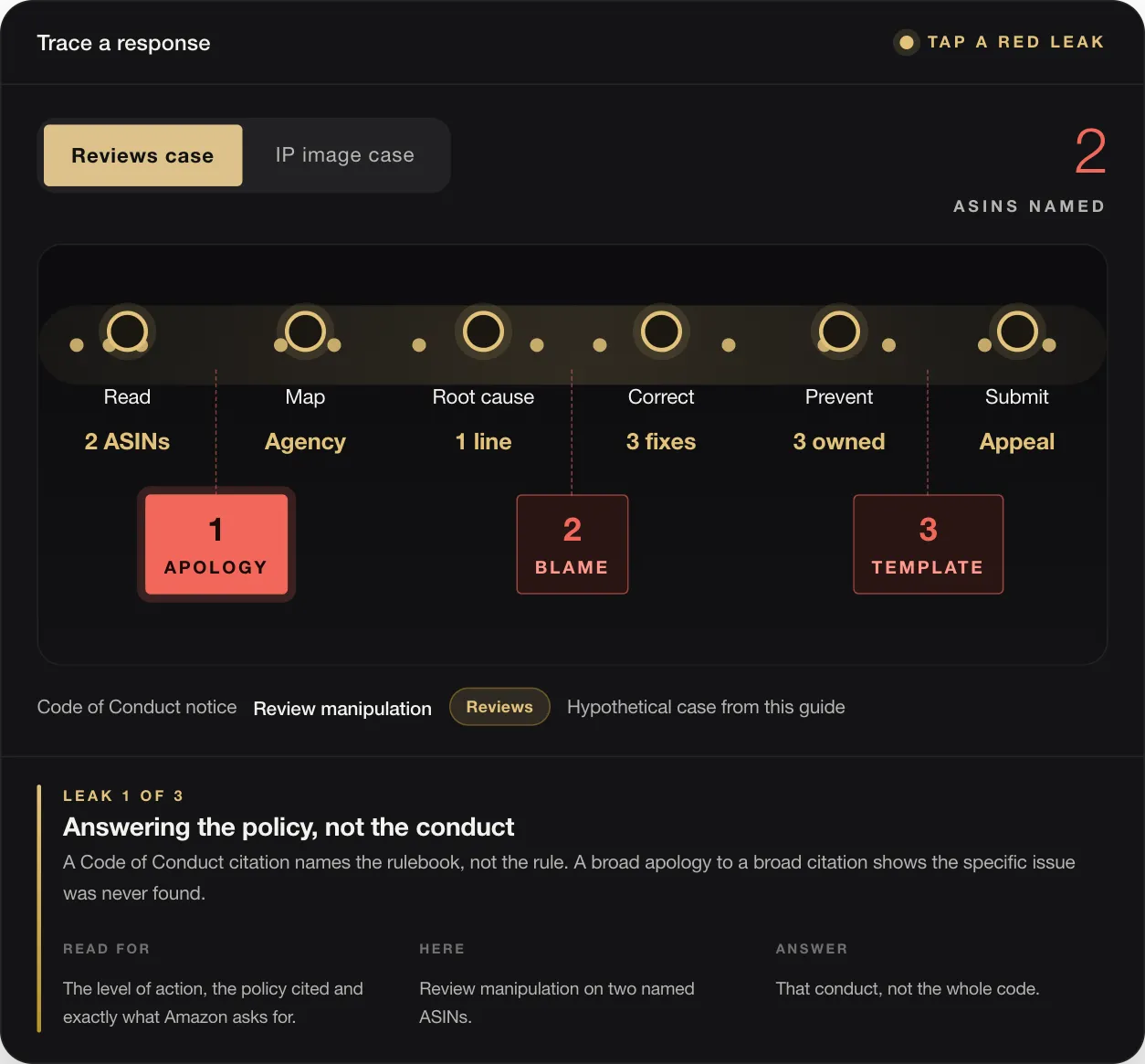
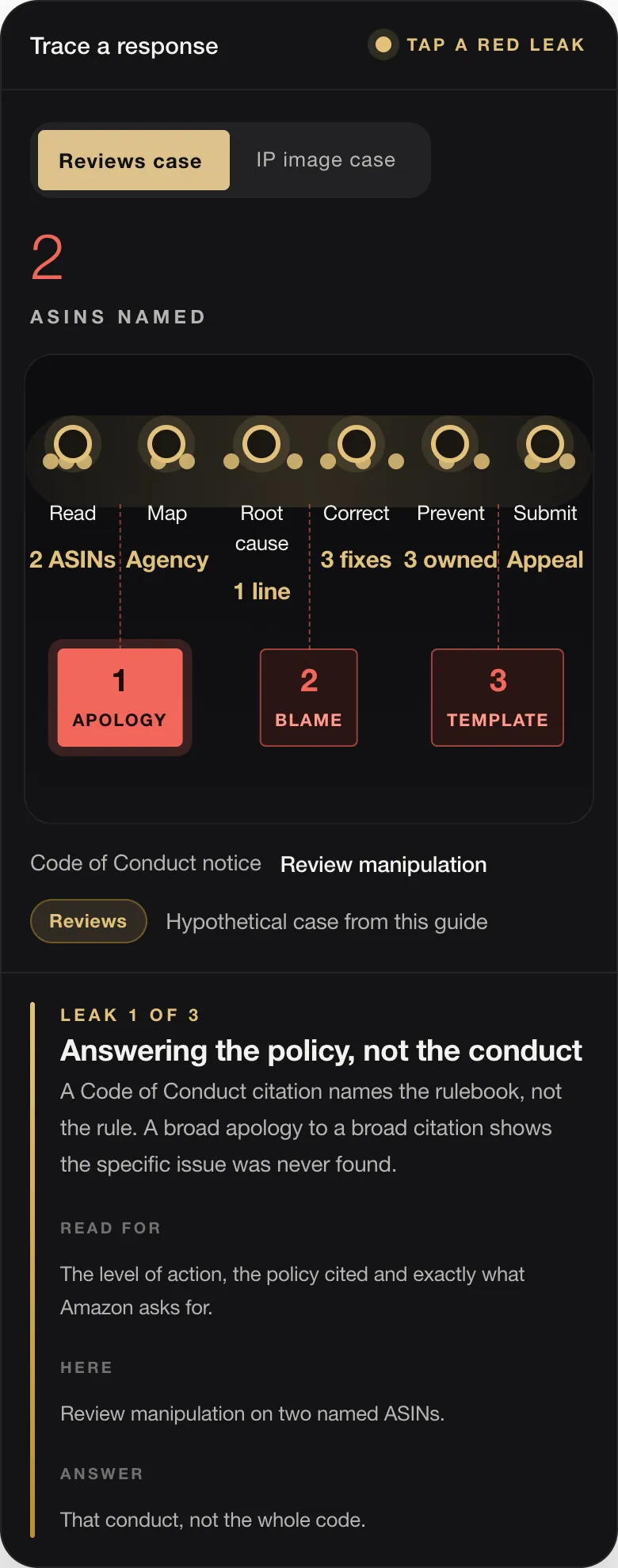
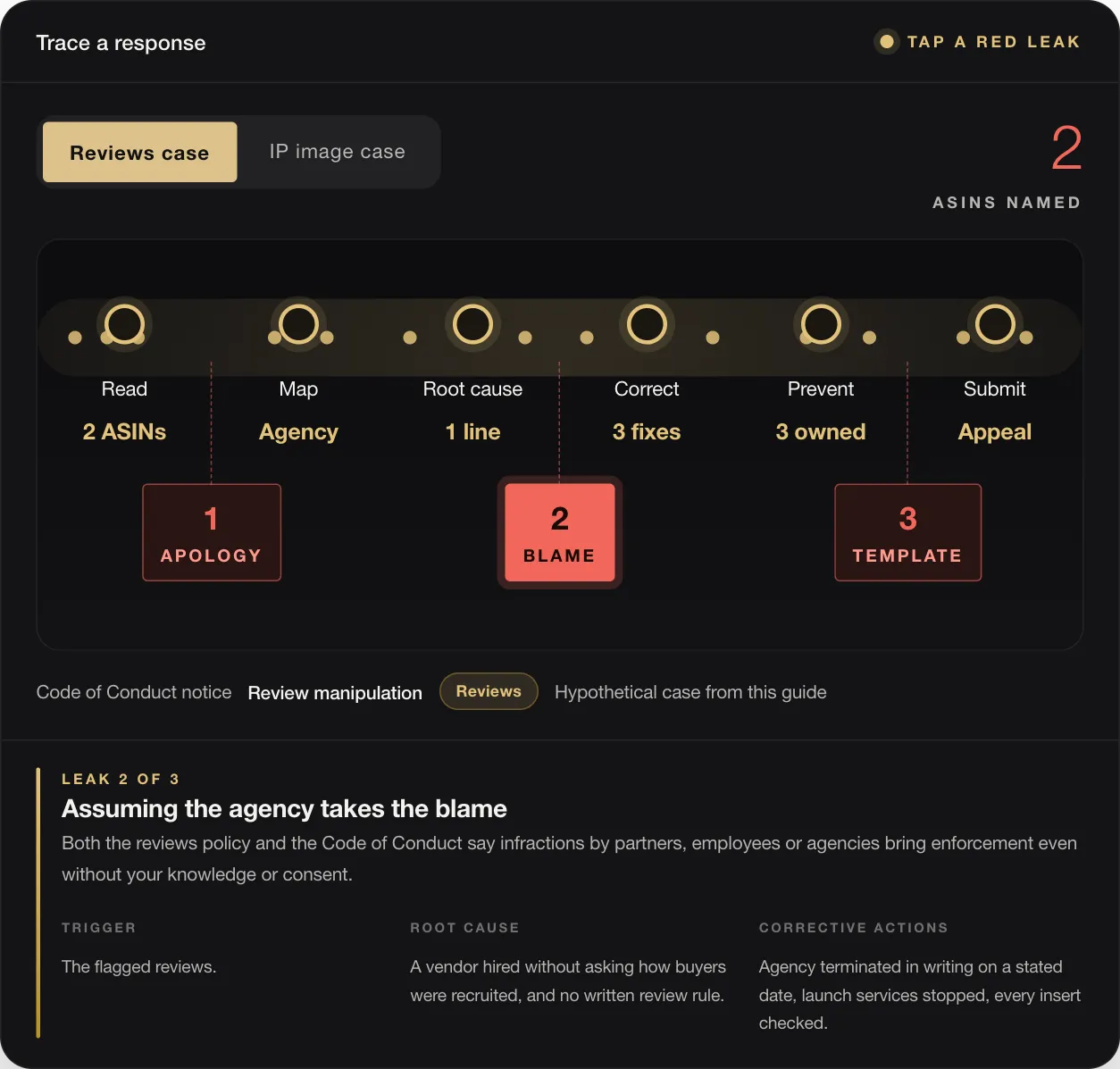
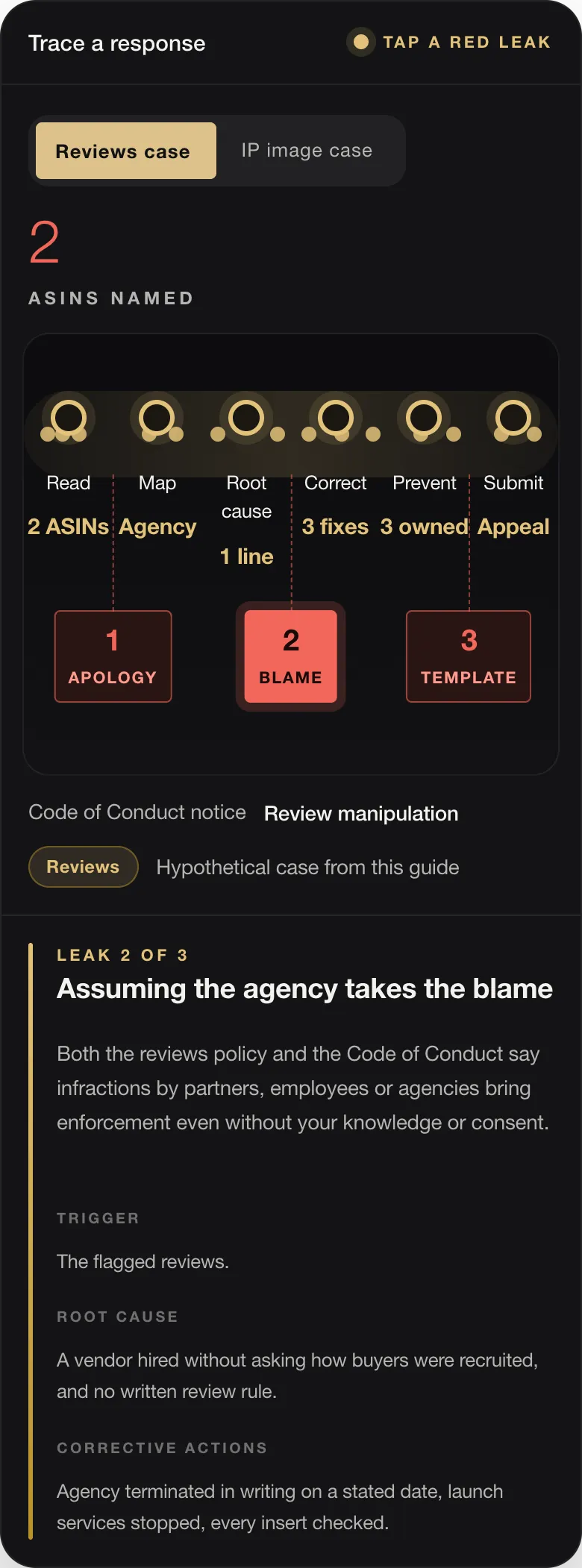
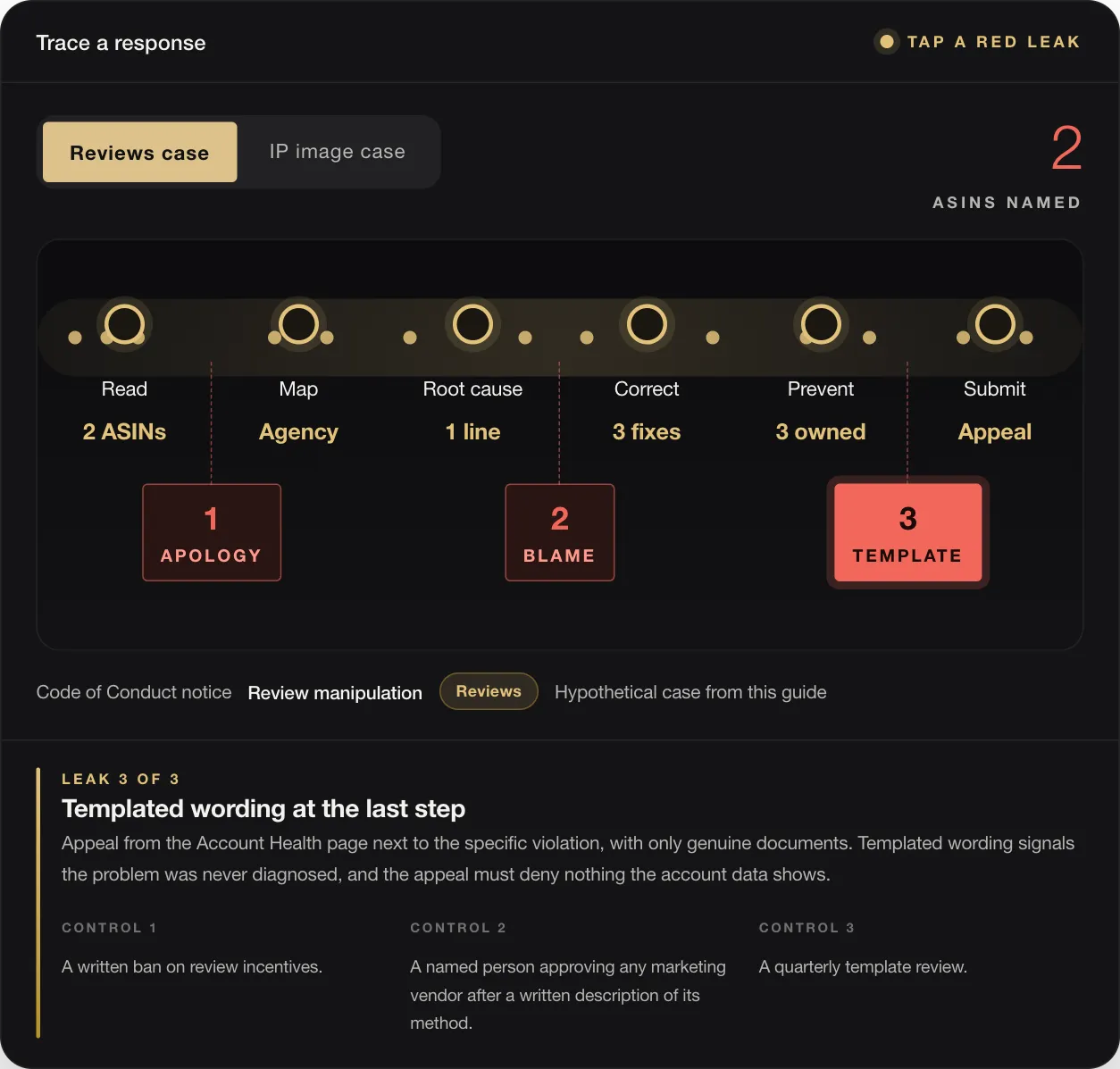
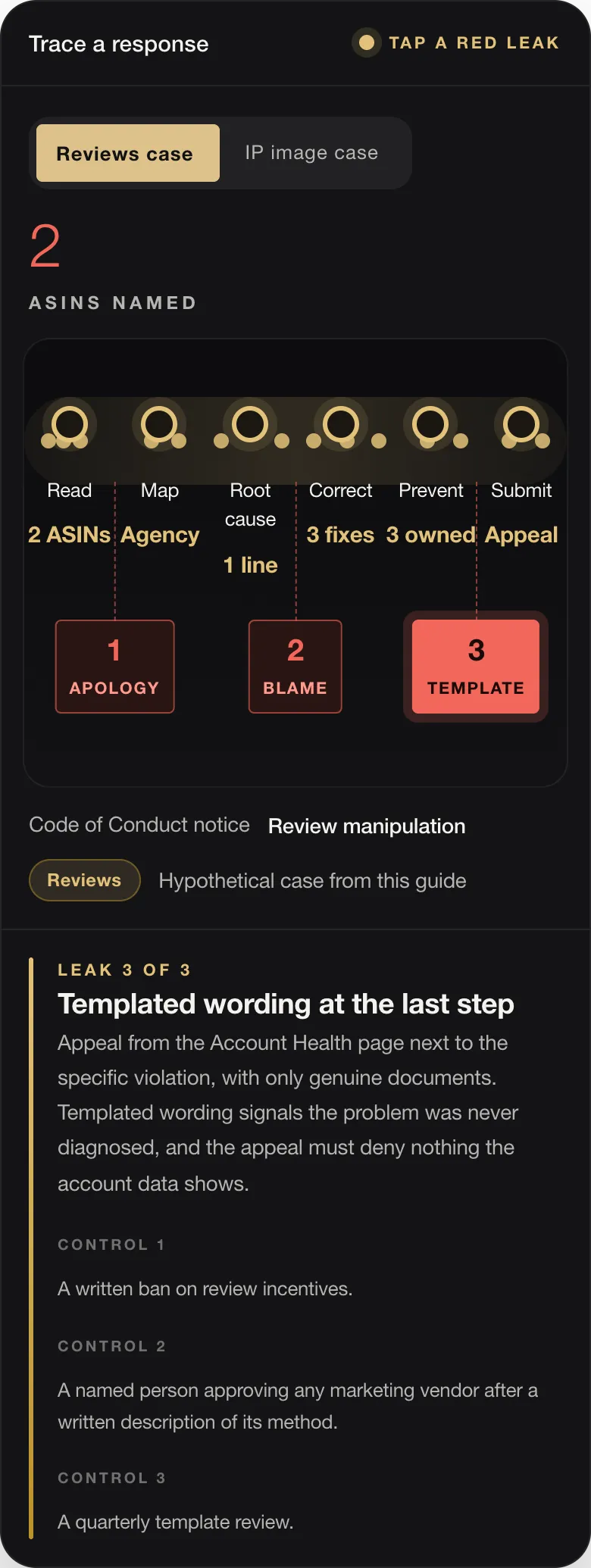
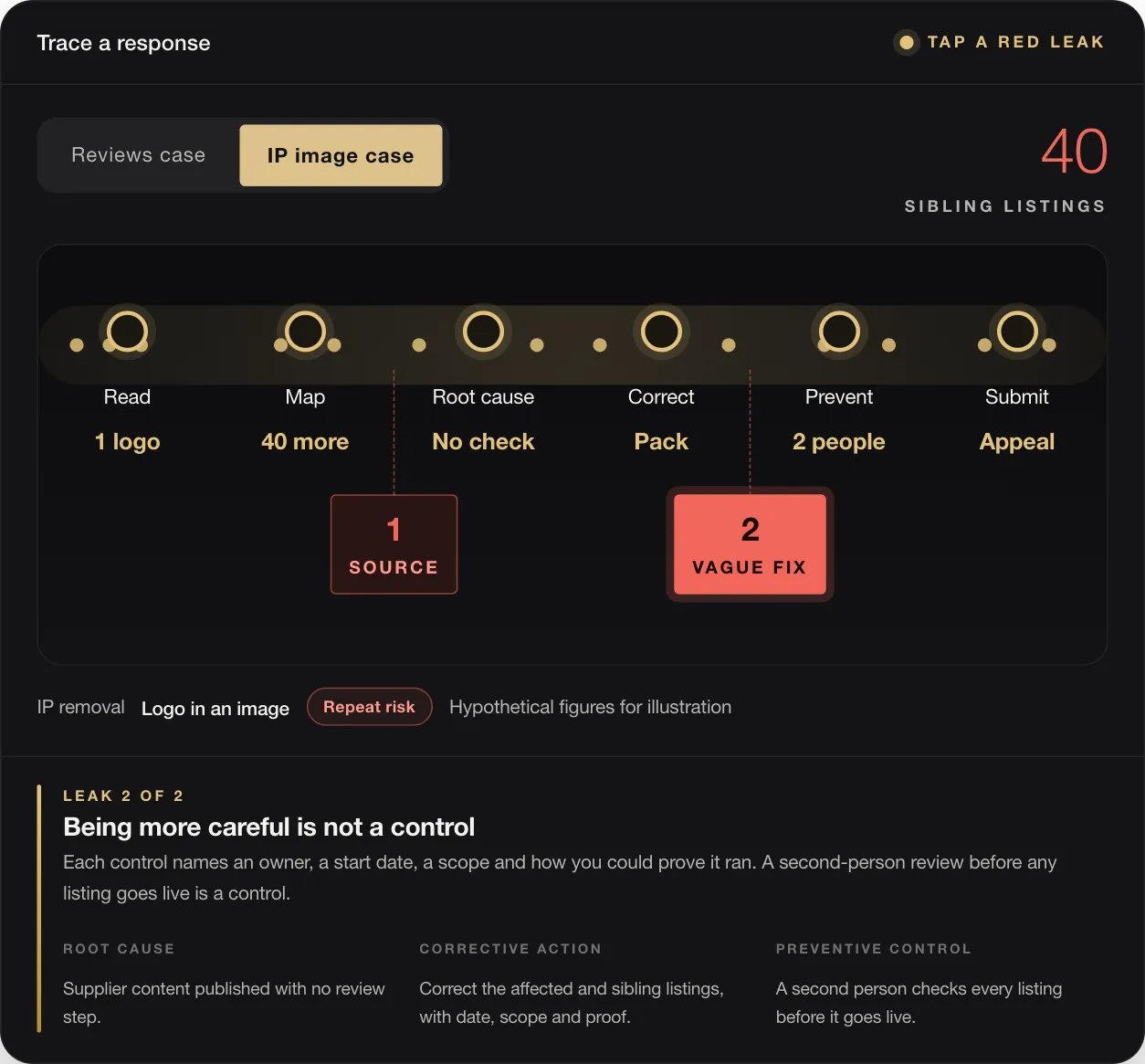
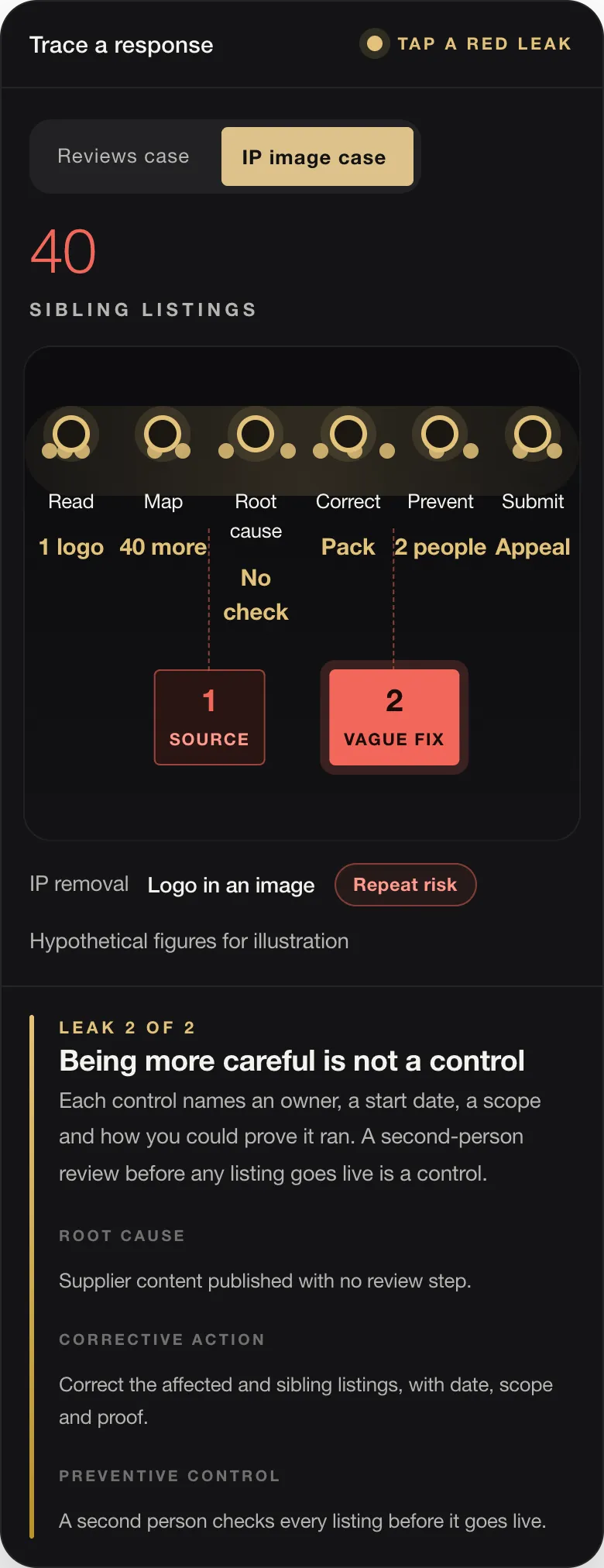
A response Amazon can act on passes through six stages in order. Pick one of this guide’s worked cases and tap a red leak to see where appeals like it break down.
A worked diagnosis
A hypothetical seller receives a Code of Conduct notice about review manipulation on two ASINs and insists they never bought reviews. Investigation shows a launch agency, hired three months earlier, refunded buyers through an outside payment app after they posted reviews. The trigger is the flagged reviews; the root cause is hiring a vendor without asking how buyers were recruited, with no written rule on review solicitation. Corrective actions: the agency terminated in writing on a stated date, all launch services stopped, every insert and template checked. Preventive controls: a written ban on review incentives, a named person approving any marketing vendor after a written description of its method, and a quarterly template review. The appeal answers that conduct, not the whole code, and denies nothing the account data shows.
Evidence standards and honest viability
Every document must be genuine, complete, internally consistent and matched to the violation. Invoices should identify supplier and buyer, describe the product as the ASIN does, and cover quantities sold. Never create, edit or “clean up” a document. If a genuine document cannot be obtained, remove the affected offers and judge honestly whether an appeal for that ASIN is viable. A third-party cause with clean remediation is often strong; a genuinely counterfeit product or deliberate circumvention is much harder.
Mistakes that turn one violation into an account problem
The most common is answering the policy instead of the conduct: a broad apology to a broad citation shows the specific issue was never found. The second is fixing the listing but not the source, leaving the same image pack, repricer rule or vendor active for a costlier repeat. The third is assuming a third party absorbs the blame; both the reviews policy and the code say otherwise. The fourth is ignoring warnings because nothing was removed, though they become part of the record a later action can cite. The fifth is letting account details and the emergency contact number drift out of date.
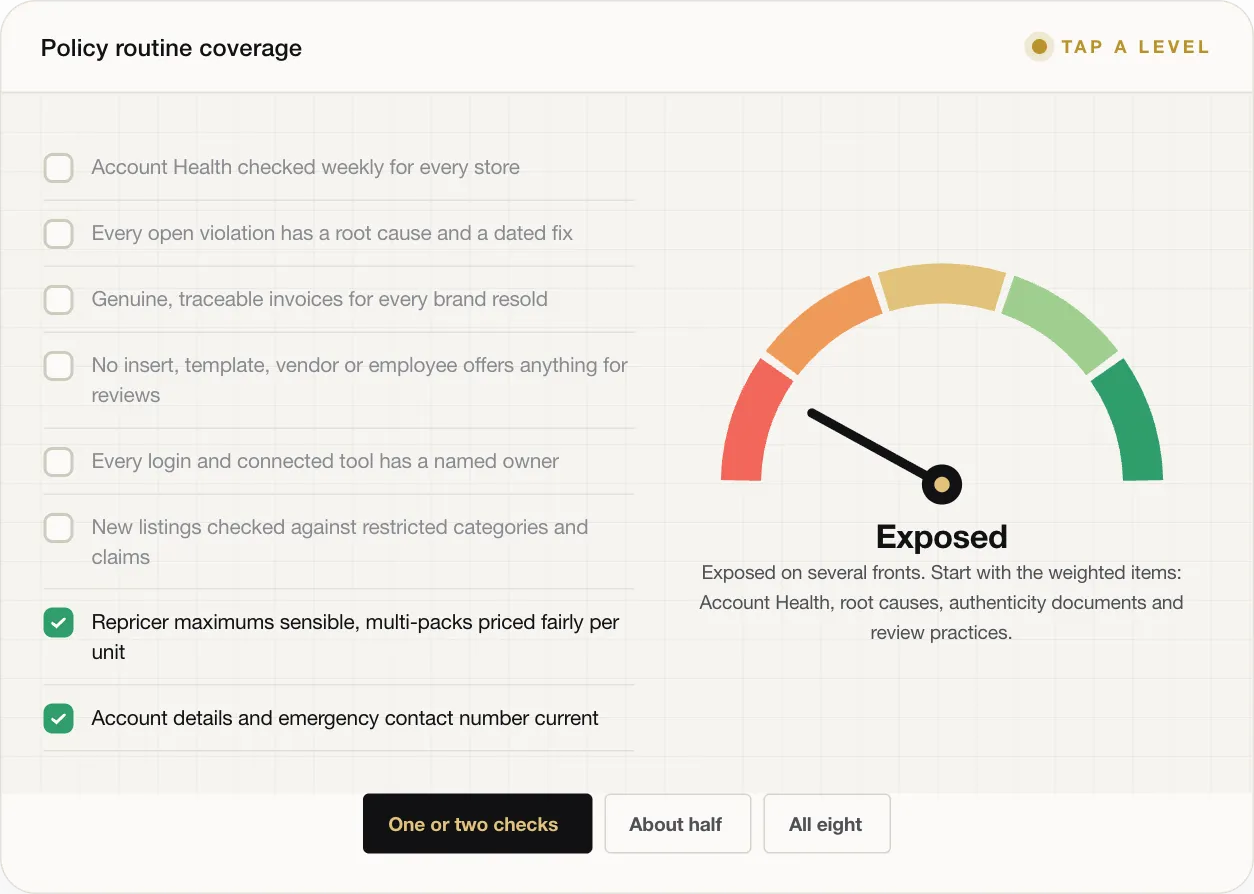
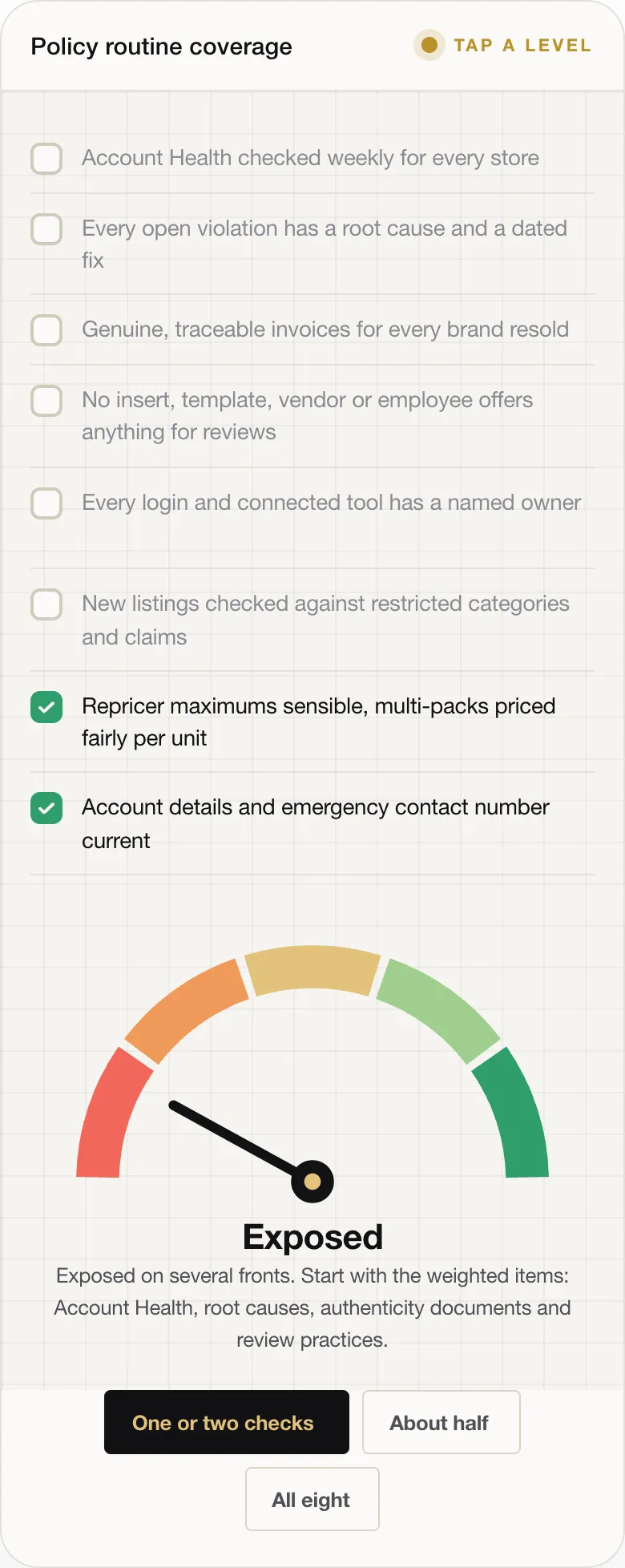
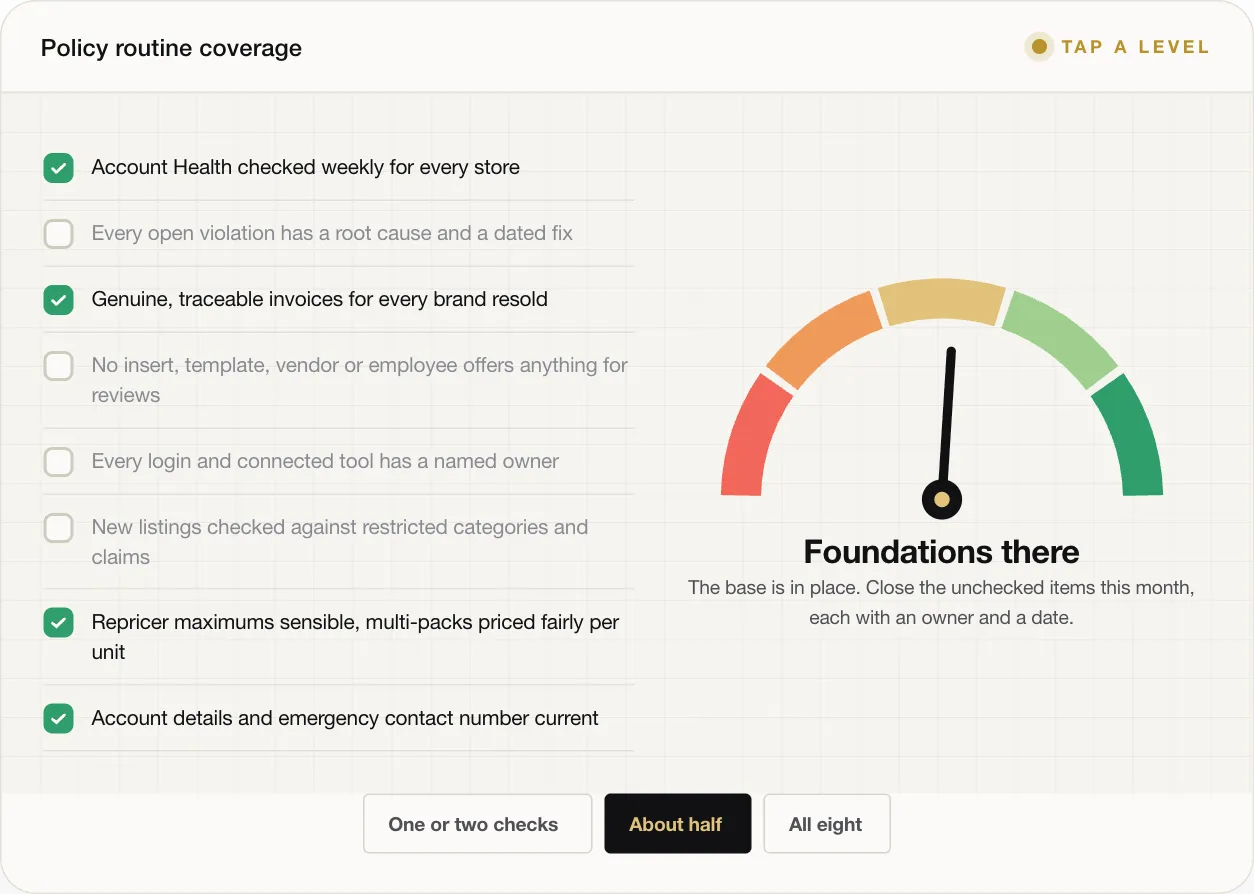
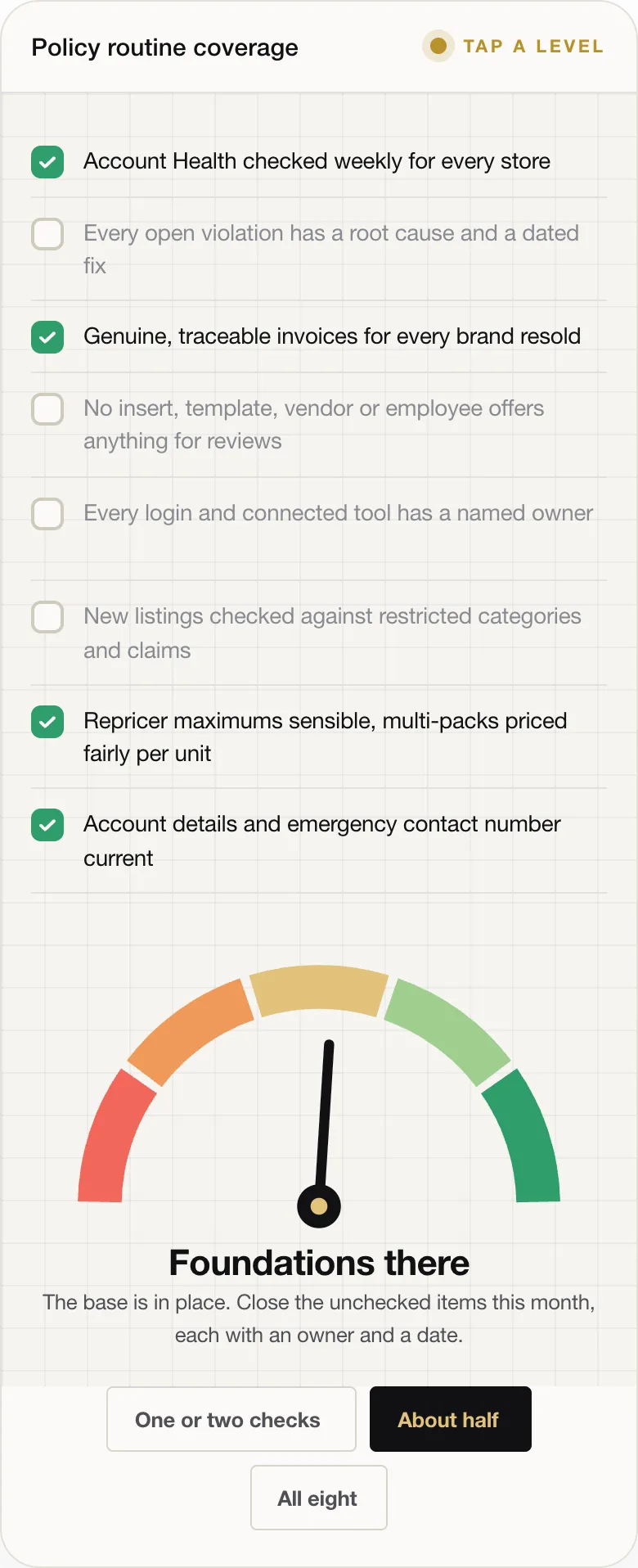
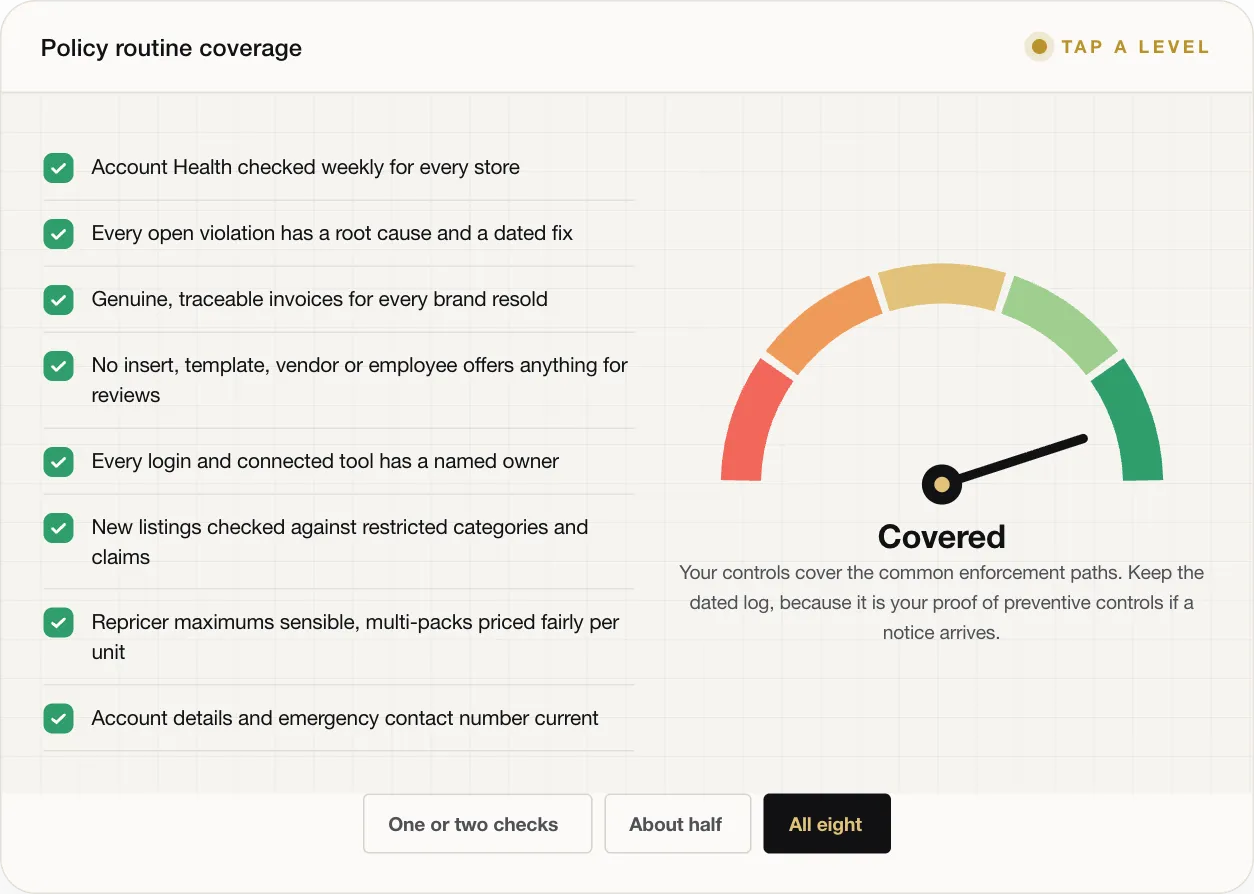
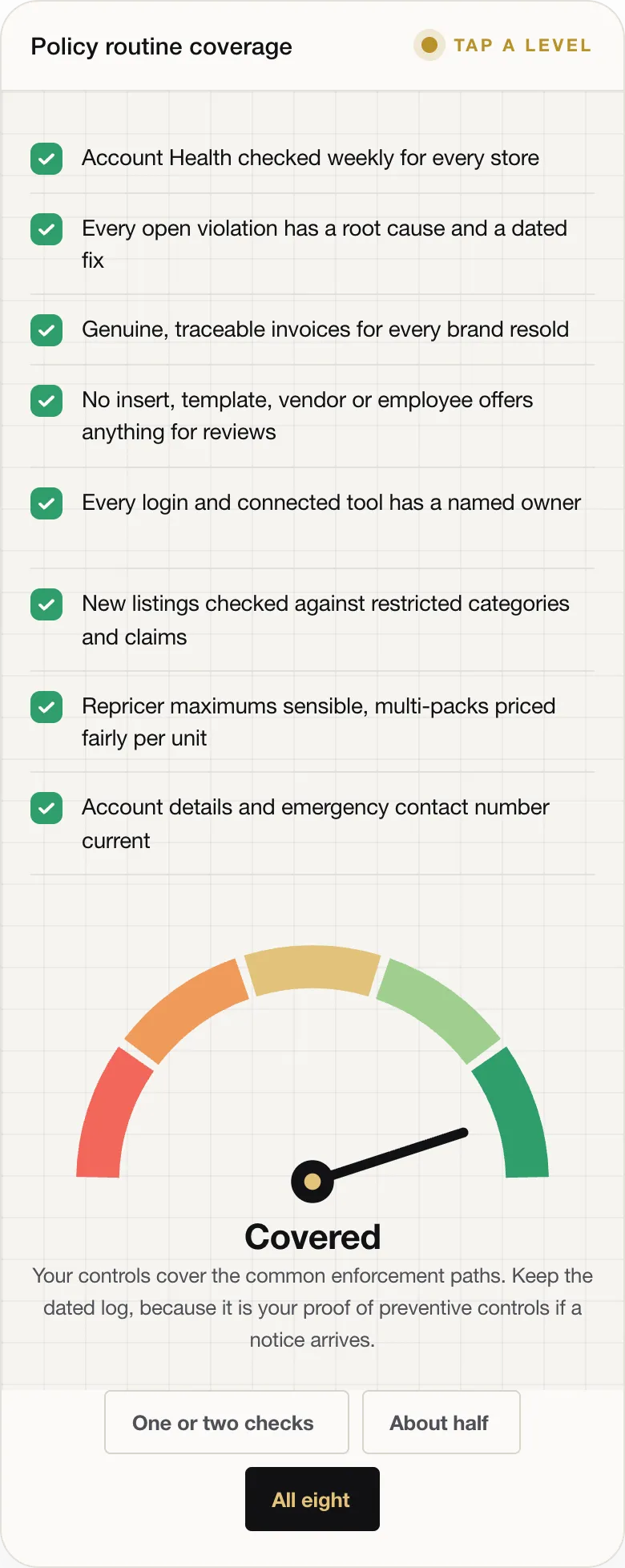
A monthly routine to stay on the right side of these policies
Run the checks in the same order each month and log the date, the person and what changed. That log is your proof of preventive controls if a notice ever arrives.
How much of the routine is already true?
The heaviest checks are Account Health, root causes, authenticity documents and review practices. Tap a level to see which checks sellers at that stage usually have in place.
Frequently Asked Questions
Which Amazon policies count toward the Account Health Rating?
Amazon’s help page lists them, including the Seller Code of Conduct, Intellectual Property, Anti-Counterfeiting, ASIN Creation, Product detail page rules, Fair Pricing, Customer Product Reviews and Restricted Products. Amazon says not all policies are included and the list is updated as policies are added.
What Account Health Rating score is safe?
Amazon says 200 to 1,000 is Healthy, 100 to 199 is At Risk, and 99 or lower is eligible for deactivation or deactivated. Amazon may still deactivate regardless of score for suspected fraudulent, deceptive, illegal or harmful activity.
How long does a violation affect my score?
Amazon says the score reflects activity over the last 180 days, and you regain points when you successfully address violations.
Can two violations get my account deactivated?
Amazon says reaching the maximum repeat violations for one policy in 180 days can put the account at immediate risk, and that maximum can be as low as two for higher-severity violations.
Am I responsible if an agency violated the reviews policy?
Yes. Amazon says infractions by partners, employees or agencies result in enforcement even without your knowledge or consent.
Can I run more than one Seller Central account?
Amazon allows one account per region unless you have a legitimate business need and all accounts are in good standing.
Can I ask customers for reviews?
Yes, in a neutral manner and only from your own customers. Amazon prohibits incentives, asking only for positive reviews, asking customers to change or remove a review, and soliciting only customers who had a good experience.
What documents does Amazon accept for multiple IP warnings?
Amazon asks for the list of affected ASINs and at least one of: invoices proving authenticity, Amazon order IDs, an authorization letter from the rights owner that is not a forwarded email, or a court order.
How will I know when Amazon changes a policy?
Amazon says it updates its Help pages and tries to share changes via Account Health News whenever possible. It does not promise individual notice, so re-read your policies regularly.
Get Help With Amazon Policy Violations
If a notice has landed and you are unsure which policy is really at issue, our team can review the account before anything is submitted. Submit your case or book a consultation.
This article is educational information only and is not legal advice. Amazon’s policies and processes change, so confirm current wording in Seller Central before acting. No outcome or timeline can be guaranteed.
Sources
- Amazon Seller Central: Program Policies
- Amazon Seller Central: Selling policies and seller code of conduct
- Amazon Seller Central: Account Health Rating program policy
- Amazon Seller Central: Policies included in Account Health Rating
- Amazon Seller Central: Intellectual Property Policy
- Amazon Seller Central: Restricted products
- Amazon Seller Central: Marketplace Fair Pricing Policy
- Amazon Seller Central: Customer product reviews policies
- eCFR: 16 CFR Part 465
- USPTO: Trademark search
- CPSC: Recalls
