
Quick answer: The Account Health Rating is a color-coded score from 0 to 1,000 that Amazon shows on the Account Health page for each store you sell in. Amazon says it indicates your account’s risk of deactivation for non-compliance with the policies included in the rating. A score of 200 to 1,000 is green (“Healthy”), 100 to 199 is yellow (“At Risk”) and 99 or lower is red (“Unhealthy”), meaning the account is eligible for deactivation or already deactivated. New sellers start at 200. You lose points when Amazon detects a policy violation, by severity, and gain them back when you successfully address it. You also gain points for orders fulfilled over the last 180 days. A critical violation sets the score to zero and starts a three-day window to fix it.
Most sellers open the Account Health page only after something has gone wrong, when the rating is a record rather than a warning. Sellers who stay out of trouble read it as a list of the risks Amazon is tracking and how close each one is to action. The number is a summary; the violations and metrics underneath it are what matters.
This guide explains how the rating works using only what Amazon publishes, how to read the dashboard as an investigator, and what to do when the rating moves toward At Risk. Order Defect Rate, late shipment and cancellation rate have their own guides on our site, linked below.
What the Account Health Rating actually measures
Amazon describes the rating as an indicator of your selling account’s risk of deactivation due to non-compliance with certain Amazon selling policies. It is not a general grade of your selling, and it is not a customer satisfaction score. It aggregates violations of a specific list of policies into one number.
It is per store and close to real time
The rating is displayed on the Account Health page for each store in which you sell. Amazon describes it as providing a near real-time status of your account’s health.
It looks back 180 days
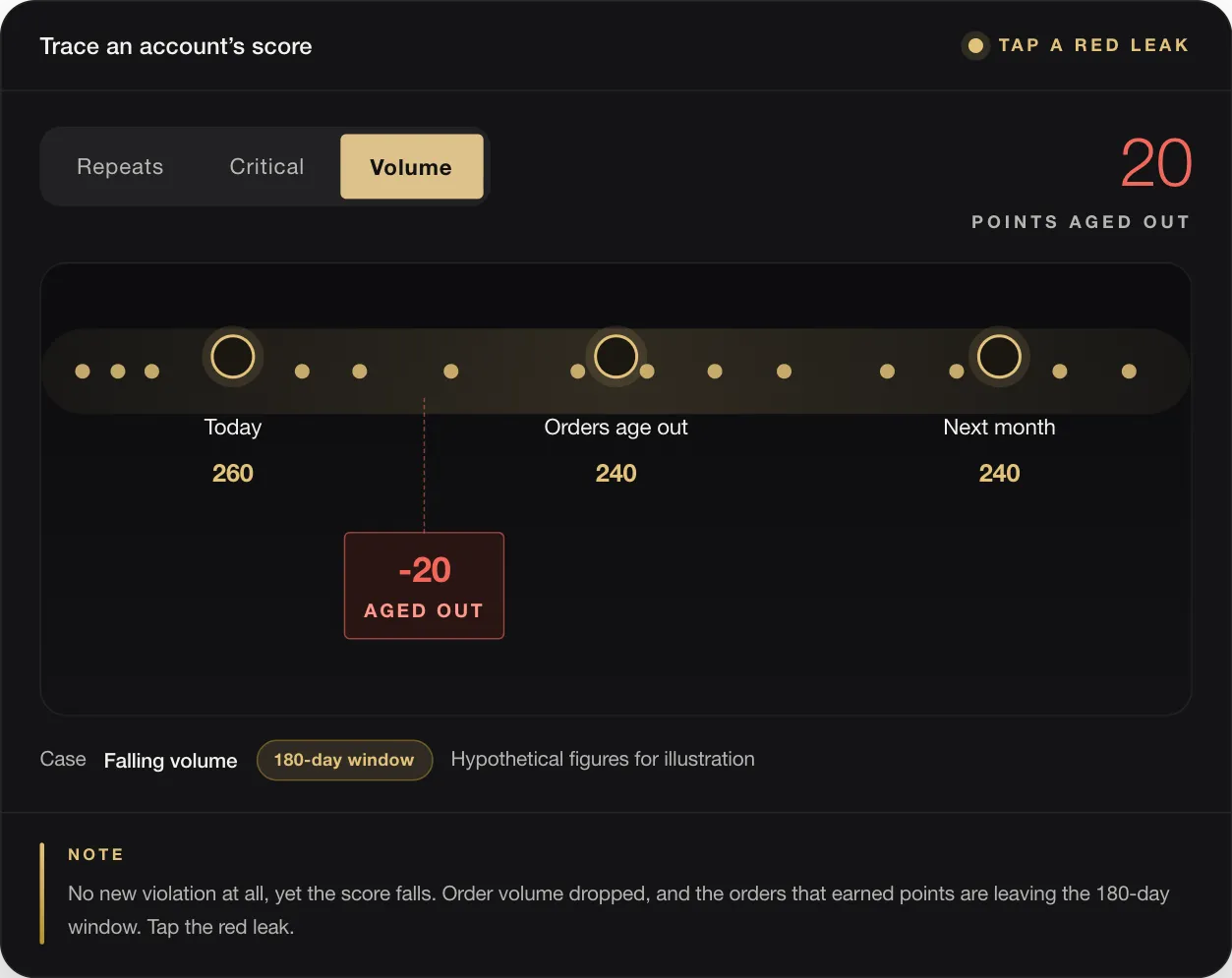
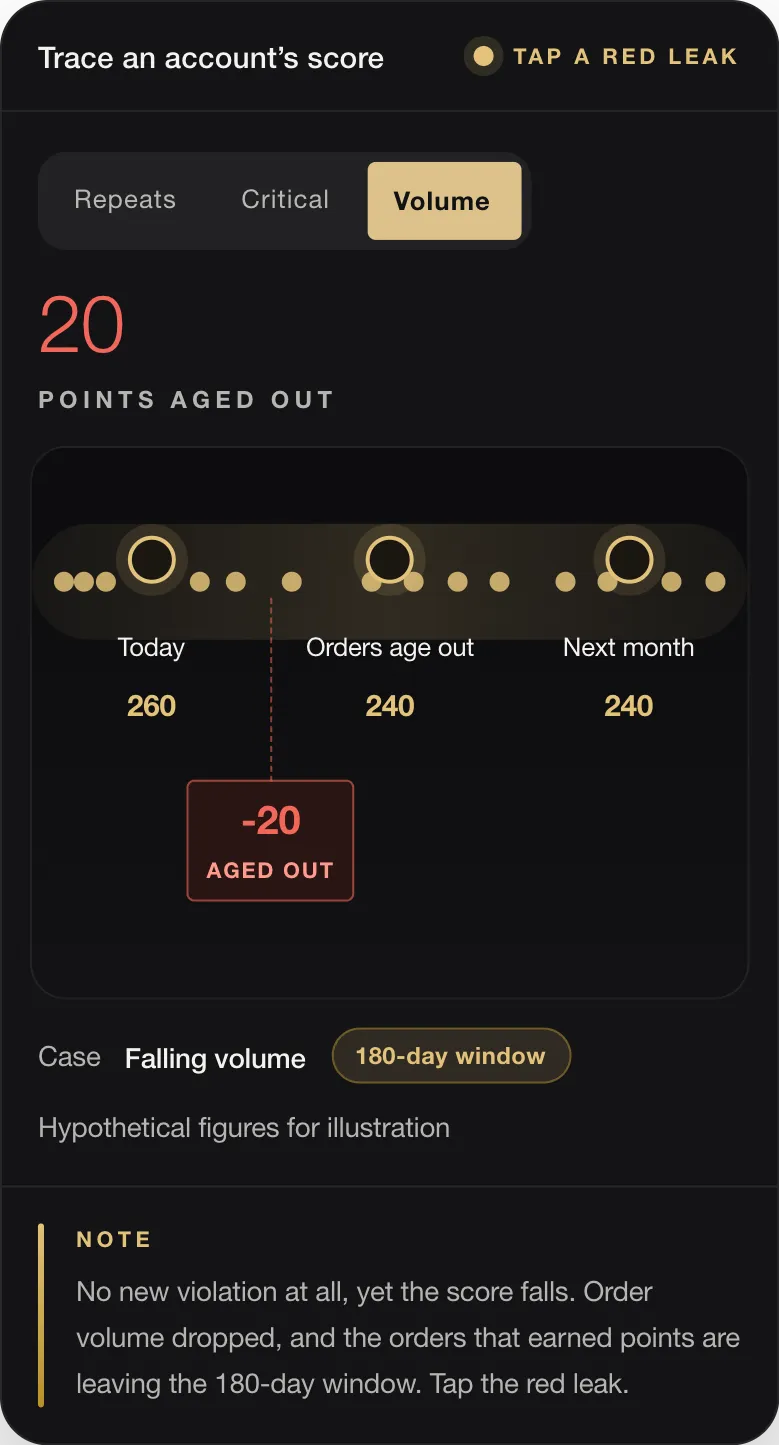
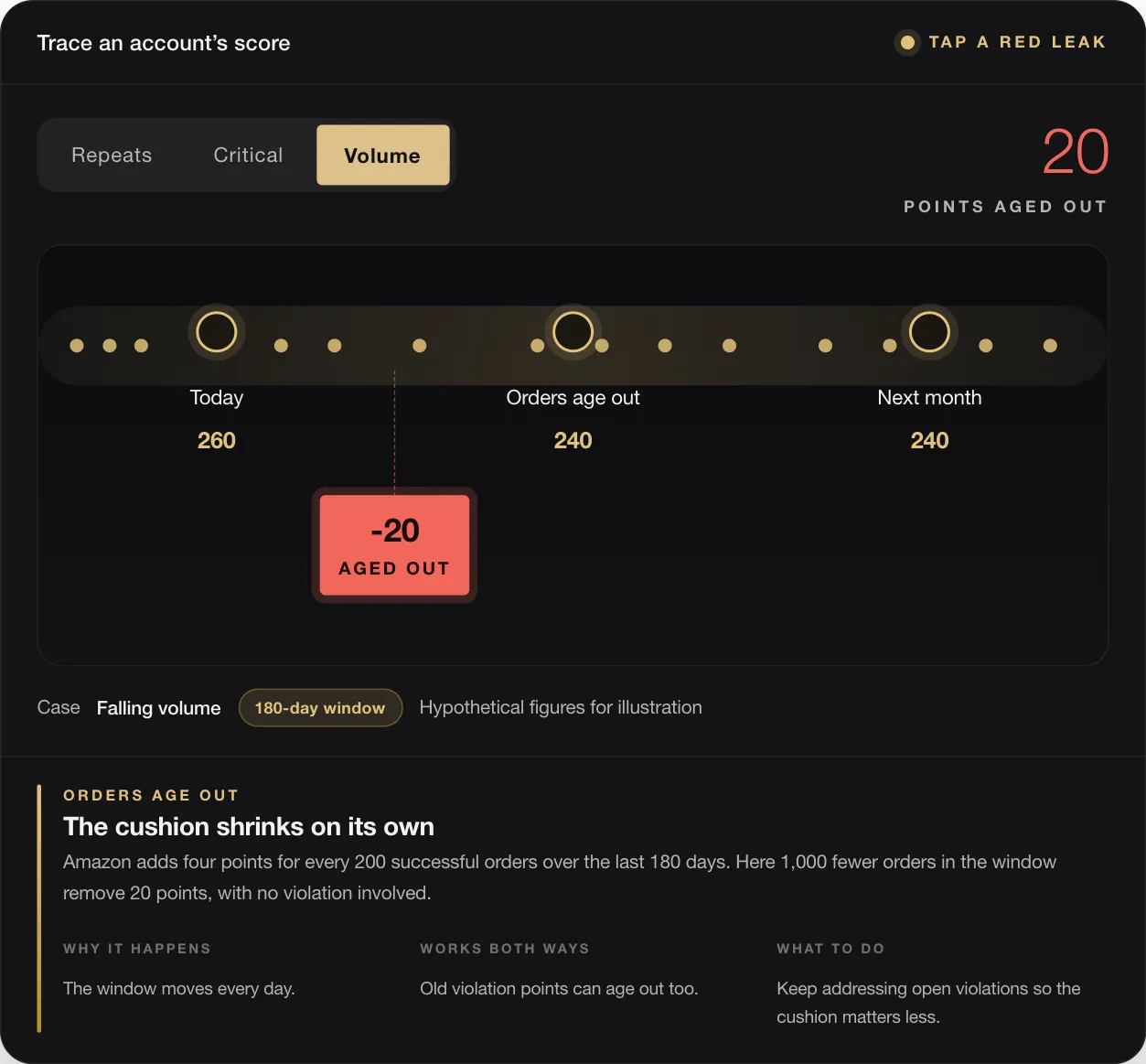
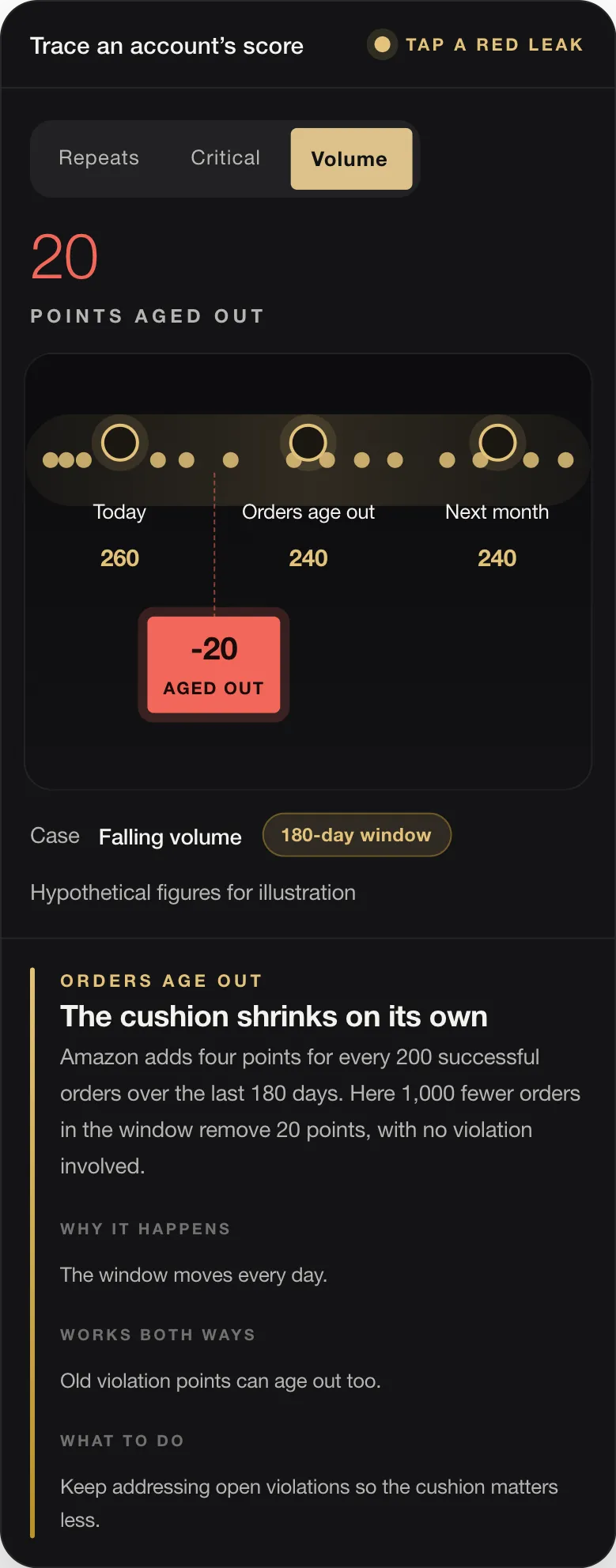
Amazon says that over time, sellers see a score that reflects their account health based on policy adherence and selling activities over the last 180 days. The window works both ways: violation points and fulfilled order points both age out, so a rating can move on a day when nothing new happened.
It does not cover everything
Amazon states that not all of its policies are currently included in the rating. It also states that, regardless of the score, it may deactivate an account immediately if required by law, if it suspects fraudulent, deceptive, illegal or otherwise harmful activity (including attempts to circumvent its systems), or if a seller violates other policies outside the rating. A green rating protects you only from deactivation for violations of the policies inside it.
The scale and the three status bands
The table sets out each band as Amazon describes it.
| Status | Score | What Amazon says it means |
|---|---|---|
| Healthy (green) | 200 to 1,000 | The account is not at risk of deactivation based on the policies comprising the score. |
| At Risk (yellow) | 100 to 199 | The account is at risk of deactivation. |
| Unhealthy (red) | 99 or lower | The account is either eligible for deactivation or already deactivated. |
Two details on this scale are easy to miss. First, the line between Healthy and At Risk sits at 200, which is also where every new seller starts. A new account has no buffer until it has a record of fulfilled orders. Second, Amazon says an account deactivated because of its rating is reinstated once the score returns to 100 or higher, so the recovery threshold is the bottom of the yellow band, not the green one.
How points are lost and how they come back
Amazon does not show point values on the dashboard, but its FAQ describes the mechanics.
Four severity levels, plus “No impact”
Amazon assigns each violation a severity, considering how much it harms the customer experience, whether it breaches applicable laws and regulations, and the number of previous violations of the same policy. Amazon describes the levels this way:
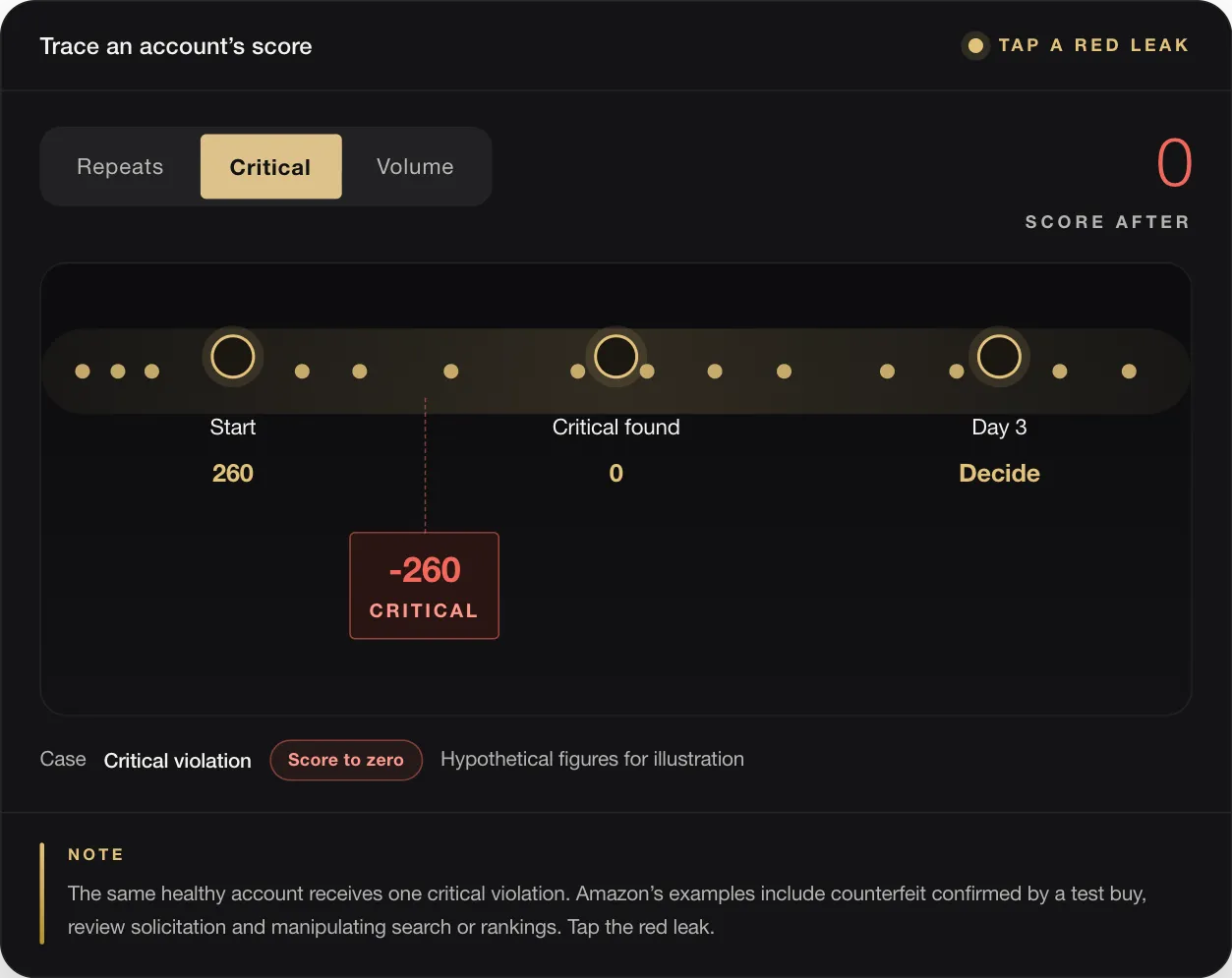
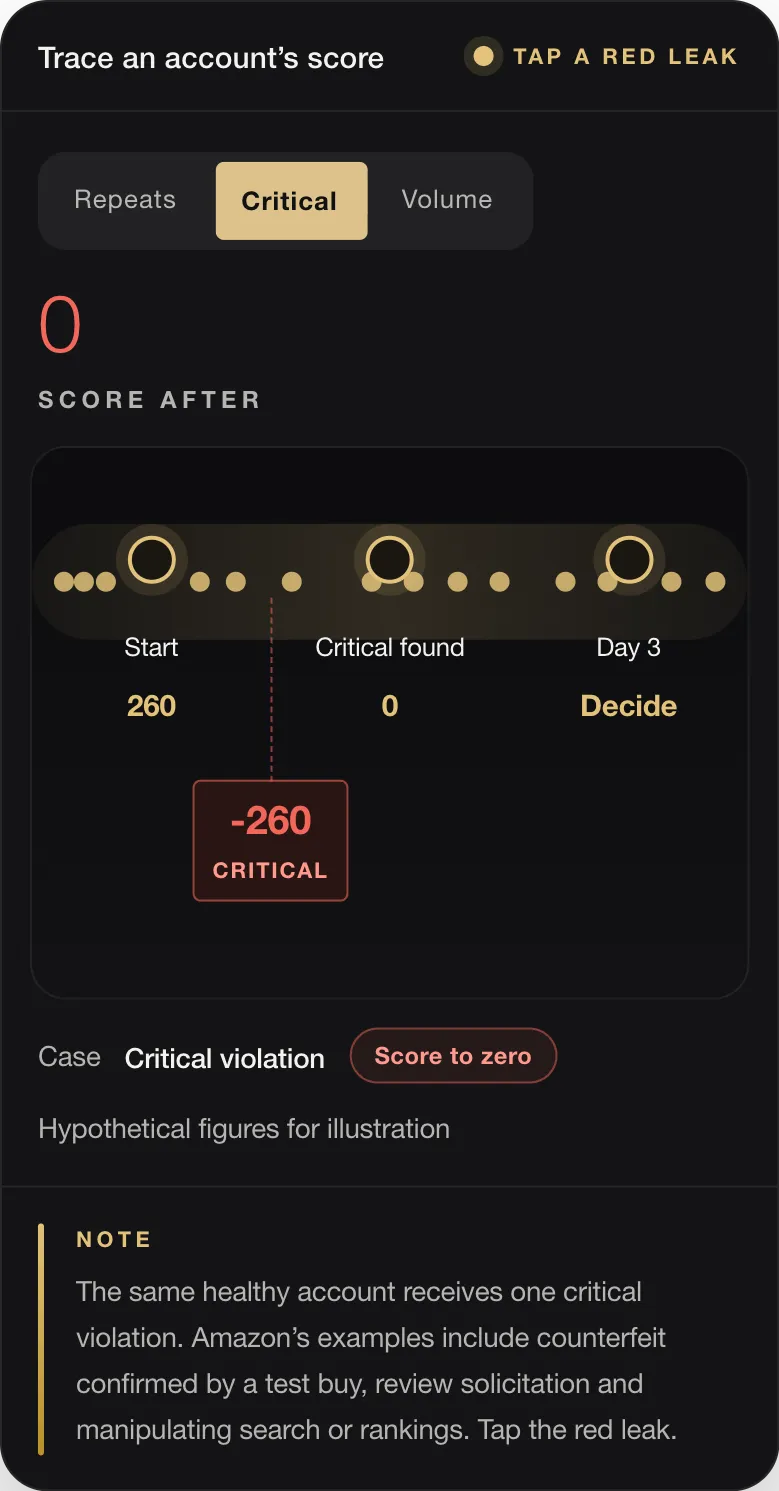
- Critical. A serious and unacceptable impact on customers, or a breach of certain laws, regulations or the rights of others. Any single critical violation immediately qualifies the account for deactivation. Amazon’s examples include a product found counterfeit or pirated through a test buy, soliciting reviews or including non-compliant inserts, attempting to damage or abuse another seller, and manipulating search results or sales rankings.
- High. Amazon says its tolerances are minimal. Examples include a valid notice of infringement from a rights owner and customer reports of infringing or counterfeit products.
- Medium. Violations that may significantly undermine trust if they keep happening. Amazon’s example is a listing with links that prompt users to visit external websites.
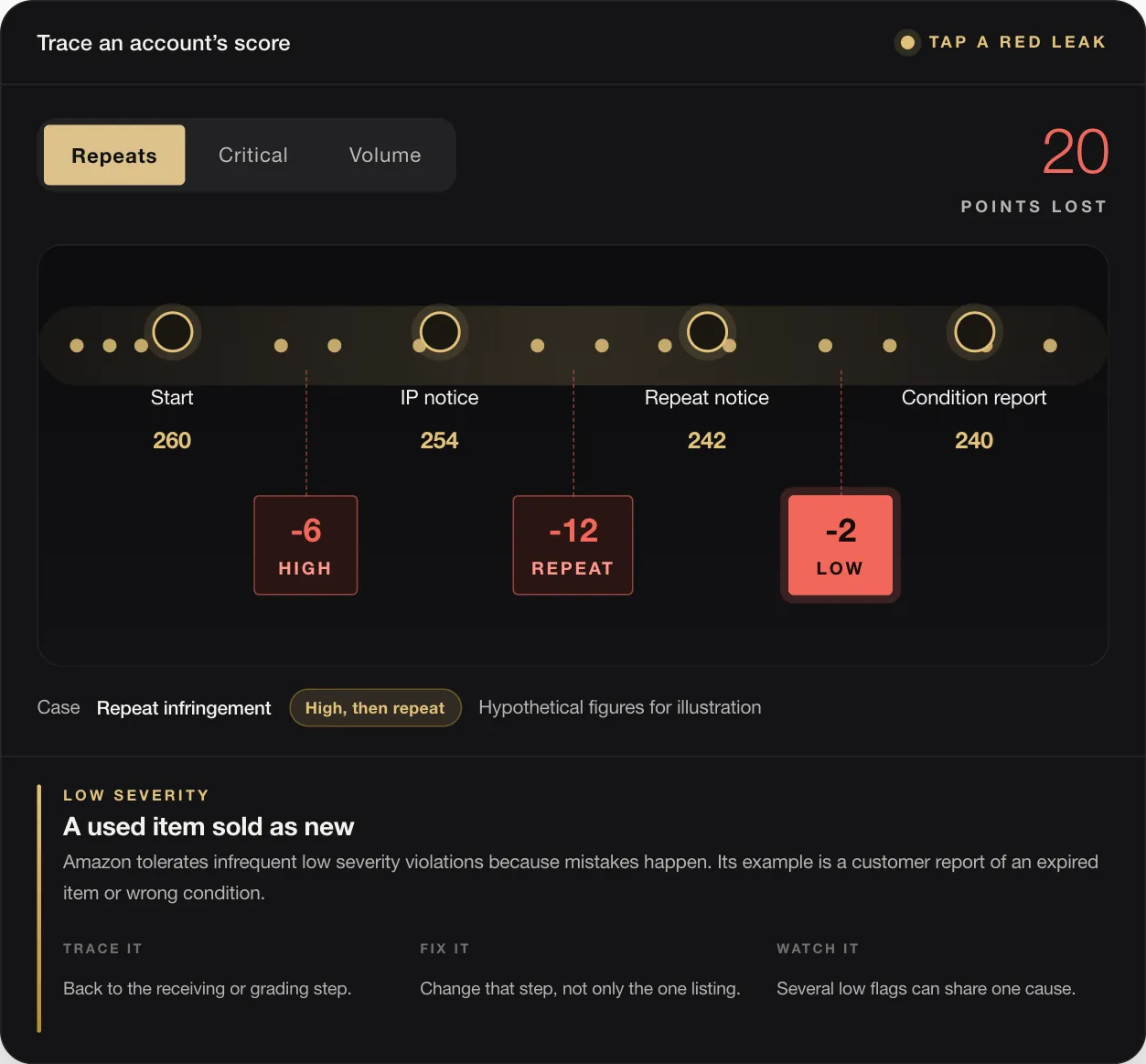
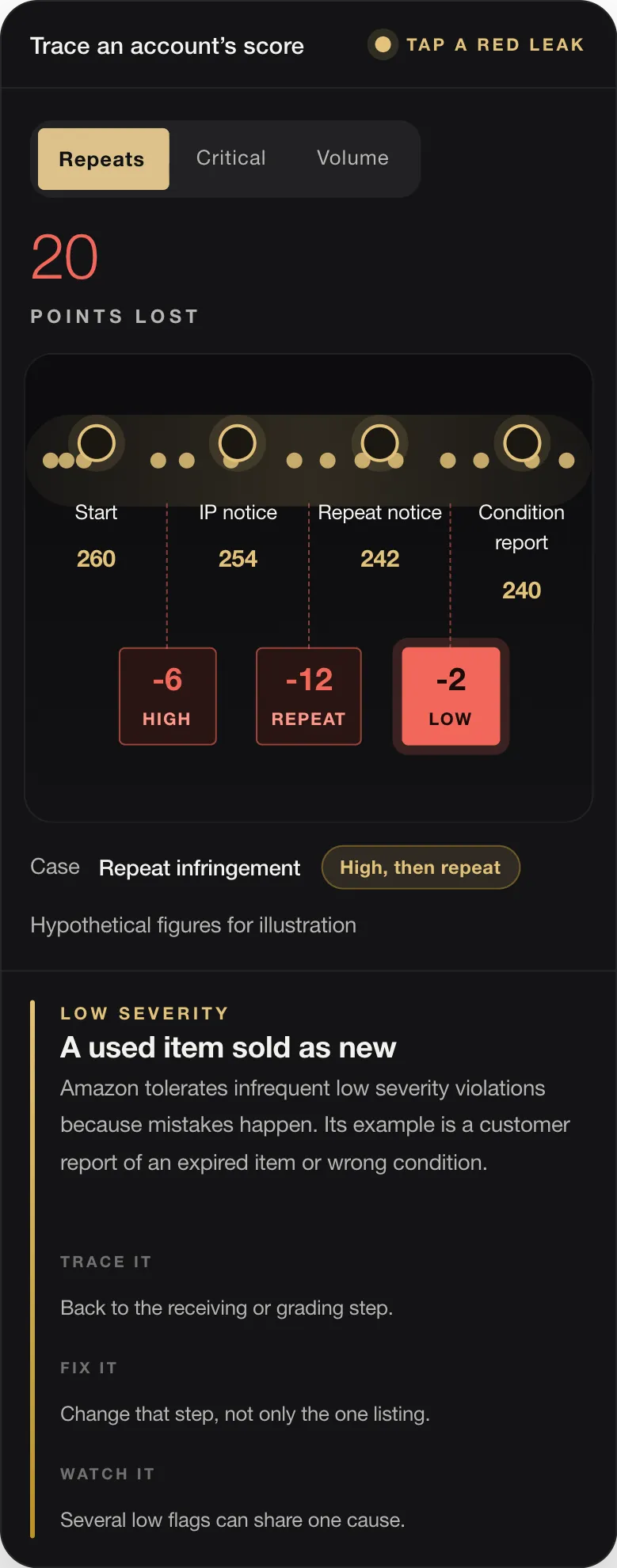
- Low. Amazon says it tolerates infrequent low severity violations because mistakes happen. Its example is a customer report that an item arrived expired or in the wrong condition, such as a used item listed as new.
- No impact. Flags on listings that Amazon wants you to address but that do not currently affect the rating.
What the numbers look like
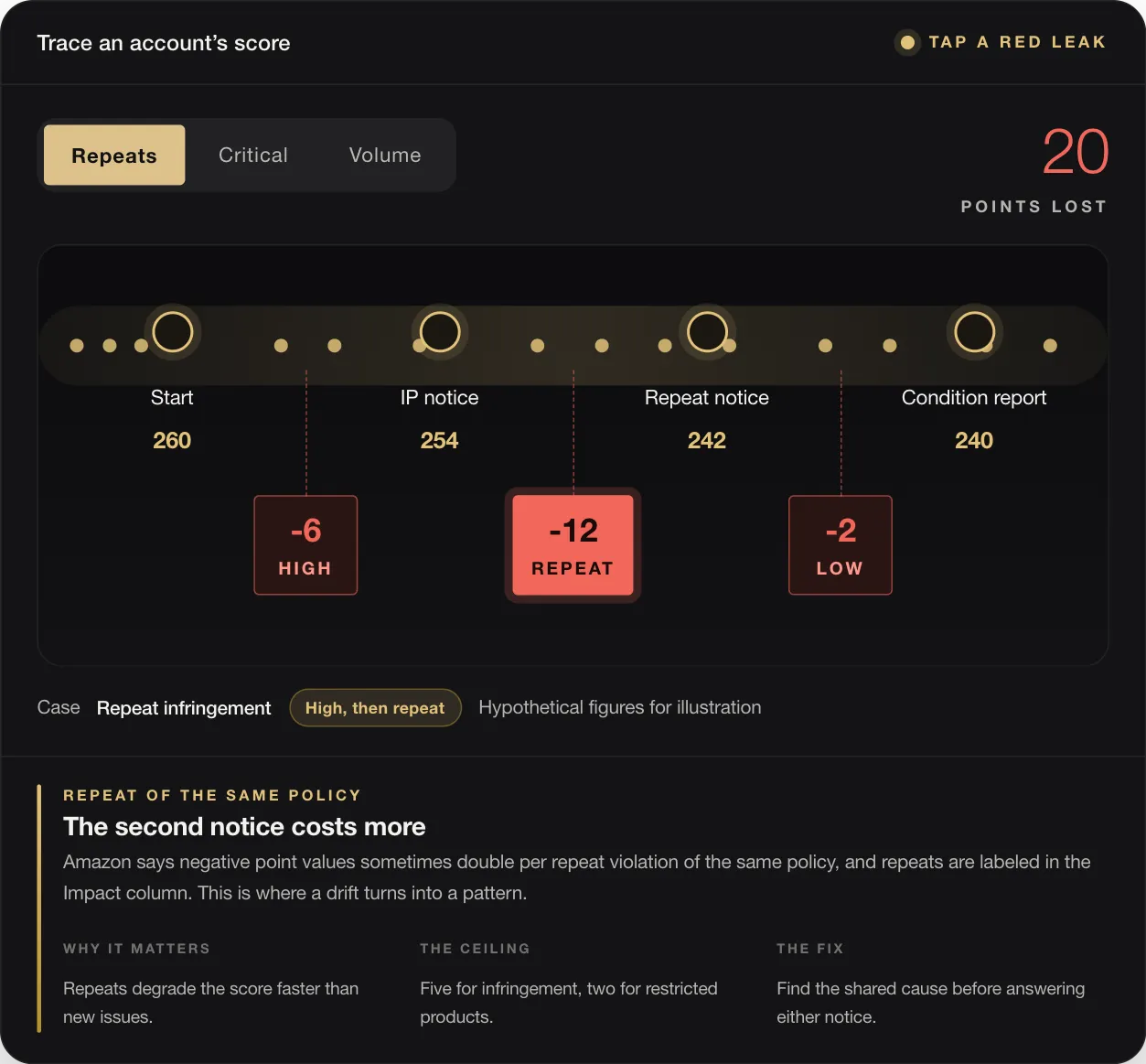
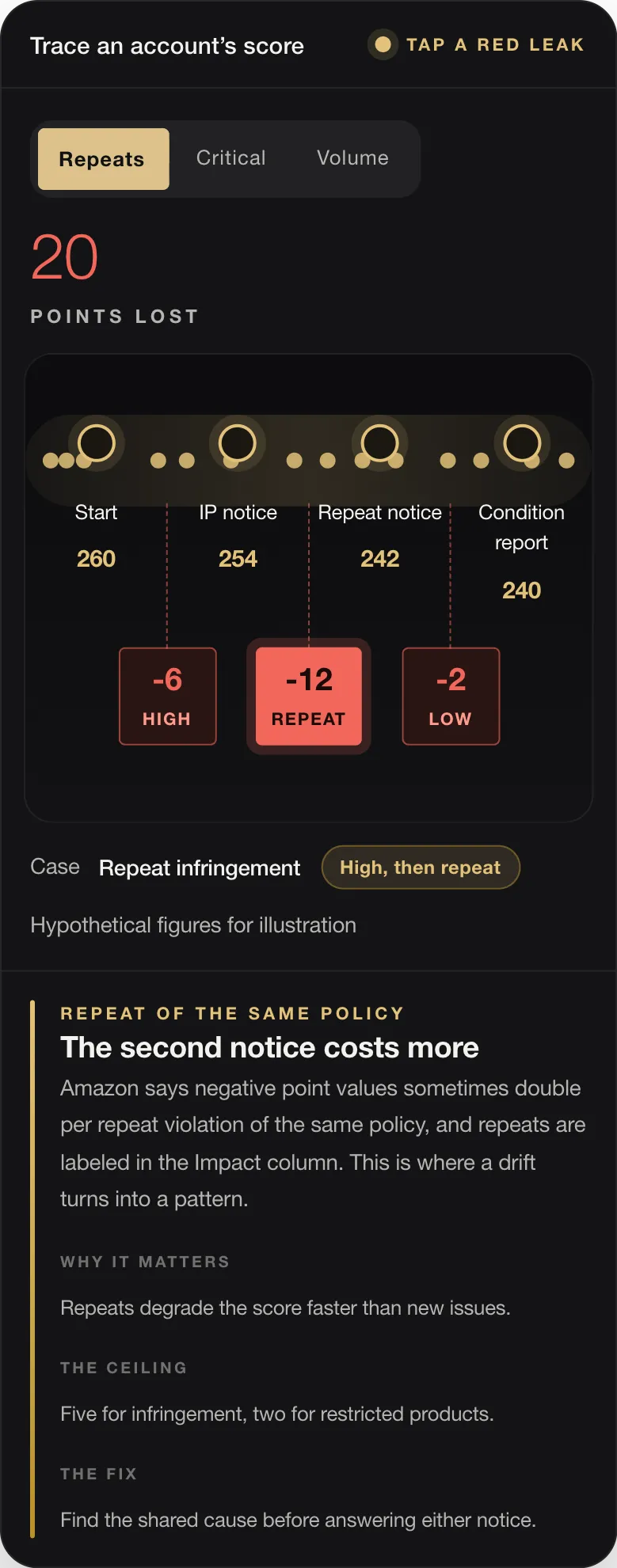
According to Amazon’s FAQ, point values for each violation are based on severity and typically range from two to eight. Critical violations automatically bring the score to zero. When the same policy is violated more than once, negative point values sometimes double per repeat violation. On the earning side, you gain four points for every 200 successful orders fulfilled over the last 180 days. Amazon adds that the formula and point values may change.
Sellers with Fulfilled by Merchant orders can also earn points for meeting or exceeding Amazon’s standards on Buyer Contact Rate, Average Contact Response Time and Buyer Dissatisfaction Rate. Amazon says it will not restrict selling privileges because of below-average performance on those three metrics. They can help the rating, but they are not a source of deactivation.
A worked example
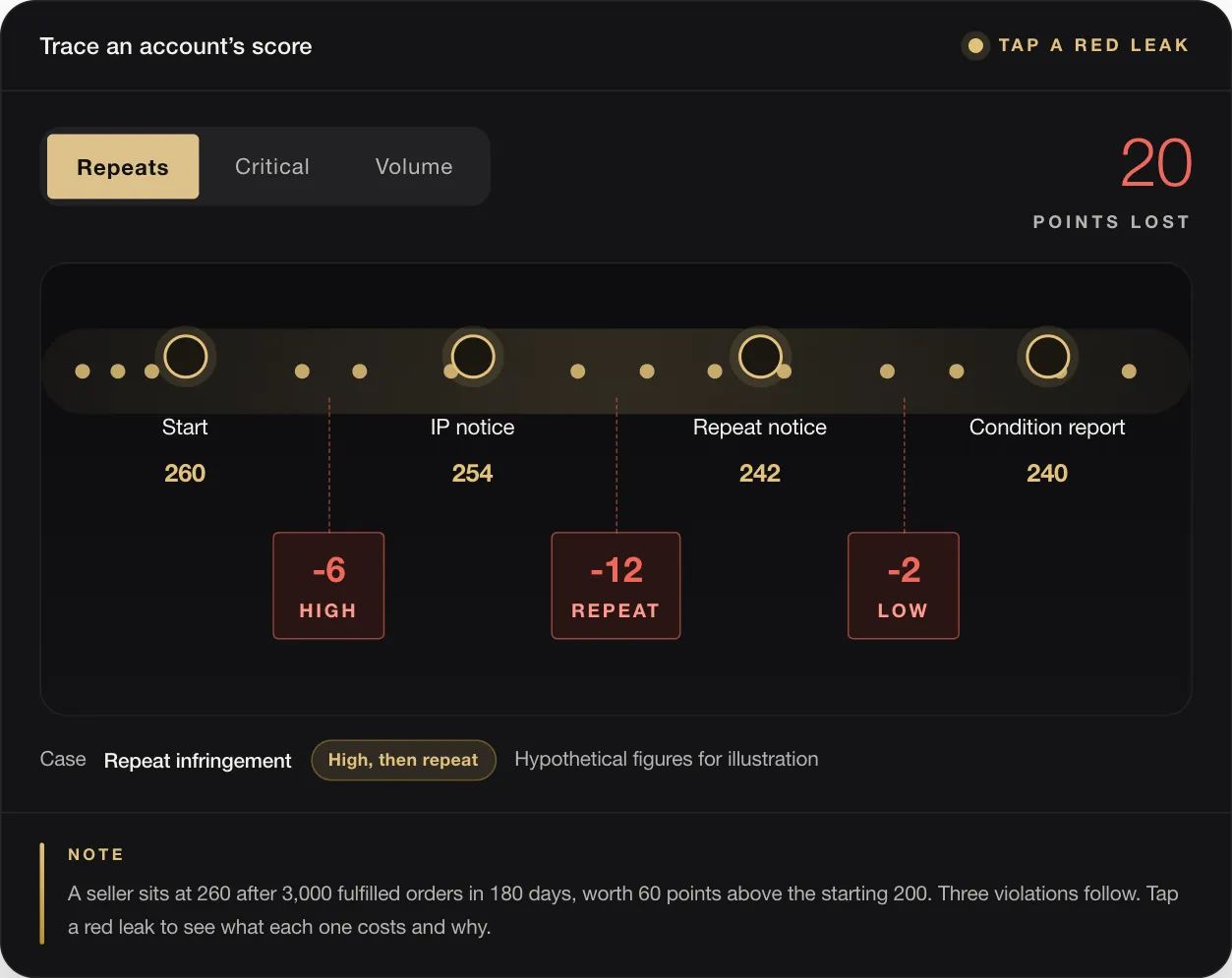
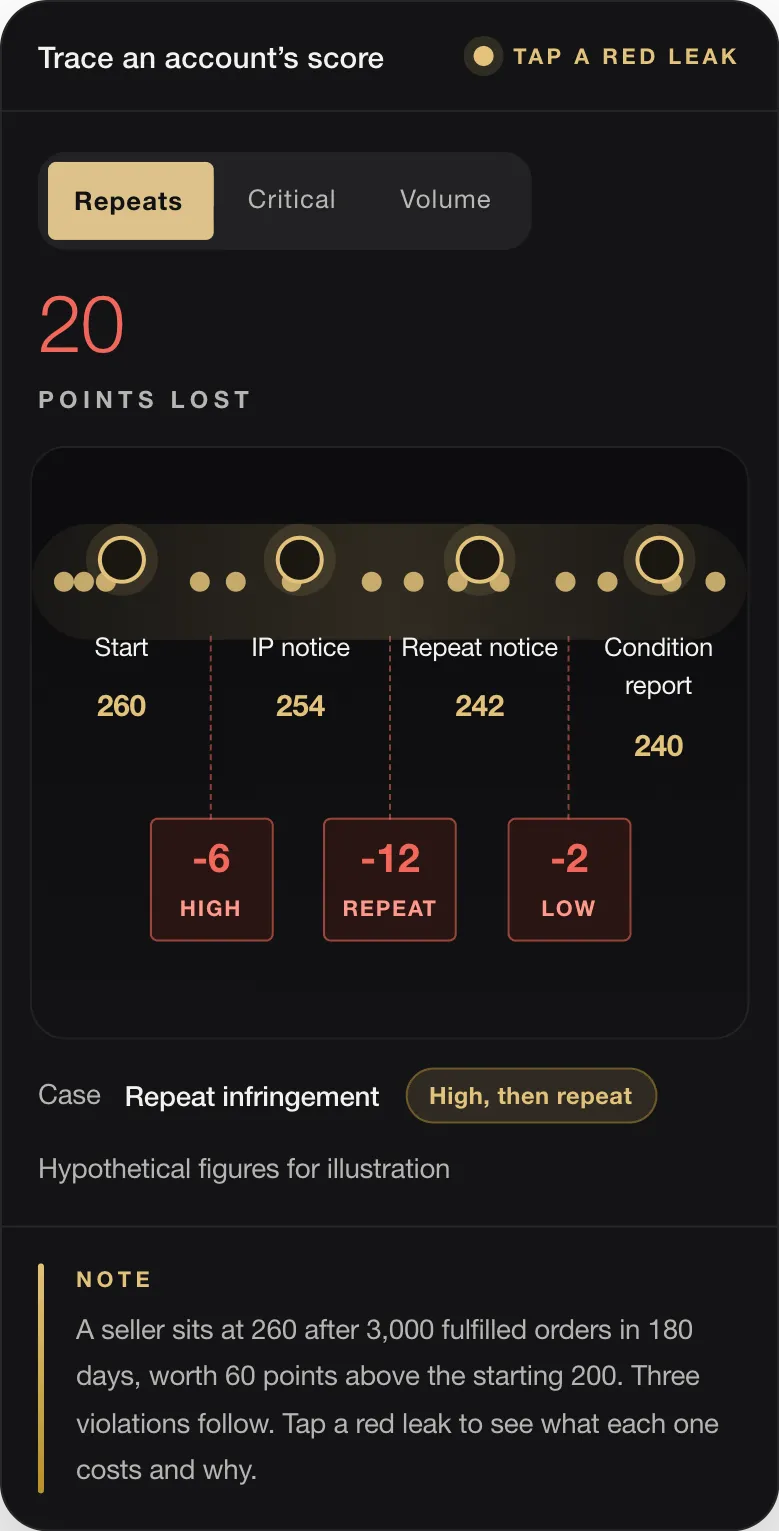
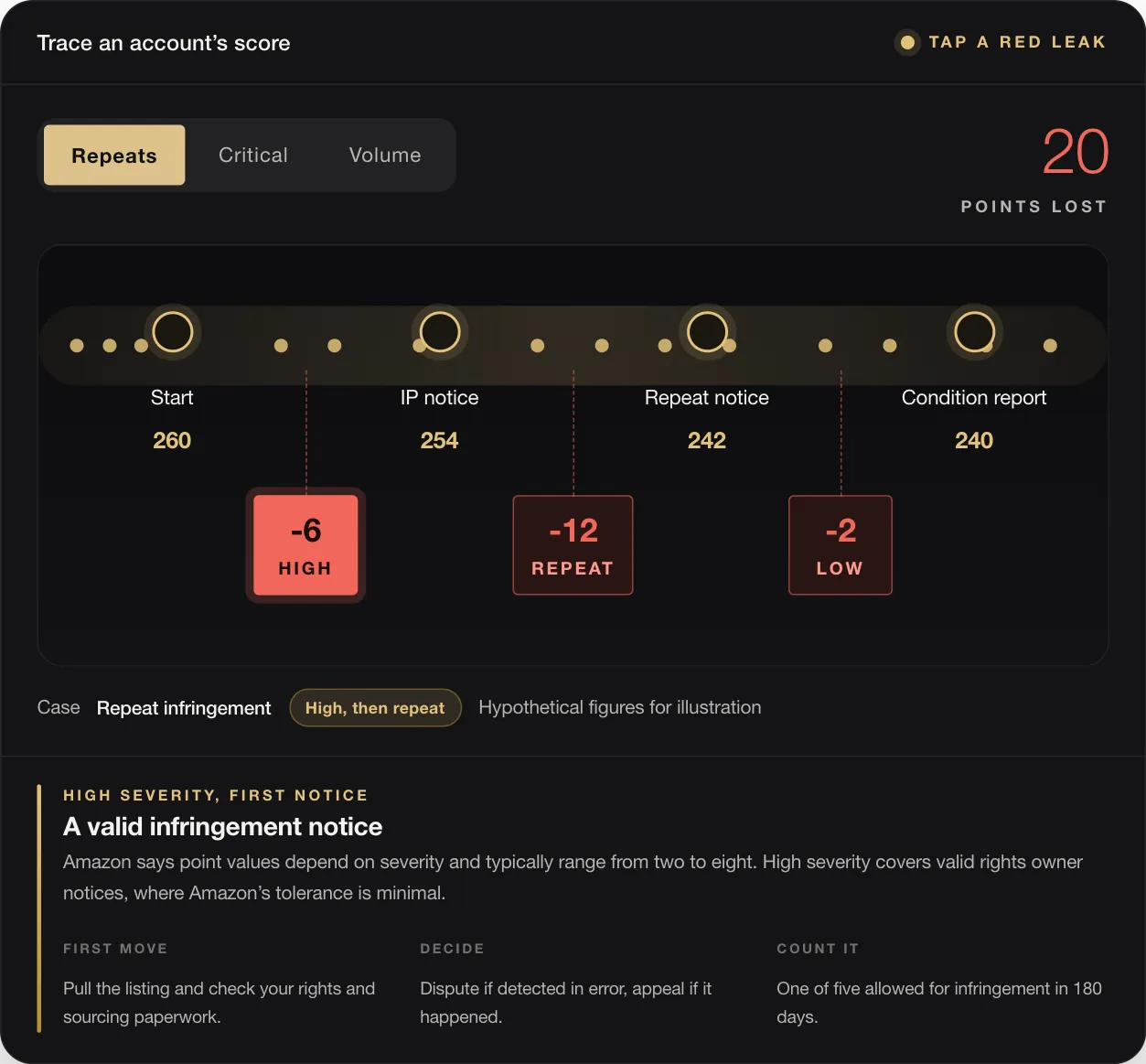
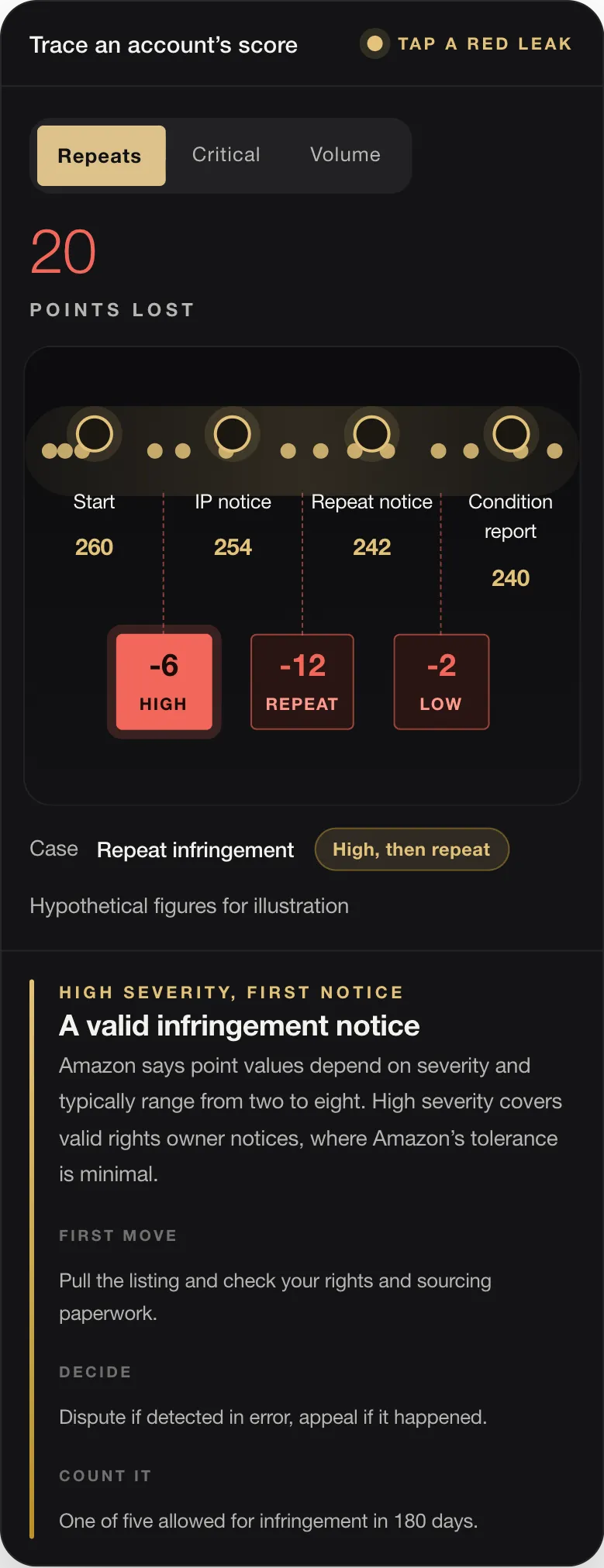
The figures below are hypothetical. A seller has fulfilled 3,000 orders in the last 180 days, worth 60 points above the starting 200 at four points per 200 orders. A valid infringement notice (high severity) goes unanswered, then a second arrives under the same policy and costs more than the first. A buyer then reports a used item sold as new (low severity). No single item looks alarming, but repeats compound while the order cushion can age out at the same time. Amazon does not publish the exact arithmetic; the direction is what matters.
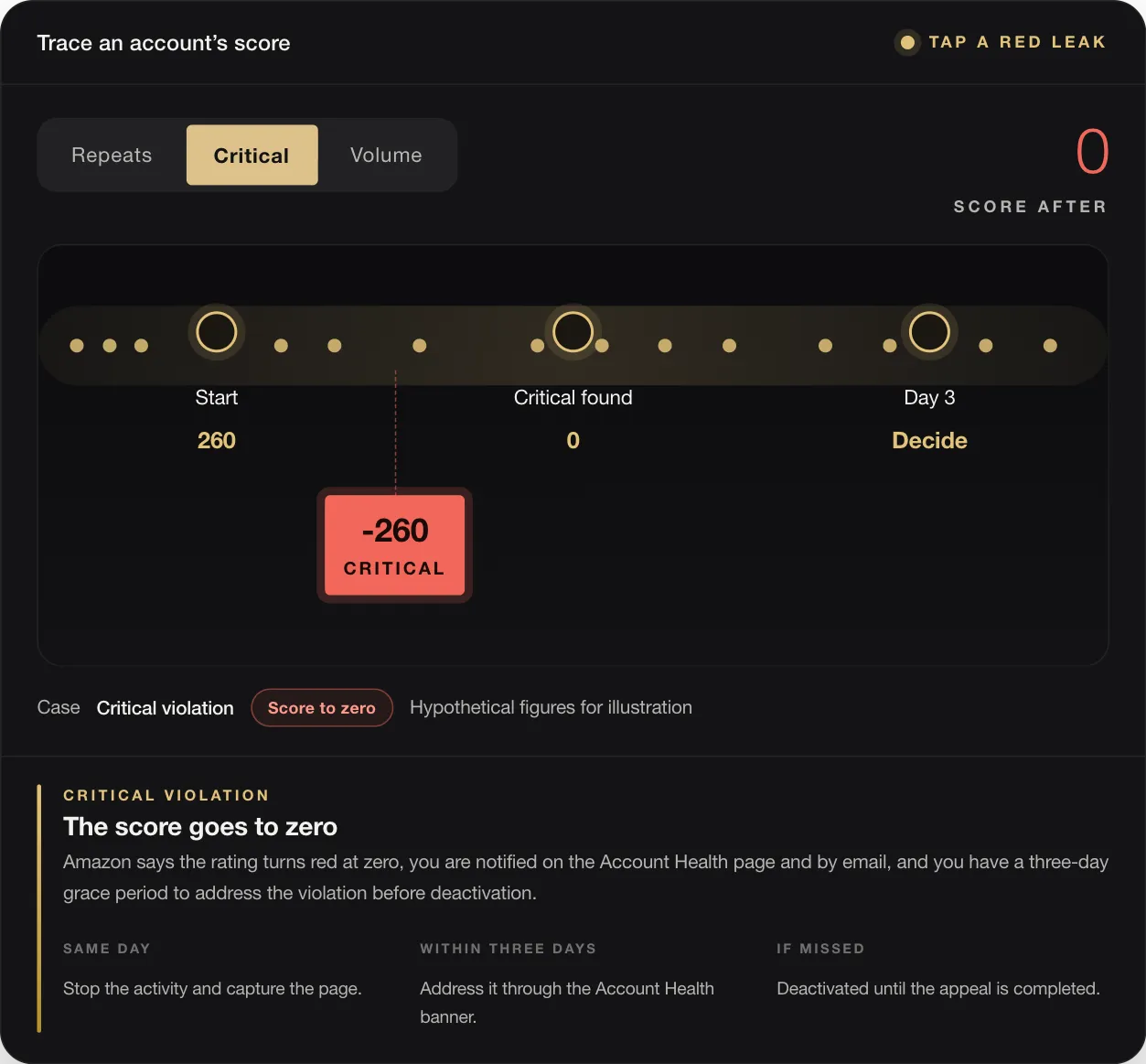
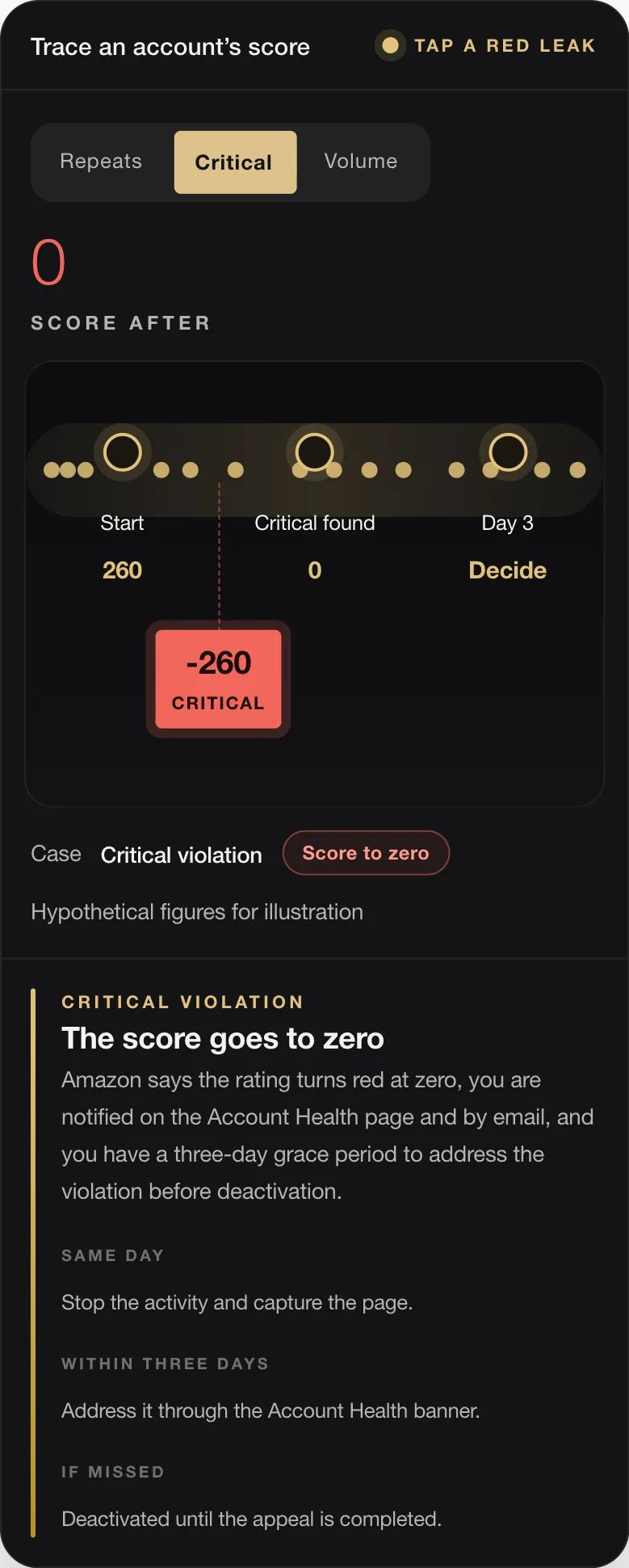
Points leave in three ways. Follow each one.
A rating falls through violations by severity, faster through repeats, all at once through a critical violation, and quietly as fulfilled orders age out of the 180-day window. Pick a case and tap a red leak.
Repeat violations and the 180-day limits
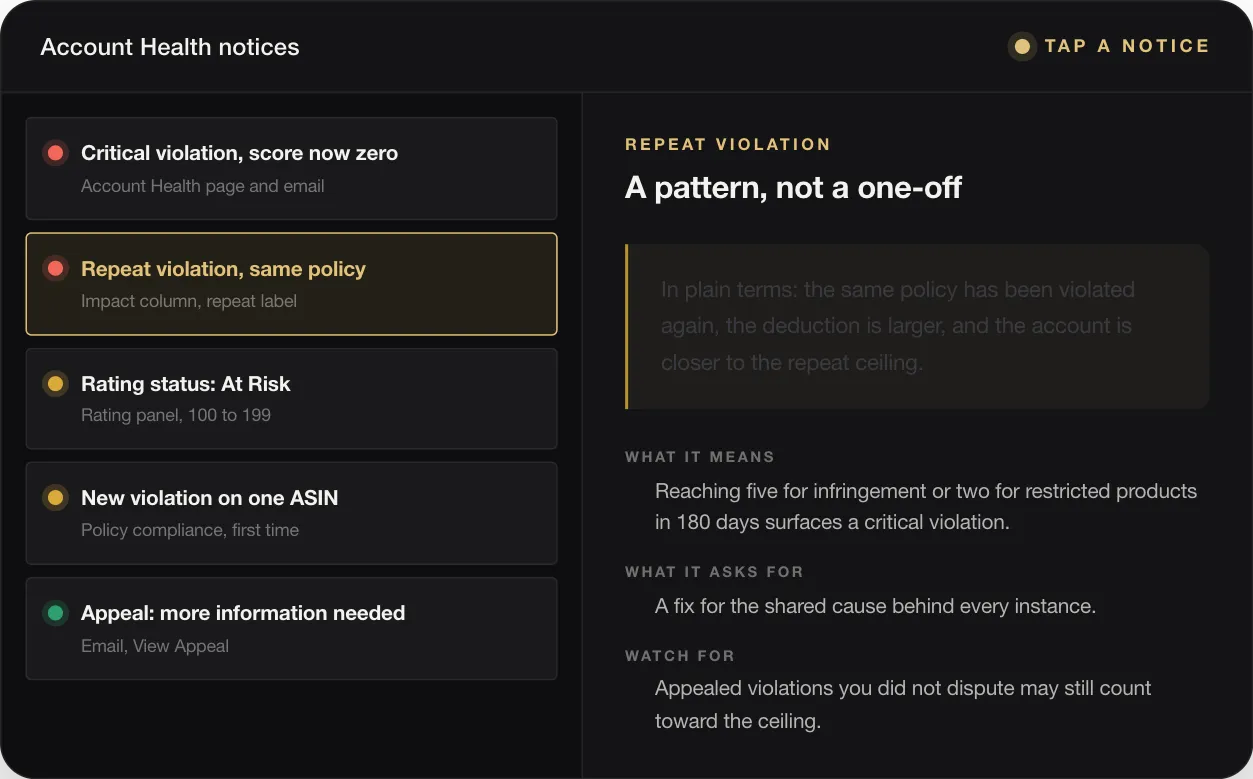
Repeat violations hurt the rating in two ways, according to Amazon. The point value increases each time the same policy is violated, so repeats degrade the score faster. And there is a ceiling: reach the maximum number of repeat violations for a single policy in a 180-day period and the account may be at immediate risk of deactivation. Amazon states the maximum is five for infringement-related policies and two for restricted products policies.
When the ceiling is reached, Amazon says a critical violation surfaces on the Account Health page, you are notified by email, the rating turns red at zero, and you have a three-day period to address the critical violation before deactivation. You can follow the banner instructions on the Account Health page and appeal through the Product Policy Compliance Dashboard. Repeat violations are labeled as such in the Impact column of the Account Health page, so the count is visible if you look for it.
One rule here surprises many sellers. Amazon says violations removed after a successful appeal, where you did not dispute that the activity occurred, may still count toward the repeat threshold within the 180-day period. An appeal can restore points without resetting the repeat counter. If you have two restricted products appeals in the window, the third case is not a routine fix. To understand what an infringement notice is and how to answer it, see our guide to intellectual property complaints.
Which policies feed the rating
Amazon publishes a list titled Policies included in Account Health Rating and says it will be updated as new policies are added. At the time we read it, the list named:
- Amazon Anti-Counterfeiting policy
- Amazon Brand Name policy
- Amazon Intellectual Property policy
- Amazon Marketplace Fair Pricing policy
- ASIN Creation policy
- Communication guidelines
- Customer Product Reviews policies
- INFORM Consumers Act
- Product condition guidelines
- Product detail page rules
- Product guidelines for adult products
- Product guidelines for selling software
- Product safety and compliance
- Restricted Products policy
- Selling policies and seller code of conduct
Amazon says it did not change any policies because of the rating; the rating aggregates violations of existing policies into a single score. Check the live list before relying on it, because it can grow.
The INFORM Consumers Act entry
One item on the list is a federal law. The Federal Trade Commission explains that the INFORM Consumers Act covers high-volume third-party sellers: 200 or more separate sales of new or unused consumer products and $5,000 or more in gross revenues in any continuous 12-month period during the past 24 months. Marketplaces must collect and verify those sellers’ bank, tax ID and contact information and have them certify it at least once a year. Keeping your verification details current when Amazon asks is part of protecting the rating. This is educational information, not legal advice.
Where performance metrics fit
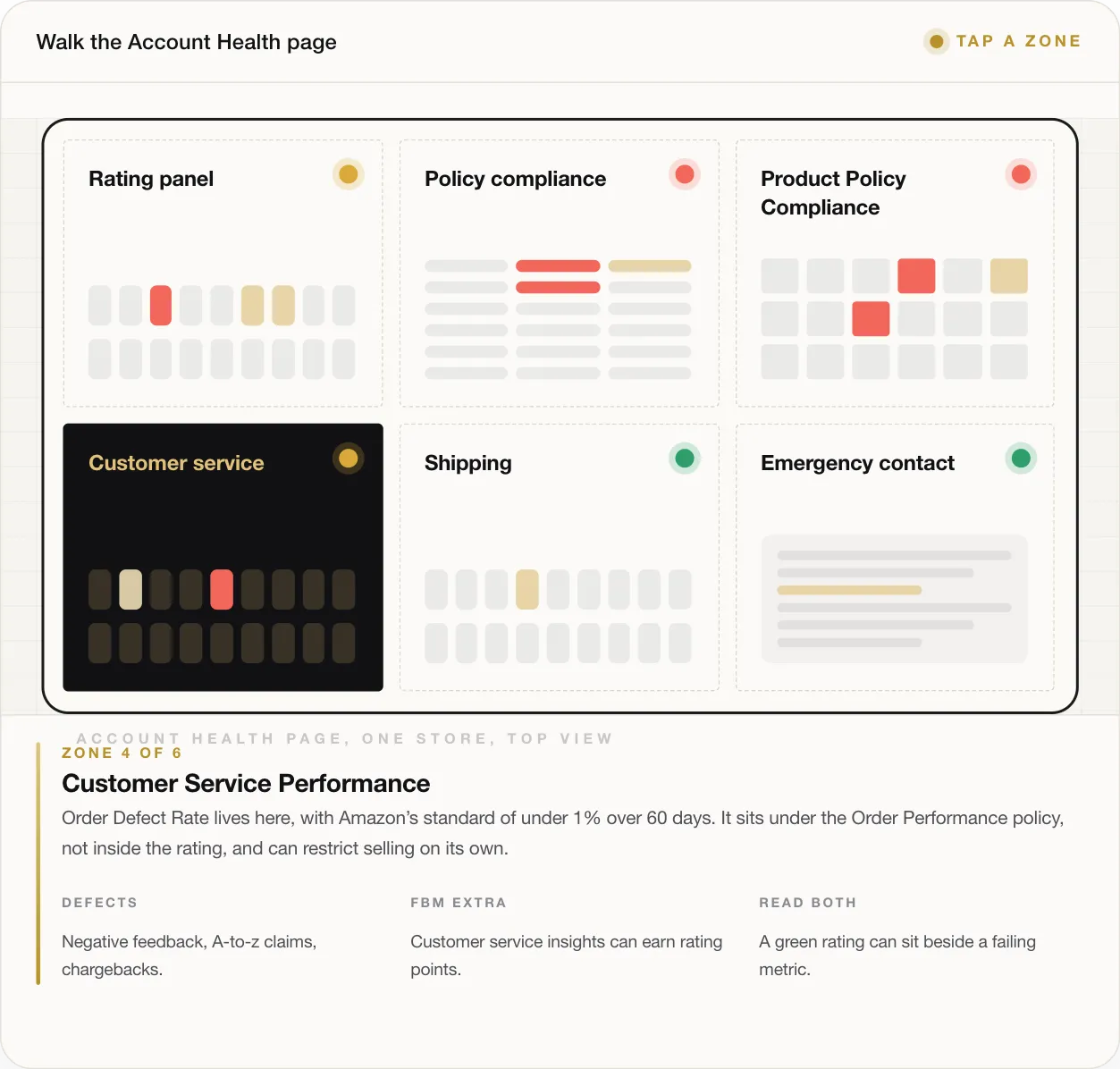
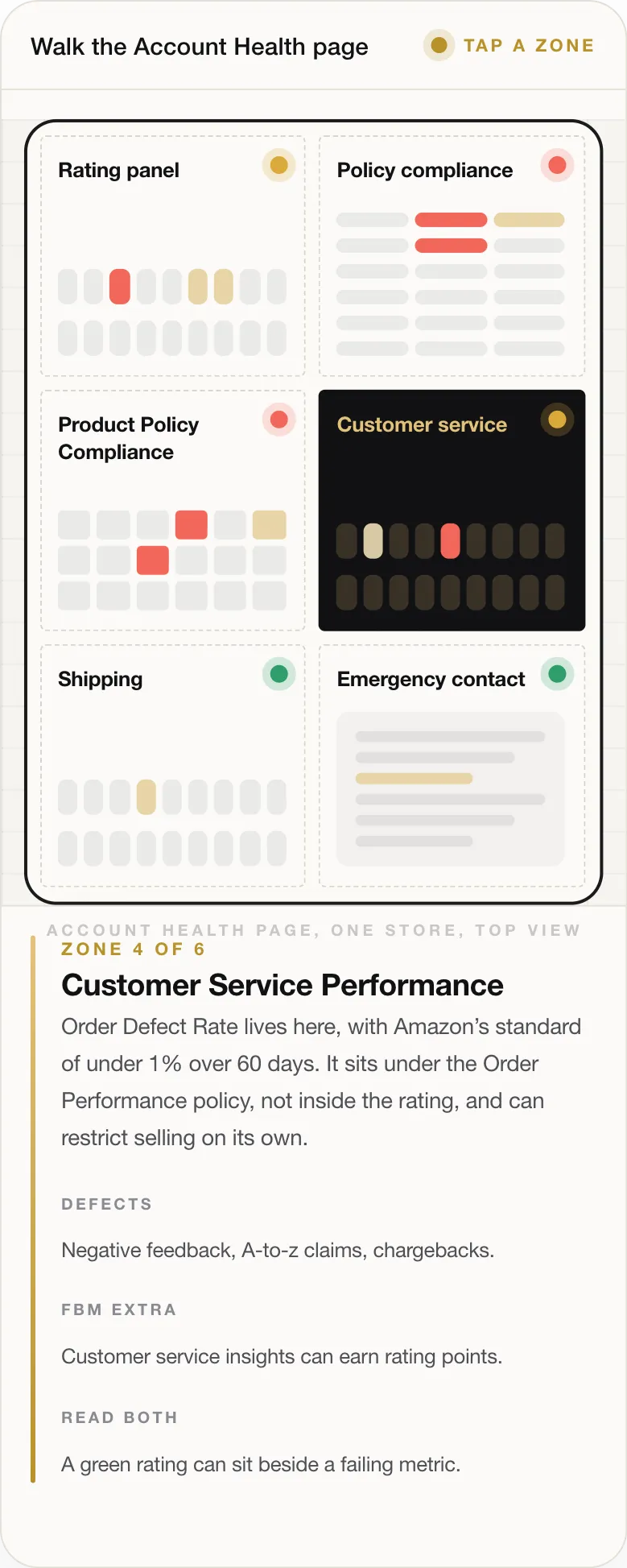
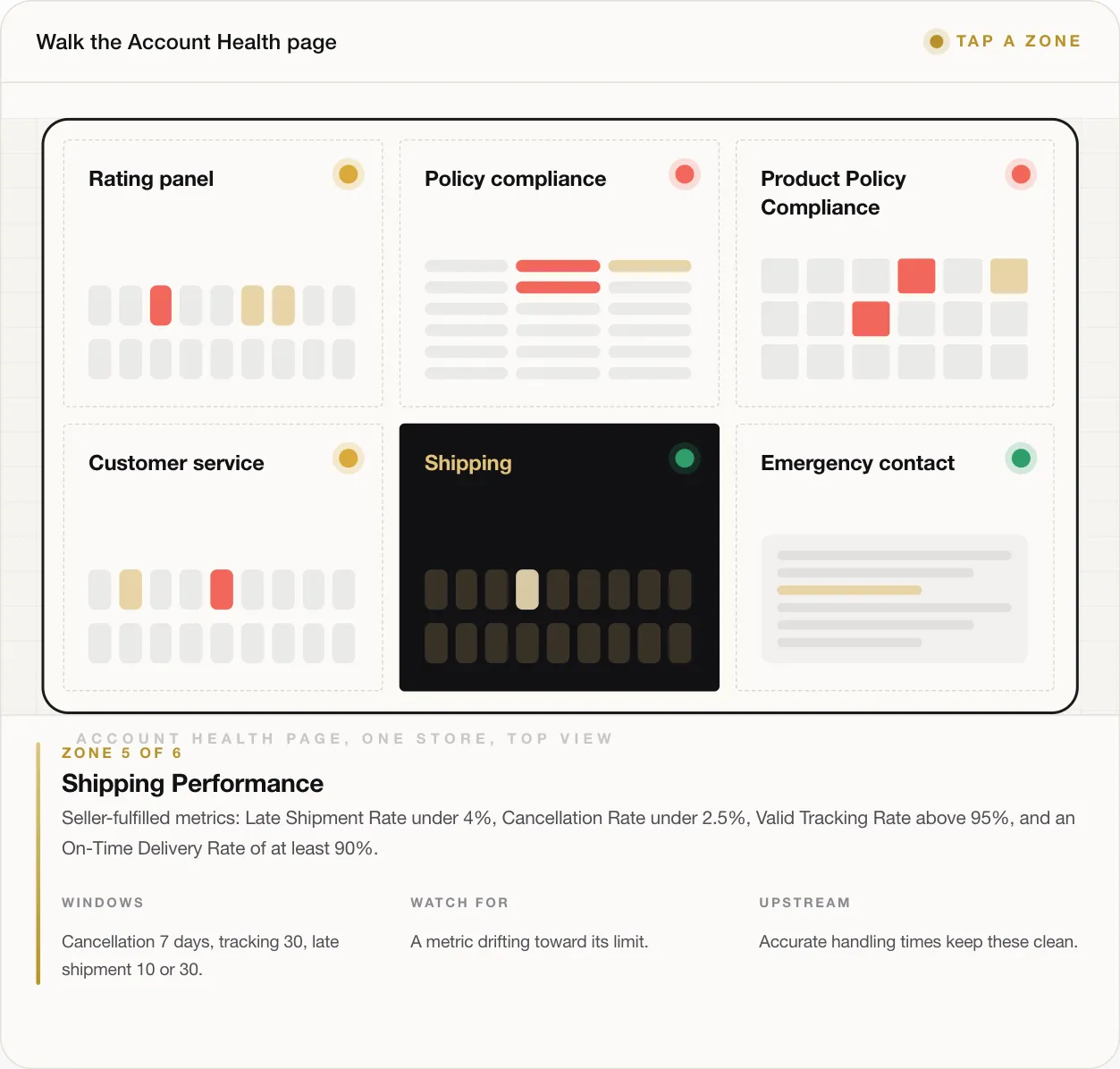
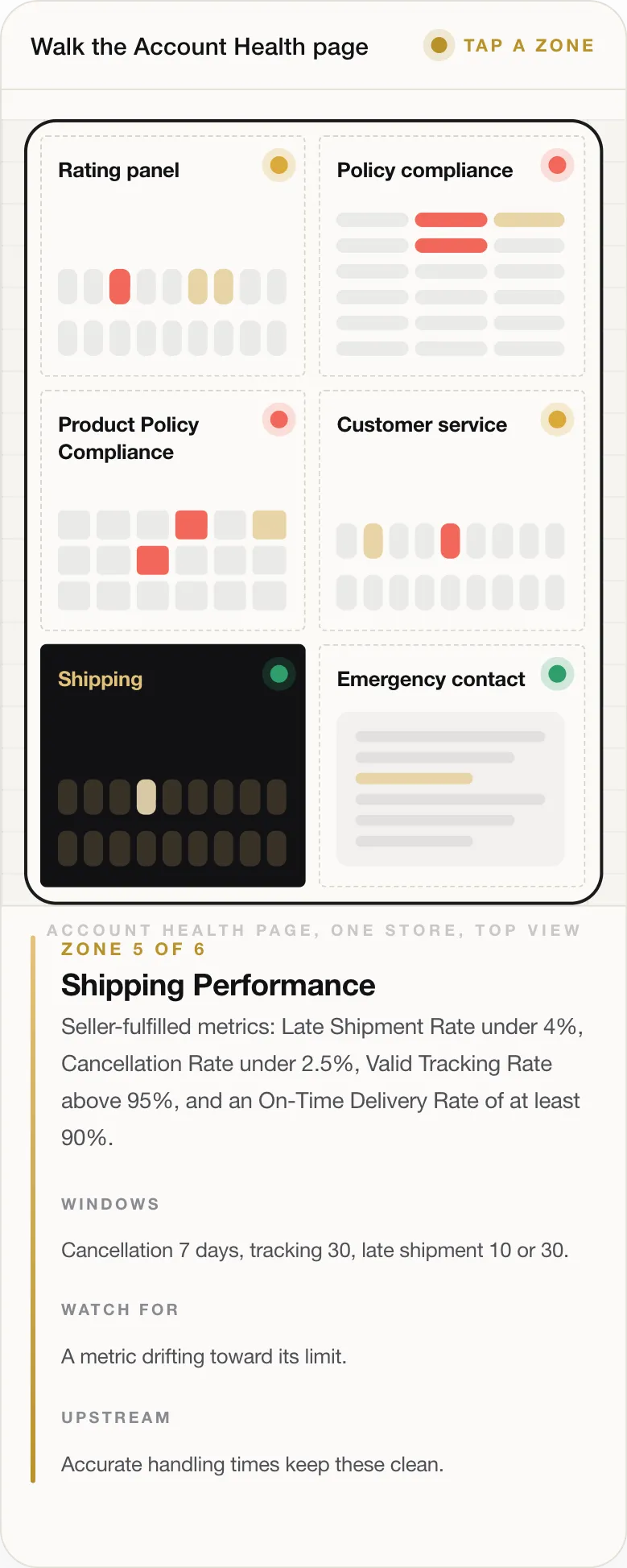
The Account Health page shows more than the rating. Amazon’s Order Performance program policy says sellers can see how they perform against its metrics in the Customer Service Performance and Shipping Performance sections of the same dashboard. Order Performance is not on Amazon’s list of policies included in the rating, and its metrics carry their own thresholds and their own consequences. A seller can have a green rating and still lose selling privileges over a metric. Read both.
| Metric | Amazon’s standard | Measured over | Applies to |
|---|---|---|---|
| Order Defect Rate | Under 1% | 60 days | All orders (negative feedback, A-to-z Guarantee claims, chargebacks) |
| Cancellation Rate | Under 2.5% | 7 days | Fulfilled by Merchant orders, seller-canceled |
| Late Shipment Rate | Under 4% | 10 or 30 days | Seller-fulfilled orders |
| Valid Tracking Rate | Greater than 95% | 30 days | Seller-fulfilled shipments, by category |
| On-Time Delivery Rate | Minimum 90% (95% recommended) | Not stated on the policy page | Seller-fulfilled items on Amazon.com |
| Business Hour Delivery Rate | 90% or higher expected | 14 days | FBM shipments to Amazon Business commercial addresses |
Amazon states that an ODR above 1%, a Cancellation Rate above 2.5% or a Late Shipment Rate above 4% may result in loss or restriction of selling privileges, a Valid Tracking Rate below 95% may restrict non-FBA selling in that category, and an On-Time Delivery Rate below 90% can restrict seller-fulfilled listings. From June 29, 2026, Amazon also requires handling times on seller-fulfilled SKUs to match actual shipping speed, and recommends Automated Handling Time.
We cover the metrics in depth elsewhere: how Order Defect Rate is graded, what to do about a late shipment suspension, and how to fix a pre-fulfillment cancellation rate problem.
How to read the Account Health dashboard
Amazon says the purpose of the Account Health page is to give an overview of your adherence to the performance targets and policies required to sell, so you can improve before violations affect your ability to sell. It encourages sellers to view the page regularly.
Read past the score to its parts. The same headline number can sit over one serious violation, a slow pile-up of low severity flags, or a metric drifting beside a policy flag. Rank each item by how close it is to action, not by how unfair it feels, and look for clusters: a late shipment trend, negative feedback and a condition complaint may all trace back to one fulfillment change. In order: capture the page, list policy issues and metrics separately, rank by proximity to action, map clusters, date every movement, then act.
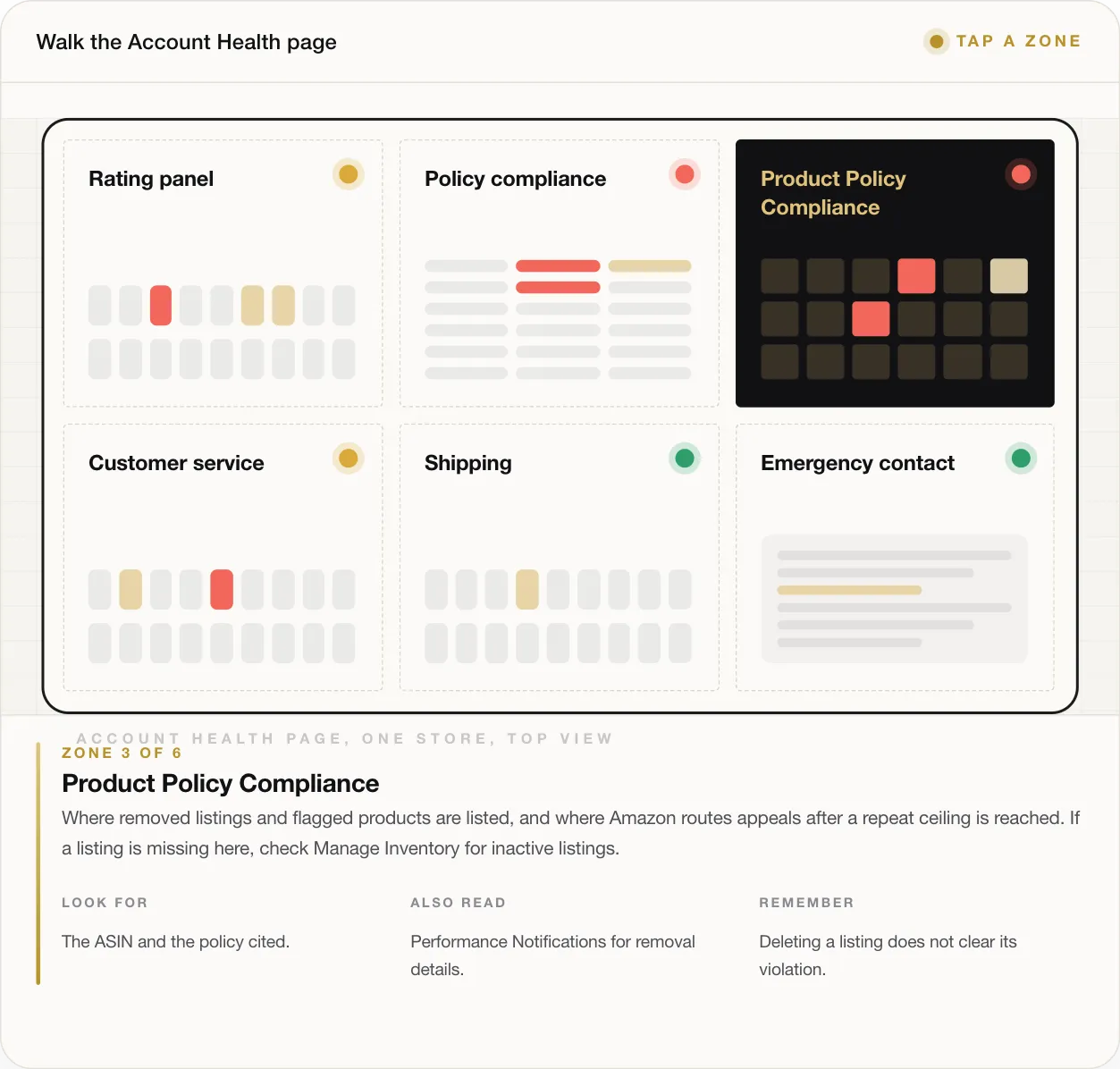
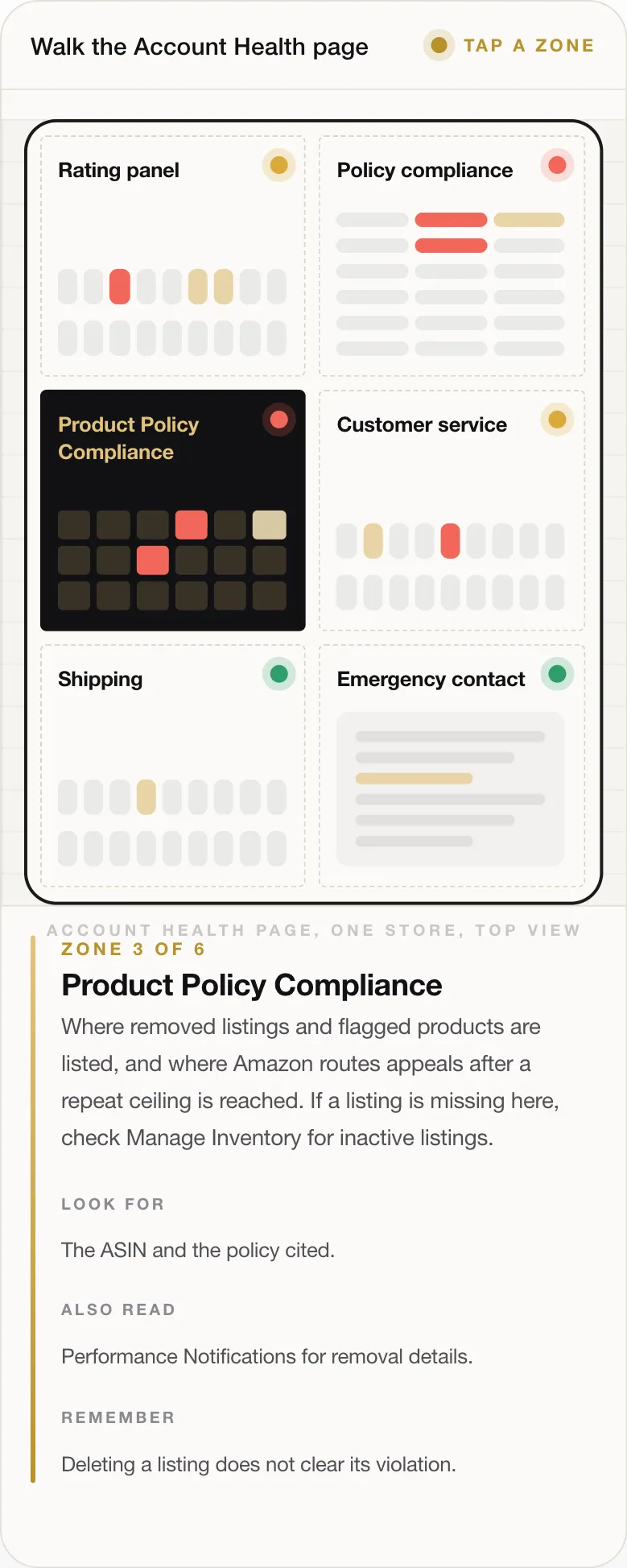
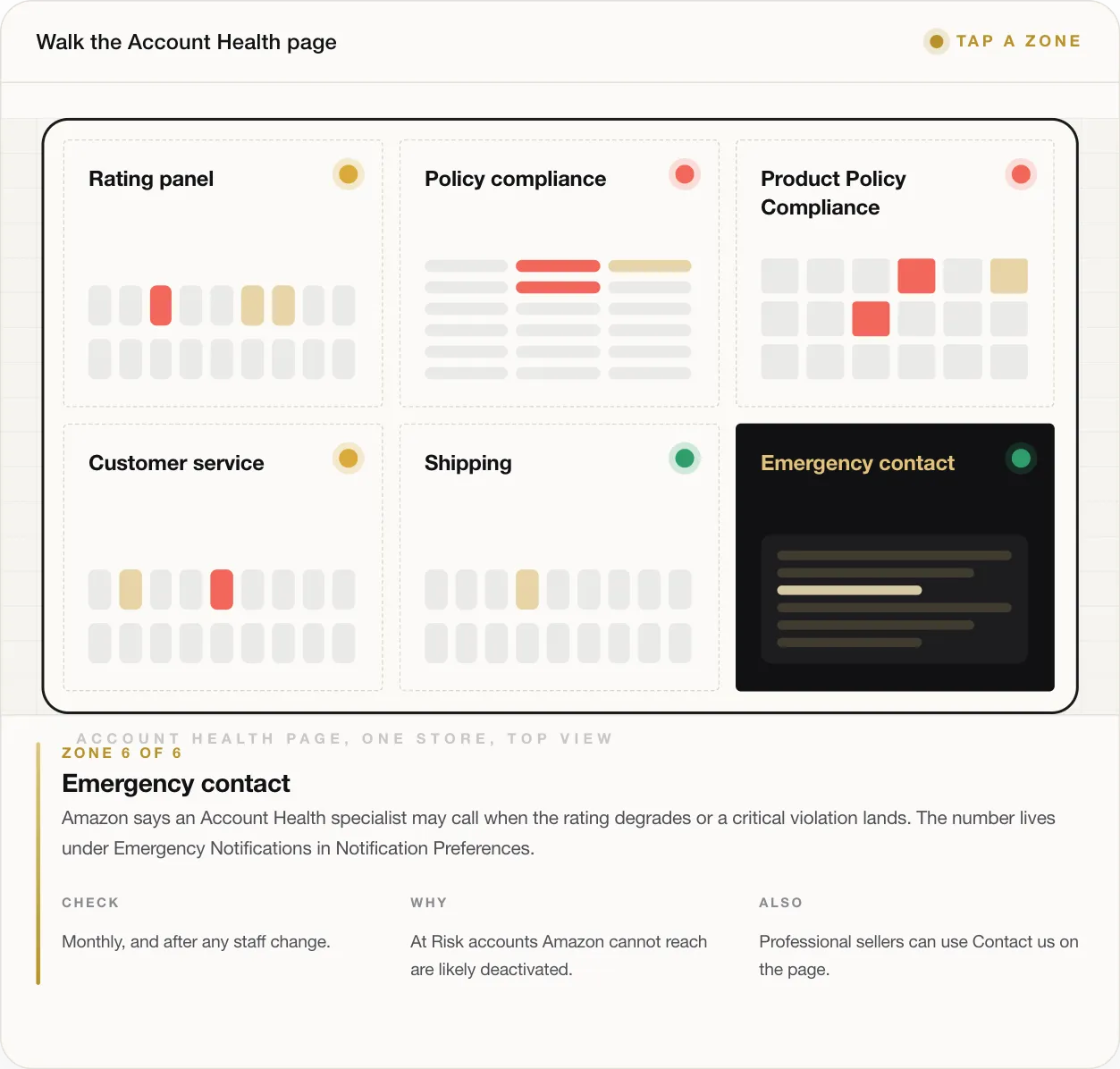
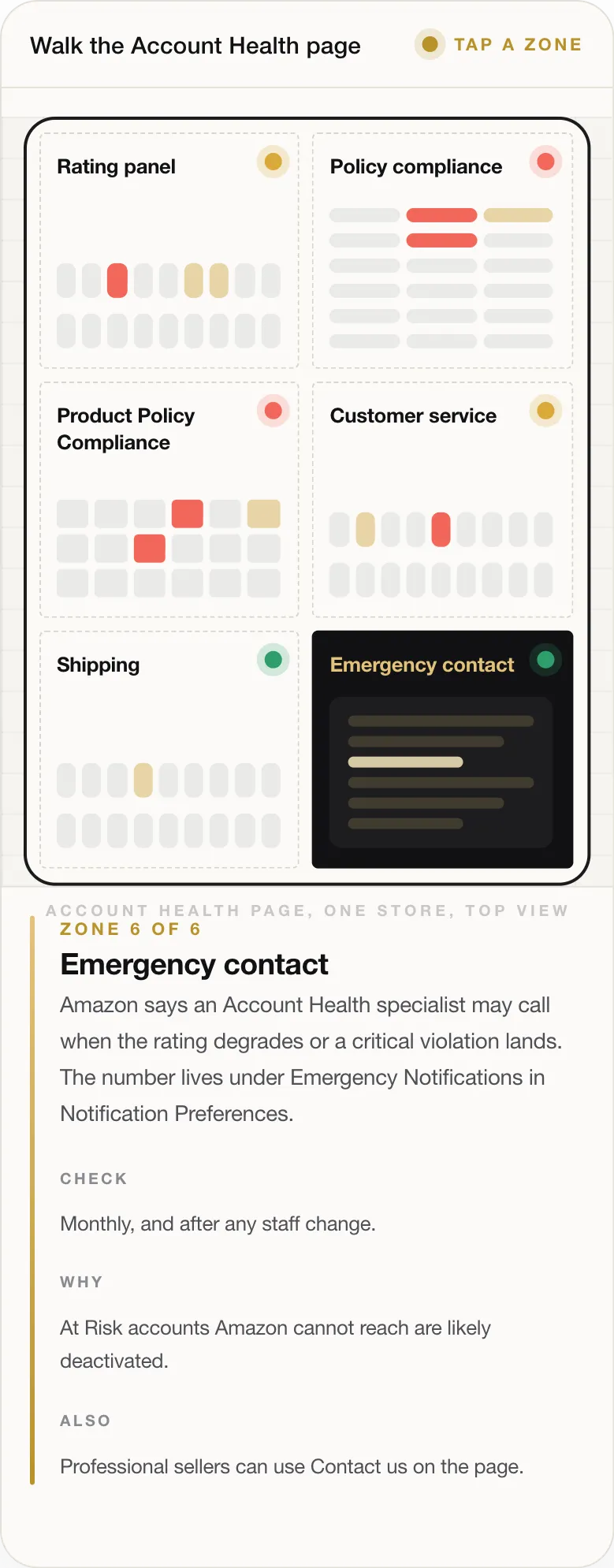
One page, six rooms. Read them in order.
The Account Health page is more than the rating. Tap a room to see what it holds, what to capture and how close it sits to action.
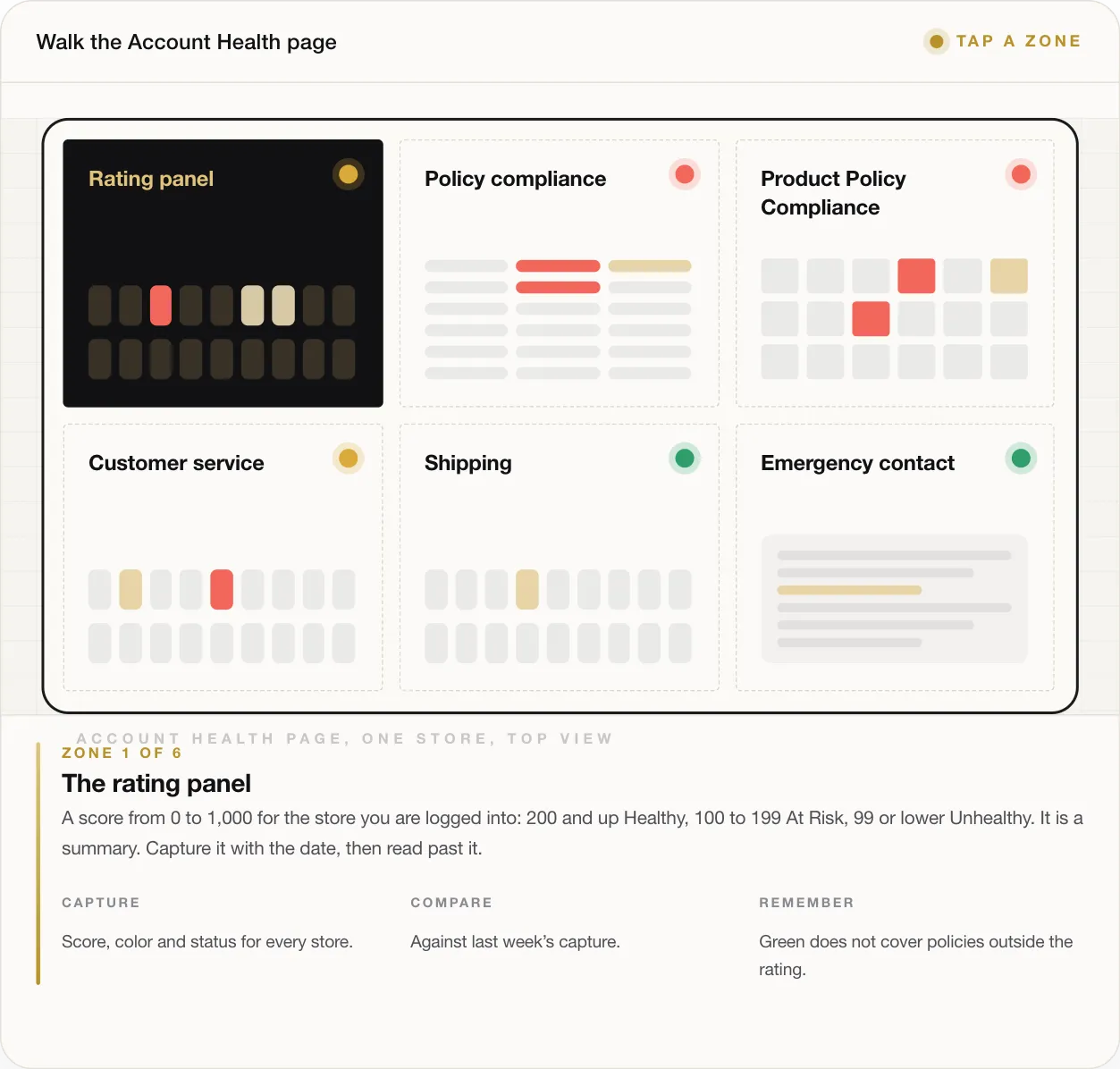
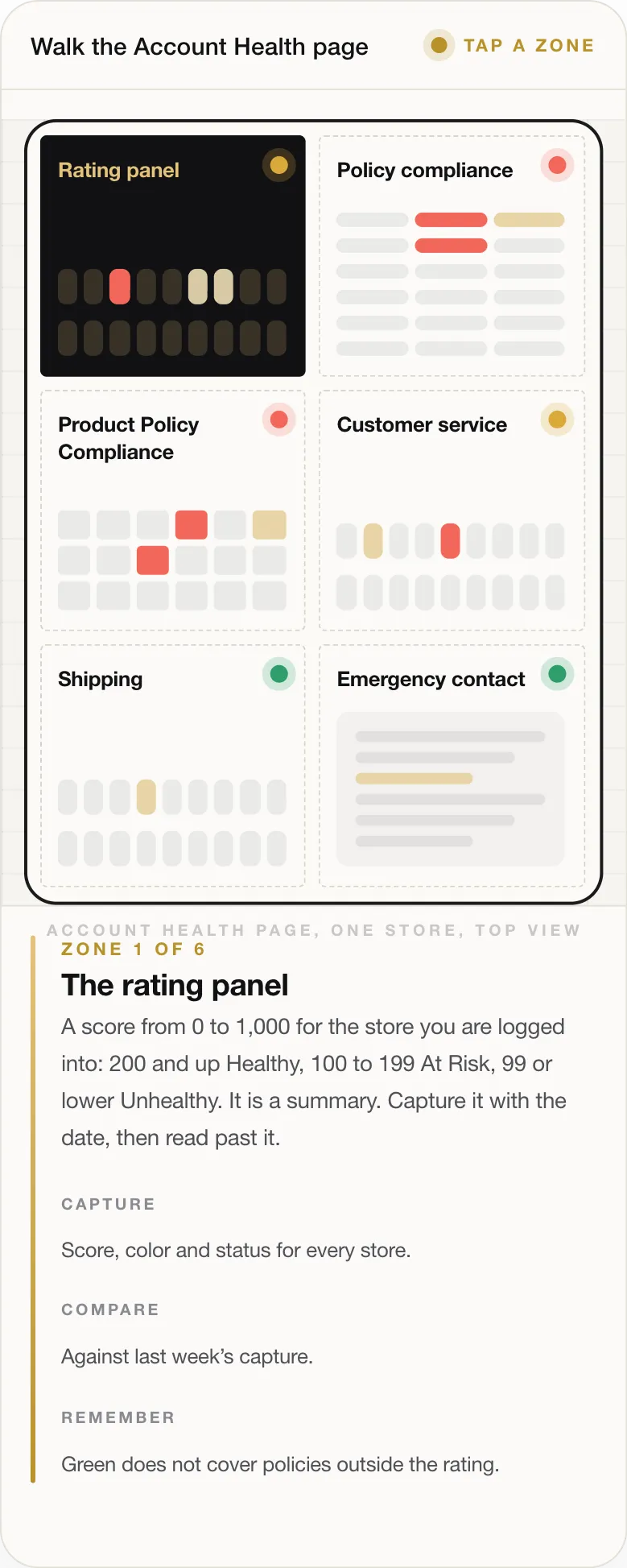
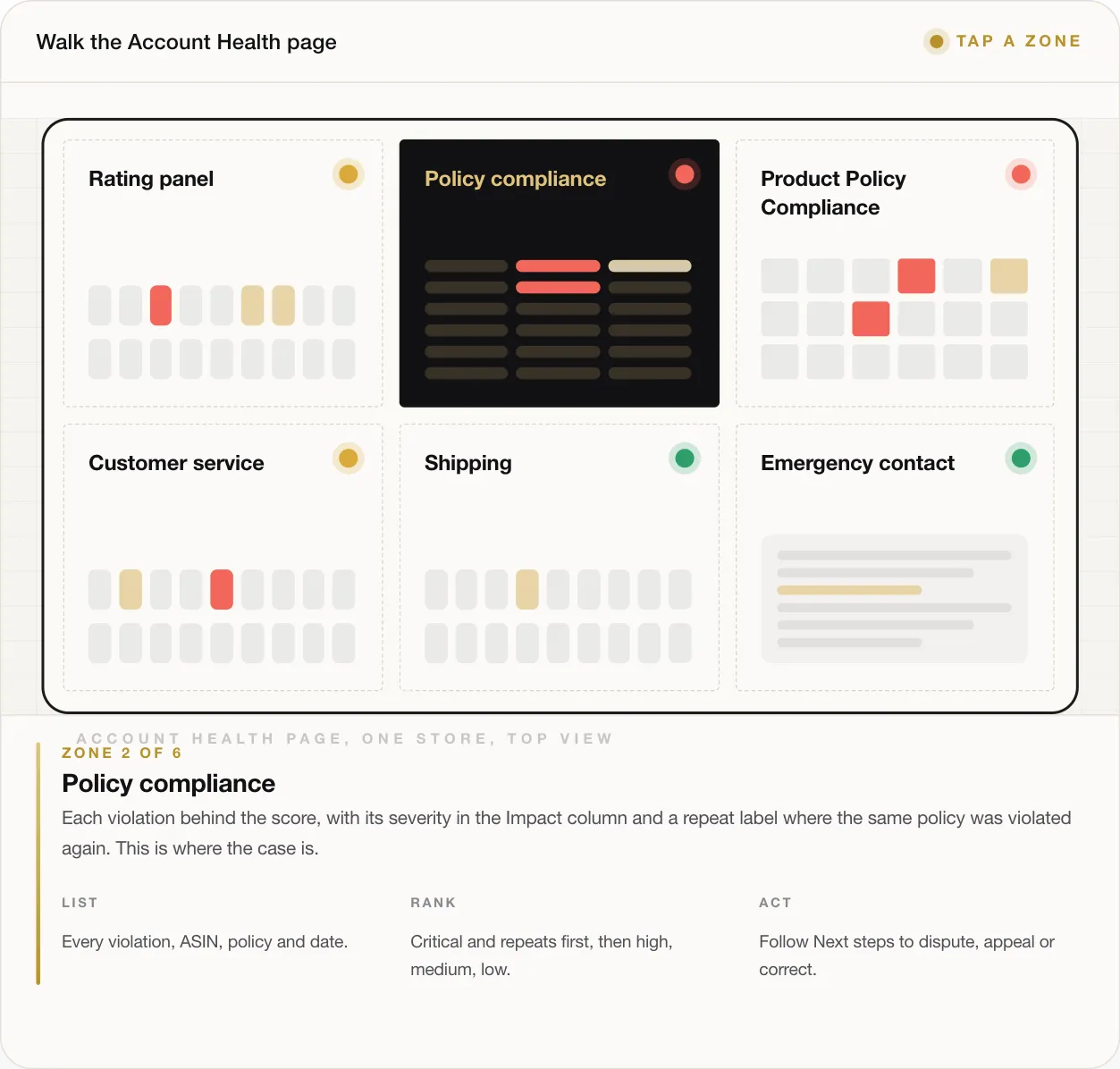
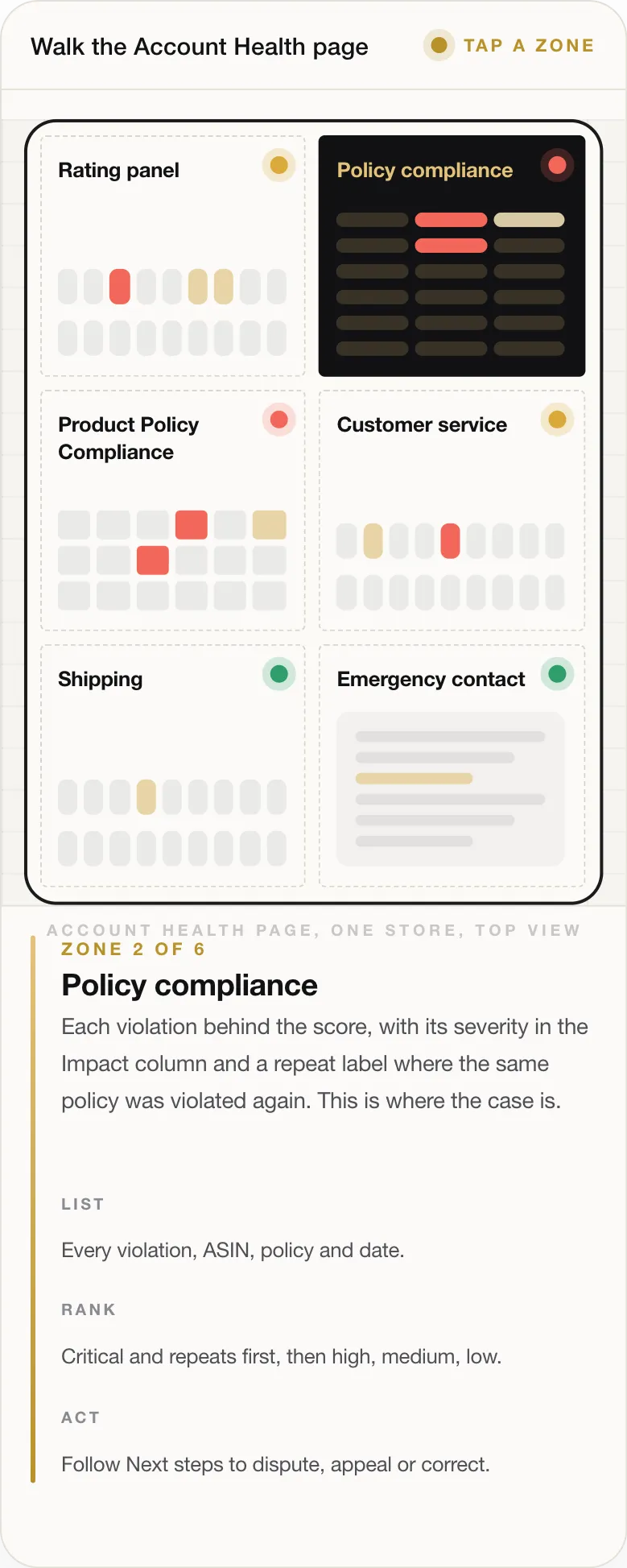
Where to verify each part of your account health
The table maps common questions to the Seller Central page that answers them.
| Question | Where to check | What to look for |
|---|---|---|
| What is my rating and status in this store? | Account Health page in Seller Central | Score, color and status for the store you are logged into |
| Which violations are pulling the score down? | Account Health page, policy compliance section | Each violation, its severity in the Impact column, and any repeat label |
| Is a listing removed or a product flagged? | Product Policy Compliance tab, then Manage Inventory for inactive listings | The ASIN, the policy cited and the Next steps option |
| Are my metrics inside Amazon’s standards? | Customer Service Performance and Shipping Performance sections | ODR, cancellation, late shipment, valid tracking and on-time delivery against the targets |
| Am I earning customer service points (FBM)? | Feedback Manager, Customer Service Quality Insights | Buyer Contact Rate, Average Contact Response Time, Buyer Dissatisfaction Rate over the past 4 weeks |
| Can Amazon reach me if the rating drops? | Notification Preferences, Emergency Notifications | A current phone number that someone answers |
| Did a notice explain the removal? | Performance Notifications and the email linked to the account | The notice date, the ASINs and the policy named |
| Which policies count toward the rating today? | The Policies included in Account Health Rating help page | Any newly added policy that affects your catalog |
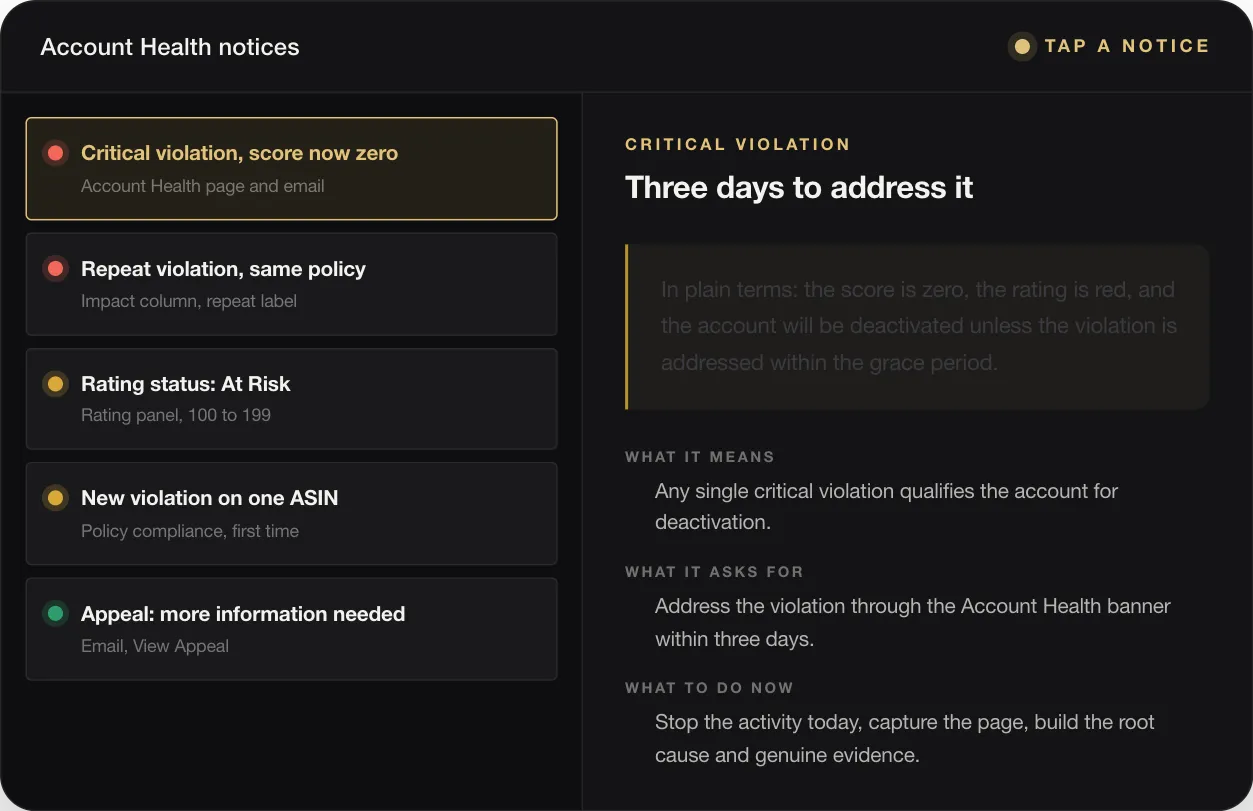
When a critical violation lands: the three-day window
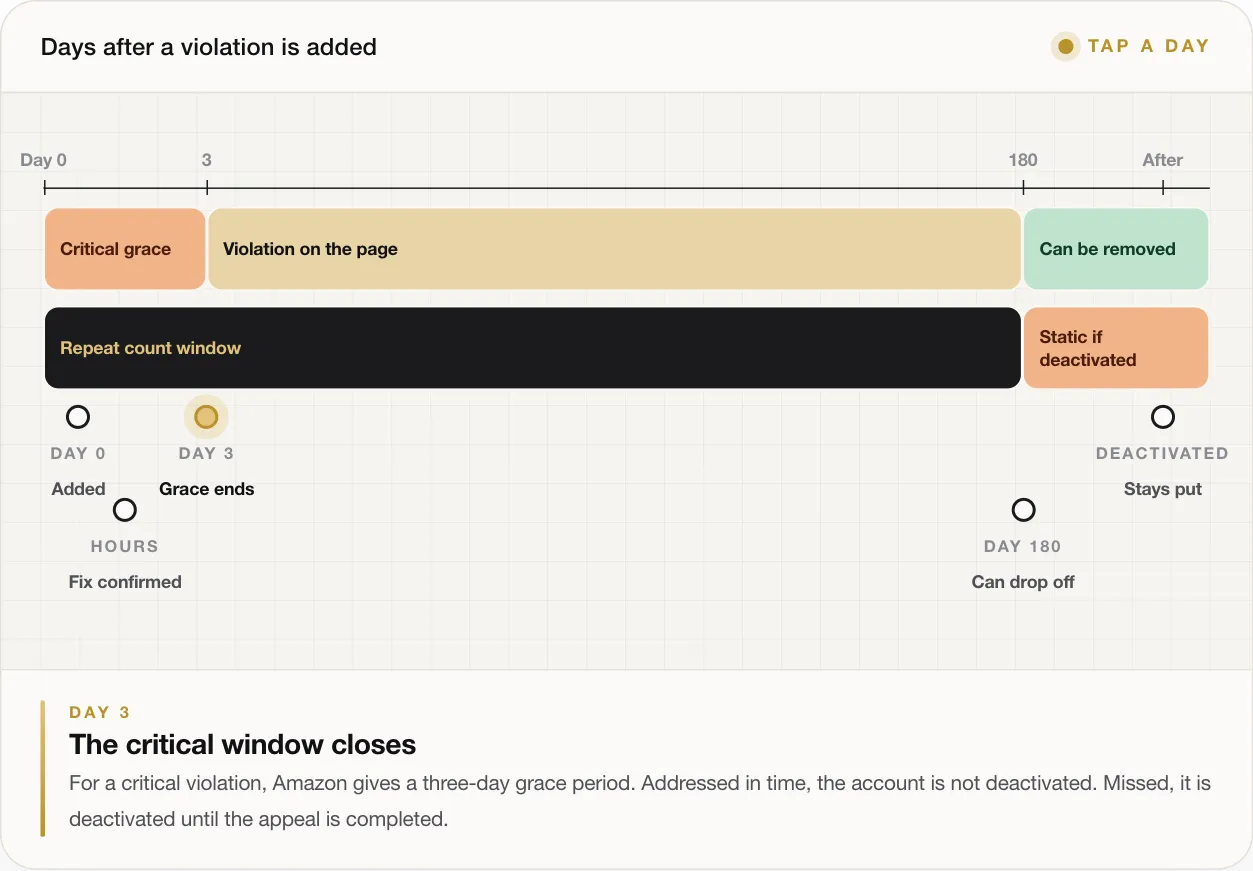
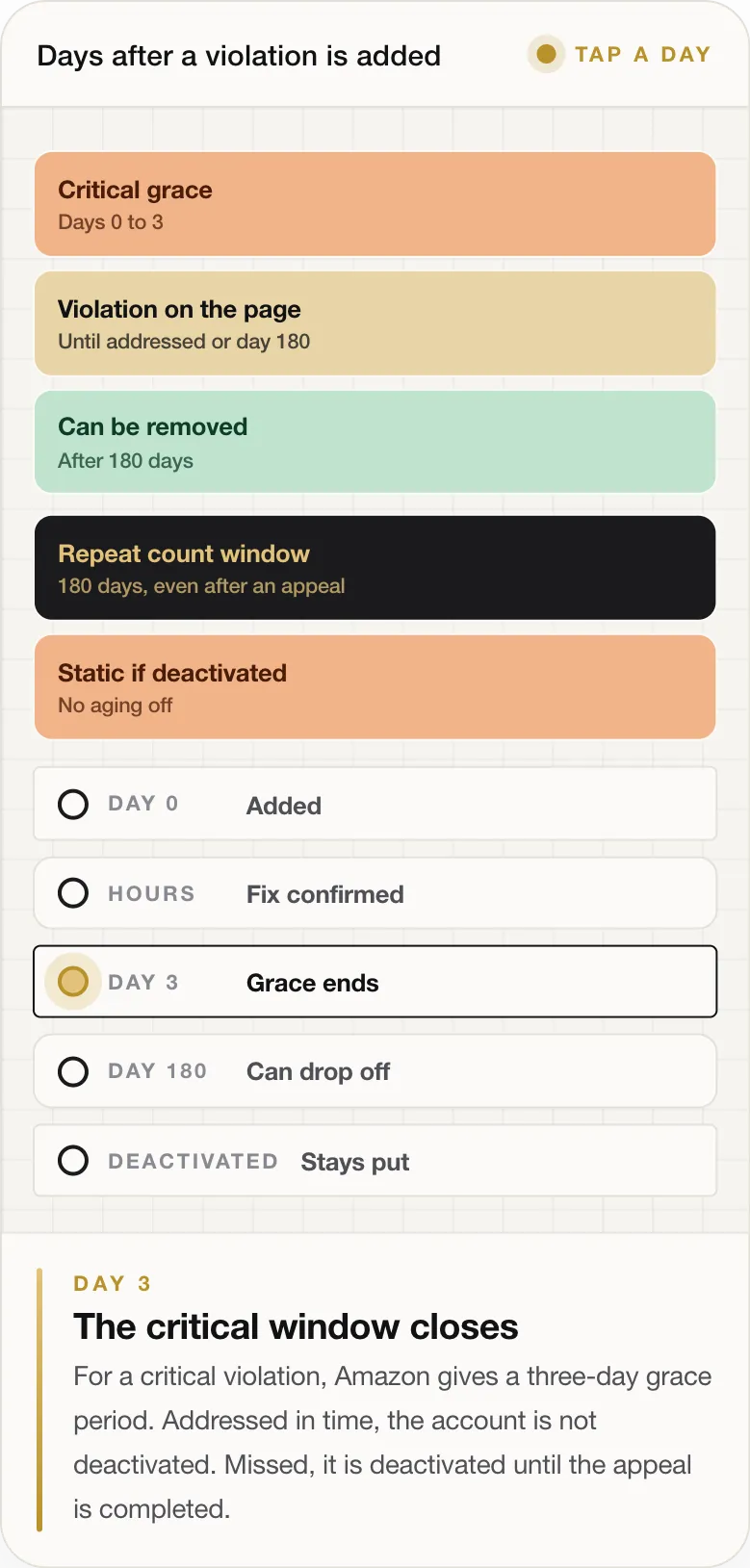
Amazon says that when it detects a critical violation it notifies you on the Account Health page and by email, the rating turns red with a score of zero, and you have a three-day grace period to address the violation before deactivation. During that time an Account Health specialist may try to call you, which is why Amazon asks sellers to keep the emergency contact number current. If you address the violation within the three days, Amazon says the account will not be deactivated and the score will update. If you do not, the account is deactivated until you complete the appeal.
Three days is too short to start organizing records from scratch. Use it to execute:
- Hour one. Capture the Account Health page and the notice. Note the policy and ASINs named.
- Same day. Stop the activity (remove the listing, pull the insert, quarantine the inventory) and record what you did and when.
- Day one and two. Establish the honest root cause and gather genuine evidence: invoices, authorizations, corrected listing content, process changes.
- Before day three ends. Submit through the route the banner gives you and watch email for requests.
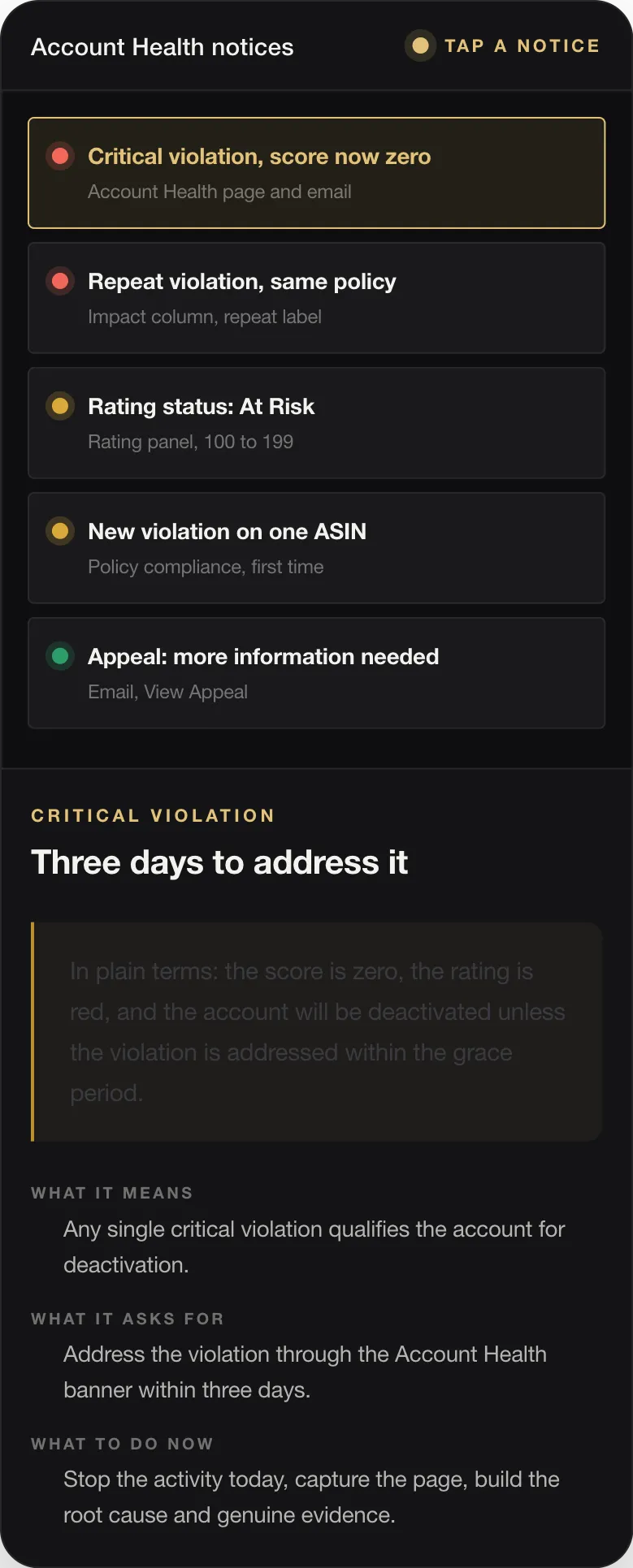
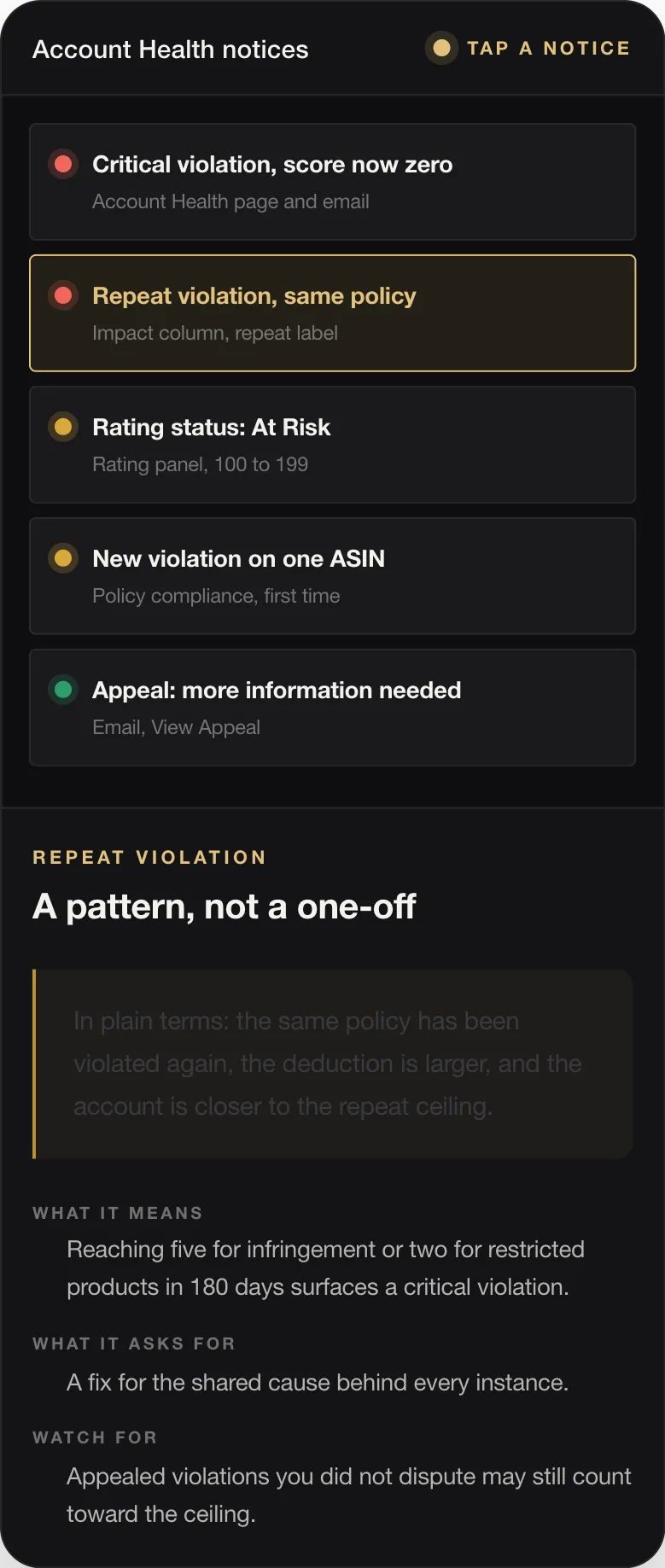
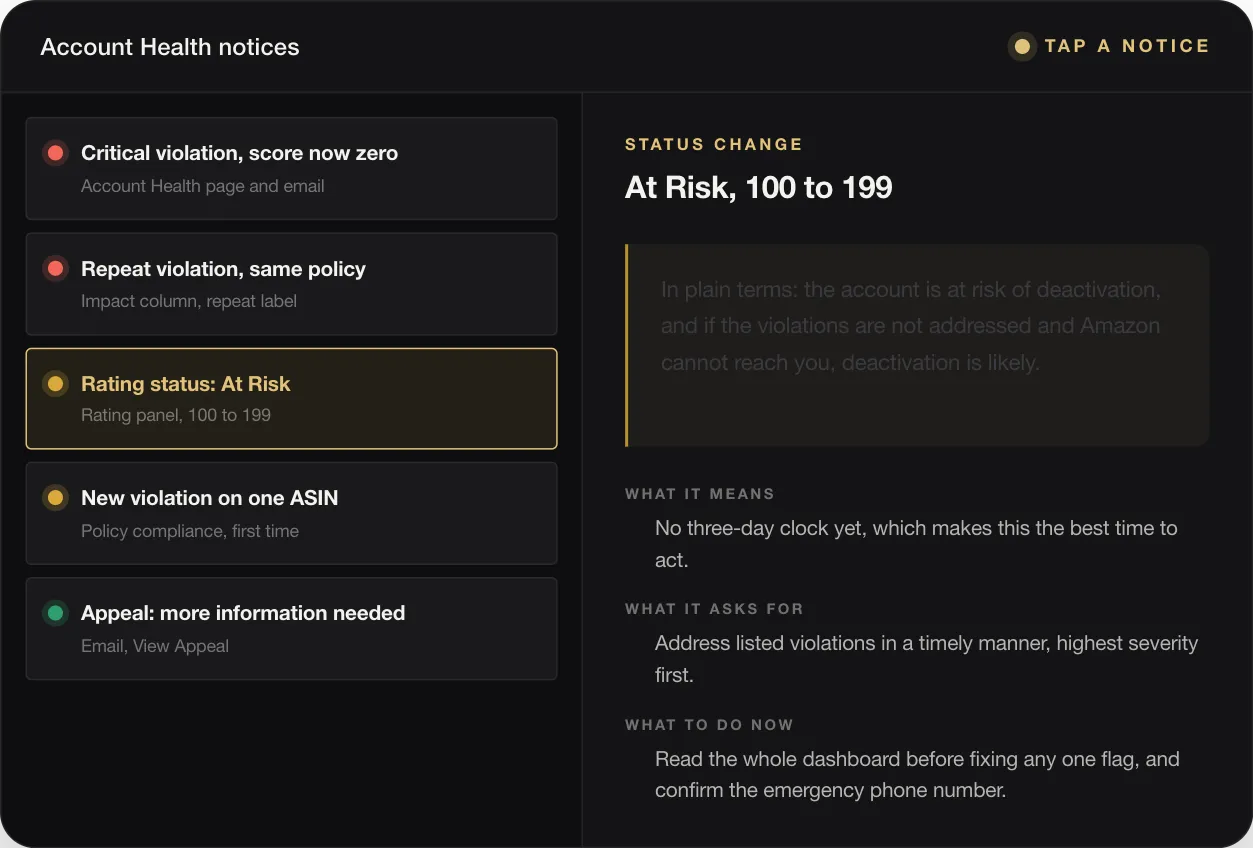
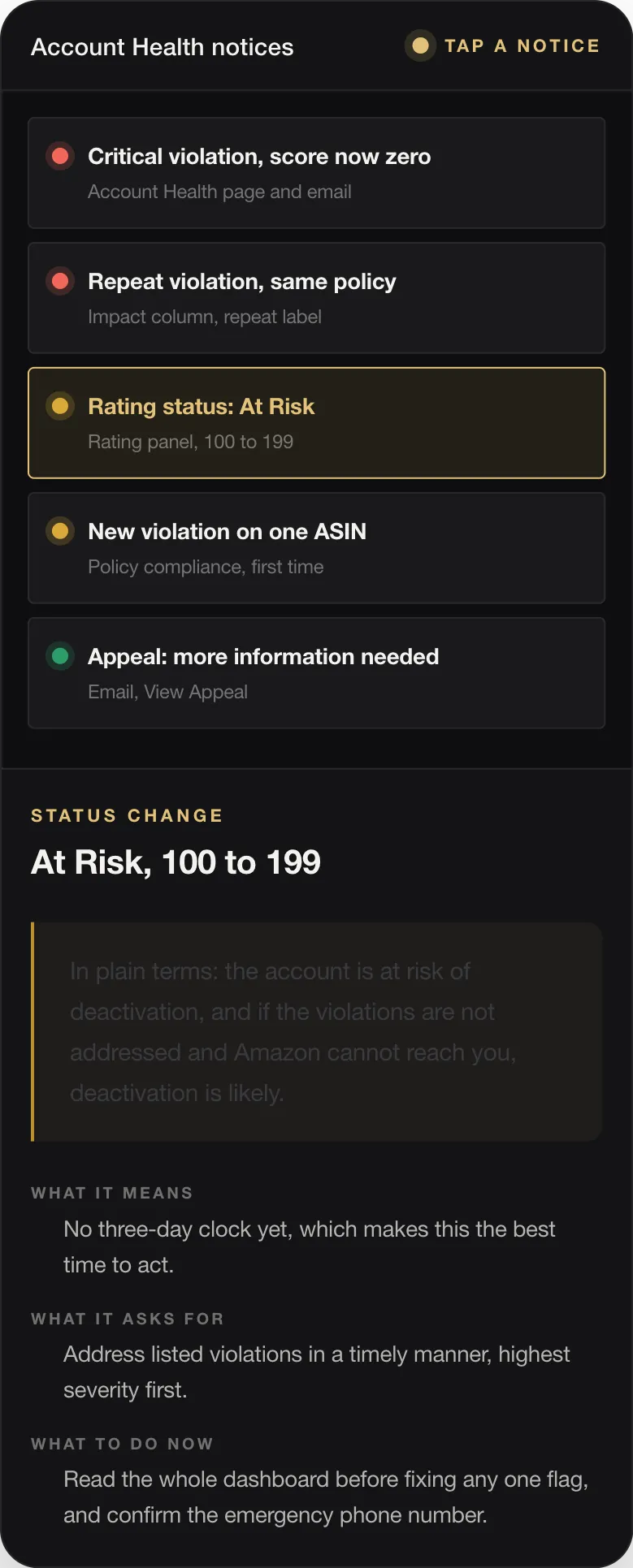
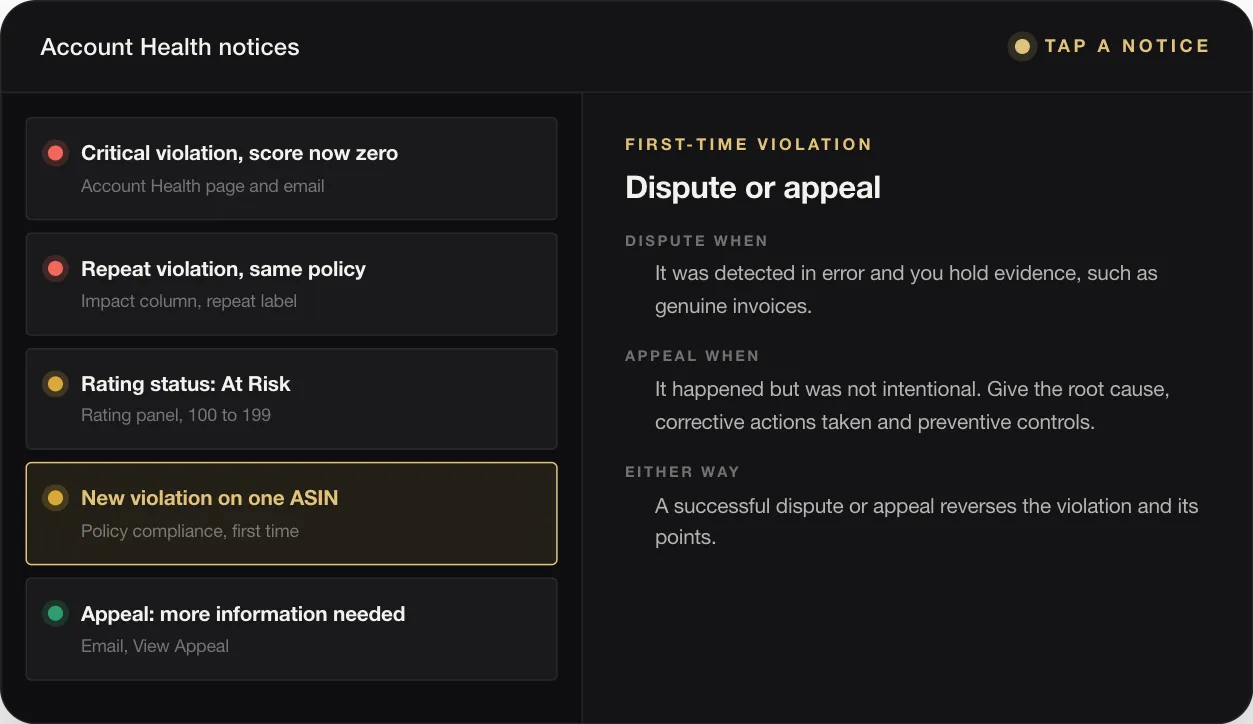
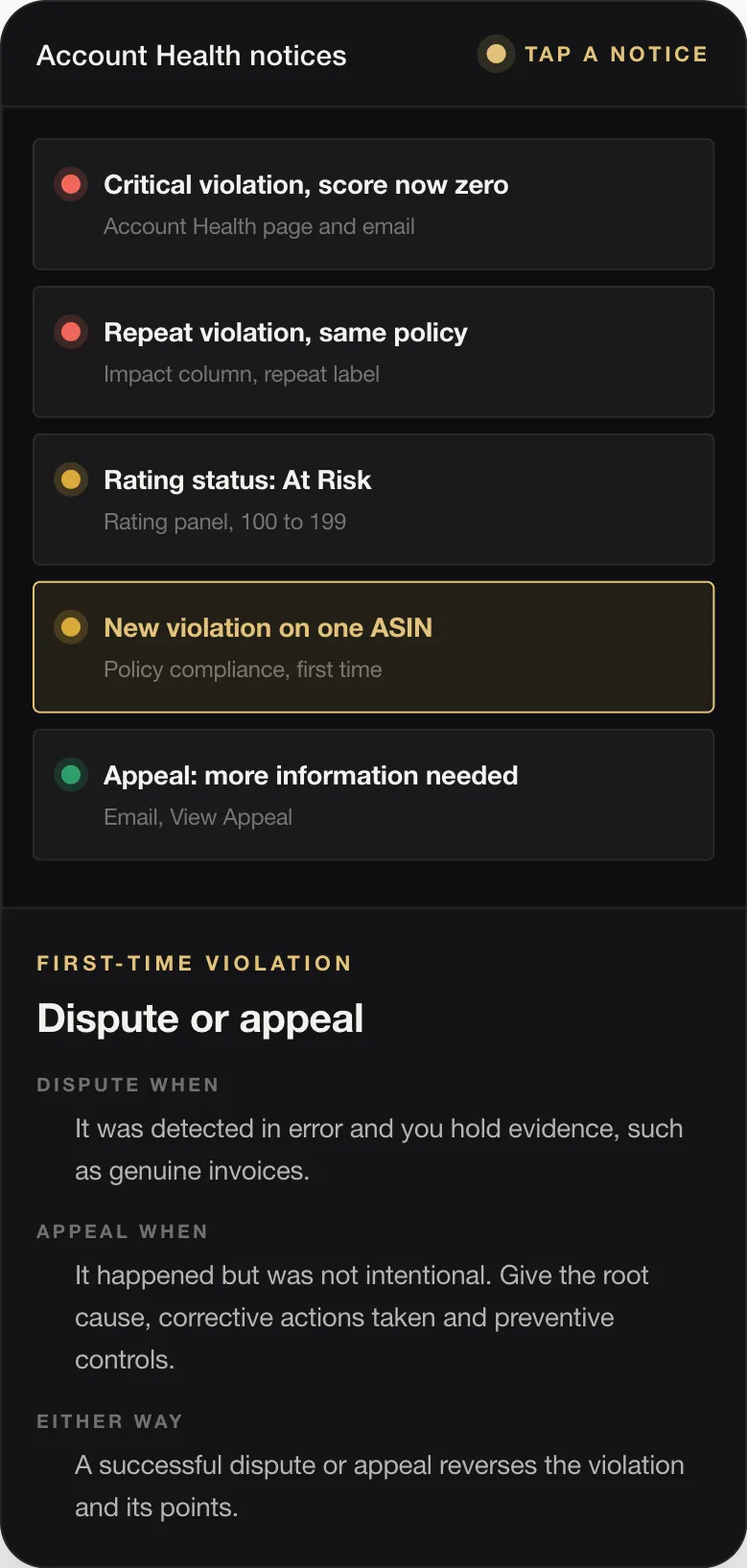
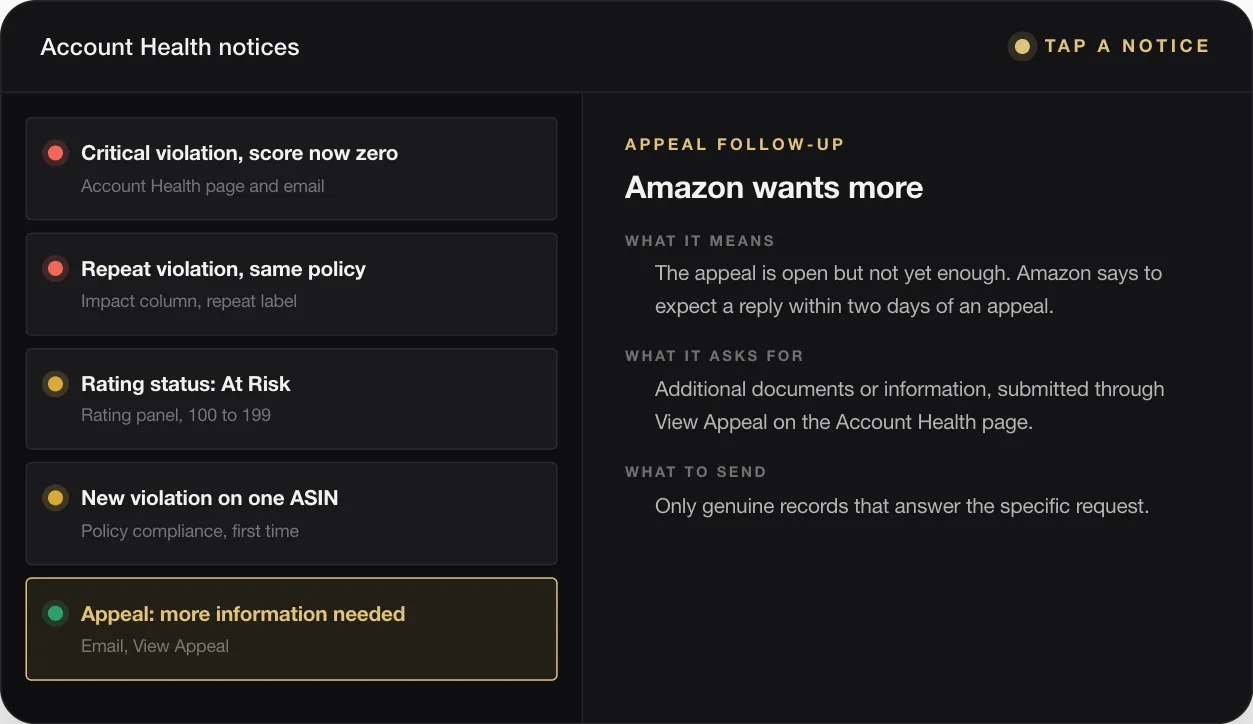
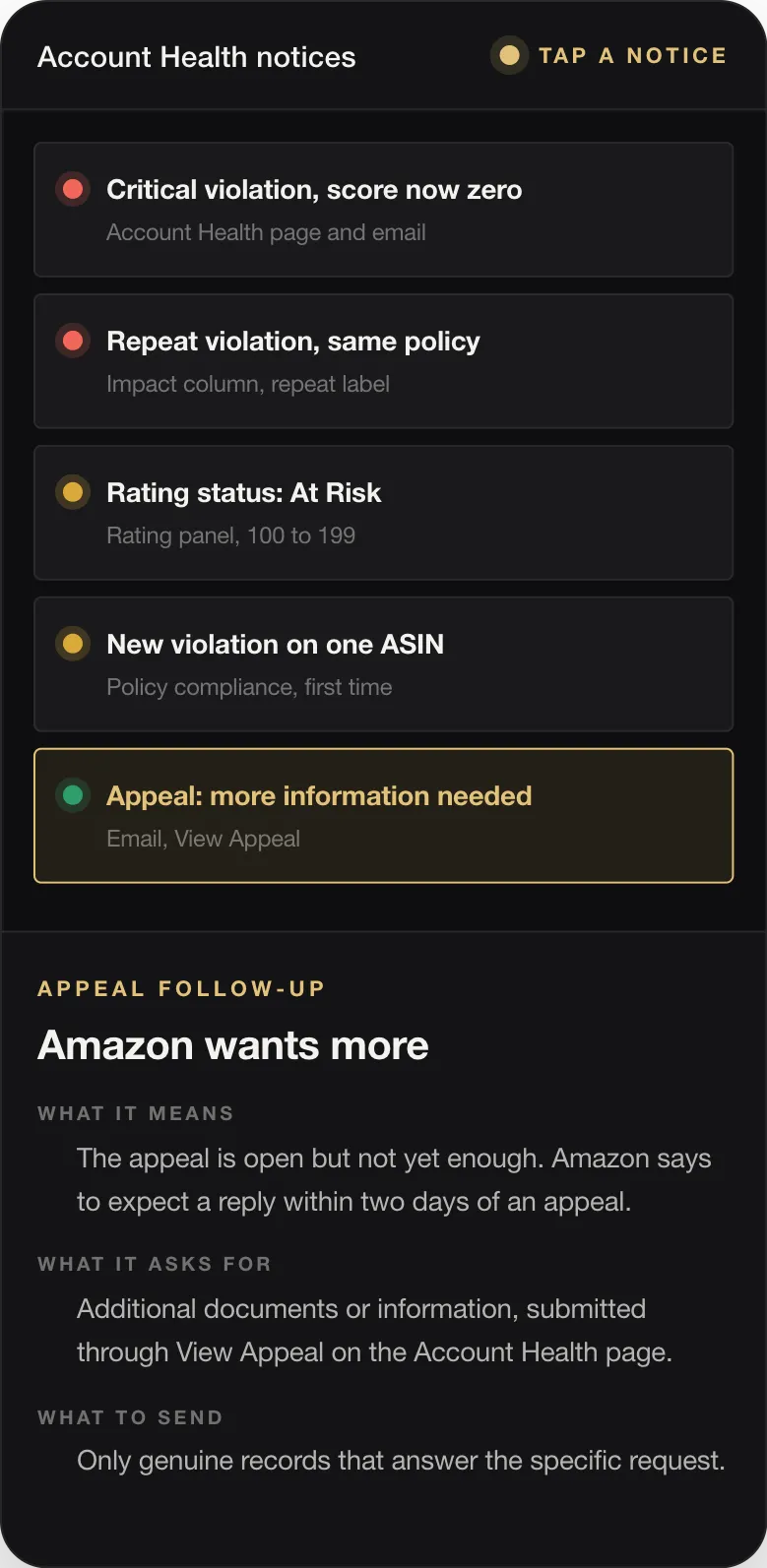
Each notice asks for something different. Answer the right one.
The first move depends on what landed: a critical violation, an At Risk status, a repeat, a first-time flag or a request for more information. Tap a notice.
Dispute, appeal or correct: choosing the right response
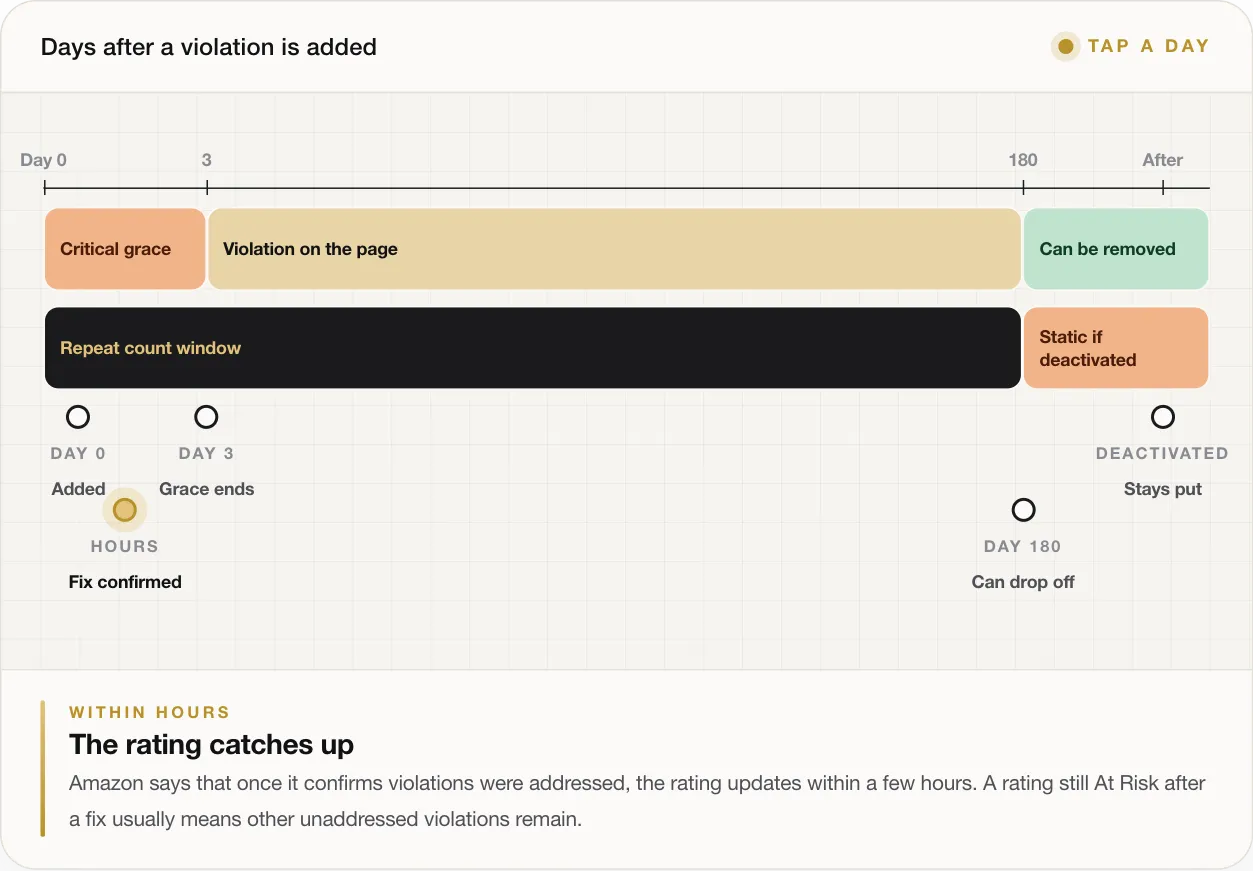
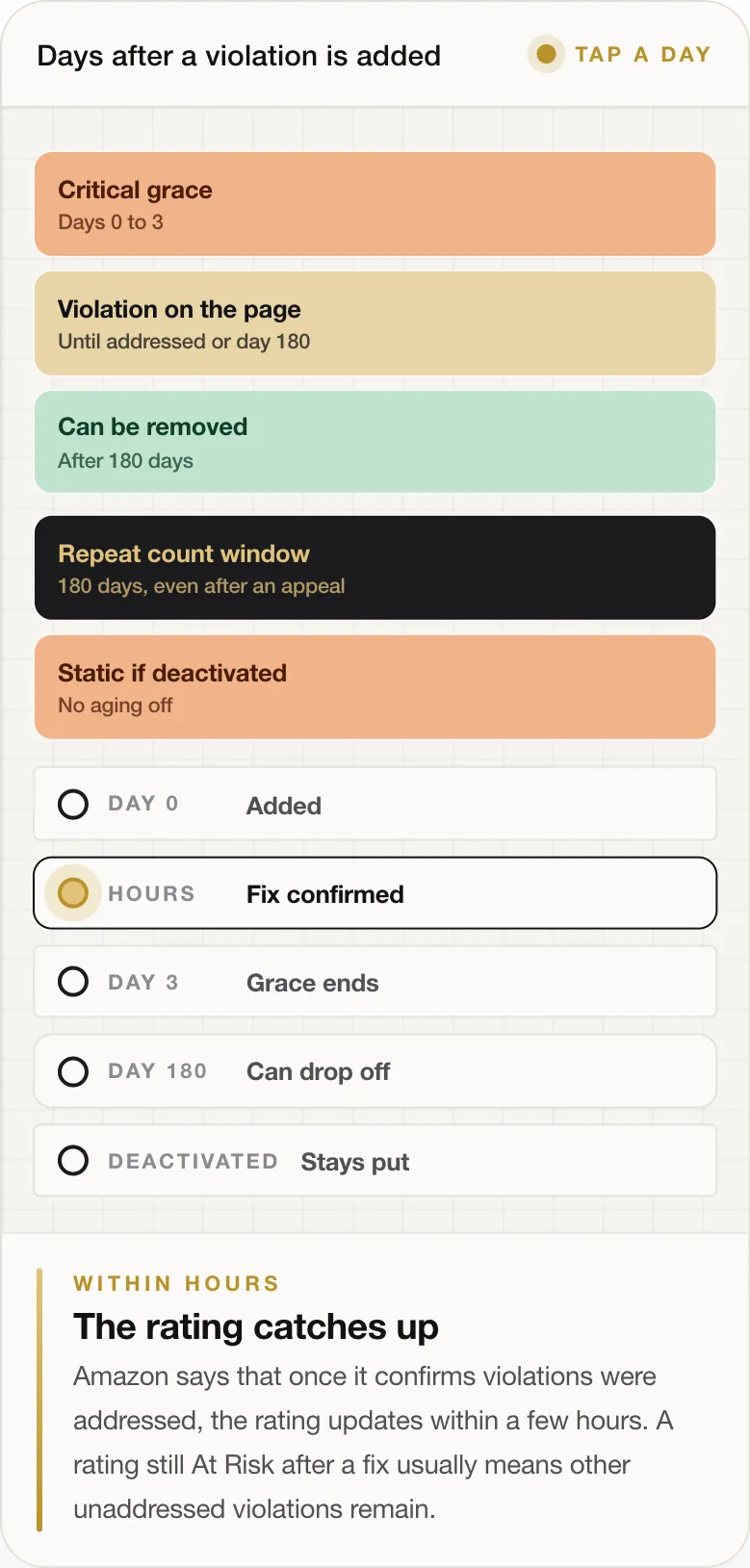
Amazon says a successful appeal or dispute through the Account Health page reverses the violation and its impact on the rating. Amazon says the rating updates within a few hours once it confirms violations were addressed. The two routes are not interchangeable.
Dispute: the violation was detected in error
Amazon describes a dispute as the seller providing evidence that the violation was detected in error. Use it when the facts are on your side, such as genuine invoices that prove authenticity. A dispute without evidence is an assertion, and assertions do not reverse violations.
Appeal: it happened, but it was not intentional
Amazon describes a successful appeal as one where it determines that while you did violate the policy, it was not intentional and the violation should be forgiven. An appeal needs an honest account of what happened, what you have already changed and what will stop it recurring. Remember the repeat rule: an appealed violation where you did not dispute the activity may still count toward the 180-day ceiling.
Other ways violations leave the page
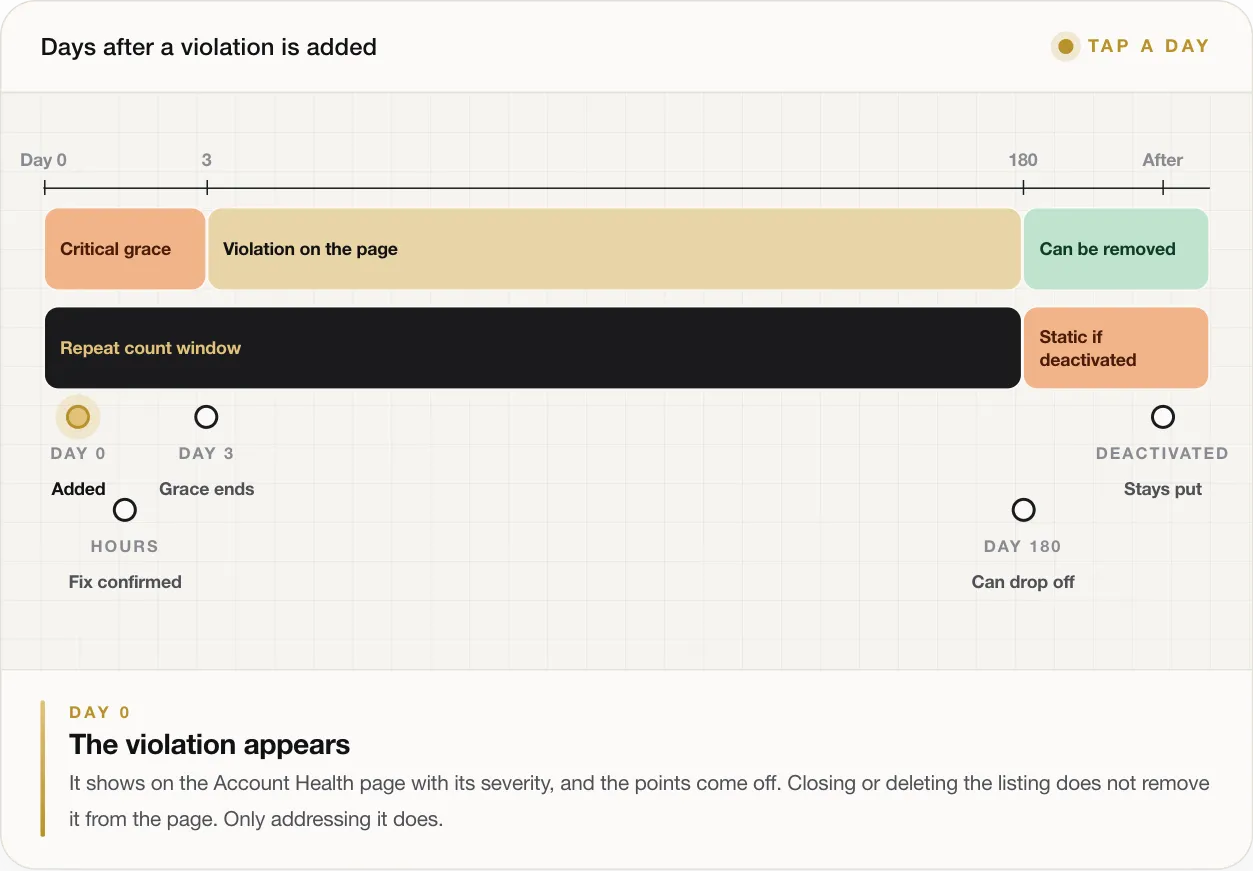
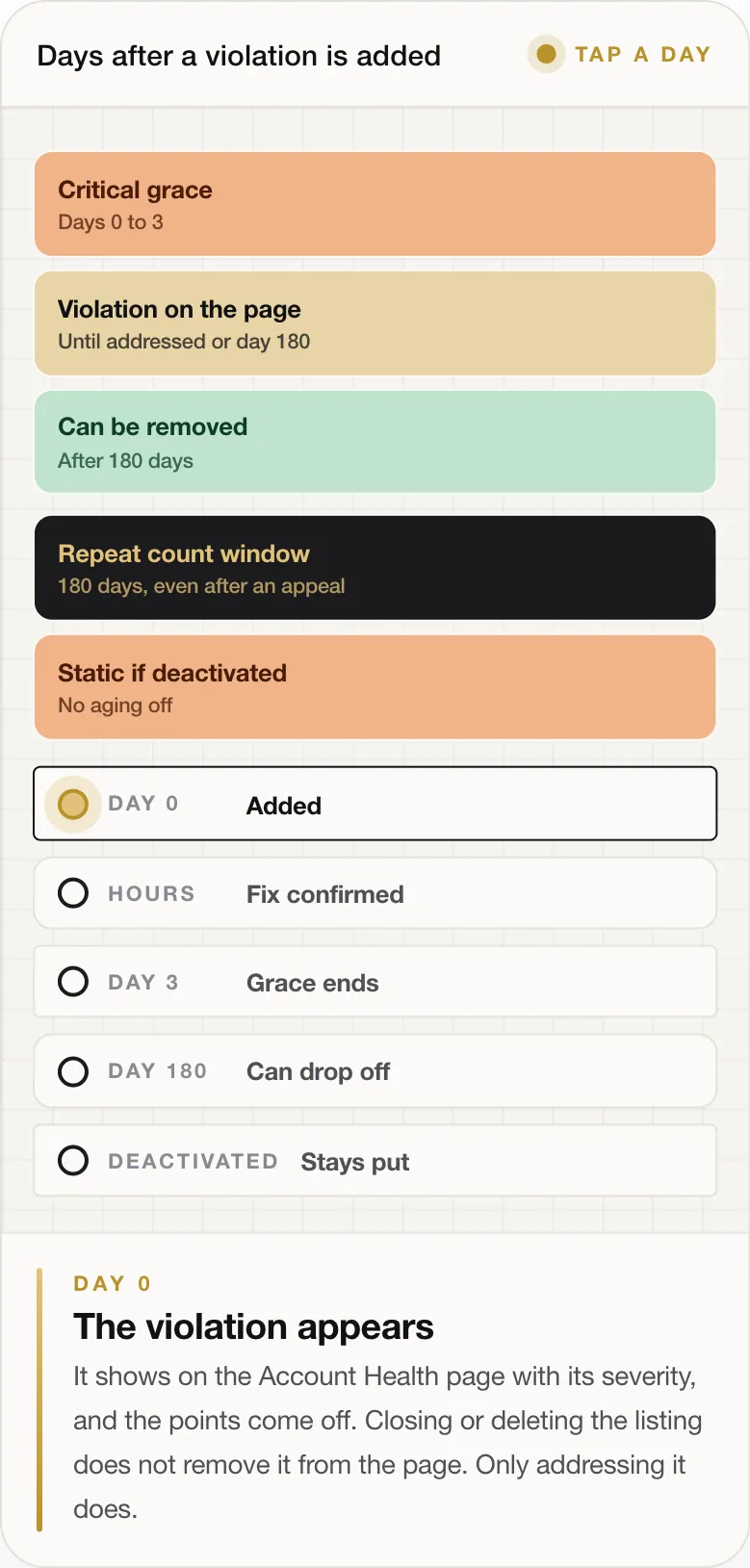
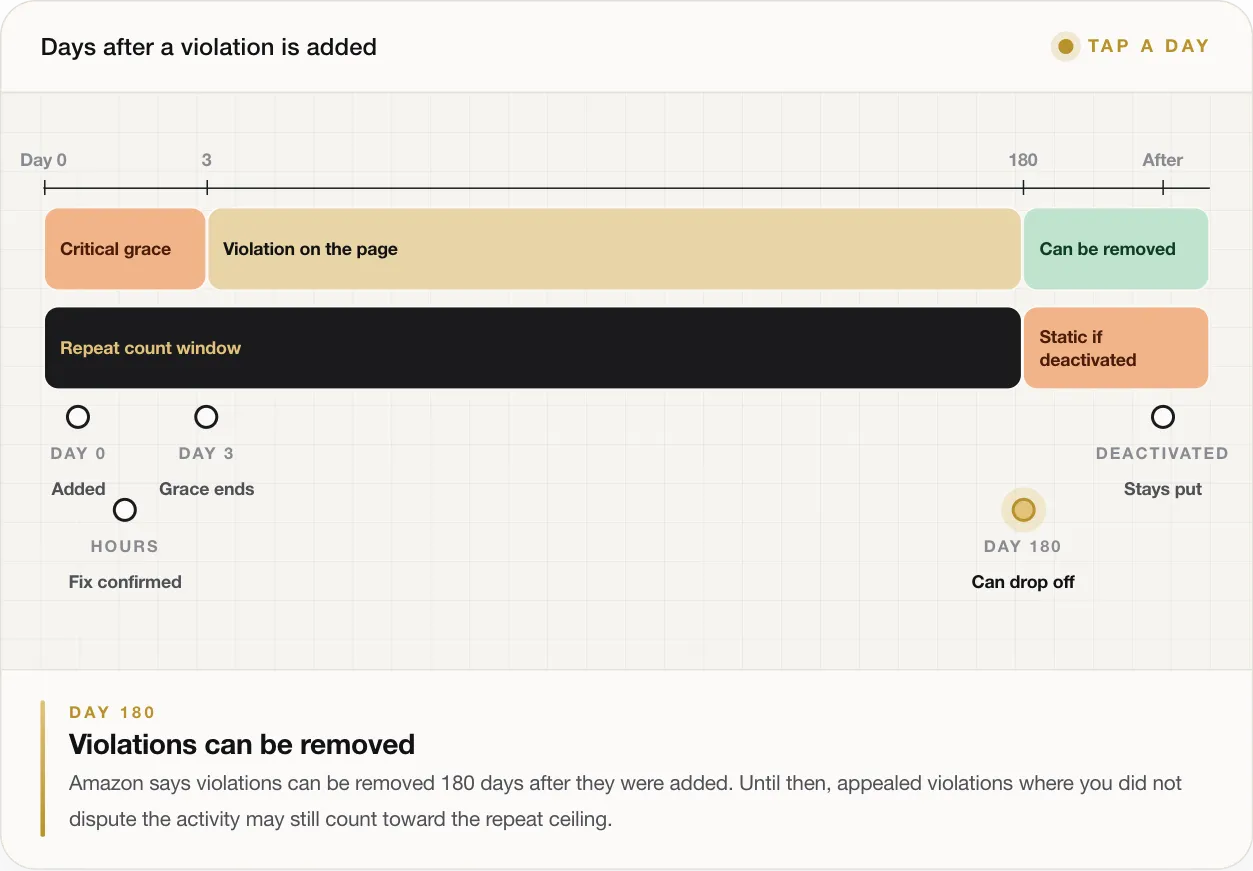
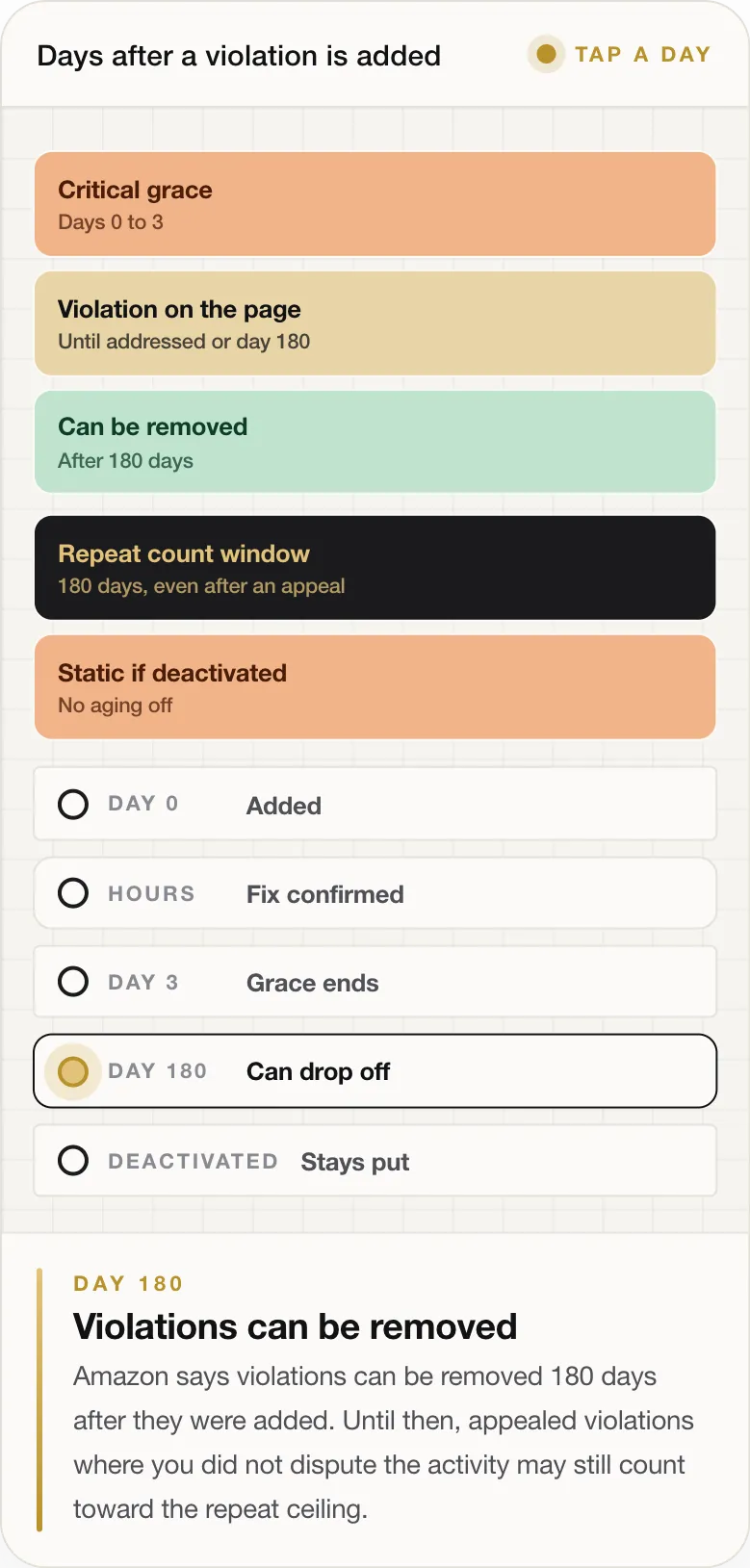
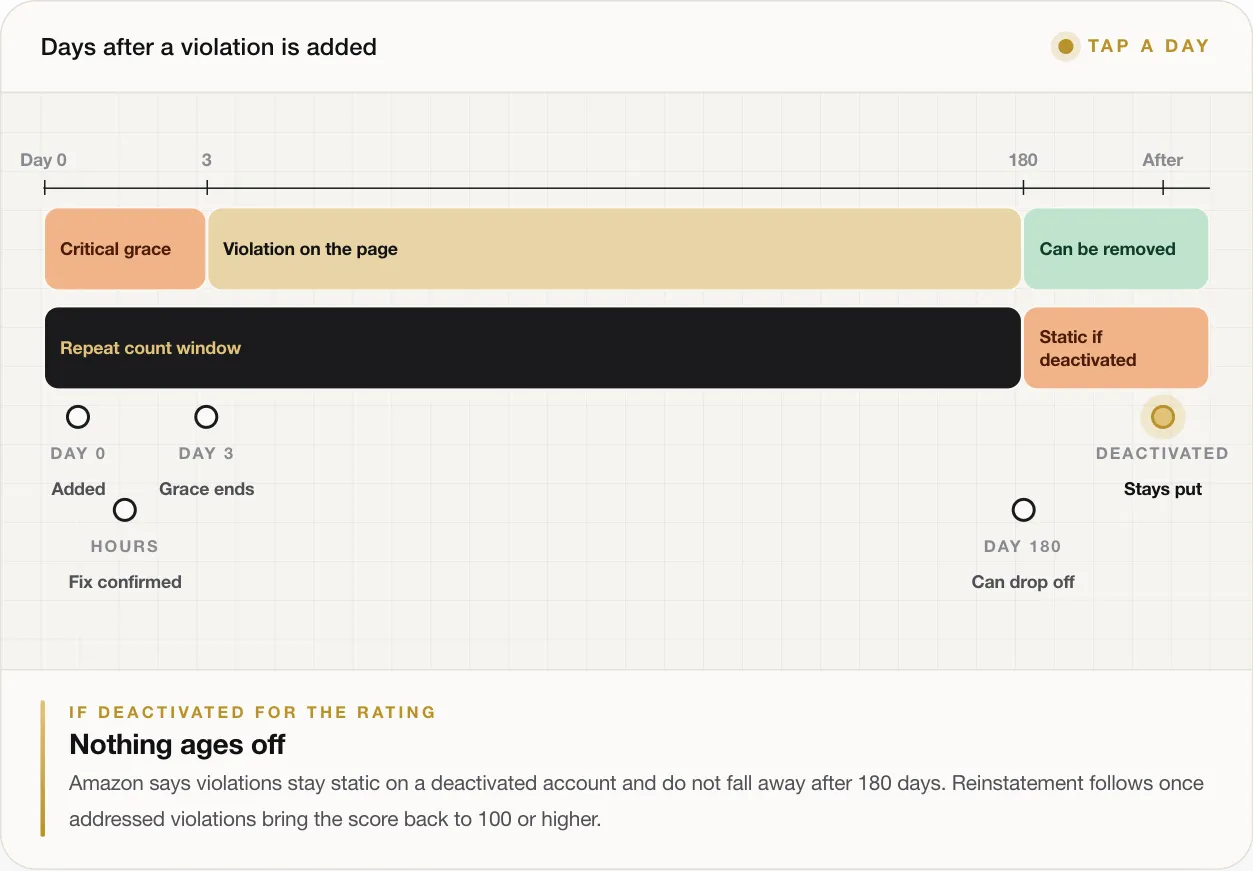
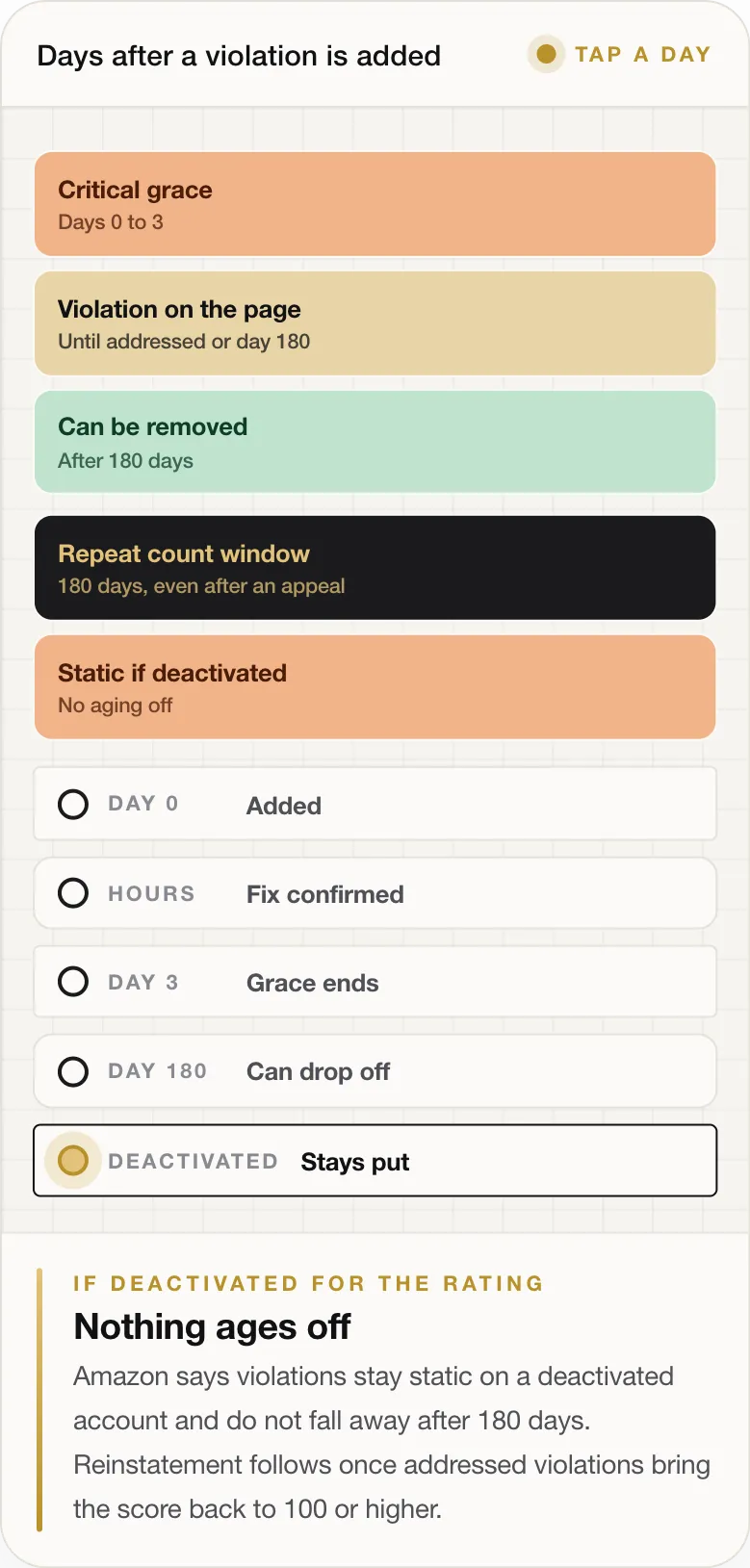
Amazon lists further scenarios: acknowledging a violation and confirming you do not want the listing reactivated (for certain violation types), a rights owner retracting an intellectual property complaint, taking the required corrective action such as removing infringing content, and the passing of 180 days from when the violation was added. Two warnings from the same FAQ: closing or deleting a listing does not remove its violation from the page, and if the account is deactivated because of the rating, the violations stay static and do not fall away after 180 days.
Some windows run three days. Others run 180.
Most myths about removing violations come from mixing up these clocks. The ruler is stretched at the start so the short window is visible. Tap a day.
Rating sliding toward At Risk?
Send us the case and we will read the page with you and tell you plainly what to fix first.
What to do when the rating drifts toward At Risk
Amazon says that if the rating is At Risk and you do not address the violations, and it cannot reach you, the account will most likely be deactivated. A slow drift is the best time to act, because nothing is yet on a three-day clock. The method below is the one we use on every account health case, adapted for a seller working alone.
Diagnose before you write anything
Use the dashboard read above. The goal is one sentence that names the controllable cause: not “Amazon made a mistake” and not “a buyer was unreasonable,” but something like “our supplier changed packaging in March and the new units did not match the listing images.” If several items share the cause, say so. A root cause that explains only one of four flags is not the root cause.
Gather evidence that matches each flag
Amazon’s own Account Health Support FAQ gives the pattern. For intellectual property violations, documentation proving your rights to sell, such as authorization letters or invoices from authorized distributors. For counterfeit allegations, invoices from manufacturers or authorized distributors showing the supply chain for the flagged products. For performance defects, a review of your metrics to identify patterns and an explanation of root causes and preventive measures. Evidence must be genuine and complete. Never alter, recreate or tidy up a document to make it fit. If a genuine invoice cannot be obtained, say so plainly, remove the affected inventory and explain what you changed in sourcing so it cannot happen again.
Write the response in three parts
- Root cause. What happened, specific to the ASINs and dates on the page.
- Corrective actions already taken. What you have done, with dates and proof: listings corrected, inventory removed, supplier changed, refunds issued.
- Preventive controls. What stops it recurring, each with an owner and a date: a pre-listing compliance check, a supplier document file, a weekly dashboard review.
For the full structure, see our guide to writing a plan of action that will not be ignored.
Use the support Amazon offers
Professional sellers can reach Account Health Support through the Contact us or Call me now button on the Account Health page. Amazon says the team is available seven days a week. If you believe a violation came from an Amazon system error, Amazon’s FAQ suggests saying so specifically and providing evidence. After a deactivation appeal, Amazon says to expect a reply within two days and to watch your email; if it asks for more information, use View Appeal on the Account Health page.
A weekly routine that keeps the rating healthy
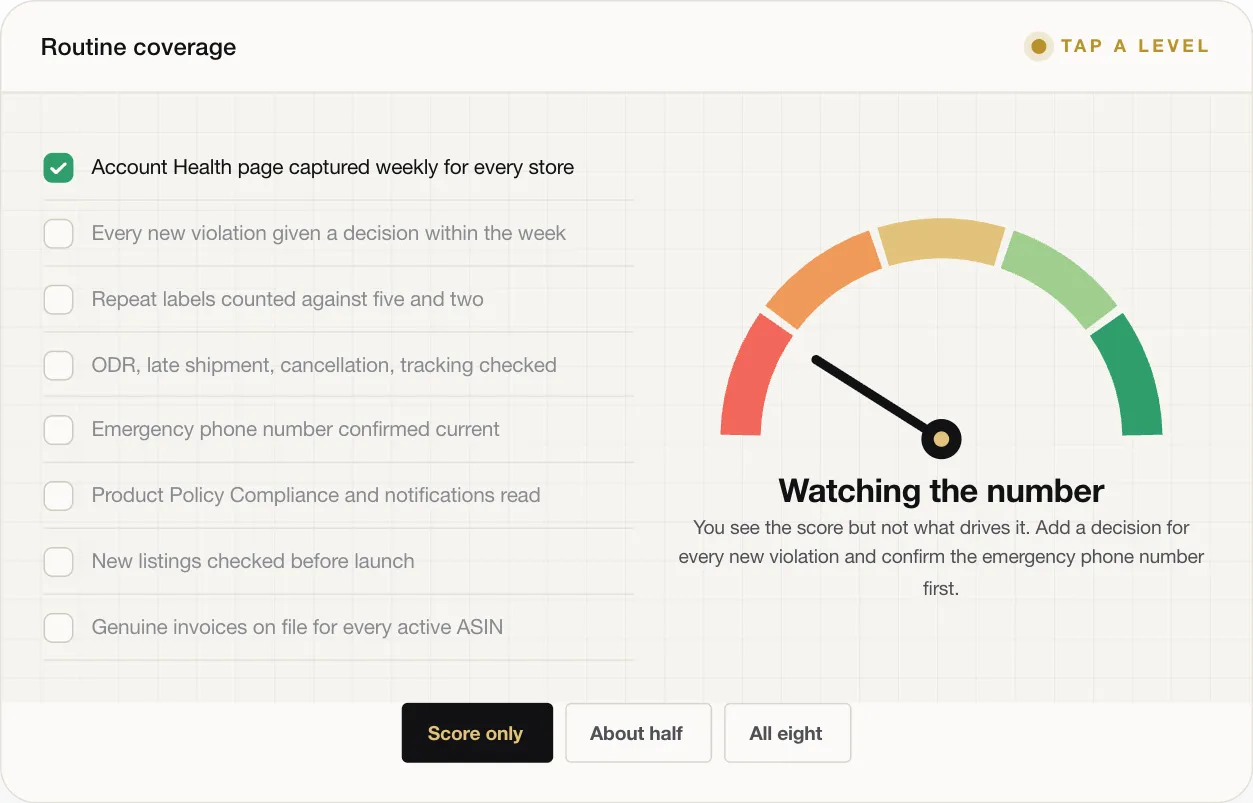
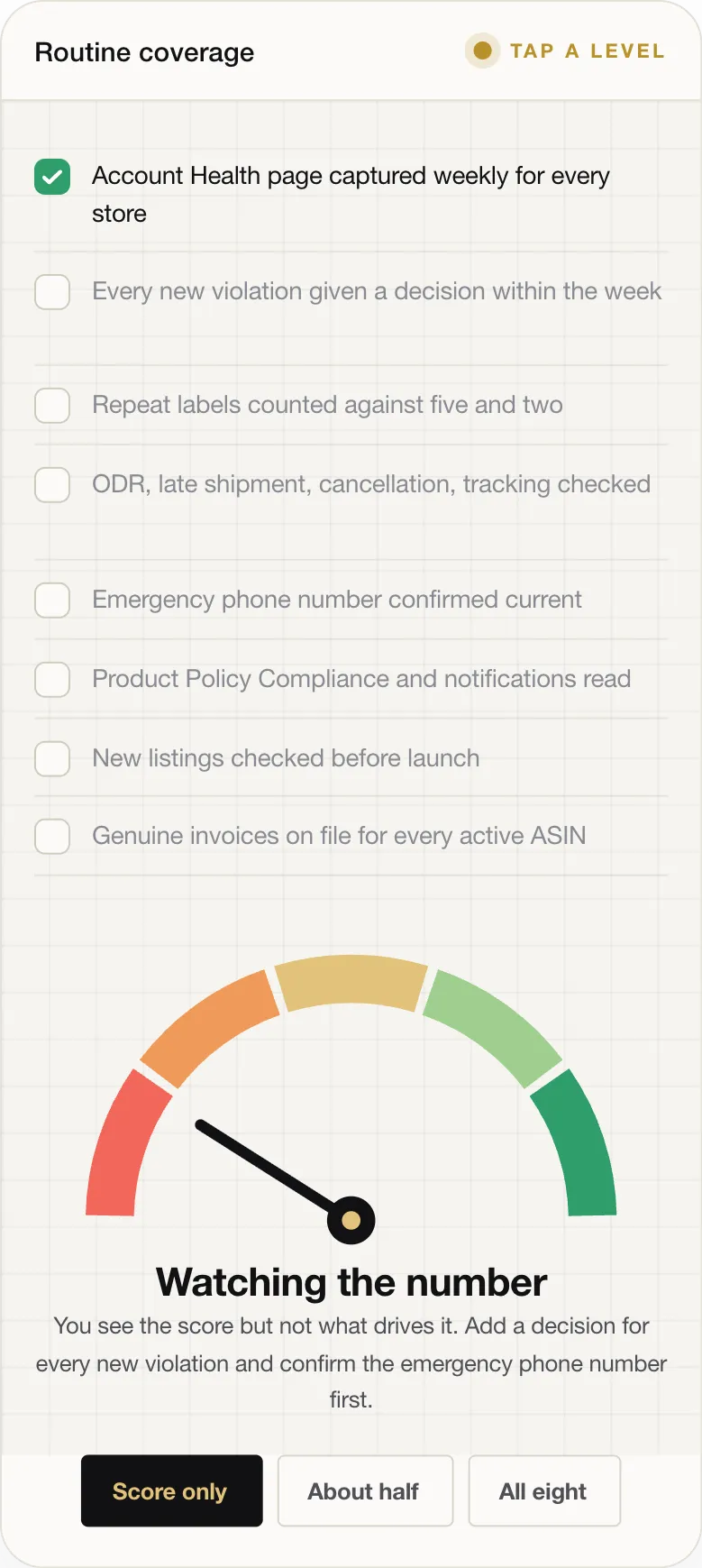
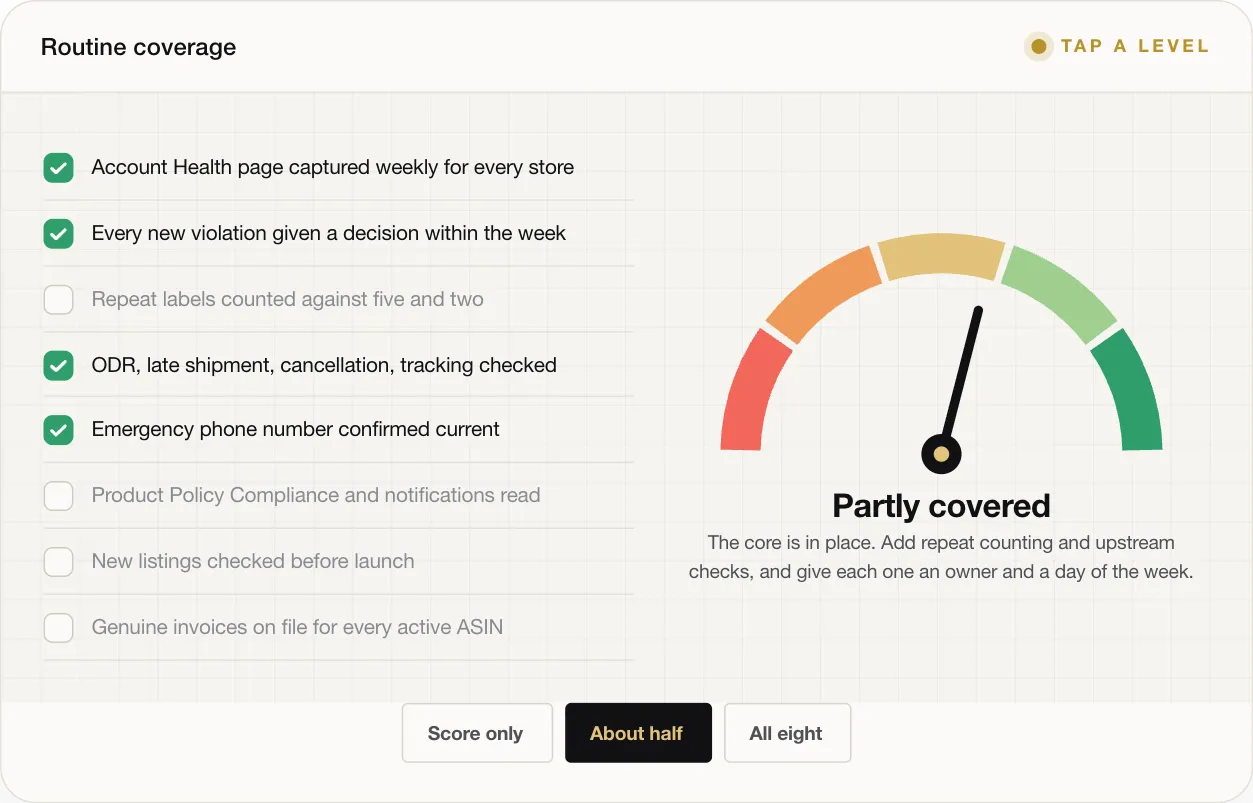
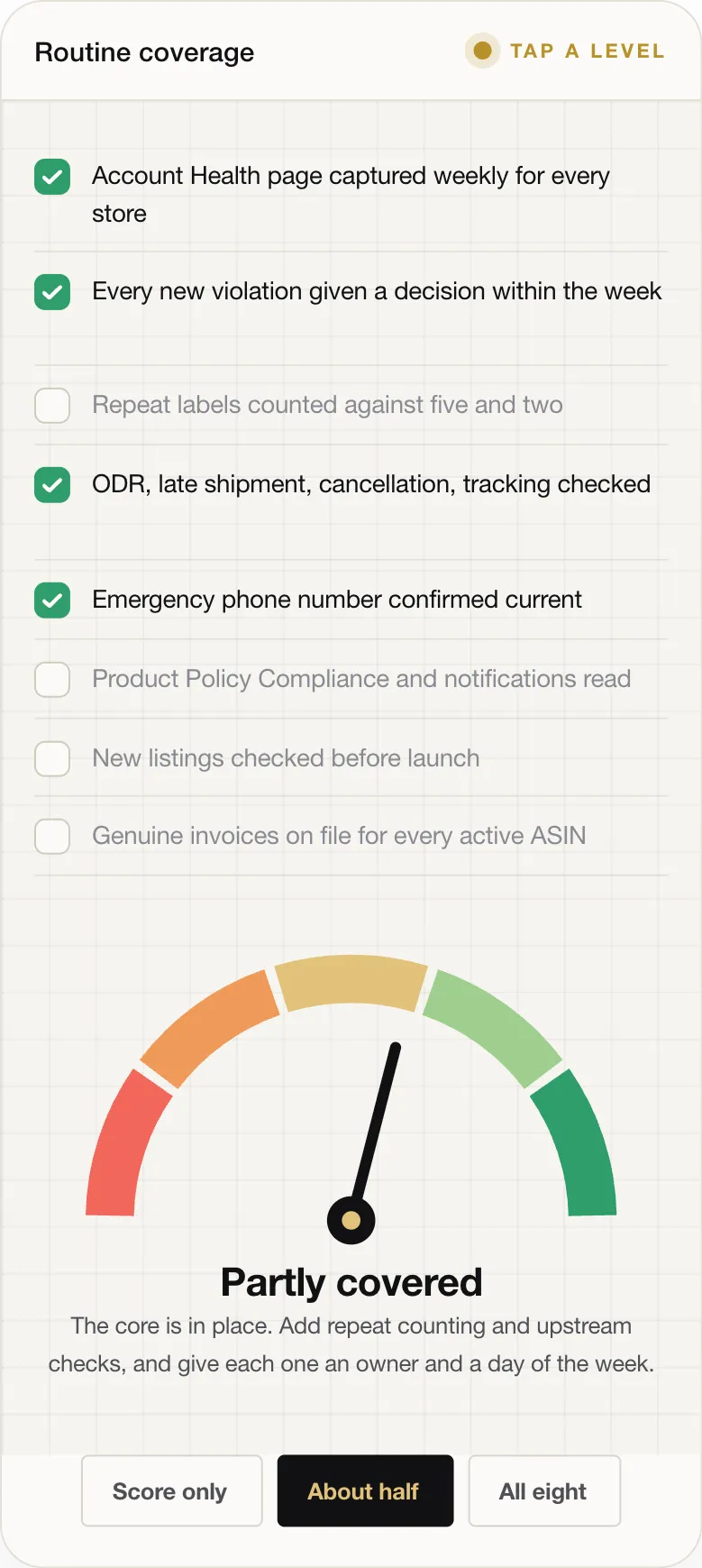
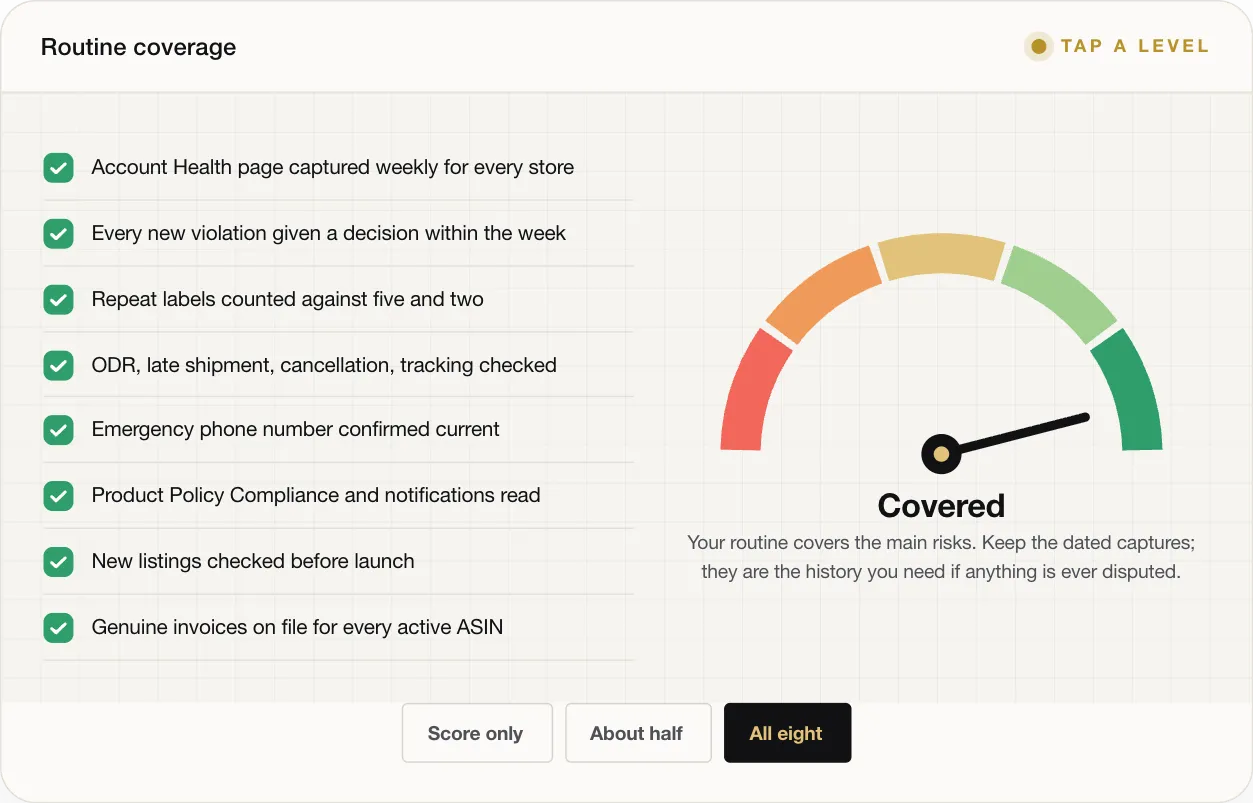
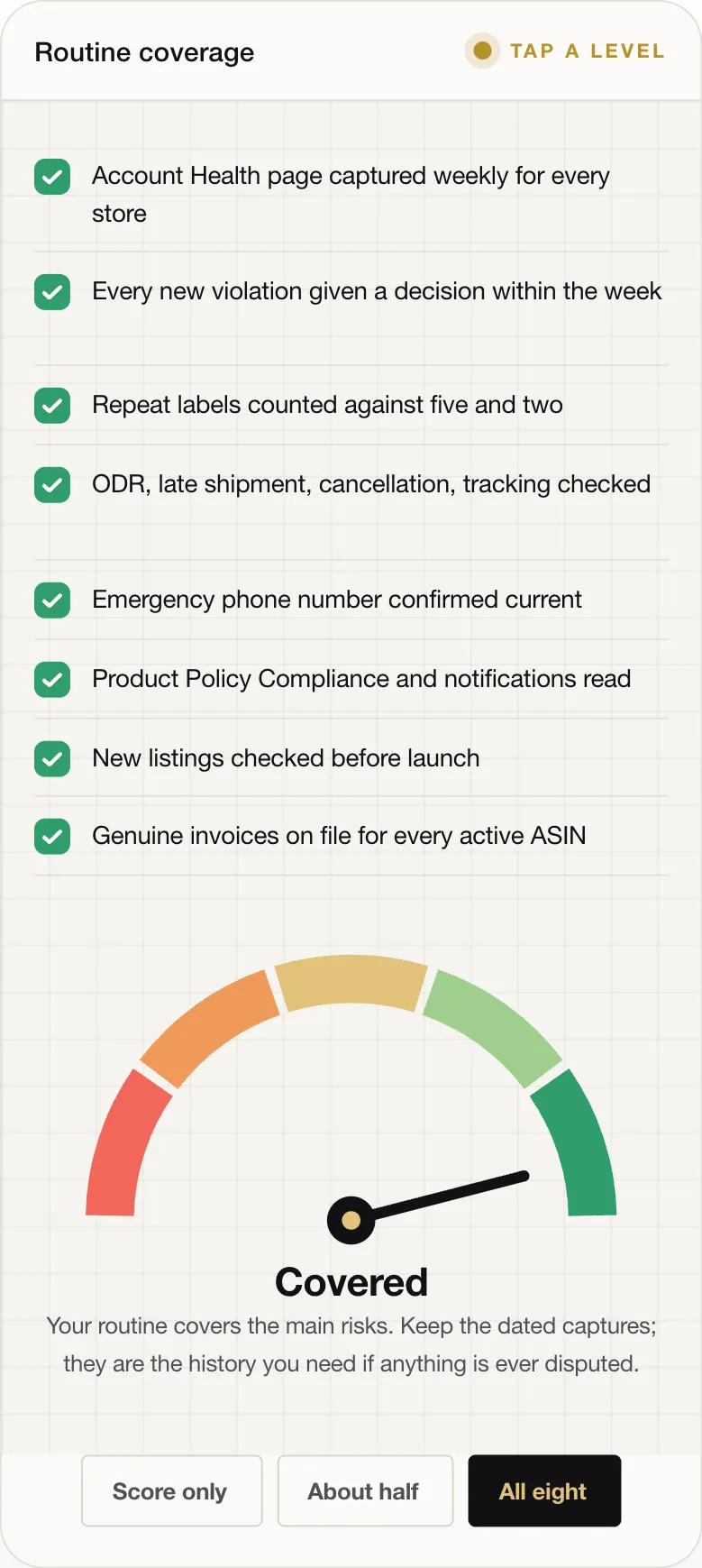
Amazon encourages sellers to view the Account Health page regularly and address issues as they arise, prioritizing those with the greatest severity. A fixed weekly routine turns that advice into a habit with an owner. Use the checklist to see how complete your current routine is.
How much is your routine catching?
Amazon encourages sellers to view the Account Health page regularly and address issues as they arise. Tap a level to see which checks sellers at that stage usually have in place.
How to run it in thirty minutes
Pick a fixed day. Save the Account Health page for each store and compare it with last week: any new violation, status change or metric movement. Record each new item with its date, ASIN, policy, severity and decision, and check the repeat count on any policy with more than one entry. Then look ahead at any listing, supplier or fulfillment change this week that could create a new flag.
Prevention lives upstream
Most rating damage starts before a listing goes live. Genuine invoices on file for every ASIN, a pre-listing check against restricted products and detail page rules, and accurate handling times prevent most flags before they compound. If you want a team to run this for you, our Amazon account health maintenance service is built around the same routine.
Common mistakes that damage the rating
- Watching the number, not the list. The score summarizes; the violations and metrics are where the work is.
- Appealing what should be disputed. If it was detected in error, prove it. An appeal concedes the activity and may still count toward repeats.
- Treating repeats as one-offs. A second violation under the same policy is a pattern with a shared cause.
- Assuming green means safe. Metrics outside the rating and conduct Amazon treats as harmful can still end in deactivation.
- Sending weak or altered evidence. Only genuine documents help. Anything else turns a fixable violation into a far more serious one.
Frequently Asked Questions
What is a good Amazon Account Health Rating?
Any score from 200 to 1,000 is green, or “Healthy,” which Amazon says means the account is not at risk of deactivation under the policies in the rating.
How many points does a violation cost?
Amazon says point values are based on severity and typically range from two to eight, critical violations bring the score to zero, and repeat violations of the same policy sometimes double.
How do I raise my Account Health Rating?
Address outstanding violations by disputing those detected in error and appealing or correcting the rest. Amazon also adds four points for every 200 successful orders fulfilled over the last 180 days, and FBM sellers can earn points on customer service metrics.
Does Order Defect Rate count toward the rating?
Order Defect Rate sits in the Customer Service Performance section of the same dashboard under the Order Performance policy, which is not on Amazon’s list of policies included in the rating. It has its own standard, under 1%, and its own consequences.
How long does a violation stay on the Account Health page?
Amazon says violations can be removed after 180 days from when they were added, or sooner after a successful dispute, appeal or corrective action. If the account is deactivated for its rating, they stay until addressed.
What happens after a critical violation?
The rating turns red at zero and Amazon gives a three-day grace period to address the violation. If it is addressed in time, Amazon says the account is not deactivated; if not, it is deactivated until the appeal is completed.
Why did my rating change when nothing happened?
The rating covers the last 180 days. Amazon says it can rise as violation points leave that window and fall as fulfilled orders leave it.
Get Help With Your Amazon Account Health
If your rating is At Risk, a critical violation is counting down, or you cannot tell which flag to work first, our team can read the page with you and build an honest, evidence-based response. You can submit your case for review or book a consultation to talk it through.
This article is educational information, not legal advice, and it does not guarantee any outcome with Amazon. Amazon’s policies, scoring and timelines change; always confirm against the current Seller Central help pages for your store before acting.
Sources
- Amazon Seller Central: Account Health Rating program policy
- Amazon Seller Central: Account Health Rating frequently asked questions
- Amazon Seller Central: Policies included in Account Health Rating
- Amazon Seller Central: Order Performance program policy
- Amazon Seller Central: Customer Service Quality Insights on Feedback Manager
- Amazon Seller Central: Appeal an account deactivation or listing removal
- Amazon Seller Central: Account Health Support FAQ
- Amazon Seller Central: Program policies
- Federal Trade Commission: Informing Businesses about the INFORM Consumers Act
