
Quick answer: Most Amazon suspensions are preceded by signals you can see in Seller Central. The Account Health Rating (AHR) runs from 0 to 1,000: Amazon calls 200 to 1,000 “Healthy”, 100 to 199 “At Risk” and 99 or lower “Unhealthy”, meaning eligible for deactivation or already deactivated. You lose points when a new policy violation is detected, gain them when you address it, and the score reflects the last 180 days. Repeat violations of the same policy cost more each time. The early signals to act on are new violations on the Account Health page, listing removals, pricing deactivations in Pricing Health, metrics drifting toward their targets, and any document or verification request. Capture the evidence, find the root cause, fix it, and log what you did, every week.
Sellers who get suspended usually describe it as sudden. When we read the account afterwards, it almost never is. There is a policy violation from five weeks earlier that was acknowledged without anyone fixing the cause, a second violation of the same policy, several listings removed for the same reason, a metric creeping toward its limit, and a score that slid from green into yellow. Each signal was visible. Nobody owned reading them.
This guide teaches you to read those signals the way an investigator does: what the AHR measures and what moves it, which warnings sit closest to an account-level action, how to tell that a review is coming, how to respond in the first hour, and a weekly routine with an owner and a log.
Why suspensions rarely come out of nowhere
Amazon says it uses “a combination of advanced machine learning techniques and automation and expert human review” to identify policy non-compliance. In practice, most enforcement starts with detection, not with a person deciding to look at your account. A metric crosses a line, a model flags behavior that resembles known risk, or complaints from buyers or rights owners accumulate until the file tips over an edge.
Amazon acts on clusters, not single flags
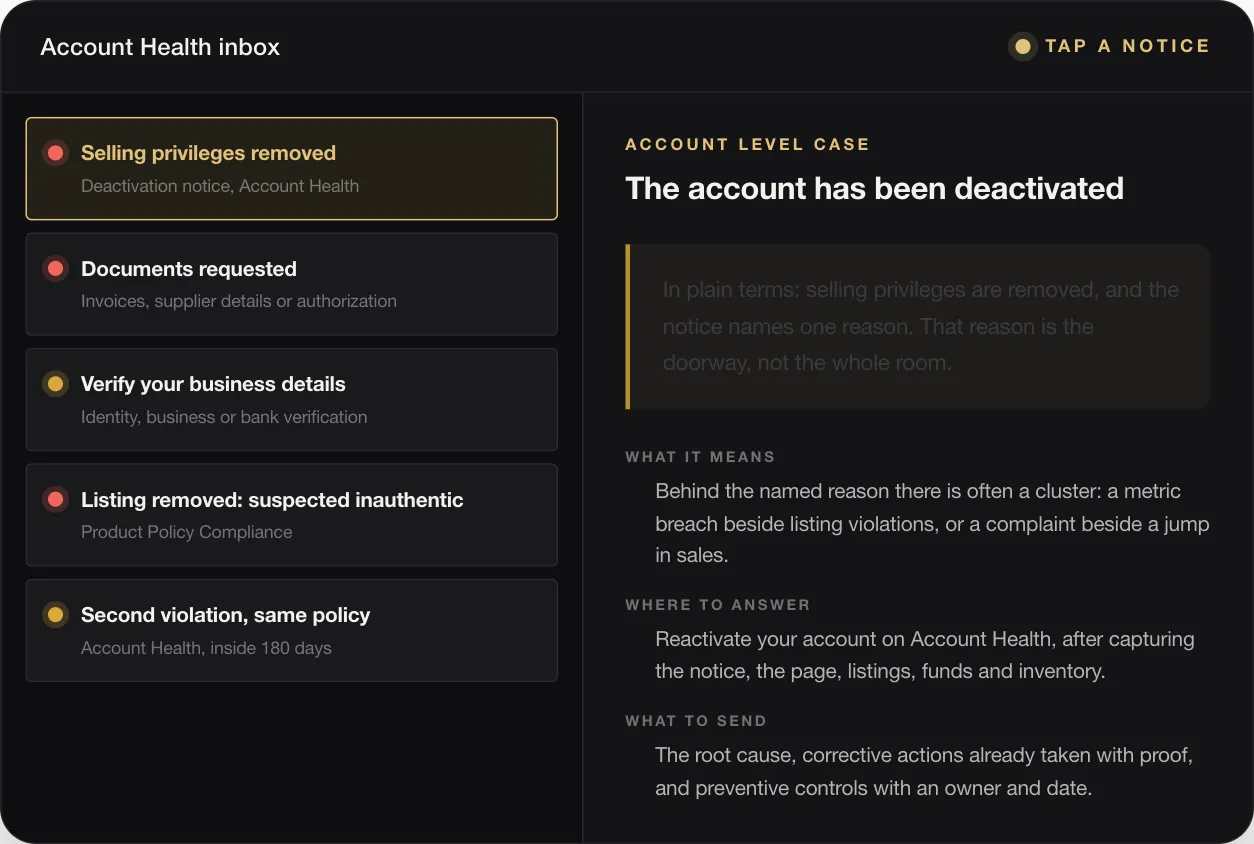
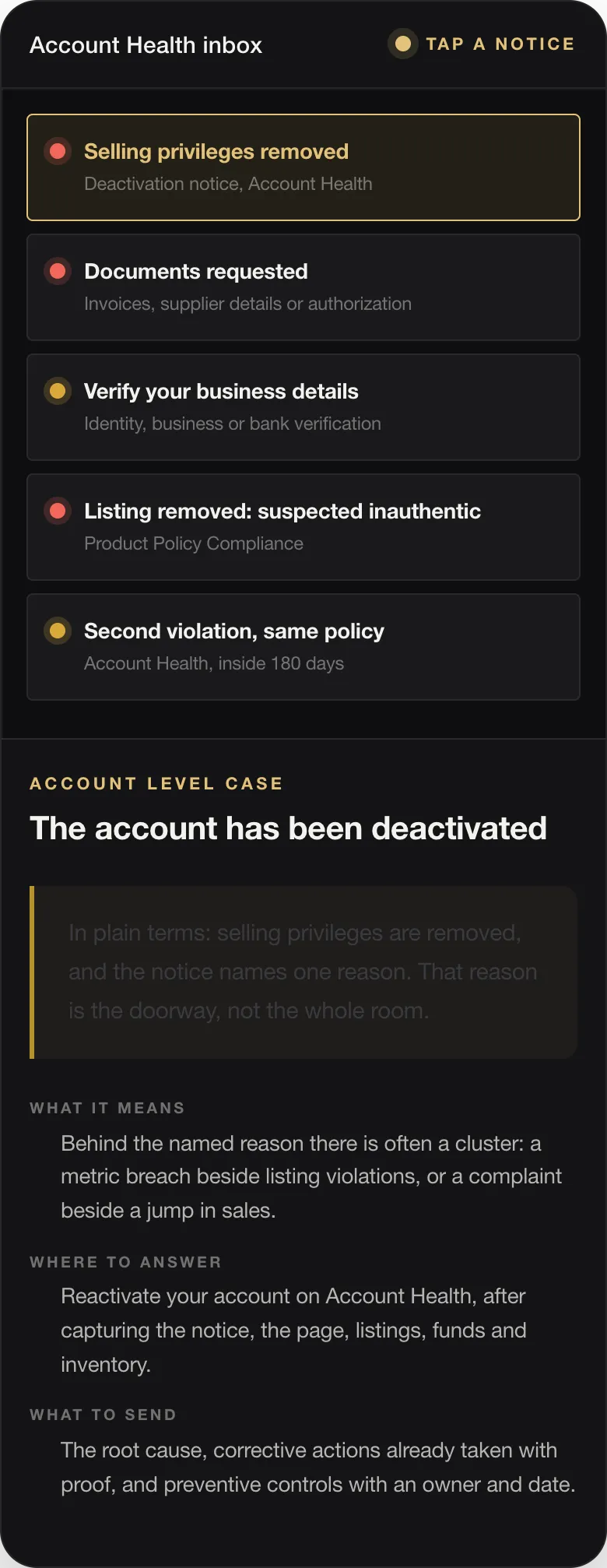
A deactivation notice usually names one reason. That reason is the doorway, not the whole room. Behind it there is often a cluster: a metric breach beside two listing-level violations, or an authenticity complaint beside a sudden jump in sales. None of those alone may have felt alarming. Together they are what the system was watching. Prevention means reading the whole Account Health page as one picture and asking whether the items on it share a cause.
The detection path decides what a fix looks like
Different signals demand different proof. A metric threshold calls for operational proof that the cause is corrected. A buyer complaint about condition or authenticity calls for sourcing records and condition controls. A rights owner complaint may be resolved partly with the rights owner as well as with Amazon. Knowing which path fired keeps you from defending your products when Amazon wanted operational proof, or the reverse.
| Early signal | Likely detection path | What the fix has to prove |
|---|---|---|
| Metric drifting toward or past its target | Metric threshold | The operational cause is found and corrected, with records |
| Condition or “not as described” violation | Buyer complaint | Condition, description and quality checks are corrected |
| Suspected inauthentic flag | Buyer complaint or internal review | Legitimate sourcing that reconciles to units sold |
| Intellectual property complaint | Rights owner report | Right to sell, or the complaint resolved with the rights owner |
| Listing deactivated for a potential pricing error | Automated pricing check | Price data corrected against reference prices and your own limits |
| Document or verification request | Pattern review or verification check | Genuine information that matches what Amazon already holds |
How the Account Health Rating actually works
Amazon describes the AHR as an indicator of “your selling account’s risk of deactivation due to non-compliance with certain Amazon selling policies.” It is shown on the Account Health page for each store in which you sell, so one store can be yellow while another is green. Check every store, not only your home store.
The three bands
According to Amazon’s Account Health Rating program policy, green (“Healthy”) is 200 to 1,000 and means the account is not at risk of deactivation based on the policies in the score. Yellow (“At Risk”) is 100 to 199 and means the account is at risk of deactivation. Red (“Unhealthy”) is 99 or lower and means the account is eligible for deactivation or already deactivated. A seller at 1,000 and a seller at 210 are both green, but the second has almost no margin. Track the number weekly, not just the color.
What takes points away
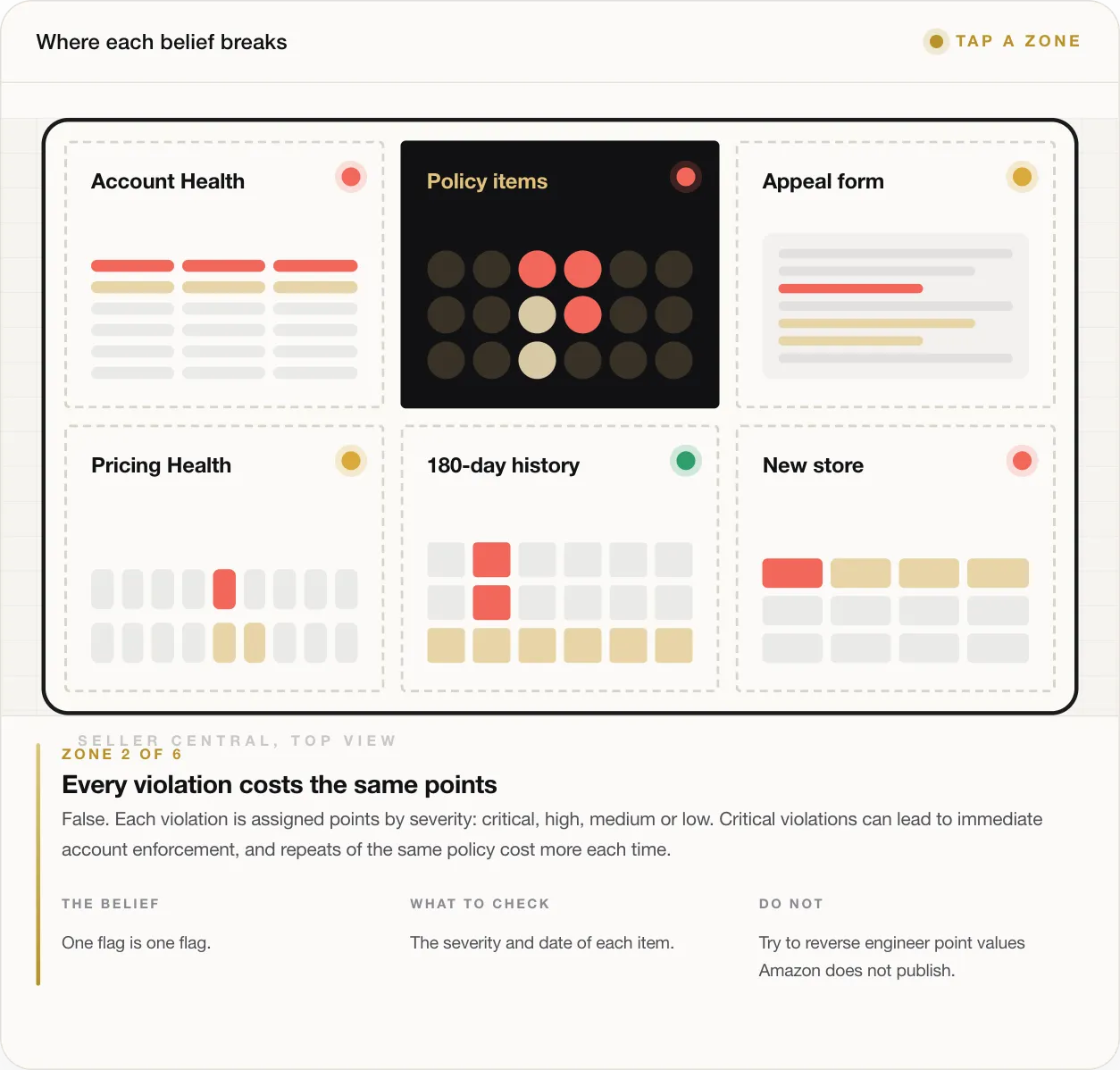
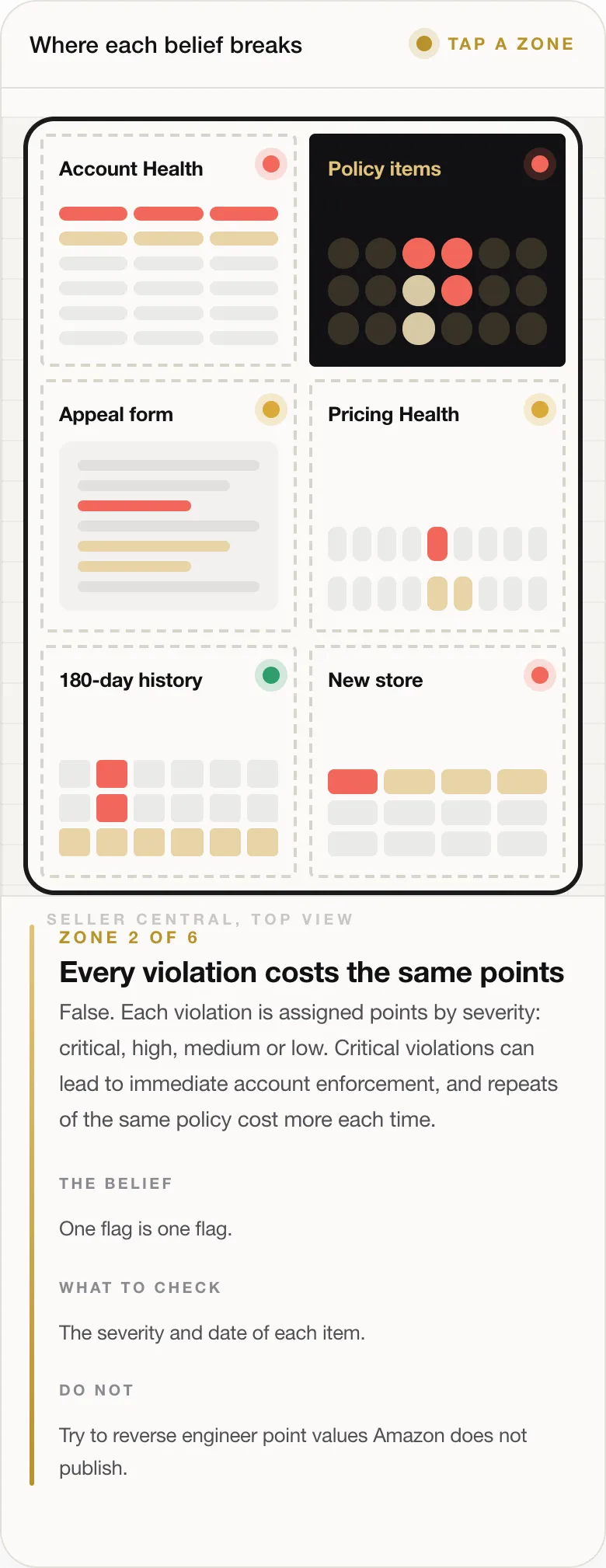
Amazon says you lose points when any new policy violation is detected, and that each violation is assigned points by severity. There are four levels: critical, high, medium and low. Critical violations “can lead to immediate account enforcement.” Severity reflects how much the violation harms customers and whether it breaks applicable laws. Amazon does not publish a point value per violation on that page, so do not try to reverse engineer one. Read the severity and the date of each item instead.
Repeat violations are the fastest way down
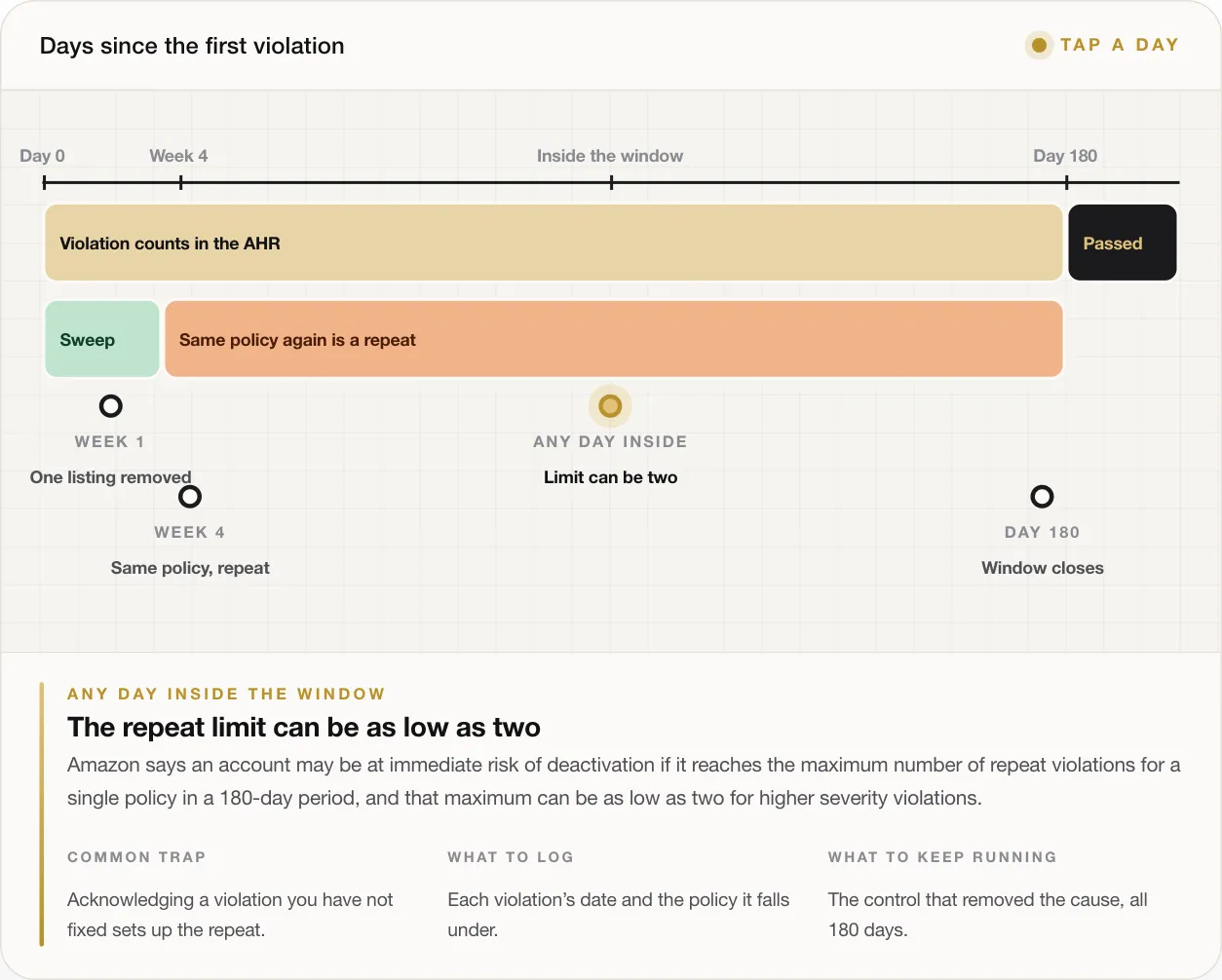
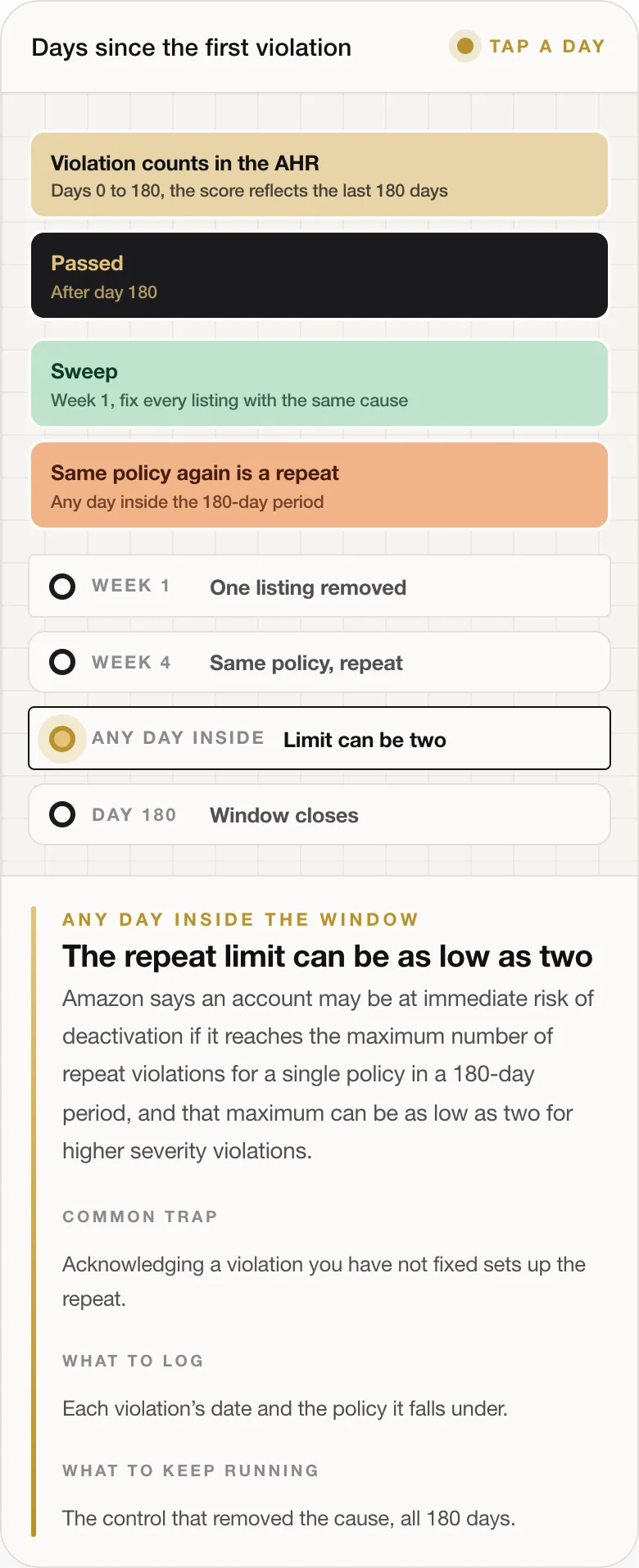
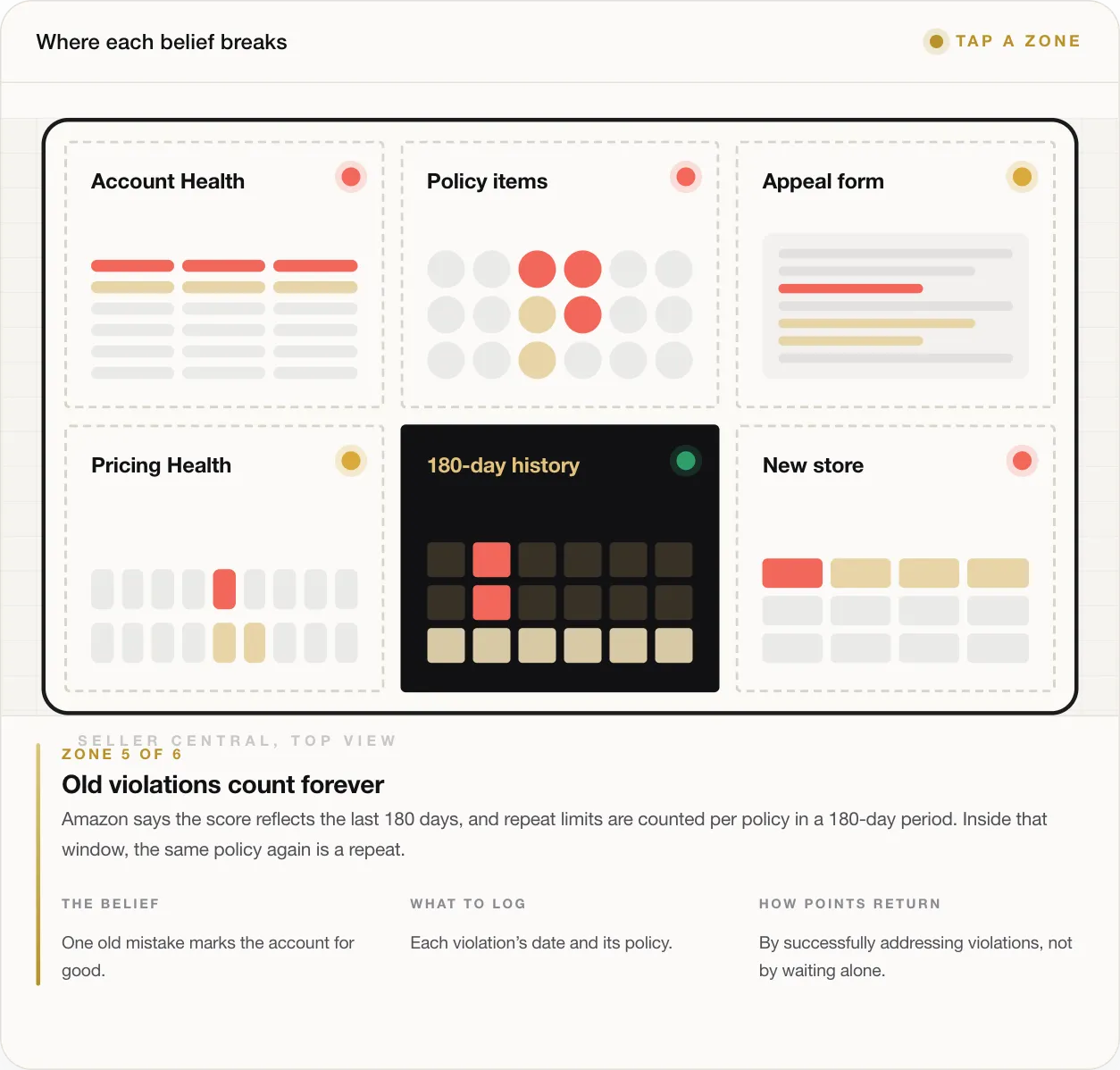
Amazon says repeat violations of the same policy hurt you twice. The points attached increase each time the same policy is violated, so the score degrades faster. And the account “may be at immediate risk of deactivation” if it reaches the maximum number of repeat violations for a single policy in a 180-day period, a maximum that “can be as low as two violations for higher severity violations.” If one listing is removed and you fix only that listing, a second listing with the same defect becomes the repeat that matters. Every fix must include a sweep of the catalog for the same cause.
What adds points back
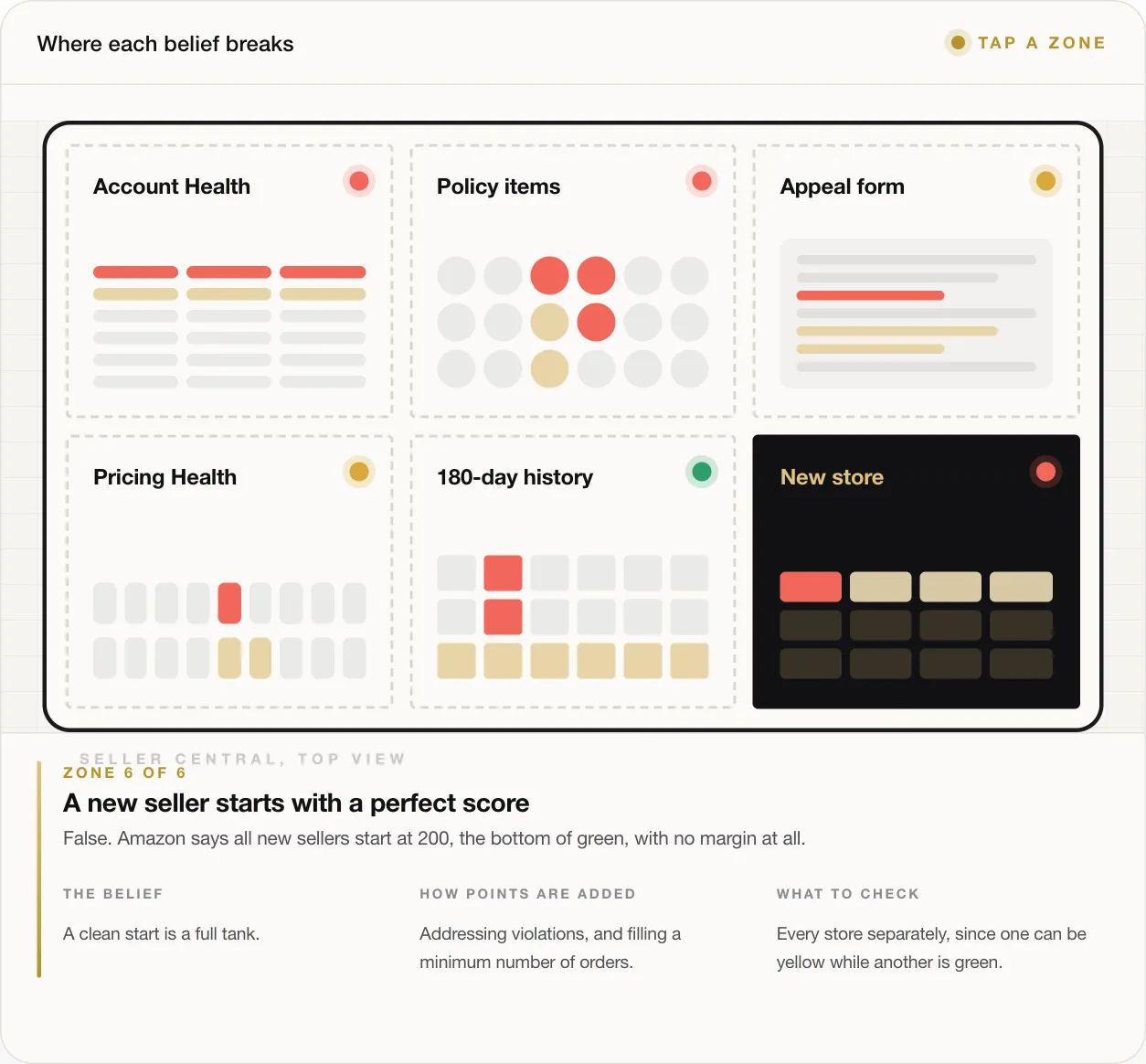
You gain points when you successfully address violations, and Amazon grants points when a minimum number of orders are filled, so the score reflects business size. Fulfilled by Merchant sellers can also earn points from Buyer Contact Rate, Average Contact Response Time and Buyer Dissatisfaction Rate; Amazon states it will not restrict selling privileges for below-average performance on those three. All new sellers start at 200, the bottom of green, with no margin at all.
The override you cannot score your way out of
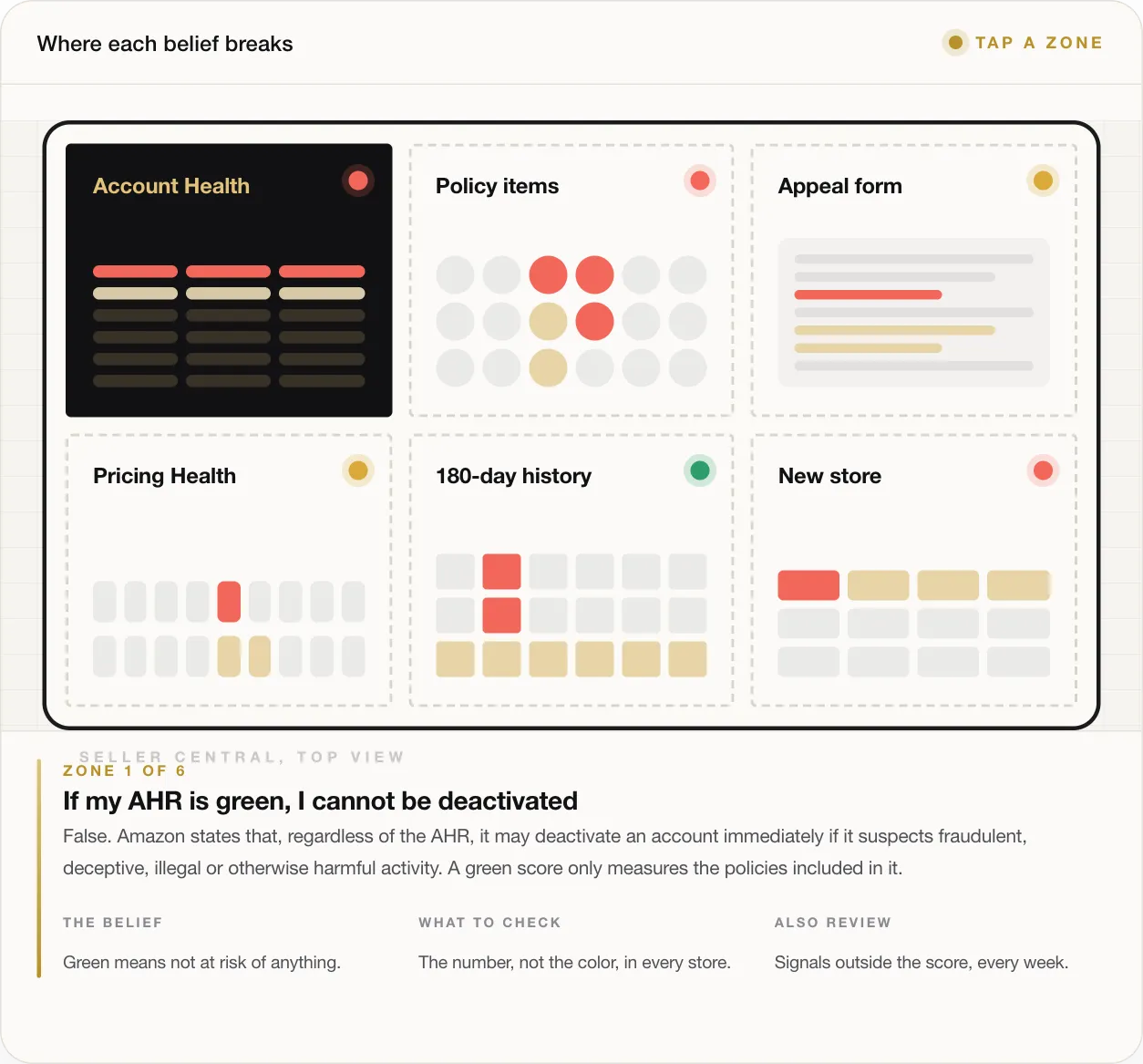
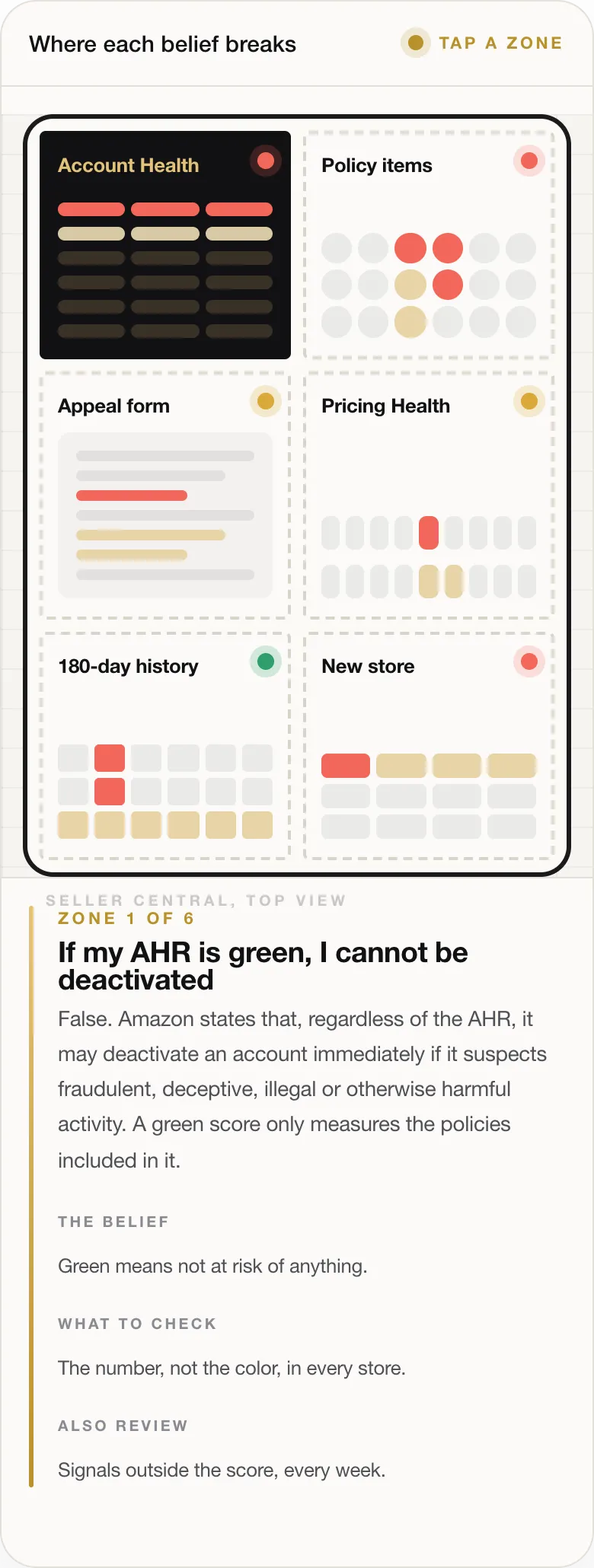
Amazon states that, regardless of the AHR, it may deactivate an account immediately if it suspects fraudulent, deceptive, illegal or otherwise harmful activity. A green score only measures the policies included in it. That is why the weekly review covers more than the number.
A worked example
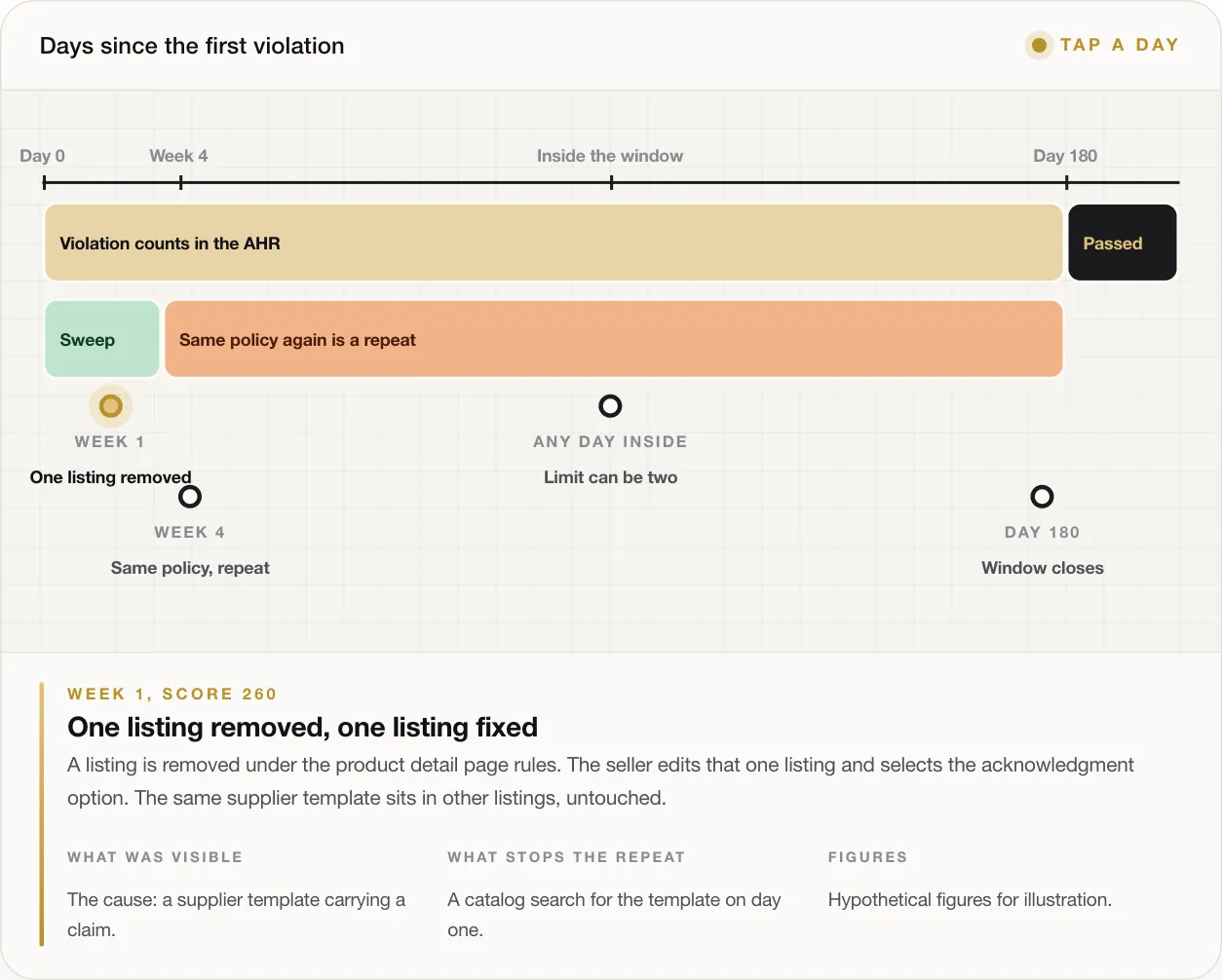
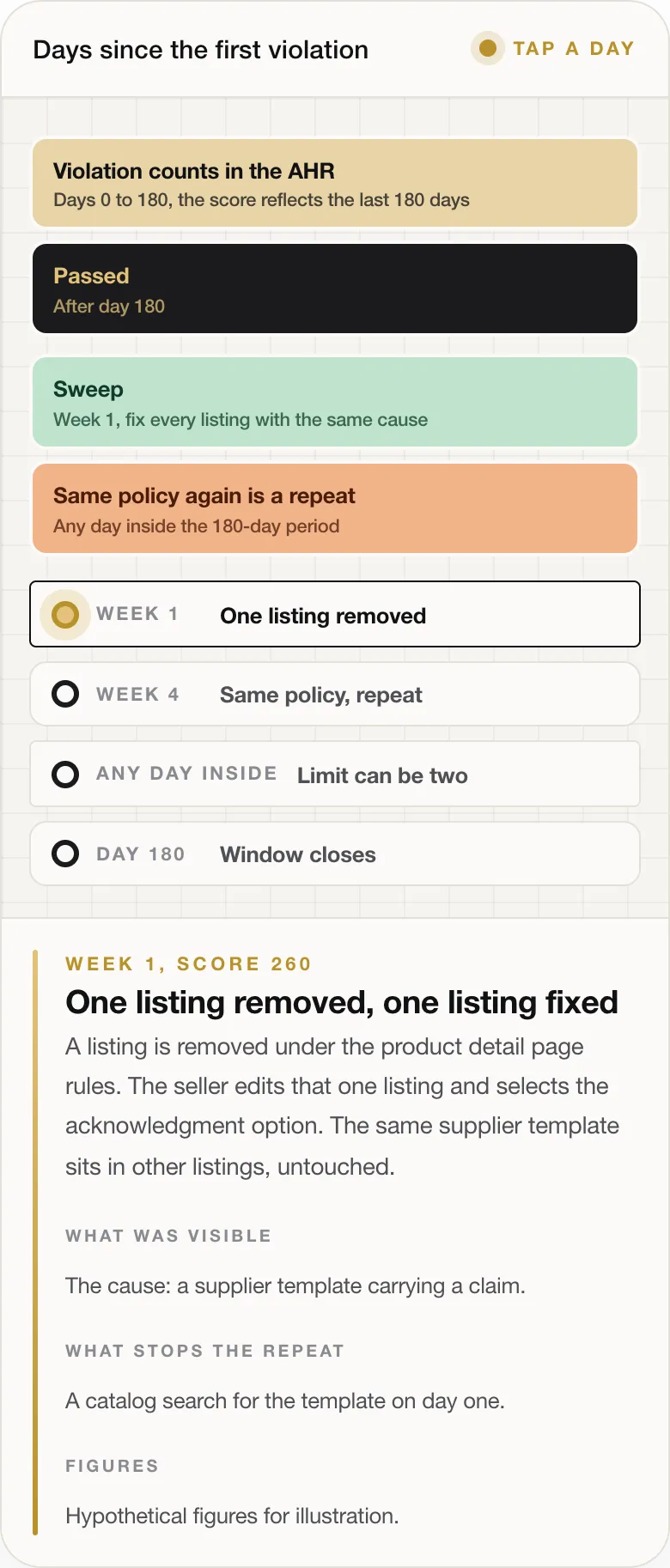
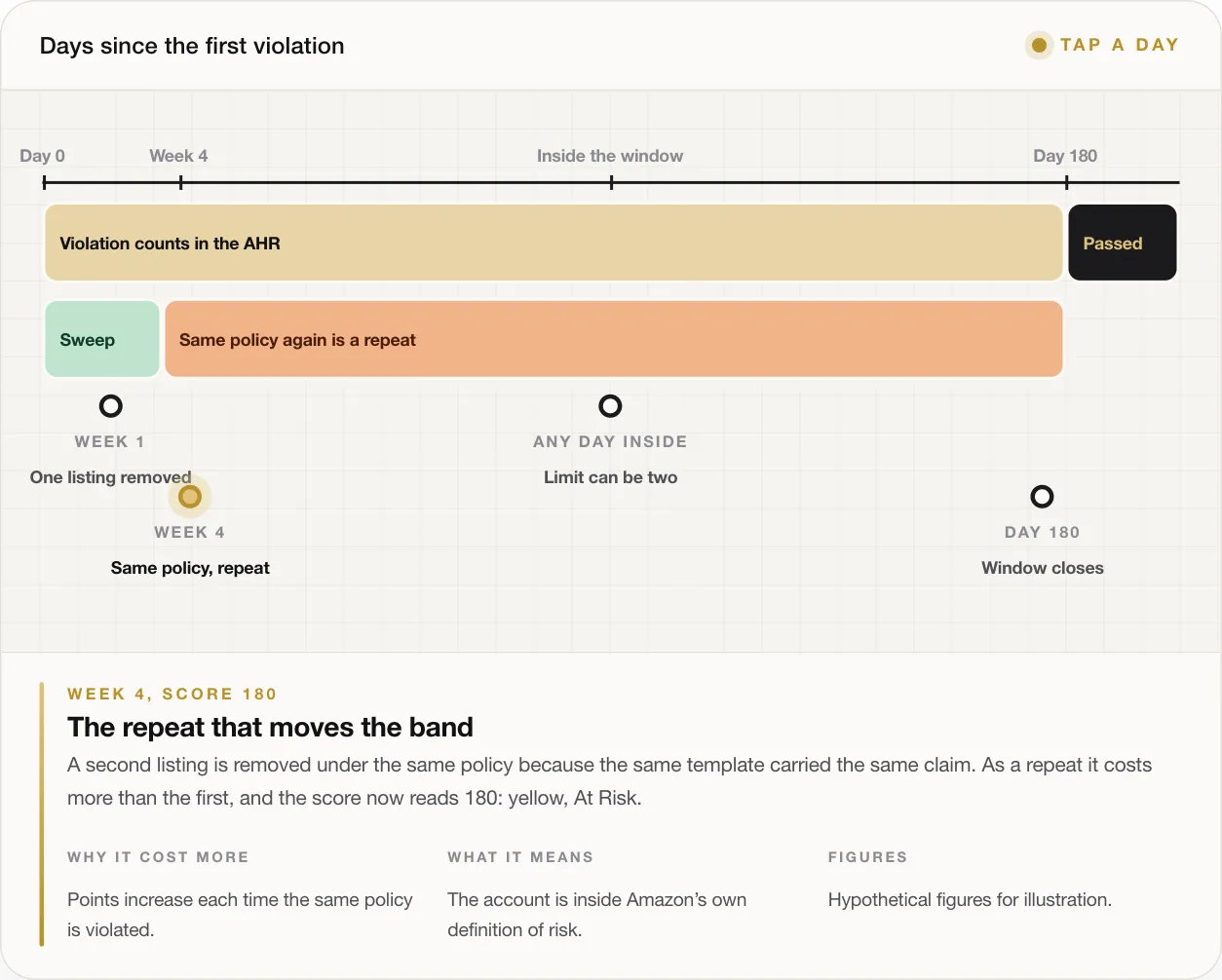
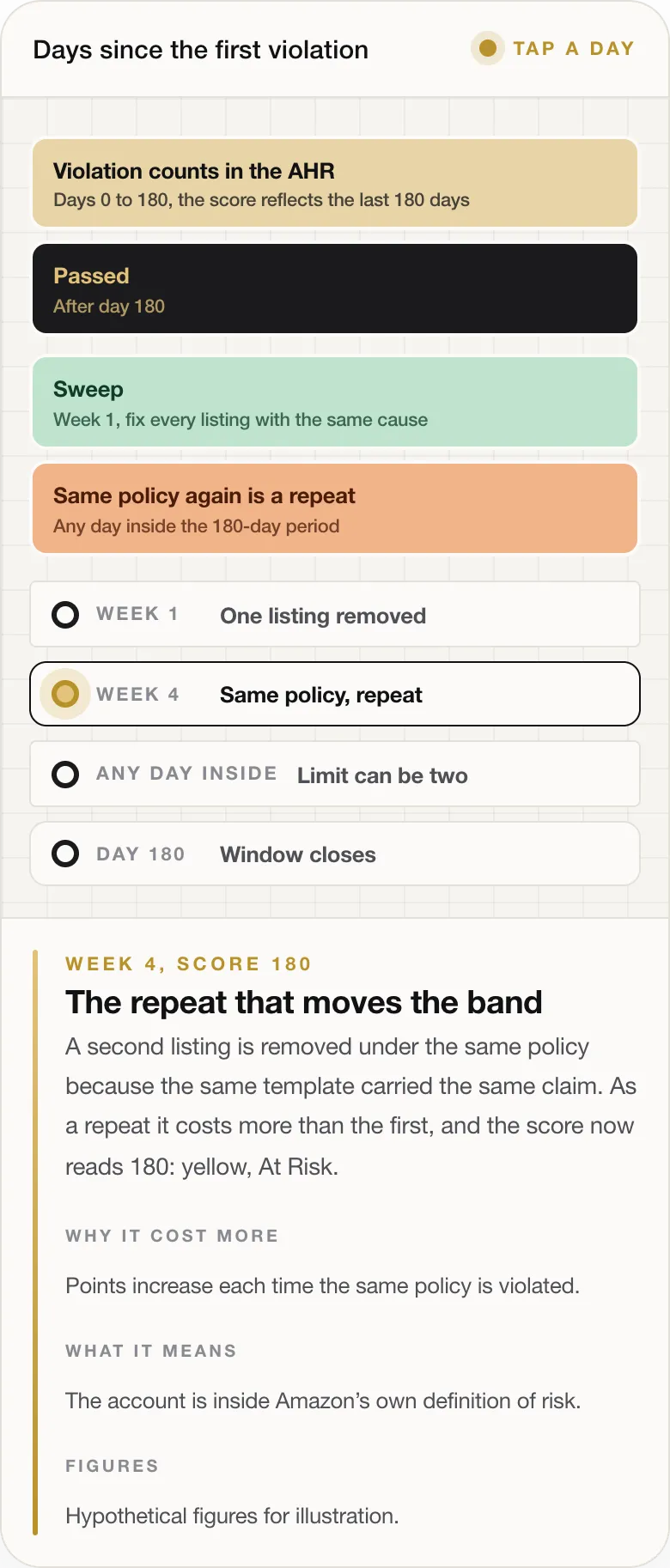
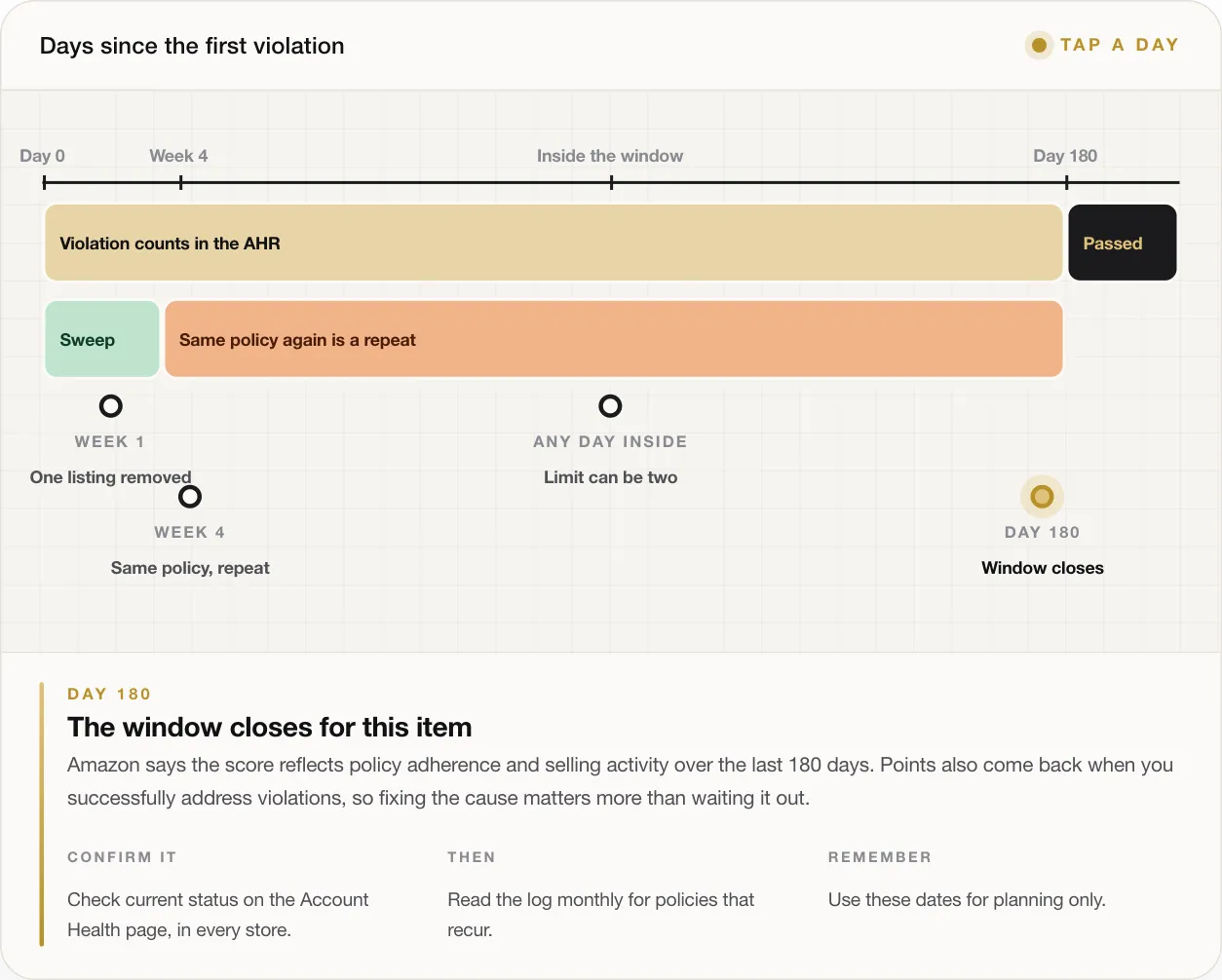
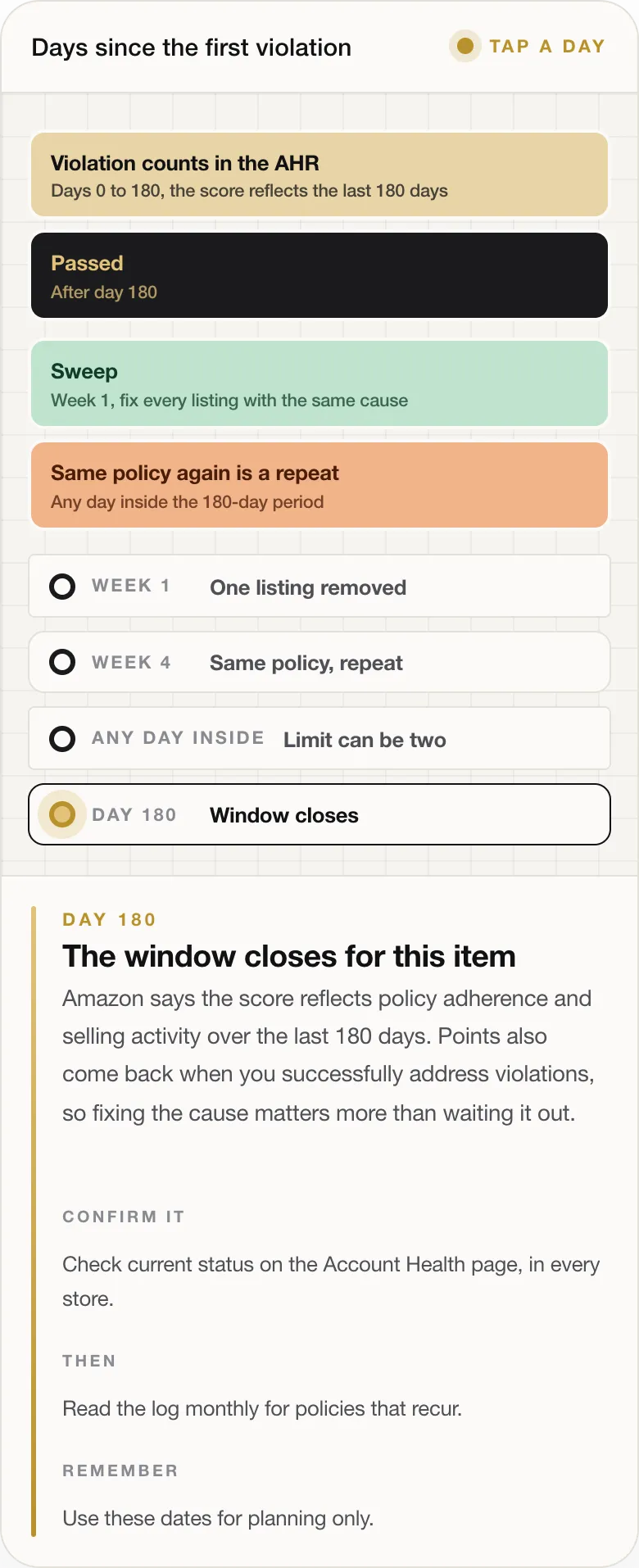
The figures are hypothetical. A seller sits at 260. In week one, a listing is removed under the product detail page rules. The seller edits that one listing and selects the acknowledgment option. In week four, a second listing is removed under the same policy because the same supplier template carried the same claim. As a repeat, it costs more than the first, and the score now reads 180: yellow, “At Risk”. The cause was visible in week one. A catalog search for the template on day one would have prevented the repeat.
One removal, one template. Watch the repeat arrive.
The worked example from this guide laid out on Amazon’s 180-day window. Tap a day to see what changed and what would have stopped it.
Which policies feed the score, and which do not
Amazon publishes the policies included in the AHR. When we read it, the list was: Anti-Counterfeiting, Brand Name, Intellectual Property, Marketplace Fair Pricing, ASIN Creation, Communication guidelines, Customer Product Reviews policies, the INFORM Consumers Act, Product condition guidelines, Product detail page rules, guidelines for adult products, guidelines for selling software, Product safety and compliance, Restricted Products, and Selling policies and seller code of conduct. Amazon also states that not all of its policies are in the AHR. A policy outside the score can still lead to enforcement.
The code of conduct items that show up early
Amazon’s seller code of conduct requires accurate information that you update when it changes, fair use of Amazon’s features, contact with customers only through Buyer-Seller Messaging, no diverting customers off Amazon, and no second selling account without a legitimate business need. On reviews, neutral requests to your own customers are allowed, but incentives, asking only for positive reviews, asking customers to change or remove a review, and soliciting only happy customers are prohibited. Insert cards, follow-up email tools and contractors are where these issues usually start, and the code says you may not allow others to act on your behalf in a way that breaks Amazon’s policies. See our guide to code of conduct suspensions.
Policy warnings and listing-level actions as early signals
A single policy violation is the cheapest moment to fix a problem. The cause is fresh, the affected listings are few, and the score has margin. Treat every new item on the Account Health page as a small investigation.
Find every removed listing, not just the one you were told about
Amazon’s page on appealing a listing removal gives the order: the Product Policy Compliance tab on Account Health first, then Manage Inventory for inactive listings, then Performance Notifications for the removal details. Run all three. The notification often carries specific wording the dashboard summary leaves out.
Choose the appeal option honestly
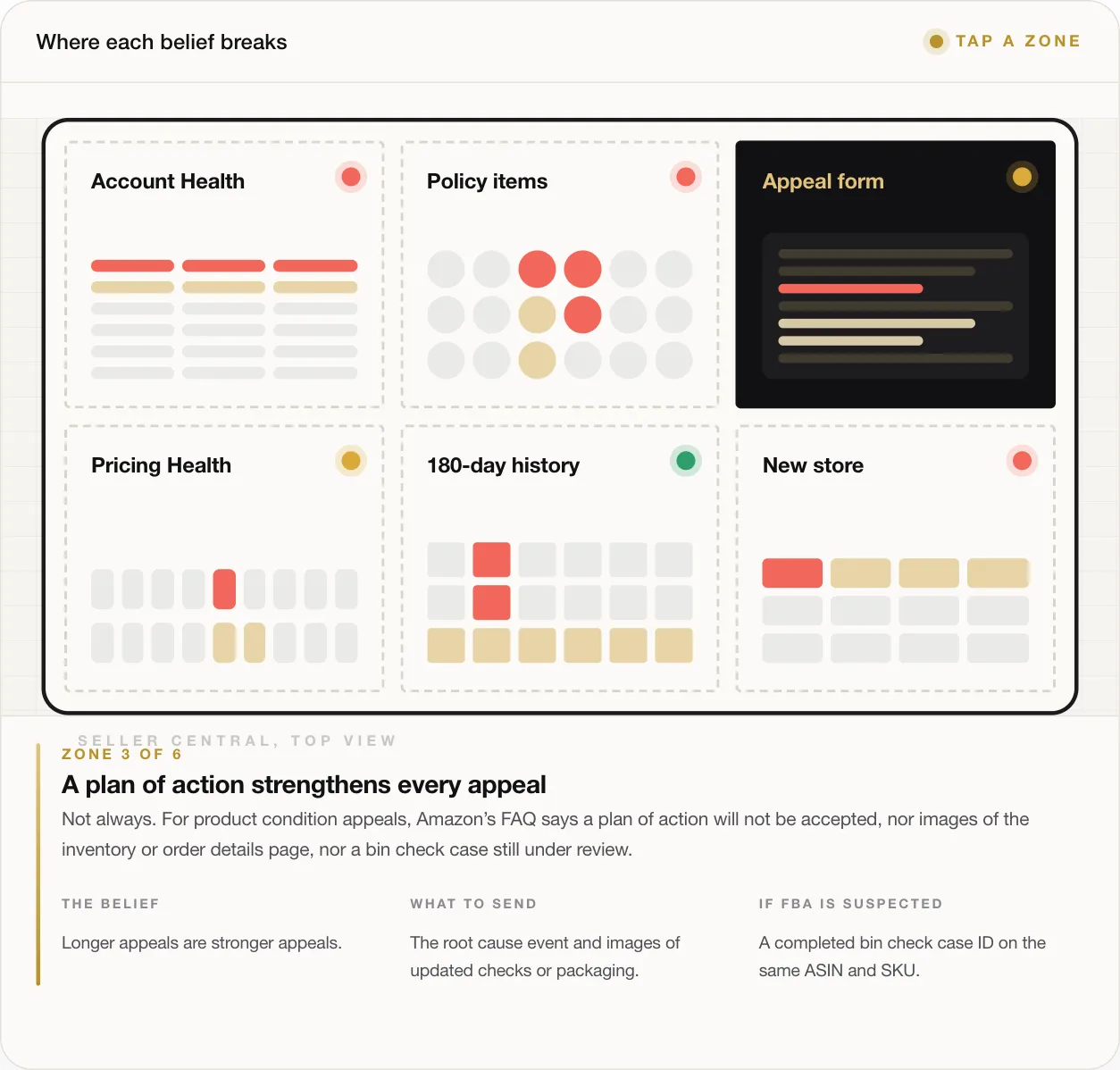
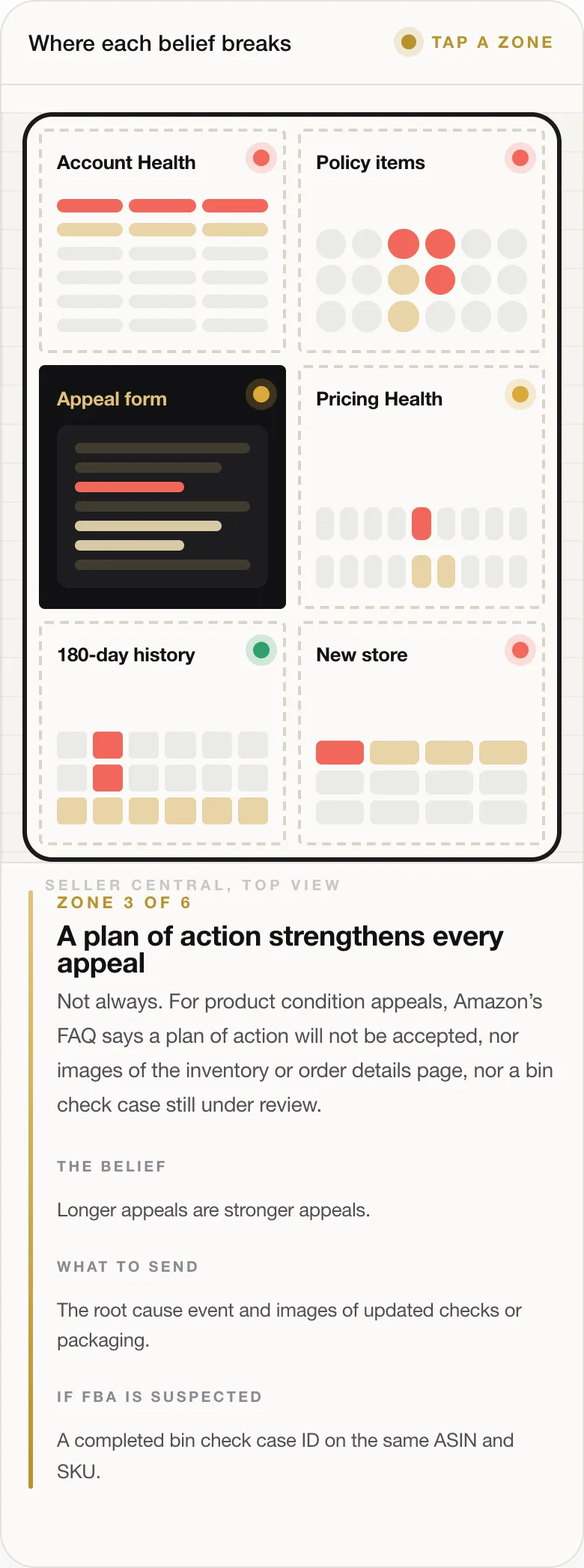
For product condition violations, Amazon’s appeals FAQ describes two options. “I understand the policy and acknowledge the violation” is for when you have changed the product condition or description to comply. “I understand the policy and have evidence or documentation to submit” is for when you believe the violation was received in error. Acknowledging a violation you have not fixed sets up the repeat. The FAQ asks the appeal to identify the root cause, meaning the event that caused the customer’s negative experience, and the corrections made, with evidence such as images of updated training materials, packaging or quality checks. If you suspect the FBA channel caused a condition issue, Amazon recommends a bin check on the same ASIN and SKU first, with the completed case ID included.
What Amazon says it will not accept
For these appeals, the FAQ lists three things that will not be accepted: a plan of action, images of the inventory or order details page as evidence, and a bin check case still under review. A long plan of action is the wrong format here. Answer the questions asked and attach specific evidence.
Search suppression is a data warning
Amazon may require you to act by a certain date, for example by adding required attributes, or the ASIN may be removed from search. Find these in Manage All Inventory under “Activate listings” with the Quick Filters “At-risk of search suppression” and “Search suppressed”. Amazon notes changes take up to 48 hours to show. Weak listing data is where product detail page violations start, so clear this filter weekly. Our guide to reading Amazon’s suspension codes helps translate notification wording.
Pricing Health: the quiet warning light
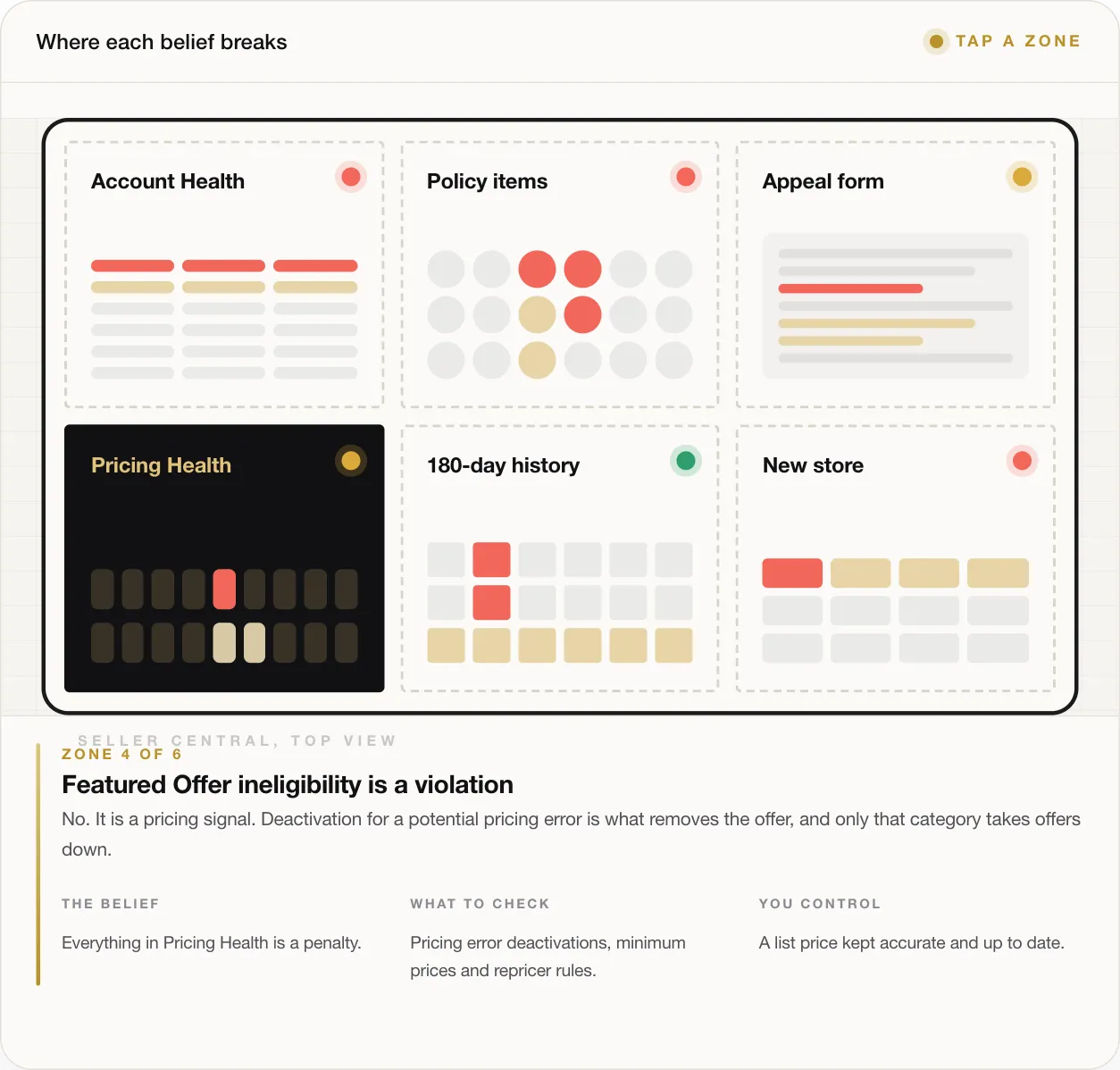
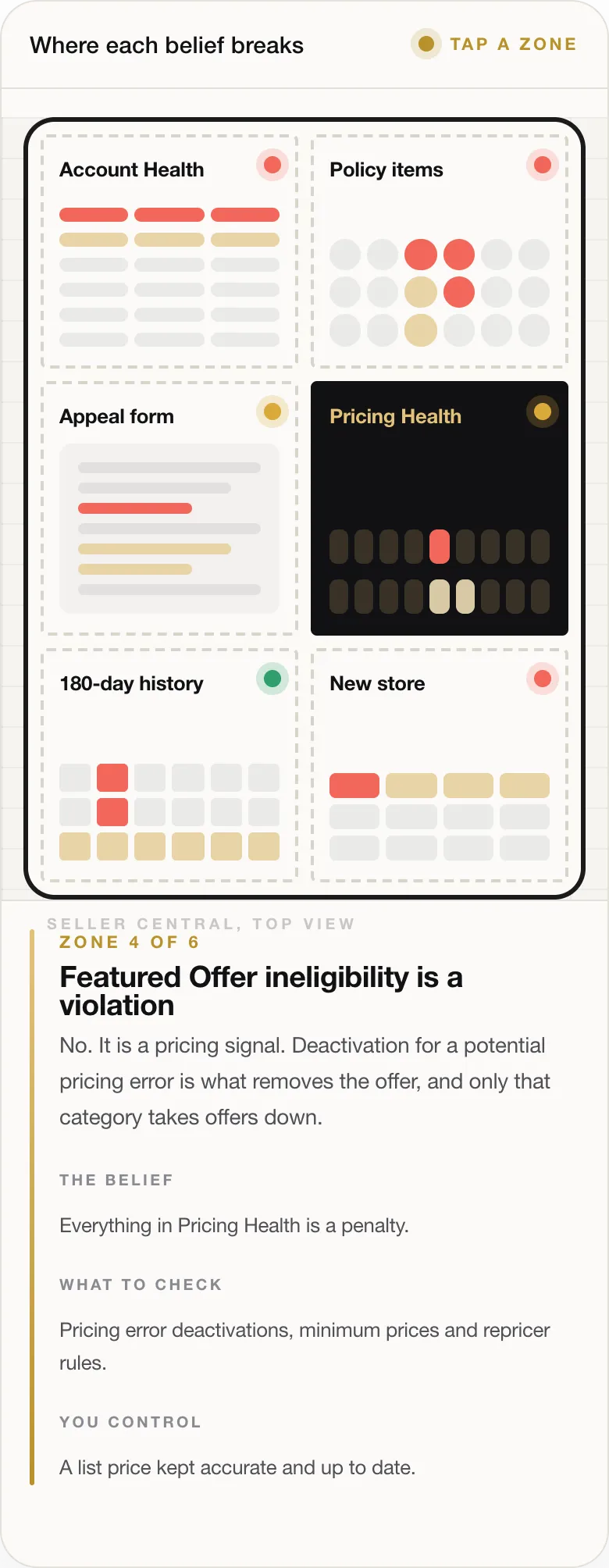
The Marketplace Fair Pricing policy is in the AHR, which makes Pricing Health part of account health. Amazon describes it as an overview of inactive offers with potential pricing errors, offers ineligible to become the Featured Offer, and offers priced within 5% of the Featured Offer price. Only the first category deactivates offers; Featured Offer ineligibility is a pricing signal, not a violation.
Pricing error deactivations
Amazon detects potential pricing errors based on factors including the Marketplace Fair Pricing policy and the limits you set, for example an offer price lower than the minimum price you previously set. It then notifies you and deactivates the affected listings. A run of these usually has one cause: an automated pricing rule, a bulk upload with a wrong column, or limits that no longer match reality. Fix that cause once rather than reactivating offers one at a time. See our article on the pros and cons of automated pricing.
Know the reference prices
Amazon lists reference prices it may use, including the Featured Offer price, the 60-day average selling price, the highest 14-day price shipped and sold by Amazon, the list price, and the typical price, which it defines as the 90-day median price buyers paid on Amazon. If you set a list price, Amazon asks that it be accurate and up to date. A stale list price is a pricing signal you control entirely.
Performance metrics: read the target printed beside the number
Amazon’s appeal page states that sellers must adhere to its performance metrics and policies, and that failure may lead to temporary deactivation, listing removals, or limits on use of the Merchant Fulfilled Network. The Account Health page shows each customer service and shipping metric with its current value and its target. We deliberately do not repeat the targets here, because Amazon sets them per metric and can change them. Record the target from your own dashboard, in each store, beside the value.
Read direction and speed, not just position
A metric inside its target but moving toward it every week is a warning. A metric that jumped in one week is a warning with a date, and the date lets you ask what changed that week: a carrier, a warehouse, a staff member, a launch. The FBM contact metrics that earn AHR points are useful leading indicators too, because buyer contacts tend to rise before the defects that matter. See our guides on how Order Defect Rate is graded and late shipment suspensions.
The signs that a review is coming
Between a few violations and a deactivation there is usually a stage where Amazon is looking more closely. These signals tell you the stakes have changed.
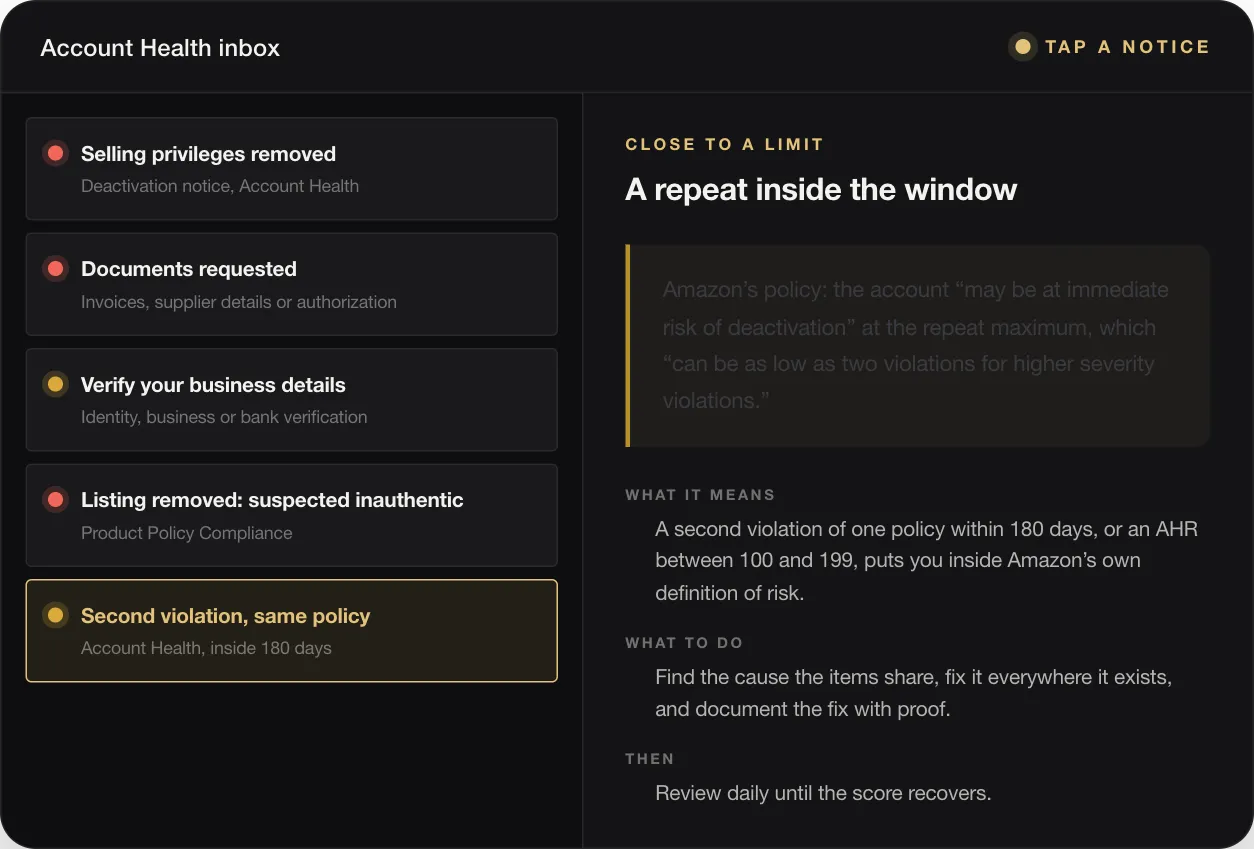
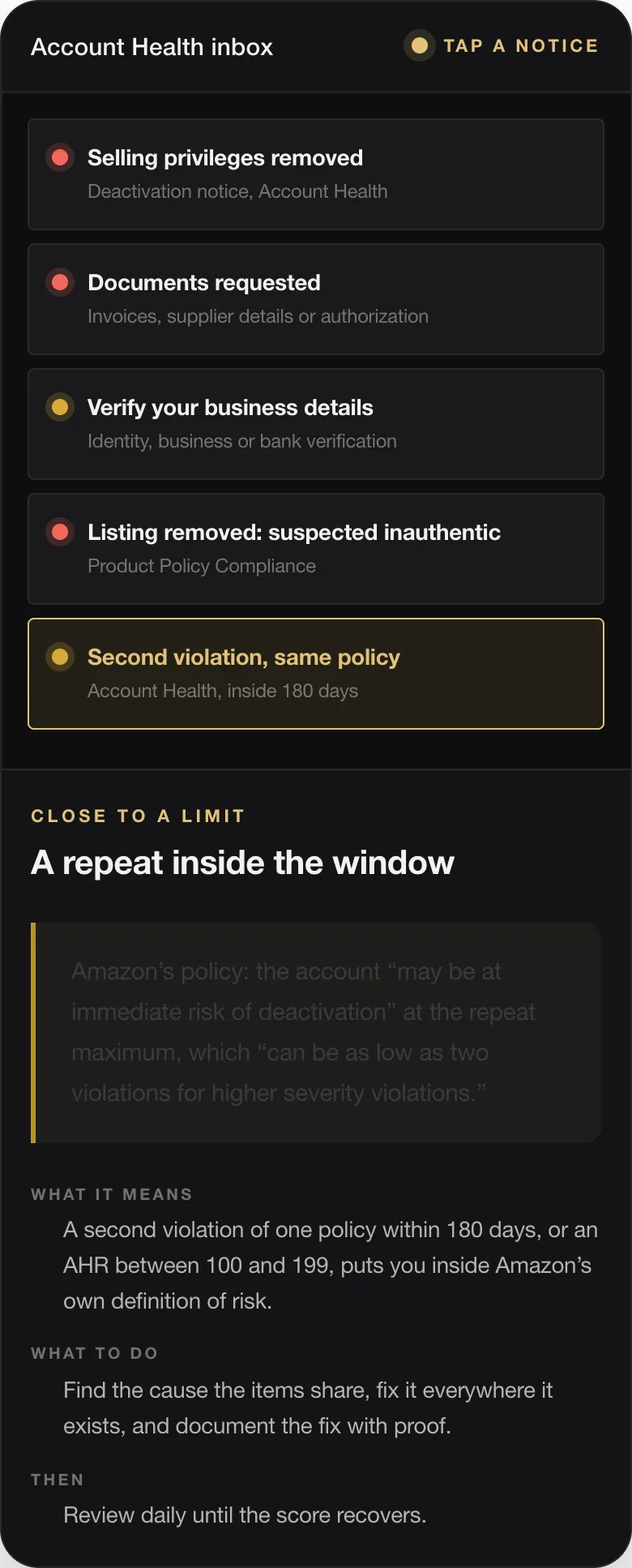
Document requests
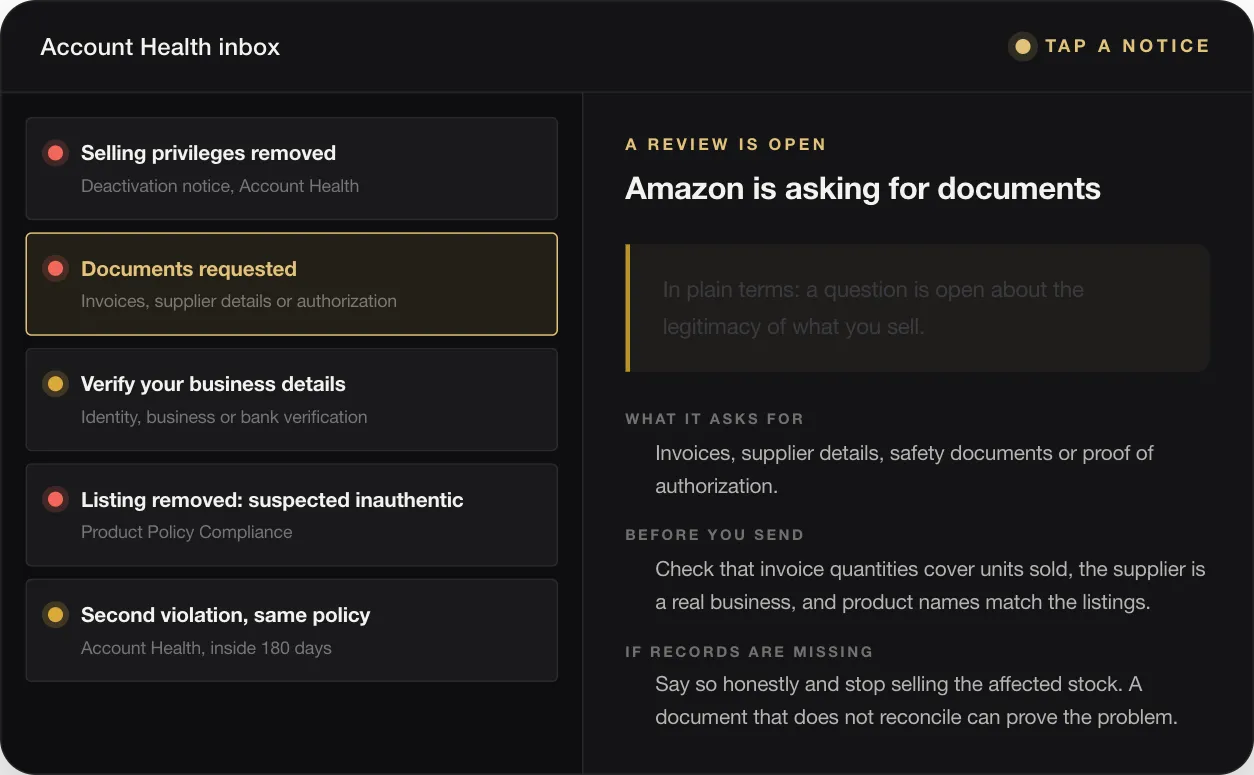
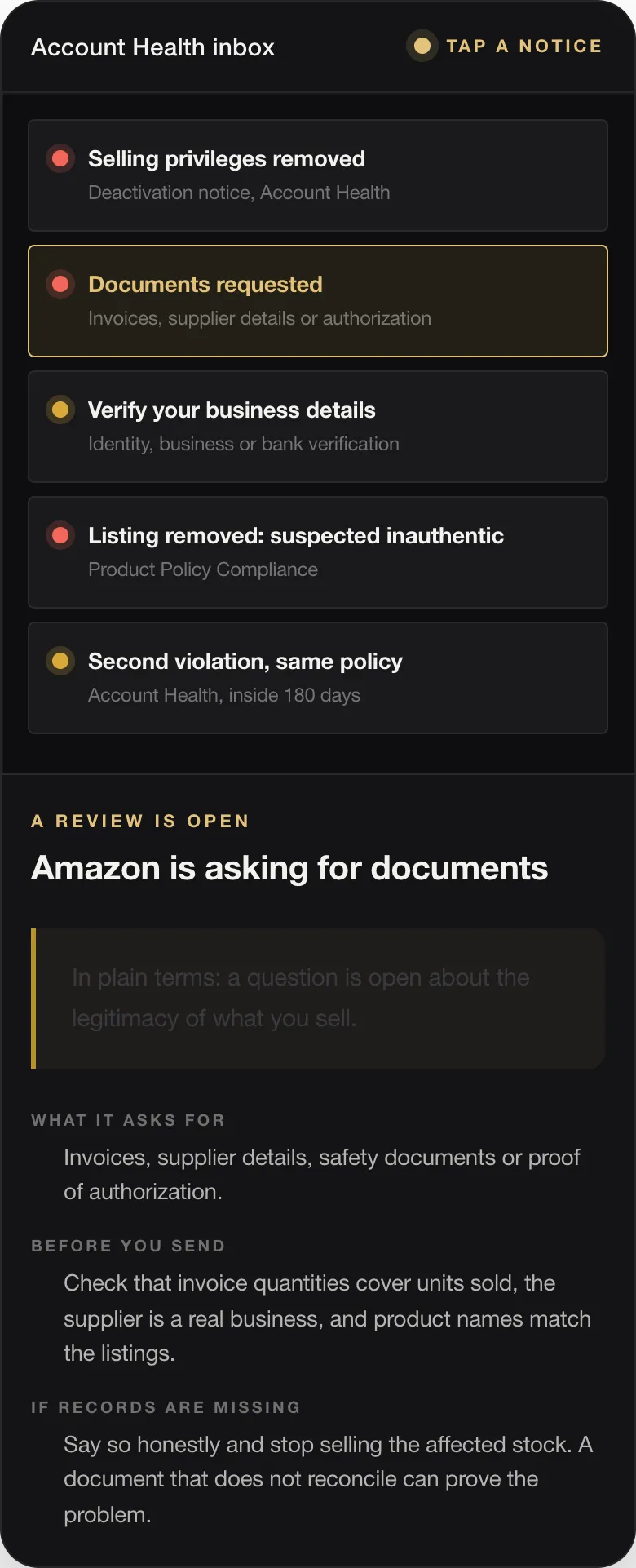
A request for invoices, supplier details, safety documents or proof of authorization means a question is open about the legitimacy of what you sell. Before sending anything, check that invoice quantities cover the units you sold, supplier details match a real business, and product names match the listings. A document that does not reconcile can prove the problem instead of resolving it.
Verification prompts
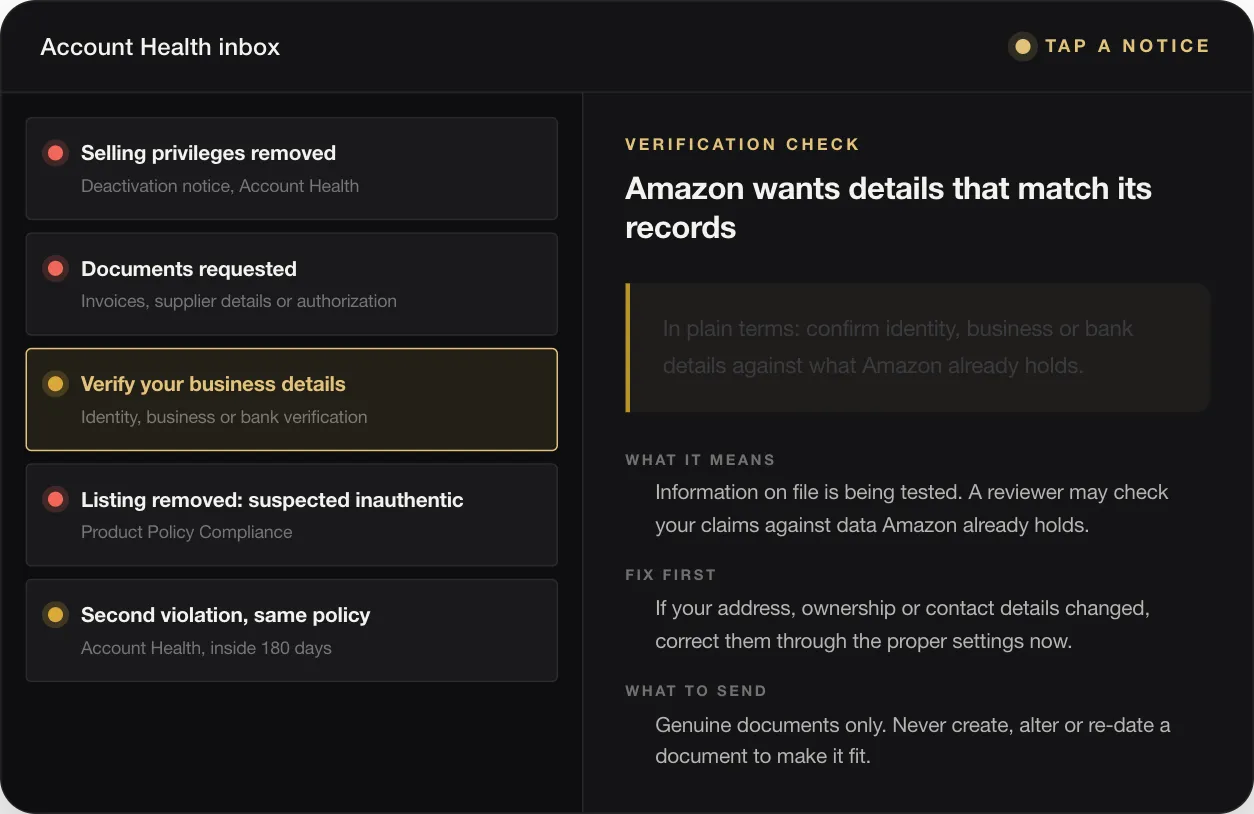
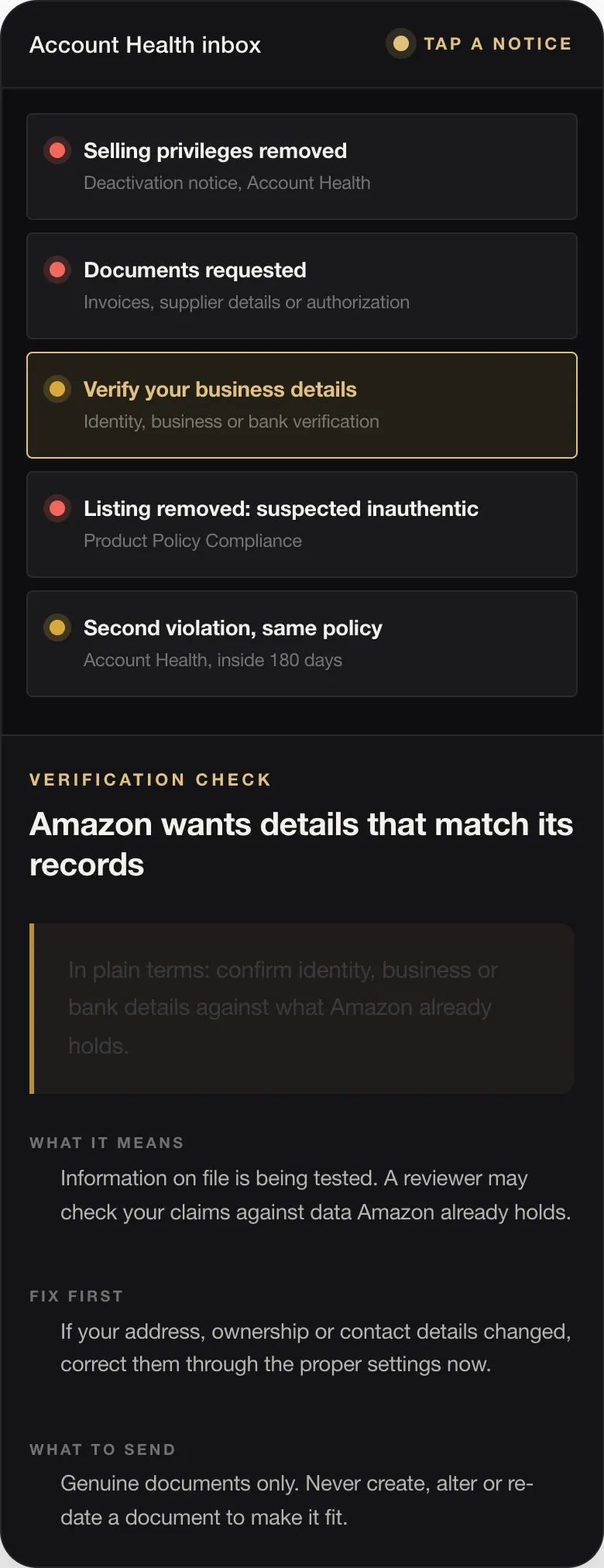
A prompt to verify identity, business or bank details means Amazon wants information that matches what it holds. If your address, ownership or contact details changed and Seller Central still shows the old ones, correct them now through the proper settings. Respond only with genuine documents.
Sudden listing removals, repeats and the yellow band
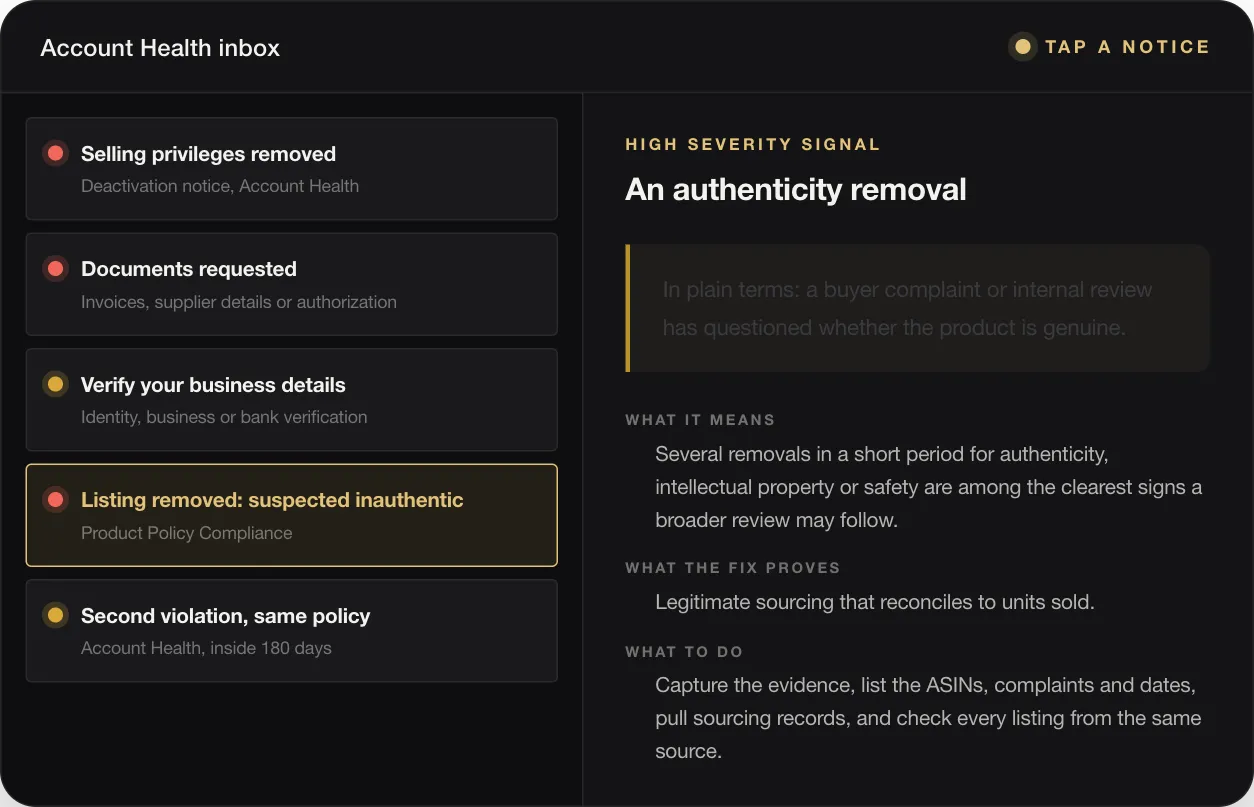
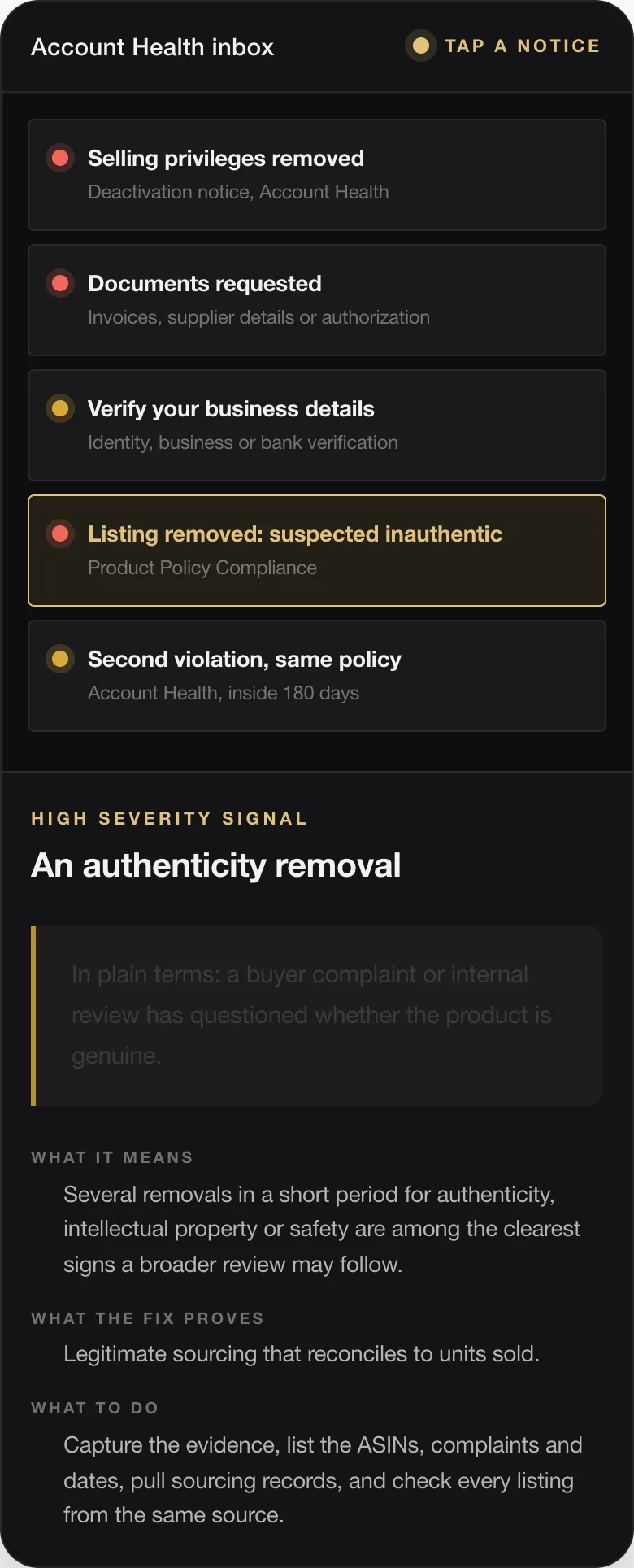
Several removals in a short period, especially for authenticity, intellectual property or safety, are among the clearest signs a broader review may follow. A second violation of the same policy within 180 days, or an AHR between 100 and 199, puts you inside Amazon’s own definition of risk.
A call from Amazon
Amazon says that if account health degrades and becomes eligible for deactivation, it may call to offer personalized support, and asks sellers to keep the Emergency Contact number under Notification preferences current. Check that number now. A missed call is a missed warning.
Five notices, five different jobs. Open each one.
Each signal tells you the stakes have changed, and each calls for a different first move. Tap a notice to see what it means, what Amazon wants and what to do before you reply.
How to respond early: the first hour
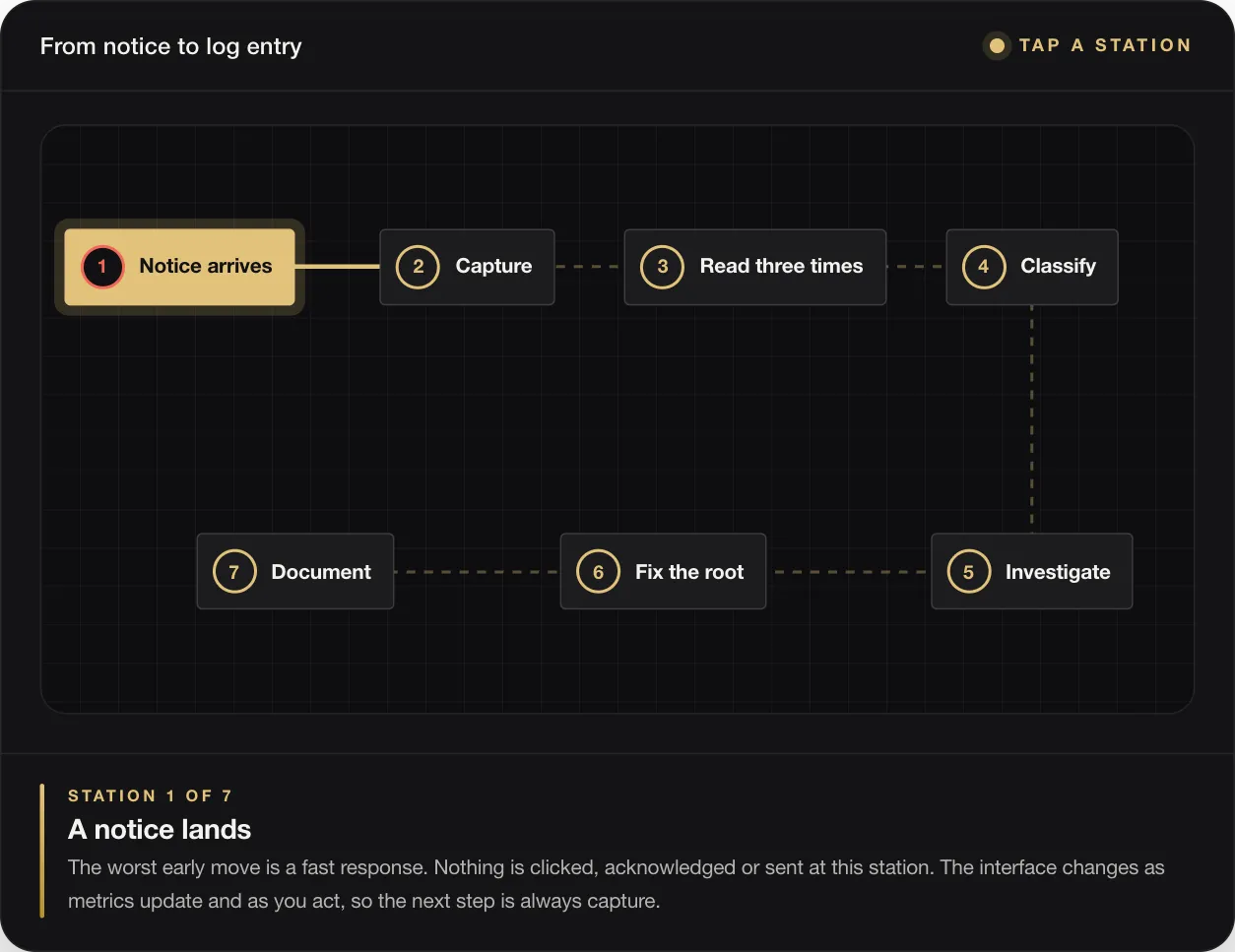
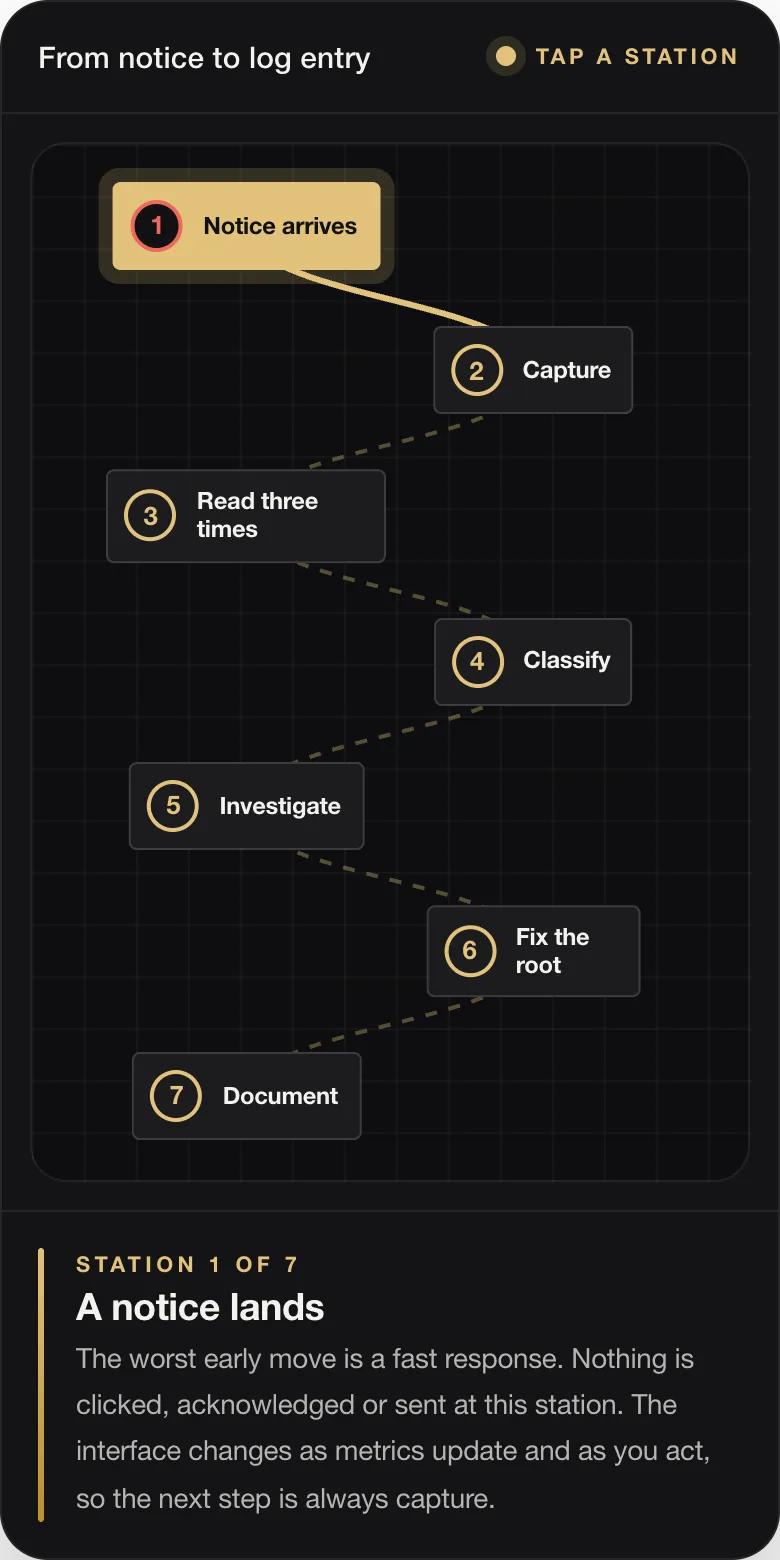
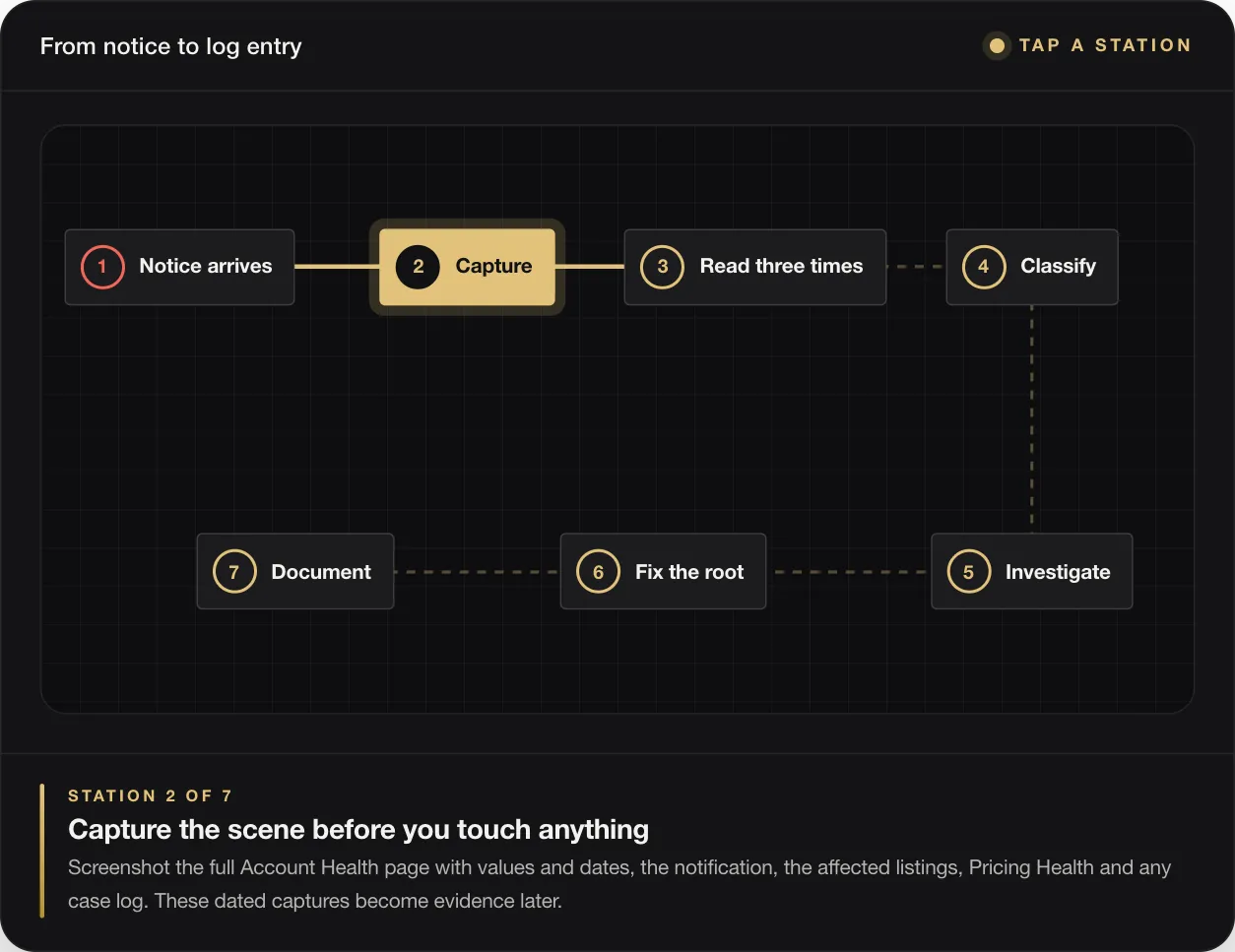
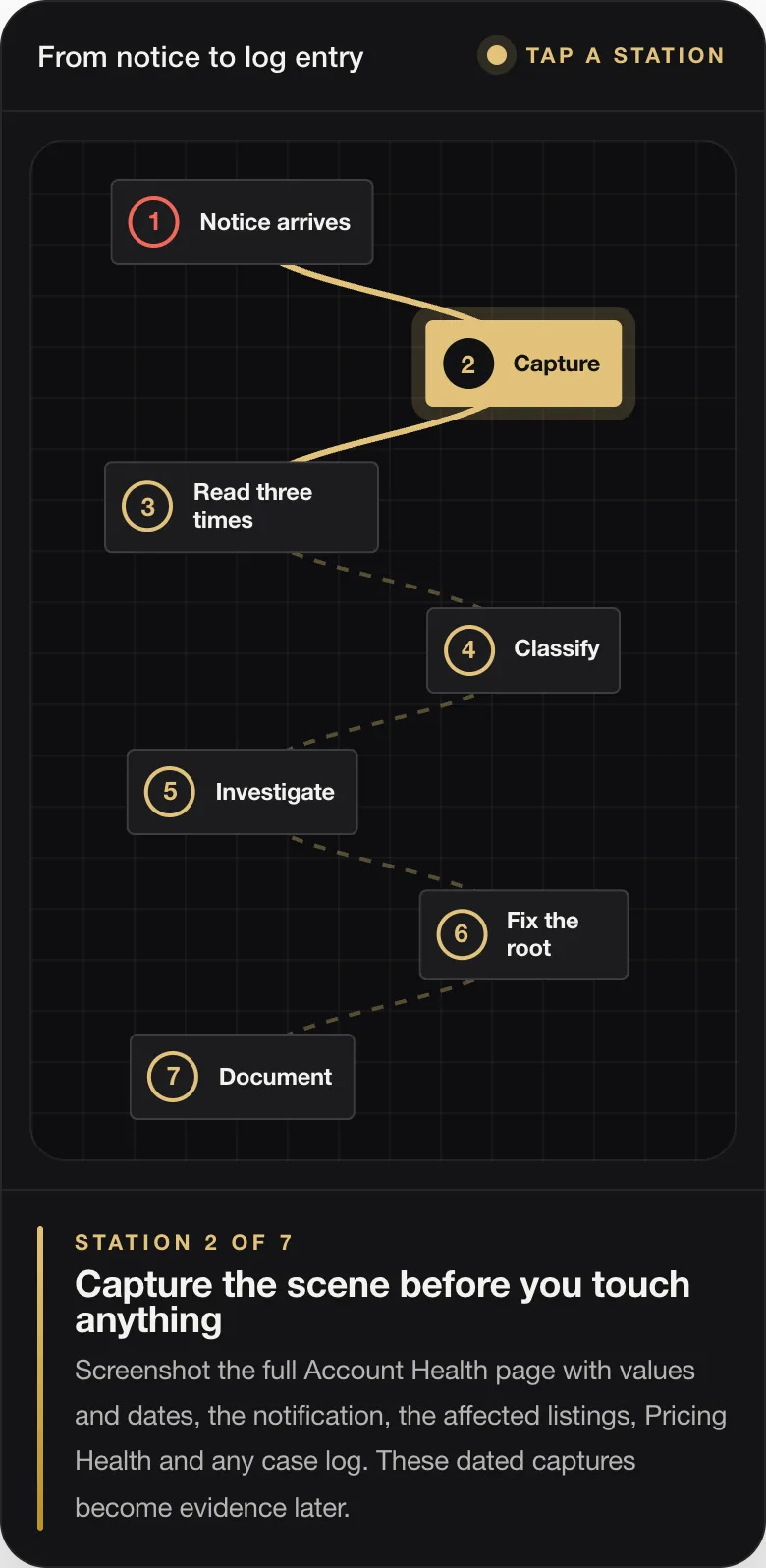
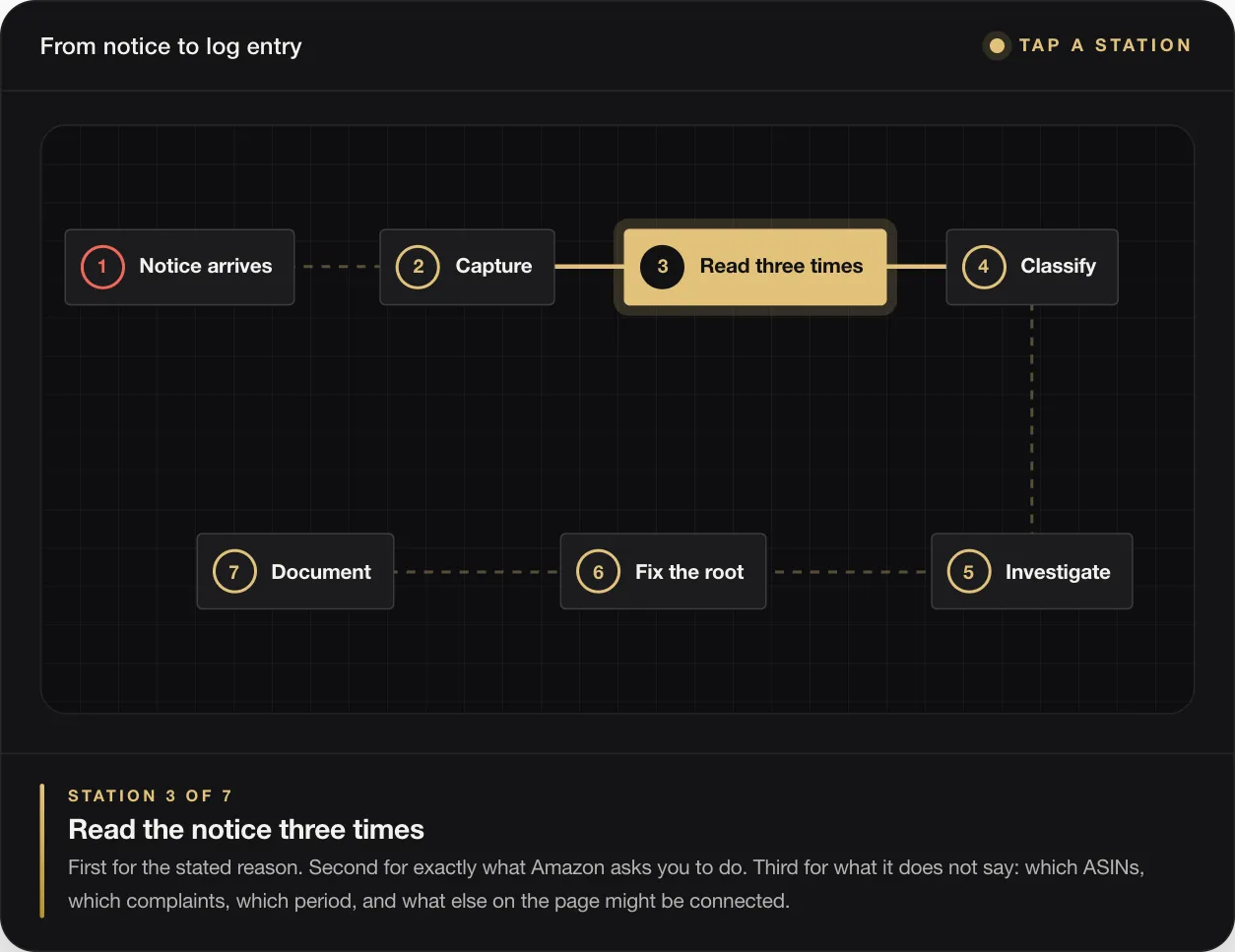
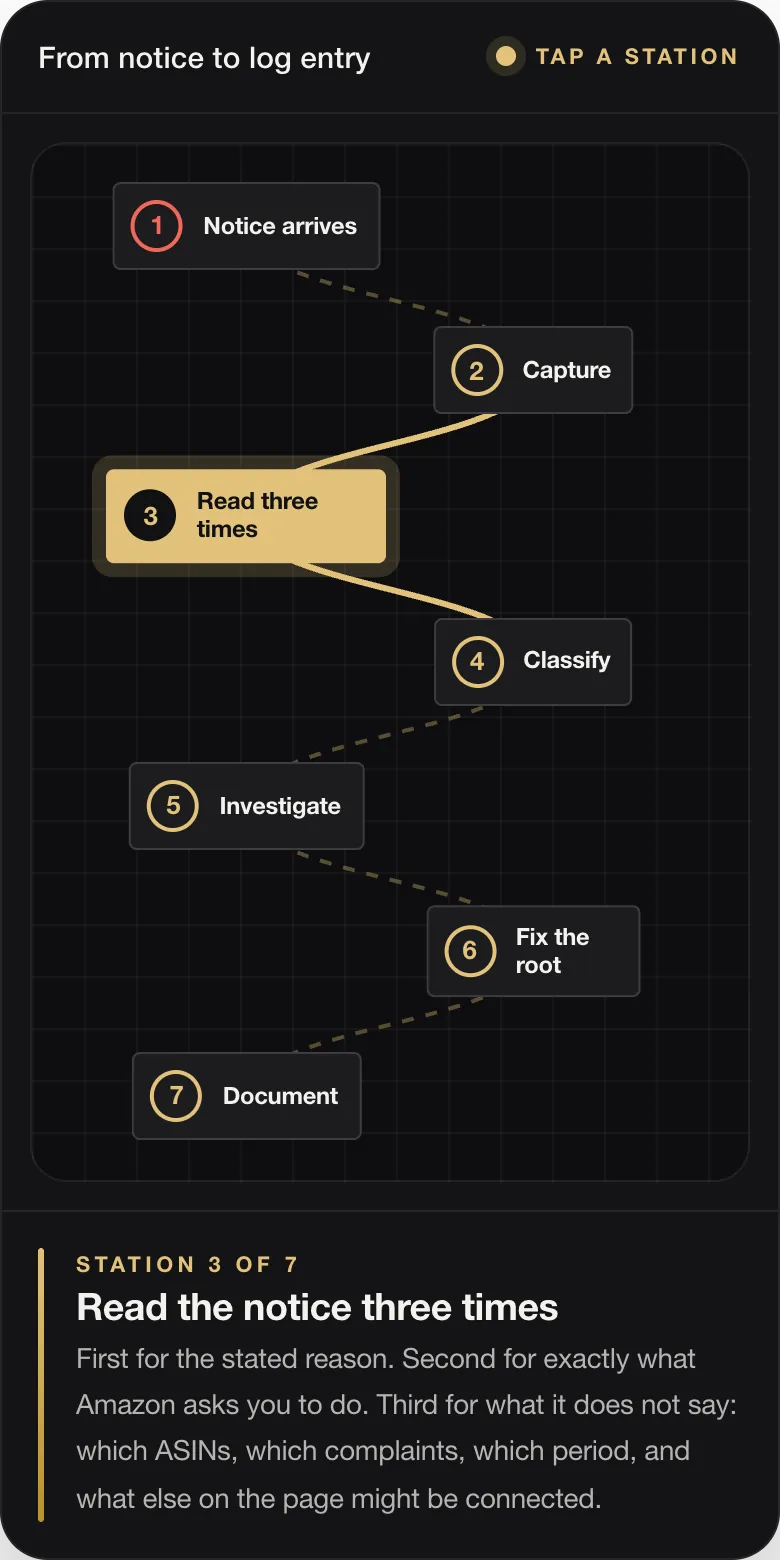
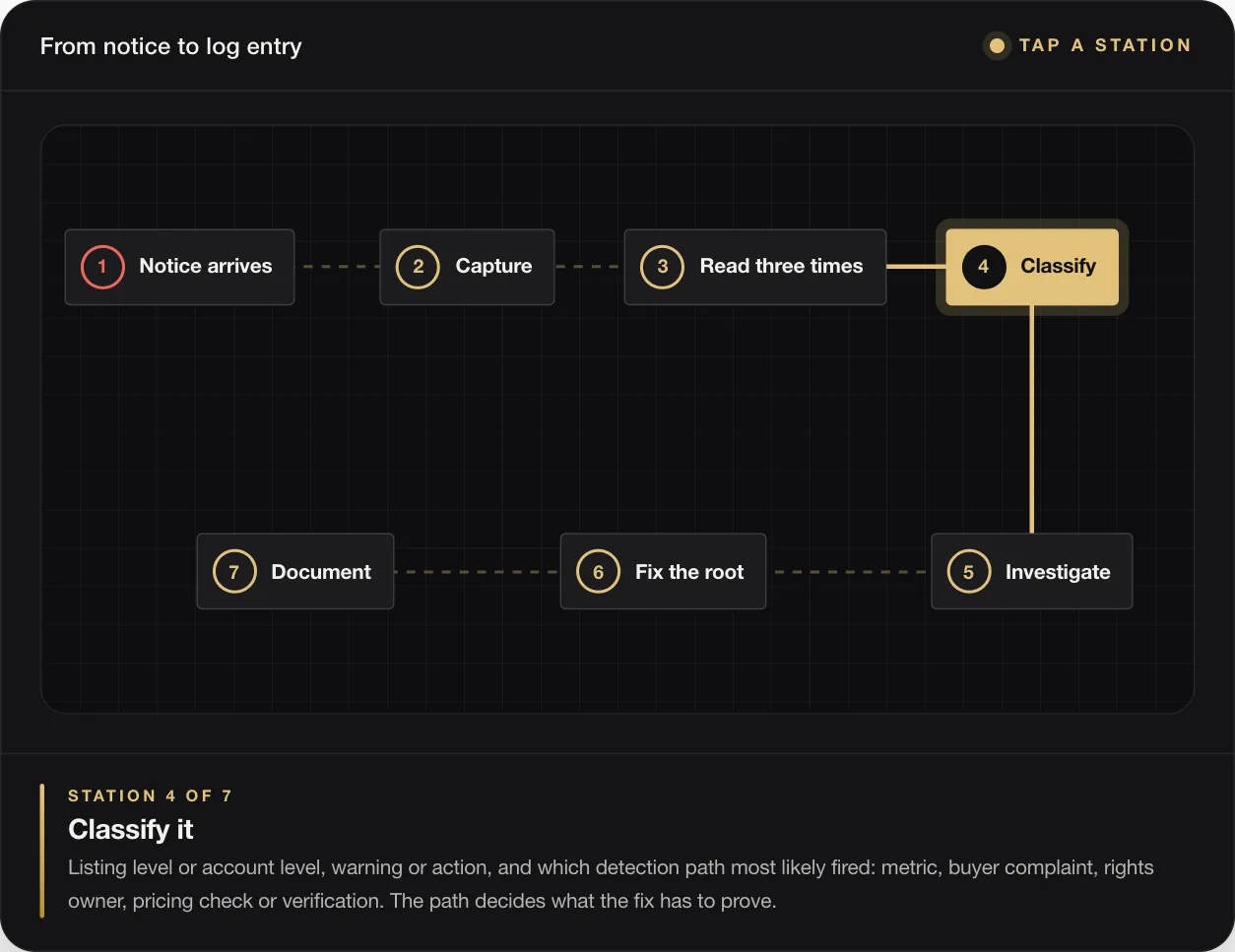
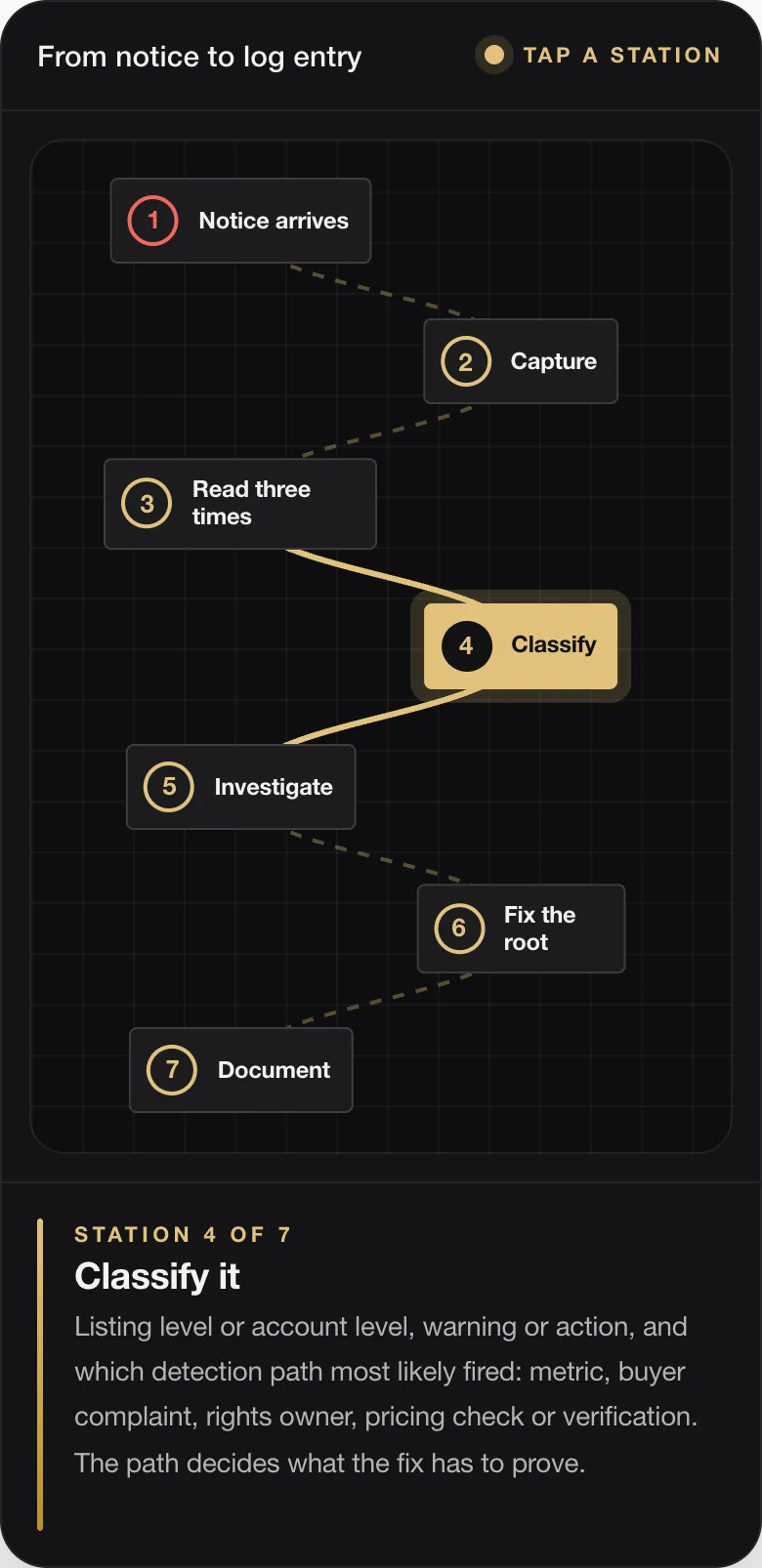
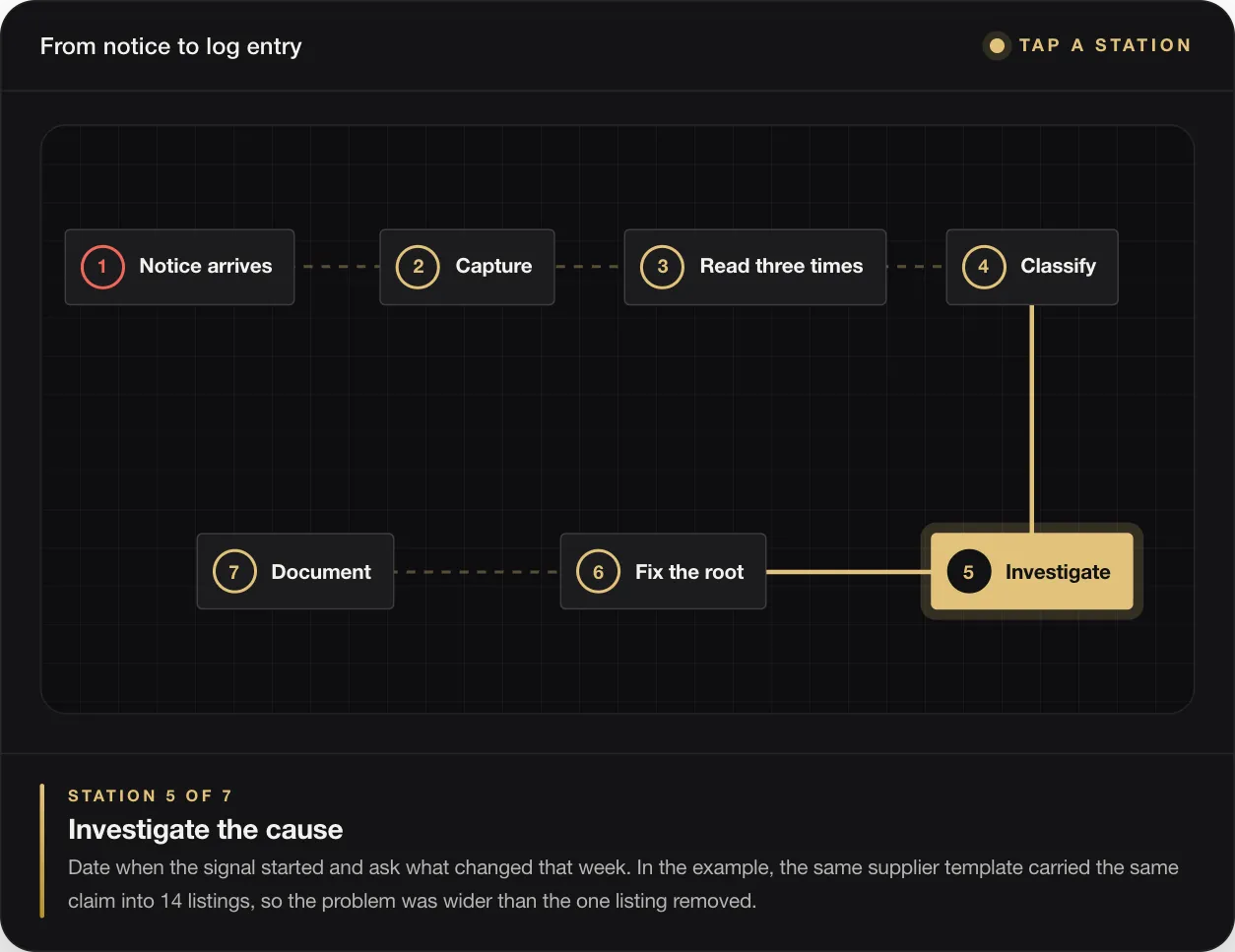
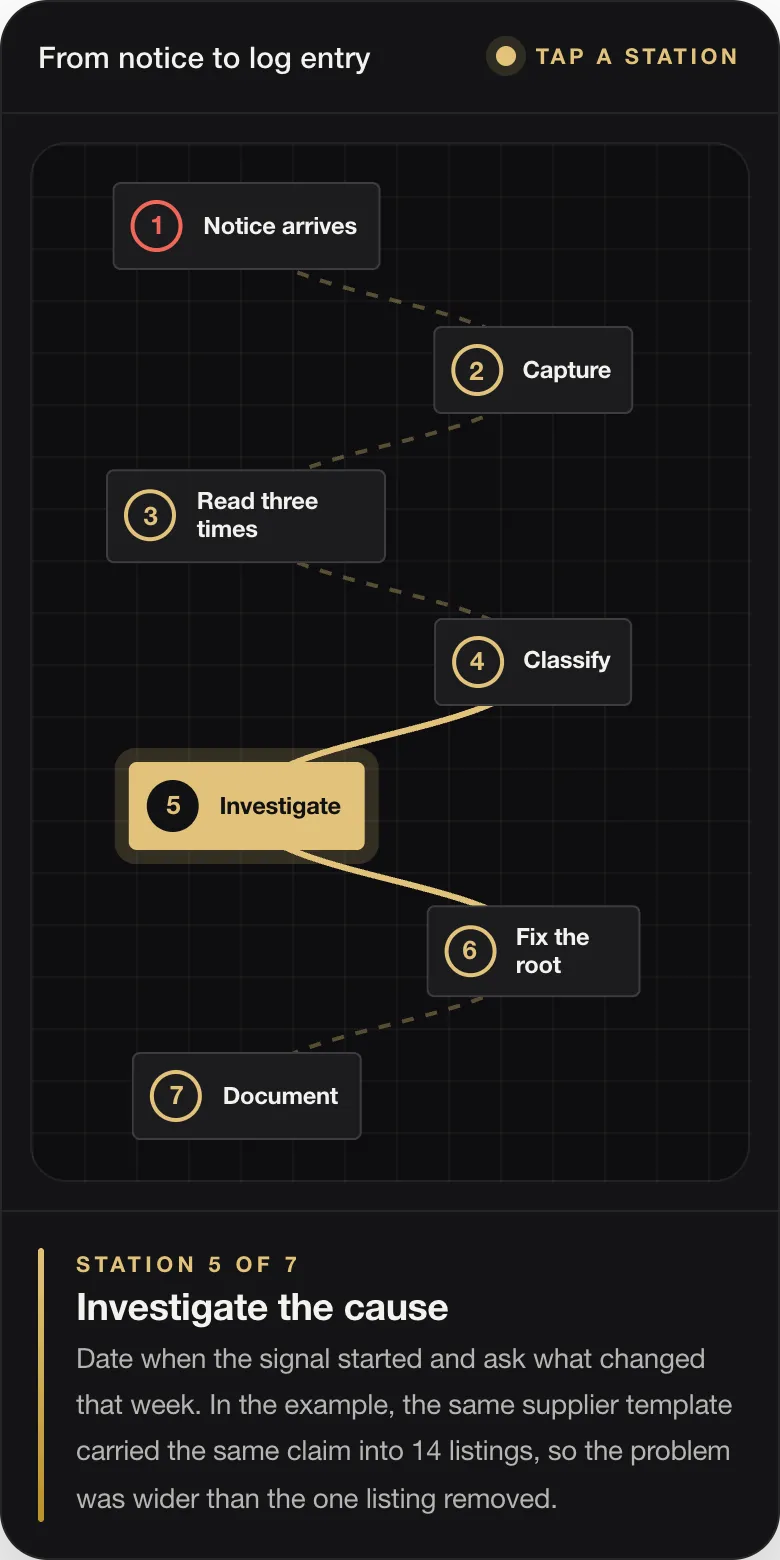
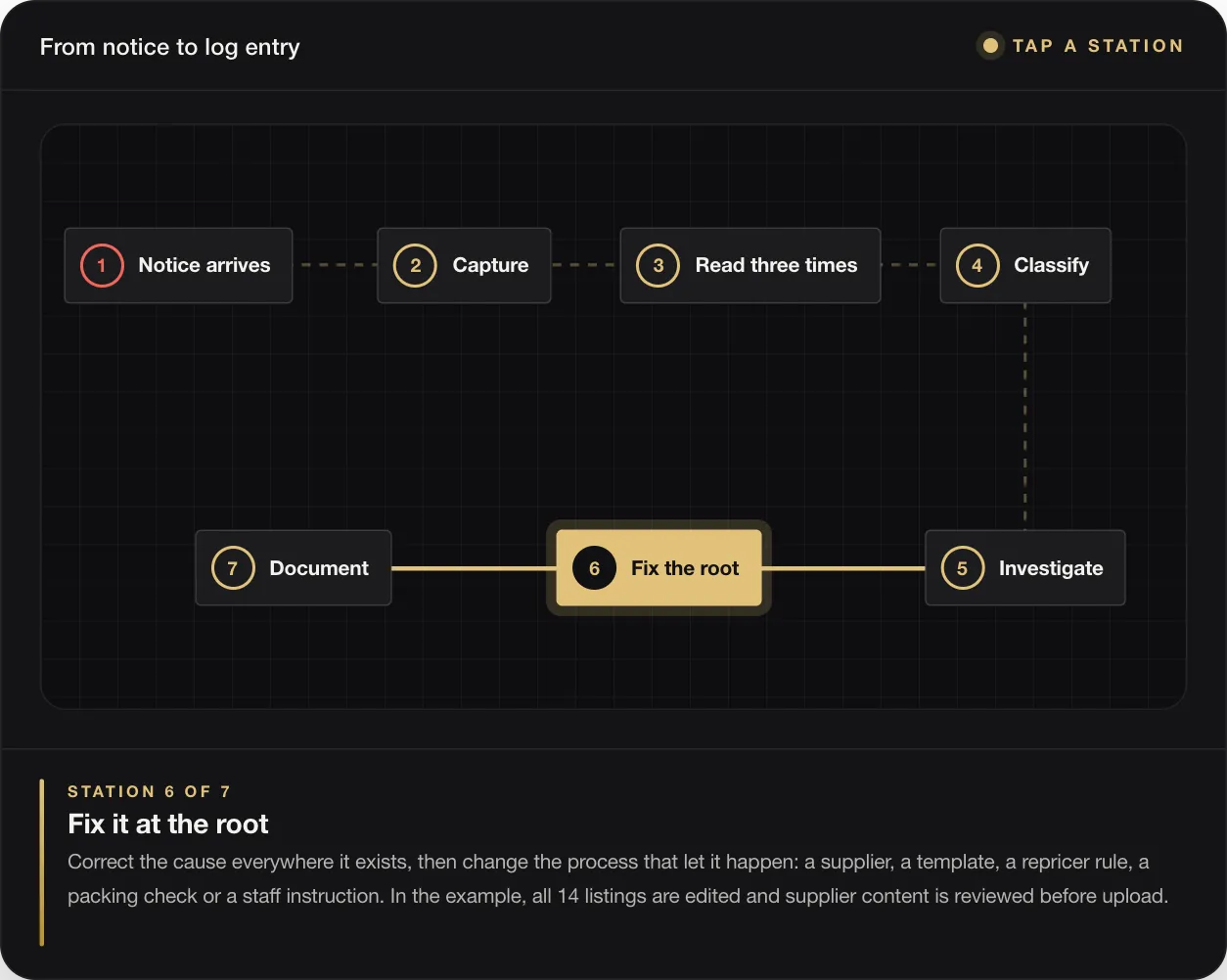
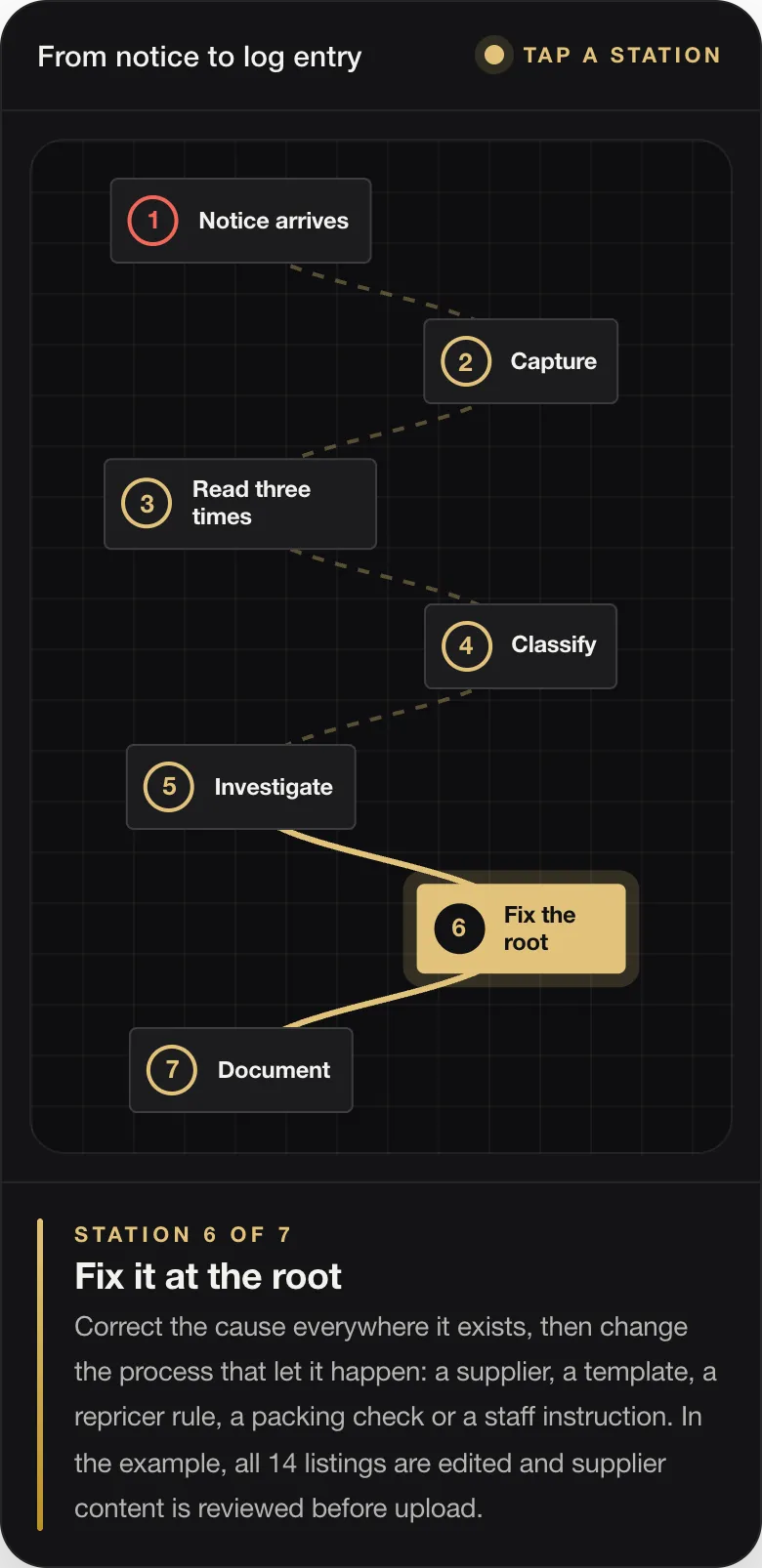
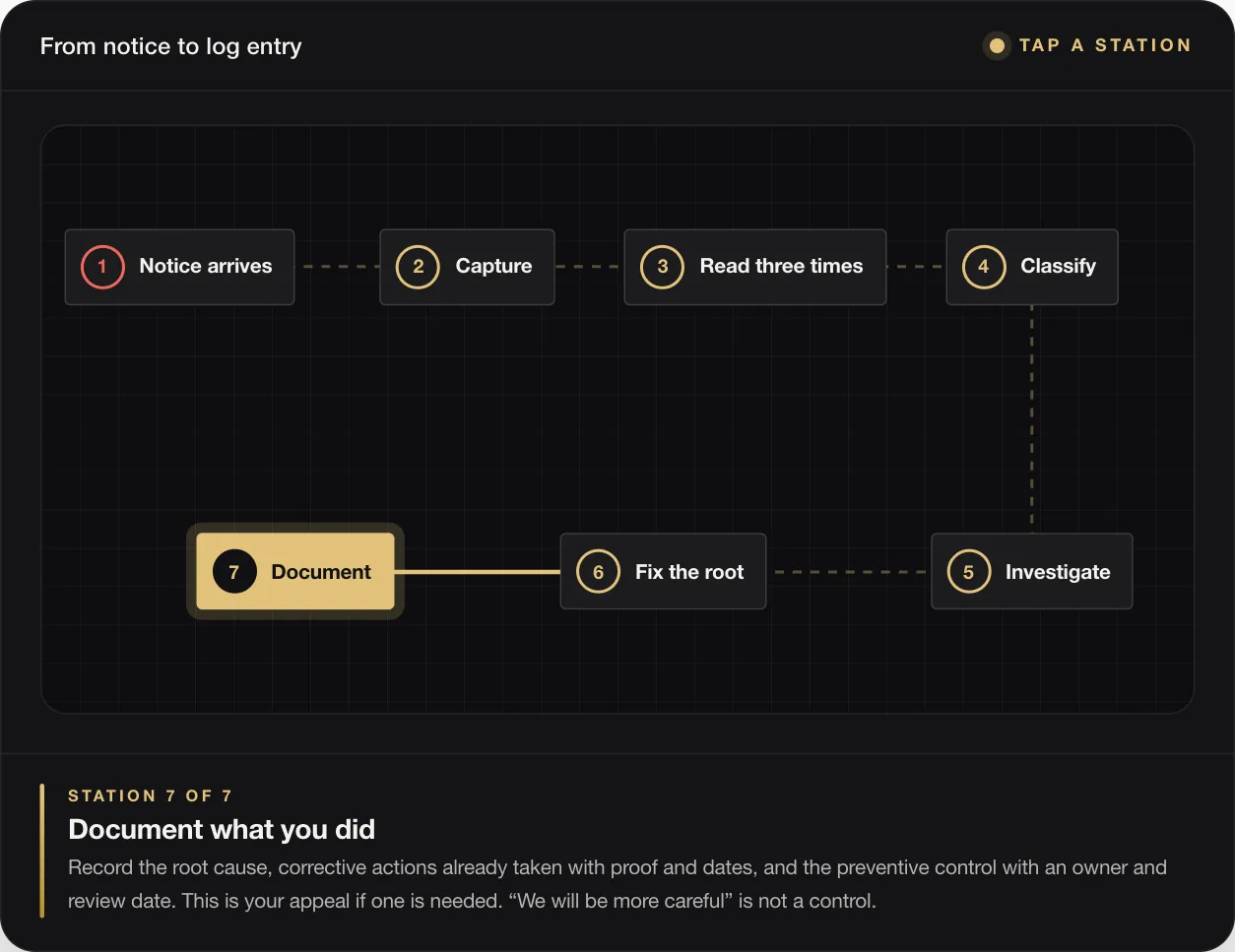
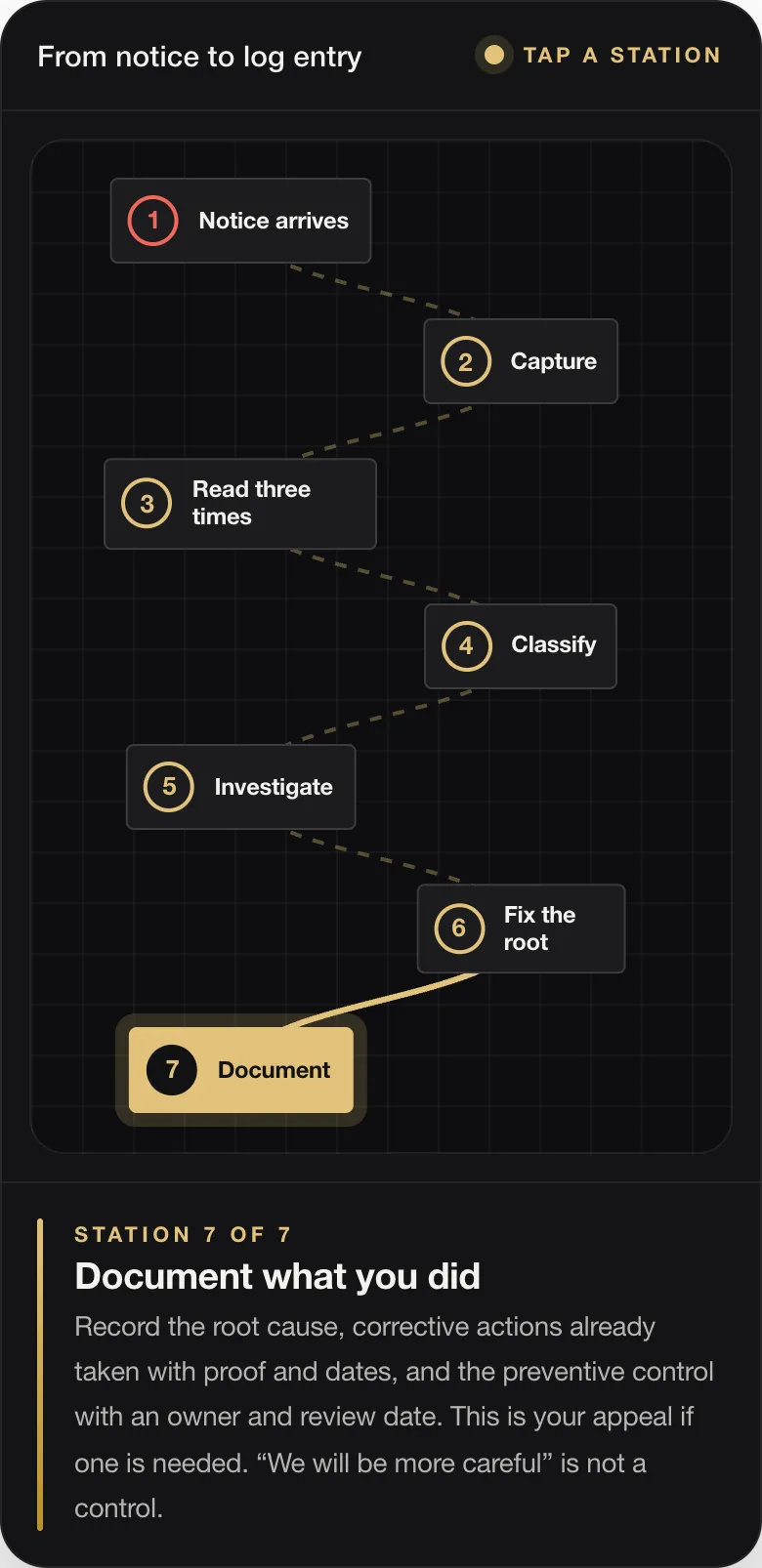
The worst early move is a fast response. The best is a fast, disciplined read that sets up a slow, correct one. Run the same sequence every time.
A fast, disciplined read sets up a slow, correct response.
Run the same sequence every time a warning lands. Tap a station to see what happens there, using this guide’s example of a listing removed under the product detail page rules.
Root cause, corrective action, preventive control
“We violated the product detail page rules” is not a root cause. “A supplier template copied into 14 listings in March contained a claim the product cannot support, and nobody reviewed supplier content before upload” is. It names the event, scope, date and process gap. Corrective actions are past tense and provable: the 14 listings were edited on a given date, with screenshots. Preventive controls name the action, person, frequency and record: “the catalog manager reviews all supplier content against the product detail page rules before upload, with a weekly sample check logged every Monday.” “We will be more careful” is not a control.
Score sliding or the same policy back again?
Send us the notice and we will tell you plainly what it puts at risk.
Where to verify each signal in Seller Central
| Question | Where to check | What to look for |
|---|---|---|
| What is my AHR in each store? | Account Health page, per store | The number, change since last week, distance to 199 |
| Which violations count against me? | Account Health, policy compliance items | Policy, severity, date, and whether the same policy appears twice |
| Which listings were removed and why? | Product Policy Compliance tab, inactive listings in Manage Inventory, Performance Notifications | Shared reason or shared source across removals |
| Are offers deactivated for pricing? | Pricing Health | Potential pricing error deactivations; prices below your minimum; stale list prices |
| Are listings at risk of leaving search? | Manage All Inventory, Activate listings, Quick Filters | Missing attributes and any action-by date |
| Are metrics moving toward targets? | Account Health, customer service and shipping performance | Value, the target shown, four-week direction |
| What are buyers complaining about? | Voice of the Customer | Condition and “not as described” themes by ASIN |
| Can Amazon reach me? | Notification preferences, Emergency Notifications | A current phone number someone answers |
Evidence and documentation standards
The records that prevent most cases also win the ones you cannot prevent. Keep genuine supplier invoices organized by ASIN with quantities that cover what you sold (our article on why Amazon does not accept receipts explains the difference), current compliance documents matched to the exact product, dated screenshots of listings and the Account Health page, dated process records such as inspection checklists and staff instructions, and completed bin check case IDs where FBA condition is in question.
When genuine documents do not exist
Never create, alter, re-date or tidy up a document to make it fit. The code of conduct requires accurate information at all times, and a reviewer may be able to check your claims against data Amazon already holds; one provable contradiction can sink everything else. If you cannot obtain genuine records for a product, stop selling it, say honestly what you can and cannot show, and fix your sourcing. This article is educational information, not legal advice; where a signal touches intellectual property, product safety law or a contract dispute, speak to a qualified professional.
Common mistakes that turn a warning into a suspension
Most escalations trace to how early signals were handled: working the flag that feels most unfair instead of the one closest to action, fixing one listing when the cause is catalog-wide, acknowledging a violation without fixing it, clicking before capturing, sending documents that do not reconcile, and leaving contractors unsupervised. The cards below test the beliefs behind those mistakes.
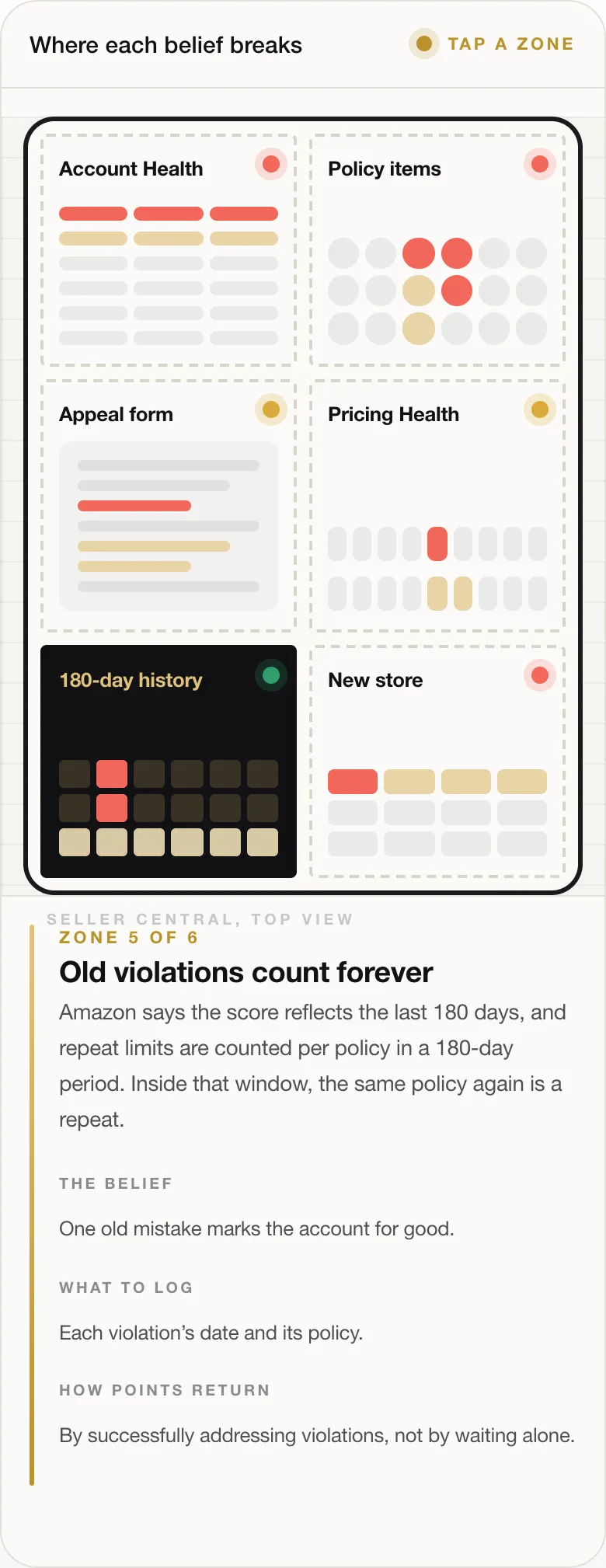
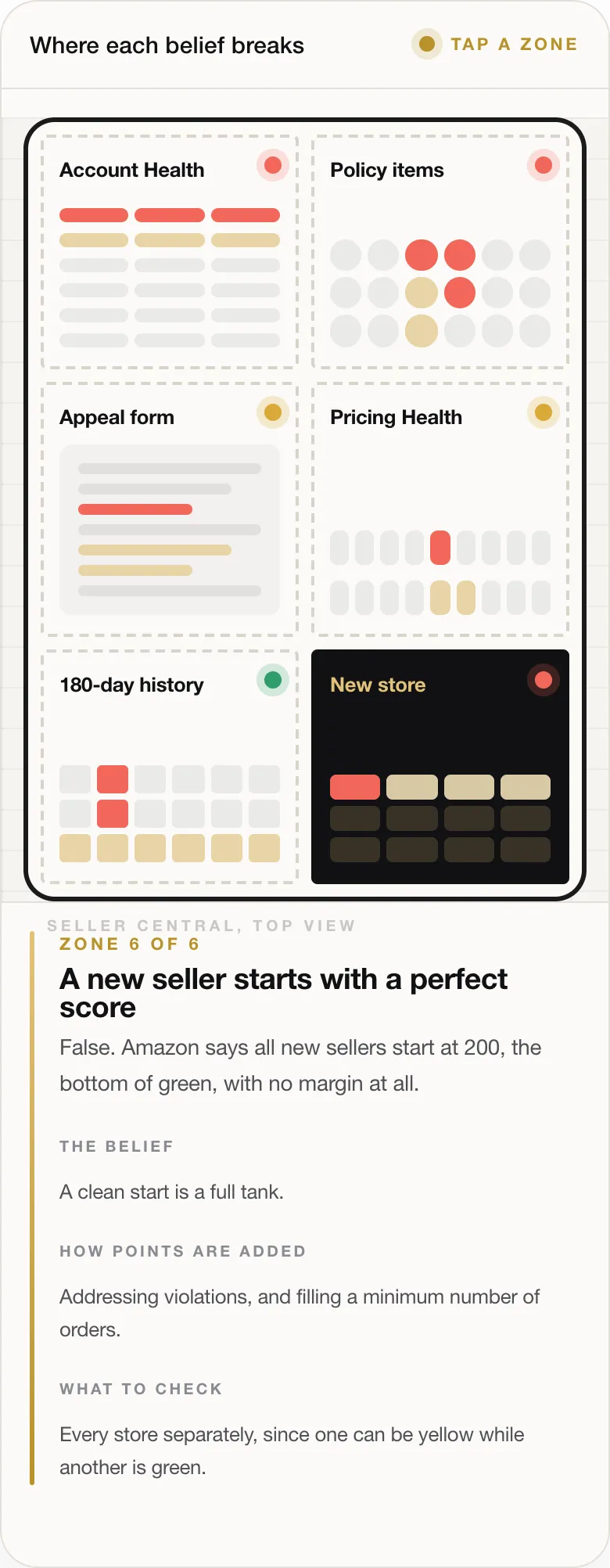
Six beliefs, six rooms. Walk Seller Central.
Most escalations trace to a belief about how account health works. Each one lives in a specific part of Seller Central. Tap a room to see the belief, what Amazon says and what to check there.
The weekly account health review
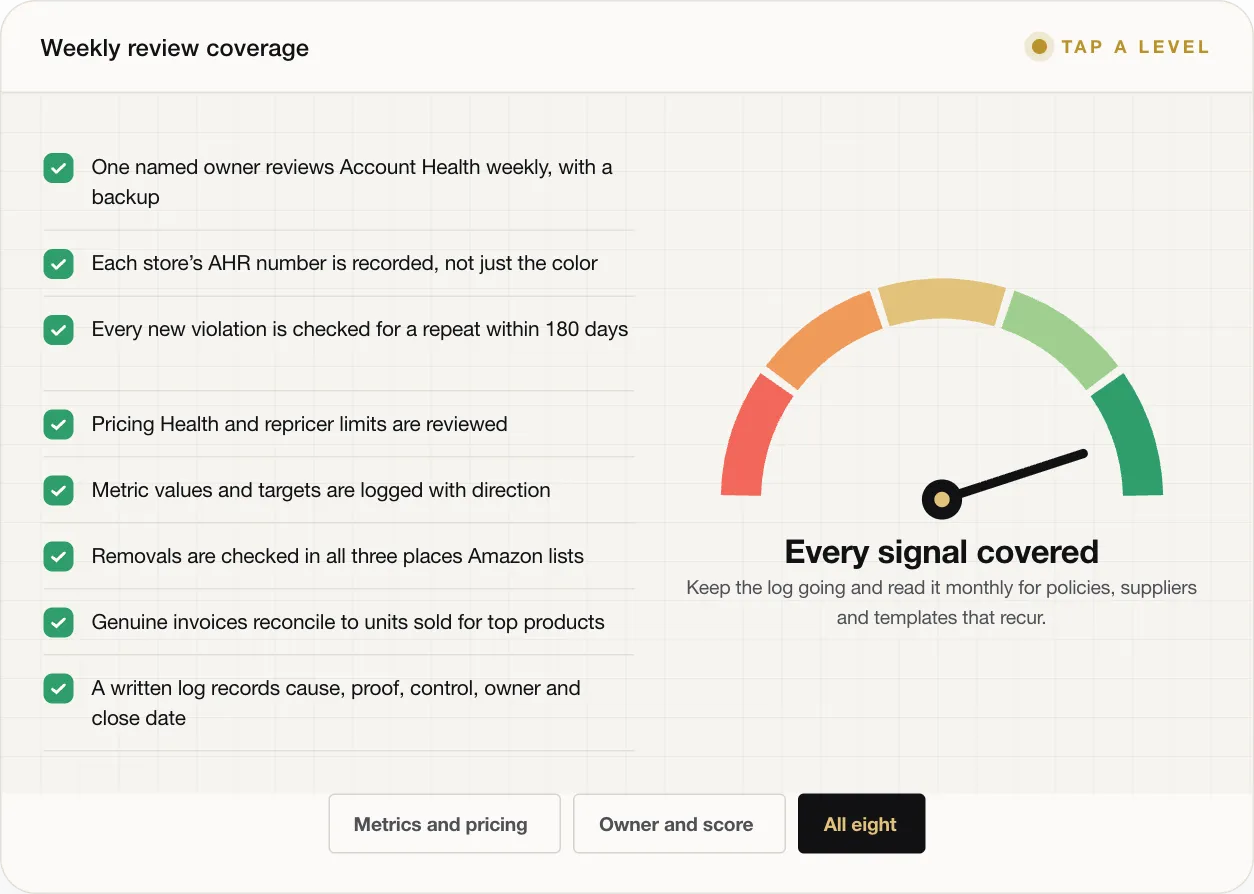
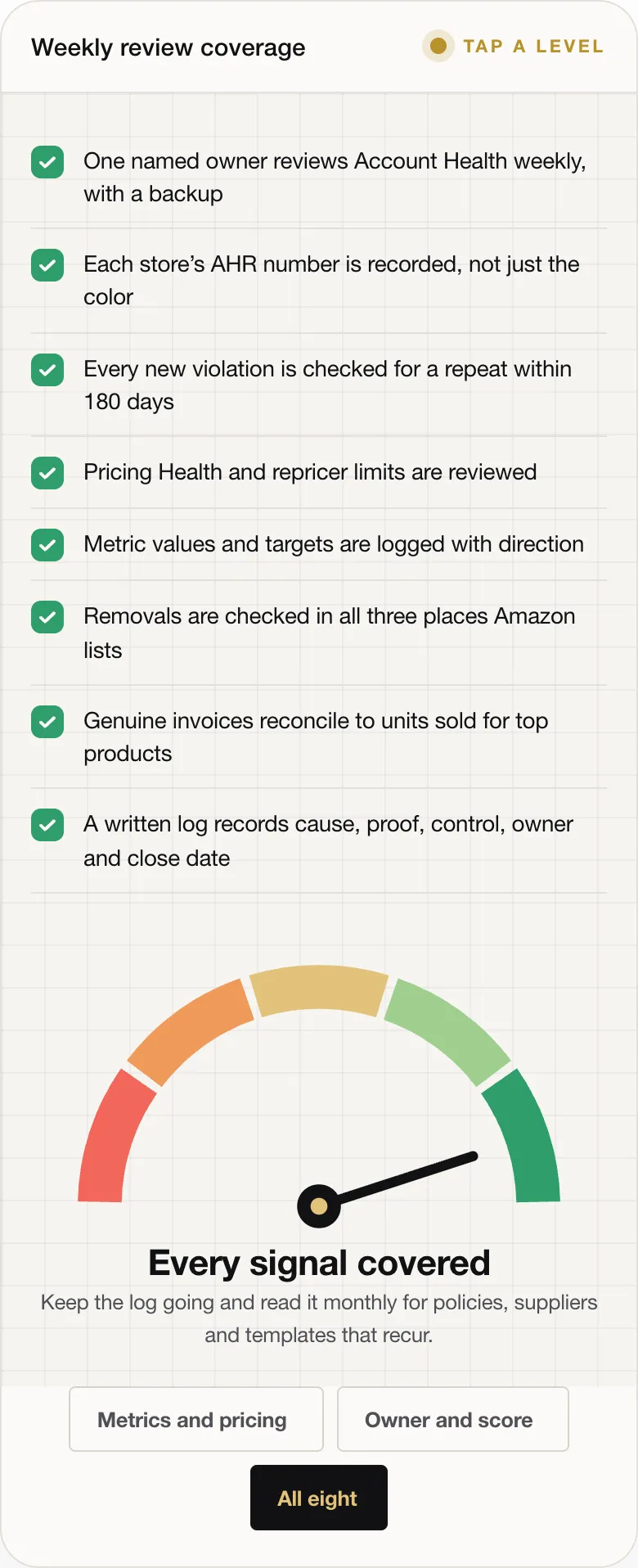
Prevention is a fixed appointment, a named owner and a written log. Name one person as account health owner, with a backup. The owner must read everything, assign each item and confirm it closed. If the review is everyone’s job, it is no one’s.
What the review covers, in order
- Capture the Account Health page for every store, dated.
- Score: record each AHR number and the weekly change. We flag any store under 250 for closer watch; that is our working margin, not an Amazon threshold.
- Violations: list new items with policy, severity, date and ASINs, and mark any policy seen in the last 180 days.
- Listings: check Product Policy Compliance, inactive listings and Performance Notifications, grouped by reason and source.
- Pricing: count pricing error deactivations and review limits and repricer rules.
- Discoverability: clear the at-risk of search suppression filter.
- Metrics: record value, target and four-week direction.
- Readiness: spot check invoices and compliance documents for top sellers, and the emergency contact number.
- Close out: assign owners and due dates; record what closed, with proof.
The log
Keep one row per item in a shared sheet, never deleted, so the history shows patterns.
| Date found | Store | Signal | Policy or metric | Severity or value | Root cause | Action and proof | Preventive control | Owner | Closed |
|---|---|---|---|---|---|---|---|---|---|
| Week 1 (example) | US | Listing removal | Product detail page rules | Medium | Supplier template claim in 14 listings | All 14 edited, screenshots filed | Pre-upload content review | Catalog manager | Week 1 |
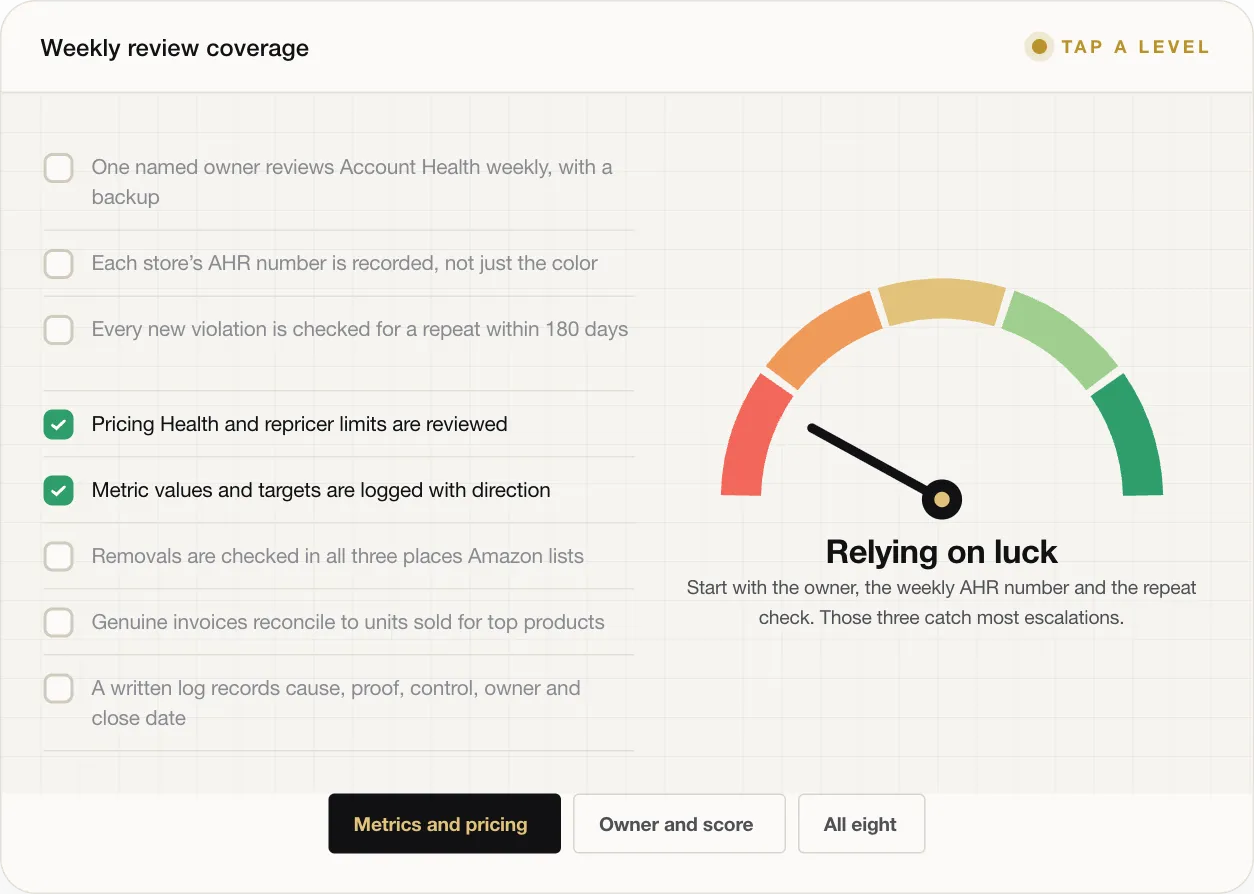
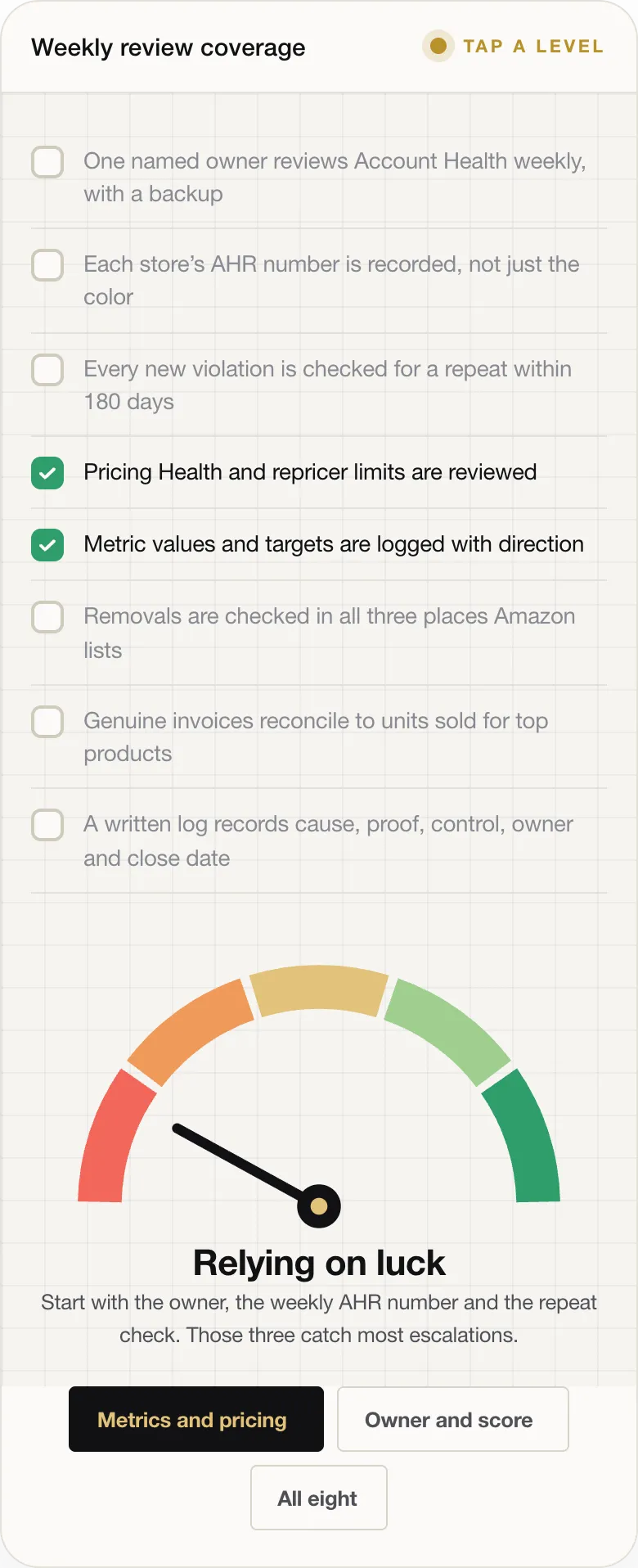
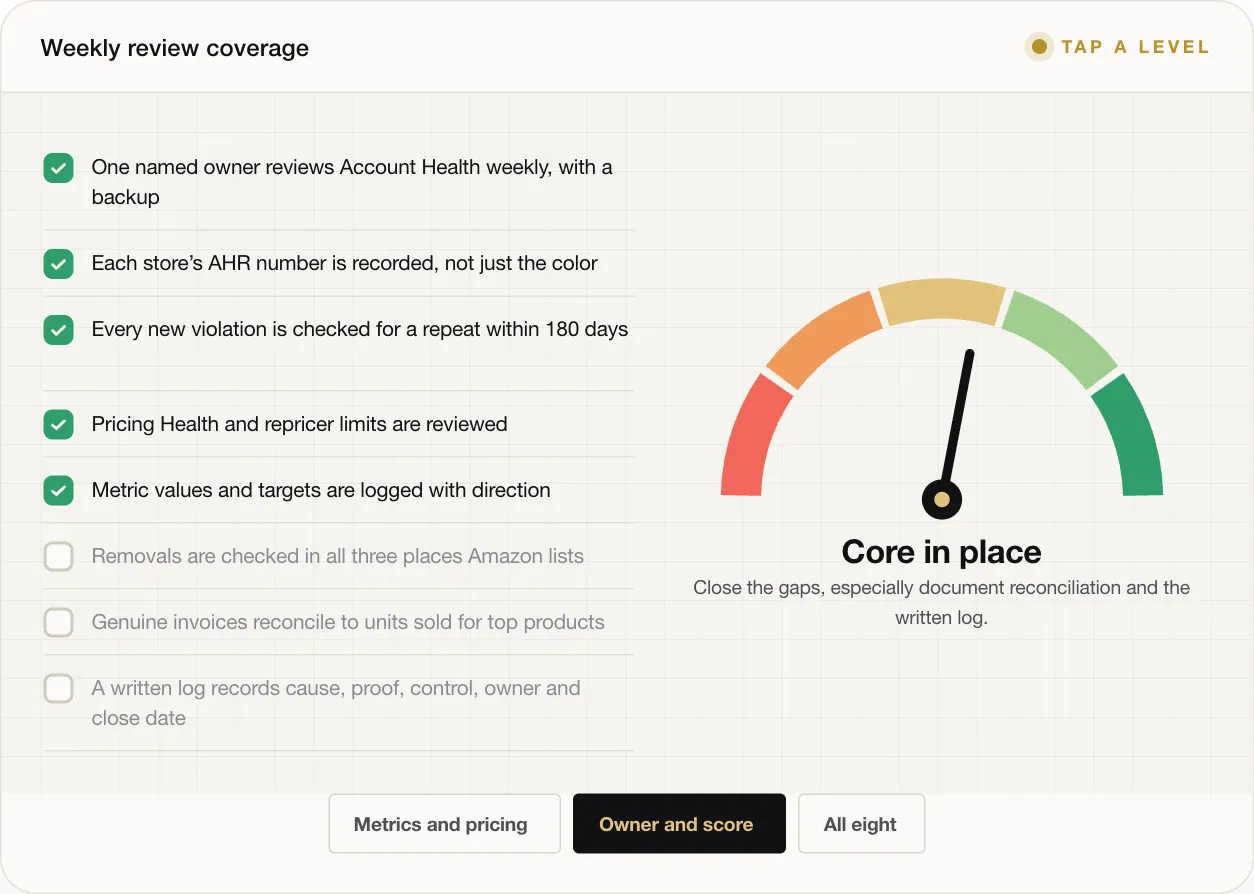
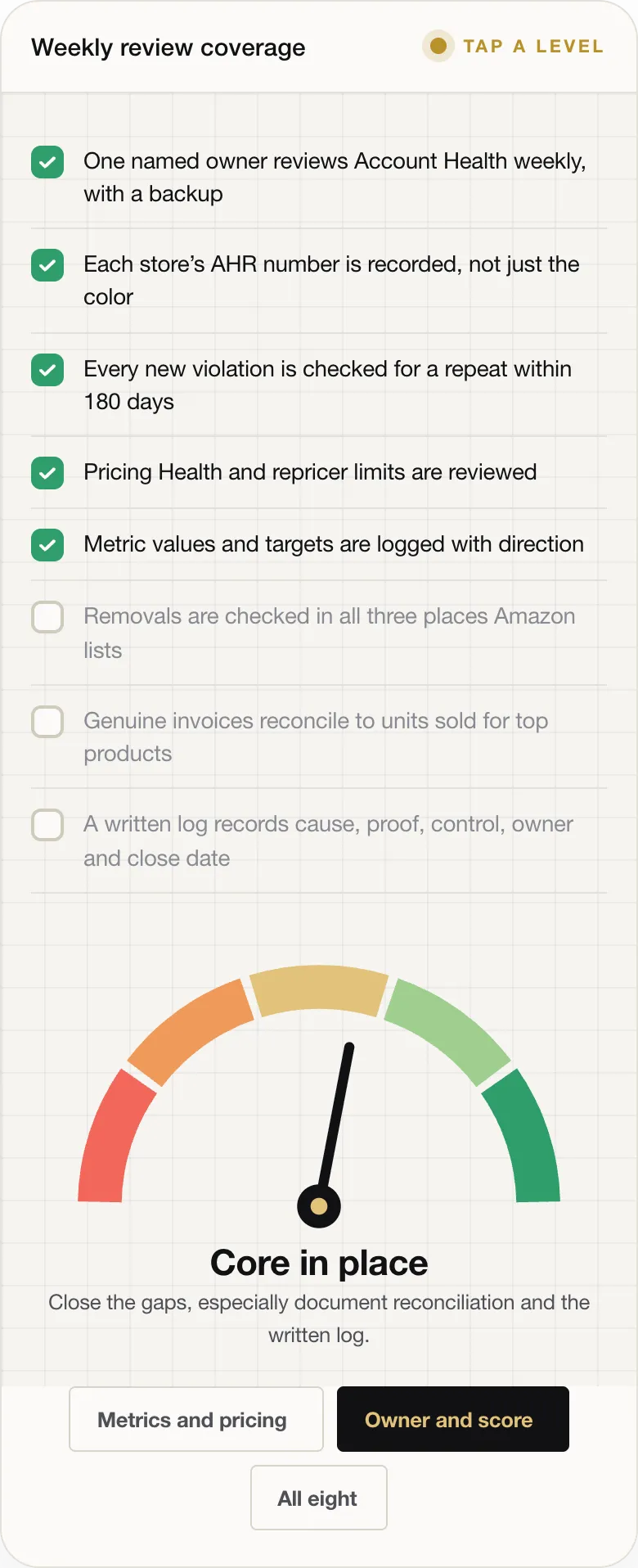
Is your weekly account health routine ready?
Prevention is a fixed appointment, a named owner and a written log. Tap a level to see which checks a routine at that stage usually has in place, and what to add next.
Monthly: read the log for patterns
Once a month, read the log as a whole for policies that recur, suppliers or templates that keep appearing as root causes, and metrics that drift in the same season. Those patterns are the clusters Amazon would see in your file. Finding them first is what nipping it in the bud means. Sellers who want a team to run this review can see our Amazon account health maintenance service.
Frequently Asked Questions
What is a good Amazon Account Health Rating?
Amazon labels 200 to 1,000 “Healthy”, 100 to 199 “At Risk” and 99 or lower “Unhealthy”. Green is the requirement, but a score just above 200 has little margin.
How long does a violation affect my AHR?
Amazon says the score reflects policy adherence and selling activity over the last 180 days, and repeat violation limits are counted in a 180-day period.
Can Amazon suspend me with a green AHR?
Yes. Amazon may deactivate immediately, regardless of the AHR, if it suspects fraudulent, deceptive, illegal or otherwise harmful activity.
How many repeat violations can trigger deactivation?
Amazon says the maximum varies by severity but can be as low as two violations of the same policy within 180 days for higher severity violations.
Does Pricing Health affect account health?
The Marketplace Fair Pricing policy is included in the AHR, and Pricing Health shows offers deactivated for potential pricing errors, so review it weekly.
Where do I find a listing Amazon removed?
Check the Product Policy Compliance tab on Account Health, then Manage Inventory for inactive listings, then Performance Notifications.
How fast does Amazon answer a deactivation appeal?
Amazon’s appeal page says to expect a reply within two days. That is Amazon’s stated expectation, not a guarantee.
Get Help With Amazon Account Health
If your score is sliding, the same policy keeps returning, or Amazon has asked for documents and you are unsure your records reconcile, our team can help find the root cause and prepare an accurate response. Submit your case or book a consultation. Amazon makes the final decision, so we cannot promise an outcome or timeline.
This article is educational information about Amazon’s published seller policies and is not legal advice. Amazon updates its policies, targets and tools regularly, so confirm current requirements on the linked Amazon pages and your own Account Health page. Got Suspended? is not affiliated with Amazon.
Sources
- Amazon Seller Central: Account Health Rating program policy
- Amazon Seller Central: Policies included in Account Health Rating
- Amazon Seller Central: Policy violation appeals FAQ
- Amazon Seller Central: Pricing Health
- Amazon Seller Central: Keep your listings discoverable
- Amazon Seller Central: Appeal an account deactivation or listing removal
- Amazon Seller Central: Selling policies and seller code of conduct
